Impact Analysis
Sixth Bi-monthly Monetary Policy Statement, 2019-20
What is RBI’s Stance?
RBI policy highlights:
• RBI kept the Repo rate unchanged to 5.15%
• Reverse Repo rate remains adjusted to 4.90%
• Marginal Standing Facility (MSF) rate and the Bank rate remains
adjusted to 5.40%
• Cash Reserve Ratio (CRR) remains unchanged at 4%
• Statutory Liquidity Ratio (SLR) stands adjusted to 18.25%
Inflation highlights:
• CPI (Consumer Price Index) inflation, ex food and fuel, surged up from
3.4% in October 2019 to 3.8% in December 2019
• Owing to increase in food and fuel inflation, retail inflation surged up
from 4.6% in October 2019 to 7.4% in December 2019
• Housing inflation moderated further in December reflecting subdued
demand
Domestic Economy
• Global economic activity has remained slow-paced
since the last MPC meeting in Advanced Economies
(AE's) as well as in major Emerging Market Economies
(EMEs)
• Equity markets in the AE’s witnessed recovery,
triggered by thawing US-China trade relations and
improved prospects of an orderly Brexit. In EME,
equity markets too witnessed gains but turned bearish
towards end-January due to the outbreak of the
coronavirus and its likely adverse impact on growth
prospects, particularly in China
• Yields in AE’s and in most EMEs fixed income markets
softened
• US dollar strengthened against other major currencies
and most EME currencies
• Gold prices shot up in Jan 2020 due to safe haven
demand
Global Economy
Accommodative
RBI’s
Inflation
Target
Data Source: RBI Sixth Bi-Monthly Monetary Policy Statement 2019-20 dated February 6, 2020, RBI Statement on Developmental and
Regulatory Policies dated February 6, 2020 ; Data Source for CRR & SLR: RBI
• The first advance estimates (FAE) released by the
National Statistical Office (NSO) placed India's real gross
domestic product (GDP) growth at 5.0 per cent and
Gross Value Added (GVA) growth is at 4.9 per cent for
2019-20
• The purchasing managers index (PMI) for Jan 2020
picked up sharply from Nov 2019 on the back of
increased output and new orders
• The transmission of policy repo rate cuts across various
money market segments and the private corporate bond
market has been sizable. Banks reduced their weighted
average lending rate (WALR) on fresh rupee loans by 69
bps and on outstanding rupee loans by 13 bps during
Feb to Dec 2019 against the cumulative policy repo rate
reduction of 135 bps
• Liquidity remained surplus in Dec 2019 & Jan 2020
reflecting RBI's open market operations (OMOs)
3.5
4.5
5.5
6.5
Feb-19
Mar-19
Apr-19
May-19
Jun-19
Jul-19
Aug-19
Sep-19
Oct-19
Nov-19
Dec-19
Jan-20
Feb-20
RBI Policy Rates Trend- Last 1 year
Repo Rate CRR Reverse Repo
0
2
4
6
8
Dec-18
Jan-19
Feb-19
Mar-19
Apr-19
May-19
Jun-19
Jul-19
Aug-19
Sep-19
Oct-19
Nov-19
Dec-19
CPI Inflation (MoM %)
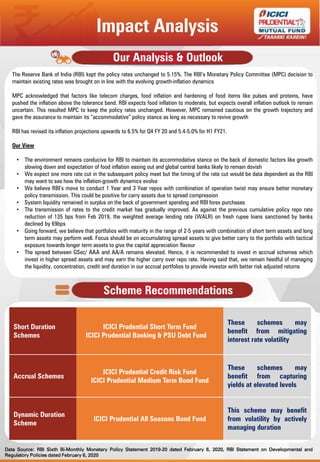
The Reserve Bank of India (RBI) kept the policy rates unchanged to 5.15%. The RBI’s Monetary Policy Committee (MPC) decision to
maintain existing rates was brought on in line with the evolving growth-inflation dynamics
MPC acknowledged that factors like telecom charges, food inflation and hardening of food items like pulses and proteins, have
pushed the inflation above the tolerance band. RBI expects food inflation to moderate, but expects overall inflation outlook to remain
uncertain. This resulted MPC to keep the policy rates unchanged. However, MPC remained cautious on the growth trajectory and
gave the assurance to maintain its “accommodative” policy stance as long as necessary to revive growth
RBI has revised its inflation projections upwards to 6.5% for Q4 FY 20 and 5.4-5.0% for H1 FY21.
Our View
• The environment remains conducive for RBI to maintain its accommodative stance on the back of domestic factors like growth
slowing down and expectation of food inflation easing out and global central banks likely to remain dovish
• We expect one more rate cut in the subsequent policy meet but the timing of the rate cut would be data dependent as the RBI
may want to see how the inflation-growth dynamics evolve
• We believe RBI’s move to conduct 1 Year and 3 Year repos with combination of operation twist may ensure better monetary
policy transmission. This could be positive for carry assets due to spread compression
• System liquidity remained in surplus on the back of government spending and RBI forex purchases
• The transmission of rates to the credit market has gradually improved. As against the previous cumulative policy repo rate
reduction of 135 bps from Feb 2019, the weighted average lending rate (WALR) on fresh rupee loans sanctioned by banks
declined by 69bps
• Going forward, we believe that portfolios with maturity in the range of 2-5 years with combination of short term assets and long
term assets may perform well. Focus should be on accumulating spread assets to give better carry to the portfolio with tactical
exposure towards longer term assets to give the capital appreciation flavour
• The spread between GSec/ AAA and AA/A remains elevated. Hence, it is recommended to invest in accrual schemes which
invest in higher spread assets and may earn the higher carry over repo rate. Having said that, we remain heedful of managing
the liquidity, concentration, credit and duration in our accrual portfolios to provide investor with better risk adjusted returns
Our Analysis & Outlook
Scheme Recommendations
Short Duration
Schemes
ICICI Prudential Short Term Fund
ICICI Prudential Banking & PSU Debt Fund
These schemes may
benefit from mitigating
interest rate volatility
Accrual Schemes
ICICI Prudential Credit Risk Fund
ICICI Prudential Medium Term Bond Fund
These schemes may
benefit from capturing
yields at elevated levels
Dynamic Duration
Scheme
ICICI Prudential All Seasons Bond Fund
This scheme may benefit
from volatility by actively
managing duration
Impact Analysis
Data Source: RBI Sixth Bi-Monthly Monetary Policy Statement 2019-20 dated February 6, 2020, RBI Statement on Developmental and
Regulatory Policies dated February 6, 2020
Disclaimer
Scheme Risk-o-meters
Mutual Fund investments are subject to market risks, read all scheme related documents carefully.
None of the aforesaid recommendations are based on any assumptions. These are purely for reference and the investors are requested to consult
their financial advisors before investing. All data/information used in the preparation of this material is specific to a time and may or may not be
relevant in future post issuance of this material. ICICI Prudential Asset Management Company Limited (the AMC) takes no responsibility of
updating any data/information in this material from time to time. The AMC (including its affiliates), ICICI Prudential Mutual Fund (the Fund), ICICI
Prudential Trust Limited (the Trust) and any of its officers, directors, personnel and employees, shall not liable for any loss, damage of any nature,
including but not limited to direct, indirect, punitive, special, exemplary, consequential, as also any loss of profit in any way arising from the use of
this material in any manner. Nothing contained in this document shall be construed to be an investment advice or an assurance of the benefits of
investing in the any of the Schemes of the Fund. Sectors/stocks mentioned in the article do not constitute any recommendation and the Fund
through its schemes may or may not have any future position in these sectors/stocks. Recipient alone shall be fully responsible for any decision
taken on the basis of this document. The information contained herein is only for the purpose of information and not for distribution and do not
constitute an offer to buy or sell or solicitation of any offer to buy or sell any securities or financial instruments in the United States of America
("US") and/or Canada or for the benefit of US persons (being persons falling within the definition of the term "US Person" under the US Securities
Act, 1933, as amended) or persons residing in Canada.
ICICI Prudential Short Term Fund (An open ended short term debt scheme investing in
instruments such that the Macaulay duration of the portfolio is between 1 Year and 3
Years) is suitable for investors who are seeking*:
• Short term income generation and capital appreciation solution
• A debt fund that aims to generate income by investing in a range of debt and money
market instruments of various maturities
ICICI Prudential Credit Risk Fund (An open ended debt scheme predominantly investing
in AA and below rated corporate bonds) is suitable for investors who are seeking*:
 Medium term savings
 A debt scheme that aims to generate income through investing predominantly in
AA and below rated corporate bonds while maintaining the optimum balance of yield,
safety and liquidity
ICICI Prudential Medium Term Bond Fund (An open ended medium term debt scheme
investing in instruments such that the Macaulay duration of the portfolio is between 3
Years and 4 Years. The Macaulay duration of the portfolio is 1 Year to 4 years under
anticipated adverse situation) is suitable for investors who are seeking*:
 Medium term savings
 A debt scheme that invests in debt and money market instruments with a view to
maximize income while maintaining optimum balance of yield, safety and liquidity
ICICI Prudential All Seasons Bond Fund (An open ended dynamic debt scheme
investing across duration) is suitable for investors who are seeking*:
 All duration savings
 A debt scheme that invests in debt and money market instruments with a view to
maximize income while maintaining optimum balance of yield, safety and liquidity
ICICI Prudential Banking & PSU Debt Fund (An open ended debt scheme predominantly
investing in Debt instruments of banks, Public Sector Undertakings, Public Financial
Institutions and Municipal Bonds.) is suitable for investors who are seeking*
 Short term savings
 An open ended debt scheme predominantly investing in Debt instruments of
banks, Public Sector Undertakings, Public Financial Institutions and Municipal
Bonds
Impact Analysis
*Investors should consult their financial advisers if in doubt about whether the product is suitable for them
Note: The Macaulay duration is the weighted average term to maturity of the cash flows from a bond. The weight of
each cash flow is determined by dividing the present value of the cash flow by the price.

Impact Analysis Sixth Bi-monthly Monetary Policy-2019-20

  • 1.
    Impact Analysis Sixth Bi-monthlyMonetary Policy Statement, 2019-20 What is RBI’s Stance? RBI policy highlights: • RBI kept the Repo rate unchanged to 5.15% • Reverse Repo rate remains adjusted to 4.90% • Marginal Standing Facility (MSF) rate and the Bank rate remains adjusted to 5.40% • Cash Reserve Ratio (CRR) remains unchanged at 4% • Statutory Liquidity Ratio (SLR) stands adjusted to 18.25% Inflation highlights: • CPI (Consumer Price Index) inflation, ex food and fuel, surged up from 3.4% in October 2019 to 3.8% in December 2019 • Owing to increase in food and fuel inflation, retail inflation surged up from 4.6% in October 2019 to 7.4% in December 2019 • Housing inflation moderated further in December reflecting subdued demand Domestic Economy • Global economic activity has remained slow-paced since the last MPC meeting in Advanced Economies (AE's) as well as in major Emerging Market Economies (EMEs) • Equity markets in the AE’s witnessed recovery, triggered by thawing US-China trade relations and improved prospects of an orderly Brexit. In EME, equity markets too witnessed gains but turned bearish towards end-January due to the outbreak of the coronavirus and its likely adverse impact on growth prospects, particularly in China • Yields in AE’s and in most EMEs fixed income markets softened • US dollar strengthened against other major currencies and most EME currencies • Gold prices shot up in Jan 2020 due to safe haven demand Global Economy Accommodative RBI’s Inflation Target Data Source: RBI Sixth Bi-Monthly Monetary Policy Statement 2019-20 dated February 6, 2020, RBI Statement on Developmental and Regulatory Policies dated February 6, 2020 ; Data Source for CRR & SLR: RBI • The first advance estimates (FAE) released by the National Statistical Office (NSO) placed India's real gross domestic product (GDP) growth at 5.0 per cent and Gross Value Added (GVA) growth is at 4.9 per cent for 2019-20 • The purchasing managers index (PMI) for Jan 2020 picked up sharply from Nov 2019 on the back of increased output and new orders • The transmission of policy repo rate cuts across various money market segments and the private corporate bond market has been sizable. Banks reduced their weighted average lending rate (WALR) on fresh rupee loans by 69 bps and on outstanding rupee loans by 13 bps during Feb to Dec 2019 against the cumulative policy repo rate reduction of 135 bps • Liquidity remained surplus in Dec 2019 & Jan 2020 reflecting RBI's open market operations (OMOs) 3.5 4.5 5.5 6.5 Feb-19 Mar-19 Apr-19 May-19 Jun-19 Jul-19 Aug-19 Sep-19 Oct-19 Nov-19 Dec-19 Jan-20 Feb-20 RBI Policy Rates Trend- Last 1 year Repo Rate CRR Reverse Repo 0 2 4 6 8 Dec-18 Jan-19 Feb-19 Mar-19 Apr-19 May-19 Jun-19 Jul-19 Aug-19 Sep-19 Oct-19 Nov-19 Dec-19 CPI Inflation (MoM %)
  • 2.
    The Reserve Bankof India (RBI) kept the policy rates unchanged to 5.15%. The RBI’s Monetary Policy Committee (MPC) decision to maintain existing rates was brought on in line with the evolving growth-inflation dynamics MPC acknowledged that factors like telecom charges, food inflation and hardening of food items like pulses and proteins, have pushed the inflation above the tolerance band. RBI expects food inflation to moderate, but expects overall inflation outlook to remain uncertain. This resulted MPC to keep the policy rates unchanged. However, MPC remained cautious on the growth trajectory and gave the assurance to maintain its “accommodative” policy stance as long as necessary to revive growth RBI has revised its inflation projections upwards to 6.5% for Q4 FY 20 and 5.4-5.0% for H1 FY21. Our View • The environment remains conducive for RBI to maintain its accommodative stance on the back of domestic factors like growth slowing down and expectation of food inflation easing out and global central banks likely to remain dovish • We expect one more rate cut in the subsequent policy meet but the timing of the rate cut would be data dependent as the RBI may want to see how the inflation-growth dynamics evolve • We believe RBI’s move to conduct 1 Year and 3 Year repos with combination of operation twist may ensure better monetary policy transmission. This could be positive for carry assets due to spread compression • System liquidity remained in surplus on the back of government spending and RBI forex purchases • The transmission of rates to the credit market has gradually improved. As against the previous cumulative policy repo rate reduction of 135 bps from Feb 2019, the weighted average lending rate (WALR) on fresh rupee loans sanctioned by banks declined by 69bps • Going forward, we believe that portfolios with maturity in the range of 2-5 years with combination of short term assets and long term assets may perform well. Focus should be on accumulating spread assets to give better carry to the portfolio with tactical exposure towards longer term assets to give the capital appreciation flavour • The spread between GSec/ AAA and AA/A remains elevated. Hence, it is recommended to invest in accrual schemes which invest in higher spread assets and may earn the higher carry over repo rate. Having said that, we remain heedful of managing the liquidity, concentration, credit and duration in our accrual portfolios to provide investor with better risk adjusted returns Our Analysis & Outlook Scheme Recommendations Short Duration Schemes ICICI Prudential Short Term Fund ICICI Prudential Banking & PSU Debt Fund These schemes may benefit from mitigating interest rate volatility Accrual Schemes ICICI Prudential Credit Risk Fund ICICI Prudential Medium Term Bond Fund These schemes may benefit from capturing yields at elevated levels Dynamic Duration Scheme ICICI Prudential All Seasons Bond Fund This scheme may benefit from volatility by actively managing duration Impact Analysis Data Source: RBI Sixth Bi-Monthly Monetary Policy Statement 2019-20 dated February 6, 2020, RBI Statement on Developmental and Regulatory Policies dated February 6, 2020
  • 3.
    Disclaimer Scheme Risk-o-meters Mutual Fundinvestments are subject to market risks, read all scheme related documents carefully. None of the aforesaid recommendations are based on any assumptions. These are purely for reference and the investors are requested to consult their financial advisors before investing. All data/information used in the preparation of this material is specific to a time and may or may not be relevant in future post issuance of this material. ICICI Prudential Asset Management Company Limited (the AMC) takes no responsibility of updating any data/information in this material from time to time. The AMC (including its affiliates), ICICI Prudential Mutual Fund (the Fund), ICICI Prudential Trust Limited (the Trust) and any of its officers, directors, personnel and employees, shall not liable for any loss, damage of any nature, including but not limited to direct, indirect, punitive, special, exemplary, consequential, as also any loss of profit in any way arising from the use of this material in any manner. Nothing contained in this document shall be construed to be an investment advice or an assurance of the benefits of investing in the any of the Schemes of the Fund. Sectors/stocks mentioned in the article do not constitute any recommendation and the Fund through its schemes may or may not have any future position in these sectors/stocks. Recipient alone shall be fully responsible for any decision taken on the basis of this document. The information contained herein is only for the purpose of information and not for distribution and do not constitute an offer to buy or sell or solicitation of any offer to buy or sell any securities or financial instruments in the United States of America ("US") and/or Canada or for the benefit of US persons (being persons falling within the definition of the term "US Person" under the US Securities Act, 1933, as amended) or persons residing in Canada. ICICI Prudential Short Term Fund (An open ended short term debt scheme investing in instruments such that the Macaulay duration of the portfolio is between 1 Year and 3 Years) is suitable for investors who are seeking*: • Short term income generation and capital appreciation solution • A debt fund that aims to generate income by investing in a range of debt and money market instruments of various maturities ICICI Prudential Credit Risk Fund (An open ended debt scheme predominantly investing in AA and below rated corporate bonds) is suitable for investors who are seeking*:  Medium term savings  A debt scheme that aims to generate income through investing predominantly in AA and below rated corporate bonds while maintaining the optimum balance of yield, safety and liquidity ICICI Prudential Medium Term Bond Fund (An open ended medium term debt scheme investing in instruments such that the Macaulay duration of the portfolio is between 3 Years and 4 Years. The Macaulay duration of the portfolio is 1 Year to 4 years under anticipated adverse situation) is suitable for investors who are seeking*:  Medium term savings  A debt scheme that invests in debt and money market instruments with a view to maximize income while maintaining optimum balance of yield, safety and liquidity ICICI Prudential All Seasons Bond Fund (An open ended dynamic debt scheme investing across duration) is suitable for investors who are seeking*:  All duration savings  A debt scheme that invests in debt and money market instruments with a view to maximize income while maintaining optimum balance of yield, safety and liquidity ICICI Prudential Banking & PSU Debt Fund (An open ended debt scheme predominantly investing in Debt instruments of banks, Public Sector Undertakings, Public Financial Institutions and Municipal Bonds.) is suitable for investors who are seeking*  Short term savings  An open ended debt scheme predominantly investing in Debt instruments of banks, Public Sector Undertakings, Public Financial Institutions and Municipal Bonds Impact Analysis *Investors should consult their financial advisers if in doubt about whether the product is suitable for them Note: The Macaulay duration is the weighted average term to maturity of the cash flows from a bond. The weight of each cash flow is determined by dividing the present value of the cash flow by the price.