Fixed Dose Drug
Combination (FDDCs):
Rational and Irrational
Combinations
Monika Singh
Assistant Professor
PSIT, Kanpur
Fixed Dose Drug Combination
(FDDCs)
DEFINITION
According to Food and Drug Administration, USA defines a fixed dose combination
product “as a product composed of any combination of a drug and
device or a biological product and a device or a drug and a
biological product or a drug, device and a biological product use for
treatment”
OR
In general, Fixed Dose (drug) Combination is defined as “a combination of two or more
active pharmaceutical ingredients or compounds formulated as a
single medicine irrespective of its dosage form designed”.
In 1977 for first time- World Health Organization (WHO) implemented concept of essential
drugs list – updated after every 2 years.
Acc. to Drug and cosmetic act 1940 (122E), every new FDCs should be considered as a new drug
and should be allowed for marketing only after submission of relevant preclinical and clinical trial
data.
Rationality or irrationality of FDCs can be examined based on the provisions made in Schedule
Y.
20th edition of WHO model list of essential medicines - published in 2017 - contains medications
between 334 and 580- of which 30 single drug & more than 25 fixed dose combination drugs.
Separate list -children up to 12 years, k/a WHO Model List of Essential Medicines for
Children (EMLc), was created in 2007 and is in its 6th edition (March 2017)- 25 new drugs added.
E.g., First combination therapy- treat all 6 Hepatitis types- SOFOSBUVIR + VELPATASVIR
Dasatinib+ Nilotinib= Chronic myeloid leukemia, oral cancer
FDDC focuses on
Safety
Efficacy and
Good quality of drug
Popular & highly profitable FDCs- in Indian drug market:–
•Analgesics Iron preparations
•Tonics Antacids
•Antibiotics Multivitamins
•Cough and cold preparations
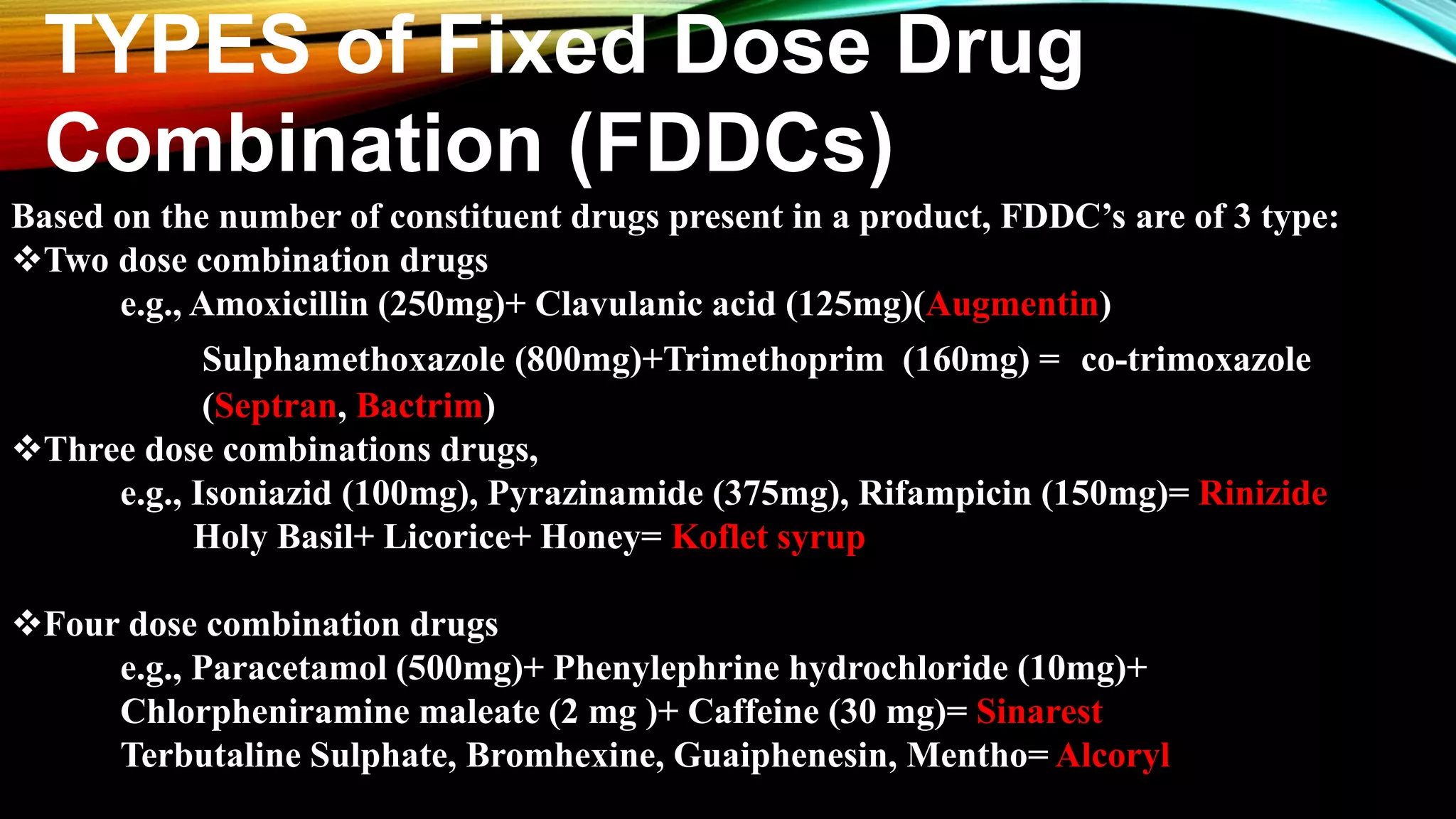
Based on the number of constituent drugs present in a product, FDDC’s are of 3 type:
Two dose combination drugs
e.g., Amoxicillin (250mg)+ Clavulanic acid (125mg)(Augmentin)
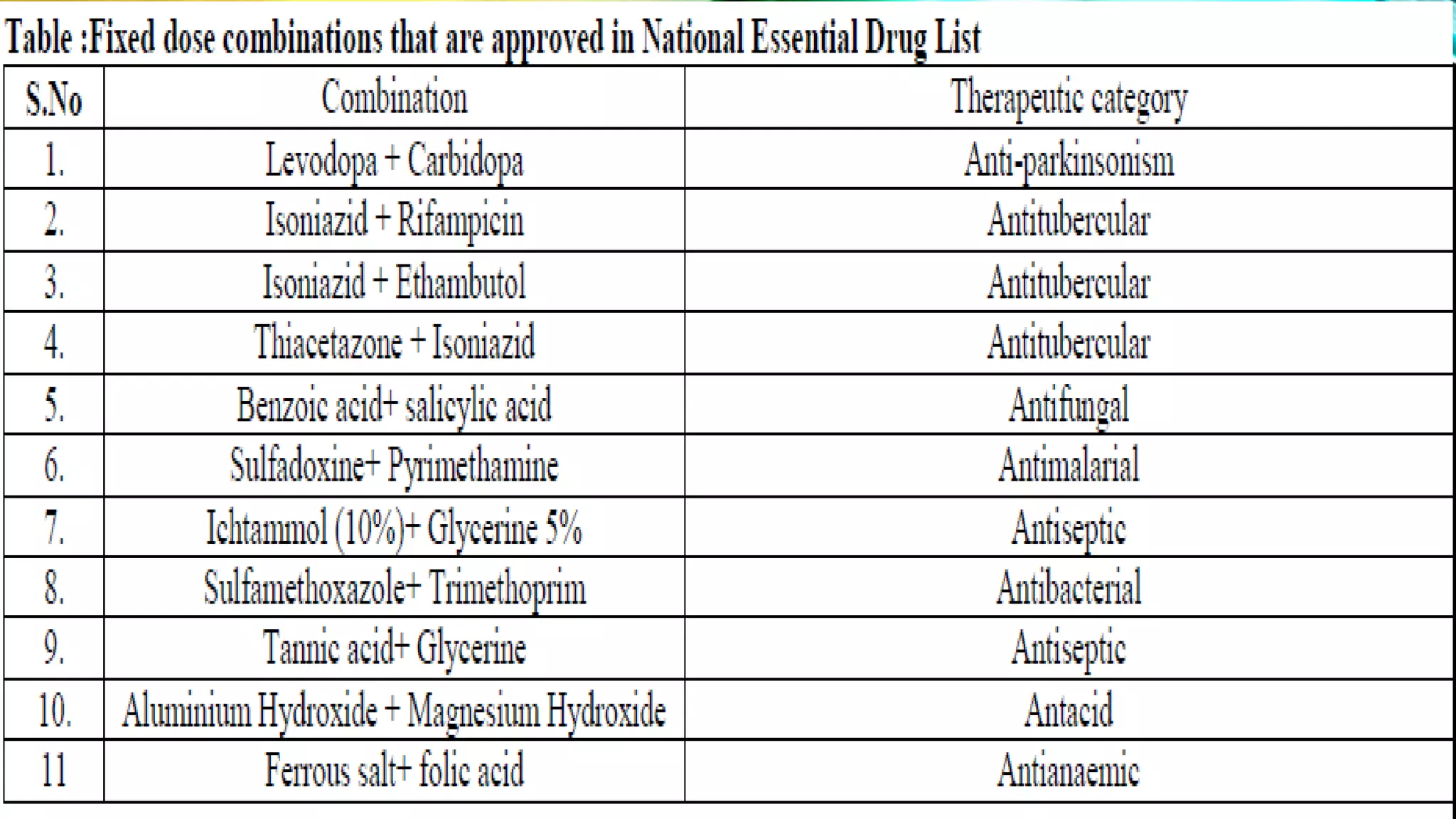
Sulphamethoxazole (800mg)+Trimethoprim (160mg) = co-trimoxazole
(Septran, Bactrim)
Three dose combinations drugs,
e.g., Isoniazid (100mg), Pyrazinamide (375mg), Rifampicin (150mg)= Rinizide
Holy Basil+ Licorice+ Honey= Koflet syrup
Four dose combination drugs
e.g., Paracetamol (500mg)+ Phenylephrine hydrochloride (10mg)+
Chlorpheniramine maleate (2 mg )+ Caffeine (30 mg)= Sinarest
Terbutaline Sulphate, Bromhexine, Guaiphenesin, Mentho= Alcoryl
TYPES of Fixed Dose Drug
Combination (FDDCs)
Based on therapeutic effect FDC are classifies into 4 categories:
Rational: Two or more drugs combined in a fixed dose formulation (tablet, capsule, syrup,
powder, injection )-their plasma half-life, peak plasma concentration, volume of
distribution to be approx. same.
Irrational : If the combination of drugs is illogical in terms of plasma half-life and
pharmacokinetics of the drug, the combination should be termed as irrational drug
combination.
Absurd: if, No rationale or justification for combination ; No increase in efficacy than
individual drugs
Rejected /Banned: Formulations which produce severe side effects and no increase in
therapeutic effect than individual molecule.
RATIONAL FIXED DOSE
COMBINATONTwo or more drugs combined in a fixed dose formulation (tablet, capsule, syrup, powder, injection )-
their plasma half-life, peak plasma concentration, volume of distribution to be approx. same.
The ratio of dose depends on – volume of distribution & peak plasma concentration.
Rational drug therapy means use of right medicine in right manner (dose, route, frequency of
administration, duration of therapy) in the right patient, at right cost and right time.
Advantages of rational FDC:
Better therapeutic efficiency,
Reduced adverse effects,
Convenience of dose and
Better patient compliance.
According to WHO guidelines FDCs are rational when they had:
Active pharmacological ingredients (API) with complementary
mechanism of action
Decrease the occurrence of resistance for antimicrobial agents
Increase the efficacy of combinations
Decrease the incidence of ADR or toxicity
Increase the compliance of drug therapy with decrease pill burden
Decrease the total cost of therapy
Dose of each API should be appropriate for defining or larger group of
population
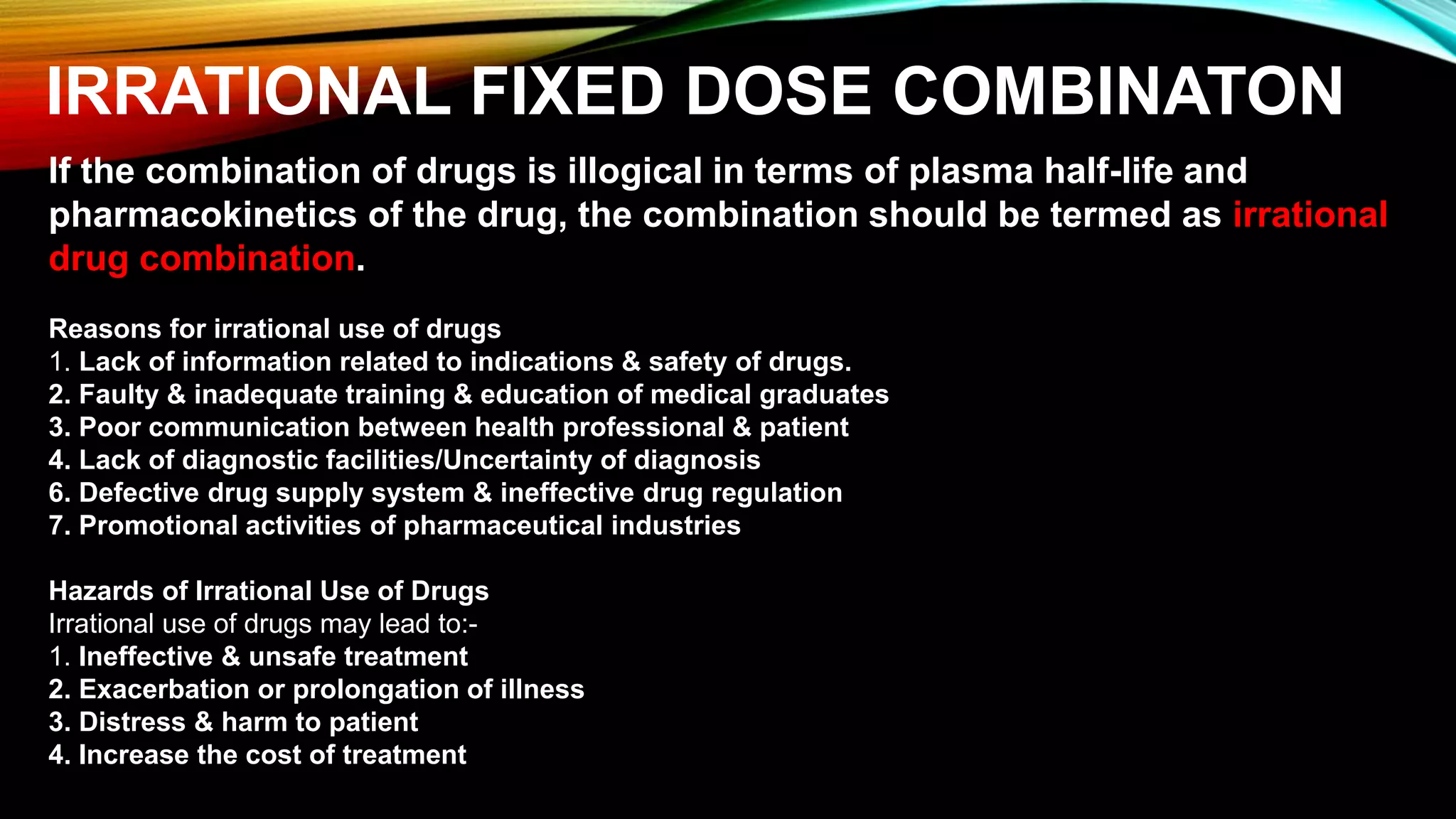
If the combination of drugs is illogical in terms of plasma half-life and
pharmacokinetics of the drug, the combination should be termed as irrational
drug combination.
Reasons for irrational use of drugs
1. Lack of information related to indications & safety of drugs.
2. Faulty & inadequate training & education of medical graduates
3. Poor communication between health professional & patient
4. Lack of diagnostic facilities/Uncertainty of diagnosis
6. Defective drug supply system & ineffective drug regulation
7. Promotional activities of pharmaceutical industries
Hazards of Irrational Use of Drugs
Irrational use of drugs may lead to:-
1. Ineffective & unsafe treatment
2. Exacerbation or prolongation of illness
3. Distress & harm to patient
4. Increase the cost of treatment
IRRATIONAL FIXED DOSE COMBINATON
The hit and trial method of combining drugs should be replaced by a rational and logical basis for
bringing out a fixed dose drug formulation.
Carefully monitoring the censor misleading claims by the pharmaceutical industry.
Some degree of irresponsibility on the part of the pharmaceutical industry and lack of vigilance of
government agencies underlies the increased popularity of irrational drug combinations- so must
overcome this problem.
ADR reporting should be made mandatory as they are in developed countries. Pharmacovigilance
should be more effective.
Hospitals should constitute drugs and therapeutics review committees to rationalize prescribing.
Medical schools and postgraduate colleges must take the responsibility of training students and
young doctors how to assess new drug combinations more logically.
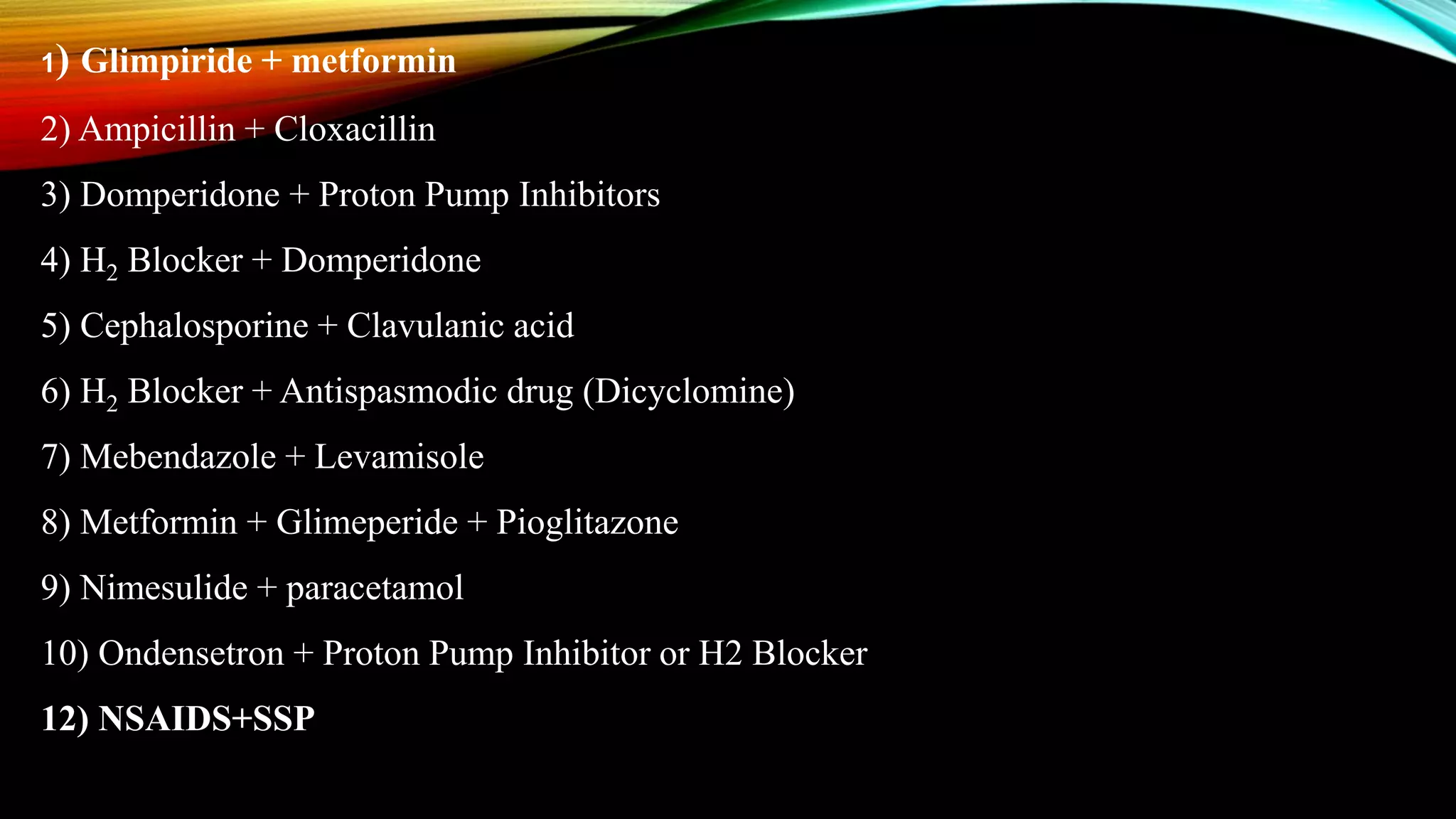
WHAT NEEDS TO BE DONE...??
1) Glimpiride + metformin
2) Ampicillin + Cloxacillin
3) Domperidone + Proton Pump Inhibitors
4) H2 Blocker + Domperidone
5) Cephalosporine + Clavulanic acid
6) H2 Blocker + Antispasmodic drug (Dicyclomine)
7) Mebendazole + Levamisole
8) Metformin + Glimeperide + Pioglitazone
9) Nimesulide + paracetamol
10) Ondensetron + Proton Pump Inhibitor or H2 Blocker
12) NSAIDS+SSP
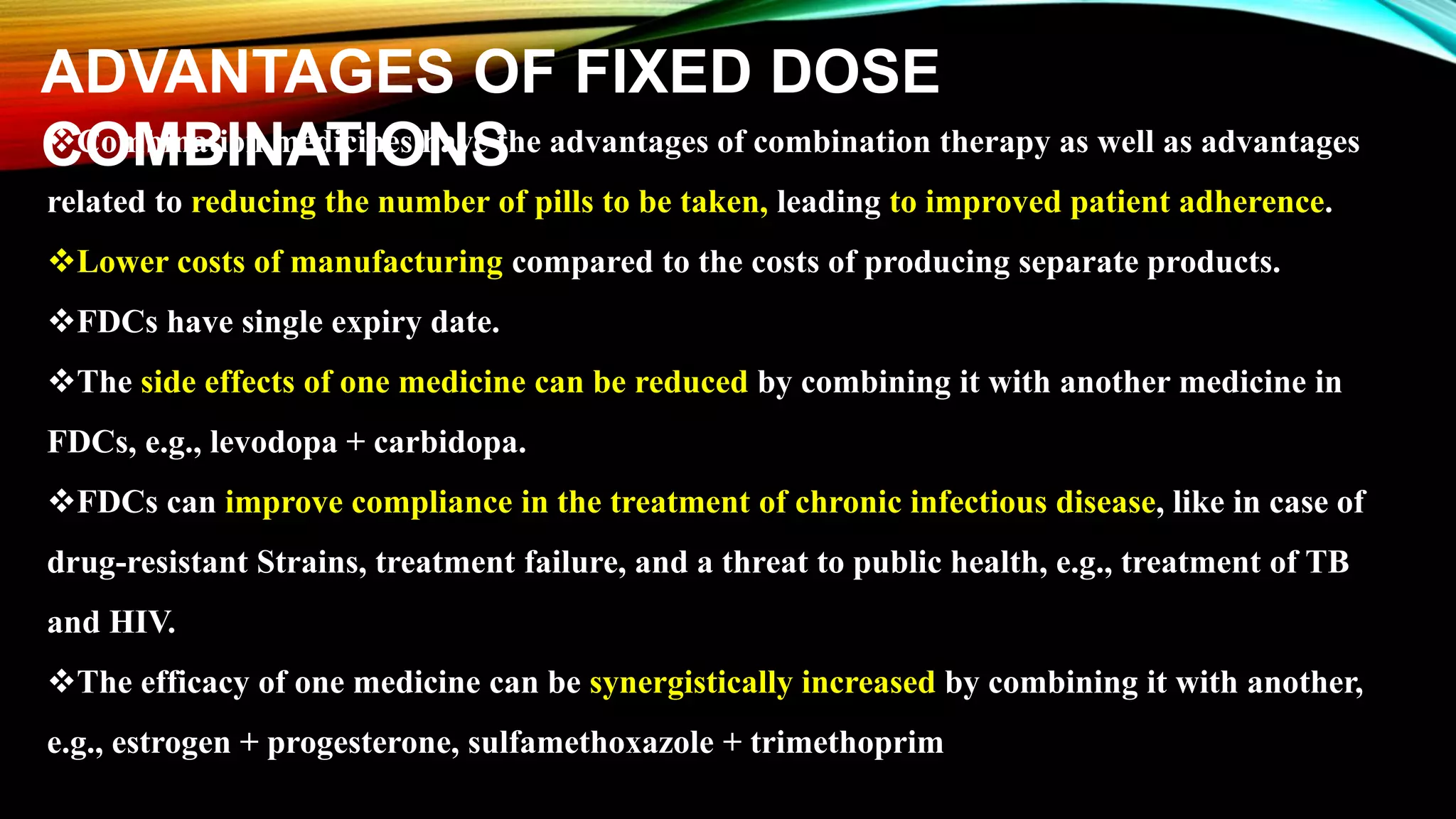
Combination medicines have the advantages of combination therapy as well as advantages
related to reducing the number of pills to be taken, leading to improved patient adherence.
Lower costs of manufacturing compared to the costs of producing separate products.
FDCs have single expiry date.
The side effects of one medicine can be reduced by combining it with another medicine in
FDCs, e.g., levodopa + carbidopa.
FDCs can improve compliance in the treatment of chronic infectious disease, like in case of
drug-resistant Strains, treatment failure, and a threat to public health, e.g., treatment of TB
and HIV.
The efficacy of one medicine can be synergistically increased by combining it with another,
e.g., estrogen + progesterone, sulfamethoxazole + trimethoprim
ADVANTAGES OF FIXED DOSE
COMBINATIONS
DISADVANTAGES OF FIXED DOSE
COMBINATIONS
Titration of dose of medicine to suit individual patients is not possible, e.g.,
atorvastatin 10 mg + amlodipine 5 mg.
One of the drugs in the combination may be superfluous or wasteful, e.g., vitamins
+ iron.
FDCs increase the price of the medication if unnecessary drugs are included, e.g.,
ibuprofen + paracetamol + caffeine.
The incidence of adverse effects increases, e.g., nimesulide + paracetamol.
Incompatible pharmacodynamics, e.g., combination of an antihistaminic with an
antidiarrheal is dangerous as the antihistaminic action may mask other symptoms
and make accurate diagnosis and treatment difficult.
It is difficult to identify which medicine in the FDCs has caused an adverse effect.
FDDC and INDIAN SCENARIO
In the recent years, a huge market for the irrational FDCs has erupted in India.
Reason: promotional activities of the pharmaceutical companies targeted directly to the
consumers and/or towards the physicians.
In India, according to rule 122E of Drug and Cosmetics Rule, a fixed dose combination of
two or more drugs is considered to be a “NEW DRUG”.
The power of examination of a FDC lies with licensing authority mentioned under section
21(b) of Schedule Y.
All molecules have to be approved by Drugs Controller General, India (DCGI).
But, the State Drug Controllers (SDCs) provide license for approval and marketing of such
combination even though they do not have this legal authority.
An expert committee was set up by Central Drug Standard Control Organization
(CDSCO) which had its first meeting in New Delhi on March 4th, 2013 to formulate a
policy on FDCs.
ANY QUERIES… ??

Fixed Dose Drug Combination (FDDC)

  • 1.
    Fixed Dose Drug Combination(FDDCs): Rational and Irrational Combinations Monika Singh Assistant Professor PSIT, Kanpur
  • 2.
    Fixed Dose DrugCombination (FDDCs) DEFINITION According to Food and Drug Administration, USA defines a fixed dose combination product “as a product composed of any combination of a drug and device or a biological product and a device or a drug and a biological product or a drug, device and a biological product use for treatment” OR In general, Fixed Dose (drug) Combination is defined as “a combination of two or more active pharmaceutical ingredients or compounds formulated as a single medicine irrespective of its dosage form designed”.
  • 3.
    In 1977 forfirst time- World Health Organization (WHO) implemented concept of essential drugs list – updated after every 2 years. Acc. to Drug and cosmetic act 1940 (122E), every new FDCs should be considered as a new drug and should be allowed for marketing only after submission of relevant preclinical and clinical trial data. Rationality or irrationality of FDCs can be examined based on the provisions made in Schedule Y. 20th edition of WHO model list of essential medicines - published in 2017 - contains medications between 334 and 580- of which 30 single drug & more than 25 fixed dose combination drugs. Separate list -children up to 12 years, k/a WHO Model List of Essential Medicines for Children (EMLc), was created in 2007 and is in its 6th edition (March 2017)- 25 new drugs added. E.g., First combination therapy- treat all 6 Hepatitis types- SOFOSBUVIR + VELPATASVIR Dasatinib+ Nilotinib= Chronic myeloid leukemia, oral cancer
  • 4.
    FDDC focuses on Safety Efficacyand Good quality of drug Popular & highly profitable FDCs- in Indian drug market:– •Analgesics Iron preparations •Tonics Antacids •Antibiotics Multivitamins •Cough and cold preparations
  • 5.
    Based on thenumber of constituent drugs present in a product, FDDC’s are of 3 type: Two dose combination drugs e.g., Amoxicillin (250mg)+ Clavulanic acid (125mg)(Augmentin) Sulphamethoxazole (800mg)+Trimethoprim (160mg) = co-trimoxazole (Septran, Bactrim) Three dose combinations drugs, e.g., Isoniazid (100mg), Pyrazinamide (375mg), Rifampicin (150mg)= Rinizide Holy Basil+ Licorice+ Honey= Koflet syrup Four dose combination drugs e.g., Paracetamol (500mg)+ Phenylephrine hydrochloride (10mg)+ Chlorpheniramine maleate (2 mg )+ Caffeine (30 mg)= Sinarest Terbutaline Sulphate, Bromhexine, Guaiphenesin, Mentho= Alcoryl TYPES of Fixed Dose Drug Combination (FDDCs)
  • 6.
    Based on therapeuticeffect FDC are classifies into 4 categories: Rational: Two or more drugs combined in a fixed dose formulation (tablet, capsule, syrup, powder, injection )-their plasma half-life, peak plasma concentration, volume of distribution to be approx. same. Irrational : If the combination of drugs is illogical in terms of plasma half-life and pharmacokinetics of the drug, the combination should be termed as irrational drug combination. Absurd: if, No rationale or justification for combination ; No increase in efficacy than individual drugs Rejected /Banned: Formulations which produce severe side effects and no increase in therapeutic effect than individual molecule.
  • 7.
    RATIONAL FIXED DOSE COMBINATONTwoor more drugs combined in a fixed dose formulation (tablet, capsule, syrup, powder, injection )- their plasma half-life, peak plasma concentration, volume of distribution to be approx. same. The ratio of dose depends on – volume of distribution & peak plasma concentration. Rational drug therapy means use of right medicine in right manner (dose, route, frequency of administration, duration of therapy) in the right patient, at right cost and right time. Advantages of rational FDC: Better therapeutic efficiency, Reduced adverse effects, Convenience of dose and Better patient compliance.
  • 8.
    According to WHOguidelines FDCs are rational when they had: Active pharmacological ingredients (API) with complementary mechanism of action Decrease the occurrence of resistance for antimicrobial agents Increase the efficacy of combinations Decrease the incidence of ADR or toxicity Increase the compliance of drug therapy with decrease pill burden Decrease the total cost of therapy Dose of each API should be appropriate for defining or larger group of population
  • 11.
    If the combinationof drugs is illogical in terms of plasma half-life and pharmacokinetics of the drug, the combination should be termed as irrational drug combination. Reasons for irrational use of drugs 1. Lack of information related to indications & safety of drugs. 2. Faulty & inadequate training & education of medical graduates 3. Poor communication between health professional & patient 4. Lack of diagnostic facilities/Uncertainty of diagnosis 6. Defective drug supply system & ineffective drug regulation 7. Promotional activities of pharmaceutical industries Hazards of Irrational Use of Drugs Irrational use of drugs may lead to:- 1. Ineffective & unsafe treatment 2. Exacerbation or prolongation of illness 3. Distress & harm to patient 4. Increase the cost of treatment IRRATIONAL FIXED DOSE COMBINATON
  • 12.
    The hit andtrial method of combining drugs should be replaced by a rational and logical basis for bringing out a fixed dose drug formulation. Carefully monitoring the censor misleading claims by the pharmaceutical industry. Some degree of irresponsibility on the part of the pharmaceutical industry and lack of vigilance of government agencies underlies the increased popularity of irrational drug combinations- so must overcome this problem. ADR reporting should be made mandatory as they are in developed countries. Pharmacovigilance should be more effective. Hospitals should constitute drugs and therapeutics review committees to rationalize prescribing. Medical schools and postgraduate colleges must take the responsibility of training students and young doctors how to assess new drug combinations more logically. WHAT NEEDS TO BE DONE...??
  • 13.
    1) Glimpiride +metformin 2) Ampicillin + Cloxacillin 3) Domperidone + Proton Pump Inhibitors 4) H2 Blocker + Domperidone 5) Cephalosporine + Clavulanic acid 6) H2 Blocker + Antispasmodic drug (Dicyclomine) 7) Mebendazole + Levamisole 8) Metformin + Glimeperide + Pioglitazone 9) Nimesulide + paracetamol 10) Ondensetron + Proton Pump Inhibitor or H2 Blocker 12) NSAIDS+SSP
  • 15.
    Combination medicines havethe advantages of combination therapy as well as advantages related to reducing the number of pills to be taken, leading to improved patient adherence. Lower costs of manufacturing compared to the costs of producing separate products. FDCs have single expiry date. The side effects of one medicine can be reduced by combining it with another medicine in FDCs, e.g., levodopa + carbidopa. FDCs can improve compliance in the treatment of chronic infectious disease, like in case of drug-resistant Strains, treatment failure, and a threat to public health, e.g., treatment of TB and HIV. The efficacy of one medicine can be synergistically increased by combining it with another, e.g., estrogen + progesterone, sulfamethoxazole + trimethoprim ADVANTAGES OF FIXED DOSE COMBINATIONS
  • 16.
    DISADVANTAGES OF FIXEDDOSE COMBINATIONS Titration of dose of medicine to suit individual patients is not possible, e.g., atorvastatin 10 mg + amlodipine 5 mg. One of the drugs in the combination may be superfluous or wasteful, e.g., vitamins + iron. FDCs increase the price of the medication if unnecessary drugs are included, e.g., ibuprofen + paracetamol + caffeine. The incidence of adverse effects increases, e.g., nimesulide + paracetamol. Incompatible pharmacodynamics, e.g., combination of an antihistaminic with an antidiarrheal is dangerous as the antihistaminic action may mask other symptoms and make accurate diagnosis and treatment difficult. It is difficult to identify which medicine in the FDCs has caused an adverse effect.
  • 17.
    FDDC and INDIANSCENARIO In the recent years, a huge market for the irrational FDCs has erupted in India. Reason: promotional activities of the pharmaceutical companies targeted directly to the consumers and/or towards the physicians. In India, according to rule 122E of Drug and Cosmetics Rule, a fixed dose combination of two or more drugs is considered to be a “NEW DRUG”. The power of examination of a FDC lies with licensing authority mentioned under section 21(b) of Schedule Y. All molecules have to be approved by Drugs Controller General, India (DCGI). But, the State Drug Controllers (SDCs) provide license for approval and marketing of such combination even though they do not have this legal authority. An expert committee was set up by Central Drug Standard Control Organization (CDSCO) which had its first meeting in New Delhi on March 4th, 2013 to formulate a policy on FDCs.
  • 18.