SEMMINAR ON
FIVE YEARPLANS
SUBJECT : CHILD HEALTH NURSING
PRESENTED TO
PRESENTED BY
DR. SHASHI KIRAN KANCHAN
DYAL
LECTURER (CHILD HEALTH NURSING) M.Sc. (N) 1ST
YEAR
SNGNC, IGMC SHIMLA SNGNC,
IGMC SHIMLA
PRESENTED ON
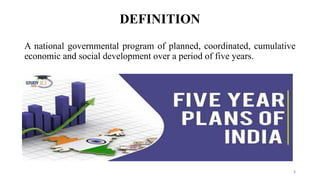
DEFINITION
A national governmentalprogram of planned, coordinated, cumulative
economic and social development over a period of five years.
3
4.
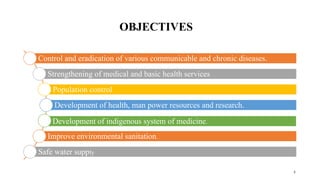
OBJECTIVES
Control and eradicationof various communicable and chronic diseases.
Strengthening of medical and basic health services
Population control
Development of health, man power resources and research.
Development of indigenous system of medicine.
Improve environmental sanitation.
Safe water supply
4
5.
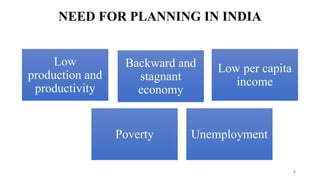
NEED FOR PLANNINGIN INDIA
Low
production and
productivity
Backward and
stagnant
economy
Low per capita
income
Poverty Unemployment
5
FIRST FIVE YEARPLAN FROM [1951-1956]
• The first Indian Prime Minister,
Pandit Jawaharlal Nehru presented
the first five year plan to the
Parliament of India on December 8,
1951.
7
8.
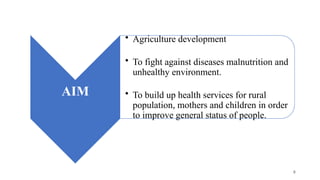
AIM
• Agriculture development
•To fight against diseases malnutrition and
unhealthy environment.
• To build up health services for rural
population, mothers and children in order
to improve general status of people.
8
9.
PRIORITIES
1. Safe watersupply and sanitation.
2. Control of malaria.
3. Health care of rural population
4. Health services for mother and children.
5. Education, training and health education
6. Self- sufficiency in drugs and equipment
7. Family planning and population control.
9
10.
THE MAJOR DEVELOPMENTSAND ACHIEVEMENTS
The year 1951
B.C.G Vaccination program to prevent and control tuberculosis was
launched.
The year 1952
A pilot project of community development program was launched in 55
project areas [Bhakra Nangal dam, Vyas Project].
The central council of health was constituted.
10
11.
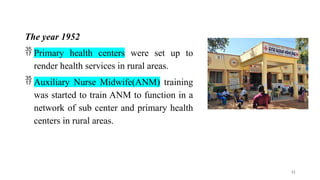
The year 1952
Primary health centers were set up to
render health services in rural areas.
Auxiliary Nurse Midwife(ANM) training
was started to train ANM to function in a
network of sub center and primary health
centers in rural areas.
11
12.
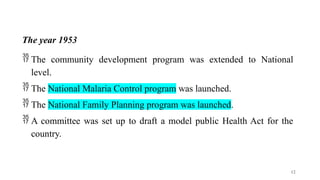
The year 1953
The community development program was extended to National
level.
The National Malaria Control program was launched.
The National Family Planning program was launched.
A committee was set up to draft a model public Health Act for the
country.
12
13.
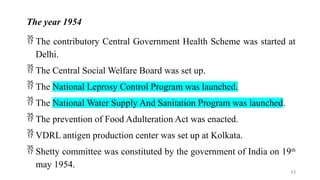
The year 1954
The contributory Central Government Health Scheme was started at
Delhi.
The Central Social Welfare Board was set up.
The National Leprosy Control Program was launched.
The National Water Supply And Sanitation Program was launched.
The prevention of Food Adulteration Act was enacted.
VDRL antigen production center was set up at Kolkata.
Shetty committee was constituted by the government of India on 19th
may 1954.
13
14.
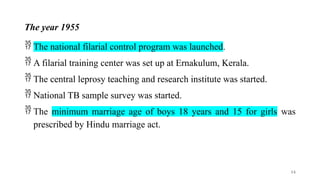
The year 1955
The national filarial control program was launched.
A filarial training center was set up at Ernakulum, Kerala.
The central leprosy teaching and research institute was started.
National TB sample survey was started.
The minimum marriage age of boys 18 years and 15 for girls was
prescribed by Hindu marriage act.
14
15.
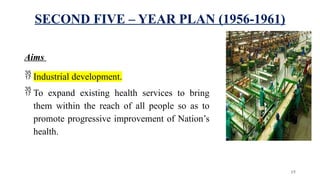
SECOND FIVE –YEAR PLAN (1956-1961)
Aims
Industrial development.
To expand existing health services to bring
them within the reach of all people so as to
promote progressive improvement of Nation’s
health.
15
16.
The Priorities
Establishmentof institutional facilities for rural as well as for urban
population.
Development of technical manpower.
Control of communicable diseases.
Water supply and sanitation.
Family planning and other supporting programs.
16
17.
THE MAJOR DEVELOPMENTSAND
ACHIEVEMENTS
The year 1956
Draft Model Public Health Act was prepared by the committee and
published.
Director, Family Planning was appointed at the center.
The Demographic Training and Research Centre was established in
Mumbai.
17
18.
The CentralHealth Education Bureau was set up at the center.
The Immoral Traffic Act was enacted.
The Tuberculosis Chemotherapy Centre was set up at madras.
The Pilot Project of Trachoma Control Program was launched.
The year 1957
The demographic research centers were established in Delhi, Kolkata
and Chennai.
18
19.
The year 1958
The national malaria control program was converted into National
malaria eradication program.
The national tuberculosis survey was completed.
The leprosy advisory committee of the government of India was
launched.
A three tier structure of local self government from the village to the
district was recommended.
19
20.
The year 1959
The Mudaliar committee was set up by the government to undertake
the review of developments and to make further developments.
Panchayati Raj was introduced in Rajasthan.
The National Institute of tuberculosis was established at Bangalore.
A central expert committee was constituted under the ICMR to study
the problem of small pox and cholera.
20
21.
The year 1960
Pilot Projects of small pox eradication was started.
Vital statistics were transferred from DGHS [Directorate General of
Health Services] to registrar general of India.
A National Nutrition Advisory Committee was formed to render
advice on nutrition policies.
The school health committee was appointed by union ministry of
Health.
21
22.
THE THIRD FIVEYEAR PLAN ( 1961 - 66)
Aims
1. Economic independence.
2. To remove the shortages
and deficiencies observed at
2nd
five year plan in the
field of health.
22
23.
The priorities
Safewater supply in villages and sanitation especially the drainage
program in the urban areas.
Expansion of Institutional facilities to promote accessibility
especially in the rural areas.
Eradication of Malaria and small pox and control of various other
communicable diseases.
Family planning and other supporting services for improving health
status of people.
Development of manpower.
23
24.
THE MAJOR DEVELOPMENTS
Theyear 1961
The central bureau of health intelligence was established.
The Mudaliar Committee report was submitted and published.
24
25.
The year 1962
The National Small Pox Eradication Program and National Goiter
Control Program were launched.
The School Health Program was started.
The District Tuberculosis Control Program was conceptualized.
The Family Planning Training Centre and Family Planning
Communications and Action Research Centre were amalgamated to
form the central family planning institute in Delhi.
25
26.
The year 1963
The applied nutrition program was started.
The malaria institute at Delhi was converted to National Institute of
Communicable diseases.
The national trachoma control program was initiated.
The name of “contributory Health Service Scheme “was launched to
Central Government Health Scheme”.
Extended Family Planning Program was introduced.
The Chadha committee was appointed.
26
27.
The year 1964
The national institute of health administration and education was
established in collaboration with Ford Foundation.
A committee under the chairmanship of Shri Shanti Lal Shab was set
to study legislation of abortion.
27
28.
The year 1965
Lippes loop was recommended as a safe and effective family
planning device.
A committee under the chairmanship of Shri Mukherji, was set
up to study the implementation of Chadha committee
recommendation and to review the strategy for family planning
program.
28
29.
The year 1966
A separate department of family planning was set up.
The postpartum family planning program was started in two
Hospitals.
A committee under the chairmanship of Shri Mukherji was
constituted to study the difficulties encountered by the state
Government in taking over the burden of maintenance phase of
various communicable diseases.
29
30.
The year 1967
The central council of health recommended compulsory payment by
patients attending hospital.
Madhok committee was appointed to review the working of Malaria
Eradication program.
The year 1968
A medical education committee was appointed
A bill on registration of birth and deaths was passed by the parliament
30
31.
THE FOURTH FIVEYEAR PLAN [1969-66]
Aim
Growth with stability and self reliance
To strengthen primary health center network in
the rural areas for undertaking preventive,
curative and family planning services and to
take over the maintenance phase of
communicable diseases.
31
32.
The priorities
Familyplanning program.
Strengthening of primary health centers.
Strengthening of sub divisional and district hospitals to provide
effective referral support to primary health centers.
Intensification of control programs.
Expansion of medical and nursing education training of paramedical
personnel to meet the minimum technical manpower requirement.
32
33.
THE MAJOR DEVELOPMENTS
Theyear 1969
The National Research Laboratory was expanded to national institute of
nutrition.
Comprehensive Legislation for Control of River Water Pollution was
drafted.
The Central Births And Deaths Registration Act (1969) was
promulgated.
The Report of Medical Education Committee (1969) was submitted.
33
34.
The year 1970
The Population Council of India was set up.
Post-Partum Family Planning Program was launched.
The Demographic Training and Research Centre at Mumbai was
changed to International Institute for Population Studies.
Registration act of the Births And Deaths (1969) came into force.
34
35.
The year 1971
The Family Pension Scheme (FPS) for industrial workers was
introduced.
The MTP Bill (1969) was passed by the parliament.
A committee was set up to draft legislation on air pollution.
35
36.
The year 1972
The MTP act was enacted.
The committee on “Multiple Workers under Health and Family
planning” headed by Kartar Singh was set up.
36
37.
The year 1973
The National Program of Minimum Need Program was formulated.
A scheme of setting 30 bedded rural hospital serving four primary
health centers was conceptualized.
The Kartar Singh Committee submitted its report.
37
38.
THE FIFTH FIVEYEAR PLAN [1974-78]
Aim
• Employment, Defense ‘‘Garibi Hatao’’
• To provide minimum level of well
integrated health, MCH, FP, Nutrition,
Immunization to all the people with
special reference to vulnerable groups.
38
39.
The priorities
Increasingaccessibility of health services in rural areas.
Correcting regional imbalance.
Further development of referral services by removing deficiencies in
district and subdivision hospitals.
Integration of health, family planning and nutrition.
The control and eradication of communicable diseases.
Qualitative improvement in the education and training of health
personnel.
39
40.
MAJOR DEVELOPMENTS
The year1974
Revised strategy for malaria control was suggested.
The year was declared as World Population Year by the United
Nations.
The water (Prevention and control of Pollution) Act was enacted by
the parliament.
“A group on medical education and support manpower” popularly
known as the Shrivastava Committee was set up.
40
41.
The year 1975
India became small pox free on 5th
July 1975.
Integrated Child Development Scheme was launched.
Children’s Welfare Board was set up.
The ESI Act was amended.
The Cigarette Regulation Act was enacted.
Shrivastav Committee submitted its report.
41
42.
The year 1976
Indian Factory Act of 1948 was amended.
The Prevention of Food Adulteration Act came into force.
The Central Council of Health proposed a 3 tier plan for medical care
in villages.
42
43.
The year 1977
Rural health scheme was launched on the basis of Kartar Singh and
Srivastav Committee report.
The training of community health workers was initiated.
Revised modified plan of Malaria Eradication was implemented.
The “Goal of Health for All” was adopted by World Health
Organization. India was one of the member countries of that
assembly.
43
44.
The year 1978
The Child Marriage Restraint Bill fixing the minimum marriage age, i.e.
21yrs for boys and 18 for girls was passed.
Alma Ata declared “Primary Health Care Strategy” to achieve the goal of
“Health for All” by the year 2000.
Extended Program of Immunization was started.
The year 1979
The declaration of Alma Ata on Primary health care was endorsed by
WHO.
44
45.
THE SIXTH FIVEYEAR PLAN [1980-85]
Aim
Economic liberalization by eradicating poverty.
To workout alternative strategy and plan of action for primary health
care as a part of national health system, which is accessible for all
section of society, especially those living in rural areas and urban
slums.
45
46.
The priorities
• Ruralhealth services
• Control of communicable and other diseases
• Development of rural, and urban hospital
dispensaries
• Improvement of medical education and training
• Medical research
• Drug control and prevention of food adulteration.
• Population welfare and family welfare including
MCH.
• Water supply and sanitation.
• Nutrition
46
47.
MAJOR DEVELOPMENTS
The year1980
WHO declared eradication of small pox from the world.
• The working group on health was constituted by the planning
commission.
47
48.
The year 1981
Census was undertaken.
The primary health care strategy for “Health for All” was evolved.
The Air Prevention and Control of Pollution Act of 1981 was enacted.
The working group on Health for All, published its report.
48
49.
The year 1982
The National Health Policy was announced and placed in the
parliament.
The 20 point program was announced.
49
50.
The year 1983
The National Leprosy Control Program was changed to National
Leprosy Eradication Program.
National Health Policy was approved by the Parliament.
National Guinea worm Eradication Program was started.
A National Plan of Action avoidable disablement was started.
50
51.
The year 1984
Bhopal Gas tragedy, a devastating industrial accident occurred.
The ESI Bill was passed by the parliament.
The Workmen’s Compensation Act 1984 came into force.
51
52.
THE SEVENTH FIVEYEAR PLAN
[1985-90]
Aim
Self-sufficient economy, technology
To plan and provide primary health care and medical services to all
with special consideration of vulnerable groups so as to achieve the
goal of Health for All by 2000 A.D.
52
53.
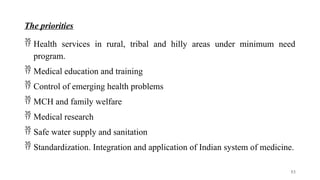
The priorities
Healthservices in rural, tribal and hilly areas under minimum need
program.
Medical education and training
Control of emerging health problems
MCH and family welfare
Medical research
Safe water supply and sanitation
Standardization. Integration and application of Indian system of medicine.
53
54.
MAJOR DEVELOPMENT
The year1985
The Universal Immunization Program was launched.
A separate department of women and child development was
established by ministry of Human Resource Development.
54
55.
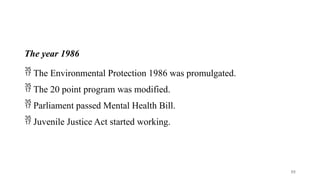
The year 1986
The Environmental Protection 1986 was promulgated.
The 20 point program was modified.
Parliament passed Mental Health Bill.
Juvenile Justice Act started working.
55
56.
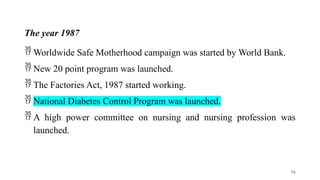
The year 1987
Worldwide Safe Motherhood campaign was started by World Bank.
New 20 point program was launched.
The Factories Act, 1987 started working.
National Diabetes Control Program was launched.
A high power committee on nursing and nursing profession was
launched.
56
57.
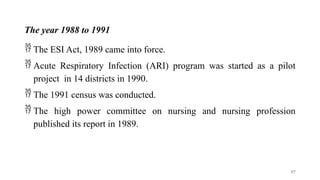
The year 1988to 1991
The ESI Act, 1989 came into force.
Acute Respiratory Infection (ARI) program was started as a pilot
project in 14 districts in 1990.
The 1991 census was conducted.
The high power committee on nursing and nursing profession
published its report in 1989.
57
58.
THE EIGHTTH FIVEYEAR PLAN [1992-97]
Aim
Employment, education, public health
To continue reorganization and strengthening of health infrastructure
and medical services accessible to all.
58
59.
The priorities
Developingrural health infrastructure
Medical education and training
Control of communicable diseases
Strengthening of health services
Medical research
Universal Immunization
MCH and Family Welfare
Safe Water Supply and sanitation
59
60.
MAJOR DEVELOPMENTS
The year1992
Child survival and Safe Motherhood program (CSSM) was started.
The infant milk substitute, feeding bottles and Infant foods
(Regulation of Production Supply and distribution) Act came into
operation.
60
61.
The year 1993
A revised strategy for National TB program with DOTS.
The year 1993
The Panchayati Raj Act came into cooperation.
Outbreak of Plague epidemic.
The first pulse polio immunization program for children under 3yrs was
organized.
Post basic three year B.Sc. Nursing program was launched through
distance education by Indira Gandhi National Open University.
61
62.
The year 1995
ICDS was changed to Integrated Mother and Child Development services.
Transplantation of Human organs Act was enacted.
Expert Committee on Malaria submitted its report.
The year 1996
Nationwide Pulse Polio Immunization was conducted.
Family planning program was made target free.
Pre-natal Diagnostic Technique (Regulation and Prevention of Misuse)
Act came into force.
62
63.
THE NINETH FIVEYEAR PLAN
Aim
Growth with social justice and equality.
• Reorganization and strengthening of infrastructure so as to provide
primary health care accessible.
63
64.
The priorities
Controlof communicable and non-communicable diseases.
Efficient primary health care system as part of basic health care
services.
Strengthening of existing Infrastructure.
Improvement of referral linkages
64
65.
Development ofhuman resources
Strengthening of National Vertical Programs.
Disaster and emergency management.
Strengthening of health research
Involvement of practitioners from indigenous system of medicine,
voluntary and private organizations.
Inter-sector coordination
65
66.
MAJOR DEVELOPMENTS
Reproductiveand Child Health Program was launched.
Govt. of India announced National population policy 2000.
National Malaria Eradication Program was renamed as National Anti
malaria program in 1999.
National Family Health Survey-2 was undertaken in 1998 – 1999.
66
67.
Phase –II national AIDS Control program started.
Census 2001 was completed.
Govt. of India announced National population policy 2002.
Govt. of India announced National AIDS prevention and Control
policy 2002.
67
68.
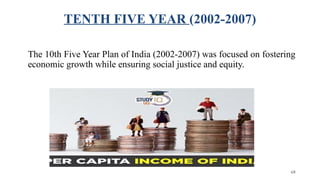
TENTH FIVE YEAR(2002-2007)
The 10th Five Year Plan of India (2002-2007) was focused on fostering
economic growth while ensuring social justice and equity.
68
69.
Aims
Double per capitaincome in next 10 years.
1. Accelerated Economic Growth
2. Reduction of Poverty
3. Social Justice
4. Human Development
5. Sustainable Development
69
70.
Priorities
• Employment Generation
•Agricultural Development
• Infrastructure Development
• Health and Education
• Women and Child Development
• Regional Development
70
71.
MAJOR DEVELOPMENTS
1. NationalFood Security Mission: Launched to increase food
production and ensure food security for the population.
2. Sarva Shiksha Abhiyan (SSA): Expanded to enhance universal
access to elementary education and improve educational quality.
3. National Rural Health Mission (NRHM): Introduced to improve
healthcare delivery in rural areas.
71
72.
4. Pradhan MantriGram Sadak Yojana (PMGSY): Continued focus
on rural road connectivity to improve access to markets and services.
5. Self-Employed Women’s Association (SEWA): Gained recognition
and support for empowering women through self-help groups.
6. Integrated Rural Development: Programs aimed at providing
sustainable livelihoods and improving rural infrastructure.
7. Environmental Initiatives: Focus on afforestation, biodiversity
conservation, and pollution control measures.
72
73.
ELEVENTH FIVE YEARPLAN [2007-2012]
The 11th Five Year Plan of India (2007-2012) was a significant period
aimed at achieving accelerated and inclusive growth.
73
74.
Aim
Rapid & moreinclusive growth
1. Achieving Higher Economic Growth: Targeted an average annual
growth rate of 9%.
2. Inclusive Development: Focused on ensuring that the benefits of
growth reached all sections of society, particularly the poor and
marginalized.
3. Reducing Poverty: Aimed to reduce poverty levels significantly
during the plan period.
74
75.
4. Human Development:Emphasized improving education, healthcare,
and overall quality of life.
5. Environmental Sustainability: Promoted sustainable practices and
resource management.
75
76.
Priorities
1. Agricultural Growth:Increased agricultural productivity and
supported farmers through better technology and resources.
2. Infrastructure Development: Focused on improving physical
infrastructure, including roads, power, and water supply.
3. Skill Development: Enhanced vocational training and education to
improve employability.
4. Social Justice: Addressed issues related to gender equality, health,
and education for marginalized groups.
76
77.
5. Urbanization Management:Managed the challenges of rapid
urbanization through planned urban development.
6. Health Care Access: Expanded healthcare services and improved
health indicators.
77
78.
MAJOR DEVELOPMENTS
1. NationalRural Health Mission (NRHM): Launched to improve healthcare delivery in rural areas.
2. National Urban Renewal Mission (NURM): Aimed at improving urban infrastructure and services in cities.
3. National Rural Livelihoods Mission (NRLM): Initiated to promote self-employment and income-generating
activities in rural areas.
4. Pradhan Mantri Gram Sadak Yojana (PMGSY): Continued focus on rural connectivity through road construction.
5. Right to Information Act: Enacted to promote transparency and accountability in governance.
6. Food Security Initiatives: Various schemes were introduced to ensure food security and improve nutritional
standards.
7. Renewable Energy Promotion: Initiatives to increase the share of renewable energy in the overall energy mix.
78
79.
Failure of EleventhFive Year Plan
No substantial increasing in the standard of living increases in
unemployment
Inequality in distribution of income and wealth
Less growth in productive sector.
79
80.
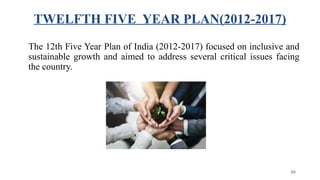
TWELFTH FIVE YEARPLAN(2012-2017)
The 12th Five Year Plan of India (2012-2017) focused on inclusive and
sustainable growth and aimed to address several critical issues facing
the country.
80
Priorities
1. Poverty Reduction:Target poverty alleviation through employment
generation and social welfare programs.
2. Education and Skill Development: Enhance the quality of education
and promote skill development initiatives.
3. Healthcare Improvement: Increase access to affordable healthcare
and improve healthcare facilities.
82
83.
4. Agricultural Growth:Boost agricultural productivity and support
farmers with better technology and credit access.
5. Infrastructure Development: Prioritize transport, energy, water
supply, and sanitation.
6. Gender Equality: Promote women's empowerment and gender-
sensitive policies.
7. Environmental Sustainability: Integrate sustainable practices in
various sectors to address climate change.
83
5. National RuralLivelihoods Mission (NRLM): Launched to promote
self-employment and organization of rural poor into self-help groups
(SHGs).
6. Renewable Energy Initiatives Increased focus on solar and wind
energy projects to promote sustainable energy sources.
7. Urban Development Schemes: Initiatives like the Jawaharlal Nehru
National Urban Renewal Mission (JNNURM) aimed at urban
infrastructure development.
85
86.
MAJOR PROGRAMS
Nationalrural employment guarantee act
Indian Awas yojna
National rural livelihood mission
Total sanitation programme
Indian water management programme
Pradhanmantri gram sadak yojna
86
RESEARCH ARTICLES
89
1. GuptaL, Mehta S. Gender equity and the Five-Year Plans: progress
and challenges. Journal of Gender Studies. Sample: Women
beneficiaries Population: Women in various sectors , Sample Size: 500
women Research Methodology: A longitudinal study was conducted
using interviews and surveys to assess the effectiveness of gender-
focused policies in the Five-Year Plans over three decades. Results: The
findings showed a gradual improvement in women's employment and
educational attainment, though barriers to full equality remain, with
only 40% of women feeling fully empowered.
90.
2. Chaudhary R,Bansal V. Environmental sustainability in the Five-
Year Plans: a critical analysis. Journal of Environmental Policy..
Sample: Environmental policies Population: Policy documents and
impact assessments Sample Size: 50 policies from five decades
Research Methodology: Content analysis was used to evaluate the
incorporation of environmental sustainability in Five-Year Plans,
supported by stakeholder interviews. Results: The analysis indicated a
gradual shift towards sustainable practices, but only 30% of policies
effectively integrated environmental considerations, suggesting the need
for stronger frameworks in future plans.
90
91.
3. Rao T,Nair K. The role of infrastructure development in India’s Five-
Year Plans. Journal of Economic Planning Sample: Infrastructure
projects Population: National infrastructure data Sample Size:150
major projects Research Methodology: A case study analysis was
conducted, examining project outcomes in relation to economic
performance metrics pre-and post-implementation. Results: The
research found that infrastructure projects funded by Five-Year Plans
led to a 20% increase in regional economic productivity, underscoring
the importance of infrastructure in national planning.
91
92.
CONCLUSION
Planning commission whichgives importance to health programs has
proposed five year plans to rebuild rural India, to lay foundations of
industrial progress and secure balanced developments of all parts of the
country. There is visible shift in the focus of development planning from
mere expansion of services to planning of enhancement of human well
being.
92
BIBLIOGRAPHY
• 1. GillKK textbook of community Health Nursing ,Edition 3rd
published by CBS Publishers.
• 2. Gulani.K.K, (2006), “Community Health Nursing”, 1st edition , Kumar publishing house, pp: 66 -
68.
• 3. Kishore. J, (2007), “Natioanal Health Programs of India”, 7th edition, century publication, pp: 50 – 57.
• 4. Prabhakara .G. N, (2004), “Textbook Of Community Health For Nurses”, 1st Edition, Jaypee Publishers,
India, pp:578.
• 5.Park.K , (2007) , “Preventive and Social Medicine”, 18th edition, M/S Banarsidar Bhanot publishers,
India, pp :728.
• 6. https://www.scribd.com
95



![FIRST FIVE YEAR PLAN FROM [1951-1956]
• The first Indian Prime Minister,
Pandit Jawaharlal Nehru presented
the first five year plan to the
Parliament of India on December 8,
1951.
7](https://image.slidesharecdn.com/presentation-copy1-250610141930-4699fef6/85/five-year-plans-by-kanchan-dyal-MSc-nursing-7-320.jpg)
![THE MAJOR DEVELOPMENTS AND ACHIEVEMENTS
The year 1951
B.C.G Vaccination program to prevent and control tuberculosis was
launched.
The year 1952
A pilot project of community development program was launched in 55
project areas [Bhakra Nangal dam, Vyas Project].
The central council of health was constituted.
10](https://image.slidesharecdn.com/presentation-copy1-250610141930-4699fef6/85/five-year-plans-by-kanchan-dyal-MSc-nursing-10-320.jpg)
![The year 1960
Pilot Projects of small pox eradication was started.
Vital statistics were transferred from DGHS [Directorate General of
Health Services] to registrar general of India.
A National Nutrition Advisory Committee was formed to render
advice on nutrition policies.
The school health committee was appointed by union ministry of
Health.
21](https://image.slidesharecdn.com/presentation-copy1-250610141930-4699fef6/85/five-year-plans-by-kanchan-dyal-MSc-nursing-21-320.jpg)
![THE FOURTH FIVE YEAR PLAN [1969-66]
Aim
Growth with stability and self reliance
To strengthen primary health center network in
the rural areas for undertaking preventive,
curative and family planning services and to
take over the maintenance phase of
communicable diseases.
31](https://image.slidesharecdn.com/presentation-copy1-250610141930-4699fef6/85/five-year-plans-by-kanchan-dyal-MSc-nursing-31-320.jpg)
![THE FIFTH FIVE YEAR PLAN [1974-78]
Aim
• Employment, Defense ‘‘Garibi Hatao’’
• To provide minimum level of well
integrated health, MCH, FP, Nutrition,
Immunization to all the people with
special reference to vulnerable groups.
38](https://image.slidesharecdn.com/presentation-copy1-250610141930-4699fef6/85/five-year-plans-by-kanchan-dyal-MSc-nursing-38-320.jpg)
![THE SIXTH FIVE YEAR PLAN [1980-85]
Aim
Economic liberalization by eradicating poverty.
To workout alternative strategy and plan of action for primary health
care as a part of national health system, which is accessible for all
section of society, especially those living in rural areas and urban
slums.
45](https://image.slidesharecdn.com/presentation-copy1-250610141930-4699fef6/85/five-year-plans-by-kanchan-dyal-MSc-nursing-45-320.jpg)
![THE SEVENTH FIVE YEAR PLAN
[1985-90]
Aim
Self-sufficient economy, technology
To plan and provide primary health care and medical services to all
with special consideration of vulnerable groups so as to achieve the
goal of Health for All by 2000 A.D.
52](https://image.slidesharecdn.com/presentation-copy1-250610141930-4699fef6/85/five-year-plans-by-kanchan-dyal-MSc-nursing-52-320.jpg)

![THE EIGHTTH FIVE YEAR PLAN [1992-97]
Aim
Employment, education, public health
To continue reorganization and strengthening of health infrastructure
and medical services accessible to all.
58](https://image.slidesharecdn.com/presentation-copy1-250610141930-4699fef6/85/five-year-plans-by-kanchan-dyal-MSc-nursing-58-320.jpg)
![ELEVENTH FIVE YEAR PLAN [2007-2012]
The 11th Five Year Plan of India (2007-2012) was a significant period
aimed at achieving accelerated and inclusive growth.
73](https://image.slidesharecdn.com/presentation-copy1-250610141930-4699fef6/85/five-year-plans-by-kanchan-dyal-MSc-nursing-73-320.jpg)