Detec%on	
  of	
  Soma%c	
  Muta%ons	
  by	
  Targeted	
  NGS	


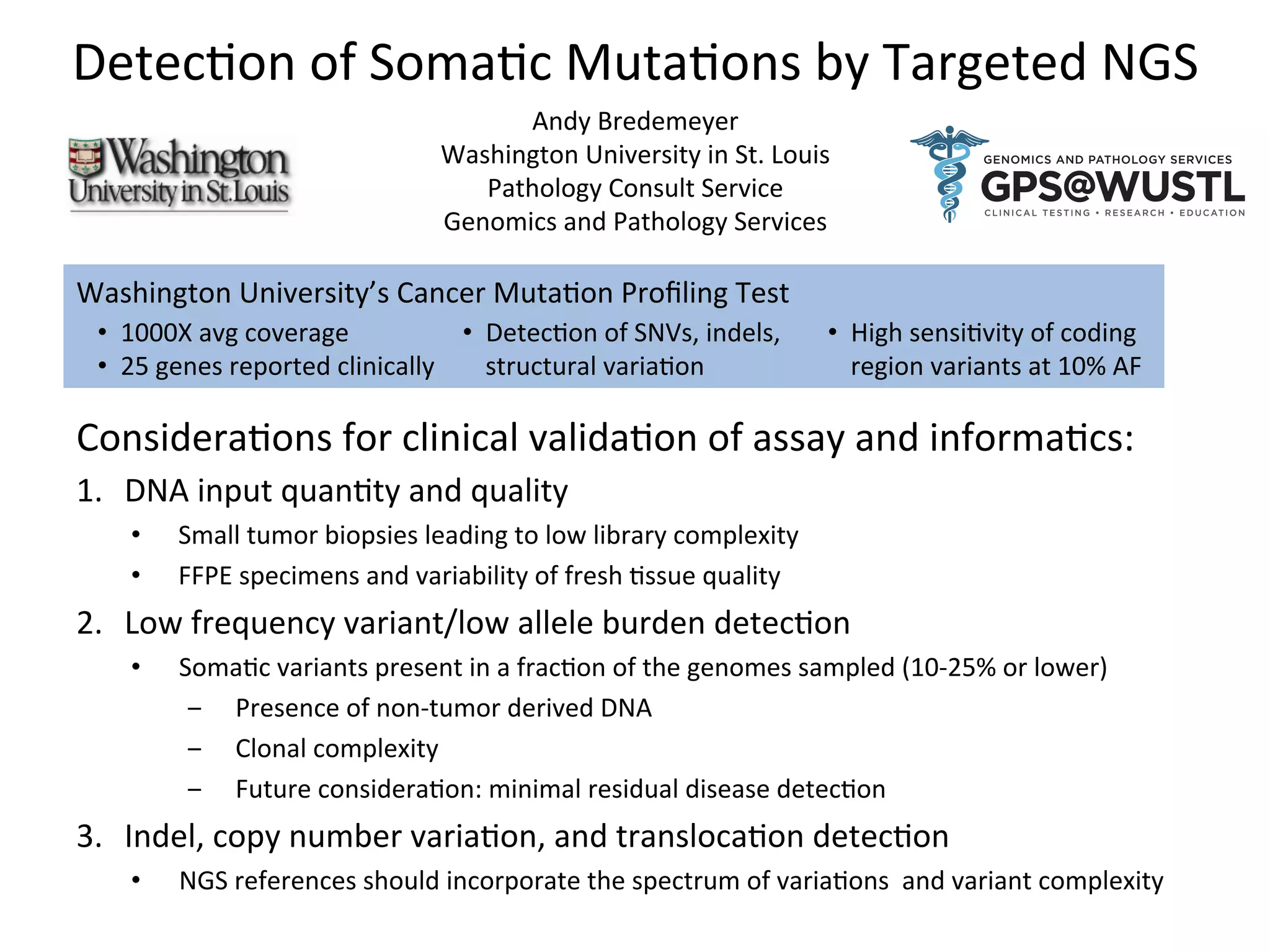
                          Andy	
  Bredemeyer	
  
                    Washington	
  University	
  in	
  St.	
  Louis	
  
                                                 Pathology	
  Consult	
  Service	
  
                                              Genomics	
  and	
  Pathology	
  Services	
  

Washington	
  University’s	
  Cancer	
  Muta%on	
  Profiling	
  Test	
  
  •  1000X	
  avg	
  coverage	
                •  Detec%on	
  of	
  SNVs,	
  indels,	
            •  High	
  sensi%vity	
  of	
  coding	
  
  •  25	
  genes	
  reported	
  clinically	
      structural	
  varia%on	
                           region	
  variants	
  at	
  10%	
  AF	
  

Considera%ons	
  for	
  clinical	
  valida%on	
  of	
  assay	
  and	
  informa%cs:	
  
1.  DNA	
  input	
  quan%ty	
  and	
  quality	
  	
  
      •     Small	
  tumor	
  biopsies	
  leading	
  to	
  low	
  library	
  complexity	
  	
  
      •     FFPE	
  specimens	
  and	
  variability	
  of	
  fresh	
  %ssue	
  quality	
  
2.  Low	
  frequency	
  variant/low	
  allele	
  burden	
  detec%on	
  
      •     Soma%c	
  variants	
  present	
  in	
  a	
  frac%on	
  of	
  the	
  genomes	
  sampled	
  (10-­‐25%	
  or	
  lower)	
  
             ‒  Presence	
  of	
  non-­‐tumor	
  derived	
  DNA	
  
             ‒  Clonal	
  complexity	
  
             ‒  Future	
  considera%on:	
  minimal	
  residual	
  disease	
  detec%on	
  
3.  Indel,	
  copy	
  number	
  varia%on,	
  and	
  transloca%on	
  detec%on	
  
      •     NGS	
  references	
  should	
  incorporate	
  the	
  spectrum	
  of	
  varia%ons	
  	
  and	
  variant	
  complexity	
  
One slide introduction : John West, CEO, Personalis Inc.

•    New VC-backed startup in Menlo Park, CA (www.personalis.com)
•    Clinical-quality genome sequencing & medically-relevant interpretation
•    Founders from Stanford (majority MD’s) & Solexa / Illumina
•    Collaborations : Stanford, Harvard, ISB
•    Extensive publication record in genetic analysis accuracy issues (esp. NGS)
•    Work guided by extensive manually-curated databases linking genetic
     variation with disease & drug metabolism
•    2010 : Quake-genome clinical interpretation
•    2009-2011 : Family quartet genome analysis
•    Current work :
      –  Larger families including CEPH1463 / NA12878; Multiplatform
      –  Lab & informatics for accuracy (vs absolutely lowest cost)
•    Using “gold-standard” genomes to characterize error mechanisms
•    Design lab & informatic methods to address them
•    Interested in joining NIST consortium
Jim	
  Mullikin,	
  Director	
  NIH	
  Intramural	
  Sequencing	
  Center	
  (NISC)	
  
•  Computa%onal	
  genomics	
  researcher	
  from	
  the	
  days	
  of	
  the	
  ramp-­‐up	
  of	
  
   the	
  human	
  genome	
  project	
  in	
  1997.	


•  Involved	
  in	
  The	
  SNP	
  Consor%um	
  project,	
  and	
  later	
  the	
  HapMap	
  project.	


•  I	
  worked	
  on	
  the	
  early	
  structural	
  varia%on	
  analysis	
  with	
  Evan	
  Eichler	
  and	
  
   selected	
  NA12878	
  as	
  one	
  of	
  the	
  eight	
  samples	
  for	
  that	
  project.	


•  The	
  1000	
  genomes	
  project	
  selected	
  this	
  individual	
  as	
  well	
  
      –  She	
  is	
  of	
  European	
  ancestry	
  
      –  Together	
  with	
  her	
  parents	
  cons%tuted	
  one	
  of	
  the	
  trios	
  for	
  the	
  1000G	
  pilot	
  
         project	
  
•  NISC	
  is	
  keenly	
  interested	
  in	
  working	
  with	
  new	
  sequencing	
  technologies.	
  
•  The	
  Genome-­‐in-­‐a-­‐Bocle	
  goal	
  of	
  providing	
  a	
  standard	
  human	
  reference	
  
   sample	
  for	
  this	
  field	
  will	
  be	
  invaluable.	
  
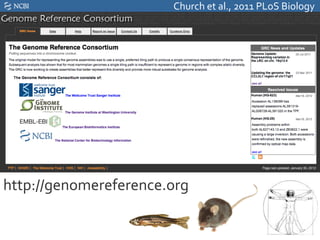
Church	
  et	
  al.,	
  2011	
  PLoS	
  Biology	


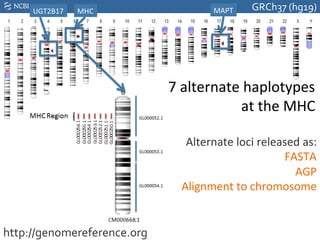
http://genomereference.org	
  
UGT2B17	
     MHC	
                    MAPT	
     GRCh37	
  (hg19)	


                                 7	
  alternate	
  haplotypes	
  
                                                 at	
  the	
  MHC	
  

                                     Alternate	
  loci	
  released	
  as:	
  
                                                               FASTA	
  
                                                                 AGP	
  
                                    Alignment	
  to	
  chromosome	


http://genomereference.org	
  
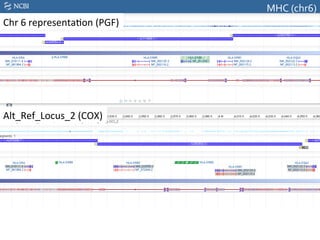
MHC	
  (chr6)	
  
Chr	
  6	
  representa%on	
  (PGF)	


Alt_Ref_Locus_2	
  (COX)	
  
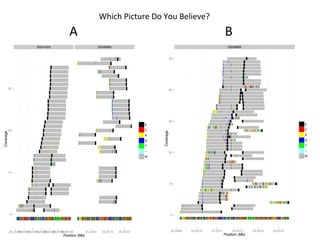
Which	
  Picture	
  Do	
  You	
  Believe?	
  
                                           A	
                                                                                        B	
  
                          23241623                                23246895                                                              23246895


                                                                                                       50


           30                                                                                          40


                                                                                                       30
                                                                                        E                                                                                 E

           20                                                                           C                                                                                 C


                                                                                            Coverage
Coverage


                                                                                        A                                                                                 A
                                                                                        G                                                                                 G
                                                                                        T                                                                                 T
                                                                                        −                                                                                 −
                                                                                                       20
                                                                                        M                                                                                 M


           10


                                                                                                       10


            0                                                                                          0


           23.24165 23.24175 23.24185 23.24195
                 23.24170 23.24180 23.24190             23.2470     23.2471   23.2472                   23.2469   23.2470   23.2471        23.2472    23.2473   23.2474
                                        Position (Mb)                                                                                 Position (Mb)
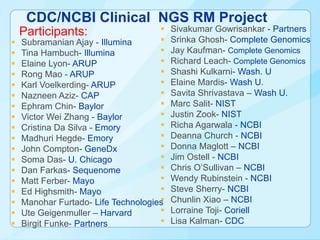
CDC/NCBI Clinical NGS RM Project
q    Two human cell lines (NA19240, NA12878)
q    Existing AND new sequence data (NGS & Sanger) from 36 clinical gene
      panels, WES, WGS (volunteer labs)
q    Assess data quality (coverage, quality scores, etc); accept data which
      meets predefined criteria
q    NCBI will analyze and host data files online for public access. Will
      display:
       q  All data sets with metrics (coverage, platform, software, etc)
       q  Consensus sequence track- regions of “high, medium or low”
           sequence confidence indicated
q    Develop guidance for using online data files as tools for test validation
      and NGS trouble-shooting
q    Publish manuscript of this process and the findings
q    This data is available to NIST


                      Office of Surveillance, Epidemiology, and Laboratory Services
                      Laboratory Science, Policy and Practice Program Office
CDC/NCBI Clinical NGS RM Project
      Participants:                    §    Sivakumar Gowrisankar - Partners
§    Subramanian Ajay - Illumina      §    Srinka Ghosh- Complete Genomics
§    Tina Hambuch- Illumina           §    Jay Kaufman- Complete Genomics
§    Elaine Lyon- ARUP                §    Richard Leach- Complete Genomics
§    Rong Mao - ARUP                  §    Shashi Kulkarni- Wash. U
§    Karl Voelkerding- ARUP           §    Elaine Mardis- Wash U.
§    Nazneen Aziz- CAP                §    Savita Shrivastava – Wash U.
§    Ephram Chin- Baylor              §    Marc Salit- NIST
§    Victor Wei Zhang - Baylor        §    Justin Zook- NIST
§    Cristina Da Silva - Emory        §    Richa Agarwala - NCBI
§    Madhuri Hegde- Emory             §    Deanna Church - NCBI
§    John Compton- GeneDx             §    Donna Maglott – NCBI
§    Soma Das- U. Chicago             §    Jim Ostell - NCBI
§    Dan Farkas- Sequenome            §    Chris O’Sullivan – NCBI
§    Matt Ferber- Mayo                §    Wendy Rubinstein - NCBI
§    Ed Highsmith- Mayo               §    Steve Sherry- NCBI
§                                     § 
      Manohar Furtado- Life Technologies     Chunlin Xiao – NCBI
§    Ute Geigenmuller – Harvard       §    Lorraine Toji- Coriell
§    Birgit Funke- Partners           §    Lisa Kalman- CDC
The
 Disclaimer:
The findings and conclusions in this
report are those of the author and do not
necessarily represent the official position
of the Centers for Disease Control and
Prevention/the Agency for Toxic
Substances and Disease Registry.
 Lisa Kalman, PhD LKalman@cdc.gov
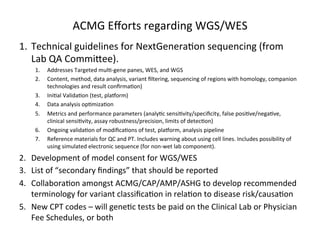
ACMG	
  Efforts	
  regarding	
  WGS/WES	


1.  Technical	
  guidelines	
  for	
  NextGenera%on	
  sequencing	
  (from	
  
     Lab	
  QA	
  Commicee).	
  
       1.    Addresses	
  Targeted	
  mul%-­‐gene	
  panes,	
  WES,	
  and	
  WGS	
  
       2.    Content,	
  method,	
  data	
  analysis,	
  variant	
  filtering,	
  sequencing	
  of	
  regions	
  with	
  homology,	
  companion	
  
             technologies	
  and	
  result	
  confirma%on)	
  
       3.    Ini%al	
  Valida%on	
  (test,	
  plalorm)	
  
       4.    Data	
  analysis	
  op%miza%on	
  
       5.    Metrics	
  and	
  performance	
  parameters	
  (analy%c	
  sensi%vity/specificity,	
  false	
  posi%ve/nega%ve,	
  
             clinical	
  sensi%vity,	
  assay	
  robustness/precision,	
  limits	
  of	
  detec%on)	
  
       6.    Ongoing	
  valida%on	
  of	
  modifica%ons	
  of	
  test,	
  plalorm,	
  analysis	
  pipeline	
  
       7.    Reference	
  materials	
  for	
  QC	
  and	
  PT.	
  Includes	
  warning	
  about	
  using	
  cell	
  lines.	
  Includes	
  possibility	
  of	
  
             using	
  simulated	
  electronic	
  sequence	
  (for	
  non-­‐wet	
  lab	
  component).	
  
2.  Development	
  of	
  model	
  consent	
  for	
  WGS/WES	
  
3.  List	
  of	
  “secondary	
  findings”	
  that	
  should	
  be	
  reported	
  
4.  Collabora%on	
  amongst	
  ACMG/CAP/AMP/ASHG	
  to	
  develop	
  recommended	
  
    terminology	
  for	
  variant	
  classifica%on	
  in	
  rela%on	
  to	
  disease	
  risk/causa%on	
  
5.  New	
  CPT	
  codes	
  –	
  will	
  gene%c	
  tests	
  be	
  paid	
  on	
  the	
  Clinical	
  Lab	
  or	
  Physician	
  
    Fee	
  Schedules,	
  or	
  both	
  
Horizon	
  Discovery	
  –	
  reference	
  standards	
  for	
  Next	
  Genera6on	
  Sequencing	
  

 1.      HorizonDx	
  combines	
  three	
  core	
  capabili6es	
  
 •     Highly	
  accurate	
  gene	
  engineering	
  technology	
  à	
  generates	
  isogenic	
  human	
  cell	
  lines	
  
 •     FFPE	
  %ssue	
  modelling	
  capability	
  à	
  FFPE	
  blocks	
  containing	
  defined	
  cell	
  ra%os	
  
 •     World-­‐class	
  molecular	
  characteriza%on	
  à	
  droplet	
  digital	
  PCR,	
  STR	
  and	
  SNP6	


 2.  HorizonDx	
  developing	
  a	
  mul6-­‐plex	
  reference	
  standard	
  for	
  NGS	
  
 •     Combining	
  >10	
  clinically	
  relevant	
  oncogene	
  muta%ons	
  into	
  a	
  single	
  gDNA/FFPE	
  standard	
  
 •     Staggered	
  allele	
  burdens	
  from	
  ranging	
  from	
  1-­‐25%	
  
 •     First	
  commercially	
  available	
  NGS	
  standard	


 3.      The	
  case	
  for	
  including	
  MCF10a	
  as	
  a	
  reference	
  genome	
  
 •     Normal	
  cell	
  line,	
  well	
  characterized	
  and	
  highly	
  u%lized	
  for	
  cancer	
  research	
  
 •     Would	
  pave	
  the	
  way	
  for	
  the	
  crea%on	
  of	
  a	
  disease	
  reference	
  genome	
  ,	
  or	
  analyte	
  specific	
  reference	
  
       material	
  which	
  offers	
  high	
  prac%cal	
  u%lity	
  
 •     Horizon	
  has	
  >100	
  knock-­‐in/knock-­‐out	
  cell	
  lines	
  in	
  MCF10a	
  background	
  to	
  leverage	
  into	
  the	
  consor%um	


  To	
  find	
  out	
  more:	
  
  visit:	
  www.horizondx.com	
  or	
  contact	
  Joshua	
  Kapp	
  at	
  j.kapp@horizondiscovery.com	


                                                                           12	
  
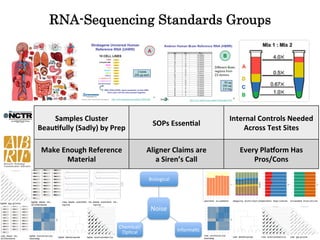
RNA-Sequencing Standards Groups


1.  FDA: Cluster	
  
    Samples	
   Sequencing Quality Control (SeQC)-eeded	
                  Internal	
  Controls	
  N
                                            SOPs	
  Essen6al	
  
Beau6fully	
  (Sadly)	
  by	
  Prep	
   SOLiD, Illumina
    Helicos, 454,                                                              Across	
  Test	
  Sites	
  

2.  ABRF:Reference	
   Study: 454, IonTorrent (PGMHas	
  	
  
 Make	
  Enough	
   NGS                   Aligner	
  Claims	
  are	
  	
      Every	
  PlaUorm	
  
    & Proton) Illumina,iren’s	
  Call	
   Biosciences
          Material	
                         a	
  S
                                                    Pacific                       Pros/Cons	
  

                                             Biological	


                                              Noise	
  

                               Chemical/
                                Op%cal	
                      Informa%c	
  
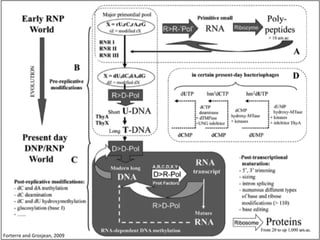
Base	
  Modifica%ons	
  of	
             DNA:	
  
                                           5-­‐methylcytosine	
  

     known	
  biological	
                 5-­‐hydroxymethylcytosine	
  	
  
                                           8-­‐oxoguanine	
  
                                           glucosylated	
  5-­‐hydroxymethylcytosine	
  
         importance	
                      4-­‐methylcytosine	
  
                                           6-­‐methyladenine	
  
                                           8-­‐oxoadenine	
  
                                           5-­‐formylcytosine	
  
                                           5-­‐carboxycytosine	
  
                                           β-­‐D-­‐Glucosyl-­‐hydroxymethyluracil	
  (J	
  base)	
  
                                           Phosphorothioa%on	
  (backbone)	
  
                                           1-­‐methyladenine	
  
                                           3-­‐methylcytosine	
  
                                           Inosine	
  
                                           5-­‐hydroxycytosine	
  
                                           O6-­‐methylguanine	
  
                                           O4-­‐methylthymine	
  
                                           5-­‐hydroxyuracil	
  
                                           5-­‐hydroxymethyluracil	
  
                                           The	
  four	
  ribonucleo%des	
  (backbone)	


                                           RNA:	
  
                                           6-­‐methyladenosine	
  
Forterre	
  and	
  Grosjean,	
  2009	
     1-­‐methyladenosine	
  

Five minute presentations

  • 1.
    Detec%on  of  Soma%c  Muta%ons  by  Targeted  NGS     Andy  Bredemeyer   Washington  University  in  St.  Louis   Pathology  Consult  Service   Genomics  and  Pathology  Services   Washington  University’s  Cancer  Muta%on  Profiling  Test   •  1000X  avg  coverage   •  Detec%on  of  SNVs,  indels,   •  High  sensi%vity  of  coding   •  25  genes  reported  clinically   structural  varia%on   region  variants  at  10%  AF   Considera%ons  for  clinical  valida%on  of  assay  and  informa%cs:   1.  DNA  input  quan%ty  and  quality     •  Small  tumor  biopsies  leading  to  low  library  complexity     •  FFPE  specimens  and  variability  of  fresh  %ssue  quality   2.  Low  frequency  variant/low  allele  burden  detec%on   •  Soma%c  variants  present  in  a  frac%on  of  the  genomes  sampled  (10-­‐25%  or  lower)   ‒  Presence  of  non-­‐tumor  derived  DNA   ‒  Clonal  complexity   ‒  Future  considera%on:  minimal  residual  disease  detec%on   3.  Indel,  copy  number  varia%on,  and  transloca%on  detec%on   •  NGS  references  should  incorporate  the  spectrum  of  varia%ons    and  variant  complexity  
  • 2.
    One slide introduction: John West, CEO, Personalis Inc. •  New VC-backed startup in Menlo Park, CA (www.personalis.com) •  Clinical-quality genome sequencing & medically-relevant interpretation •  Founders from Stanford (majority MD’s) & Solexa / Illumina •  Collaborations : Stanford, Harvard, ISB •  Extensive publication record in genetic analysis accuracy issues (esp. NGS) •  Work guided by extensive manually-curated databases linking genetic variation with disease & drug metabolism •  2010 : Quake-genome clinical interpretation •  2009-2011 : Family quartet genome analysis •  Current work : –  Larger families including CEPH1463 / NA12878; Multiplatform –  Lab & informatics for accuracy (vs absolutely lowest cost) •  Using “gold-standard” genomes to characterize error mechanisms •  Design lab & informatic methods to address them •  Interested in joining NIST consortium
  • 3.
    Jim  Mullikin,  Director  NIH  Intramural  Sequencing  Center  (NISC)   •  Computa%onal  genomics  researcher  from  the  days  of  the  ramp-­‐up  of   the  human  genome  project  in  1997.       •  Involved  in  The  SNP  Consor%um  project,  and  later  the  HapMap  project.       •  I  worked  on  the  early  structural  varia%on  analysis  with  Evan  Eichler  and   selected  NA12878  as  one  of  the  eight  samples  for  that  project.       •  The  1000  genomes  project  selected  this  individual  as  well   –  She  is  of  European  ancestry   –  Together  with  her  parents  cons%tuted  one  of  the  trios  for  the  1000G  pilot   project   •  NISC  is  keenly  interested  in  working  with  new  sequencing  technologies.   •  The  Genome-­‐in-­‐a-­‐Bocle  goal  of  providing  a  standard  human  reference   sample  for  this  field  will  be  invaluable.  
  • 4.
    Church  et  al.,  2011  PLoS  Biology   http://genomereference.org  
  • 5.
    UGT2B17   MHC   MAPT   GRCh37  (hg19)   7  alternate  haplotypes   at  the  MHC   Alternate  loci  released  as:   FASTA   AGP   Alignment  to  chromosome   http://genomereference.org  
  • 6.
    MHC  (chr6)   Chr  6  representa%on  (PGF)   Alt_Ref_Locus_2  (COX)  
  • 7.
    Which  Picture  Do  You  Believe?   A   B   23241623 23246895 23246895 50 30 40 30 E E 20 C C Coverage Coverage A A G G T T − − 20 M M 10 10 0 0 23.24165 23.24175 23.24185 23.24195 23.24170 23.24180 23.24190 23.2470 23.2471 23.2472 23.2469 23.2470 23.2471 23.2472 23.2473 23.2474 Position (Mb) Position (Mb)
  • 8.
    CDC/NCBI Clinical NGSRM Project q  Two human cell lines (NA19240, NA12878) q  Existing AND new sequence data (NGS & Sanger) from 36 clinical gene panels, WES, WGS (volunteer labs) q  Assess data quality (coverage, quality scores, etc); accept data which meets predefined criteria q  NCBI will analyze and host data files online for public access. Will display: q  All data sets with metrics (coverage, platform, software, etc) q  Consensus sequence track- regions of “high, medium or low” sequence confidence indicated q  Develop guidance for using online data files as tools for test validation and NGS trouble-shooting q  Publish manuscript of this process and the findings q  This data is available to NIST Office of Surveillance, Epidemiology, and Laboratory Services Laboratory Science, Policy and Practice Program Office
  • 9.
    CDC/NCBI Clinical NGSRM Project Participants: §  Sivakumar Gowrisankar - Partners §  Subramanian Ajay - Illumina §  Srinka Ghosh- Complete Genomics §  Tina Hambuch- Illumina §  Jay Kaufman- Complete Genomics §  Elaine Lyon- ARUP §  Richard Leach- Complete Genomics §  Rong Mao - ARUP §  Shashi Kulkarni- Wash. U §  Karl Voelkerding- ARUP §  Elaine Mardis- Wash U. §  Nazneen Aziz- CAP §  Savita Shrivastava – Wash U. §  Ephram Chin- Baylor §  Marc Salit- NIST §  Victor Wei Zhang - Baylor §  Justin Zook- NIST §  Cristina Da Silva - Emory §  Richa Agarwala - NCBI §  Madhuri Hegde- Emory §  Deanna Church - NCBI §  John Compton- GeneDx §  Donna Maglott – NCBI §  Soma Das- U. Chicago §  Jim Ostell - NCBI §  Dan Farkas- Sequenome §  Chris O’Sullivan – NCBI §  Matt Ferber- Mayo §  Wendy Rubinstein - NCBI §  Ed Highsmith- Mayo §  Steve Sherry- NCBI §  §  Manohar Furtado- Life Technologies Chunlin Xiao – NCBI §  Ute Geigenmuller – Harvard §  Lorraine Toji- Coriell §  Birgit Funke- Partners §  Lisa Kalman- CDC
  • 10.
    The Disclaimer: The findingsand conclusions in this report are those of the author and do not necessarily represent the official position of the Centers for Disease Control and Prevention/the Agency for Toxic Substances and Disease Registry. Lisa Kalman, PhD LKalman@cdc.gov
  • 11.
    ACMG  Efforts  regarding  WGS/WES     1.  Technical  guidelines  for  NextGenera%on  sequencing  (from   Lab  QA  Commicee).   1.  Addresses  Targeted  mul%-­‐gene  panes,  WES,  and  WGS   2.  Content,  method,  data  analysis,  variant  filtering,  sequencing  of  regions  with  homology,  companion   technologies  and  result  confirma%on)   3.  Ini%al  Valida%on  (test,  plalorm)   4.  Data  analysis  op%miza%on   5.  Metrics  and  performance  parameters  (analy%c  sensi%vity/specificity,  false  posi%ve/nega%ve,   clinical  sensi%vity,  assay  robustness/precision,  limits  of  detec%on)   6.  Ongoing  valida%on  of  modifica%ons  of  test,  plalorm,  analysis  pipeline   7.  Reference  materials  for  QC  and  PT.  Includes  warning  about  using  cell  lines.  Includes  possibility  of   using  simulated  electronic  sequence  (for  non-­‐wet  lab  component).   2.  Development  of  model  consent  for  WGS/WES   3.  List  of  “secondary  findings”  that  should  be  reported   4.  Collabora%on  amongst  ACMG/CAP/AMP/ASHG  to  develop  recommended   terminology  for  variant  classifica%on  in  rela%on  to  disease  risk/causa%on   5.  New  CPT  codes  –  will  gene%c  tests  be  paid  on  the  Clinical  Lab  or  Physician   Fee  Schedules,  or  both  
  • 12.
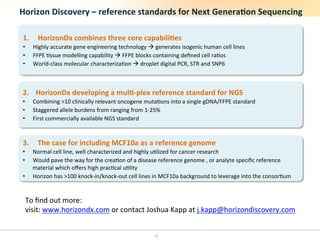
    Horizon  Discovery  –  reference  standards  for  Next  Genera6on  Sequencing   1.  HorizonDx  combines  three  core  capabili6es   •  Highly  accurate  gene  engineering  technology  à  generates  isogenic  human  cell  lines   •  FFPE  %ssue  modelling  capability  à  FFPE  blocks  containing  defined  cell  ra%os   •  World-­‐class  molecular  characteriza%on  à  droplet  digital  PCR,  STR  and  SNP6   2.  HorizonDx  developing  a  mul6-­‐plex  reference  standard  for  NGS   •  Combining  >10  clinically  relevant  oncogene  muta%ons  into  a  single  gDNA/FFPE  standard   •  Staggered  allele  burdens  from  ranging  from  1-­‐25%   •  First  commercially  available  NGS  standard   3.  The  case  for  including  MCF10a  as  a  reference  genome   •  Normal  cell  line,  well  characterized  and  highly  u%lized  for  cancer  research   •  Would  pave  the  way  for  the  crea%on  of  a  disease  reference  genome  ,  or  analyte  specific  reference   material  which  offers  high  prac%cal  u%lity   •  Horizon  has  >100  knock-­‐in/knock-­‐out  cell  lines  in  MCF10a  background  to  leverage  into  the  consor%um   To  find  out  more:   visit:  www.horizondx.com  or  contact  Joshua  Kapp  at  j.kapp@horizondiscovery.com     12  
  • 13.
    RNA-Sequencing Standards Groups 1. FDA: Cluster   Samples   Sequencing Quality Control (SeQC)-eeded   Internal  Controls  N SOPs  Essen6al   Beau6fully  (Sadly)  by  Prep   SOLiD, Illumina Helicos, 454, Across  Test  Sites   2.  ABRF:Reference   Study: 454, IonTorrent (PGMHas     Make  Enough   NGS Aligner  Claims  are     Every  PlaUorm   & Proton) Illumina,iren’s  Call   Biosciences Material   a  S Pacific Pros/Cons   Biological   Noise   Chemical/ Op%cal   Informa%c  
  • 14.
    Base  Modifica%ons  of   DNA:   5-­‐methylcytosine   known  biological   5-­‐hydroxymethylcytosine     8-­‐oxoguanine   glucosylated  5-­‐hydroxymethylcytosine   importance   4-­‐methylcytosine   6-­‐methyladenine   8-­‐oxoadenine   5-­‐formylcytosine   5-­‐carboxycytosine   β-­‐D-­‐Glucosyl-­‐hydroxymethyluracil  (J  base)   Phosphorothioa%on  (backbone)   1-­‐methyladenine   3-­‐methylcytosine   Inosine   5-­‐hydroxycytosine   O6-­‐methylguanine   O4-­‐methylthymine   5-­‐hydroxyuracil   5-­‐hydroxymethyluracil   The  four  ribonucleo%des  (backbone)     RNA:   6-­‐methyladenosine   Forterre  and  Grosjean,  2009   1-­‐methyladenosine