Government College of Engineering, Karad
SCHEME OF INSTRUCTION & SYLLABI
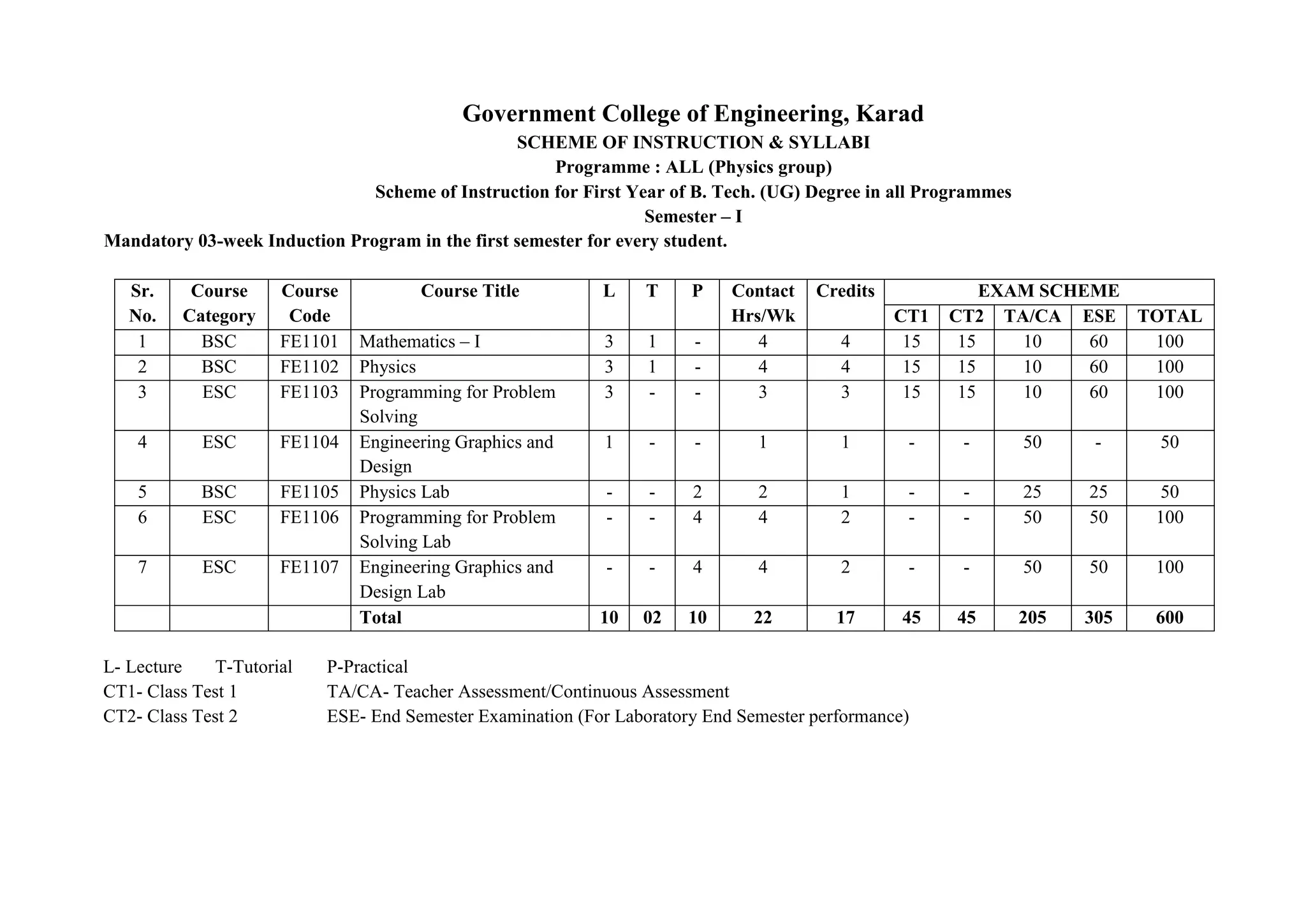
Programme : ALL (Physics group)
Scheme of Instruction for First Year of B. Tech. (UG) Degree in all Programmes
Semester – I
Mandatory 03-week Induction Program in the first semester for every student.
Sr.
No.
Course
Category
Course
Code
Course Title L T P Contact
Hrs/Wk
Credits EXAM SCHEME
CT1 CT2 TA/CA ESE TOTAL
1 BSC FE1101 Mathematics – I 3 1 - 4 4 15 15 10 60 100
2 BSC FE1102 Physics 3 1 - 4 4 15 15 10 60 100
3 ESC FE1103 Programming for Problem
Solving
3 - - 3 3 15 15 10 60 100
4 ESC FE1104 Engineering Graphics and
Design
1 - - 1 1 - - 50 - 50
5 BSC FE1105 Physics Lab - - 2 2 1 - - 25 25 50
6 ESC FE1106 Programming for Problem
Solving Lab
- - 4 4 2 - - 50 50 100
7 ESC FE1107 Engineering Graphics and
Design Lab
- - 4 4 2 - - 50 50 100
Total 10 02 10 22 17 45 45 205 305 600
L- Lecture T-Tutorial P-Practical
CT1- Class Test 1 TA/CA- Teacher Assessment/Continuous Assessment
CT2- Class Test 2 ESE- End Semester Examination (For Laboratory End Semester performance)
Course Category HSMC (Hum., So.
Sc, Mgmt.)
BSC
(Basic Sc.)
ESC
(Engg. Sc.)
PCC (Programme
Core courses)
PEC (Programme
Elective courses)
OEC (Open
Elective courses)
MCC (Mandatory
Courses)
Project / Seminar /
Industrial Training
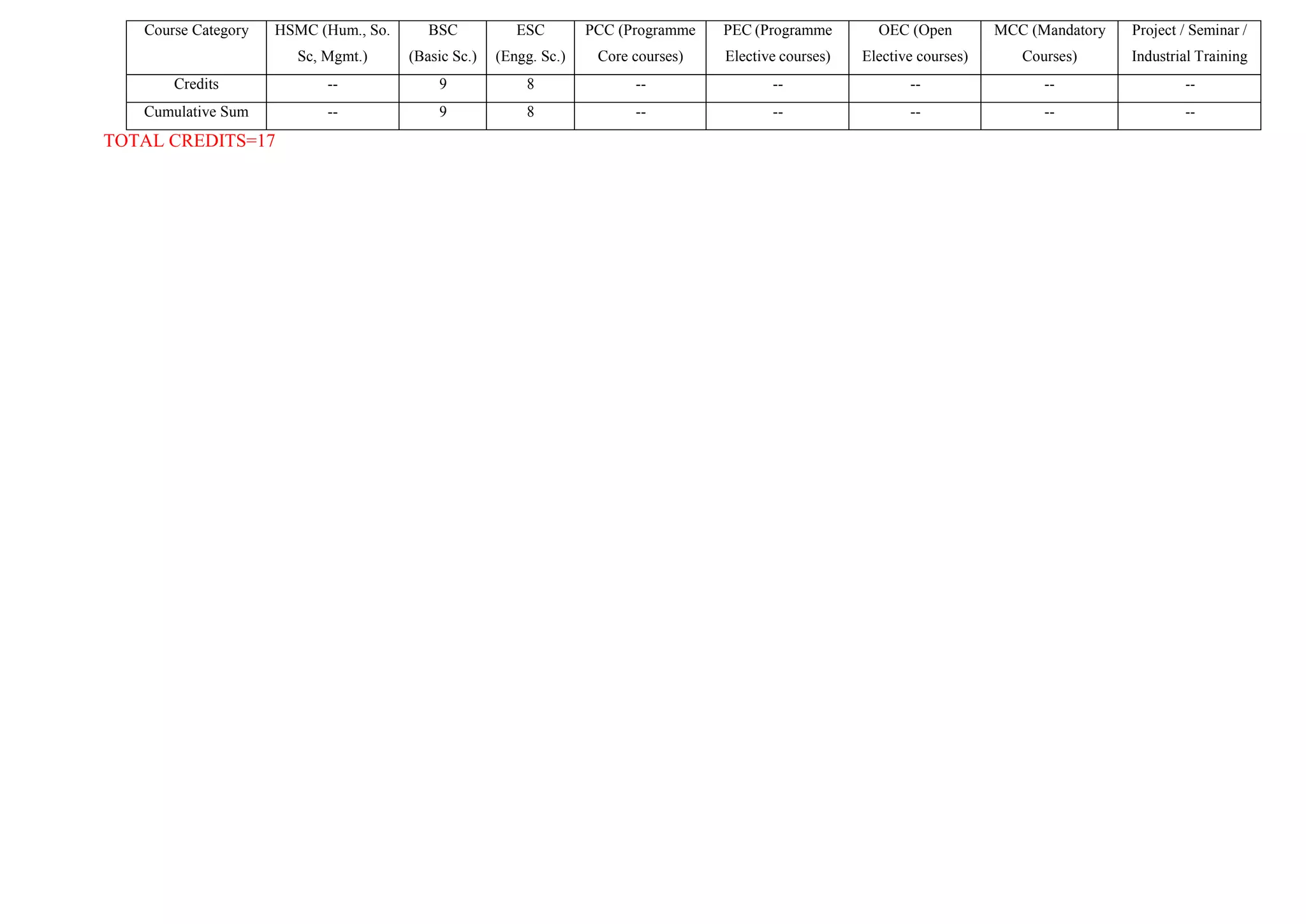
Credits -- 9 8 -- -- -- -- --
Cumulative Sum -- 9 8 -- -- -- -- --
TOTAL CREDITS=17
Government College of Engineering, Karad
SCHEME OF INSTRUCTION & SYLLABI
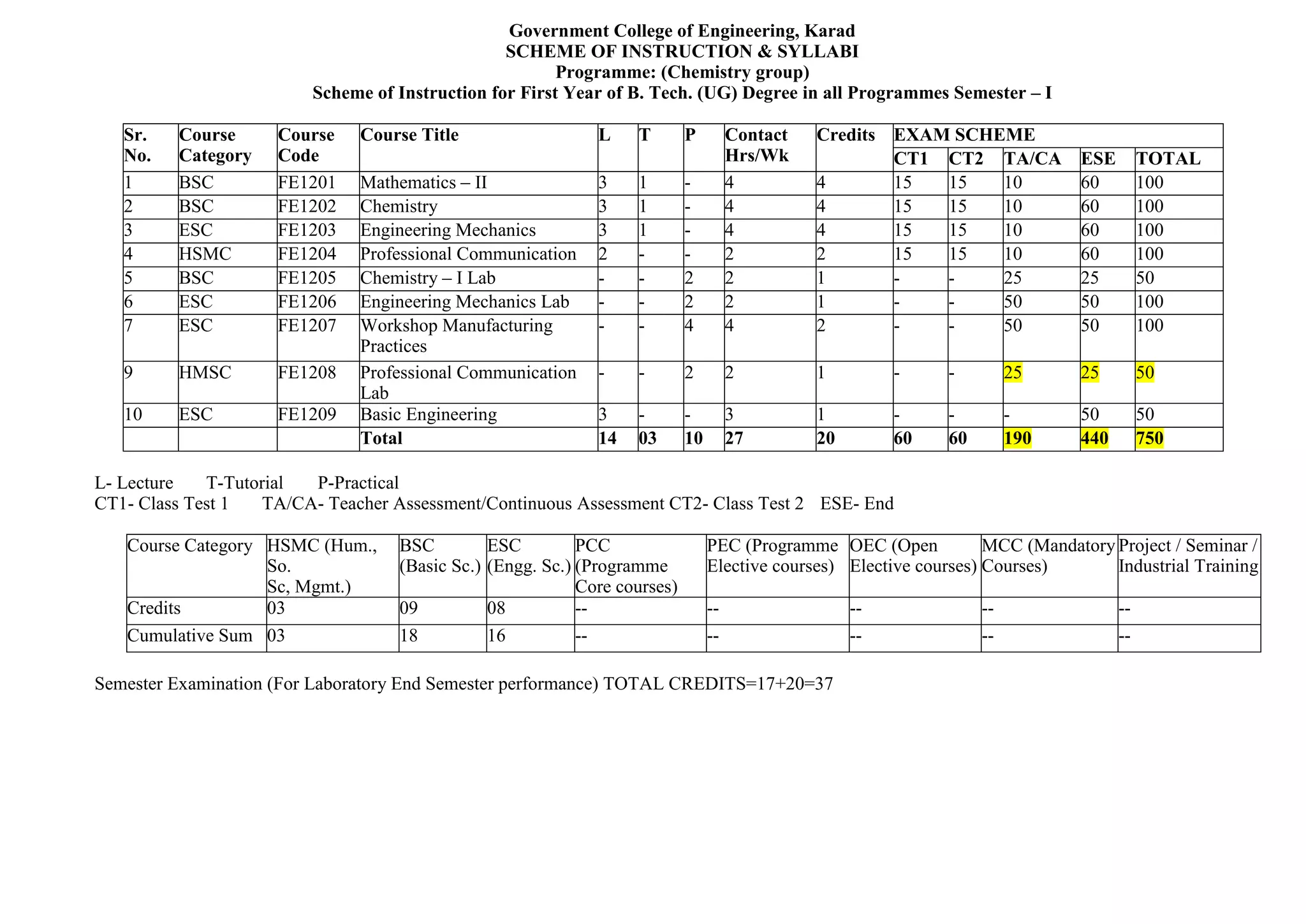
Programme: (Chemistry group)
Scheme of Instruction for First Year of B. Tech. (UG) Degree in all Programmes Semester – I
Sr.
No.
Course
Category
Course
Code
Course Title L T P Contact
Hrs/Wk
Credits EXAM SCHEME
CT1 CT2 TA/CA ESE TOTAL
1 BSC FE1201 Mathematics – II 3 1 - 4 4 15 15 10 60 100
2 BSC FE1202 Chemistry 3 1 - 4 4 15 15 10 60 100
3 ESC FE1203 Engineering Mechanics 3 1 - 4 4 15 15 10 60 100
4 HSMC FE1204 Professional Communication 2 - - 2 2 15 15 10 60 100
5 BSC FE1205 Chemistry – I Lab - - 2 2 1 - - 25 25 50
6 ESC FE1206 Engineering Mechanics Lab - - 2 2 1 - - 50 50 100
7 ESC FE1207 Workshop Manufacturing
Practices
- - 4 4 2 - - 50 50 100
9 HMSC FE1208 Professional Communication
Lab
- - 2 2 1 - - 25 25 50
10 ESC FE1209 Basic Engineering 3 - - 3 1 - - - 50 50
Total 14 03 10 27 20 60 60 190 440 750
L- Lecture T-Tutorial P-Practical
CT1- Class Test 1 TA/CA- Teacher Assessment/Continuous Assessment CT2- Class Test 2 ESE- End
Course Category HSMC (Hum.,
So.
Sc, Mgmt.)
BSC
(Basic Sc.)
ESC
(Engg. Sc.)
PCC
(Programme
Core courses)
PEC (Programme
Elective courses)
OEC (Open
Elective courses)
MCC (Mandatory
Courses)
Project / Seminar /
Industrial Training
Credits 03 09 08 -- -- -- -- --
Cumulative Sum 03 18 16 -- -- -- -- --
Semester Examination (For Laboratory End Semester performance) TOTAL CREDITS=17+20=37
Government College of Engineering, Karad
First Year B. Tech
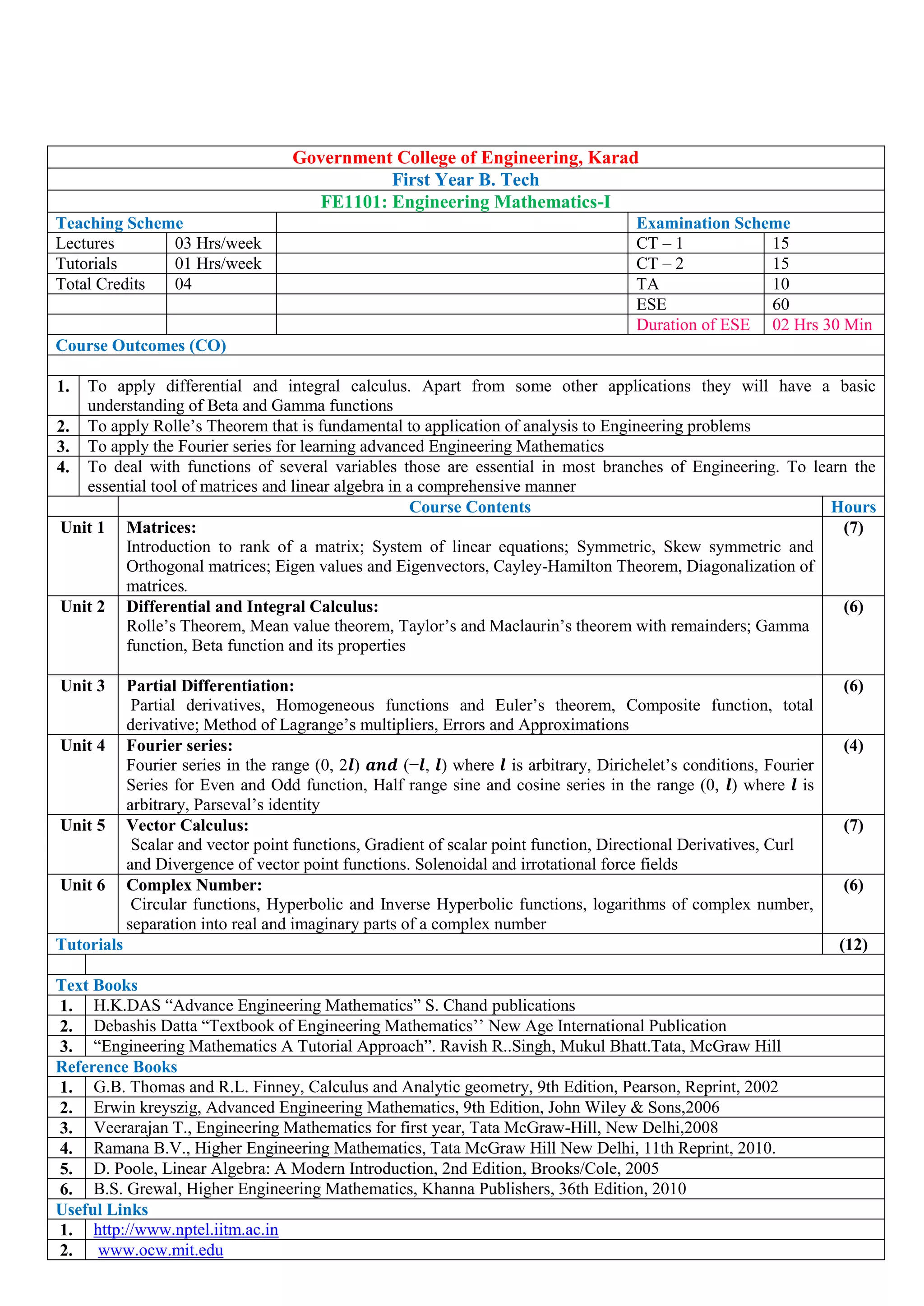
FE1101: Engineering Mathematics-I
Teaching Scheme Examination Scheme
Lectures 03 Hrs/week CT – 1 15
Tutorials 01 Hrs/week CT – 2 15
Total Credits 04 TA 10
ESE 60
Duration of ESE 02 Hrs 30 Min
Course Outcomes (CO)
1. To apply differential and integral calculus. Apart from some other applications they will have a basic
understanding of Beta and Gamma functions
2. To apply Rolle‟s Theorem that is fundamental to application of analysis to Engineering problems
3. To apply the Fourier series for learning advanced Engineering Mathematics
4. To deal with functions of several variables those are essential in most branches of Engineering. To learn the
essential tool of matrices and linear algebra in a comprehensive manner
Course Contents Hours
Unit 1 Matrices:
Introduction to rank of a matrix; System of linear equations; Symmetric, Skew symmetric and
Orthogonal matrices; Eigen values and Eigenvectors, Cayley-Hamilton Theorem, Diagonalization of
matrices.
(7)
Unit 2 Differential and Integral Calculus:
Rolle‟s Theorem, Mean value theorem, Taylor‟s and Maclaurin‟s theorem with remainders; Gamma
function, Beta function and its properties
(6)
Unit 3 Partial Differentiation:
Partial derivatives, Homogeneous functions and Euler‟s theorem, Composite function, total
derivative; Method of Lagrange‟s multipliers, Errors and Approximations
(6)
Unit 4 Fourier series:
Fourier series in the range (0, 2𝒍) 𝒂𝒏𝒅 (−𝒍, 𝒍) where 𝒍 is arbitrary, Dirichelet‟s conditions, Fourier
Series for Even and Odd function, Half range sine and cosine series in the range (0, 𝒍) where 𝒍 is
arbitrary, Parseval‟s identity
(4)
Unit 5 Vector Calculus:
Scalar and vector point functions, Gradient of scalar point function, Directional Derivatives, Curl
and Divergence of vector point functions. Solenoidal and irrotational force fields
(7)
Unit 6 Complex Number:
Circular functions, Hyperbolic and Inverse Hyperbolic functions, logarithms of complex number,
separation into real and imaginary parts of a complex number
(6)
Tutorials (12)
Text Books
1. H.K.DAS “Advance Engineering Mathematics” S. Chand publications
2. Debashis Datta “Textbook of Engineering Mathematics‟‟ New Age International Publication
3. “Engineering Mathematics A Tutorial Approach”. Ravish R..Singh, Mukul Bhatt.Tata, McGraw Hill
Reference Books
1. G.B. Thomas and R.L. Finney, Calculus and Analytic geometry, 9th Edition, Pearson, Reprint, 2002
2. Erwin kreyszig, Advanced Engineering Mathematics, 9th Edition, John Wiley & Sons,2006
3. Veerarajan T., Engineering Mathematics for first year, Tata McGraw-Hill, New Delhi,2008
4. Ramana B.V., Higher Engineering Mathematics, Tata McGraw Hill New Delhi, 11th Reprint, 2010.
5. D. Poole, Linear Algebra: A Modern Introduction, 2nd Edition, Brooks/Cole, 2005
6. B.S. Grewal, Higher Engineering Mathematics, Khanna Publishers, 36th Edition, 2010
Useful Links
1. http://www.nptel.iitm.ac.in
2. www.ocw.mit.edu
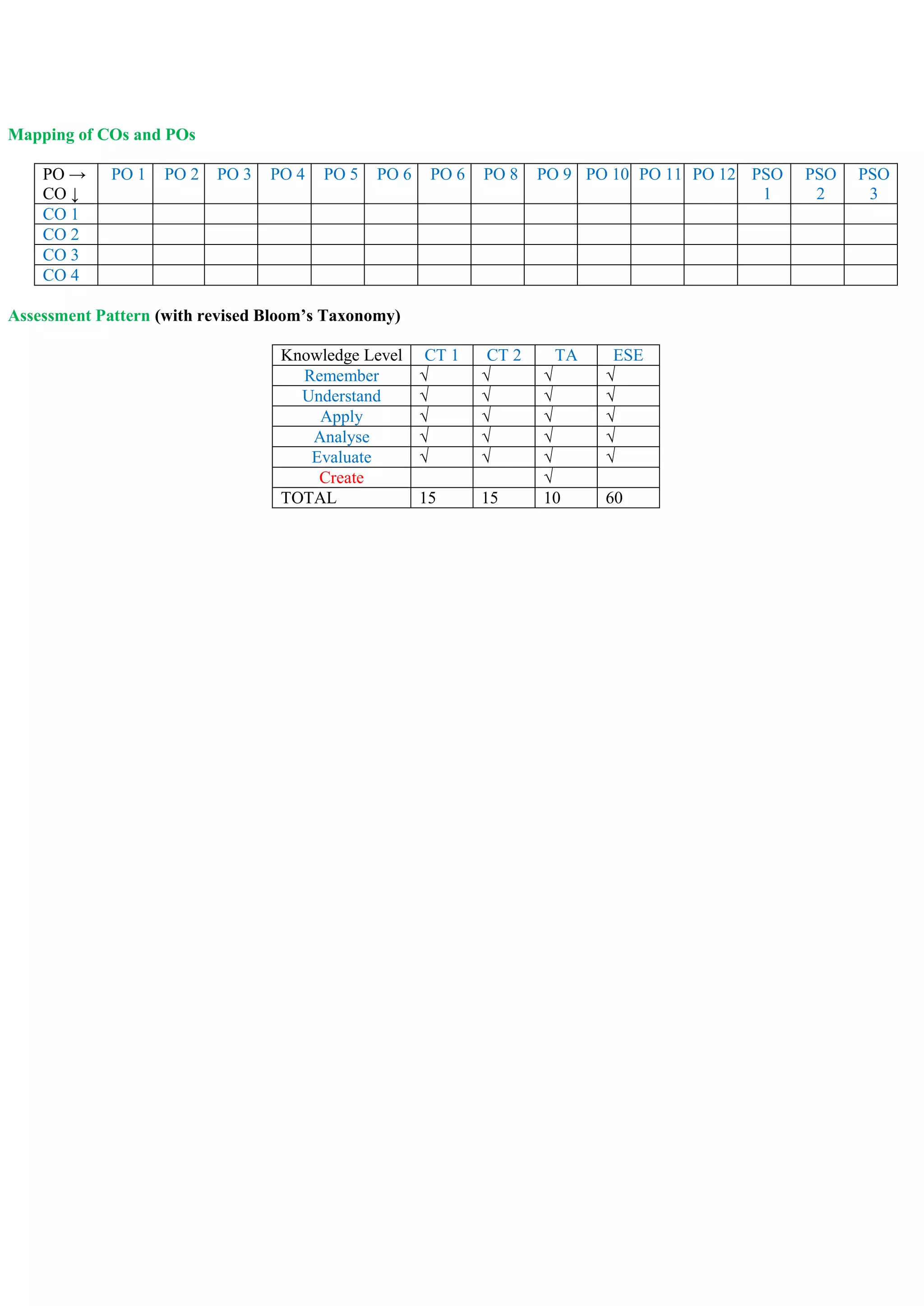
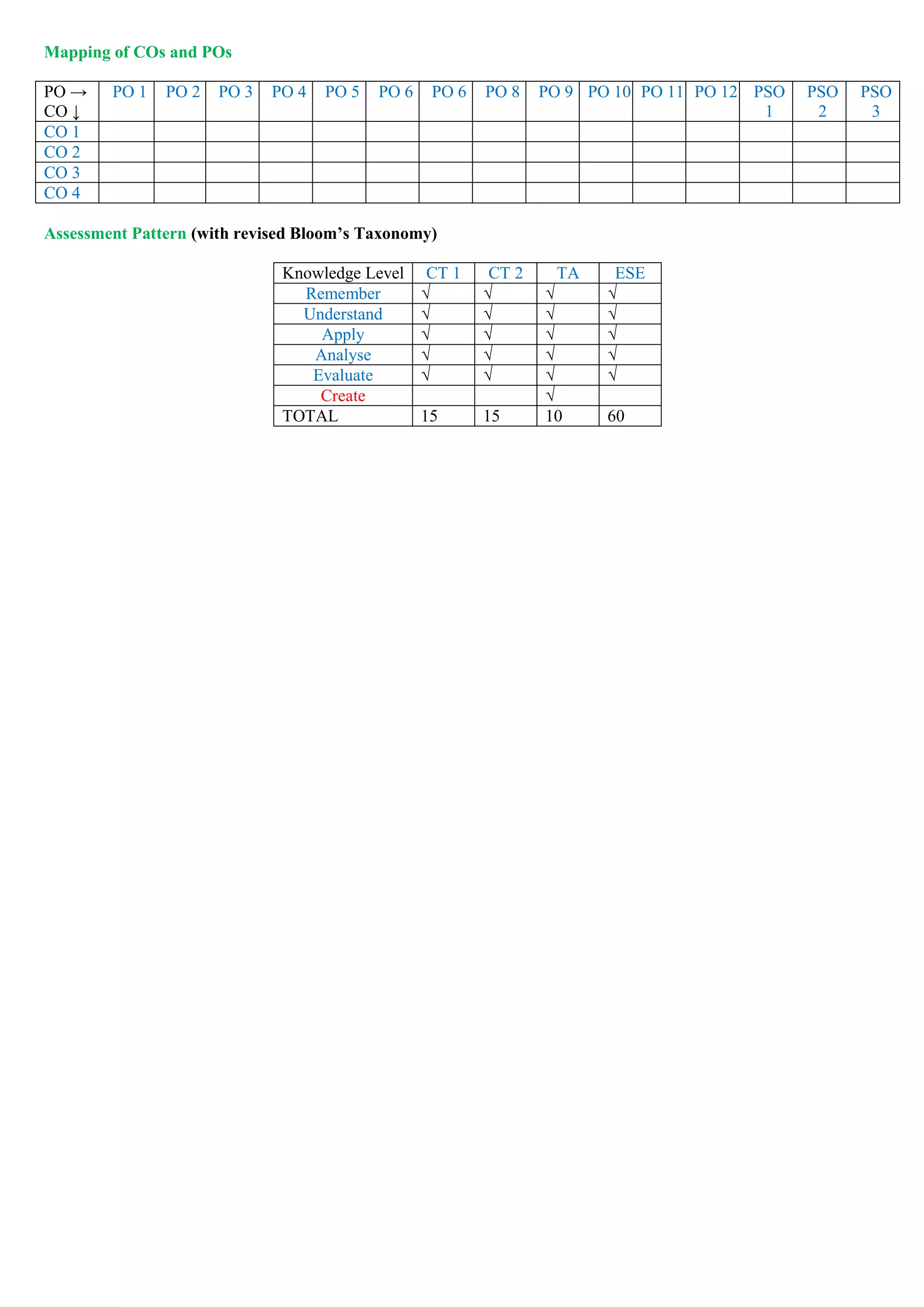
Mapping of COs and POs
PO →
CO ↓
PO 1 PO 2 PO 3 PO 4 PO 5 PO 6 PO 6 PO 8 PO 9 PO 10 PO 11 PO 12 PSO
1
PSO
2
PSO
3
CO 1
CO 2
CO 3
CO 4
Assessment Pattern (with revised Bloom’s Taxonomy)
Knowledge Level CT 1 CT 2 TA ESE
Remember √ √ √ √
Understand √ √ √ √
Apply √ √ √ √
Analyse √ √ √ √
Evaluate √ √ √ √
Create √
TOTAL 15 15 10 60
Government College of Engineering, Karad
First Year B. Tech
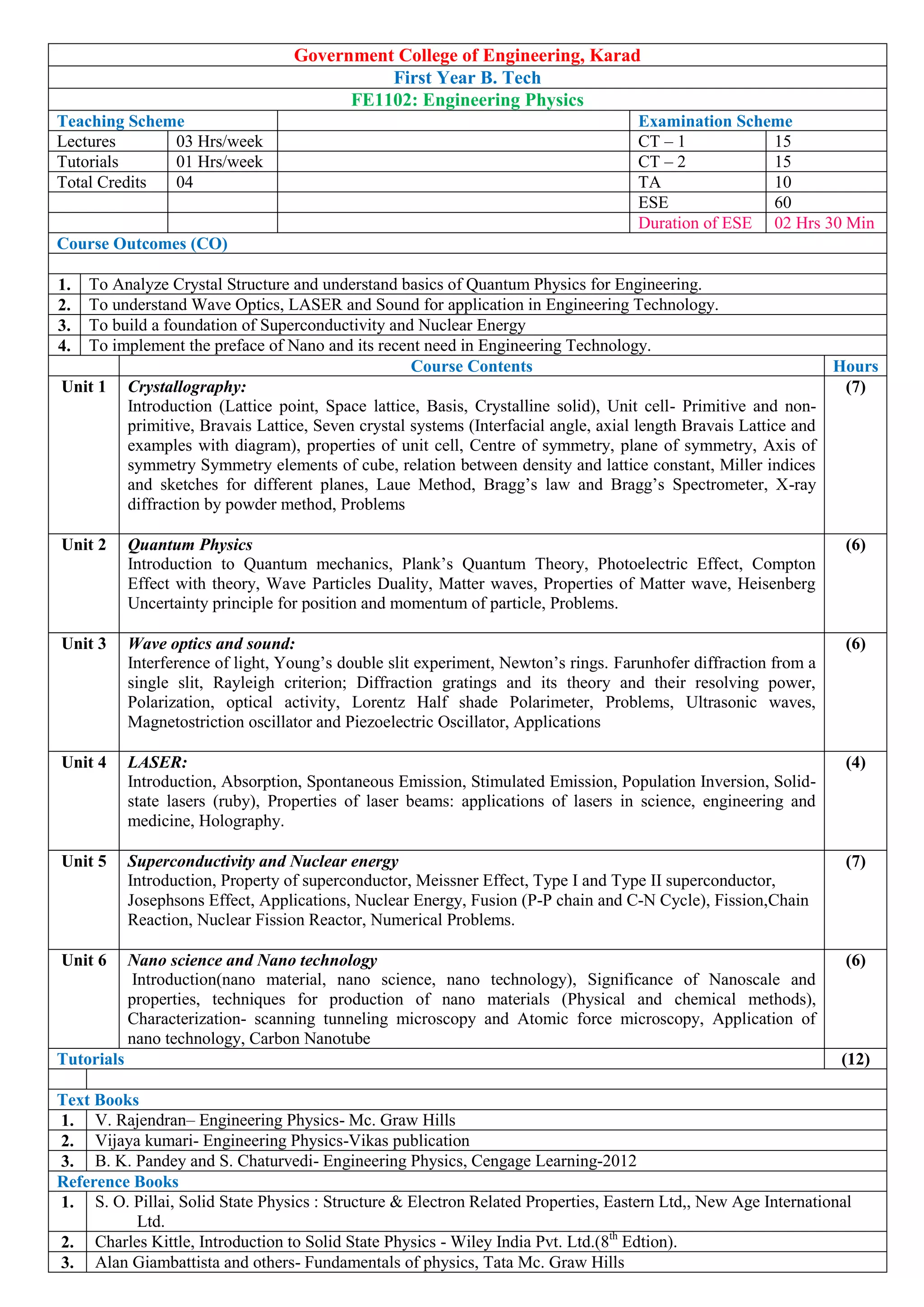
FE1102: Engineering Physics
Teaching Scheme Examination Scheme
Lectures 03 Hrs/week CT – 1 15
Tutorials 01 Hrs/week CT – 2 15
Total Credits 04 TA 10
ESE 60
Duration of ESE 02 Hrs 30 Min
Course Outcomes (CO)
1. To Analyze Crystal Structure and understand basics of Quantum Physics for Engineering.
2. To understand Wave Optics, LASER and Sound for application in Engineering Technology.
3. To build a foundation of Superconductivity and Nuclear Energy
4. To implement the preface of Nano and its recent need in Engineering Technology.
Course Contents Hours
Unit 1 Crystallography:
Introduction (Lattice point, Space lattice, Basis, Crystalline solid), Unit cell- Primitive and non-
primitive, Bravais Lattice, Seven crystal systems (Interfacial angle, axial length Bravais Lattice and
examples with diagram), properties of unit cell, Centre of symmetry, plane of symmetry, Axis of
symmetry Symmetry elements of cube, relation between density and lattice constant, Miller indices
and sketches for different planes, Laue Method, Bragg‟s law and Bragg‟s Spectrometer, X-ray
diffraction by powder method, Problems
(7)
Unit 2 Quantum Physics
Introduction to Quantum mechanics, Plank‟s Quantum Theory, Photoelectric Effect, Compton
Effect with theory, Wave Particles Duality, Matter waves, Properties of Matter wave, Heisenberg
Uncertainty principle for position and momentum of particle, Problems.
(6)
Unit 3 Wave optics and sound:
Interference of light, Young‟s double slit experiment, Newton‟s rings. Farunhofer diffraction from a
single slit, Rayleigh criterion; Diffraction gratings and its theory and their resolving power,
Polarization, optical activity, Lorentz Half shade Polarimeter, Problems, Ultrasonic waves,
Magnetostriction oscillator and Piezoelectric Oscillator, Applications
(6)
Unit 4 LASER:
Introduction, Absorption, Spontaneous Emission, Stimulated Emission, Population Inversion, Solid-
state lasers (ruby), Properties of laser beams: applications of lasers in science, engineering and
medicine, Holography.
(4)
Unit 5 Superconductivity and Nuclear energy
Introduction, Property of superconductor, Meissner Effect, Type I and Type II superconductor,
Josephsons Effect, Applications, Nuclear Energy, Fusion (P-P chain and C-N Cycle), Fission,Chain
Reaction, Nuclear Fission Reactor, Numerical Problems.
(7)
Unit 6 Nano science and Nano technology
Introduction(nano material, nano science, nano technology), Significance of Nanoscale and
properties, techniques for production of nano materials (Physical and chemical methods),
Characterization- scanning tunneling microscopy and Atomic force microscopy, Application of
nano technology, Carbon Nanotube
(6)
Tutorials (12)
Text Books
1. V. Rajendran– Engineering Physics- Mc. Graw Hills
2. Vijaya kumari- Engineering Physics-Vikas publication
3. B. K. Pandey and S. Chaturvedi- Engineering Physics, Cengage Learning-2012
Reference Books
1. S. O. Pillai, Solid State Physics : Structure & Electron Related Properties, Eastern Ltd,, New Age International
Ltd.
2. Charles Kittle, Introduction to Solid State Physics - Wiley India Pvt. Ltd.(8th
Edtion).
3. Alan Giambattista and others- Fundamentals of physics, Tata Mc. Graw Hills
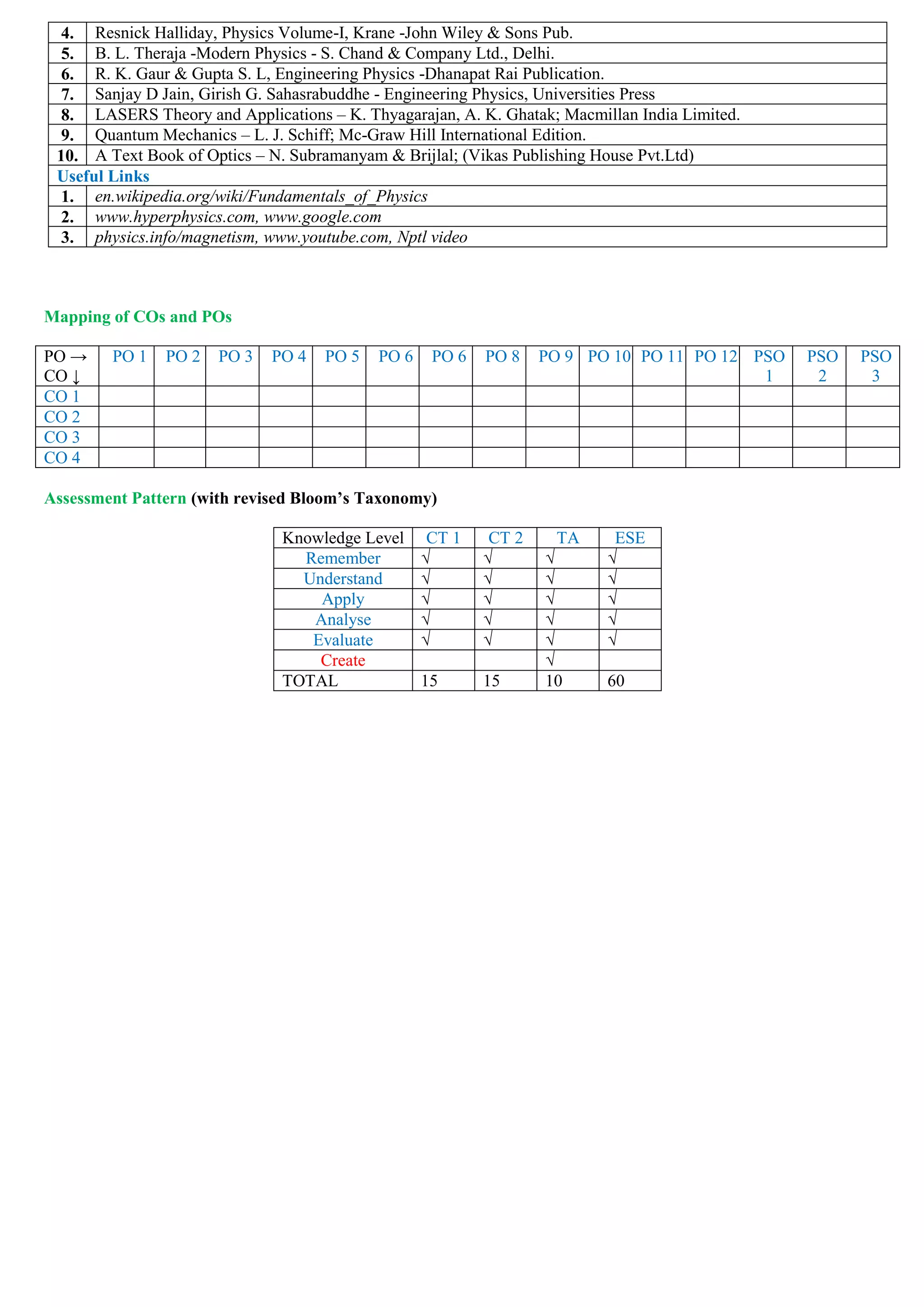
4. Resnick Halliday, Physics Volume-I, Krane -John Wiley & Sons Pub.
5. B. L. Theraja -Modern Physics - S. Chand & Company Ltd., Delhi.
6. R. K. Gaur & Gupta S. L, Engineering Physics -Dhanapat Rai Publication.
7. Sanjay D Jain, Girish G. Sahasrabuddhe - Engineering Physics, Universities Press
8. LASERS Theory and Applications – K. Thyagarajan, A. K. Ghatak; Macmillan India Limited.
9. Quantum Mechanics – L. J. Schiff; Mc-Graw Hill International Edition.
10. A Text Book of Optics – N. Subramanyam & Brijlal; (Vikas Publishing House Pvt.Ltd)
Useful Links
1. en.wikipedia.org/wiki/Fundamentals_of_Physics
2. www.hyperphysics.com, www.google.com
3. physics.info/magnetism, www.youtube.com, Nptl video
Mapping of COs and POs
PO →
CO ↓
PO 1 PO 2 PO 3 PO 4 PO 5 PO 6 PO 6 PO 8 PO 9 PO 10 PO 11 PO 12 PSO
1
PSO
2
PSO
3
CO 1
CO 2
CO 3
CO 4
Assessment Pattern (with revised Bloom’s Taxonomy)
Knowledge Level CT 1 CT 2 TA ESE
Remember √ √ √ √
Understand √ √ √ √
Apply √ √ √ √
Analyse √ √ √ √
Evaluate √ √ √ √
Create √
TOTAL 15 15 10 60
Government College of Engineering, Karad
First Year B. Tech
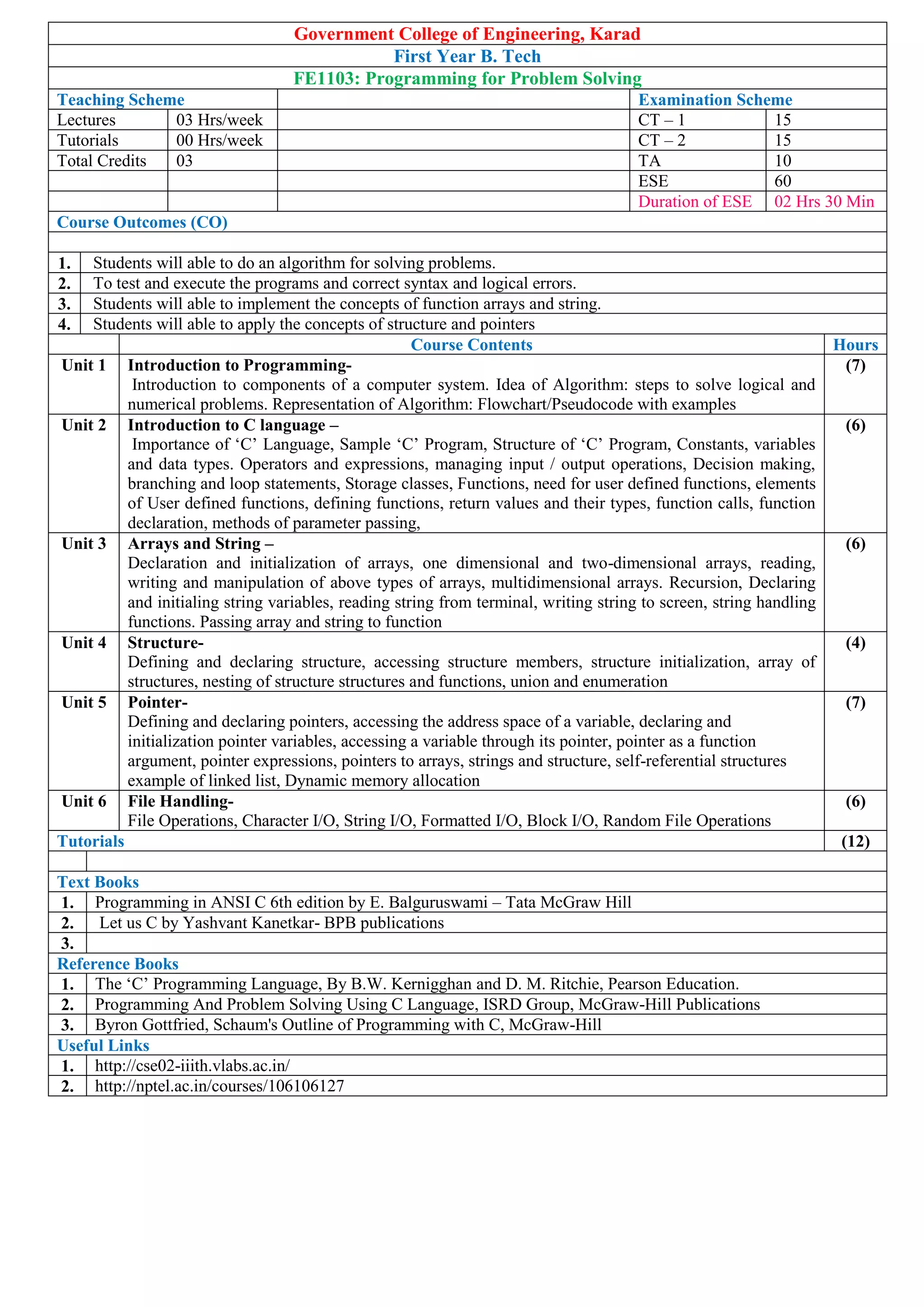
FE1103: Programming for Problem Solving
Teaching Scheme Examination Scheme
Lectures 03 Hrs/week CT – 1 15
Tutorials 00 Hrs/week CT – 2 15
Total Credits 03 TA 10
ESE 60
Duration of ESE 02 Hrs 30 Min
Course Outcomes (CO)
1. Students will able to do an algorithm for solving problems.
2. To test and execute the programs and correct syntax and logical errors.
3. Students will able to implement the concepts of function arrays and string.
4. Students will able to apply the concepts of structure and pointers
Course Contents Hours
Unit 1 Introduction to Programming-
Introduction to components of a computer system. Idea of Algorithm: steps to solve logical and
numerical problems. Representation of Algorithm: Flowchart/Pseudocode with examples
(7)
Unit 2 Introduction to C language –
Importance of „C‟ Language, Sample „C‟ Program, Structure of „C‟ Program, Constants, variables
and data types. Operators and expressions, managing input / output operations, Decision making,
branching and loop statements, Storage classes, Functions, need for user defined functions, elements
of User defined functions, defining functions, return values and their types, function calls, function
declaration, methods of parameter passing,
(6)
Unit 3 Arrays and String –
Declaration and initialization of arrays, one dimensional and two-dimensional arrays, reading,
writing and manipulation of above types of arrays, multidimensional arrays. Recursion, Declaring
and initialing string variables, reading string from terminal, writing string to screen, string handling
functions. Passing array and string to function
(6)
Unit 4 Structure-
Defining and declaring structure, accessing structure members, structure initialization, array of
structures, nesting of structure structures and functions, union and enumeration
(4)
Unit 5 Pointer-
Defining and declaring pointers, accessing the address space of a variable, declaring and
initialization pointer variables, accessing a variable through its pointer, pointer as a function
argument, pointer expressions, pointers to arrays, strings and structure, self-referential structures
example of linked list, Dynamic memory allocation
(7)
Unit 6 File Handling-
File Operations, Character I/O, String I/O, Formatted I/O, Block I/O, Random File Operations
(6)
Tutorials (12)
Text Books
1. Programming in ANSI C 6th edition by E. Balguruswami – Tata McGraw Hill
2. Let us C by Yashvant Kanetkar- BPB publications
3.
Reference Books
1. The „C‟ Programming Language, By B.W. Kernigghan and D. M. Ritchie, Pearson Education.
2. Programming And Problem Solving Using C Language, ISRD Group, McGraw-Hill Publications
3. Byron Gottfried, Schaum's Outline of Programming with C, McGraw-Hill
Useful Links
1. http://cse02-iiith.vlabs.ac.in/
2. http://nptel.ac.in/courses/106106127
Mapping of COs and POs
PO →
CO ↓
PO 1 PO 2 PO 3 PO 4 PO 5 PO 6 PO 6 PO 8 PO 9 PO 10 PO 11 PO 12 PSO
1
PSO
2
PSO
3
CO 1
CO 2
CO 3
CO 4
Assessment Pattern (with revised Bloom’s Taxonomy)
Knowledge Level CT 1 CT 2 TA ESE
Remember √ √ √ √
Understand √ √ √ √
Apply √ √ √ √
Analyse √ √ √ √
Evaluate √ √ √ √
Create √
TOTAL 15 15 10 60
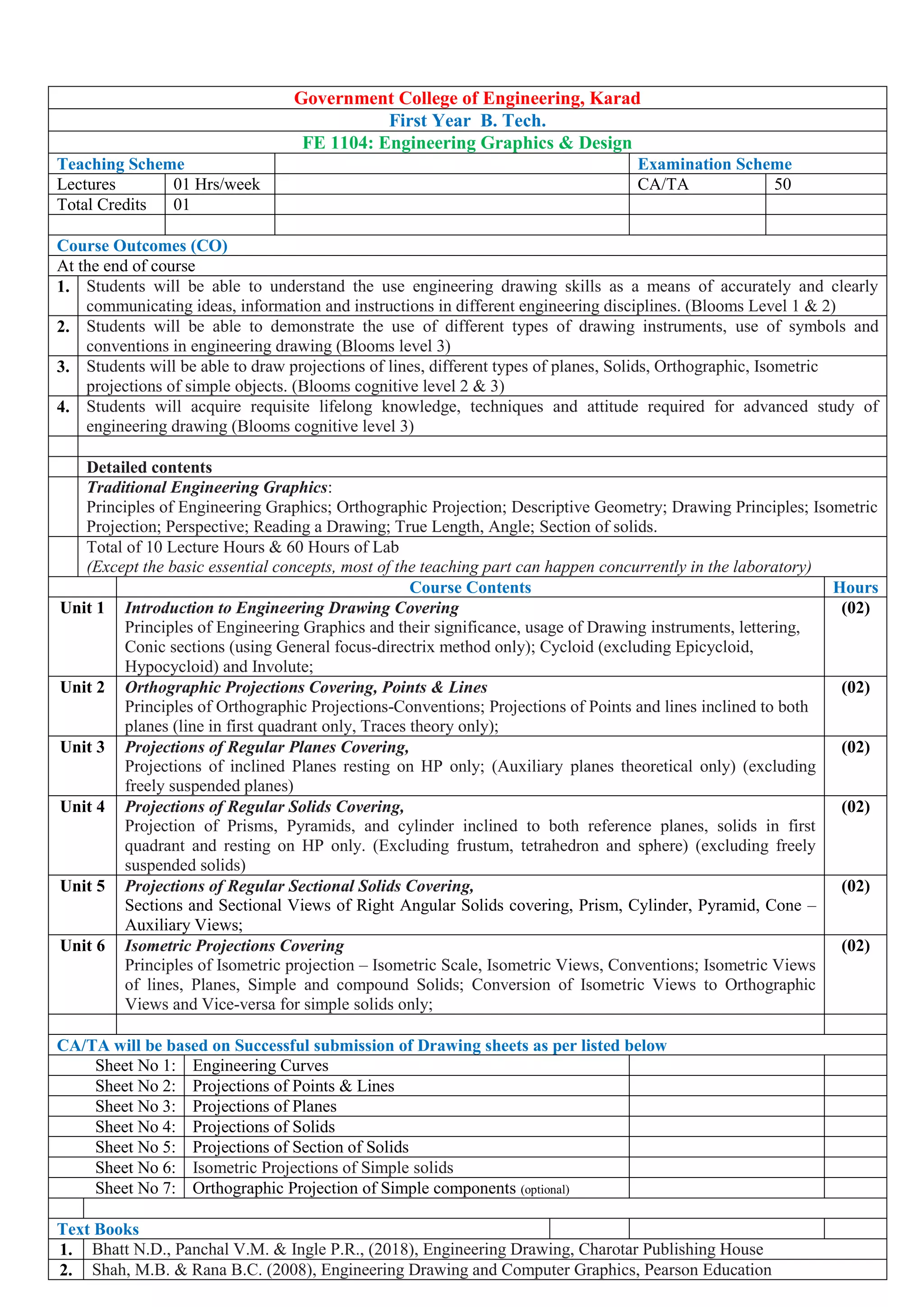
Government College of Engineering, Karad
First Year B. Tech.
FE 1104: Engineering Graphics & Design
Teaching Scheme Examination Scheme
Lectures 01 Hrs/week CA/TA 50
Total Credits 01
Course Outcomes (CO)
At the end of course
1. Students will be able to understand the use engineering drawing skills as a means of accurately and clearly
communicating ideas, information and instructions in different engineering disciplines. (Blooms Level 1 & 2)
2. Students will be able to demonstrate the use of different types of drawing instruments, use of symbols and
conventions in engineering drawing (Blooms level 3)
3. Students will be able to draw projections of lines, different types of planes, Solids, Orthographic, Isometric
projections of simple objects. (Blooms cognitive level 2 & 3)
4. Students will acquire requisite lifelong knowledge, techniques and attitude required for advanced study of
engineering drawing (Blooms cognitive level 3)
Detailed contents
Traditional Engineering Graphics:
Principles of Engineering Graphics; Orthographic Projection; Descriptive Geometry; Drawing Principles; Isometric
Projection; Perspective; Reading a Drawing; True Length, Angle; Section of solids.
Total of 10 Lecture Hours & 60 Hours of Lab
(Except the basic essential concepts, most of the teaching part can happen concurrently in the laboratory)
Course Contents Hours
Unit 1 Introduction to Engineering Drawing Covering
Principles of Engineering Graphics and their significance, usage of Drawing instruments, lettering,
Conic sections (using General focus-directrix method only); Cycloid (excluding Epicycloid,
Hypocycloid) and Involute;
(02)
Unit 2 Orthographic Projections Covering, Points & Lines
Principles of Orthographic Projections-Conventions; Projections of Points and lines inclined to both
planes (line in first quadrant only, Traces theory only);
(02)
Unit 3 Projections of Regular Planes Covering,
Projections of inclined Planes resting on HP only; (Auxiliary planes theoretical only) (excluding
freely suspended planes)
(02)
Unit 4 Projections of Regular Solids Covering,
Projection of Prisms, Pyramids, and cylinder inclined to both reference planes, solids in first
quadrant and resting on HP only. (Excluding frustum, tetrahedron and sphere) (excluding freely
suspended solids)
(02)
Unit 5 Projections of Regular Sectional Solids Covering,
Sections and Sectional Views of Right Angular Solids covering, Prism, Cylinder, Pyramid, Cone –
Auxiliary Views;
(02)
Unit 6 Isometric Projections Covering
Principles of Isometric projection – Isometric Scale, Isometric Views, Conventions; Isometric Views
of lines, Planes, Simple and compound Solids; Conversion of Isometric Views to Orthographic
Views and Vice-versa for simple solids only;
(02)
CA/TA will be based on Successful submission of Drawing sheets as per listed below
Sheet No 1: Engineering Curves
Sheet No 2: Projections of Points & Lines
Sheet No 3: Projections of Planes
Sheet No 4: Projections of Solids
Sheet No 5: Projections of Section of Solids
Sheet No 6: Isometric Projections of Simple solids
Sheet No 7: Orthographic Projection of Simple components (optional)
Text Books
1. Bhatt N.D., Panchal V.M. & Ingle P.R., (2018), Engineering Drawing, Charotar Publishing House
2. Shah, M.B. & Rana B.C. (2008), Engineering Drawing and Computer Graphics, Pearson Education
3. Agrawal B. & Agrawal C. M. (2012), Engineering Graphics, TMH Publication
4. Dhananjay A Jolhe, Engineering Drawing with an introduction to AutoCAD, TMH Publication
5. P. S. Gill, Engineering Drawing, S. K. Katariya & sons Publication
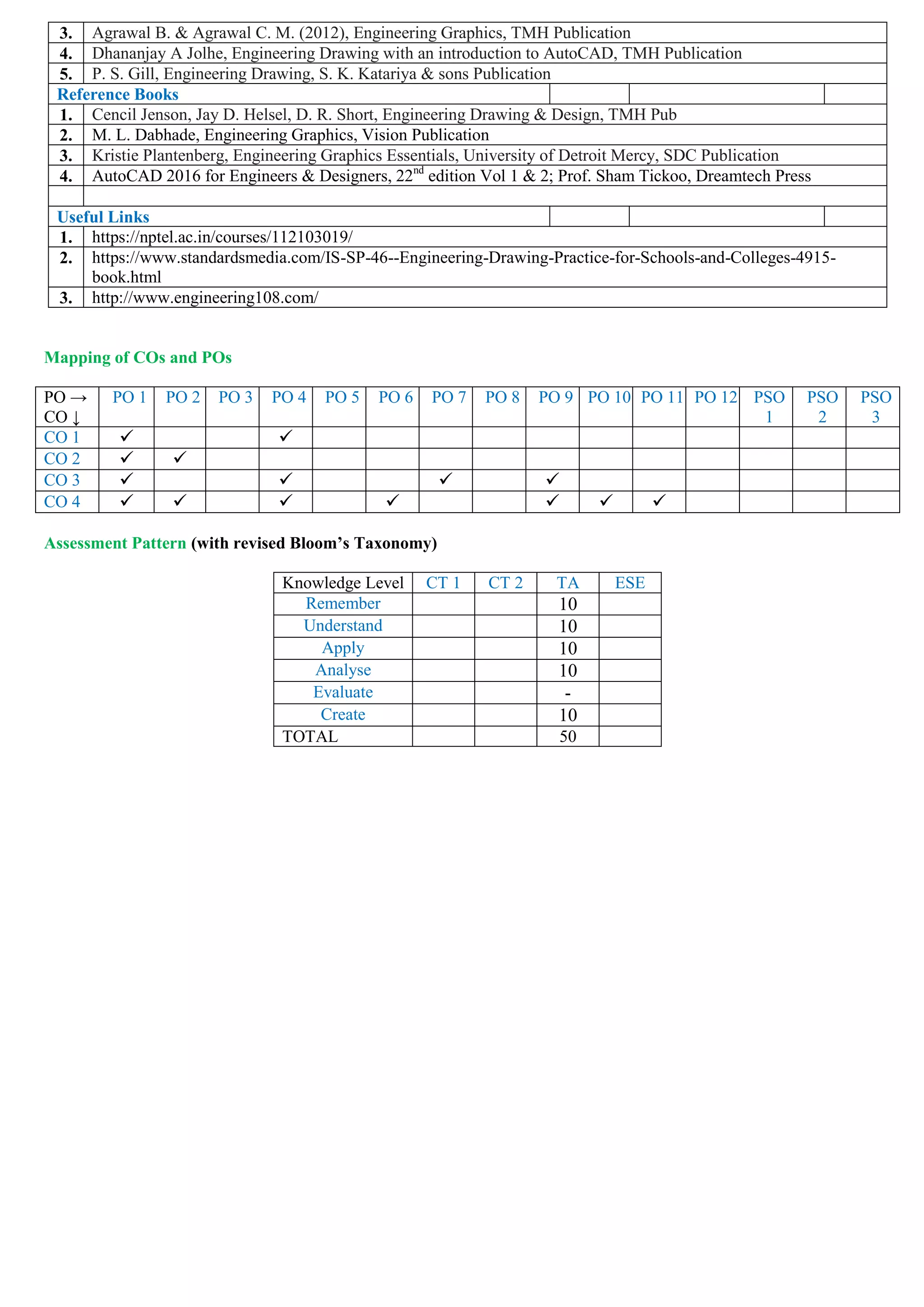
Reference Books
1. Cencil Jenson, Jay D. Helsel, D. R. Short, Engineering Drawing & Design, TMH Pub
2. M. L. Dabhade, Engineering Graphics, Vision Publication
3. Kristie Plantenberg, Engineering Graphics Essentials, University of Detroit Mercy, SDC Publication
4. AutoCAD 2016 for Engineers & Designers, 22nd
edition Vol 1 & 2; Prof. Sham Tickoo, Dreamtech Press
Useful Links
1. https://nptel.ac.in/courses/112103019/
2. https://www.standardsmedia.com/IS-SP-46--Engineering-Drawing-Practice-for-Schools-and-Colleges-4915-
book.html
3. http://www.engineering108.com/
Mapping of COs and POs
PO →
CO ↓
PO 1 PO 2 PO 3 PO 4 PO 5 PO 6 PO 7 PO 8 PO 9 PO 10 PO 11 PO 12 PSO
1
PSO
2
PSO
3
CO 1  
CO 2  
CO 3    
CO 4       
Assessment Pattern (with revised Bloom’s Taxonomy)
Knowledge Level CT 1 CT 2 TA ESE
Remember 10
Understand 10
Apply 10
Analyse 10
Evaluate -
Create 10
TOTAL 50
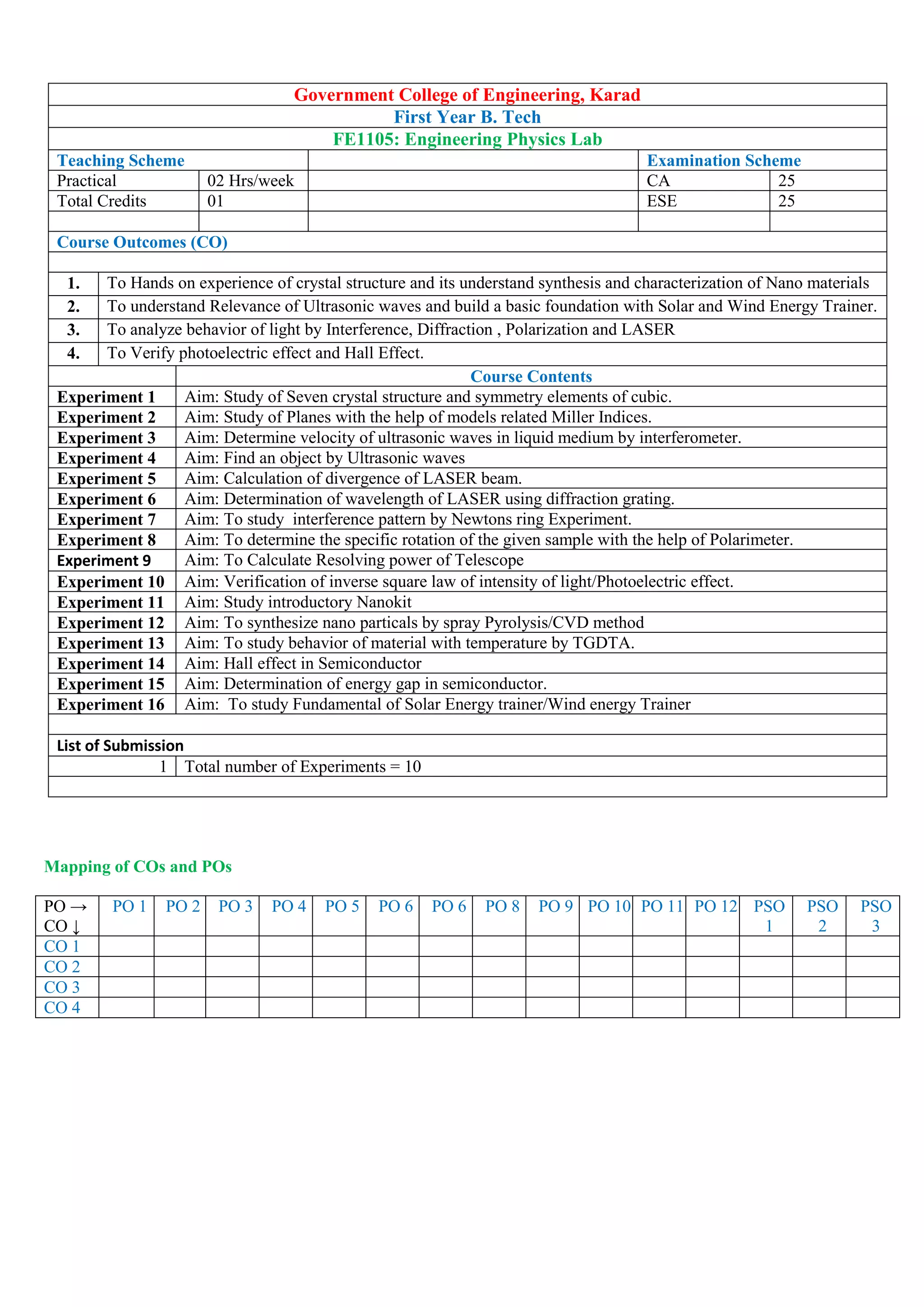
Government College of Engineering, Karad
First Year B. Tech
FE1105: Engineering Physics Lab
Teaching Scheme Examination Scheme
Practical 02 Hrs/week CA 25
Total Credits 01 ESE 25
Course Outcomes (CO)
1. To Hands on experience of crystal structure and its understand synthesis and characterization of Nano materials
2. To understand Relevance of Ultrasonic waves and build a basic foundation with Solar and Wind Energy Trainer.
3. To analyze behavior of light by Interference, Diffraction , Polarization and LASER
4. To Verify photoelectric effect and Hall Effect.
Course Contents
Experiment 1 Aim: Study of Seven crystal structure and symmetry elements of cubic.
Experiment 2 Aim: Study of Planes with the help of models related Miller Indices.
Experiment 3 Aim: Determine velocity of ultrasonic waves in liquid medium by interferometer.
Experiment 4 Aim: Find an object by Ultrasonic waves
Experiment 5 Aim: Calculation of divergence of LASER beam.
Experiment 6 Aim: Determination of wavelength of LASER using diffraction grating.
Experiment 7 Aim: To study interference pattern by Newtons ring Experiment.
Experiment 8 Aim: To determine the specific rotation of the given sample with the help of Polarimeter.
Experiment 9 Aim: To Calculate Resolving power of Telescope
Experiment 10 Aim: Verification of inverse square law of intensity of light/Photoelectric effect.
Experiment 11 Aim: Study introductory Nanokit
Experiment 12 Aim: To synthesize nano particals by spray Pyrolysis/CVD method
Experiment 13 Aim: To study behavior of material with temperature by TGDTA.
Experiment 14 Aim: Hall effect in Semiconductor
Experiment 15 Aim: Determination of energy gap in semiconductor.
Experiment 16 Aim: To study Fundamental of Solar Energy trainer/Wind energy Trainer
List of Submission
1 Total number of Experiments = 10
Mapping of COs and POs
PO →
CO ↓
PO 1 PO 2 PO 3 PO 4 PO 5 PO 6 PO 6 PO 8 PO 9 PO 10 PO 11 PO 12 PSO
1
PSO
2
PSO
3
CO 1
CO 2
CO 3
CO 4
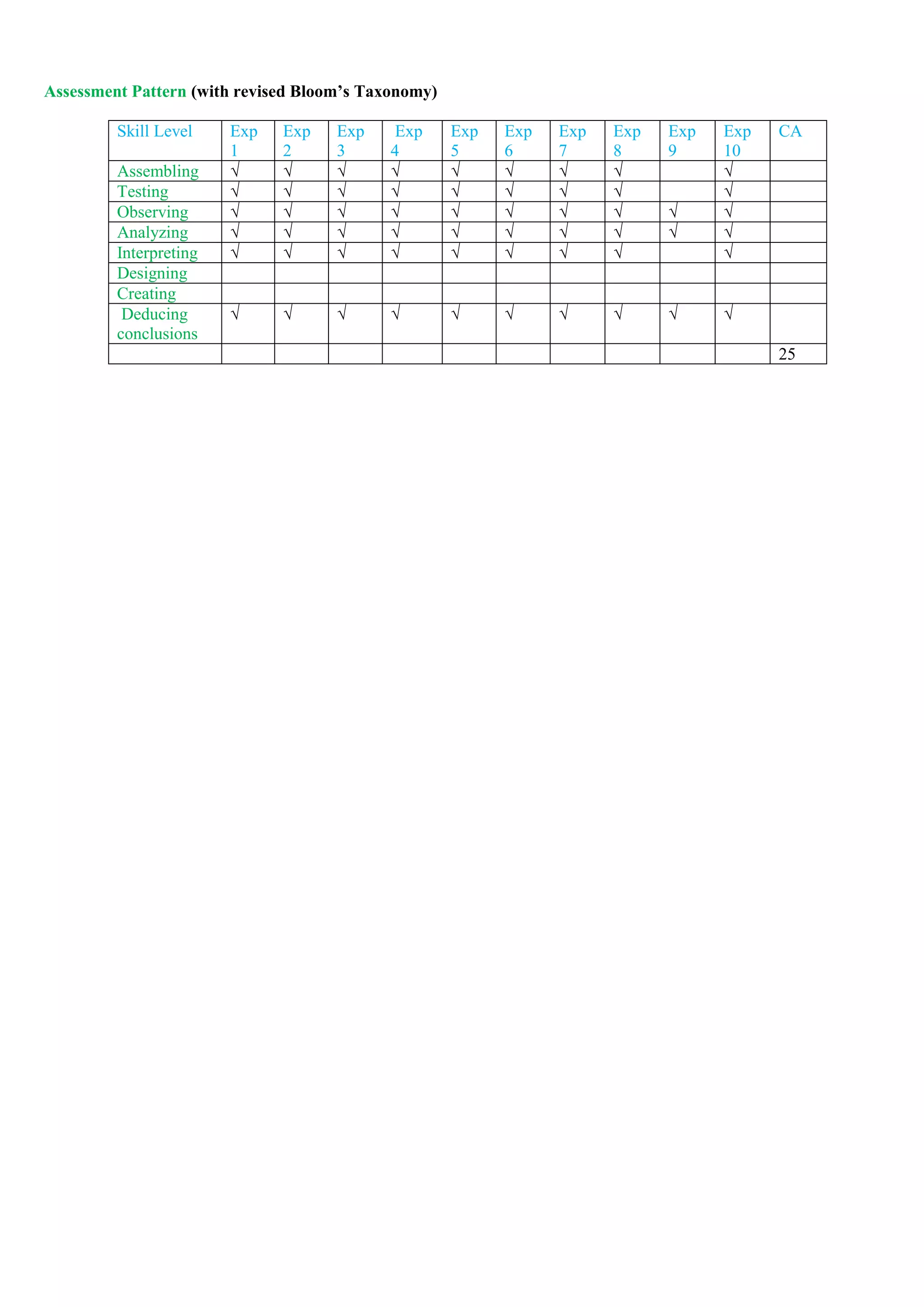
Assessment Pattern (with revised Bloom’s Taxonomy)
Skill Level Exp
1
Exp
2
Exp
3
Exp
4
Exp
5
Exp
6
Exp
7
Exp
8
Exp
9
Exp
10
CA
Assembling √ √ √ √ √ √ √ √ √
Testing √ √ √ √ √ √ √ √ √
Observing √ √ √ √ √ √ √ √ √ √
Analyzing √ √ √ √ √ √ √ √ √ √
Interpreting √ √ √ √ √ √ √ √ √
Designing
Creating
Deducing
conclusions
√ √ √ √ √ √ √ √ √ √
25
Government College of Engineering, Karad
First Year B. Tech
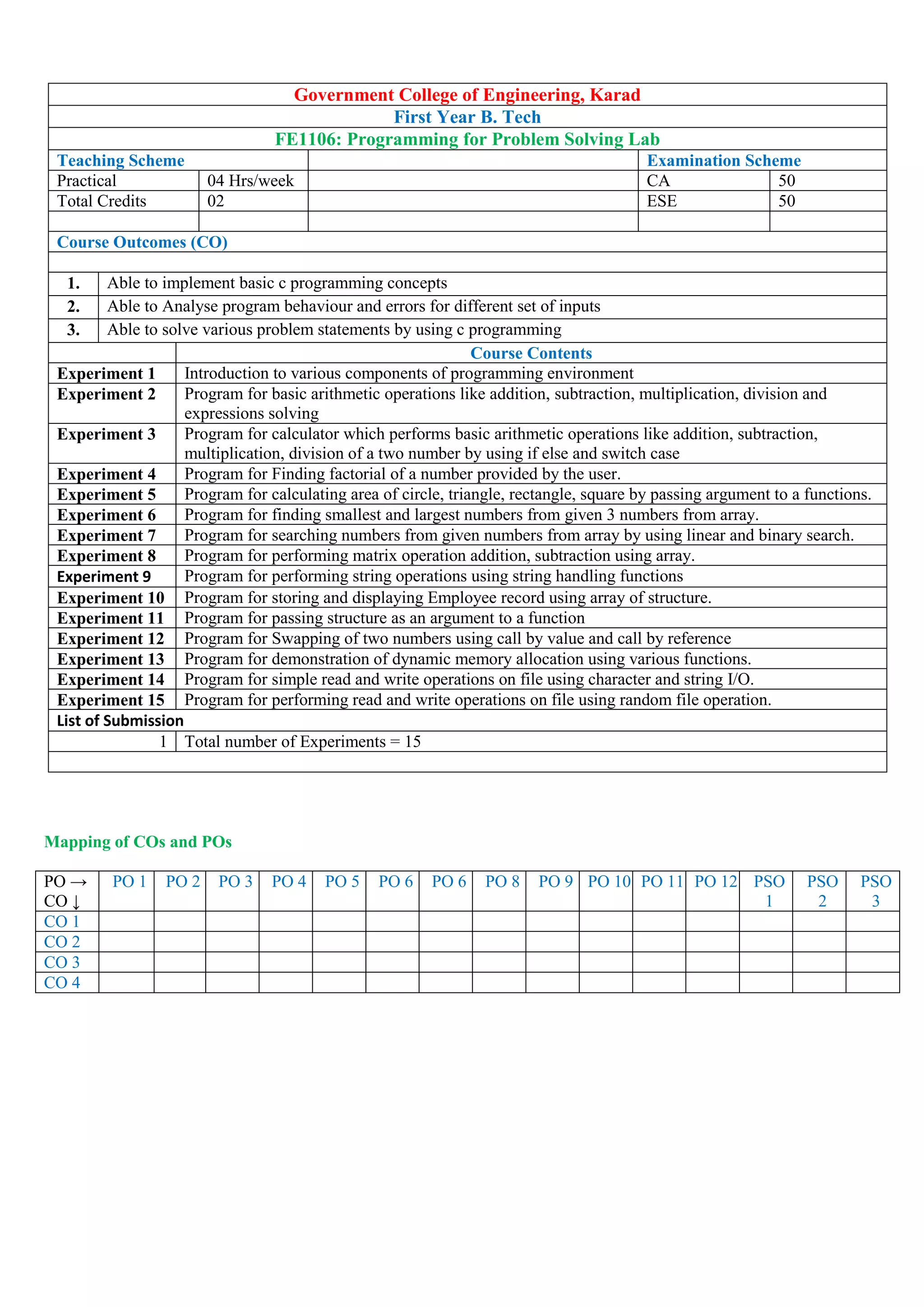
FE1106: Programming for Problem Solving Lab
Teaching Scheme Examination Scheme
Practical 04 Hrs/week CA 50
Total Credits 02 ESE 50
Course Outcomes (CO)
1. Able to implement basic c programming concepts
2. Able to Analyse program behaviour and errors for different set of inputs
3. Able to solve various problem statements by using c programming
Course Contents
Experiment 1 Introduction to various components of programming environment
Experiment 2 Program for basic arithmetic operations like addition, subtraction, multiplication, division and
expressions solving
Experiment 3 Program for calculator which performs basic arithmetic operations like addition, subtraction,
multiplication, division of a two number by using if else and switch case
Experiment 4 Program for Finding factorial of a number provided by the user.
Experiment 5 Program for calculating area of circle, triangle, rectangle, square by passing argument to a functions.
Experiment 6 Program for finding smallest and largest numbers from given 3 numbers from array.
Experiment 7 Program for searching numbers from given numbers from array by using linear and binary search.
Experiment 8 Program for performing matrix operation addition, subtraction using array.
Experiment 9 Program for performing string operations using string handling functions
Experiment 10 Program for storing and displaying Employee record using array of structure.
Experiment 11 Program for passing structure as an argument to a function
Experiment 12 Program for Swapping of two numbers using call by value and call by reference
Experiment 13 Program for demonstration of dynamic memory allocation using various functions.
Experiment 14 Program for simple read and write operations on file using character and string I/O.
Experiment 15 Program for performing read and write operations on file using random file operation.
List of Submission
1 Total number of Experiments = 15
Mapping of COs and POs
PO →
CO ↓
PO 1 PO 2 PO 3 PO 4 PO 5 PO 6 PO 6 PO 8 PO 9 PO 10 PO 11 PO 12 PSO
1
PSO
2
PSO
3
CO 1
CO 2
CO 3
CO 4
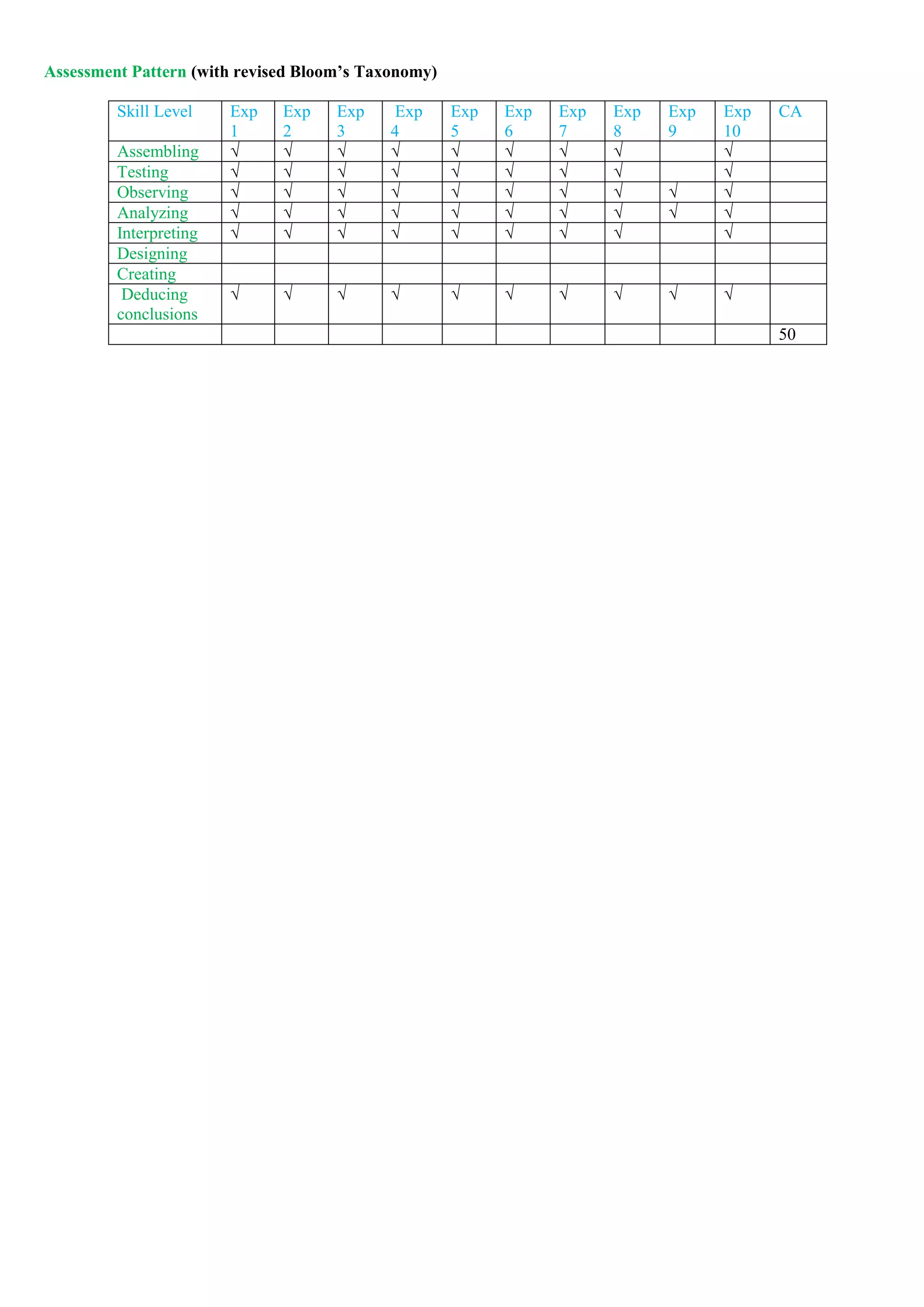
Assessment Pattern (with revised Bloom’s Taxonomy)
Skill Level Exp
1
Exp
2
Exp
3
Exp
4
Exp
5
Exp
6
Exp
7
Exp
8
Exp
9
Exp
10
CA
Assembling √ √ √ √ √ √ √ √ √
Testing √ √ √ √ √ √ √ √ √
Observing √ √ √ √ √ √ √ √ √ √
Analyzing √ √ √ √ √ √ √ √ √ √
Interpreting √ √ √ √ √ √ √ √ √
Designing
Creating
Deducing
conclusions
√ √ √ √ √ √ √ √ √ √
50
Government College of Engineering, Karad
First Year B. Tech.
FE 1107: Engineering Graphics & Design Lab
Teaching Scheme Examination Scheme
Practical 04 Hrs/week CA/TA 50
Tutorials - ESE 50
Total Credits 02
Course Outcomes (CO)
At the end of lab course
1. Student will be able understand the basic principles of Technical/Engineering Drawing to improve the visualization
skills using drafting software (Blooms cognitive level 1 & 2)
2. Student will be able to establish the relationship between traditional drafting technique and computer aided drafting
(Blooms cognitive level 3)
3. The ability to demonstrates ideas and design concepts using drafting software. (Blooms cognitive level 2 & 3)
4. Students will acquire requisite lifelong knowledge, techniques and attitude required for advanced study of
engineering drawing by using CAD software‟s (Blooms cognitive level 3)
Detailed contents
Computer Graphics:
Engineering Graphics Software; -Spatial Transformations; Orthographic
Projections; Model Viewing; Co-ordinate Systems; Multi-view Projection; Exploded Assembly;
Model Viewing; Animation; Spatial Manipulation; Surface Modelling; Solid Modelling; Introduction to Building
Information Modelling (BIM)Angle; intersection.
Course Contents Hours
Unit 1 Overview of Computer Graphics covering,
listing the computer technologies that impact on graphical communication, Demonstrating
knowledge of the theory of CAD software [such as: The Menu System, Toolbars (Standard, Object
Properties, Draw, Modify and Dimension), Drawing Area (Background, Crosshairs, Coordinate
System), Dialog boxes and windows, Shortcut menus (Button Bars), The Command Line (where
applicable), The Status Bar, Different methods of zoom as used in CAD, Select and erase objects.;
Isometric Views of lines, Planes, Simple and compound Solids];
(05)
Unit 2 Customisation & CAD Drawing
consisting of set up of the drawing page and the printer, including scale settings, Setting up of units
and drawing limits; ISO and ANSI standards for coordinate dimensioning and tolerancing;
Orthographic constraints, Snap to objects manually and automatically; Producing drawings by
using various coordinate input entry methods to draw straight lines, Applying various ways of
drawing circles;
(05)
Unit 3 Annotations, layering & other functions covering
applying dimensions to objects, applying annotations to drawings; Setting up and use of Layers,
layers to create drawings, Create, edit and use customized layers; Changing line lengths through
modifying existing lines
(extend/lengthen); Printing documents to paper using the print command;
(05)
Unit 4 Orthographic projection techniques;
Drawing sectional views of composite right regular geometric solids and project the true shape of the
sectioned surface; Drawing annotation
(05)
Unit 5 Planar projection theory,
including sketching of isometric, multi-view, section views. Dimensioning guidelines, tolerancing
techniques; dimensioning and scale multi views of dwelling;
(05)
Unit 6 Demonstration of a simple team design project
Geometry and topology of engineered components: creation of engineering models and their
presentation in standard 2D blueprint form and as 3D wire-frame and shaded solids. Use of solid-
modelling software for creating associative models at the component and assembly levels; floor
plans that include: windows, doors, and fixtures such as WC, bath, sink, shower, etc.
(05)
List of submission
Experiment 1 Study of capabilities of software for Drafting and Modelling – Coordinate systems (absolute, relative,
polar, etc.) – Creation of simple figures like polygon and general multi-line figures.
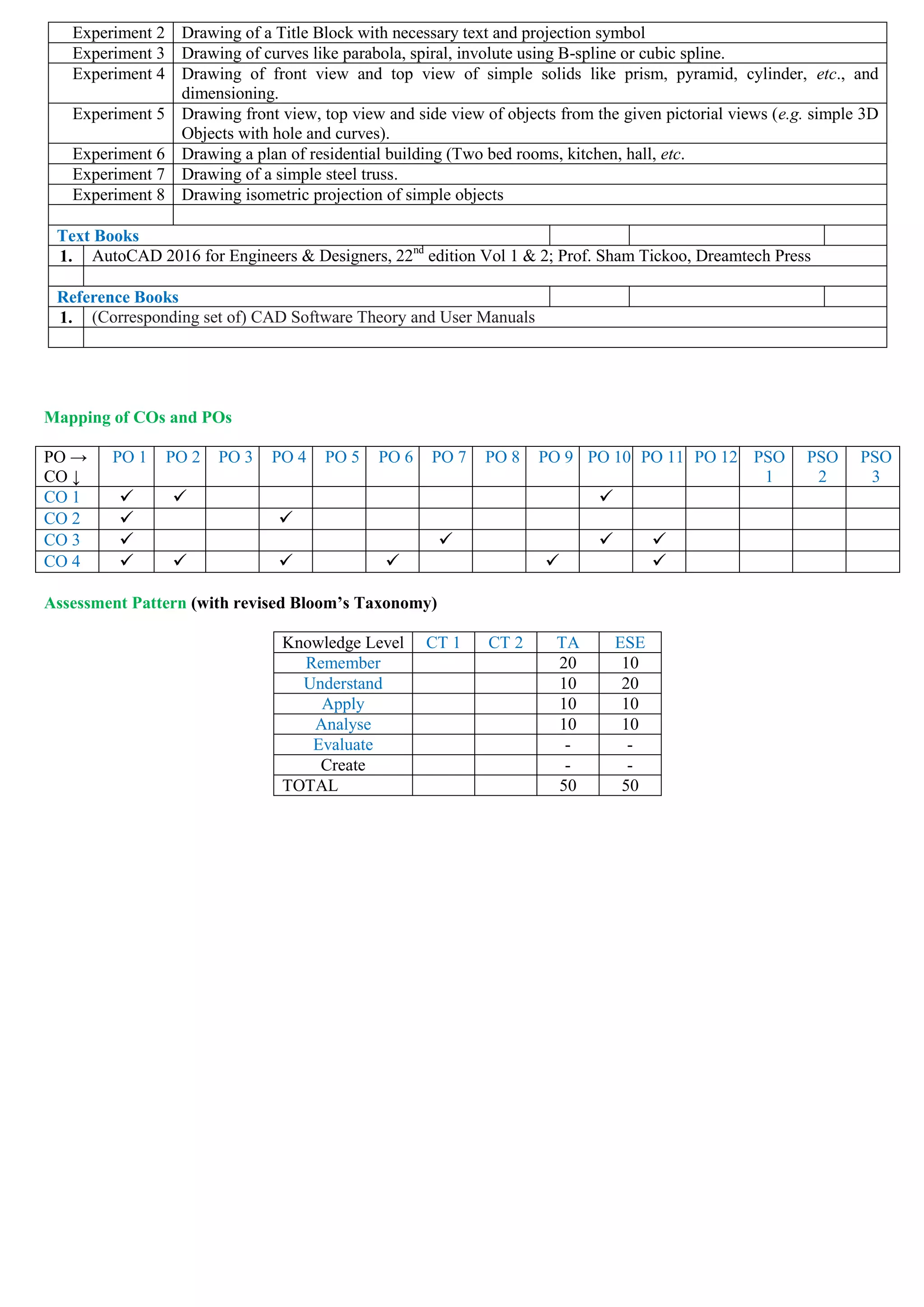
Experiment 2 Drawing of a Title Block with necessary text and projection symbol
Experiment 3 Drawing of curves like parabola, spiral, involute using B-spline or cubic spline.
Experiment 4 Drawing of front view and top view of simple solids like prism, pyramid, cylinder, etc., and
dimensioning.
Experiment 5 Drawing front view, top view and side view of objects from the given pictorial views (e.g. simple 3D
Objects with hole and curves).
Experiment 6 Drawing a plan of residential building (Two bed rooms, kitchen, hall, etc.
Experiment 7 Drawing of a simple steel truss.
Experiment 8 Drawing isometric projection of simple objects
Text Books
1. AutoCAD 2016 for Engineers & Designers, 22nd
edition Vol 1 & 2; Prof. Sham Tickoo, Dreamtech Press
Reference Books
1. (Corresponding set of) CAD Software Theory and User Manuals
Mapping of COs and POs
PO →
CO ↓
PO 1 PO 2 PO 3 PO 4 PO 5 PO 6 PO 7 PO 8 PO 9 PO 10 PO 11 PO 12 PSO
1
PSO
2
PSO
3
CO 1   
CO 2  
CO 3    
CO 4      
Assessment Pattern (with revised Bloom’s Taxonomy)
Knowledge Level CT 1 CT 2 TA ESE
Remember 20 10
Understand 10 20
Apply 10 10
Analyse 10 10
Evaluate - -
Create - -
TOTAL 50 50
Government College of Engineering, Karad
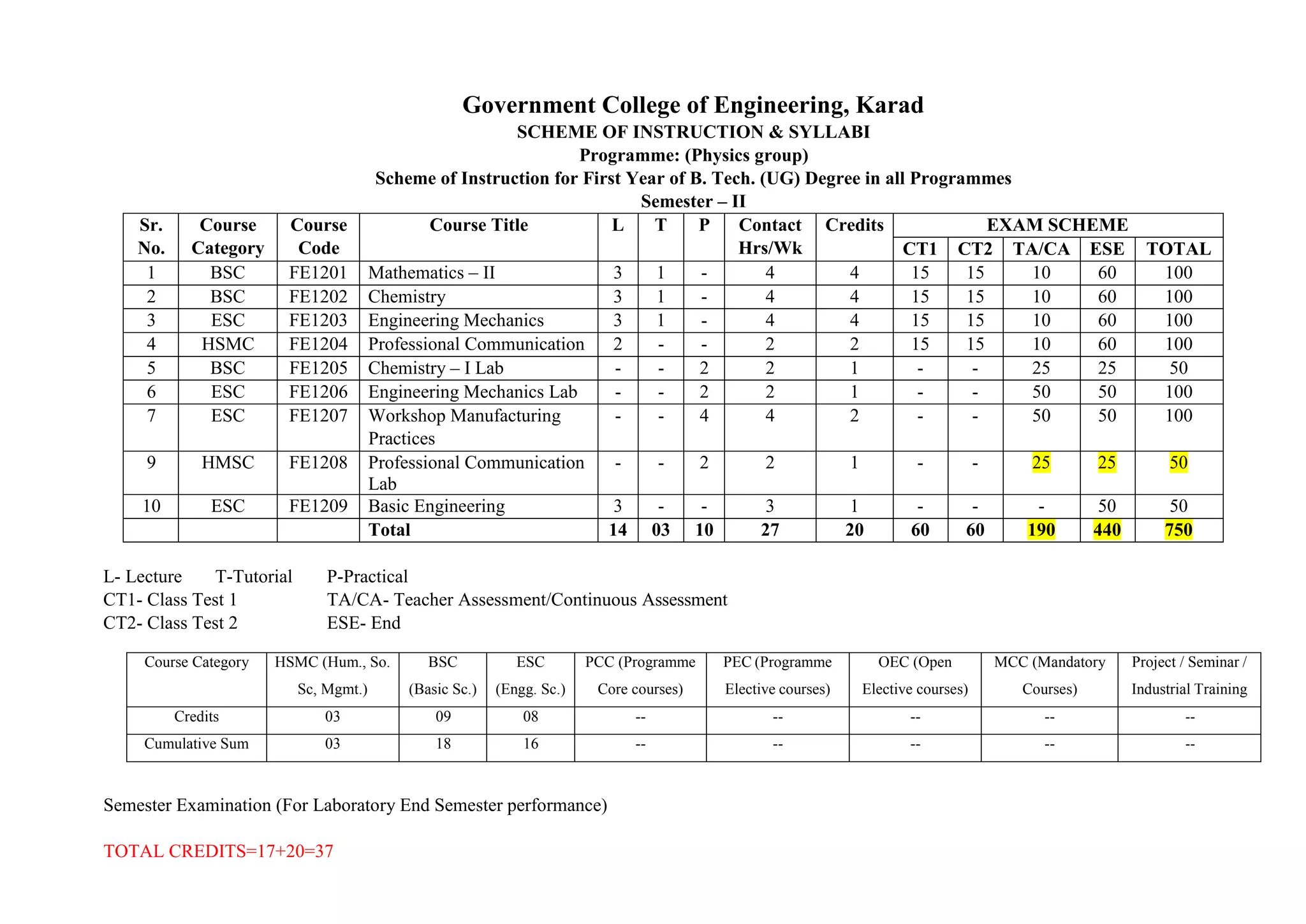
SCHEME OF INSTRUCTION & SYLLABI
Programme: (Physics group)
Scheme of Instruction for First Year of B. Tech. (UG) Degree in all Programmes
Semester – II
Sr.
No.
Course
Category
Course
Code
Course Title L T P Contact
Hrs/Wk
Credits EXAM SCHEME
CT1 CT2 TA/CA ESE TOTAL
1 BSC FE1201 Mathematics – II 3 1 - 4 4 15 15 10 60 100
2 BSC FE1202 Chemistry 3 1 - 4 4 15 15 10 60 100
3 ESC FE1203 Engineering Mechanics 3 1 - 4 4 15 15 10 60 100
4 HSMC FE1204 Professional Communication 2 - - 2 2 15 15 10 60 100
5 BSC FE1205 Chemistry – I Lab - - 2 2 1 - - 25 25 50
6 ESC FE1206 Engineering Mechanics Lab - - 2 2 1 - - 50 50 100
7 ESC FE1207 Workshop Manufacturing
Practices
- - 4 4 2 - - 50 50 100
9 HMSC FE1208 Professional Communication
Lab
- - 2 2 1 - - 25 25 50
10 ESC FE1209 Basic Engineering 3 - - 3 1 - - - 50 50
Total 14 03 10 27 20 60 60 190 440 750
L- Lecture T-Tutorial P-Practical
CT1- Class Test 1 TA/CA- Teacher Assessment/Continuous Assessment
CT2- Class Test 2 ESE- End
Course Category HSMC (Hum., So.
Sc, Mgmt.)
BSC
(Basic Sc.)
ESC
(Engg. Sc.)
PCC (Programme
Core courses)
PEC (Programme
Elective courses)
OEC (Open
Elective courses)
MCC (Mandatory
Courses)
Project / Seminar /
Industrial Training
Credits 03 09 08 -- -- -- -- --
Cumulative Sum 03 18 16 -- -- -- -- --
Semester Examination (For Laboratory End Semester performance)
TOTAL CREDITS=17+20=37
Government College of Engineering, Karad
SCHEME OF INSTRUCTION & SYLLABI
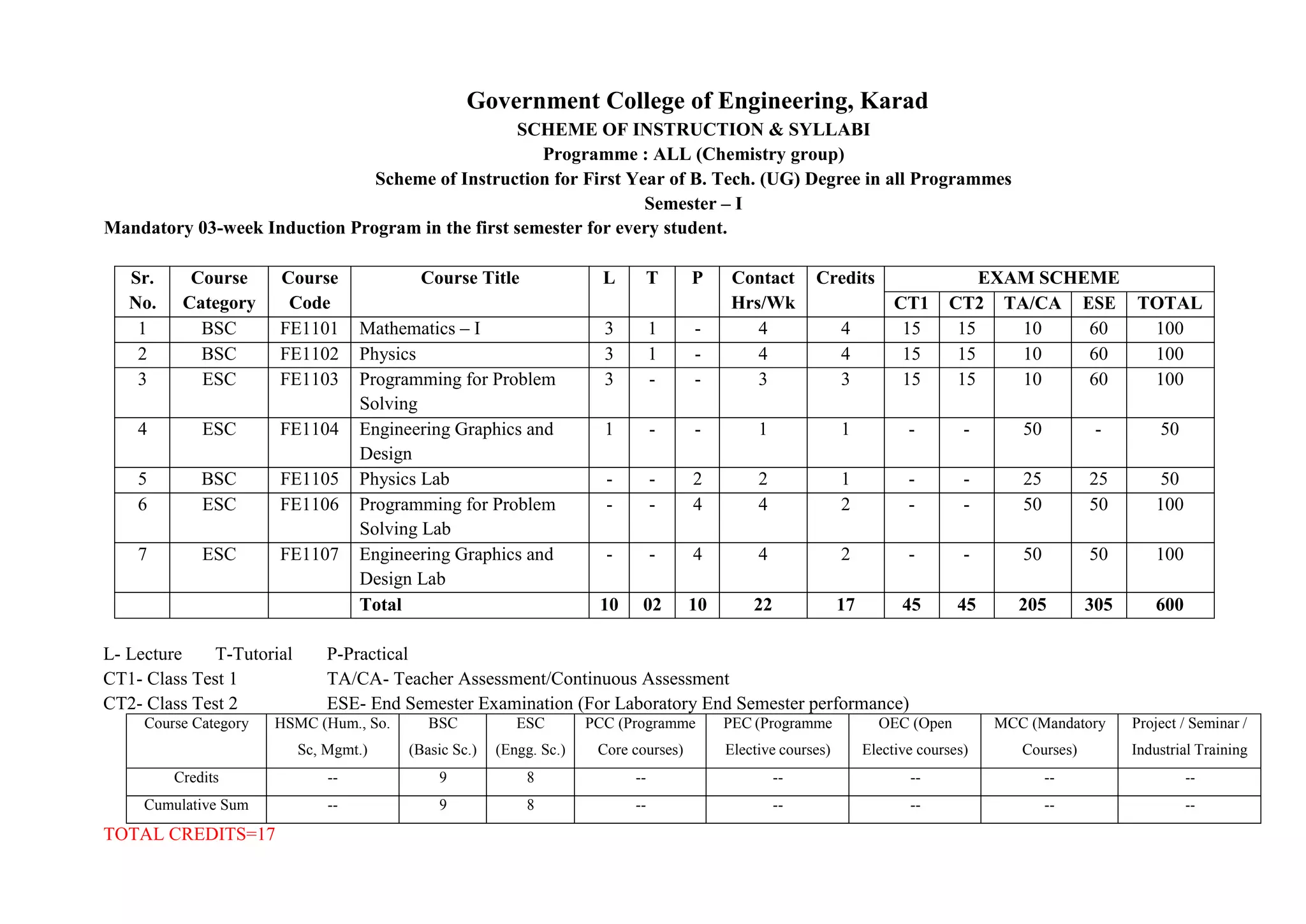
Programme : ALL (Chemistry group)
Scheme of Instruction for First Year of B. Tech. (UG) Degree in all Programmes
Semester – I
Mandatory 03-week Induction Program in the first semester for every student.
Sr.
No.
Course
Category
Course
Code
Course Title L T P Contact
Hrs/Wk
Credits EXAM SCHEME
CT1 CT2 TA/CA ESE TOTAL
1 BSC FE1101 Mathematics – I 3 1 - 4 4 15 15 10 60 100
2 BSC FE1102 Physics 3 1 - 4 4 15 15 10 60 100
3 ESC FE1103 Programming for Problem
Solving
3 - - 3 3 15 15 10 60 100
4 ESC FE1104 Engineering Graphics and
Design
1 - - 1 1 - - 50 - 50
5 BSC FE1105 Physics Lab - - 2 2 1 - - 25 25 50
6 ESC FE1106 Programming for Problem
Solving Lab
- - 4 4 2 - - 50 50 100
7 ESC FE1107 Engineering Graphics and
Design Lab
- - 4 4 2 - - 50 50 100
Total 10 02 10 22 17 45 45 205 305 600
L- Lecture T-Tutorial P-Practical
CT1- Class Test 1 TA/CA- Teacher Assessment/Continuous Assessment
CT2- Class Test 2 ESE- End Semester Examination (For Laboratory End Semester performance)
Course Category HSMC (Hum., So.
Sc, Mgmt.)
BSC
(Basic Sc.)
ESC
(Engg. Sc.)
PCC (Programme
Core courses)
PEC (Programme
Elective courses)
OEC (Open
Elective courses)
MCC (Mandatory
Courses)
Project / Seminar /
Industrial Training
Credits -- 9 8 -- -- -- -- --
Cumulative Sum -- 9 8 -- -- -- -- --
TOTAL CREDITS=17
Government College of Engineering, Karad
First Year B. Tech
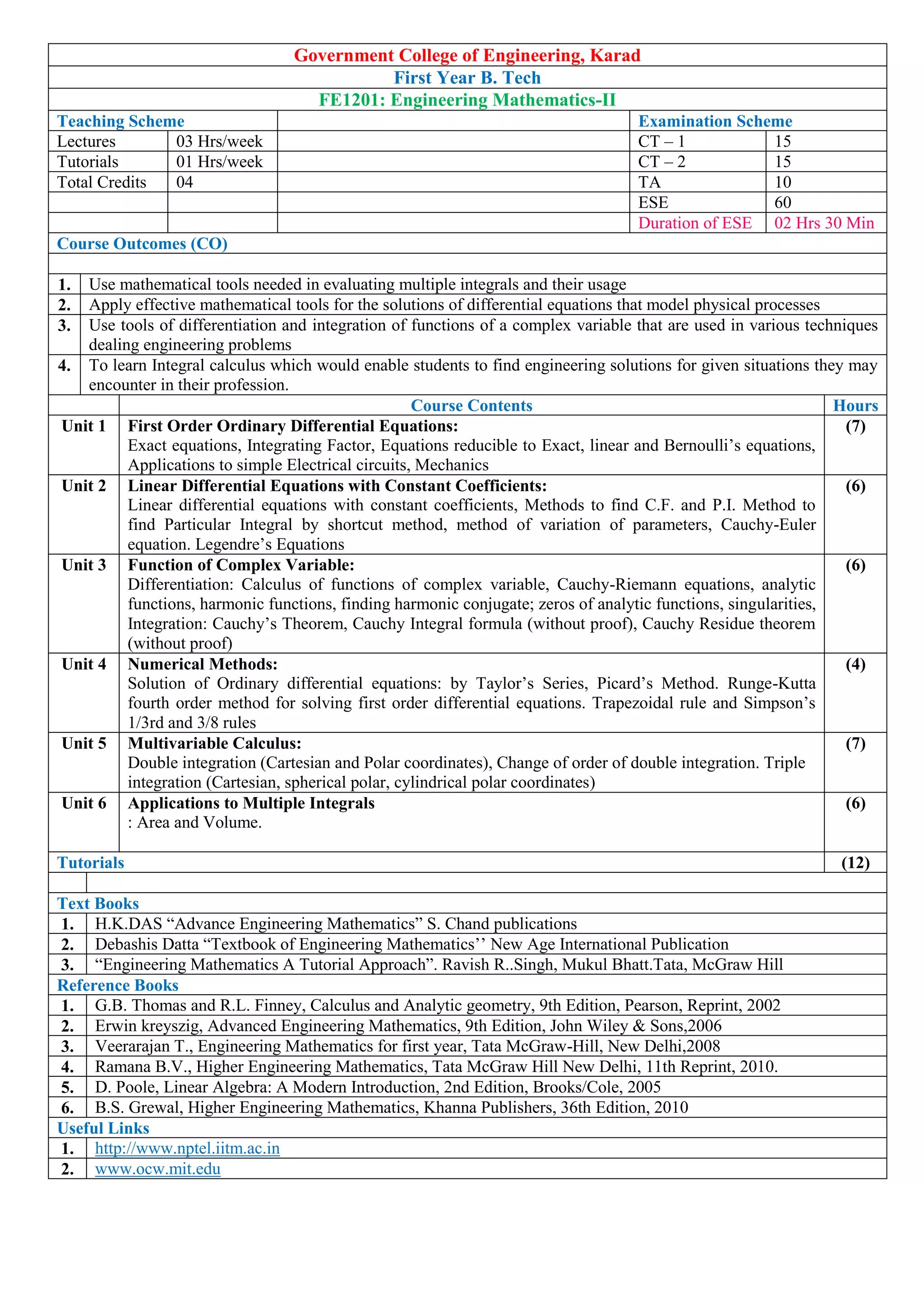
FE1201: Engineering Mathematics-II
Teaching Scheme Examination Scheme
Lectures 03 Hrs/week CT – 1 15
Tutorials 01 Hrs/week CT – 2 15
Total Credits 04 TA 10
ESE 60
Duration of ESE 02 Hrs 30 Min
Course Outcomes (CO)
1. Use mathematical tools needed in evaluating multiple integrals and their usage
2. Apply effective mathematical tools for the solutions of differential equations that model physical processes
3. Use tools of differentiation and integration of functions of a complex variable that are used in various techniques
dealing engineering problems
4. To learn Integral calculus which would enable students to find engineering solutions for given situations they may
encounter in their profession.
Course Contents Hours
Unit 1 First Order Ordinary Differential Equations:
Exact equations, Integrating Factor, Equations reducible to Exact, linear and Bernoulli’s equations,
Applications to simple Electrical circuits, Mechanics
(7)
Unit 2 Linear Differential Equations with Constant Coefficients:
Linear differential equations with constant coefficients, Methods to find C.F. and P.I. Method to
find Particular Integral by shortcut method, method of variation of parameters, Cauchy-Euler
equation. Legendre’s Equations
(6)
Unit 3 Function of Complex Variable:
Differentiation: Calculus of functions of complex variable, Cauchy-Riemann equations, analytic
functions, harmonic functions, finding harmonic conjugate; zeros of analytic functions, singularities,
Integration: Cauchy’s Theorem, Cauchy Integral formula (without proof), Cauchy Residue theorem
(without proof)
(6)
Unit 4 Numerical Methods:
Solution of Ordinary differential equations: by Taylor’s Series, Picard’s Method. Runge-Kutta
fourth order method for solving first order differential equations. Trapezoidal rule and Simpson’s
1/3rd and 3/8 rules
(4)
Unit 5 Multivariable Calculus:
Double integration (Cartesian and Polar coordinates), Change of order of double integration. Triple
integration (Cartesian, spherical polar, cylindrical polar coordinates)
(7)
Unit 6 Applications to Multiple Integrals
: Area and Volume.
(6)
Tutorials (12)
Text Books
1. H.K.DAS “Advance Engineering Mathematics” S. Chand publications
2. Debashis Datta “Textbook of Engineering Mathematics’’ New Age International Publication
3. “Engineering Mathematics A Tutorial Approach”. Ravish R..Singh, Mukul Bhatt.Tata, McGraw Hill
Reference Books
1. G.B. Thomas and R.L. Finney, Calculus and Analytic geometry, 9th Edition, Pearson, Reprint, 2002
2. Erwin kreyszig, Advanced Engineering Mathematics, 9th Edition, John Wiley & Sons,2006
3. Veerarajan T., Engineering Mathematics for first year, Tata McGraw-Hill, New Delhi,2008
4. Ramana B.V., Higher Engineering Mathematics, Tata McGraw Hill New Delhi, 11th Reprint, 2010.
5. D. Poole, Linear Algebra: A Modern Introduction, 2nd Edition, Brooks/Cole, 2005
6. B.S. Grewal, Higher Engineering Mathematics, Khanna Publishers, 36th Edition, 2010
Useful Links
1. http://www.nptel.iitm.ac.in
2. www.ocw.mit.edu
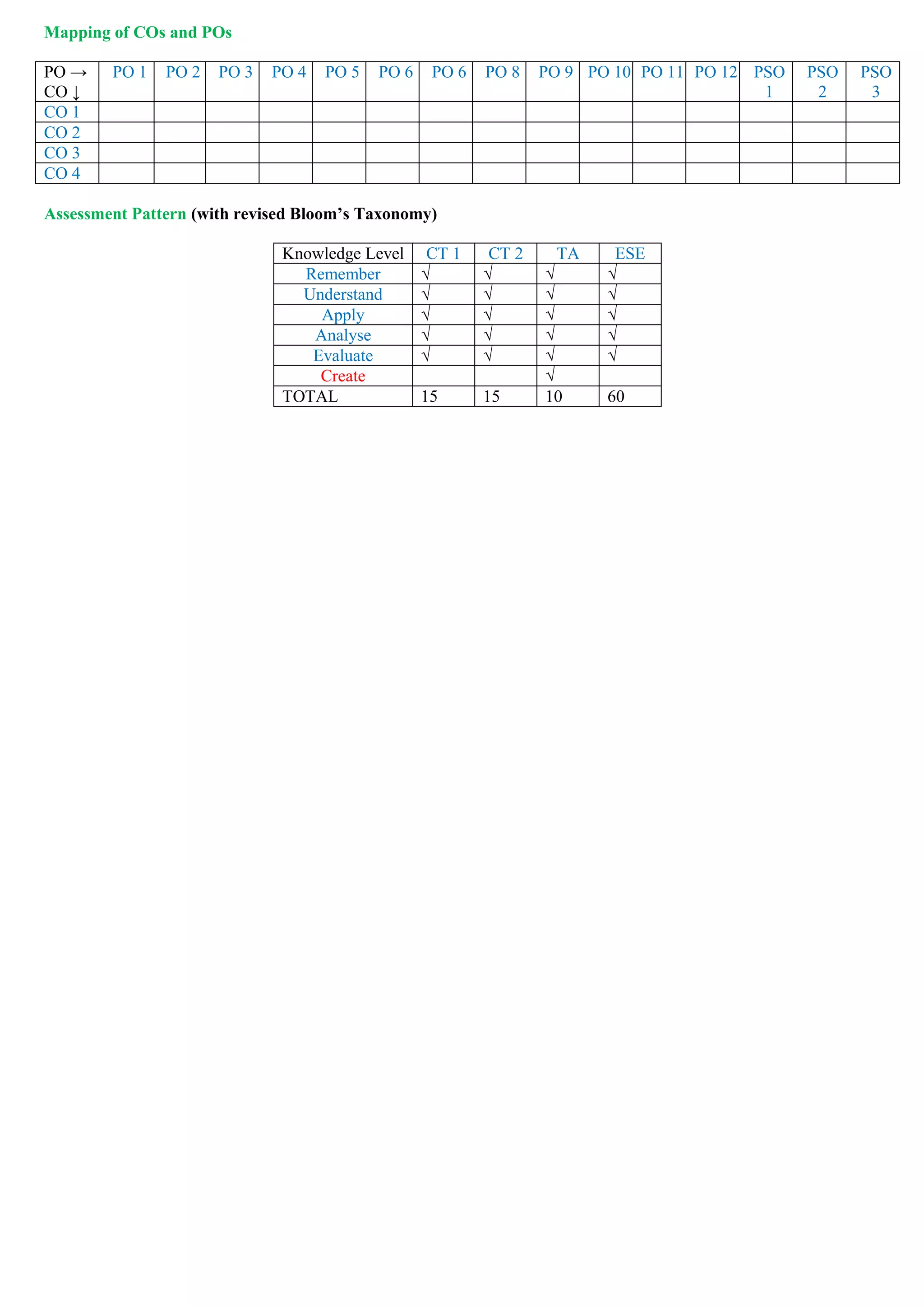
Mapping of COs and POs
PO →
CO ↓
PO 1 PO 2 PO 3 PO 4 PO 5 PO 6 PO 6 PO 8 PO 9 PO 10 PO 11 PO 12 PSO
1
PSO
2
PSO
3
CO 1
CO 2
CO 3
CO 4
Assessment Pattern (with revised Bloom’s Taxonomy)
Knowledge Level CT 1 CT 2 TA ESE
Remember √ √ √ √
Understand √ √ √ √
Apply √ √ √ √
Analyse √ √ √ √
Evaluate √ √ √ √
Create √
TOTAL 15 15 10 60
Government College of Engineering, Karad
First Year B. Tech
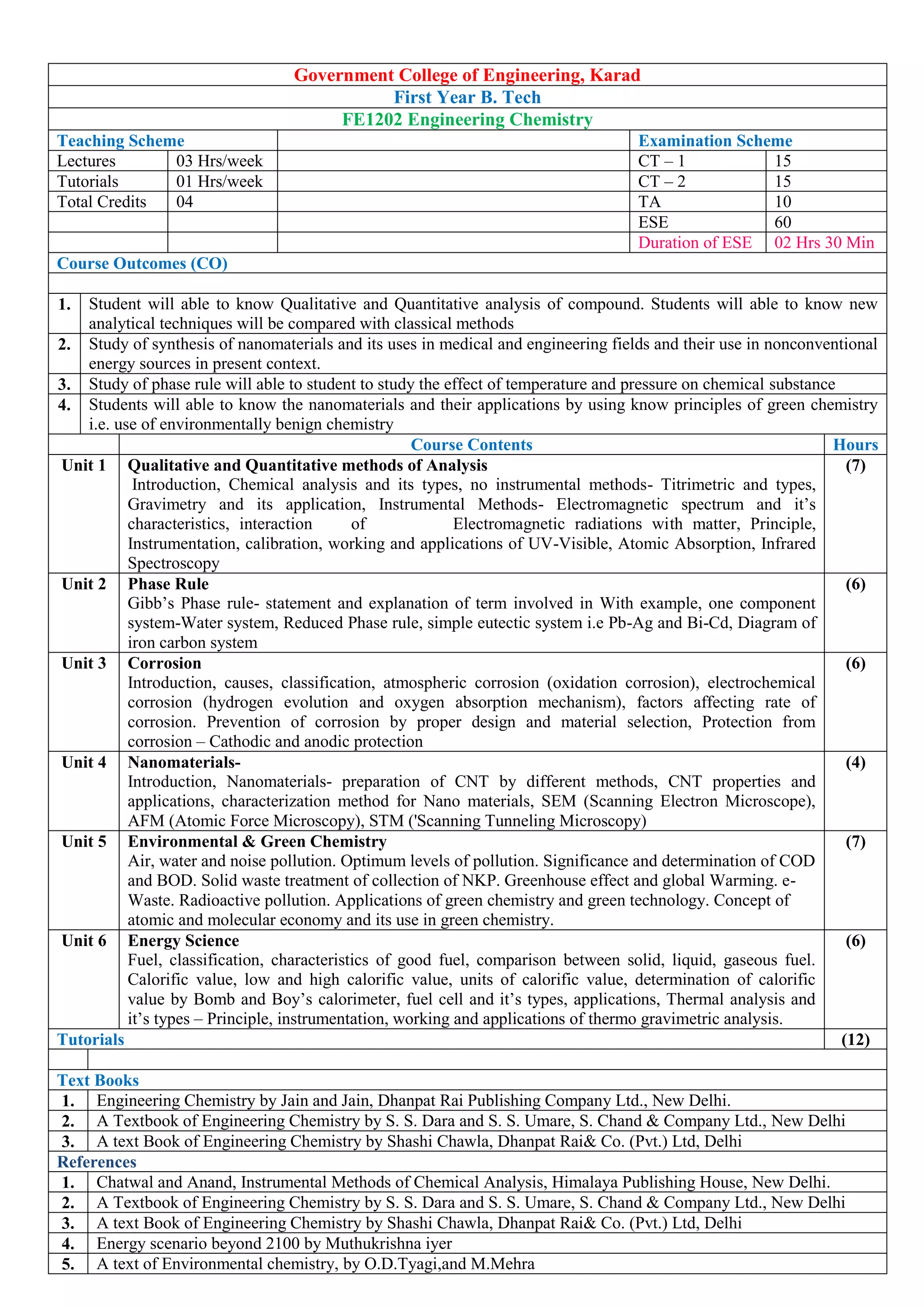
FE1202 Engineering Chemistry
Teaching Scheme Examination Scheme
Lectures 03 Hrs/week CT – 1 15
Tutorials 01 Hrs/week CT – 2 15
Total Credits 04 TA 10
ESE 60
Duration of ESE 02 Hrs 30 Min
Course Outcomes (CO)
1. Student will able to know Qualitative and Quantitative analysis of compound. Students will able to know new
analytical techniques will be compared with classical methods
2. Study of synthesis of nanomaterials and its uses in medical and engineering fields and their use in nonconventional
energy sources in present context.
3. Study of phase rule will able to student to study the effect of temperature and pressure on chemical substance
4. Students will able to know the nanomaterials and their applications by using know principles of green chemistry
i.e. use of environmentally benign chemistry
Course Contents Hours
Unit 1 Qualitative and Quantitative methods of Analysis
Introduction, Chemical analysis and its types, no instrumental methods- Titrimetric and types,
Gravimetry and its application, Instrumental Methods- Electromagnetic spectrum and it’s
characteristics, interaction of Electromagnetic radiations with matter, Principle,
Instrumentation, calibration, working and applications of UV-Visible, Atomic Absorption, Infrared
Spectroscopy
(7)
Unit 2 Phase Rule
Gibb’s Phase rule- statement and explanation of term involved in With example, one component
system-Water system, Reduced Phase rule, simple eutectic system i.e Pb-Ag and Bi-Cd, Diagram of
iron carbon system
(6)
Unit 3 Corrosion
Introduction, causes, classification, atmospheric corrosion (oxidation corrosion), electrochemical
corrosion (hydrogen evolution and oxygen absorption mechanism), factors affecting rate of
corrosion. Prevention of corrosion by proper design and material selection, Protection from
corrosion – Cathodic and anodic protection
(6)
Unit 4 Nanomaterials-
Introduction, Nanomaterials- preparation of CNT by different methods, CNT properties and
applications, characterization method for Nano materials, SEM (Scanning Electron Microscope),
AFM (Atomic Force Microscopy), STM ('Scanning Tunneling Microscopy)
(4)
Unit 5 Environmental & Green Chemistry
Air, water and noise pollution. Optimum levels of pollution. Significance and determination of COD
and BOD. Solid waste treatment of collection of NKP. Greenhouse effect and global Warming. e-
Waste. Radioactive pollution. Applications of green chemistry and green technology. Concept of
atomic and molecular economy and its use in green chemistry.
(7)
Unit 6 Energy Science
Fuel, classification, characteristics of good fuel, comparison between solid, liquid, gaseous fuel.
Calorific value, low and high calorific value, units of calorific value, determination of calorific
value by Bomb and Boy’s calorimeter, fuel cell and it’s types, applications, Thermal analysis and
it’s types – Principle, instrumentation, working and applications of thermo gravimetric analysis.
(6)
Tutorials (12)
Text Books
1. Engineering Chemistry by Jain and Jain, Dhanpat Rai Publishing Company Ltd., New Delhi.
2. A Textbook of Engineering Chemistry by S. S. Dara and S. S. Umare, S. Chand & Company Ltd., New Delhi
3. A text Book of Engineering Chemistry by Shashi Chawla, Dhanpat Rai& Co. (Pvt.) Ltd, Delhi
References
1. Chatwal and Anand, Instrumental Methods of Chemical Analysis, Himalaya Publishing House, New Delhi.
2. A Textbook of Engineering Chemistry by S. S. Dara and S. S. Umare, S. Chand & Company Ltd., New Delhi
3. A text Book of Engineering Chemistry by Shashi Chawla, Dhanpat Rai& Co. (Pvt.) Ltd, Delhi
4. Energy scenario beyond 2100 by Muthukrishna iyer
5. A text of Environmental chemistry, by O.D.Tyagi,and M.Mehra
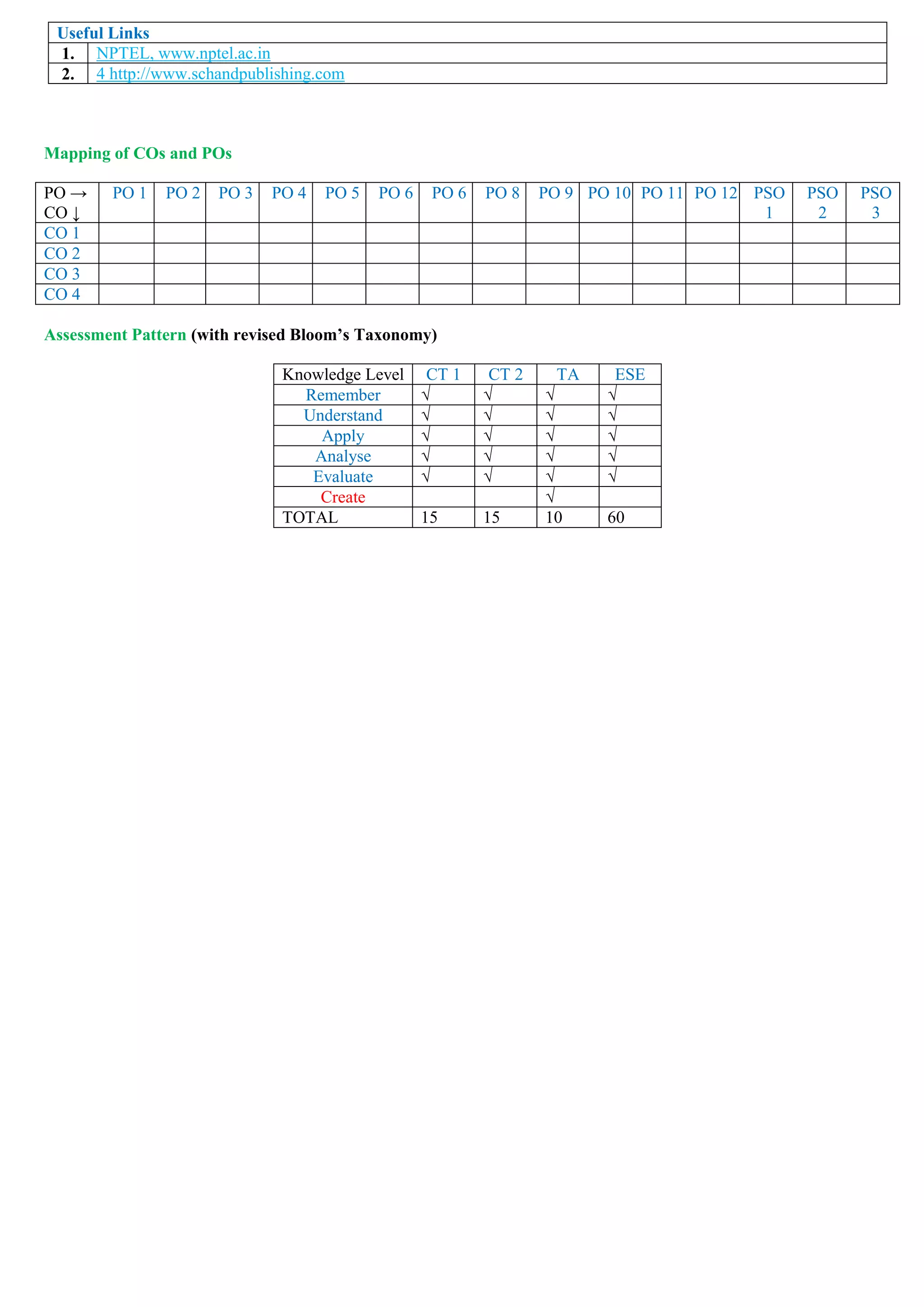
Useful Links
1. NPTEL, www.nptel.ac.in
2. 4 http://www.schandpublishing.com
Mapping of COs and POs
PO →
CO ↓
PO 1 PO 2 PO 3 PO 4 PO 5 PO 6 PO 6 PO 8 PO 9 PO 10 PO 11 PO 12 PSO
1
PSO
2
PSO
3
CO 1
CO 2
CO 3
CO 4
Assessment Pattern (with revised Bloom’s Taxonomy)
Knowledge Level CT 1 CT 2 TA ESE
Remember √ √ √ √
Understand √ √ √ √
Apply √ √ √ √
Analyse √ √ √ √
Evaluate √ √ √ √
Create √
TOTAL 15 15 10 60
Government College of Engineering, Karad
First Year B. Tech
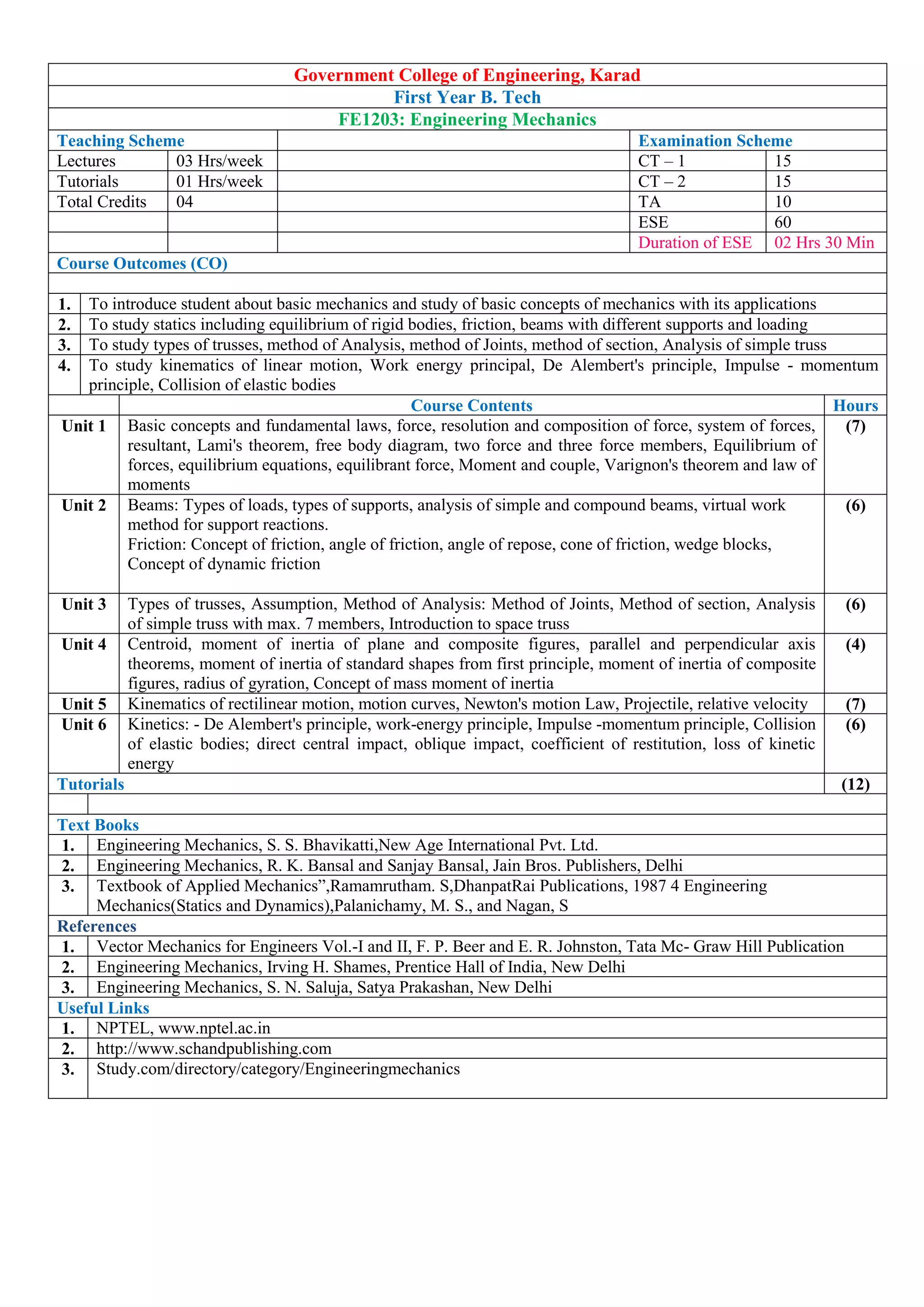
FE1203: Engineering Mechanics
Teaching Scheme Examination Scheme
Lectures 03 Hrs/week CT – 1 15
Tutorials 01 Hrs/week CT – 2 15
Total Credits 04 TA 10
ESE 60
Duration of ESE 02 Hrs 30 Min
Course Outcomes (CO)
1. To introduce student about basic mechanics and study of basic concepts of mechanics with its applications
2. To study statics including equilibrium of rigid bodies, friction, beams with different supports and loading
3. To study types of trusses, method of Analysis, method of Joints, method of section, Analysis of simple truss
4. To study kinematics of linear motion, Work energy principal, De Alembert's principle, Impulse - momentum
principle, Collision of elastic bodies
Course Contents Hours
Unit 1 Basic concepts and fundamental laws, force, resolution and composition of force, system of forces,
resultant, Lami's theorem, free body diagram, two force and three force members, Equilibrium of
forces, equilibrium equations, equilibrant force, Moment and couple, Varignon's theorem and law of
moments
(7)
Unit 2 Beams: Types of loads, types of supports, analysis of simple and compound beams, virtual work
method for support reactions.
Friction: Concept of friction, angle of friction, angle of repose, cone of friction, wedge blocks,
Concept of dynamic friction
(6)
Unit 3 Types of trusses, Assumption, Method of Analysis: Method of Joints, Method of section, Analysis
of simple truss with max. 7 members, Introduction to space truss
(6)
Unit 4 Centroid, moment of inertia of plane and composite figures, parallel and perpendicular axis
theorems, moment of inertia of standard shapes from first principle, moment of inertia of composite
figures, radius of gyration, Concept of mass moment of inertia
(4)
Unit 5 Kinematics of rectilinear motion, motion curves, Newton's motion Law, Projectile, relative velocity (7)
Unit 6 Kinetics: - De Alembert's principle, work-energy principle, Impulse -momentum principle, Collision
of elastic bodies; direct central impact, oblique impact, coefficient of restitution, loss of kinetic
energy
(6)
Tutorials (12)
Text Books
1. Engineering Mechanics, S. S. Bhavikatti,New Age International Pvt. Ltd.
2. Engineering Mechanics, R. K. Bansal and Sanjay Bansal, Jain Bros. Publishers, Delhi
3. Textbook of Applied Mechanics”,Ramamrutham. S,DhanpatRai Publications, 1987 4 Engineering
Mechanics(Statics and Dynamics),Palanichamy, M. S., and Nagan, S
References
1. Vector Mechanics for Engineers Vol.-I and II, F. P. Beer and E. R. Johnston, Tata Mc- Graw Hill Publication
2. Engineering Mechanics, Irving H. Shames, Prentice Hall of India, New Delhi
3. Engineering Mechanics, S. N. Saluja, Satya Prakashan, New Delhi
Useful Links
1. NPTEL, www.nptel.ac.in
2. http://www.schandpublishing.com
3. Study.com/directory/category/Engineeringmechanics
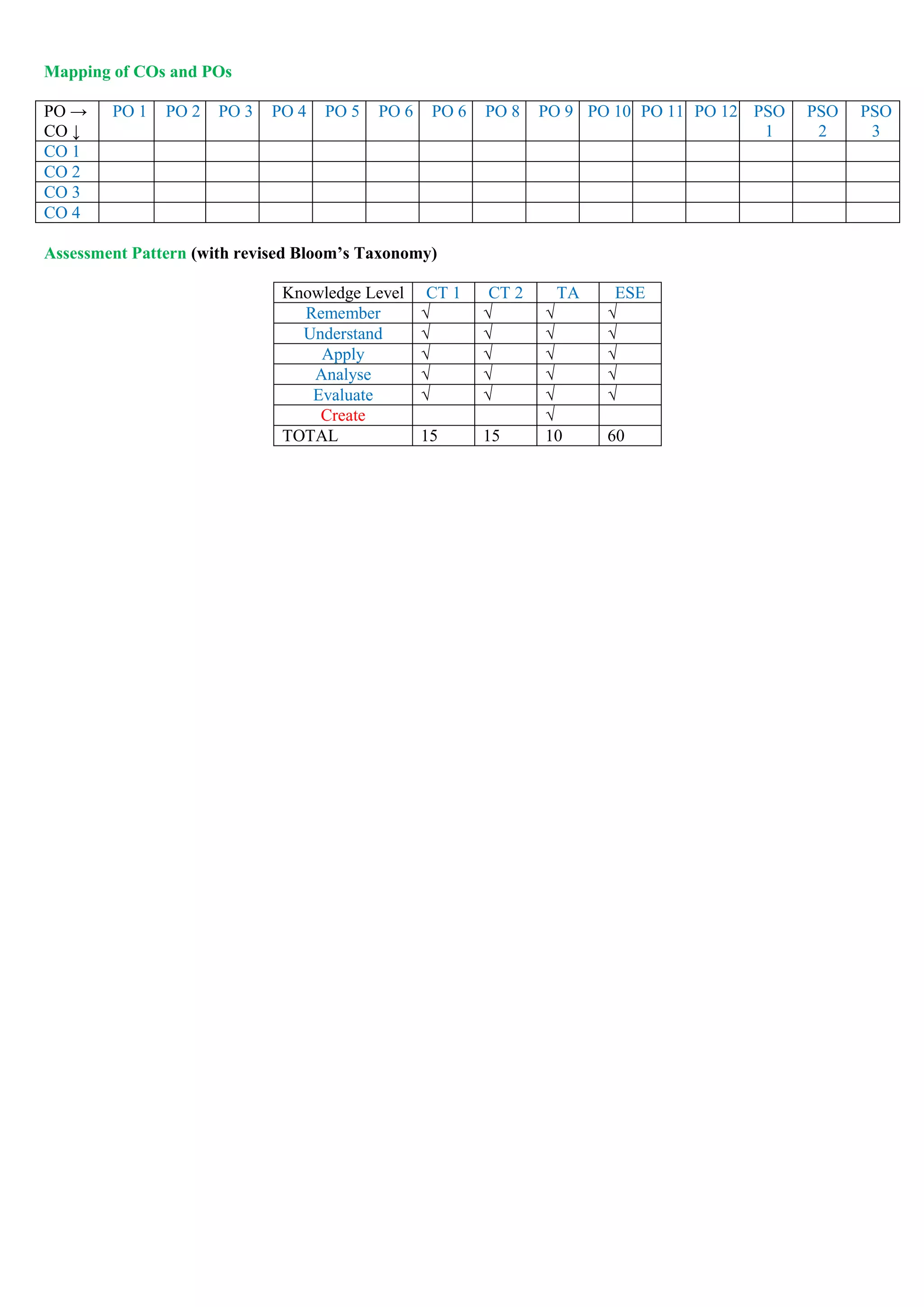
Mapping of COs and POs
PO →
CO ↓
PO 1 PO 2 PO 3 PO 4 PO 5 PO 6 PO 6 PO 8 PO 9 PO 10 PO 11 PO 12 PSO
1
PSO
2
PSO
3
CO 1
CO 2
CO 3
CO 4
Assessment Pattern (with revised Bloom’s Taxonomy)
Knowledge Level CT 1 CT 2 TA ESE
Remember √ √ √ √
Understand √ √ √ √
Apply √ √ √ √
Analyse √ √ √ √
Evaluate √ √ √ √
Create √
TOTAL 15 15 10 60
Government College of Engineering, Karad
First Year B. Tech
FE1204: Professional Communication
Teaching Scheme Examination Scheme
Lectures 02 Hrs/week CT – 1 15
Tutorials 00 Hrs/week CT – 2 15
Total Credits 02 TA 10
ESE 60
Duration of ESE 02 Hrs 30 Min
Course Outcomes (CO)
1. Use appropriate vocabulary in each situation
2. Use variety of accurate sentence structures in each situation
3. Generate coherent content supported with relevant details
4. Use communication strategies to participate in academic & non-academic activities
Course Contents Hours
Unit 1 Listening Skill
Listening Stories – I (Listen and reproduce [oral])
Listening Discourse &Motivational Talks – II
(Listen and summarize [written]),
Listening Interviews – III (Listen and answer the questions)
(7)
Unit 2 Vocabulary Building
1. Root Words
2. Synonyms, Antonyms, Close Synonyms (e.g. see, observe, stare, glare, view, etc.)
3. Formal and. Informal Vocabulary
4. Problem Words, Homonyms, Homophones
5. Common Errors: Usage of - Prepositions, Tenses, Articles
(6)
Unit 3 Speaking Skills
1. Basic Sentence Patterns
2. Types of Sentences: Statements, Interrogative, Exclamatory, Imperative (Order, Command,
Request, Advice, Suggestions/Proposals)
3. Expressing Situation based Emotions (Formal & Informal): Apology, Greetings, Regrets,
Condolences, Offer, Invitation, Compliments, Compulsion, Permission, Agreement, Disagreement,
Interruption
4. Introducing Yourself and others
(6)
Unit 4 Writing Skills
1. E-mail writing and Etiquettes (Formal & Informal)
2. Job Application, Curriculum Vitae or Resume and Covering Letter (Difference between CV and
Resume, Format, effective use of language)
3. Essay Writing
(4)
Unit 5 Developing Presentation Skills
1. Group Discussion: Dos and Don'ts (subject knowledge, approach to a problem, ability, analytical
mind, listening skill, decision-making capacity, critical thinking, leadership, tolerance, your attitude,
and confidence)
2. Presentation Techniques (Designing/Effective delivery/Body language)
3. Interview Techniques (Communication skills, Body Language, leadership quality, problem-
solving capacity, teamwork, etc.)
(7)
Unit 6 Developing Soft Skills (Activity-Based)
1. Team Building (understanding the concept of team-building, communication skills, goal setting,
role-setting, a delegation of task, brainstorming, encouragement, etc)
2. Creative thinking (concept understanding, open perspective, reformulating a problem,
brainstorming, mind mapping, analyzing, etc.)
3. Stress Management (concept understanding, identifying the problem, limiting unnecessary stress,
accepting the things you can't change, following a healthy lifestyle, connecting to others, spending
time for fun & relaxation, exercising /meditating, etc.)
4. Emotional Intelligence (concept understanding, knowing self-strengths & weaknesses, managing
self, feeling empathy, employing social skills)
(6)
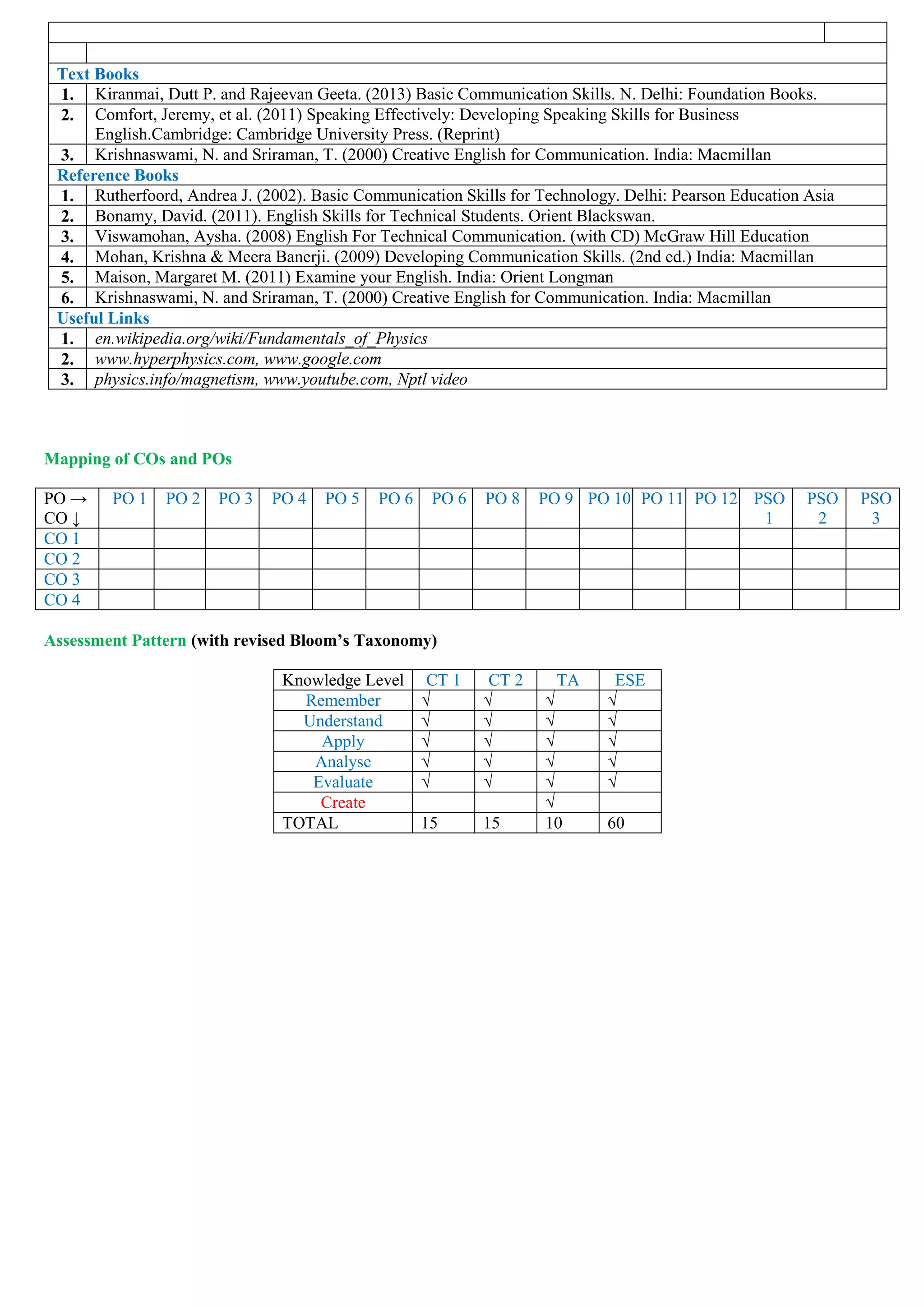
Text Books
1. Kiranmai, Dutt P. and Rajeevan Geeta. (2013) Basic Communication Skills. N. Delhi: Foundation Books.
2. Comfort, Jeremy, et al. (2011) Speaking Effectively: Developing Speaking Skills for Business
English.Cambridge: Cambridge University Press. (Reprint)
3. Krishnaswami, N. and Sriraman, T. (2000) Creative English for Communication. India: Macmillan
Reference Books
1. Rutherfoord, Andrea J. (2002). Basic Communication Skills for Technology. Delhi: Pearson Education Asia
2. Bonamy, David. (2011). English Skills for Technical Students. Orient Blackswan.
3. Viswamohan, Aysha. (2008) English For Technical Communication. (with CD) McGraw Hill Education
4. Mohan, Krishna & Meera Banerji. (2009) Developing Communication Skills. (2nd ed.) India: Macmillan
5. Maison, Margaret M. (2011) Examine your English. India: Orient Longman
6. Krishnaswami, N. and Sriraman, T. (2000) Creative English for Communication. India: Macmillan
Useful Links
1. en.wikipedia.org/wiki/Fundamentals_of_Physics
2. www.hyperphysics.com, www.google.com
3. physics.info/magnetism, www.youtube.com, Nptl video
Mapping of COs and POs
PO →
CO ↓
PO 1 PO 2 PO 3 PO 4 PO 5 PO 6 PO 6 PO 8 PO 9 PO 10 PO 11 PO 12 PSO
1
PSO
2
PSO
3
CO 1
CO 2
CO 3
CO 4
Assessment Pattern (with revised Bloom’s Taxonomy)
Knowledge Level CT 1 CT 2 TA ESE
Remember √ √ √ √
Understand √ √ √ √
Apply √ √ √ √
Analyse √ √ √ √
Evaluate √ √ √ √
Create √
TOTAL 15 15 10 60
Government College of Engineering, Karad
First Year B. Tech
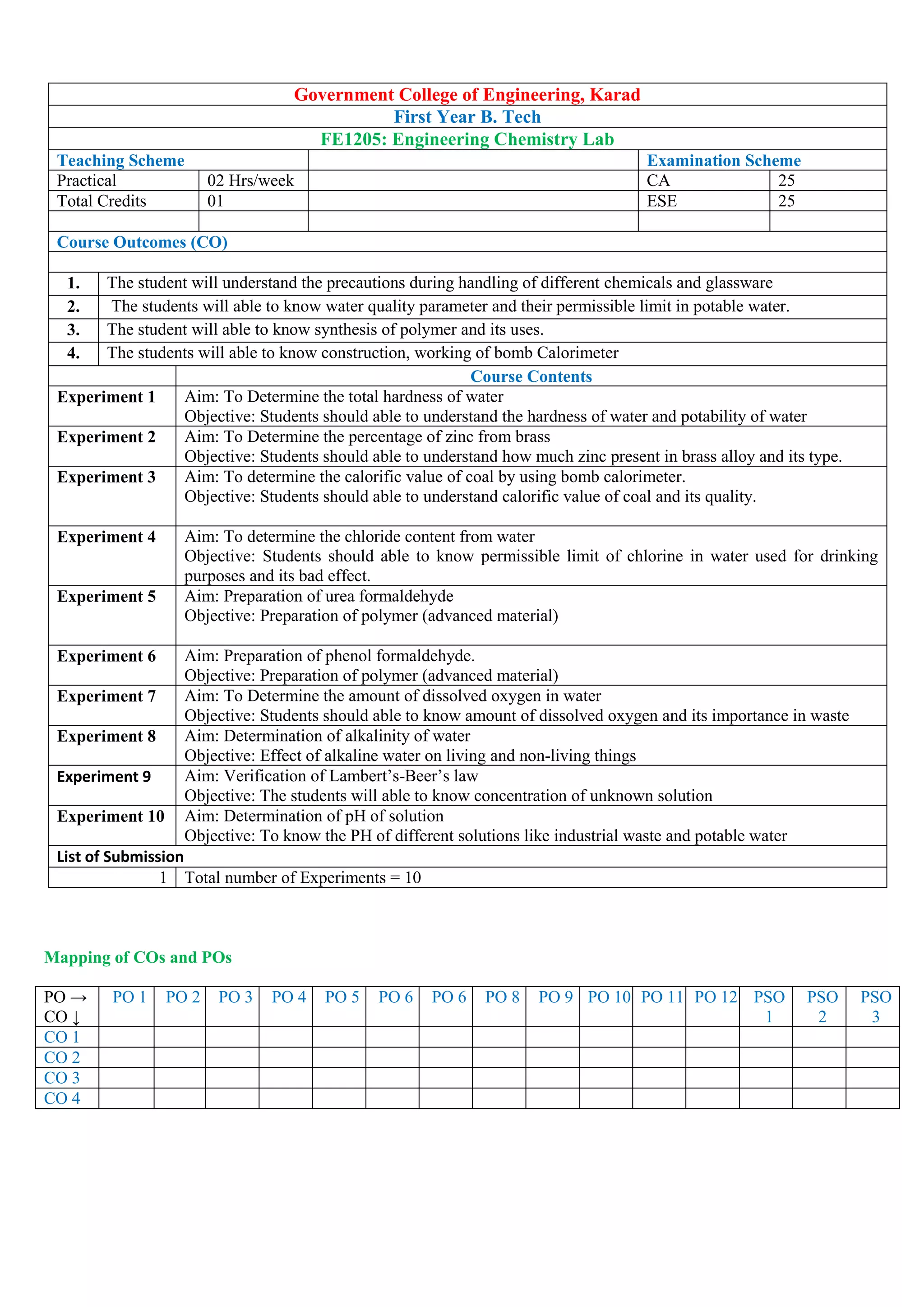
FE1205: Engineering Chemistry Lab
Teaching Scheme Examination Scheme
Practical 02 Hrs/week CA 25
Total Credits 01 ESE 25
Course Outcomes (CO)
1. The student will understand the precautions during handling of different chemicals and glassware
2. The students will able to know water quality parameter and their permissible limit in potable water.
3. The student will able to know synthesis of polymer and its uses.
4. The students will able to know construction, working of bomb Calorimeter
Course Contents
Experiment 1 Aim: To Determine the total hardness of water
Objective: Students should able to understand the hardness of water and potability of water
Experiment 2 Aim: To Determine the percentage of zinc from brass
Objective: Students should able to understand how much zinc present in brass alloy and its type.
Experiment 3 Aim: To determine the calorific value of coal by using bomb calorimeter.
Objective: Students should able to understand calorific value of coal and its quality.
Experiment 4 Aim: To determine the chloride content from water
Objective: Students should able to know permissible limit of chlorine in water used for drinking
purposes and its bad effect.
Experiment 5 Aim: Preparation of urea formaldehyde
Objective: Preparation of polymer (advanced material)
Experiment 6 Aim: Preparation of phenol formaldehyde.
Objective: Preparation of polymer (advanced material)
Experiment 7 Aim: To Determine the amount of dissolved oxygen in water
Objective: Students should able to know amount of dissolved oxygen and its importance in waste
Experiment 8 Aim: Determination of alkalinity of water
Objective: Effect of alkaline water on living and non-living things
Experiment 9 Aim: Verification of Lambert’s-Beer’s law
Objective: The students will able to know concentration of unknown solution
Experiment 10 Aim: Determination of pH of solution
Objective: To know the PH of different solutions like industrial waste and potable water
List of Submission
1 Total number of Experiments = 10
Mapping of COs and POs
PO →
CO ↓
PO 1 PO 2 PO 3 PO 4 PO 5 PO 6 PO 6 PO 8 PO 9 PO 10 PO 11 PO 12 PSO
1
PSO
2
PSO
3
CO 1
CO 2
CO 3
CO 4
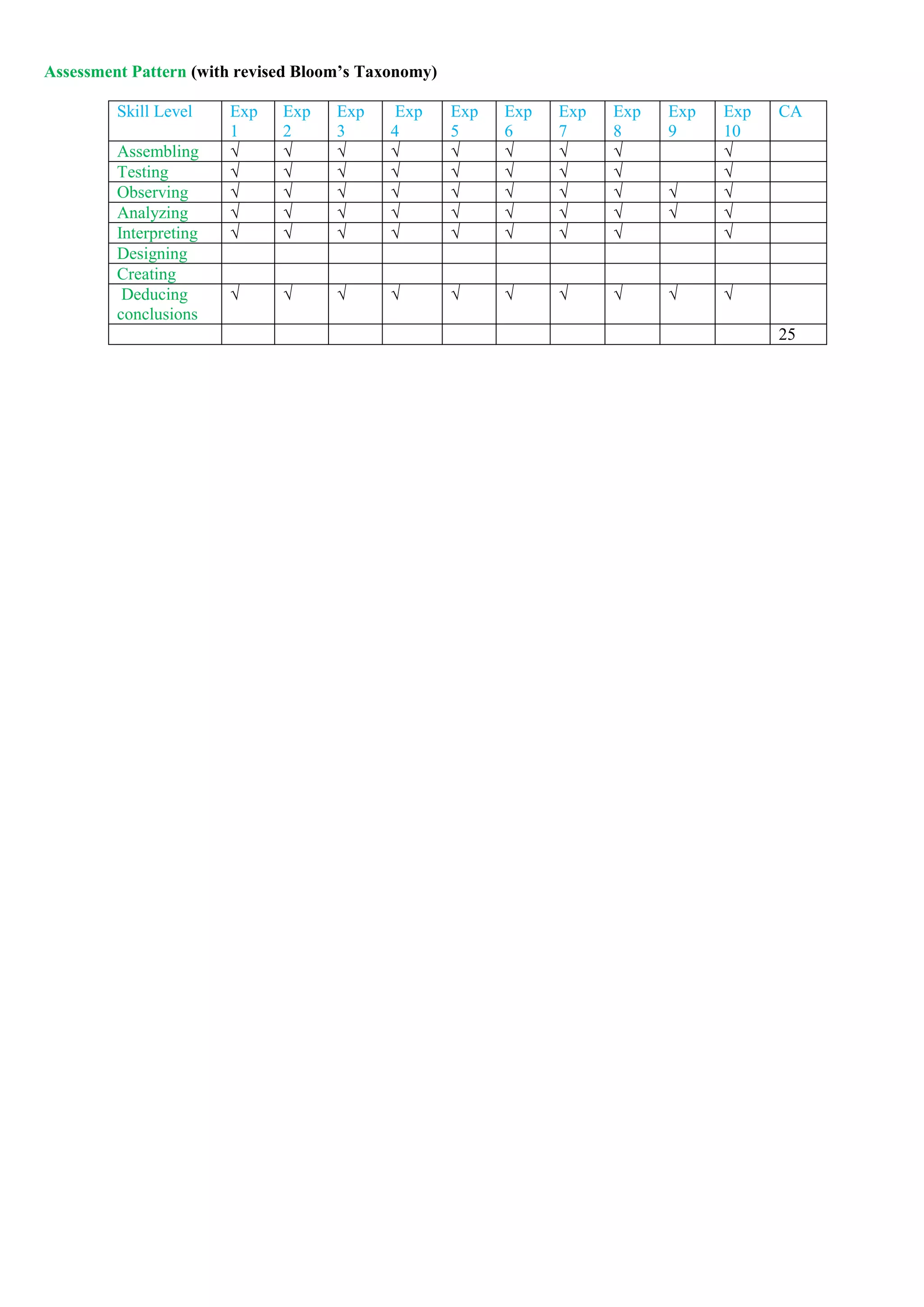
Assessment Pattern (with revised Bloom’s Taxonomy)
Skill Level Exp
1
Exp
2
Exp
3
Exp
4
Exp
5
Exp
6
Exp
7
Exp
8
Exp
9
Exp
10
CA
Assembling √ √ √ √ √ √ √ √ √
Testing √ √ √ √ √ √ √ √ √
Observing √ √ √ √ √ √ √ √ √ √
Analyzing √ √ √ √ √ √ √ √ √ √
Interpreting √ √ √ √ √ √ √ √ √
Designing
Creating
Deducing
conclusions
√ √ √ √ √ √ √ √ √ √
25
Government College of Engineering, Karad
First Year B. Tech
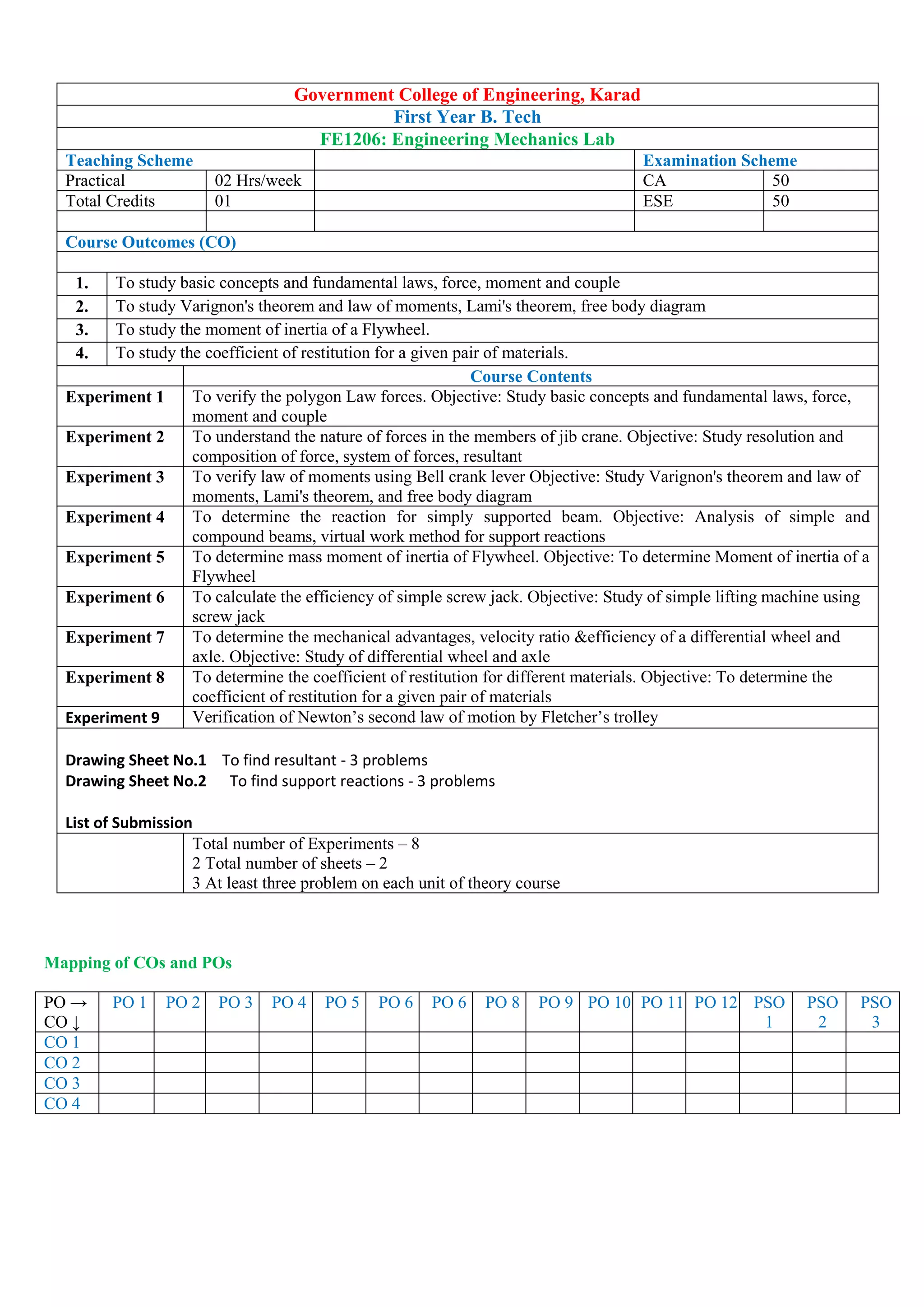
FE1206: Engineering Mechanics Lab
Teaching Scheme Examination Scheme
Practical 02 Hrs/week CA 50
Total Credits 01 ESE 50
Course Outcomes (CO)
1. To study basic concepts and fundamental laws, force, moment and couple
2. To study Varignon's theorem and law of moments, Lami's theorem, free body diagram
3. To study the moment of inertia of a Flywheel.
4. To study the coefficient of restitution for a given pair of materials.
Course Contents
Experiment 1 To verify the polygon Law forces. Objective: Study basic concepts and fundamental laws, force,
moment and couple
Experiment 2 To understand the nature of forces in the members of jib crane. Objective: Study resolution and
composition of force, system of forces, resultant
Experiment 3 To verify law of moments using Bell crank lever Objective: Study Varignon's theorem and law of
moments, Lami's theorem, and free body diagram
Experiment 4 To determine the reaction for simply supported beam. Objective: Analysis of simple and
compound beams, virtual work method for support reactions
Experiment 5 To determine mass moment of inertia of Flywheel. Objective: To determine Moment of inertia of a
Flywheel
Experiment 6 To calculate the efficiency of simple screw jack. Objective: Study of simple lifting machine using
screw jack
Experiment 7 To determine the mechanical advantages, velocity ratio &efficiency of a differential wheel and
axle. Objective: Study of differential wheel and axle
Experiment 8 To determine the coefficient of restitution for different materials. Objective: To determine the
coefficient of restitution for a given pair of materials
Experiment 9 Verification of Newton’s second law of motion by Fletcher’s trolley
Drawing Sheet No.1 To find resultant - 3 problems
Drawing Sheet No.2 To find support reactions - 3 problems
List of Submission
Total number of Experiments – 8
2 Total number of sheets – 2
3 At least three problem on each unit of theory course
Mapping of COs and POs
PO →
CO ↓
PO 1 PO 2 PO 3 PO 4 PO 5 PO 6 PO 6 PO 8 PO 9 PO 10 PO 11 PO 12 PSO
1
PSO
2
PSO
3
CO 1
CO 2
CO 3
CO 4
Assessment Pattern (with revised Bloom’s Taxonomy)
Skill Level Exp
1
Exp
2
Exp
3
Exp
4
Exp
5
Exp
6
Exp
7
Exp
8
Exp
9
Exp
10
CA
Assembling √ √ √ √ √ √ √ √ √
Testing √ √ √ √ √ √ √ √ √
Observing √ √ √ √ √ √ √ √ √ √
Analyzing √ √ √ √ √ √ √ √ √ √
Interpreting √ √ √ √ √ √ √ √ √
Designing
Creating
Deducing
conclusions
√ √ √ √ √ √ √ √ √ √
50
Government College of Engineering, Karad
First Year B. Tech.
ESC 1207 : Workshop/Manufacturing Practices
Teaching Scheme Examination Scheme
Practical 04 Hrs/week TA 50
Total Credits 02 ESE 50
Course Outcomes (CO)
1. Students will able to understand different manufacturing processes which are commonly employed in the industry,
to fabricate components using different materials.
2. students will able to remember use of marking tools, hand tools, measuring instruments (mechanical and electrical)
and to work to prescribed dimensions/tolerances
3. Students will able to create good workmanship
4. Students will able apply various manufacturing skills to engineering applications
Course Contents Hours
I Machine shop [6]
II Fitting shop [6]
III Carpentry [6]
IV Electrical & Electronics [6]
V Welding shop [6]
VI Casting [6]
VII Smithy [6]
VIII Plastic moulding & Glass Cutting [6]
Text Books
1. Hajra Choudhury S.K., Hajra Choudhury A.K. and Nirjhar Roy S.K., “Elements of Workshop Technology”, Vol. I
2008 and Vol. II 2010, Media promoters and publishers private limited, Mumbai.
2. Kalpak Jain, Steven S. Schmidt, “Manufacturing Engineering and Technology”, 4th edition, Pearson Education
Indian Edition, 2002.
3. Gowri P., Hariharan and A. Suresh Babu,”Manufacturing Technology – I” Pearson Education, 2008.
4. Roy A. Lindberg, “Processes and Materials of Manufacture”, 4th edition, Prentice Hall India, 1998.
5. Rao P.N., “Manufacturing Technology”, Vol. I and Vol. II, Tata Mc Graw Hill House, 2017.
6. Chapman series on Manufacturing process
Mapping of COs and POs
PO →
CO ↓
PO 1 PO 2 PO 3 PO 4 PO 5 PO 6 PO 6 PO 8 PO 9 PO 10 PO 11 PO 12 PSO
1
PSO
2
PSO
3
CO 1
CO 2
CO 3
CO 4
Assessment Pattern (with revised Bloom’s Taxonomy)
Skill Level Exp
1
Exp
2
Exp
3
Exp
4
Exp
5
Exp
6
Exp
7
Exp
8
Exp
9
Exp
10
CA
Assembling √ √ √ √ √ √ √ √ √
Testing √ √ √ √ √ √ √ √ √
Observing √ √ √ √ √ √ √ √ √ √
Analyzing √ √ √ √ √ √ √ √ √ √
Interpreting √ √ √ √ √ √ √ √ √
Designing
Creating
Deducing
conclusions
√ √ √ √ √ √ √ √ √ √
50
Government College of Engineering, Karad
First Year B. Tech
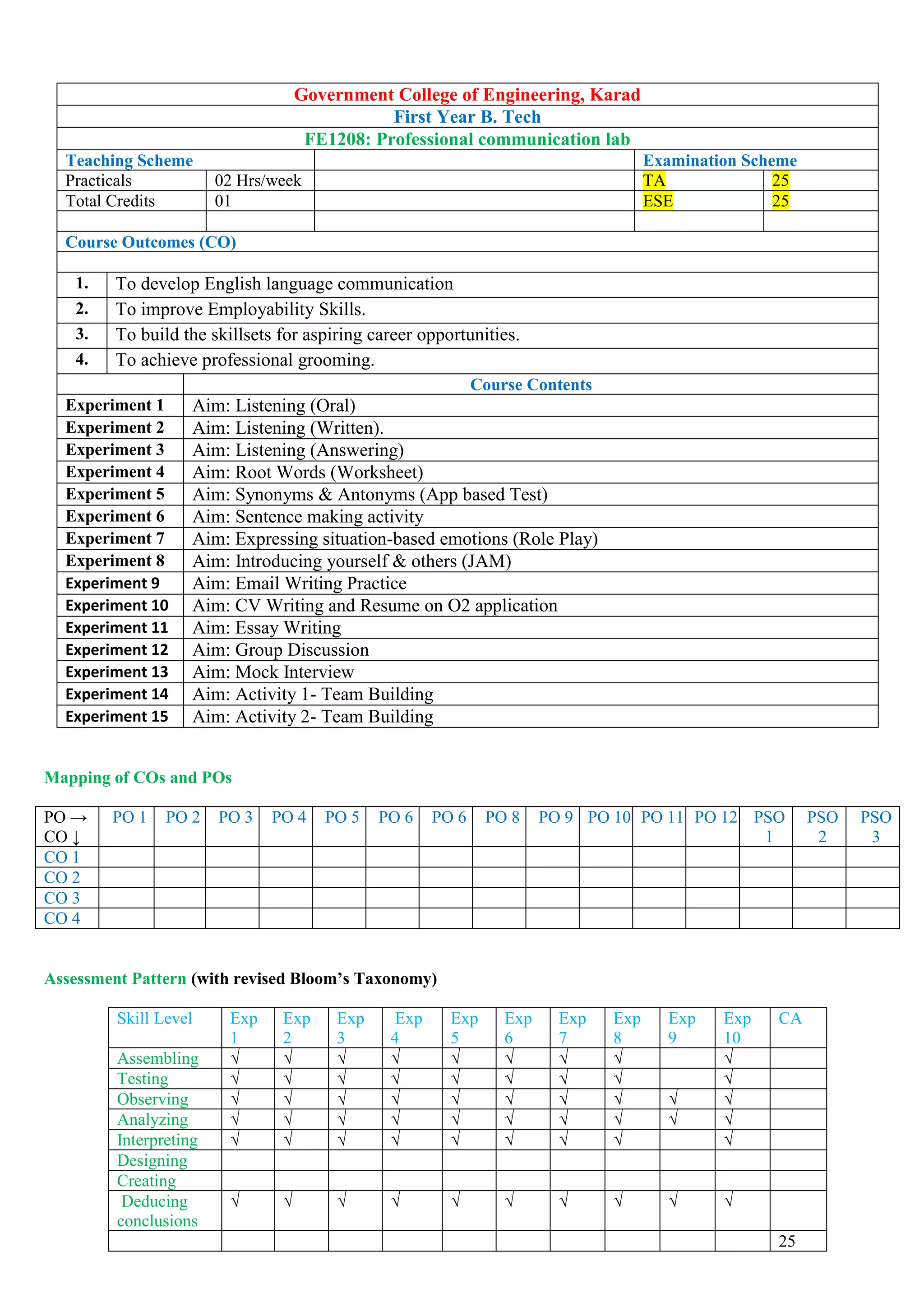
FE1208: Professional communication lab
Teaching Scheme Examination Scheme
Practicals 02 Hrs/week TA 25
Total Credits 01 ESE 25
Course Outcomes (CO)
1. To develop English language communication
2. To improve Employability Skills.
3. To build the skillsets for aspiring career opportunities.
4. To achieve professional grooming.
Course Contents
Experiment 1 Aim: Listening (Oral)
Experiment 2 Aim: Listening (Written).
Experiment 3 Aim: Listening (Answering)
Experiment 4 Aim: Root Words (Worksheet)
Experiment 5 Aim: Synonyms & Antonyms (App based Test)
Experiment 6 Aim: Sentence making activity
Experiment 7 Aim: Expressing situation-based emotions (Role Play)
Experiment 8 Aim: Introducing yourself & others (JAM)
Experiment 9 Aim: Email Writing Practice
Experiment 10 Aim: CV Writing and Resume on O2 application
Experiment 11 Aim: Essay Writing
Experiment 12 Aim: Group Discussion
Experiment 13 Aim: Mock Interview
Experiment 14 Aim: Activity 1- Team Building
Experiment 15 Aim: Activity 2- Team Building
Mapping of COs and POs
PO →
CO ↓
PO 1 PO 2 PO 3 PO 4 PO 5 PO 6 PO 6 PO 8 PO 9 PO 10 PO 11 PO 12 PSO
1
PSO
2
PSO
3
CO 1
CO 2
CO 3
CO 4
Assessment Pattern (with revised Bloom’s Taxonomy)
Skill Level Exp
1
Exp
2
Exp
3
Exp
4
Exp
5
Exp
6
Exp
7
Exp
8
Exp
9
Exp
10
CA
Assembling √ √ √ √ √ √ √ √ √
Testing √ √ √ √ √ √ √ √ √
Observing √ √ √ √ √ √ √ √ √ √
Analyzing √ √ √ √ √ √ √ √ √ √
Interpreting √ √ √ √ √ √ √ √ √
Designing
Creating
Deducing
conclusions
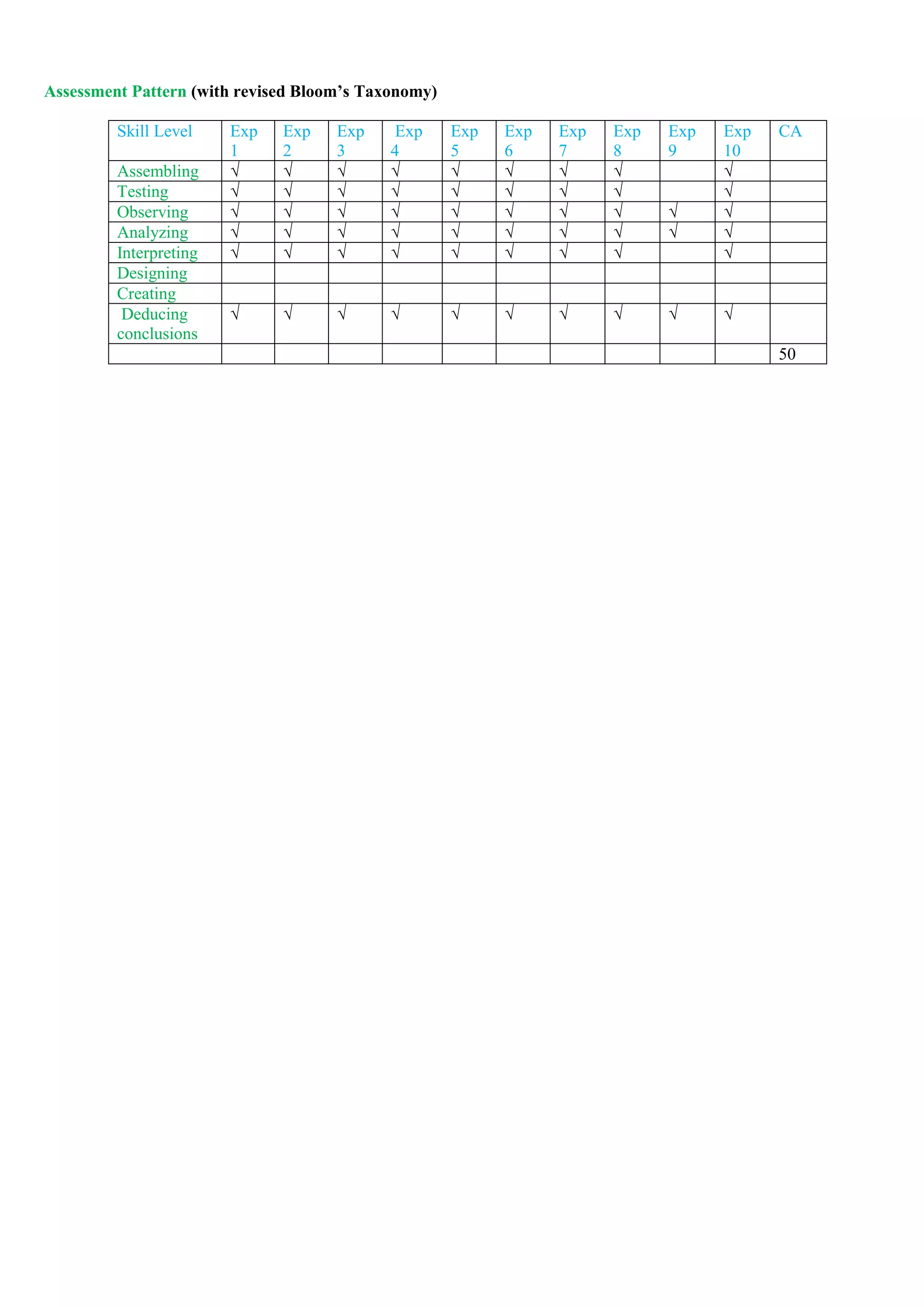
√ √ √ √ √ √ √ √ √ √
25
Government College of Engineering, Karad
First Year B. Tech
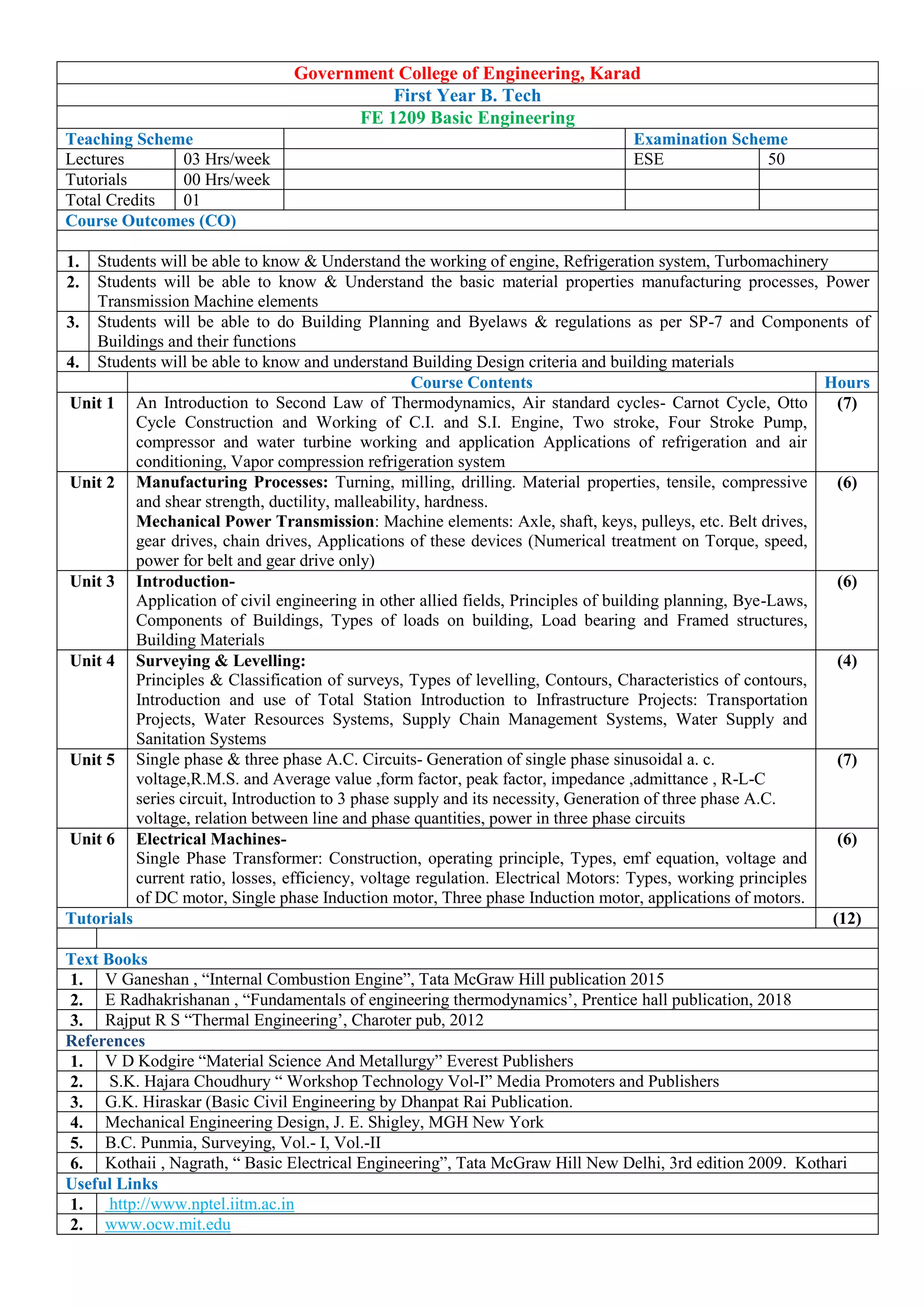
FE 1209 Basic Engineering
Teaching Scheme Examination Scheme
Lectures 03 Hrs/week ESE 50
Tutorials 00 Hrs/week
Total Credits 01
Course Outcomes (CO)
1. Students will be able to know & Understand the working of engine, Refrigeration system, Turbomachinery
2. Students will be able to know & Understand the basic material properties manufacturing processes, Power
Transmission Machine elements
3. Students will be able to do Building Planning and Byelaws & regulations as per SP-7 and Components of
Buildings and their functions
4. Students will be able to know and understand Building Design criteria and building materials
Course Contents Hours
Unit 1 An Introduction to Second Law of Thermodynamics, Air standard cycles- Carnot Cycle, Otto
Cycle Construction and Working of C.I. and S.I. Engine, Two stroke, Four Stroke Pump,
compressor and water turbine working and application Applications of refrigeration and air
conditioning, Vapor compression refrigeration system
(7)
Unit 2 Manufacturing Processes: Turning, milling, drilling. Material properties, tensile, compressive
and shear strength, ductility, malleability, hardness.
Mechanical Power Transmission: Machine elements: Axle, shaft, keys, pulleys, etc. Belt drives,
gear drives, chain drives, Applications of these devices (Numerical treatment on Torque, speed,
power for belt and gear drive only)
(6)
Unit 3 Introduction-
Application of civil engineering in other allied fields, Principles of building planning, Bye-Laws,
Components of Buildings, Types of loads on building, Load bearing and Framed structures,
Building Materials
(6)
Unit 4 Surveying & Levelling:
Principles & Classification of surveys, Types of levelling, Contours, Characteristics of contours,
Introduction and use of Total Station Introduction to Infrastructure Projects: Transportation
Projects, Water Resources Systems, Supply Chain Management Systems, Water Supply and
Sanitation Systems
(4)
Unit 5 Single phase & three phase A.C. Circuits- Generation of single phase sinusoidal a. c.
voltage,R.M.S. and Average value ,form factor, peak factor, impedance ,admittance , R-L-C
series circuit, Introduction to 3 phase supply and its necessity, Generation of three phase A.C.
voltage, relation between line and phase quantities, power in three phase circuits
(7)
Unit 6 Electrical Machines-
Single Phase Transformer: Construction, operating principle, Types, emf equation, voltage and
current ratio, losses, efficiency, voltage regulation. Electrical Motors: Types, working principles
of DC motor, Single phase Induction motor, Three phase Induction motor, applications of motors.
(6)
Tutorials (12)
Text Books
1. V Ganeshan , “Internal Combustion Engine”, Tata McGraw Hill publication 2015
2. E Radhakrishanan , “Fundamentals of engineering thermodynamics’, Prentice hall publication, 2018
3. Rajput R S “Thermal Engineering’, Charoter pub, 2012
References
1. V D Kodgire “Material Science And Metallurgy” Everest Publishers
2. S.K. Hajara Choudhury “ Workshop Technology Vol-I” Media Promoters and Publishers
3. G.K. Hiraskar (Basic Civil Engineering by Dhanpat Rai Publication.
4. Mechanical Engineering Design, J. E. Shigley, MGH New York
5. B.C. Punmia, Surveying, Vol.- I, Vol.-II
6. Kothaii , Nagrath, “ Basic Electrical Engineering”, Tata McGraw Hill New Delhi, 3rd edition 2009. Kothari
Useful Links
1. http://www.nptel.iitm.ac.in
2. www.ocw.mit.edu
Mapping of COs and POs
PO →
CO ↓
PO 1 PO 2 PO 3 PO 4 PO 5 PO 6 PO 6 PO 8 PO 9 PO 10 PO 11 PO 12 PSO
1
PSO
2
PSO
3
CO 1
CO 2
CO 3
CO 4

First_Year syllabus nep.pdf

  • 1.
    Government College ofEngineering, Karad SCHEME OF INSTRUCTION & SYLLABI Programme : ALL (Physics group) Scheme of Instruction for First Year of B. Tech. (UG) Degree in all Programmes Semester – I Mandatory 03-week Induction Program in the first semester for every student. Sr. No. Course Category Course Code Course Title L T P Contact Hrs/Wk Credits EXAM SCHEME CT1 CT2 TA/CA ESE TOTAL 1 BSC FE1101 Mathematics – I 3 1 - 4 4 15 15 10 60 100 2 BSC FE1102 Physics 3 1 - 4 4 15 15 10 60 100 3 ESC FE1103 Programming for Problem Solving 3 - - 3 3 15 15 10 60 100 4 ESC FE1104 Engineering Graphics and Design 1 - - 1 1 - - 50 - 50 5 BSC FE1105 Physics Lab - - 2 2 1 - - 25 25 50 6 ESC FE1106 Programming for Problem Solving Lab - - 4 4 2 - - 50 50 100 7 ESC FE1107 Engineering Graphics and Design Lab - - 4 4 2 - - 50 50 100 Total 10 02 10 22 17 45 45 205 305 600 L- Lecture T-Tutorial P-Practical CT1- Class Test 1 TA/CA- Teacher Assessment/Continuous Assessment CT2- Class Test 2 ESE- End Semester Examination (For Laboratory End Semester performance)
  • 2.
    Course Category HSMC(Hum., So. Sc, Mgmt.) BSC (Basic Sc.) ESC (Engg. Sc.) PCC (Programme Core courses) PEC (Programme Elective courses) OEC (Open Elective courses) MCC (Mandatory Courses) Project / Seminar / Industrial Training Credits -- 9 8 -- -- -- -- -- Cumulative Sum -- 9 8 -- -- -- -- -- TOTAL CREDITS=17
  • 3.
    Government College ofEngineering, Karad SCHEME OF INSTRUCTION & SYLLABI Programme: (Chemistry group) Scheme of Instruction for First Year of B. Tech. (UG) Degree in all Programmes Semester – I Sr. No. Course Category Course Code Course Title L T P Contact Hrs/Wk Credits EXAM SCHEME CT1 CT2 TA/CA ESE TOTAL 1 BSC FE1201 Mathematics – II 3 1 - 4 4 15 15 10 60 100 2 BSC FE1202 Chemistry 3 1 - 4 4 15 15 10 60 100 3 ESC FE1203 Engineering Mechanics 3 1 - 4 4 15 15 10 60 100 4 HSMC FE1204 Professional Communication 2 - - 2 2 15 15 10 60 100 5 BSC FE1205 Chemistry – I Lab - - 2 2 1 - - 25 25 50 6 ESC FE1206 Engineering Mechanics Lab - - 2 2 1 - - 50 50 100 7 ESC FE1207 Workshop Manufacturing Practices - - 4 4 2 - - 50 50 100 9 HMSC FE1208 Professional Communication Lab - - 2 2 1 - - 25 25 50 10 ESC FE1209 Basic Engineering 3 - - 3 1 - - - 50 50 Total 14 03 10 27 20 60 60 190 440 750 L- Lecture T-Tutorial P-Practical CT1- Class Test 1 TA/CA- Teacher Assessment/Continuous Assessment CT2- Class Test 2 ESE- End Course Category HSMC (Hum., So. Sc, Mgmt.) BSC (Basic Sc.) ESC (Engg. Sc.) PCC (Programme Core courses) PEC (Programme Elective courses) OEC (Open Elective courses) MCC (Mandatory Courses) Project / Seminar / Industrial Training Credits 03 09 08 -- -- -- -- -- Cumulative Sum 03 18 16 -- -- -- -- -- Semester Examination (For Laboratory End Semester performance) TOTAL CREDITS=17+20=37
  • 4.
    Government College ofEngineering, Karad First Year B. Tech FE1101: Engineering Mathematics-I Teaching Scheme Examination Scheme Lectures 03 Hrs/week CT – 1 15 Tutorials 01 Hrs/week CT – 2 15 Total Credits 04 TA 10 ESE 60 Duration of ESE 02 Hrs 30 Min Course Outcomes (CO) 1. To apply differential and integral calculus. Apart from some other applications they will have a basic understanding of Beta and Gamma functions 2. To apply Rolle‟s Theorem that is fundamental to application of analysis to Engineering problems 3. To apply the Fourier series for learning advanced Engineering Mathematics 4. To deal with functions of several variables those are essential in most branches of Engineering. To learn the essential tool of matrices and linear algebra in a comprehensive manner Course Contents Hours Unit 1 Matrices: Introduction to rank of a matrix; System of linear equations; Symmetric, Skew symmetric and Orthogonal matrices; Eigen values and Eigenvectors, Cayley-Hamilton Theorem, Diagonalization of matrices. (7) Unit 2 Differential and Integral Calculus: Rolle‟s Theorem, Mean value theorem, Taylor‟s and Maclaurin‟s theorem with remainders; Gamma function, Beta function and its properties (6) Unit 3 Partial Differentiation: Partial derivatives, Homogeneous functions and Euler‟s theorem, Composite function, total derivative; Method of Lagrange‟s multipliers, Errors and Approximations (6) Unit 4 Fourier series: Fourier series in the range (0, 2𝒍) 𝒂𝒏𝒅 (−𝒍, 𝒍) where 𝒍 is arbitrary, Dirichelet‟s conditions, Fourier Series for Even and Odd function, Half range sine and cosine series in the range (0, 𝒍) where 𝒍 is arbitrary, Parseval‟s identity (4) Unit 5 Vector Calculus: Scalar and vector point functions, Gradient of scalar point function, Directional Derivatives, Curl and Divergence of vector point functions. Solenoidal and irrotational force fields (7) Unit 6 Complex Number: Circular functions, Hyperbolic and Inverse Hyperbolic functions, logarithms of complex number, separation into real and imaginary parts of a complex number (6) Tutorials (12) Text Books 1. H.K.DAS “Advance Engineering Mathematics” S. Chand publications 2. Debashis Datta “Textbook of Engineering Mathematics‟‟ New Age International Publication 3. “Engineering Mathematics A Tutorial Approach”. Ravish R..Singh, Mukul Bhatt.Tata, McGraw Hill Reference Books 1. G.B. Thomas and R.L. Finney, Calculus and Analytic geometry, 9th Edition, Pearson, Reprint, 2002 2. Erwin kreyszig, Advanced Engineering Mathematics, 9th Edition, John Wiley & Sons,2006 3. Veerarajan T., Engineering Mathematics for first year, Tata McGraw-Hill, New Delhi,2008 4. Ramana B.V., Higher Engineering Mathematics, Tata McGraw Hill New Delhi, 11th Reprint, 2010. 5. D. Poole, Linear Algebra: A Modern Introduction, 2nd Edition, Brooks/Cole, 2005 6. B.S. Grewal, Higher Engineering Mathematics, Khanna Publishers, 36th Edition, 2010 Useful Links 1. http://www.nptel.iitm.ac.in 2. www.ocw.mit.edu
  • 5.
    Mapping of COsand POs PO → CO ↓ PO 1 PO 2 PO 3 PO 4 PO 5 PO 6 PO 6 PO 8 PO 9 PO 10 PO 11 PO 12 PSO 1 PSO 2 PSO 3 CO 1 CO 2 CO 3 CO 4 Assessment Pattern (with revised Bloom’s Taxonomy) Knowledge Level CT 1 CT 2 TA ESE Remember √ √ √ √ Understand √ √ √ √ Apply √ √ √ √ Analyse √ √ √ √ Evaluate √ √ √ √ Create √ TOTAL 15 15 10 60
  • 6.
    Government College ofEngineering, Karad First Year B. Tech FE1102: Engineering Physics Teaching Scheme Examination Scheme Lectures 03 Hrs/week CT – 1 15 Tutorials 01 Hrs/week CT – 2 15 Total Credits 04 TA 10 ESE 60 Duration of ESE 02 Hrs 30 Min Course Outcomes (CO) 1. To Analyze Crystal Structure and understand basics of Quantum Physics for Engineering. 2. To understand Wave Optics, LASER and Sound for application in Engineering Technology. 3. To build a foundation of Superconductivity and Nuclear Energy 4. To implement the preface of Nano and its recent need in Engineering Technology. Course Contents Hours Unit 1 Crystallography: Introduction (Lattice point, Space lattice, Basis, Crystalline solid), Unit cell- Primitive and non- primitive, Bravais Lattice, Seven crystal systems (Interfacial angle, axial length Bravais Lattice and examples with diagram), properties of unit cell, Centre of symmetry, plane of symmetry, Axis of symmetry Symmetry elements of cube, relation between density and lattice constant, Miller indices and sketches for different planes, Laue Method, Bragg‟s law and Bragg‟s Spectrometer, X-ray diffraction by powder method, Problems (7) Unit 2 Quantum Physics Introduction to Quantum mechanics, Plank‟s Quantum Theory, Photoelectric Effect, Compton Effect with theory, Wave Particles Duality, Matter waves, Properties of Matter wave, Heisenberg Uncertainty principle for position and momentum of particle, Problems. (6) Unit 3 Wave optics and sound: Interference of light, Young‟s double slit experiment, Newton‟s rings. Farunhofer diffraction from a single slit, Rayleigh criterion; Diffraction gratings and its theory and their resolving power, Polarization, optical activity, Lorentz Half shade Polarimeter, Problems, Ultrasonic waves, Magnetostriction oscillator and Piezoelectric Oscillator, Applications (6) Unit 4 LASER: Introduction, Absorption, Spontaneous Emission, Stimulated Emission, Population Inversion, Solid- state lasers (ruby), Properties of laser beams: applications of lasers in science, engineering and medicine, Holography. (4) Unit 5 Superconductivity and Nuclear energy Introduction, Property of superconductor, Meissner Effect, Type I and Type II superconductor, Josephsons Effect, Applications, Nuclear Energy, Fusion (P-P chain and C-N Cycle), Fission,Chain Reaction, Nuclear Fission Reactor, Numerical Problems. (7) Unit 6 Nano science and Nano technology Introduction(nano material, nano science, nano technology), Significance of Nanoscale and properties, techniques for production of nano materials (Physical and chemical methods), Characterization- scanning tunneling microscopy and Atomic force microscopy, Application of nano technology, Carbon Nanotube (6) Tutorials (12) Text Books 1. V. Rajendran– Engineering Physics- Mc. Graw Hills 2. Vijaya kumari- Engineering Physics-Vikas publication 3. B. K. Pandey and S. Chaturvedi- Engineering Physics, Cengage Learning-2012 Reference Books 1. S. O. Pillai, Solid State Physics : Structure & Electron Related Properties, Eastern Ltd,, New Age International Ltd. 2. Charles Kittle, Introduction to Solid State Physics - Wiley India Pvt. Ltd.(8th Edtion). 3. Alan Giambattista and others- Fundamentals of physics, Tata Mc. Graw Hills
  • 7.
    4. Resnick Halliday,Physics Volume-I, Krane -John Wiley & Sons Pub. 5. B. L. Theraja -Modern Physics - S. Chand & Company Ltd., Delhi. 6. R. K. Gaur & Gupta S. L, Engineering Physics -Dhanapat Rai Publication. 7. Sanjay D Jain, Girish G. Sahasrabuddhe - Engineering Physics, Universities Press 8. LASERS Theory and Applications – K. Thyagarajan, A. K. Ghatak; Macmillan India Limited. 9. Quantum Mechanics – L. J. Schiff; Mc-Graw Hill International Edition. 10. A Text Book of Optics – N. Subramanyam & Brijlal; (Vikas Publishing House Pvt.Ltd) Useful Links 1. en.wikipedia.org/wiki/Fundamentals_of_Physics 2. www.hyperphysics.com, www.google.com 3. physics.info/magnetism, www.youtube.com, Nptl video Mapping of COs and POs PO → CO ↓ PO 1 PO 2 PO 3 PO 4 PO 5 PO 6 PO 6 PO 8 PO 9 PO 10 PO 11 PO 12 PSO 1 PSO 2 PSO 3 CO 1 CO 2 CO 3 CO 4 Assessment Pattern (with revised Bloom’s Taxonomy) Knowledge Level CT 1 CT 2 TA ESE Remember √ √ √ √ Understand √ √ √ √ Apply √ √ √ √ Analyse √ √ √ √ Evaluate √ √ √ √ Create √ TOTAL 15 15 10 60
  • 8.
    Government College ofEngineering, Karad First Year B. Tech FE1103: Programming for Problem Solving Teaching Scheme Examination Scheme Lectures 03 Hrs/week CT – 1 15 Tutorials 00 Hrs/week CT – 2 15 Total Credits 03 TA 10 ESE 60 Duration of ESE 02 Hrs 30 Min Course Outcomes (CO) 1. Students will able to do an algorithm for solving problems. 2. To test and execute the programs and correct syntax and logical errors. 3. Students will able to implement the concepts of function arrays and string. 4. Students will able to apply the concepts of structure and pointers Course Contents Hours Unit 1 Introduction to Programming- Introduction to components of a computer system. Idea of Algorithm: steps to solve logical and numerical problems. Representation of Algorithm: Flowchart/Pseudocode with examples (7) Unit 2 Introduction to C language – Importance of „C‟ Language, Sample „C‟ Program, Structure of „C‟ Program, Constants, variables and data types. Operators and expressions, managing input / output operations, Decision making, branching and loop statements, Storage classes, Functions, need for user defined functions, elements of User defined functions, defining functions, return values and their types, function calls, function declaration, methods of parameter passing, (6) Unit 3 Arrays and String – Declaration and initialization of arrays, one dimensional and two-dimensional arrays, reading, writing and manipulation of above types of arrays, multidimensional arrays. Recursion, Declaring and initialing string variables, reading string from terminal, writing string to screen, string handling functions. Passing array and string to function (6) Unit 4 Structure- Defining and declaring structure, accessing structure members, structure initialization, array of structures, nesting of structure structures and functions, union and enumeration (4) Unit 5 Pointer- Defining and declaring pointers, accessing the address space of a variable, declaring and initialization pointer variables, accessing a variable through its pointer, pointer as a function argument, pointer expressions, pointers to arrays, strings and structure, self-referential structures example of linked list, Dynamic memory allocation (7) Unit 6 File Handling- File Operations, Character I/O, String I/O, Formatted I/O, Block I/O, Random File Operations (6) Tutorials (12) Text Books 1. Programming in ANSI C 6th edition by E. Balguruswami – Tata McGraw Hill 2. Let us C by Yashvant Kanetkar- BPB publications 3. Reference Books 1. The „C‟ Programming Language, By B.W. Kernigghan and D. M. Ritchie, Pearson Education. 2. Programming And Problem Solving Using C Language, ISRD Group, McGraw-Hill Publications 3. Byron Gottfried, Schaum's Outline of Programming with C, McGraw-Hill Useful Links 1. http://cse02-iiith.vlabs.ac.in/ 2. http://nptel.ac.in/courses/106106127
  • 9.
    Mapping of COsand POs PO → CO ↓ PO 1 PO 2 PO 3 PO 4 PO 5 PO 6 PO 6 PO 8 PO 9 PO 10 PO 11 PO 12 PSO 1 PSO 2 PSO 3 CO 1 CO 2 CO 3 CO 4 Assessment Pattern (with revised Bloom’s Taxonomy) Knowledge Level CT 1 CT 2 TA ESE Remember √ √ √ √ Understand √ √ √ √ Apply √ √ √ √ Analyse √ √ √ √ Evaluate √ √ √ √ Create √ TOTAL 15 15 10 60
  • 10.
    Government College ofEngineering, Karad First Year B. Tech. FE 1104: Engineering Graphics & Design Teaching Scheme Examination Scheme Lectures 01 Hrs/week CA/TA 50 Total Credits 01 Course Outcomes (CO) At the end of course 1. Students will be able to understand the use engineering drawing skills as a means of accurately and clearly communicating ideas, information and instructions in different engineering disciplines. (Blooms Level 1 & 2) 2. Students will be able to demonstrate the use of different types of drawing instruments, use of symbols and conventions in engineering drawing (Blooms level 3) 3. Students will be able to draw projections of lines, different types of planes, Solids, Orthographic, Isometric projections of simple objects. (Blooms cognitive level 2 & 3) 4. Students will acquire requisite lifelong knowledge, techniques and attitude required for advanced study of engineering drawing (Blooms cognitive level 3) Detailed contents Traditional Engineering Graphics: Principles of Engineering Graphics; Orthographic Projection; Descriptive Geometry; Drawing Principles; Isometric Projection; Perspective; Reading a Drawing; True Length, Angle; Section of solids. Total of 10 Lecture Hours & 60 Hours of Lab (Except the basic essential concepts, most of the teaching part can happen concurrently in the laboratory) Course Contents Hours Unit 1 Introduction to Engineering Drawing Covering Principles of Engineering Graphics and their significance, usage of Drawing instruments, lettering, Conic sections (using General focus-directrix method only); Cycloid (excluding Epicycloid, Hypocycloid) and Involute; (02) Unit 2 Orthographic Projections Covering, Points & Lines Principles of Orthographic Projections-Conventions; Projections of Points and lines inclined to both planes (line in first quadrant only, Traces theory only); (02) Unit 3 Projections of Regular Planes Covering, Projections of inclined Planes resting on HP only; (Auxiliary planes theoretical only) (excluding freely suspended planes) (02) Unit 4 Projections of Regular Solids Covering, Projection of Prisms, Pyramids, and cylinder inclined to both reference planes, solids in first quadrant and resting on HP only. (Excluding frustum, tetrahedron and sphere) (excluding freely suspended solids) (02) Unit 5 Projections of Regular Sectional Solids Covering, Sections and Sectional Views of Right Angular Solids covering, Prism, Cylinder, Pyramid, Cone – Auxiliary Views; (02) Unit 6 Isometric Projections Covering Principles of Isometric projection – Isometric Scale, Isometric Views, Conventions; Isometric Views of lines, Planes, Simple and compound Solids; Conversion of Isometric Views to Orthographic Views and Vice-versa for simple solids only; (02) CA/TA will be based on Successful submission of Drawing sheets as per listed below Sheet No 1: Engineering Curves Sheet No 2: Projections of Points & Lines Sheet No 3: Projections of Planes Sheet No 4: Projections of Solids Sheet No 5: Projections of Section of Solids Sheet No 6: Isometric Projections of Simple solids Sheet No 7: Orthographic Projection of Simple components (optional) Text Books 1. Bhatt N.D., Panchal V.M. & Ingle P.R., (2018), Engineering Drawing, Charotar Publishing House 2. Shah, M.B. & Rana B.C. (2008), Engineering Drawing and Computer Graphics, Pearson Education
  • 11.
    3. Agrawal B.& Agrawal C. M. (2012), Engineering Graphics, TMH Publication 4. Dhananjay A Jolhe, Engineering Drawing with an introduction to AutoCAD, TMH Publication 5. P. S. Gill, Engineering Drawing, S. K. Katariya & sons Publication Reference Books 1. Cencil Jenson, Jay D. Helsel, D. R. Short, Engineering Drawing & Design, TMH Pub 2. M. L. Dabhade, Engineering Graphics, Vision Publication 3. Kristie Plantenberg, Engineering Graphics Essentials, University of Detroit Mercy, SDC Publication 4. AutoCAD 2016 for Engineers & Designers, 22nd edition Vol 1 & 2; Prof. Sham Tickoo, Dreamtech Press Useful Links 1. https://nptel.ac.in/courses/112103019/ 2. https://www.standardsmedia.com/IS-SP-46--Engineering-Drawing-Practice-for-Schools-and-Colleges-4915- book.html 3. http://www.engineering108.com/ Mapping of COs and POs PO → CO ↓ PO 1 PO 2 PO 3 PO 4 PO 5 PO 6 PO 7 PO 8 PO 9 PO 10 PO 11 PO 12 PSO 1 PSO 2 PSO 3 CO 1   CO 2   CO 3     CO 4        Assessment Pattern (with revised Bloom’s Taxonomy) Knowledge Level CT 1 CT 2 TA ESE Remember 10 Understand 10 Apply 10 Analyse 10 Evaluate - Create 10 TOTAL 50
  • 12.
    Government College ofEngineering, Karad First Year B. Tech FE1105: Engineering Physics Lab Teaching Scheme Examination Scheme Practical 02 Hrs/week CA 25 Total Credits 01 ESE 25 Course Outcomes (CO) 1. To Hands on experience of crystal structure and its understand synthesis and characterization of Nano materials 2. To understand Relevance of Ultrasonic waves and build a basic foundation with Solar and Wind Energy Trainer. 3. To analyze behavior of light by Interference, Diffraction , Polarization and LASER 4. To Verify photoelectric effect and Hall Effect. Course Contents Experiment 1 Aim: Study of Seven crystal structure and symmetry elements of cubic. Experiment 2 Aim: Study of Planes with the help of models related Miller Indices. Experiment 3 Aim: Determine velocity of ultrasonic waves in liquid medium by interferometer. Experiment 4 Aim: Find an object by Ultrasonic waves Experiment 5 Aim: Calculation of divergence of LASER beam. Experiment 6 Aim: Determination of wavelength of LASER using diffraction grating. Experiment 7 Aim: To study interference pattern by Newtons ring Experiment. Experiment 8 Aim: To determine the specific rotation of the given sample with the help of Polarimeter. Experiment 9 Aim: To Calculate Resolving power of Telescope Experiment 10 Aim: Verification of inverse square law of intensity of light/Photoelectric effect. Experiment 11 Aim: Study introductory Nanokit Experiment 12 Aim: To synthesize nano particals by spray Pyrolysis/CVD method Experiment 13 Aim: To study behavior of material with temperature by TGDTA. Experiment 14 Aim: Hall effect in Semiconductor Experiment 15 Aim: Determination of energy gap in semiconductor. Experiment 16 Aim: To study Fundamental of Solar Energy trainer/Wind energy Trainer List of Submission 1 Total number of Experiments = 10 Mapping of COs and POs PO → CO ↓ PO 1 PO 2 PO 3 PO 4 PO 5 PO 6 PO 6 PO 8 PO 9 PO 10 PO 11 PO 12 PSO 1 PSO 2 PSO 3 CO 1 CO 2 CO 3 CO 4
  • 13.
    Assessment Pattern (withrevised Bloom’s Taxonomy) Skill Level Exp 1 Exp 2 Exp 3 Exp 4 Exp 5 Exp 6 Exp 7 Exp 8 Exp 9 Exp 10 CA Assembling √ √ √ √ √ √ √ √ √ Testing √ √ √ √ √ √ √ √ √ Observing √ √ √ √ √ √ √ √ √ √ Analyzing √ √ √ √ √ √ √ √ √ √ Interpreting √ √ √ √ √ √ √ √ √ Designing Creating Deducing conclusions √ √ √ √ √ √ √ √ √ √ 25
  • 14.
    Government College ofEngineering, Karad First Year B. Tech FE1106: Programming for Problem Solving Lab Teaching Scheme Examination Scheme Practical 04 Hrs/week CA 50 Total Credits 02 ESE 50 Course Outcomes (CO) 1. Able to implement basic c programming concepts 2. Able to Analyse program behaviour and errors for different set of inputs 3. Able to solve various problem statements by using c programming Course Contents Experiment 1 Introduction to various components of programming environment Experiment 2 Program for basic arithmetic operations like addition, subtraction, multiplication, division and expressions solving Experiment 3 Program for calculator which performs basic arithmetic operations like addition, subtraction, multiplication, division of a two number by using if else and switch case Experiment 4 Program for Finding factorial of a number provided by the user. Experiment 5 Program for calculating area of circle, triangle, rectangle, square by passing argument to a functions. Experiment 6 Program for finding smallest and largest numbers from given 3 numbers from array. Experiment 7 Program for searching numbers from given numbers from array by using linear and binary search. Experiment 8 Program for performing matrix operation addition, subtraction using array. Experiment 9 Program for performing string operations using string handling functions Experiment 10 Program for storing and displaying Employee record using array of structure. Experiment 11 Program for passing structure as an argument to a function Experiment 12 Program for Swapping of two numbers using call by value and call by reference Experiment 13 Program for demonstration of dynamic memory allocation using various functions. Experiment 14 Program for simple read and write operations on file using character and string I/O. Experiment 15 Program for performing read and write operations on file using random file operation. List of Submission 1 Total number of Experiments = 15 Mapping of COs and POs PO → CO ↓ PO 1 PO 2 PO 3 PO 4 PO 5 PO 6 PO 6 PO 8 PO 9 PO 10 PO 11 PO 12 PSO 1 PSO 2 PSO 3 CO 1 CO 2 CO 3 CO 4
  • 15.
    Assessment Pattern (withrevised Bloom’s Taxonomy) Skill Level Exp 1 Exp 2 Exp 3 Exp 4 Exp 5 Exp 6 Exp 7 Exp 8 Exp 9 Exp 10 CA Assembling √ √ √ √ √ √ √ √ √ Testing √ √ √ √ √ √ √ √ √ Observing √ √ √ √ √ √ √ √ √ √ Analyzing √ √ √ √ √ √ √ √ √ √ Interpreting √ √ √ √ √ √ √ √ √ Designing Creating Deducing conclusions √ √ √ √ √ √ √ √ √ √ 50
  • 16.
    Government College ofEngineering, Karad First Year B. Tech. FE 1107: Engineering Graphics & Design Lab Teaching Scheme Examination Scheme Practical 04 Hrs/week CA/TA 50 Tutorials - ESE 50 Total Credits 02 Course Outcomes (CO) At the end of lab course 1. Student will be able understand the basic principles of Technical/Engineering Drawing to improve the visualization skills using drafting software (Blooms cognitive level 1 & 2) 2. Student will be able to establish the relationship between traditional drafting technique and computer aided drafting (Blooms cognitive level 3) 3. The ability to demonstrates ideas and design concepts using drafting software. (Blooms cognitive level 2 & 3) 4. Students will acquire requisite lifelong knowledge, techniques and attitude required for advanced study of engineering drawing by using CAD software‟s (Blooms cognitive level 3) Detailed contents Computer Graphics: Engineering Graphics Software; -Spatial Transformations; Orthographic Projections; Model Viewing; Co-ordinate Systems; Multi-view Projection; Exploded Assembly; Model Viewing; Animation; Spatial Manipulation; Surface Modelling; Solid Modelling; Introduction to Building Information Modelling (BIM)Angle; intersection. Course Contents Hours Unit 1 Overview of Computer Graphics covering, listing the computer technologies that impact on graphical communication, Demonstrating knowledge of the theory of CAD software [such as: The Menu System, Toolbars (Standard, Object Properties, Draw, Modify and Dimension), Drawing Area (Background, Crosshairs, Coordinate System), Dialog boxes and windows, Shortcut menus (Button Bars), The Command Line (where applicable), The Status Bar, Different methods of zoom as used in CAD, Select and erase objects.; Isometric Views of lines, Planes, Simple and compound Solids]; (05) Unit 2 Customisation & CAD Drawing consisting of set up of the drawing page and the printer, including scale settings, Setting up of units and drawing limits; ISO and ANSI standards for coordinate dimensioning and tolerancing; Orthographic constraints, Snap to objects manually and automatically; Producing drawings by using various coordinate input entry methods to draw straight lines, Applying various ways of drawing circles; (05) Unit 3 Annotations, layering & other functions covering applying dimensions to objects, applying annotations to drawings; Setting up and use of Layers, layers to create drawings, Create, edit and use customized layers; Changing line lengths through modifying existing lines (extend/lengthen); Printing documents to paper using the print command; (05) Unit 4 Orthographic projection techniques; Drawing sectional views of composite right regular geometric solids and project the true shape of the sectioned surface; Drawing annotation (05) Unit 5 Planar projection theory, including sketching of isometric, multi-view, section views. Dimensioning guidelines, tolerancing techniques; dimensioning and scale multi views of dwelling; (05) Unit 6 Demonstration of a simple team design project Geometry and topology of engineered components: creation of engineering models and their presentation in standard 2D blueprint form and as 3D wire-frame and shaded solids. Use of solid- modelling software for creating associative models at the component and assembly levels; floor plans that include: windows, doors, and fixtures such as WC, bath, sink, shower, etc. (05) List of submission Experiment 1 Study of capabilities of software for Drafting and Modelling – Coordinate systems (absolute, relative, polar, etc.) – Creation of simple figures like polygon and general multi-line figures.
  • 17.
    Experiment 2 Drawingof a Title Block with necessary text and projection symbol Experiment 3 Drawing of curves like parabola, spiral, involute using B-spline or cubic spline. Experiment 4 Drawing of front view and top view of simple solids like prism, pyramid, cylinder, etc., and dimensioning. Experiment 5 Drawing front view, top view and side view of objects from the given pictorial views (e.g. simple 3D Objects with hole and curves). Experiment 6 Drawing a plan of residential building (Two bed rooms, kitchen, hall, etc. Experiment 7 Drawing of a simple steel truss. Experiment 8 Drawing isometric projection of simple objects Text Books 1. AutoCAD 2016 for Engineers & Designers, 22nd edition Vol 1 & 2; Prof. Sham Tickoo, Dreamtech Press Reference Books 1. (Corresponding set of) CAD Software Theory and User Manuals Mapping of COs and POs PO → CO ↓ PO 1 PO 2 PO 3 PO 4 PO 5 PO 6 PO 7 PO 8 PO 9 PO 10 PO 11 PO 12 PSO 1 PSO 2 PSO 3 CO 1    CO 2   CO 3     CO 4       Assessment Pattern (with revised Bloom’s Taxonomy) Knowledge Level CT 1 CT 2 TA ESE Remember 20 10 Understand 10 20 Apply 10 10 Analyse 10 10 Evaluate - - Create - - TOTAL 50 50
  • 18.
    Government College ofEngineering, Karad SCHEME OF INSTRUCTION & SYLLABI Programme: (Physics group) Scheme of Instruction for First Year of B. Tech. (UG) Degree in all Programmes Semester – II Sr. No. Course Category Course Code Course Title L T P Contact Hrs/Wk Credits EXAM SCHEME CT1 CT2 TA/CA ESE TOTAL 1 BSC FE1201 Mathematics – II 3 1 - 4 4 15 15 10 60 100 2 BSC FE1202 Chemistry 3 1 - 4 4 15 15 10 60 100 3 ESC FE1203 Engineering Mechanics 3 1 - 4 4 15 15 10 60 100 4 HSMC FE1204 Professional Communication 2 - - 2 2 15 15 10 60 100 5 BSC FE1205 Chemistry – I Lab - - 2 2 1 - - 25 25 50 6 ESC FE1206 Engineering Mechanics Lab - - 2 2 1 - - 50 50 100 7 ESC FE1207 Workshop Manufacturing Practices - - 4 4 2 - - 50 50 100 9 HMSC FE1208 Professional Communication Lab - - 2 2 1 - - 25 25 50 10 ESC FE1209 Basic Engineering 3 - - 3 1 - - - 50 50 Total 14 03 10 27 20 60 60 190 440 750 L- Lecture T-Tutorial P-Practical CT1- Class Test 1 TA/CA- Teacher Assessment/Continuous Assessment CT2- Class Test 2 ESE- End Course Category HSMC (Hum., So. Sc, Mgmt.) BSC (Basic Sc.) ESC (Engg. Sc.) PCC (Programme Core courses) PEC (Programme Elective courses) OEC (Open Elective courses) MCC (Mandatory Courses) Project / Seminar / Industrial Training Credits 03 09 08 -- -- -- -- -- Cumulative Sum 03 18 16 -- -- -- -- -- Semester Examination (For Laboratory End Semester performance) TOTAL CREDITS=17+20=37
  • 19.
    Government College ofEngineering, Karad SCHEME OF INSTRUCTION & SYLLABI Programme : ALL (Chemistry group) Scheme of Instruction for First Year of B. Tech. (UG) Degree in all Programmes Semester – I Mandatory 03-week Induction Program in the first semester for every student. Sr. No. Course Category Course Code Course Title L T P Contact Hrs/Wk Credits EXAM SCHEME CT1 CT2 TA/CA ESE TOTAL 1 BSC FE1101 Mathematics – I 3 1 - 4 4 15 15 10 60 100 2 BSC FE1102 Physics 3 1 - 4 4 15 15 10 60 100 3 ESC FE1103 Programming for Problem Solving 3 - - 3 3 15 15 10 60 100 4 ESC FE1104 Engineering Graphics and Design 1 - - 1 1 - - 50 - 50 5 BSC FE1105 Physics Lab - - 2 2 1 - - 25 25 50 6 ESC FE1106 Programming for Problem Solving Lab - - 4 4 2 - - 50 50 100 7 ESC FE1107 Engineering Graphics and Design Lab - - 4 4 2 - - 50 50 100 Total 10 02 10 22 17 45 45 205 305 600 L- Lecture T-Tutorial P-Practical CT1- Class Test 1 TA/CA- Teacher Assessment/Continuous Assessment CT2- Class Test 2 ESE- End Semester Examination (For Laboratory End Semester performance) Course Category HSMC (Hum., So. Sc, Mgmt.) BSC (Basic Sc.) ESC (Engg. Sc.) PCC (Programme Core courses) PEC (Programme Elective courses) OEC (Open Elective courses) MCC (Mandatory Courses) Project / Seminar / Industrial Training Credits -- 9 8 -- -- -- -- -- Cumulative Sum -- 9 8 -- -- -- -- -- TOTAL CREDITS=17
  • 20.
    Government College ofEngineering, Karad First Year B. Tech FE1201: Engineering Mathematics-II Teaching Scheme Examination Scheme Lectures 03 Hrs/week CT – 1 15 Tutorials 01 Hrs/week CT – 2 15 Total Credits 04 TA 10 ESE 60 Duration of ESE 02 Hrs 30 Min Course Outcomes (CO) 1. Use mathematical tools needed in evaluating multiple integrals and their usage 2. Apply effective mathematical tools for the solutions of differential equations that model physical processes 3. Use tools of differentiation and integration of functions of a complex variable that are used in various techniques dealing engineering problems 4. To learn Integral calculus which would enable students to find engineering solutions for given situations they may encounter in their profession. Course Contents Hours Unit 1 First Order Ordinary Differential Equations: Exact equations, Integrating Factor, Equations reducible to Exact, linear and Bernoulli’s equations, Applications to simple Electrical circuits, Mechanics (7) Unit 2 Linear Differential Equations with Constant Coefficients: Linear differential equations with constant coefficients, Methods to find C.F. and P.I. Method to find Particular Integral by shortcut method, method of variation of parameters, Cauchy-Euler equation. Legendre’s Equations (6) Unit 3 Function of Complex Variable: Differentiation: Calculus of functions of complex variable, Cauchy-Riemann equations, analytic functions, harmonic functions, finding harmonic conjugate; zeros of analytic functions, singularities, Integration: Cauchy’s Theorem, Cauchy Integral formula (without proof), Cauchy Residue theorem (without proof) (6) Unit 4 Numerical Methods: Solution of Ordinary differential equations: by Taylor’s Series, Picard’s Method. Runge-Kutta fourth order method for solving first order differential equations. Trapezoidal rule and Simpson’s 1/3rd and 3/8 rules (4) Unit 5 Multivariable Calculus: Double integration (Cartesian and Polar coordinates), Change of order of double integration. Triple integration (Cartesian, spherical polar, cylindrical polar coordinates) (7) Unit 6 Applications to Multiple Integrals : Area and Volume. (6) Tutorials (12) Text Books 1. H.K.DAS “Advance Engineering Mathematics” S. Chand publications 2. Debashis Datta “Textbook of Engineering Mathematics’’ New Age International Publication 3. “Engineering Mathematics A Tutorial Approach”. Ravish R..Singh, Mukul Bhatt.Tata, McGraw Hill Reference Books 1. G.B. Thomas and R.L. Finney, Calculus and Analytic geometry, 9th Edition, Pearson, Reprint, 2002 2. Erwin kreyszig, Advanced Engineering Mathematics, 9th Edition, John Wiley & Sons,2006 3. Veerarajan T., Engineering Mathematics for first year, Tata McGraw-Hill, New Delhi,2008 4. Ramana B.V., Higher Engineering Mathematics, Tata McGraw Hill New Delhi, 11th Reprint, 2010. 5. D. Poole, Linear Algebra: A Modern Introduction, 2nd Edition, Brooks/Cole, 2005 6. B.S. Grewal, Higher Engineering Mathematics, Khanna Publishers, 36th Edition, 2010 Useful Links 1. http://www.nptel.iitm.ac.in 2. www.ocw.mit.edu
  • 21.
    Mapping of COsand POs PO → CO ↓ PO 1 PO 2 PO 3 PO 4 PO 5 PO 6 PO 6 PO 8 PO 9 PO 10 PO 11 PO 12 PSO 1 PSO 2 PSO 3 CO 1 CO 2 CO 3 CO 4 Assessment Pattern (with revised Bloom’s Taxonomy) Knowledge Level CT 1 CT 2 TA ESE Remember √ √ √ √ Understand √ √ √ √ Apply √ √ √ √ Analyse √ √ √ √ Evaluate √ √ √ √ Create √ TOTAL 15 15 10 60
  • 22.
    Government College ofEngineering, Karad First Year B. Tech FE1202 Engineering Chemistry Teaching Scheme Examination Scheme Lectures 03 Hrs/week CT – 1 15 Tutorials 01 Hrs/week CT – 2 15 Total Credits 04 TA 10 ESE 60 Duration of ESE 02 Hrs 30 Min Course Outcomes (CO) 1. Student will able to know Qualitative and Quantitative analysis of compound. Students will able to know new analytical techniques will be compared with classical methods 2. Study of synthesis of nanomaterials and its uses in medical and engineering fields and their use in nonconventional energy sources in present context. 3. Study of phase rule will able to student to study the effect of temperature and pressure on chemical substance 4. Students will able to know the nanomaterials and their applications by using know principles of green chemistry i.e. use of environmentally benign chemistry Course Contents Hours Unit 1 Qualitative and Quantitative methods of Analysis Introduction, Chemical analysis and its types, no instrumental methods- Titrimetric and types, Gravimetry and its application, Instrumental Methods- Electromagnetic spectrum and it’s characteristics, interaction of Electromagnetic radiations with matter, Principle, Instrumentation, calibration, working and applications of UV-Visible, Atomic Absorption, Infrared Spectroscopy (7) Unit 2 Phase Rule Gibb’s Phase rule- statement and explanation of term involved in With example, one component system-Water system, Reduced Phase rule, simple eutectic system i.e Pb-Ag and Bi-Cd, Diagram of iron carbon system (6) Unit 3 Corrosion Introduction, causes, classification, atmospheric corrosion (oxidation corrosion), electrochemical corrosion (hydrogen evolution and oxygen absorption mechanism), factors affecting rate of corrosion. Prevention of corrosion by proper design and material selection, Protection from corrosion – Cathodic and anodic protection (6) Unit 4 Nanomaterials- Introduction, Nanomaterials- preparation of CNT by different methods, CNT properties and applications, characterization method for Nano materials, SEM (Scanning Electron Microscope), AFM (Atomic Force Microscopy), STM ('Scanning Tunneling Microscopy) (4) Unit 5 Environmental & Green Chemistry Air, water and noise pollution. Optimum levels of pollution. Significance and determination of COD and BOD. Solid waste treatment of collection of NKP. Greenhouse effect and global Warming. e- Waste. Radioactive pollution. Applications of green chemistry and green technology. Concept of atomic and molecular economy and its use in green chemistry. (7) Unit 6 Energy Science Fuel, classification, characteristics of good fuel, comparison between solid, liquid, gaseous fuel. Calorific value, low and high calorific value, units of calorific value, determination of calorific value by Bomb and Boy’s calorimeter, fuel cell and it’s types, applications, Thermal analysis and it’s types – Principle, instrumentation, working and applications of thermo gravimetric analysis. (6) Tutorials (12) Text Books 1. Engineering Chemistry by Jain and Jain, Dhanpat Rai Publishing Company Ltd., New Delhi. 2. A Textbook of Engineering Chemistry by S. S. Dara and S. S. Umare, S. Chand & Company Ltd., New Delhi 3. A text Book of Engineering Chemistry by Shashi Chawla, Dhanpat Rai& Co. (Pvt.) Ltd, Delhi References 1. Chatwal and Anand, Instrumental Methods of Chemical Analysis, Himalaya Publishing House, New Delhi. 2. A Textbook of Engineering Chemistry by S. S. Dara and S. S. Umare, S. Chand & Company Ltd., New Delhi 3. A text Book of Engineering Chemistry by Shashi Chawla, Dhanpat Rai& Co. (Pvt.) Ltd, Delhi 4. Energy scenario beyond 2100 by Muthukrishna iyer 5. A text of Environmental chemistry, by O.D.Tyagi,and M.Mehra
  • 23.
    Useful Links 1. NPTEL,www.nptel.ac.in 2. 4 http://www.schandpublishing.com Mapping of COs and POs PO → CO ↓ PO 1 PO 2 PO 3 PO 4 PO 5 PO 6 PO 6 PO 8 PO 9 PO 10 PO 11 PO 12 PSO 1 PSO 2 PSO 3 CO 1 CO 2 CO 3 CO 4 Assessment Pattern (with revised Bloom’s Taxonomy) Knowledge Level CT 1 CT 2 TA ESE Remember √ √ √ √ Understand √ √ √ √ Apply √ √ √ √ Analyse √ √ √ √ Evaluate √ √ √ √ Create √ TOTAL 15 15 10 60
  • 24.
    Government College ofEngineering, Karad First Year B. Tech FE1203: Engineering Mechanics Teaching Scheme Examination Scheme Lectures 03 Hrs/week CT – 1 15 Tutorials 01 Hrs/week CT – 2 15 Total Credits 04 TA 10 ESE 60 Duration of ESE 02 Hrs 30 Min Course Outcomes (CO) 1. To introduce student about basic mechanics and study of basic concepts of mechanics with its applications 2. To study statics including equilibrium of rigid bodies, friction, beams with different supports and loading 3. To study types of trusses, method of Analysis, method of Joints, method of section, Analysis of simple truss 4. To study kinematics of linear motion, Work energy principal, De Alembert's principle, Impulse - momentum principle, Collision of elastic bodies Course Contents Hours Unit 1 Basic concepts and fundamental laws, force, resolution and composition of force, system of forces, resultant, Lami's theorem, free body diagram, two force and three force members, Equilibrium of forces, equilibrium equations, equilibrant force, Moment and couple, Varignon's theorem and law of moments (7) Unit 2 Beams: Types of loads, types of supports, analysis of simple and compound beams, virtual work method for support reactions. Friction: Concept of friction, angle of friction, angle of repose, cone of friction, wedge blocks, Concept of dynamic friction (6) Unit 3 Types of trusses, Assumption, Method of Analysis: Method of Joints, Method of section, Analysis of simple truss with max. 7 members, Introduction to space truss (6) Unit 4 Centroid, moment of inertia of plane and composite figures, parallel and perpendicular axis theorems, moment of inertia of standard shapes from first principle, moment of inertia of composite figures, radius of gyration, Concept of mass moment of inertia (4) Unit 5 Kinematics of rectilinear motion, motion curves, Newton's motion Law, Projectile, relative velocity (7) Unit 6 Kinetics: - De Alembert's principle, work-energy principle, Impulse -momentum principle, Collision of elastic bodies; direct central impact, oblique impact, coefficient of restitution, loss of kinetic energy (6) Tutorials (12) Text Books 1. Engineering Mechanics, S. S. Bhavikatti,New Age International Pvt. Ltd. 2. Engineering Mechanics, R. K. Bansal and Sanjay Bansal, Jain Bros. Publishers, Delhi 3. Textbook of Applied Mechanics”,Ramamrutham. S,DhanpatRai Publications, 1987 4 Engineering Mechanics(Statics and Dynamics),Palanichamy, M. S., and Nagan, S References 1. Vector Mechanics for Engineers Vol.-I and II, F. P. Beer and E. R. Johnston, Tata Mc- Graw Hill Publication 2. Engineering Mechanics, Irving H. Shames, Prentice Hall of India, New Delhi 3. Engineering Mechanics, S. N. Saluja, Satya Prakashan, New Delhi Useful Links 1. NPTEL, www.nptel.ac.in 2. http://www.schandpublishing.com 3. Study.com/directory/category/Engineeringmechanics
  • 25.
    Mapping of COsand POs PO → CO ↓ PO 1 PO 2 PO 3 PO 4 PO 5 PO 6 PO 6 PO 8 PO 9 PO 10 PO 11 PO 12 PSO 1 PSO 2 PSO 3 CO 1 CO 2 CO 3 CO 4 Assessment Pattern (with revised Bloom’s Taxonomy) Knowledge Level CT 1 CT 2 TA ESE Remember √ √ √ √ Understand √ √ √ √ Apply √ √ √ √ Analyse √ √ √ √ Evaluate √ √ √ √ Create √ TOTAL 15 15 10 60
  • 26.
    Government College ofEngineering, Karad First Year B. Tech FE1204: Professional Communication Teaching Scheme Examination Scheme Lectures 02 Hrs/week CT – 1 15 Tutorials 00 Hrs/week CT – 2 15 Total Credits 02 TA 10 ESE 60 Duration of ESE 02 Hrs 30 Min Course Outcomes (CO) 1. Use appropriate vocabulary in each situation 2. Use variety of accurate sentence structures in each situation 3. Generate coherent content supported with relevant details 4. Use communication strategies to participate in academic & non-academic activities Course Contents Hours Unit 1 Listening Skill Listening Stories – I (Listen and reproduce [oral]) Listening Discourse &Motivational Talks – II (Listen and summarize [written]), Listening Interviews – III (Listen and answer the questions) (7) Unit 2 Vocabulary Building 1. Root Words 2. Synonyms, Antonyms, Close Synonyms (e.g. see, observe, stare, glare, view, etc.) 3. Formal and. Informal Vocabulary 4. Problem Words, Homonyms, Homophones 5. Common Errors: Usage of - Prepositions, Tenses, Articles (6) Unit 3 Speaking Skills 1. Basic Sentence Patterns 2. Types of Sentences: Statements, Interrogative, Exclamatory, Imperative (Order, Command, Request, Advice, Suggestions/Proposals) 3. Expressing Situation based Emotions (Formal & Informal): Apology, Greetings, Regrets, Condolences, Offer, Invitation, Compliments, Compulsion, Permission, Agreement, Disagreement, Interruption 4. Introducing Yourself and others (6) Unit 4 Writing Skills 1. E-mail writing and Etiquettes (Formal & Informal) 2. Job Application, Curriculum Vitae or Resume and Covering Letter (Difference between CV and Resume, Format, effective use of language) 3. Essay Writing (4) Unit 5 Developing Presentation Skills 1. Group Discussion: Dos and Don'ts (subject knowledge, approach to a problem, ability, analytical mind, listening skill, decision-making capacity, critical thinking, leadership, tolerance, your attitude, and confidence) 2. Presentation Techniques (Designing/Effective delivery/Body language) 3. Interview Techniques (Communication skills, Body Language, leadership quality, problem- solving capacity, teamwork, etc.) (7) Unit 6 Developing Soft Skills (Activity-Based) 1. Team Building (understanding the concept of team-building, communication skills, goal setting, role-setting, a delegation of task, brainstorming, encouragement, etc) 2. Creative thinking (concept understanding, open perspective, reformulating a problem, brainstorming, mind mapping, analyzing, etc.) 3. Stress Management (concept understanding, identifying the problem, limiting unnecessary stress, accepting the things you can't change, following a healthy lifestyle, connecting to others, spending time for fun & relaxation, exercising /meditating, etc.) 4. Emotional Intelligence (concept understanding, knowing self-strengths & weaknesses, managing self, feeling empathy, employing social skills) (6)
  • 27.
    Text Books 1. Kiranmai,Dutt P. and Rajeevan Geeta. (2013) Basic Communication Skills. N. Delhi: Foundation Books. 2. Comfort, Jeremy, et al. (2011) Speaking Effectively: Developing Speaking Skills for Business English.Cambridge: Cambridge University Press. (Reprint) 3. Krishnaswami, N. and Sriraman, T. (2000) Creative English for Communication. India: Macmillan Reference Books 1. Rutherfoord, Andrea J. (2002). Basic Communication Skills for Technology. Delhi: Pearson Education Asia 2. Bonamy, David. (2011). English Skills for Technical Students. Orient Blackswan. 3. Viswamohan, Aysha. (2008) English For Technical Communication. (with CD) McGraw Hill Education 4. Mohan, Krishna & Meera Banerji. (2009) Developing Communication Skills. (2nd ed.) India: Macmillan 5. Maison, Margaret M. (2011) Examine your English. India: Orient Longman 6. Krishnaswami, N. and Sriraman, T. (2000) Creative English for Communication. India: Macmillan Useful Links 1. en.wikipedia.org/wiki/Fundamentals_of_Physics 2. www.hyperphysics.com, www.google.com 3. physics.info/magnetism, www.youtube.com, Nptl video Mapping of COs and POs PO → CO ↓ PO 1 PO 2 PO 3 PO 4 PO 5 PO 6 PO 6 PO 8 PO 9 PO 10 PO 11 PO 12 PSO 1 PSO 2 PSO 3 CO 1 CO 2 CO 3 CO 4 Assessment Pattern (with revised Bloom’s Taxonomy) Knowledge Level CT 1 CT 2 TA ESE Remember √ √ √ √ Understand √ √ √ √ Apply √ √ √ √ Analyse √ √ √ √ Evaluate √ √ √ √ Create √ TOTAL 15 15 10 60
  • 28.
    Government College ofEngineering, Karad First Year B. Tech FE1205: Engineering Chemistry Lab Teaching Scheme Examination Scheme Practical 02 Hrs/week CA 25 Total Credits 01 ESE 25 Course Outcomes (CO) 1. The student will understand the precautions during handling of different chemicals and glassware 2. The students will able to know water quality parameter and their permissible limit in potable water. 3. The student will able to know synthesis of polymer and its uses. 4. The students will able to know construction, working of bomb Calorimeter Course Contents Experiment 1 Aim: To Determine the total hardness of water Objective: Students should able to understand the hardness of water and potability of water Experiment 2 Aim: To Determine the percentage of zinc from brass Objective: Students should able to understand how much zinc present in brass alloy and its type. Experiment 3 Aim: To determine the calorific value of coal by using bomb calorimeter. Objective: Students should able to understand calorific value of coal and its quality. Experiment 4 Aim: To determine the chloride content from water Objective: Students should able to know permissible limit of chlorine in water used for drinking purposes and its bad effect. Experiment 5 Aim: Preparation of urea formaldehyde Objective: Preparation of polymer (advanced material) Experiment 6 Aim: Preparation of phenol formaldehyde. Objective: Preparation of polymer (advanced material) Experiment 7 Aim: To Determine the amount of dissolved oxygen in water Objective: Students should able to know amount of dissolved oxygen and its importance in waste Experiment 8 Aim: Determination of alkalinity of water Objective: Effect of alkaline water on living and non-living things Experiment 9 Aim: Verification of Lambert’s-Beer’s law Objective: The students will able to know concentration of unknown solution Experiment 10 Aim: Determination of pH of solution Objective: To know the PH of different solutions like industrial waste and potable water List of Submission 1 Total number of Experiments = 10 Mapping of COs and POs PO → CO ↓ PO 1 PO 2 PO 3 PO 4 PO 5 PO 6 PO 6 PO 8 PO 9 PO 10 PO 11 PO 12 PSO 1 PSO 2 PSO 3 CO 1 CO 2 CO 3 CO 4
  • 29.
    Assessment Pattern (withrevised Bloom’s Taxonomy) Skill Level Exp 1 Exp 2 Exp 3 Exp 4 Exp 5 Exp 6 Exp 7 Exp 8 Exp 9 Exp 10 CA Assembling √ √ √ √ √ √ √ √ √ Testing √ √ √ √ √ √ √ √ √ Observing √ √ √ √ √ √ √ √ √ √ Analyzing √ √ √ √ √ √ √ √ √ √ Interpreting √ √ √ √ √ √ √ √ √ Designing Creating Deducing conclusions √ √ √ √ √ √ √ √ √ √ 25
  • 30.
    Government College ofEngineering, Karad First Year B. Tech FE1206: Engineering Mechanics Lab Teaching Scheme Examination Scheme Practical 02 Hrs/week CA 50 Total Credits 01 ESE 50 Course Outcomes (CO) 1. To study basic concepts and fundamental laws, force, moment and couple 2. To study Varignon's theorem and law of moments, Lami's theorem, free body diagram 3. To study the moment of inertia of a Flywheel. 4. To study the coefficient of restitution for a given pair of materials. Course Contents Experiment 1 To verify the polygon Law forces. Objective: Study basic concepts and fundamental laws, force, moment and couple Experiment 2 To understand the nature of forces in the members of jib crane. Objective: Study resolution and composition of force, system of forces, resultant Experiment 3 To verify law of moments using Bell crank lever Objective: Study Varignon's theorem and law of moments, Lami's theorem, and free body diagram Experiment 4 To determine the reaction for simply supported beam. Objective: Analysis of simple and compound beams, virtual work method for support reactions Experiment 5 To determine mass moment of inertia of Flywheel. Objective: To determine Moment of inertia of a Flywheel Experiment 6 To calculate the efficiency of simple screw jack. Objective: Study of simple lifting machine using screw jack Experiment 7 To determine the mechanical advantages, velocity ratio &efficiency of a differential wheel and axle. Objective: Study of differential wheel and axle Experiment 8 To determine the coefficient of restitution for different materials. Objective: To determine the coefficient of restitution for a given pair of materials Experiment 9 Verification of Newton’s second law of motion by Fletcher’s trolley Drawing Sheet No.1 To find resultant - 3 problems Drawing Sheet No.2 To find support reactions - 3 problems List of Submission Total number of Experiments – 8 2 Total number of sheets – 2 3 At least three problem on each unit of theory course Mapping of COs and POs PO → CO ↓ PO 1 PO 2 PO 3 PO 4 PO 5 PO 6 PO 6 PO 8 PO 9 PO 10 PO 11 PO 12 PSO 1 PSO 2 PSO 3 CO 1 CO 2 CO 3 CO 4
  • 31.
    Assessment Pattern (withrevised Bloom’s Taxonomy) Skill Level Exp 1 Exp 2 Exp 3 Exp 4 Exp 5 Exp 6 Exp 7 Exp 8 Exp 9 Exp 10 CA Assembling √ √ √ √ √ √ √ √ √ Testing √ √ √ √ √ √ √ √ √ Observing √ √ √ √ √ √ √ √ √ √ Analyzing √ √ √ √ √ √ √ √ √ √ Interpreting √ √ √ √ √ √ √ √ √ Designing Creating Deducing conclusions √ √ √ √ √ √ √ √ √ √ 50
  • 32.
    Government College ofEngineering, Karad First Year B. Tech. ESC 1207 : Workshop/Manufacturing Practices Teaching Scheme Examination Scheme Practical 04 Hrs/week TA 50 Total Credits 02 ESE 50 Course Outcomes (CO) 1. Students will able to understand different manufacturing processes which are commonly employed in the industry, to fabricate components using different materials. 2. students will able to remember use of marking tools, hand tools, measuring instruments (mechanical and electrical) and to work to prescribed dimensions/tolerances 3. Students will able to create good workmanship 4. Students will able apply various manufacturing skills to engineering applications Course Contents Hours I Machine shop [6] II Fitting shop [6] III Carpentry [6] IV Electrical & Electronics [6] V Welding shop [6] VI Casting [6] VII Smithy [6] VIII Plastic moulding & Glass Cutting [6] Text Books 1. Hajra Choudhury S.K., Hajra Choudhury A.K. and Nirjhar Roy S.K., “Elements of Workshop Technology”, Vol. I 2008 and Vol. II 2010, Media promoters and publishers private limited, Mumbai. 2. Kalpak Jain, Steven S. Schmidt, “Manufacturing Engineering and Technology”, 4th edition, Pearson Education Indian Edition, 2002. 3. Gowri P., Hariharan and A. Suresh Babu,”Manufacturing Technology – I” Pearson Education, 2008. 4. Roy A. Lindberg, “Processes and Materials of Manufacture”, 4th edition, Prentice Hall India, 1998. 5. Rao P.N., “Manufacturing Technology”, Vol. I and Vol. II, Tata Mc Graw Hill House, 2017. 6. Chapman series on Manufacturing process Mapping of COs and POs PO → CO ↓ PO 1 PO 2 PO 3 PO 4 PO 5 PO 6 PO 6 PO 8 PO 9 PO 10 PO 11 PO 12 PSO 1 PSO 2 PSO 3 CO 1 CO 2 CO 3 CO 4
  • 33.
    Assessment Pattern (withrevised Bloom’s Taxonomy) Skill Level Exp 1 Exp 2 Exp 3 Exp 4 Exp 5 Exp 6 Exp 7 Exp 8 Exp 9 Exp 10 CA Assembling √ √ √ √ √ √ √ √ √ Testing √ √ √ √ √ √ √ √ √ Observing √ √ √ √ √ √ √ √ √ √ Analyzing √ √ √ √ √ √ √ √ √ √ Interpreting √ √ √ √ √ √ √ √ √ Designing Creating Deducing conclusions √ √ √ √ √ √ √ √ √ √ 50
  • 34.
    Government College ofEngineering, Karad First Year B. Tech FE1208: Professional communication lab Teaching Scheme Examination Scheme Practicals 02 Hrs/week TA 25 Total Credits 01 ESE 25 Course Outcomes (CO) 1. To develop English language communication 2. To improve Employability Skills. 3. To build the skillsets for aspiring career opportunities. 4. To achieve professional grooming. Course Contents Experiment 1 Aim: Listening (Oral) Experiment 2 Aim: Listening (Written). Experiment 3 Aim: Listening (Answering) Experiment 4 Aim: Root Words (Worksheet) Experiment 5 Aim: Synonyms & Antonyms (App based Test) Experiment 6 Aim: Sentence making activity Experiment 7 Aim: Expressing situation-based emotions (Role Play) Experiment 8 Aim: Introducing yourself & others (JAM) Experiment 9 Aim: Email Writing Practice Experiment 10 Aim: CV Writing and Resume on O2 application Experiment 11 Aim: Essay Writing Experiment 12 Aim: Group Discussion Experiment 13 Aim: Mock Interview Experiment 14 Aim: Activity 1- Team Building Experiment 15 Aim: Activity 2- Team Building Mapping of COs and POs PO → CO ↓ PO 1 PO 2 PO 3 PO 4 PO 5 PO 6 PO 6 PO 8 PO 9 PO 10 PO 11 PO 12 PSO 1 PSO 2 PSO 3 CO 1 CO 2 CO 3 CO 4 Assessment Pattern (with revised Bloom’s Taxonomy) Skill Level Exp 1 Exp 2 Exp 3 Exp 4 Exp 5 Exp 6 Exp 7 Exp 8 Exp 9 Exp 10 CA Assembling √ √ √ √ √ √ √ √ √ Testing √ √ √ √ √ √ √ √ √ Observing √ √ √ √ √ √ √ √ √ √ Analyzing √ √ √ √ √ √ √ √ √ √ Interpreting √ √ √ √ √ √ √ √ √ Designing Creating Deducing conclusions √ √ √ √ √ √ √ √ √ √ 25
  • 35.
    Government College ofEngineering, Karad First Year B. Tech FE 1209 Basic Engineering Teaching Scheme Examination Scheme Lectures 03 Hrs/week ESE 50 Tutorials 00 Hrs/week Total Credits 01 Course Outcomes (CO) 1. Students will be able to know & Understand the working of engine, Refrigeration system, Turbomachinery 2. Students will be able to know & Understand the basic material properties manufacturing processes, Power Transmission Machine elements 3. Students will be able to do Building Planning and Byelaws & regulations as per SP-7 and Components of Buildings and their functions 4. Students will be able to know and understand Building Design criteria and building materials Course Contents Hours Unit 1 An Introduction to Second Law of Thermodynamics, Air standard cycles- Carnot Cycle, Otto Cycle Construction and Working of C.I. and S.I. Engine, Two stroke, Four Stroke Pump, compressor and water turbine working and application Applications of refrigeration and air conditioning, Vapor compression refrigeration system (7) Unit 2 Manufacturing Processes: Turning, milling, drilling. Material properties, tensile, compressive and shear strength, ductility, malleability, hardness. Mechanical Power Transmission: Machine elements: Axle, shaft, keys, pulleys, etc. Belt drives, gear drives, chain drives, Applications of these devices (Numerical treatment on Torque, speed, power for belt and gear drive only) (6) Unit 3 Introduction- Application of civil engineering in other allied fields, Principles of building planning, Bye-Laws, Components of Buildings, Types of loads on building, Load bearing and Framed structures, Building Materials (6) Unit 4 Surveying & Levelling: Principles & Classification of surveys, Types of levelling, Contours, Characteristics of contours, Introduction and use of Total Station Introduction to Infrastructure Projects: Transportation Projects, Water Resources Systems, Supply Chain Management Systems, Water Supply and Sanitation Systems (4) Unit 5 Single phase & three phase A.C. Circuits- Generation of single phase sinusoidal a. c. voltage,R.M.S. and Average value ,form factor, peak factor, impedance ,admittance , R-L-C series circuit, Introduction to 3 phase supply and its necessity, Generation of three phase A.C. voltage, relation between line and phase quantities, power in three phase circuits (7) Unit 6 Electrical Machines- Single Phase Transformer: Construction, operating principle, Types, emf equation, voltage and current ratio, losses, efficiency, voltage regulation. Electrical Motors: Types, working principles of DC motor, Single phase Induction motor, Three phase Induction motor, applications of motors. (6) Tutorials (12) Text Books 1. V Ganeshan , “Internal Combustion Engine”, Tata McGraw Hill publication 2015 2. E Radhakrishanan , “Fundamentals of engineering thermodynamics’, Prentice hall publication, 2018 3. Rajput R S “Thermal Engineering’, Charoter pub, 2012 References 1. V D Kodgire “Material Science And Metallurgy” Everest Publishers 2. S.K. Hajara Choudhury “ Workshop Technology Vol-I” Media Promoters and Publishers 3. G.K. Hiraskar (Basic Civil Engineering by Dhanpat Rai Publication. 4. Mechanical Engineering Design, J. E. Shigley, MGH New York 5. B.C. Punmia, Surveying, Vol.- I, Vol.-II 6. Kothaii , Nagrath, “ Basic Electrical Engineering”, Tata McGraw Hill New Delhi, 3rd edition 2009. Kothari Useful Links 1. http://www.nptel.iitm.ac.in 2. www.ocw.mit.edu
  • 36.
    Mapping of COsand POs PO → CO ↓ PO 1 PO 2 PO 3 PO 4 PO 5 PO 6 PO 6 PO 8 PO 9 PO 10 PO 11 PO 12 PSO 1 PSO 2 PSO 3 CO 1 CO 2 CO 3 CO 4