Rules for First Sets
 If X is a terminal then First(X) is just X!
 If there is a Production X → ε then add ε to first(X)
 If there is a Production X → Y1Y2..Yk then add
first(Y1Y2..Yk) to first(X)
 First(Y1Y2..Yk) is either
• First(Y1) (if First(Y1) doesn't contain ε)
• OR (if First(Y1) does contain ε) then First (Y1Y2..Yk) is
everything in First(Y1) <except for ε > as well as
everything in First(Y2..Yk)
• If First(Y1) First(Y2)..First(Yk) all contain ε then add ε to
First(Y1Y2..Yk) as well.
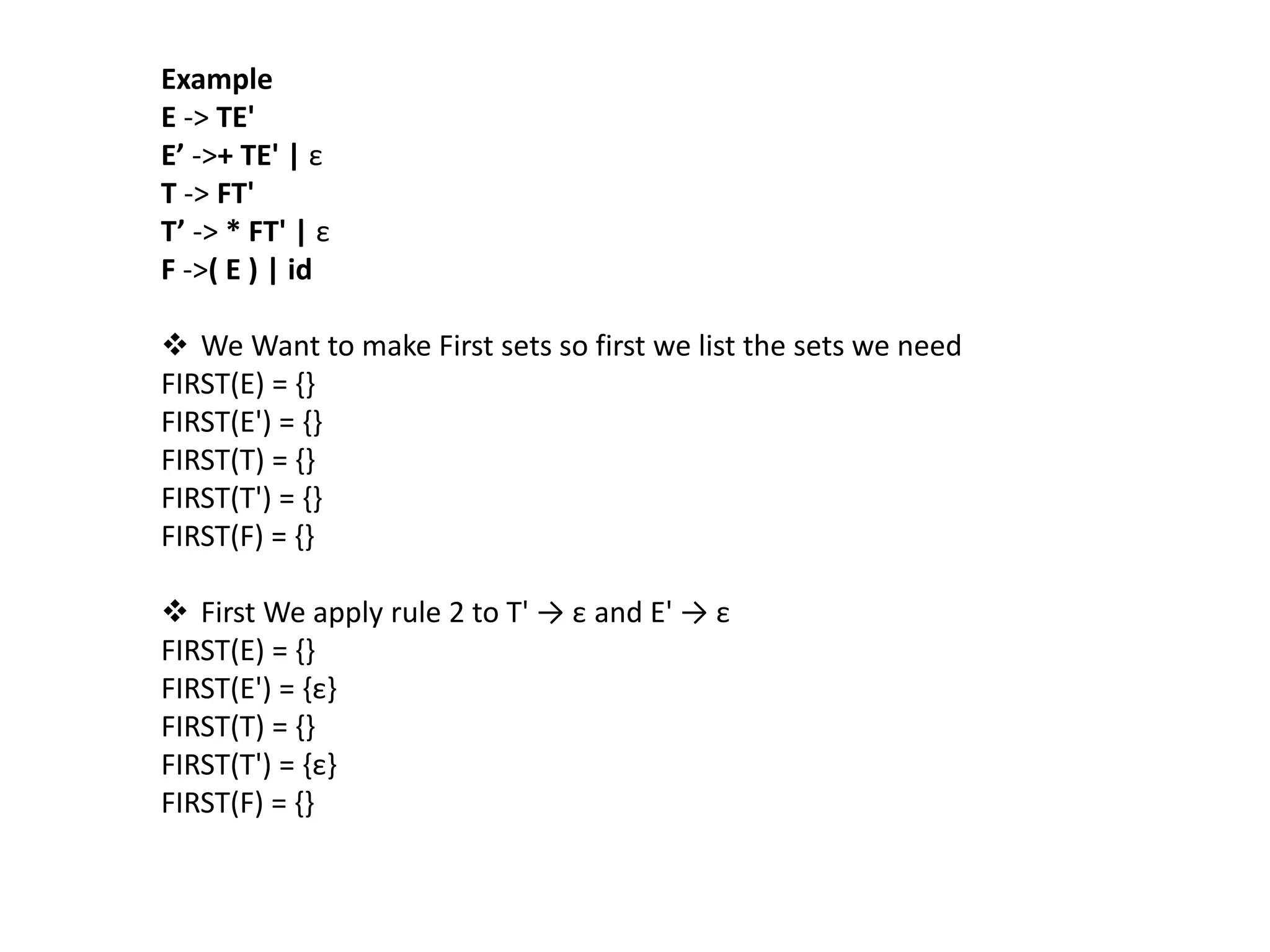
Example
E -> TE'
E’ ->+ TE' | ε
T -> FT'
T’ -> * FT' | ε
F ->( E ) | id
 We Want to make First sets so first we list the sets we need
FIRST(E) = {}
FIRST(E') = {}
FIRST(T) = {}
FIRST(T') = {}
FIRST(F) = {}
 First We apply rule 2 to T' → ε and E' → ε
FIRST(E) = {}
FIRST(E') = {ε}
FIRST(T) = {}
FIRST(T') = {ε}
FIRST(F) = {}
 First We apply rule 3 to T' → *FT' this rule tells us that we can add everything in
First(*FT') into First(T')
Since First(*) useing rule 1 is * we can add * to First(T')
FIRST(E) = {}
FIRST(E') = {+,ε}
FIRST(T) = {}
FIRST(T') = {*,ε}
FIRST(F) = {}
 First We apply rule 3 to T' → *FT' this rule tells us that we can add everything in
First(*FT') into First(T')
Since First(*) useing rule 1 is * we can add * to First(T')
FIRST(E) = {}
FIRST(E') = {+,ε}
FIRST(T) = {}
FIRST(T') = {*,ε}
FIRST(F) = {}
Two more productions begin with terminals F → (E) and F → id If we apply rule 3 to
these we get...
FIRST(E) = {}
FIRST(E') = {+,ε}
FIRST(T) = {}
FIRST(T') = {*,ε}
FIRST(F) = {'(',id}
Next we apply rule 3 to T → FT' once again this tells us that we can add First(FT') to
First(T)
Since First(F) doesn't contain ε that means that First(FT') is just First(F)
FIRST(E) = {}
FIRST(E') = {+,ε}
FIRST(T) = {'(',id}
FIRST(T') = {*,ε}
FIRST(F) = {'(',id}
Lastly we apply rule 3 to E → TE' once again this tells us that we can add First(TE') to
First(E)
Since First(T) doesn't contain ε that means that First(TE') is just First(T)
FIRST(E) = {'(',id}
FIRST(E') = {+,ε}
FIRST(T) = {'(',id}
FIRST(T') = {*,ε}
FIRST(F) = {'(',id}
Doing anything else doesn't change the sets so we are done!
Rules for Follow Sets
First put $ (the end of input marker) in Follow(S) (S is the
start symbol)
If there is a production A → aBb, (where a can be a whole
string) then everything in FIRST(b) except for ε is placed
in FOLLOW(B).
If there is a production A → aB, then everything in
FOLLOW(A) is in FOLLOW(B)
If there is a production A → aBb, where FIRST(b) contains
ε, then everything in FOLLOW(A) is in FOLLOW(B)
 We want to make Follow sets so first we list the sets we
need
FOLLOW(E) = {}
FOLLOW(E') = {}
FOLLOW(T) ={}
FOLLOW(T') = {}
FOLLOW(F) = {}
 The First thing we do is Add $ to the start Symbol 'E'
FOLLOW(E) = {$}
FOLLOW(E') = {}
FOLLOW(T) ={}
FOLLOW(T') = {}
FOLLOW(F) = {}
 Next we apply rule 2 to E' →+TE' This says that everything in First(E') except forε
should be in Follow(T)
FOLLOW(E) = {$}
FOLLOW(E') = {}
FOLLOW(T) ={+}
FOLLOW(T') = {}
FOLLOW(F) = {}
 Next we apply rule 3 to E →TE' This says that we should add everything in Follow(E)
into Follow(E')
FOLLOW(E) = {$}
FOLLOW(E') = {$}
FOLLOW(T) ={+}
FOLLOW(T') = {}
FOLLOW(F) = {}
 Next we apply rule 3 to T → FT' This says that we should add everything in Follow(T)
into Follow(T')
FOLLOW(E) = {$}
FOLLOW(E') = {$}
FOLLOW(T) ={+}
FOLLOW(T') = {+}
FOLLOW(F) = {}
 Now we apply rule 2 to T' →*FT' This says that everything in First(T') except
for ε should be in Follow(F)
FOLLOW(E) = {$}
FOLLOW(E') = {$}
FOLLOW(T) ={+}
FOLLOW(T') = {+}
FOLLOW(F) = {*}
 Now we apply rule 2 to F → (E) This says that everything in First(')') should
be in Follow(E)
FOLLOW(E) = {$,)}
FOLLOW(E') = {$}
FOLLOW(T) ={+}
FOLLOW(T') = {+}
FOLLOW(F) = {*}
 Next we apply rule 3 to E → TE' This says that we should add everything in
Follow(E) into Follow(E')
FOLLOW(E) = {$,)}
FOLLOW(E') = {$,)}
FOLLOW(T) = {+}
FOLLOW(T') = {+}
FOLLOW(F) = {*}
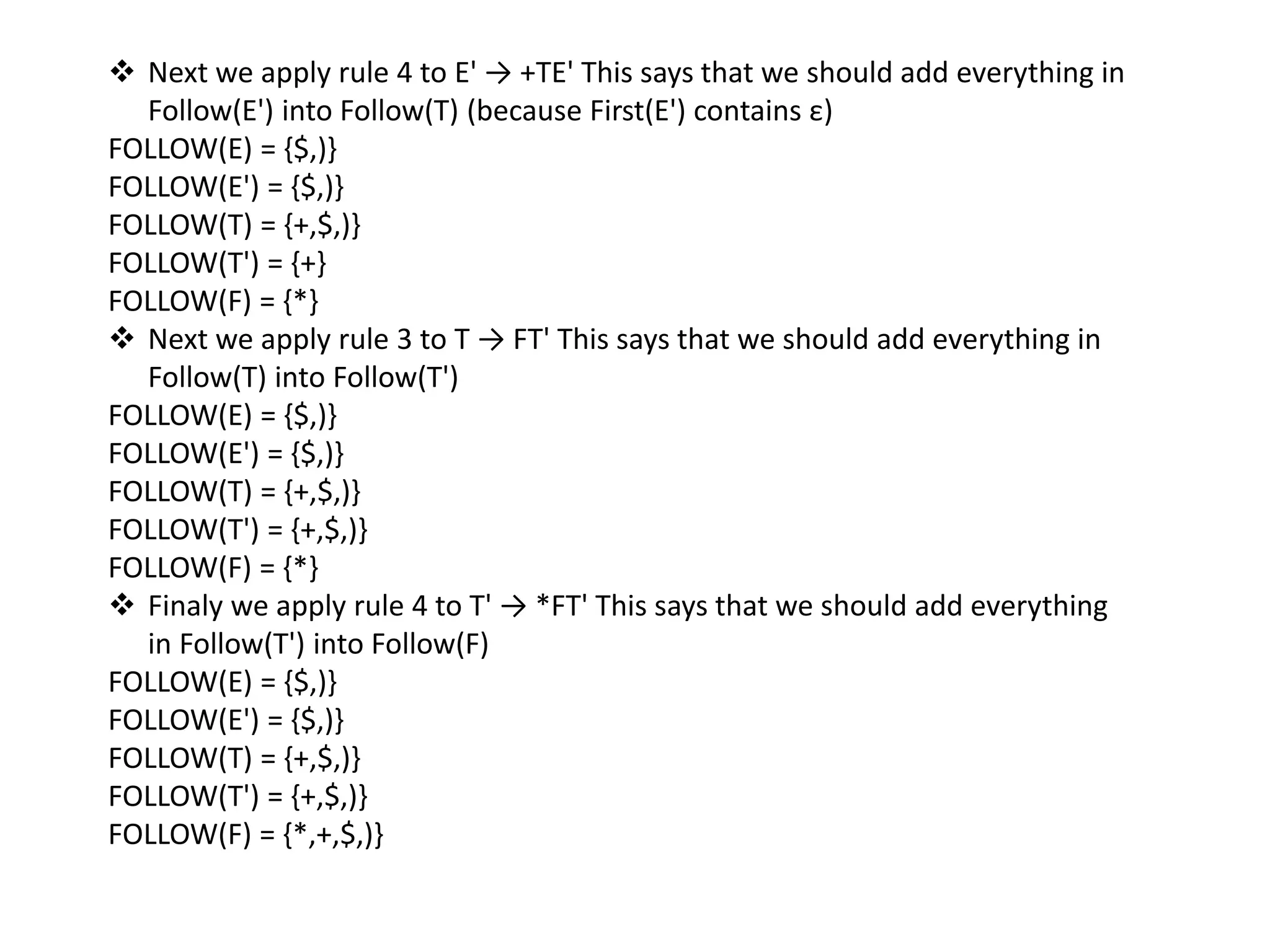
 Next we apply rule 4 to E' → +TE' This says that we should add everything in
Follow(E') into Follow(T) (because First(E') contains ε)
FOLLOW(E) = {$,)}
FOLLOW(E') = {$,)}
FOLLOW(T) = {+,$,)}
FOLLOW(T') = {+}
FOLLOW(F) = {*}
 Next we apply rule 3 to T → FT' This says that we should add everything in
Follow(T) into Follow(T')
FOLLOW(E) = {$,)}
FOLLOW(E') = {$,)}
FOLLOW(T) = {+,$,)}
FOLLOW(T') = {+,$,)}
FOLLOW(F) = {*}
 Finaly we apply rule 4 to T' → *FT' This says that we should add everything
in Follow(T') into Follow(F)
FOLLOW(E) = {$,)}
FOLLOW(E') = {$,)}
FOLLOW(T) = {+,$,)}
FOLLOW(T') = {+,$,)}
FOLLOW(F) = {*,+,$,)}

First() and Follow()

  • 1.
    Rules for FirstSets  If X is a terminal then First(X) is just X!  If there is a Production X → ε then add ε to first(X)  If there is a Production X → Y1Y2..Yk then add first(Y1Y2..Yk) to first(X)  First(Y1Y2..Yk) is either • First(Y1) (if First(Y1) doesn't contain ε) • OR (if First(Y1) does contain ε) then First (Y1Y2..Yk) is everything in First(Y1) <except for ε > as well as everything in First(Y2..Yk) • If First(Y1) First(Y2)..First(Yk) all contain ε then add ε to First(Y1Y2..Yk) as well.
  • 2.
    Example E -> TE' E’->+ TE' | ε T -> FT' T’ -> * FT' | ε F ->( E ) | id  We Want to make First sets so first we list the sets we need FIRST(E) = {} FIRST(E') = {} FIRST(T) = {} FIRST(T') = {} FIRST(F) = {}  First We apply rule 2 to T' → ε and E' → ε FIRST(E) = {} FIRST(E') = {ε} FIRST(T) = {} FIRST(T') = {ε} FIRST(F) = {}
  • 3.
     First Weapply rule 3 to T' → *FT' this rule tells us that we can add everything in First(*FT') into First(T') Since First(*) useing rule 1 is * we can add * to First(T') FIRST(E) = {} FIRST(E') = {+,ε} FIRST(T) = {} FIRST(T') = {*,ε} FIRST(F) = {}  First We apply rule 3 to T' → *FT' this rule tells us that we can add everything in First(*FT') into First(T') Since First(*) useing rule 1 is * we can add * to First(T') FIRST(E) = {} FIRST(E') = {+,ε} FIRST(T) = {} FIRST(T') = {*,ε} FIRST(F) = {}
  • 4.
    Two more productionsbegin with terminals F → (E) and F → id If we apply rule 3 to these we get... FIRST(E) = {} FIRST(E') = {+,ε} FIRST(T) = {} FIRST(T') = {*,ε} FIRST(F) = {'(',id} Next we apply rule 3 to T → FT' once again this tells us that we can add First(FT') to First(T) Since First(F) doesn't contain ε that means that First(FT') is just First(F) FIRST(E) = {} FIRST(E') = {+,ε} FIRST(T) = {'(',id} FIRST(T') = {*,ε} FIRST(F) = {'(',id} Lastly we apply rule 3 to E → TE' once again this tells us that we can add First(TE') to First(E) Since First(T) doesn't contain ε that means that First(TE') is just First(T) FIRST(E) = {'(',id} FIRST(E') = {+,ε} FIRST(T) = {'(',id} FIRST(T') = {*,ε} FIRST(F) = {'(',id} Doing anything else doesn't change the sets so we are done!
  • 5.
    Rules for FollowSets First put $ (the end of input marker) in Follow(S) (S is the start symbol) If there is a production A → aBb, (where a can be a whole string) then everything in FIRST(b) except for ε is placed in FOLLOW(B). If there is a production A → aB, then everything in FOLLOW(A) is in FOLLOW(B) If there is a production A → aBb, where FIRST(b) contains ε, then everything in FOLLOW(A) is in FOLLOW(B)
  • 6.
     We wantto make Follow sets so first we list the sets we need FOLLOW(E) = {} FOLLOW(E') = {} FOLLOW(T) ={} FOLLOW(T') = {} FOLLOW(F) = {}  The First thing we do is Add $ to the start Symbol 'E' FOLLOW(E) = {$} FOLLOW(E') = {} FOLLOW(T) ={} FOLLOW(T') = {} FOLLOW(F) = {}
  • 7.
     Next weapply rule 2 to E' →+TE' This says that everything in First(E') except forε should be in Follow(T) FOLLOW(E) = {$} FOLLOW(E') = {} FOLLOW(T) ={+} FOLLOW(T') = {} FOLLOW(F) = {}  Next we apply rule 3 to E →TE' This says that we should add everything in Follow(E) into Follow(E') FOLLOW(E) = {$} FOLLOW(E') = {$} FOLLOW(T) ={+} FOLLOW(T') = {} FOLLOW(F) = {}  Next we apply rule 3 to T → FT' This says that we should add everything in Follow(T) into Follow(T') FOLLOW(E) = {$} FOLLOW(E') = {$} FOLLOW(T) ={+} FOLLOW(T') = {+} FOLLOW(F) = {}
  • 8.
     Now weapply rule 2 to T' →*FT' This says that everything in First(T') except for ε should be in Follow(F) FOLLOW(E) = {$} FOLLOW(E') = {$} FOLLOW(T) ={+} FOLLOW(T') = {+} FOLLOW(F) = {*}  Now we apply rule 2 to F → (E) This says that everything in First(')') should be in Follow(E) FOLLOW(E) = {$,)} FOLLOW(E') = {$} FOLLOW(T) ={+} FOLLOW(T') = {+} FOLLOW(F) = {*}  Next we apply rule 3 to E → TE' This says that we should add everything in Follow(E) into Follow(E') FOLLOW(E) = {$,)} FOLLOW(E') = {$,)} FOLLOW(T) = {+} FOLLOW(T') = {+} FOLLOW(F) = {*}
  • 9.
     Next weapply rule 4 to E' → +TE' This says that we should add everything in Follow(E') into Follow(T) (because First(E') contains ε) FOLLOW(E) = {$,)} FOLLOW(E') = {$,)} FOLLOW(T) = {+,$,)} FOLLOW(T') = {+} FOLLOW(F) = {*}  Next we apply rule 3 to T → FT' This says that we should add everything in Follow(T) into Follow(T') FOLLOW(E) = {$,)} FOLLOW(E') = {$,)} FOLLOW(T) = {+,$,)} FOLLOW(T') = {+,$,)} FOLLOW(F) = {*}  Finaly we apply rule 4 to T' → *FT' This says that we should add everything in Follow(T') into Follow(F) FOLLOW(E) = {$,)} FOLLOW(E') = {$,)} FOLLOW(T) = {+,$,)} FOLLOW(T') = {+,$,)} FOLLOW(F) = {*,+,$,)}