Carrying
Technique
s
Group 3
Knowledge of the different carrying
techniques is important beacause it is
necessary to evacuate a sick or injured
person from an emergency scene to a safe
location. Patients must be carried carefully
and handled correctly; otherwise, their
injuries may come more serious or
possibly fatal.
Learn and Share
ONE-PERSON
CARRY
Carrying Techniques
01
ONE-PERSON CARRY
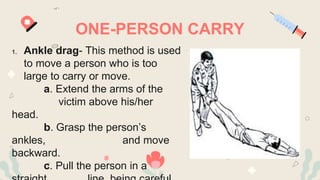
1. Ankle drag- This method is used
to move a person who is too
large to carry or move.
a. Extend the arms of the
victim above his/her
head.
b. Grasp the person’s
ankles, and move
backward.
c. Pull the person in a
ONE-PERSON CARRY
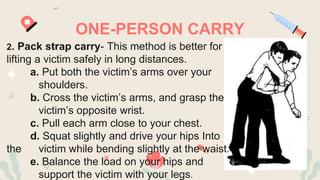
2. Pack strap carry- This method is better for
lifting a victim safely in long distances.
a. Put both the victim’s arms over your
shoulders.
b. Cross the victim’s arms, and grasp the
victim’s opposite wrist.
c. Pull each arm close to your chest.
d. Squat slightly and drive your hips Into
the victim while bending slightly at the waist.
e. Balance the load on your hips and
support the victim with your legs.
ONE-PERSON CARRY
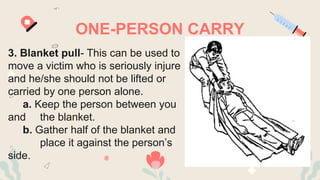
3. Blanket pull- This can be used to
move a victim who is seriously injure
and he/she should not be lifted or
carried by one person alone.
a. Keep the person between you
and the blanket.
b. Gather half of the blanket and
place it against the person’s
side.
ONE-PERSON CARRY
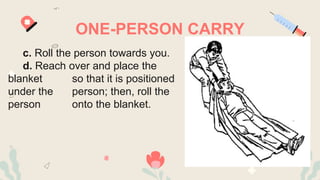
c. Roll the person towards you.
d. Reach over and place the
blanket so that it is positioned
under the person; then, roll the
person onto the blanket.
TWO-PERSON
CARRY
02
Carrying Techniques
TWO-PERSON CARRY
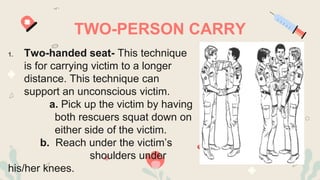
1. Two-handed seat- This technique
is for carrying victim to a longer
distance. This technique can
support an unconscious victim.
a. Pick up the victim by having
both rescuers squat down on
either side of the victim.
b. Reach under the victim’s
shoulders under
his/her knees.
TWO-PERSON CARRY
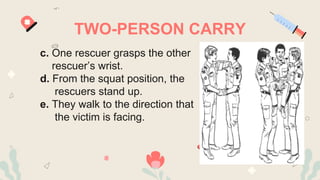
c. One rescuer grasps the other
rescuer’s wrist.
d. From the squat position, the
rescuers stand up.
e. They walk to the direction that
the victim is facing.
TWO-PERSON CARRY
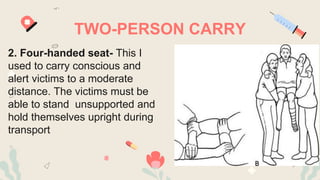
2. Four-handed seat- This I
used to carry conscious and
alert victims to a moderate
distance. The victims must be
able to stand unsupported and
hold themselves upright during
transport
TWO-PERSON CARRY
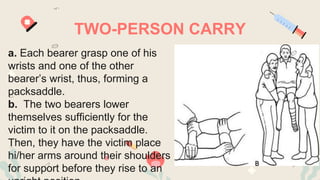
a. Each bearer grasp one of his
wrists and one of the other
bearer’s wrist, thus, forming a
packsaddle.
b. The two bearers lower
themselves sufficiently for the
victim to it on the packsaddle.
Then, they have the victim place
hi/her arms around their shoulders
for support before they rise to an
TWO-PERSON CARRY
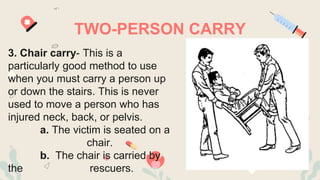
3. Chair carry- This is a
particularly good method to use
when you must carry a person up
or down the stairs. This is never
used to move a person who has
injured neck, back, or pelvis.
a. The victim is seated on a
chair.
b. The chair is carried by
the rescuers.
THREE-MAN
CARRY
03
THREE-MAN CARRY
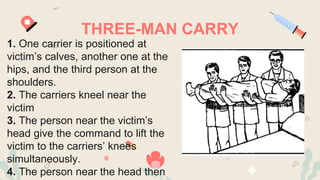
1. One carrier is positioned at
victim’s calves, another one at the
hips, and the third person at the
shoulders.
2. The carriers kneel near the
victim
3. The person near the victim’s
head give the command to lift the
victim to the carriers’ knees
simultaneously.
4. The person near the head then
CARRY ME!
04
ACTIVITY
CARRY ME!
Work with tour assigned group and demonstrate
the randomly picked carrying technique. Your
group will be given points based on the delivery
and effectivity of he carrying techniques you
demonstrated.
ACTIVITY
05
Carrying Techniques
ACTIVITY
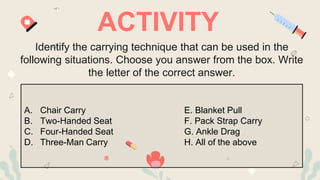
Identify the carrying technique that can be used in the
following situations. Choose you answer from the box. Write
the letter of the correct answer.
A. Chair Carry E. Blanket Pull
B. Two-Handed Seat F. Pack Strap Carry
C. Four-Handed Seat G. Ankle Drag
D. Three-Man Carry H. All of the above
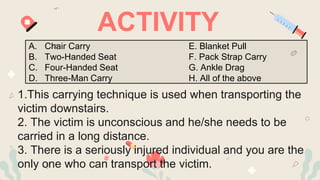
ACTIVITY
1.This carrying technique is used when transporting the
victim downstairs.
2. The victim is unconscious and he/she needs to be
carried in a long distance.
3. There is a seriously injured individual and you are the
only one who can transport the victim.
A. Chair Carry E. Blanket Pull
B. Two-Handed Seat F. Pack Strap Carry
C. Four-Handed Seat G. Ankle Drag
D. Three-Man Carry H. All of the above
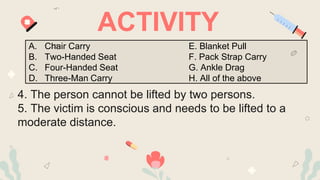
ACTIVITY
4. The person cannot be lifted by two persons.
5. The victim is conscious and needs to be lifted to a
moderate distance.
A. Chair Carry E. Blanket Pull
B. Two-Handed Seat F. Pack Strap Carry
C. Four-Handed Seat G. Ankle Drag
D. Three-Man Carry H. All of the above

Carrying-Techniques-G3.pptx

  • 1.
  • 2.
    Knowledge of thedifferent carrying techniques is important beacause it is necessary to evacuate a sick or injured person from an emergency scene to a safe location. Patients must be carried carefully and handled correctly; otherwise, their injuries may come more serious or possibly fatal. Learn and Share
  • 3.
  • 4.
    ONE-PERSON CARRY 1. Ankledrag- This method is used to move a person who is too large to carry or move. a. Extend the arms of the victim above his/her head. b. Grasp the person’s ankles, and move backward. c. Pull the person in a
  • 5.
    ONE-PERSON CARRY 2. Packstrap carry- This method is better for lifting a victim safely in long distances. a. Put both the victim’s arms over your shoulders. b. Cross the victim’s arms, and grasp the victim’s opposite wrist. c. Pull each arm close to your chest. d. Squat slightly and drive your hips Into the victim while bending slightly at the waist. e. Balance the load on your hips and support the victim with your legs.
  • 6.
    ONE-PERSON CARRY 3. Blanketpull- This can be used to move a victim who is seriously injure and he/she should not be lifted or carried by one person alone. a. Keep the person between you and the blanket. b. Gather half of the blanket and place it against the person’s side.
  • 7.
    ONE-PERSON CARRY c. Rollthe person towards you. d. Reach over and place the blanket so that it is positioned under the person; then, roll the person onto the blanket.
  • 8.
  • 9.
    TWO-PERSON CARRY 1. Two-handedseat- This technique is for carrying victim to a longer distance. This technique can support an unconscious victim. a. Pick up the victim by having both rescuers squat down on either side of the victim. b. Reach under the victim’s shoulders under his/her knees.
  • 10.
    TWO-PERSON CARRY c. Onerescuer grasps the other rescuer’s wrist. d. From the squat position, the rescuers stand up. e. They walk to the direction that the victim is facing.
  • 11.
    TWO-PERSON CARRY 2. Four-handedseat- This I used to carry conscious and alert victims to a moderate distance. The victims must be able to stand unsupported and hold themselves upright during transport
  • 12.
    TWO-PERSON CARRY a. Eachbearer grasp one of his wrists and one of the other bearer’s wrist, thus, forming a packsaddle. b. The two bearers lower themselves sufficiently for the victim to it on the packsaddle. Then, they have the victim place hi/her arms around their shoulders for support before they rise to an
  • 13.
    TWO-PERSON CARRY 3. Chaircarry- This is a particularly good method to use when you must carry a person up or down the stairs. This is never used to move a person who has injured neck, back, or pelvis. a. The victim is seated on a chair. b. The chair is carried by the rescuers.
  • 14.
  • 15.
    THREE-MAN CARRY 1. Onecarrier is positioned at victim’s calves, another one at the hips, and the third person at the shoulders. 2. The carriers kneel near the victim 3. The person near the victim’s head give the command to lift the victim to the carriers’ knees simultaneously. 4. The person near the head then
  • 16.
  • 17.
    CARRY ME! Work withtour assigned group and demonstrate the randomly picked carrying technique. Your group will be given points based on the delivery and effectivity of he carrying techniques you demonstrated.
  • 18.
  • 19.
    ACTIVITY Identify the carryingtechnique that can be used in the following situations. Choose you answer from the box. Write the letter of the correct answer. A. Chair Carry E. Blanket Pull B. Two-Handed Seat F. Pack Strap Carry C. Four-Handed Seat G. Ankle Drag D. Three-Man Carry H. All of the above
  • 20.
    ACTIVITY 1.This carrying techniqueis used when transporting the victim downstairs. 2. The victim is unconscious and he/she needs to be carried in a long distance. 3. There is a seriously injured individual and you are the only one who can transport the victim. A. Chair Carry E. Blanket Pull B. Two-Handed Seat F. Pack Strap Carry C. Four-Handed Seat G. Ankle Drag D. Three-Man Carry H. All of the above
  • 21.
    ACTIVITY 4. The personcannot be lifted by two persons. 5. The victim is conscious and needs to be lifted to a moderate distance. A. Chair Carry E. Blanket Pull B. Two-Handed Seat F. Pack Strap Carry C. Four-Handed Seat G. Ankle Drag D. Three-Man Carry H. All of the above