Firestopping Standards Originally Firestopping design standards were  covered by ASTM  E 119 and  UL  263. With the need for standards for testing procedures and Installation methods, ASTM E 814 and UL 1479 were developed .
Where is Firestopping used There are 4 primary locations where Firestopping is used to prevent the spread of fire, smoke or gases.
Where is Firestopping used  cont’d Joints  - Any joint between fire rated components. i.e. wall/wall (WW), floor/ wall (FW), wall/ceiling or structure (HW). Floors  - (CEJ) perimeter slab edges/ exterior wall cavities ( curtain walls) Penetrations  - (F,W,C) Any opening(s) in rated walls or floors. ( MEP penetrations)
Where is Firestopping used  cont’d Blank Openings  – Openings with no penetrating items.
Joints Wall/Wall ( WWD &WWS ) Drywall construction usually does not require joints that need to be firestopped. Concrete and Masonry walls - are where wall  to wall joints are most commonly used.
Floors Slab edges – (CEJ) exterior wall cavity (Curtain Wall construction) Expansion Joints (CEJ) Floor to floor (FFD) Floor to wall (FWD)
Blank Openings This is a condition that is not commonly seen in the Healthcare Construction arena. Most of what we deal with is Drywall construction. In most cases a opening/hole in the wall is covered with what is referred to as a “Blow Out patch”
Penetrations (F, W, C) Floor, Wall, or Combination. These would mainly consist of pipes, conduits, cableing and ductwork. There are Firestop systems for virtually every condition listed above with some exceptions.  These exceptions would be for penetrations which are not the norm; i.e., perpendicular to the item being penetrated. These are usually skewed or partially penetrate the wall/floor plane.
Penetrations  cont’d When there are penetrations for which there are no known  UL  approved details, An Engineering Judgment may be issued. These judgments usually come from the Engineering staff of one of the major Firestopping Manufacturers. They will make a judgment that the condition in question closely resembles that of an  UL  tested condition and therefore they issue an Engineering Judgment that tells the Contractor what detail to follow. Most (AHJ’s) Authority Having Jurisdiction accept these judgments.
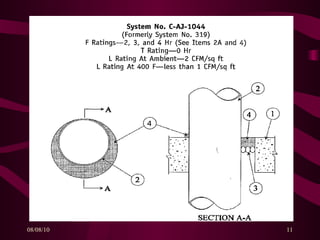
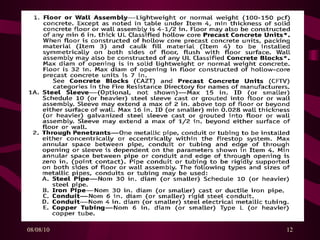
UL  Designations For Firestop Systems For example, System # CAJ-1044 is deciphered as follows:  C = Either floor or wall A or J = Concrete floor or wall, with minimum thickness less than or equal to 5 or 8 inches, respectively. 1000 to 1999 = Specific types of metallic piping and specific diameters. #1044 is the 44th system in the 1000 series of metallic penetrations.


UL  Designations For Firestop Systems Translation: This system, CAJ-1044, can be specified for use on metallic piping such as steel, iron, or copper tubing and copper pipe with specific outside dimensions, and installed through concrete floors or walls 5 to 8 inches thick or in framed floors.
UL  Designations For Firestop Systems In a nutshell, the tested firestop system is given a letter designation indicating what type of floor or wall assembly the firestop system has been tested in: concrete, masonry, gypsum, etc. Following the letter is a number designation referring to the type of penetrating item that has been tested, such as metallic pipe, non-metallic pipe, cable, electrical, etc.
Firestopping Nomenclature Annular space  – The gap between the penetrating item and the hole. Backer rod /material  – Materials used as a support for gunned or troweled sealant materials. Intumescent  – Materials that swell in the prescence of heat to seal gaps around a  penetration.
Firestopping Nomenclature  cont’d Point of contact  – when a pentrating item makes contact with the hole. UL  Fire Resistance Directory  – the publication which contains details/descriptions for all Firestopping systems. Fire Resistance Rating  – an hourly rating defined by building codes for the endurance of types of construction to resist fire.
Firestopping Nomenclature Courtesy of 3M 1A  Metal Stud 1B  Sheet Rock Penetrating pipe/conduit Intumescent Material
Firestopping Nomenclature Courtesy Of  3M 1A  Metal stud 1B  Sheet Rock Penetrating pipe or conduit with (point of Contact). Firestopping sealant
Ratings of  UL  Firestop systems Also located in the UL Fire Resistance Directory Vol. 2 are the F, T and L ratings for each firestop system. These are hourly ratings that indicate specific performance capabilities and correspond to building code requirements. The Directory defines these ratings as follows:
Ratings of  UL  Firestop Systems The F rating provides "the time period for which the system is capable of prohibiting the passage of flame through the system and requires acceptable hose stream performance."
Ratings of  UL  Firestop Systems The T designation indicates "the time period for which the system is capable of limiting the maximum temperature rise on the unexposed surface of the wall or floor assembly, on the penetrating item, and on the fill material in the annular space, not to exceed 325° F (181° C) above ambient temperature, and requires acceptable hose stream performance."
Ratings of  UL  Firestop Systems The L rating designates "information concerning the amount of air leakage, in cubic feet per minute per square foot of opening through the firestop system and/or 400° F air temperatures at an air pressure differential of 0.30 in W.C."
Available Products Some of the many products available today include: Intumescent, Silicone, Latex and Acrylic caulks Elastomeric Sprays Puttys, putty pads Collars, wrap strips Pillows, Foam, Mortar
Firestopping Industry Today Many manufactuers have entered the arena. The industry has a trade organization Firestop Contractors International Assoc. They promote industry wide education for Contractors.  They work with Code officials to improve codes and standards for firestopping. They assist Architects in writing tight specs.
Firestopping Installations A large majority of firestopping work today  is not installed correctly. One key factor is the lack of education regarding Firestopping and the use of unskilled workers being asked to perform the work. A General lack of understanding that  all Firestopping work must be done in accordance with approved  UL  details  exist in the Construction Industry today.

Firestopping info

  • 1.
    Firestopping Standards OriginallyFirestopping design standards were covered by ASTM E 119 and UL 263. With the need for standards for testing procedures and Installation methods, ASTM E 814 and UL 1479 were developed .
  • 2.
    Where is Firestoppingused There are 4 primary locations where Firestopping is used to prevent the spread of fire, smoke or gases.
  • 3.
    Where is Firestoppingused cont’d Joints - Any joint between fire rated components. i.e. wall/wall (WW), floor/ wall (FW), wall/ceiling or structure (HW). Floors - (CEJ) perimeter slab edges/ exterior wall cavities ( curtain walls) Penetrations - (F,W,C) Any opening(s) in rated walls or floors. ( MEP penetrations)
  • 4.
    Where is Firestoppingused cont’d Blank Openings – Openings with no penetrating items.
  • 5.
    Joints Wall/Wall (WWD &WWS ) Drywall construction usually does not require joints that need to be firestopped. Concrete and Masonry walls - are where wall to wall joints are most commonly used.
  • 6.
    Floors Slab edges– (CEJ) exterior wall cavity (Curtain Wall construction) Expansion Joints (CEJ) Floor to floor (FFD) Floor to wall (FWD)
  • 7.
    Blank Openings Thisis a condition that is not commonly seen in the Healthcare Construction arena. Most of what we deal with is Drywall construction. In most cases a opening/hole in the wall is covered with what is referred to as a “Blow Out patch”
  • 8.
    Penetrations (F, W,C) Floor, Wall, or Combination. These would mainly consist of pipes, conduits, cableing and ductwork. There are Firestop systems for virtually every condition listed above with some exceptions. These exceptions would be for penetrations which are not the norm; i.e., perpendicular to the item being penetrated. These are usually skewed or partially penetrate the wall/floor plane.
  • 9.
    Penetrations cont’dWhen there are penetrations for which there are no known UL approved details, An Engineering Judgment may be issued. These judgments usually come from the Engineering staff of one of the major Firestopping Manufacturers. They will make a judgment that the condition in question closely resembles that of an UL tested condition and therefore they issue an Engineering Judgment that tells the Contractor what detail to follow. Most (AHJ’s) Authority Having Jurisdiction accept these judgments.
  • 10.
    UL DesignationsFor Firestop Systems For example, System # CAJ-1044 is deciphered as follows: C = Either floor or wall A or J = Concrete floor or wall, with minimum thickness less than or equal to 5 or 8 inches, respectively. 1000 to 1999 = Specific types of metallic piping and specific diameters. #1044 is the 44th system in the 1000 series of metallic penetrations.
  • 11.
  • 12.
  • 13.
  • 14.
    UL DesignationsFor Firestop Systems Translation: This system, CAJ-1044, can be specified for use on metallic piping such as steel, iron, or copper tubing and copper pipe with specific outside dimensions, and installed through concrete floors or walls 5 to 8 inches thick or in framed floors.
  • 15.
    UL DesignationsFor Firestop Systems In a nutshell, the tested firestop system is given a letter designation indicating what type of floor or wall assembly the firestop system has been tested in: concrete, masonry, gypsum, etc. Following the letter is a number designation referring to the type of penetrating item that has been tested, such as metallic pipe, non-metallic pipe, cable, electrical, etc.
  • 16.
    Firestopping Nomenclature Annularspace – The gap between the penetrating item and the hole. Backer rod /material – Materials used as a support for gunned or troweled sealant materials. Intumescent – Materials that swell in the prescence of heat to seal gaps around a penetration.
  • 17.
    Firestopping Nomenclature cont’d Point of contact – when a pentrating item makes contact with the hole. UL Fire Resistance Directory – the publication which contains details/descriptions for all Firestopping systems. Fire Resistance Rating – an hourly rating defined by building codes for the endurance of types of construction to resist fire.
  • 18.
    Firestopping Nomenclature Courtesyof 3M 1A Metal Stud 1B Sheet Rock Penetrating pipe/conduit Intumescent Material
  • 19.
    Firestopping Nomenclature CourtesyOf 3M 1A Metal stud 1B Sheet Rock Penetrating pipe or conduit with (point of Contact). Firestopping sealant
  • 20.
    Ratings of UL Firestop systems Also located in the UL Fire Resistance Directory Vol. 2 are the F, T and L ratings for each firestop system. These are hourly ratings that indicate specific performance capabilities and correspond to building code requirements. The Directory defines these ratings as follows:
  • 21.
    Ratings of UL Firestop Systems The F rating provides "the time period for which the system is capable of prohibiting the passage of flame through the system and requires acceptable hose stream performance."
  • 22.
    Ratings of UL Firestop Systems The T designation indicates "the time period for which the system is capable of limiting the maximum temperature rise on the unexposed surface of the wall or floor assembly, on the penetrating item, and on the fill material in the annular space, not to exceed 325° F (181° C) above ambient temperature, and requires acceptable hose stream performance."
  • 23.
    Ratings of UL Firestop Systems The L rating designates "information concerning the amount of air leakage, in cubic feet per minute per square foot of opening through the firestop system and/or 400° F air temperatures at an air pressure differential of 0.30 in W.C."
  • 24.
    Available Products Someof the many products available today include: Intumescent, Silicone, Latex and Acrylic caulks Elastomeric Sprays Puttys, putty pads Collars, wrap strips Pillows, Foam, Mortar
  • 25.
    Firestopping Industry TodayMany manufactuers have entered the arena. The industry has a trade organization Firestop Contractors International Assoc. They promote industry wide education for Contractors. They work with Code officials to improve codes and standards for firestopping. They assist Architects in writing tight specs.
  • 26.
    Firestopping Installations Alarge majority of firestopping work today is not installed correctly. One key factor is the lack of education regarding Firestopping and the use of unskilled workers being asked to perform the work. A General lack of understanding that all Firestopping work must be done in accordance with approved UL details exist in the Construction Industry today.