WELCOME
RELEVANCE OF
VALUES IN
MANAGEMENT
VALUES
Values are important and lasting belief or ideal
shared by the member of a culture about what is
good or bad and desirable or undesirable .
Values have major influence on person's behaviour
and attitude and serve as a broad guideline in all
situations.
• Values are different from attitude
• Values are general belief about life
• Whereas attitude are directed towards specific
object events or people
TYPES OF VALUES
• Terminal values
• Instrumental values
• Theoretical
• Economic
• Aesthetic
• Social
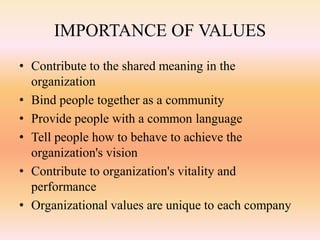
IMPORTANCE OF VALUES
• Contribute to the shared meaning in the
organization
• Bind people together as a community
• Provide people with a common language
• Tell people how to behave to achieve the
organization's vision
• Contribute to organization's vitality and
performance
• Organizational values are unique to each company
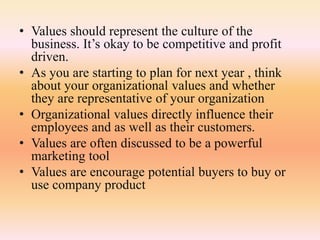
• Values should represent the culture of the
business. It’s okay to be competitive and profit
driven.
• As you are starting to plan for next year , think
about your organizational values and whether
they are representative of your organization
• Organizational values directly influence their
employees and as well as their customers.
• Values are often discussed to be a powerful
marketing tool
• Values are encourage potential buyers to buy or
use company product
IMPORTANCE OF VALUES IN
VARIOUS FIELDS
• Recruiting
• Training
• Performance
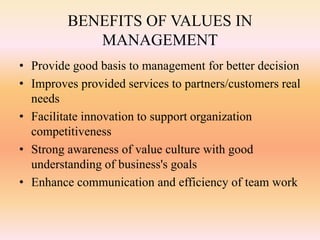
BENEFITS OF VALUES IN
MANAGEMENT
• Provide good basis to management for better decision
• Improves provided services to partners/customers real
needs
• Facilitate innovation to support organization
competitiveness
• Strong awareness of value culture with good
understanding of business's goals
• Enhance communication and efficiency of team work
CONCLUSION
• Values are the ideal of an individual personal
importance
• However to be successful in an organisation,
manager's need to learn adopted values,a set of
values that are part of the organisation's culture
• When personal values and organizational values
are congruent, these become highly pragmatic
operative values
THANKYOU

finl value.pptx

  • 1.
  • 2.
  • 3.
    VALUES Values are importantand lasting belief or ideal shared by the member of a culture about what is good or bad and desirable or undesirable . Values have major influence on person's behaviour and attitude and serve as a broad guideline in all situations.
  • 4.
    • Values aredifferent from attitude • Values are general belief about life • Whereas attitude are directed towards specific object events or people
  • 5.
    TYPES OF VALUES •Terminal values • Instrumental values • Theoretical • Economic • Aesthetic • Social
  • 6.
    IMPORTANCE OF VALUES •Contribute to the shared meaning in the organization • Bind people together as a community • Provide people with a common language • Tell people how to behave to achieve the organization's vision • Contribute to organization's vitality and performance • Organizational values are unique to each company
  • 7.
    • Values shouldrepresent the culture of the business. It’s okay to be competitive and profit driven. • As you are starting to plan for next year , think about your organizational values and whether they are representative of your organization • Organizational values directly influence their employees and as well as their customers. • Values are often discussed to be a powerful marketing tool • Values are encourage potential buyers to buy or use company product
  • 8.
    IMPORTANCE OF VALUESIN VARIOUS FIELDS • Recruiting • Training • Performance
  • 9.
    BENEFITS OF VALUESIN MANAGEMENT • Provide good basis to management for better decision • Improves provided services to partners/customers real needs • Facilitate innovation to support organization competitiveness • Strong awareness of value culture with good understanding of business's goals • Enhance communication and efficiency of team work
  • 10.
    CONCLUSION • Values arethe ideal of an individual personal importance • However to be successful in an organisation, manager's need to learn adopted values,a set of values that are part of the organisation's culture • When personal values and organizational values are congruent, these become highly pragmatic operative values
  • 11.