Friday, June 14, 2013 1Graduate School Training Courses
Finishing your Thesis
Friday, June 14, 2013 Graduate School Training Courses 2
Objectives
By the end of this course you will have
– reviewed the structural features of an argument
– identified some strategies for helping with the
writing-up process
– written an individual timetable for submission
– collected some tips on formatting your thesis
Friday, June 14, 2013 Graduate School Training Courses 3
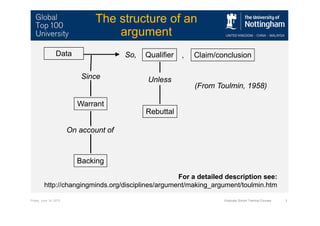
The structure of an
argument
(From Toulmin, 1958)
Data Qualifier Claim/conclusionSo, ,
Since Unless
On account of
Warrant
Backing
Rebuttal
For a detailed description see:
http://changingminds.org/disciplines/argument/making_argument/toulmin.htm
Friday, June 14, 2013 Graduate School Training Courses 4
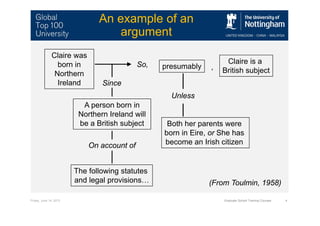
An example of an
argument
(From Toulmin, 1958)
Claire was
born in
Northern
Ireland
presumably
Claire is a
British subject
So,
Since
Unless
On account of
A person born in
Northern Ireland will
be a British subject
The following statutes
and legal provisions…
Both her parents were
born in Eire, or She has
become an Irish citizen
,
Friday, June 14, 2013 Graduate School Training Courses 5
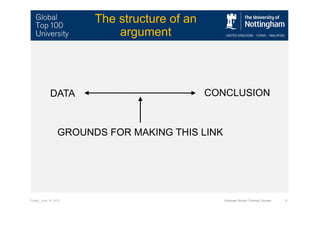
The structure of an
argument
DATA CONCLUSION
GROUNDS FOR MAKING THIS LINK
Friday, June 14, 2013 Graduate School Training Courses 6
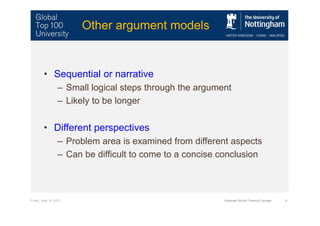
Other argument models
• Sequential or narrative
– Small logical steps through the argument
– Likely to be longer
• Different perspectives
– Problem area is examined from different aspects
– Can be difficult to come to a concise conclusion
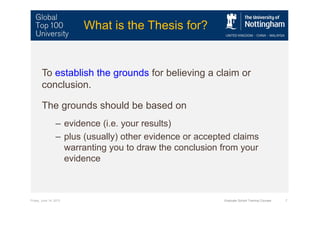
Friday, June 14, 2013 Graduate School Training Courses 7
What is the Thesis for?
To establish the grounds for believing a claim or
conclusion.
The grounds should be based on
– evidence (i.e. your results)
– plus (usually) other evidence or accepted claims
warranting you to draw the conclusion from your
evidence
Friday, June 14, 2013 Graduate School Training Courses 8
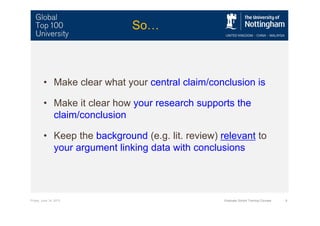
So…
• Make clear what your central claim/conclusion is
• Make it clear how your research supports the
claim/conclusion
• Keep the background (e.g. lit. review) relevant to
your argument linking data with conclusions
Friday, June 14, 2013 Graduate School Training Courses 9
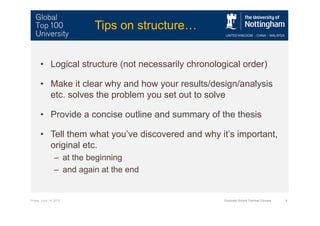
Tips on structure…
• Logical structure (not necessarily chronological order)
• Make it clear why and how your results/design/analysis
etc. solves the problem you set out to solve
• Provide a concise outline and summary of the thesis
• Tell them what you’ve discovered and why it’s important,
original etc.
– at the beginning
– and again at the end
Friday, June 14, 2013 Graduate School Training Courses 10
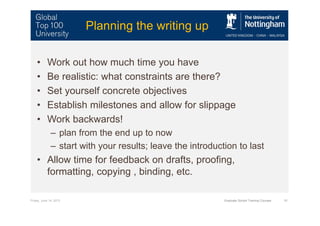
Planning the writing up
• Work out how much time you have
• Be realistic: what constraints are there?
• Set yourself concrete objectives
• Establish milestones and allow for slippage
• Work backwards!
– plan from the end up to now
– start with your results; leave the introduction to last
• Allow time for feedback on drafts, proofing,
formatting, copying , binding, etc.
Friday, June 14, 2013 Graduate School Training Courses 11
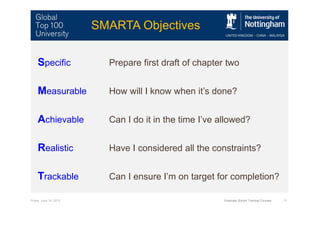
SMARTA Objectives
Specific Prepare first draft of chapter two
Measurable How will I know when it’s done?
Achievable Can I do it in the time I’ve allowed?
Realistic Have I considered all the constraints?
Trackable Can I ensure I’m on target for completion?
Friday, June 14, 2013 Graduate School Training Courses 12
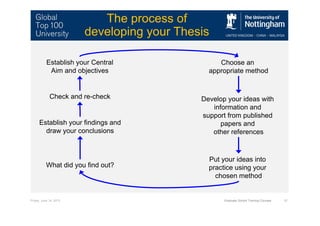
The process of
developing your Thesis
Establish your Central
Aim and objectives
Choose an
appropriate method
Develop your ideas with
information and
support from published
papers and
other references
Put your ideas into
practice using your
chosen method
What did you find out?
Establish your findings and
draw your conclusions
Check and re-check
Friday, June 14, 2013 Graduate School Training Courses 13
Key formatting tips (1)
• Follow guidelines for presentation of thesis from your Faculty
Office, if any.
• Check out some recently completed theses:
http://etheses.nottingham.ac.uk
• Be familiar with the language and typesetting conventions of
your discipline
• Keep records of individual data so that you can go back to
them if necessary
• Keep backup copies on USB/memory sticks, CDs/DVDs,
documents sent to yourself or family on email etc.
Friday, June 14, 2013 Graduate School Training Courses 14
Key formatting tips (2)
• Be careful about recording the sequence of any changes to the
data
• Keep control over different versions
• Buy or borrow a good dictionary and thesaurus
• Number your pages, figures and tables. It is also a good idea
to number sections for cross-referencing
• Consider putting a brief introduction at the start, and a
summary at the end, of each chapter
• Define styles using “Word”:
– this will help make your formatting consistent
– you can automatically generate tables of content/figures etc.
• Use EndNote or another bibliographic management software to
store and output your references
Friday, June 14, 2013 Graduate School Training Courses 15
General skills
• Knowledge of the general field of scholarship to
which the particular subject belongs
• Critical judgement in a particular subject
• Competence in designing and executing a theoretical
or empirical enquiry
• Capacity to assume responsibility for independent
research in the field
Friday, June 14, 2013 Graduate School Training Courses 16
Content of Thesis
• A work of substance, representing not less than 2
years (normally 3) of full-time research
• Distinct addition to knowledge
• Originality (discovering new facts, critical
examinations of existing facts or ideas; devising and
conducting investigations into ideas supplied by
others)
Friday, June 14, 2013 Graduate School Training Courses 17

Finishing your thesis

  • 1.
    Friday, June 14,2013 1Graduate School Training Courses Finishing your Thesis
  • 2.
    Friday, June 14,2013 Graduate School Training Courses 2 Objectives By the end of this course you will have – reviewed the structural features of an argument – identified some strategies for helping with the writing-up process – written an individual timetable for submission – collected some tips on formatting your thesis
  • 3.
    Friday, June 14,2013 Graduate School Training Courses 3 The structure of an argument (From Toulmin, 1958) Data Qualifier Claim/conclusionSo, , Since Unless On account of Warrant Backing Rebuttal For a detailed description see: http://changingminds.org/disciplines/argument/making_argument/toulmin.htm
  • 4.
    Friday, June 14,2013 Graduate School Training Courses 4 An example of an argument (From Toulmin, 1958) Claire was born in Northern Ireland presumably Claire is a British subject So, Since Unless On account of A person born in Northern Ireland will be a British subject The following statutes and legal provisions… Both her parents were born in Eire, or She has become an Irish citizen ,
  • 5.
    Friday, June 14,2013 Graduate School Training Courses 5 The structure of an argument DATA CONCLUSION GROUNDS FOR MAKING THIS LINK
  • 6.
    Friday, June 14,2013 Graduate School Training Courses 6 Other argument models • Sequential or narrative – Small logical steps through the argument – Likely to be longer • Different perspectives – Problem area is examined from different aspects – Can be difficult to come to a concise conclusion
  • 7.
    Friday, June 14,2013 Graduate School Training Courses 7 What is the Thesis for? To establish the grounds for believing a claim or conclusion. The grounds should be based on – evidence (i.e. your results) – plus (usually) other evidence or accepted claims warranting you to draw the conclusion from your evidence
  • 8.
    Friday, June 14,2013 Graduate School Training Courses 8 So… • Make clear what your central claim/conclusion is • Make it clear how your research supports the claim/conclusion • Keep the background (e.g. lit. review) relevant to your argument linking data with conclusions
  • 9.
    Friday, June 14,2013 Graduate School Training Courses 9 Tips on structure… • Logical structure (not necessarily chronological order) • Make it clear why and how your results/design/analysis etc. solves the problem you set out to solve • Provide a concise outline and summary of the thesis • Tell them what you’ve discovered and why it’s important, original etc. – at the beginning – and again at the end
  • 10.
    Friday, June 14,2013 Graduate School Training Courses 10 Planning the writing up • Work out how much time you have • Be realistic: what constraints are there? • Set yourself concrete objectives • Establish milestones and allow for slippage • Work backwards! – plan from the end up to now – start with your results; leave the introduction to last • Allow time for feedback on drafts, proofing, formatting, copying , binding, etc.
  • 11.
    Friday, June 14,2013 Graduate School Training Courses 11 SMARTA Objectives Specific Prepare first draft of chapter two Measurable How will I know when it’s done? Achievable Can I do it in the time I’ve allowed? Realistic Have I considered all the constraints? Trackable Can I ensure I’m on target for completion?
  • 12.
    Friday, June 14,2013 Graduate School Training Courses 12 The process of developing your Thesis Establish your Central Aim and objectives Choose an appropriate method Develop your ideas with information and support from published papers and other references Put your ideas into practice using your chosen method What did you find out? Establish your findings and draw your conclusions Check and re-check
  • 13.
    Friday, June 14,2013 Graduate School Training Courses 13 Key formatting tips (1) • Follow guidelines for presentation of thesis from your Faculty Office, if any. • Check out some recently completed theses: http://etheses.nottingham.ac.uk • Be familiar with the language and typesetting conventions of your discipline • Keep records of individual data so that you can go back to them if necessary • Keep backup copies on USB/memory sticks, CDs/DVDs, documents sent to yourself or family on email etc.
  • 14.
    Friday, June 14,2013 Graduate School Training Courses 14 Key formatting tips (2) • Be careful about recording the sequence of any changes to the data • Keep control over different versions • Buy or borrow a good dictionary and thesaurus • Number your pages, figures and tables. It is also a good idea to number sections for cross-referencing • Consider putting a brief introduction at the start, and a summary at the end, of each chapter • Define styles using “Word”: – this will help make your formatting consistent – you can automatically generate tables of content/figures etc. • Use EndNote or another bibliographic management software to store and output your references
  • 15.
    Friday, June 14,2013 Graduate School Training Courses 15 General skills • Knowledge of the general field of scholarship to which the particular subject belongs • Critical judgement in a particular subject • Competence in designing and executing a theoretical or empirical enquiry • Capacity to assume responsibility for independent research in the field
  • 16.
    Friday, June 14,2013 Graduate School Training Courses 16 Content of Thesis • A work of substance, representing not less than 2 years (normally 3) of full-time research • Distinct addition to knowledge • Originality (discovering new facts, critical examinations of existing facts or ideas; devising and conducting investigations into ideas supplied by others)
  • 17.
    Friday, June 14,2013 Graduate School Training Courses 17