The Administrative State:
Conclusion
By: Dwight Waldo
Presentation By: James Trubia
Westfield State University
Administrative Theory CRJU 0624-501
Dr. Rizzo
February 3, 2015
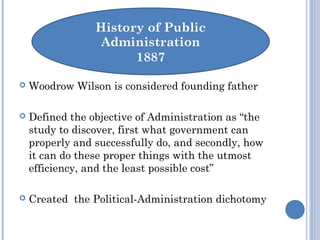
 Woodrow Wilson is considered founding father
 Defined the objective of Administration as “the
study to discover, first what government can
properly and successfully do, and secondly, how
it can do these proper things with the utmost
efficiency, and the least possible cost”
 Created the Political-Administration dichotomy
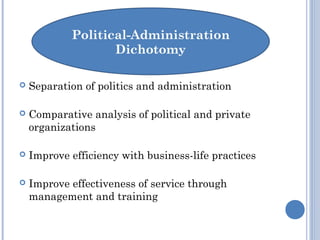
 Separation of politics and administration
 Comparative analysis of political and private
organizations
 Improve efficiency with business-life practices
 Improve effectiveness of service through
management and training
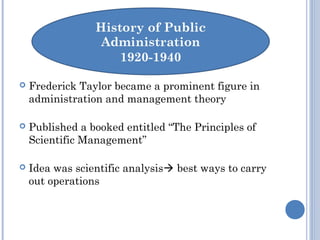
 Frederick Taylor became a prominent figure in
administration and management theory
 Published a booked entitled “The Principles of
Scientific Management”
 Idea was scientific analysis best ways to carry
out operations
 Replace work methods with scientific study
 Scientifically train and develop each employee
 Provide detailed instruction and supervision of
each employee
 Divide work equally between managers and
workers so scientific methods can be applied
 Dwight Waldo became a prominent figure for
administration
 Developed the “Administrative State”
 His theories later became known as Waldoian
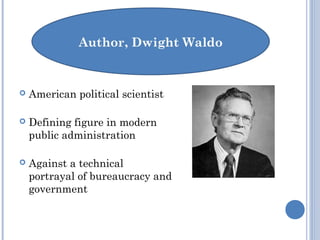
 American political scientist
 Defining figure in modern
public administration
 Against a technical
portrayal of bureaucracy and
government
:
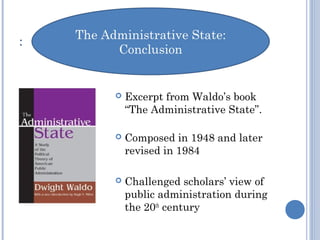
 Excerpt from Waldo’s book
“The Administrative State”.
 Composed in 1948 and later
revised in 1984
 Challenged scholars’ view of
public administration during
the 20th
century
 Idea/Term came about in early 1900s
 Intellectual development of public administration
 The political-administration dichotomy is false
 Woodrow Wilson
 Waldoian Approach
 Administration is not separate
 Administration is claimed to be at the core of
modern democratic government
 This CLAIM helps justify the entire disciple of
public administration
 If this claim has merit, then it implies two
thoughts,
 Democratic theory must deal with administration
 Administrative theory must deal with democratic
politics
 Nature of the “Good Life”
 What a good society looks like
 Action
 Procedures for determining how decisions are made
 Who should rule?
 How the powers of the state should be divided
and apportioned (Divided powers)
 Centralization vs. decentralization
 “Orthodox” ideology
 Indication of a quality of general agreement
 Certain general beliefs predominated
 Efficiency
 Political claim
 Input-output ratio

 Consist of 4 Characteristics
 1. Democracy = Efficiency
 The two terms thought to be synonymous
 Referring to bureaucracy
 2. Government work was though to be divisible
into two parts
 Decisions and execution
 Politics administration dichotomy
 3. Execution is a science based on firm scientific
principles for administration
 Easily discoverable and applied
 4. Values of business management apply to
government administration
 Practices lead to success
 The term itself is a value and it can run counter
to other variables
 Such as democratic participation
 Efficiency can not remain the disciplines
talisman against politics. Why? Efficiency is a
political claim.
 By specialization of the task among the group
 By arranging the members of a group in
hierarchy of authority
 By limiting the span of control at any point in
hierarchy to a small number
 Grouping workers according to purpose, process,
and place
1. Fundamental tension between democracy,
efficiency, and bureaucracy that protect
democratic principles.
2. PA dictotomy is wrong. Public servants hold
political positions that require implementing
policy by elected officials.
3. Public servants must negotiate efficiencies
demanded by scientific management with due
process and public access to government.
4. Government cannot be run like business.
Constitution must be honored.
 Held in patronage for Waldo in 1968
 Brought about the idea of “New Public
Administration” consisting of
 Democratic citizenship
 Public interest
 Public policy
 Services to citizens

Finished Powerpoint

  • 1.
    The Administrative State: Conclusion By:Dwight Waldo Presentation By: James Trubia Westfield State University Administrative Theory CRJU 0624-501 Dr. Rizzo February 3, 2015
  • 2.
     Woodrow Wilsonis considered founding father  Defined the objective of Administration as “the study to discover, first what government can properly and successfully do, and secondly, how it can do these proper things with the utmost efficiency, and the least possible cost”  Created the Political-Administration dichotomy
  • 3.
     Separation ofpolitics and administration  Comparative analysis of political and private organizations  Improve efficiency with business-life practices  Improve effectiveness of service through management and training
  • 4.
     Frederick Taylorbecame a prominent figure in administration and management theory  Published a booked entitled “The Principles of Scientific Management”  Idea was scientific analysis best ways to carry out operations
  • 5.
     Replace workmethods with scientific study  Scientifically train and develop each employee  Provide detailed instruction and supervision of each employee  Divide work equally between managers and workers so scientific methods can be applied
  • 6.
     Dwight Waldobecame a prominent figure for administration  Developed the “Administrative State”  His theories later became known as Waldoian
  • 7.
     American politicalscientist  Defining figure in modern public administration  Against a technical portrayal of bureaucracy and government
  • 8.
    :  Excerpt fromWaldo’s book “The Administrative State”.  Composed in 1948 and later revised in 1984  Challenged scholars’ view of public administration during the 20th century
  • 9.
     Idea/Term cameabout in early 1900s  Intellectual development of public administration  The political-administration dichotomy is false  Woodrow Wilson  Waldoian Approach  Administration is not separate
  • 10.
     Administration isclaimed to be at the core of modern democratic government  This CLAIM helps justify the entire disciple of public administration
  • 11.
     If thisclaim has merit, then it implies two thoughts,  Democratic theory must deal with administration  Administrative theory must deal with democratic politics
  • 12.
     Nature ofthe “Good Life”  What a good society looks like  Action  Procedures for determining how decisions are made  Who should rule?  How the powers of the state should be divided and apportioned (Divided powers)  Centralization vs. decentralization
  • 13.
     “Orthodox” ideology Indication of a quality of general agreement  Certain general beliefs predominated  Efficiency  Political claim  Input-output ratio
  • 14.
      Consist of4 Characteristics  1. Democracy = Efficiency  The two terms thought to be synonymous  Referring to bureaucracy
  • 15.
     2. Governmentwork was though to be divisible into two parts  Decisions and execution  Politics administration dichotomy
  • 16.
     3. Executionis a science based on firm scientific principles for administration  Easily discoverable and applied
  • 17.
     4. Valuesof business management apply to government administration  Practices lead to success
  • 18.
     The termitself is a value and it can run counter to other variables  Such as democratic participation  Efficiency can not remain the disciplines talisman against politics. Why? Efficiency is a political claim.
  • 19.
     By specializationof the task among the group  By arranging the members of a group in hierarchy of authority  By limiting the span of control at any point in hierarchy to a small number  Grouping workers according to purpose, process, and place
  • 20.
    1. Fundamental tensionbetween democracy, efficiency, and bureaucracy that protect democratic principles. 2. PA dictotomy is wrong. Public servants hold political positions that require implementing policy by elected officials. 3. Public servants must negotiate efficiencies demanded by scientific management with due process and public access to government. 4. Government cannot be run like business. Constitution must be honored.
  • 21.
     Held inpatronage for Waldo in 1968  Brought about the idea of “New Public Administration” consisting of  Democratic citizenship  Public interest  Public policy  Services to citizens