Why Niinue?
To speak to Kenyan youth is to experience entrepreneurship based on
innovation at its best. Yet the young Kenyan entrepreneur still
experiences huge difficulties raising the capital to fund their ideas,
innovations and budding enterprises.
Niinue provides an avenue for serious young entrepreneurs, who are
looking for capital and the following to be able to actualize their dreams:
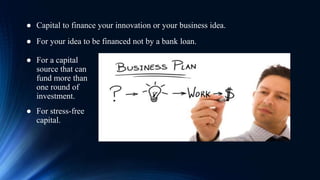
● Capital to finance your innovation or your business idea.
● For your idea to be financed not by a bank loan.
● For a capital
source that can
fund more than
one round of
investment.
● For stress-free
capital.
Why Niinue?
• For capital that understands the risk involved in enterprise.
• Partner(s) who add value to the proposition not just cash.
• For capital that comes with growth opportunities.
Why Niinue?
•For capital that gives you a free hand to execute your vision after
understanding it.
•For capital that gives you the ability to be a market leader.
•For capital that understands the need for flexibility in the growth of
enterprises.
•For capital that is patient
•For capital that is keen on the return on investment but also wants to see
the business grow.
•For capital that comes with genuine partners
Why Niinue?
● It is for this reason that Niinue was
created. To give those who fit into this
segment the capacity to raise the
capital they require from partners that
fit their needs.
Niinue is a Marketplace Investment
Platform executing a Debt-Equity Crowd
Funding model.
What is a marketplace investment
platform?
What Is Debt Equity Crowdfunding?
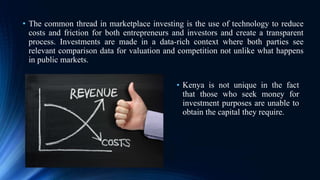
• The common thread in marketplace investing is the use of technology to reduce
costs and friction for both entrepreneurs and investors and create a transparent
process. Investments are made in a data-rich context where both parties see
relevant comparison data for valuation and competition not unlike what happens
in public markets.
• Kenya is not unique in the fact
that those who seek money for
investment purposes are unable to
obtain the capital they require.
• There is also a growing entrepreneurial minded middle class that is hungry
for investment opportunities that pay a healthy return that enables them to
be able to supplement their incomes, cushion them against shocks and
to gradually accumulate wealth to improve their quality of life while
building a nest-egg for their retirement.
What is unique in the Kenyan context is that the necessary interventions are
not emerging to deal with this problem.
Banks lend based on security and not against the idea or its inherent
potential.
Venture capital hasn’t taken off in Kenya. The rules to run a venture capital
fund were written without looking at the reality on the ground and merely
for the purposes of having regulatory legislation.
Kenyan law in this critical area is not reflective of the needs on the ground
and did not emerge organically.
Rather it was copy pasted from foreign jurisdictions and delivered
wholesale.
Private equity though it may not lack the resources to provide finances to
drive innovation in Kenya, it is completely inaccessible to the vast majority
of the generators of the innovative ideas that change the marketplace and
drive the economy.
On the demand side to speak of Kenyan youth is to experience
entrepreneurship at its best. An entire generation appears to have learnt
from the generation before them.
The public and private sectors combined are only creating some 40,000
permanent and pensionable jobs a year against a total annual youth output
from the school system of 250,000.
With only 16% of their age mates managing to get jobs, Kenyan youth have
been forced into entrepreneurship to survive by the old English saying
“necessity is the mother of invention”.
Kenyan youth have taken to enterprise with gusto innovating at every juncture
and making a living and growing businesses in the most difficult of
circumstances.
Most of them with no more than a high school diploma dare to dream big and
innovate with little technical assistance or capital, learning what they can as
they go along and using the internet as their key resource base.
“85-90% of all start-ups by Kenyan youth are the mundane run of the mill
imitations that one finds in the market place all across the world. 10-15% of
start-ups are real gems that simply lack that capital and advice to become
targets for acquisition by multinational corporations, private equity or stars on
the Nairobi Stock Exchange.
Starved of capital and a listening ear, many of them will die within the first
18 months of operation on their shoe string budgets.
What is even more startling is “on average, return on investment for these
10-15% of high potential start-ups is 260% plus per annum in the first year,
dropping to 140-170% in the second year with investments and innovations
in agriculture that are usually scalable, leading the way with returns of
310% per annum consistently for the first two years”.
In a survey of 2,331 youth surveyed over two years ending in 2015 the
major complaint of 94% was that “youth don’t need loans. Youth need
capital and advice.” To be told this is a bad project or bad plan and why.
This is a good project or a good plan but this is what you will need to do
take it to the next level.
“Things like the youth development fund won’t help us. That money can only
help imitators not innovators because it is structured like bank debt even if it is
interest-free and it doesn’t grow with the business. You get Kshs 100,000 and
that is it. When you need Kshs 250,000 to take the business to the next stage,
they have no capacity to extend any more capital to you.”
The survey identified some 315 startups that had “the potential to transform
their communities, that used replicable problem solving techniques and
technology in a fashion that was not only scalable but also profitable; with each
requiring no more than US$ 5,000 in three rounds of funding to reach
profitability, financial stability and commercial scalability.”
If all of them were invested in at a cost of Kshs157,500,000, the report
estimates that the “combined value of all the start-ups together after twenty-
four months would be Kshs 1,700,000,000 with the potential to attract private
equity worth 30% of that to keep them going” A 300% return on valuation.
On the supply side 95% of middle and upper class Kenyans are making
entrepreneurial investments to supplement their daily incomes and as a way
of building savings for their retirement.
The results of these investments however are extremely worrying.
80% of all investments made by this category of investors are no longer
commercially viable within 18 months. The balance of 20% will struggle on
for another 18 months with only 2% surviving after 36 months usually only
through additional injections of capital.
What are the reasons for this extremely high failure rate?
1. Most investors who are making these investments are simply investors and not
entrepreneurs and lack the skill set, the knowledge and the time to make these
enterprises succeed.
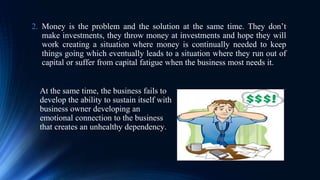
At the same time, the business fails to
develop the ability to sustain itself with
business owner developing an
emotional connection to the business
that creates an unhealthy dependency.
2. Money is the problem and the solution at the same time. They don’t
make investments, they throw money at investments and hope they will
work creating a situation where money is continually needed to keep
things going which eventually leads to a situation where they run out of
capital or suffer from capital fatigue when the business most needs it.
3. Just like the vast majority of the population they are imitators and not
innovators and simply get into the business because they have seen
others in it without realizing that 300 others are doing exactly what they
are doing driving margins down and eventually making them non
existent.
4. Instead of pooling capital to spread their risk, they finance businesses
individually so when an enterprise collapses it collapses with all their
cash.
5. The fail to litmus test their idea with critical minds to point out the
flaws in their plans, most never write a business plan for themselves,
most have no projection when the business will break even and they
completely ignore the importance of sales in driving revenues while
putting all their stock in marketing and advertising.
• As a result of the difficulties that many have as investor – entrepreneurs, by the
end of their second investment, most move towards the safety of real estate and
land banking. Whereas land banking is safe for capital gains, more and more
investors in land are targeting virgin areas which means that sales where people
have land banked are increasingly getting harder to dispose of even as paper
valuations rise.
• Real estate on the other hand, though a
safe investment, rarely pays more than a
paltry 8-10% return per annum before
land rates and income tax bringing
returns back down to the 5-6% region.
It makes more sense and is less of a
headache to put your money in a fixed
deposit account than to buy land.
Our connection as a nation to real estate is driven by maxims like “the
rich invest in real estate”, “real estate is a safe investment” and “real
estate is a smart way to grow rich” ignoring the fact that real estate “the
rich save via real estate” with their main aim being to reap via capital
gains over extremely long periods and that those who invest in real estate
for these long periods generally have a higher and more stable income.
The Kenyan middle income investor is stuck between a rock and a hard
place. Invest individually in tricky risky self-funded investments, the
stock exchange that is either stagnant or in decline, buy unit trusts or
insurance company backed investments whose returns are paltry or
invest in real estate where there is safety and capital gains but poor
returns along the way and an arduous sale process to realize those
returns.
A real solution:
There has to be a middle way that allows the Kenyan investor to make exponential
returns and allows the best and brightest Kenyan start-ups and going concerns to
obtain the capital they require to generate the value and returns that they so clearly
have the potential to. Three examples come to mind as we walk down this road:
• First Chartered Securities
• Transcentury and
•Centum Investments.
These are picked as opposed to the current private equity concerns in Kenya
because these were indigenous initiatives financed wholly indigenously.
• First Chartered Securities was created by a group of friends who were spread
across the private and public sectors who decided to pool capital and make
strategic equity investments. Though their monthly contributions were small,
they were able by continually invest in enterprises to take advantage of
opportunities as they arose and to build a veritable empire over 30 years that
bestrides finance, insurance and real estate which holds among its prize
possessions the NIC Bank Group and The Insurance Corporation of East
Africa.
• Transcentury followed on the heels of First Chartered Securities imitating their
investment philosophy and systems based management policies, bringing
together 29 friends with steady monthly contributions that were funneled into
private equity. They now boast among its prize possessions: East African
Cables, Avery (East Africa) Limited, Kewberg and Civicon, and has expanded
its investment writ to cover not only Kenya but southern Africa as well.
• Centum Investments, which is the rebranded Industrial and
Commercial Development Corporation Investments Limited
(ICDCI) was created as an arm of government that allowed for
Kenyans to pool their capital and invest in new opportunities that
were emerging after independence. ICDCI created UAP Insurance
and Carbacid and currently Centum holds in its portfolio K-Rep
Bank, Amu Power, Genesis Kenya Investment Management
Limited, Kenya Wine Agencies, AON Insurance Brokers, Two
Rivers Mall and NAS Servair.
The founder shareholders of these three companies are all billionaires
and among Kenya’s top 100 in wealth with their investments having
paid measurable life changing returns within 5 years.
As successful as these modes have been most Kenyans know nothing
about them and continue to think individuality in investment is the way
to go.
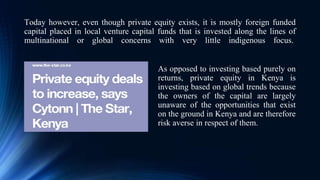
Today however, even though private equity exists, it is mostly foreign funded
capital placed in local venture capital funds that is invested along the lines of
multinational or global concerns with very little indigenous focus.
As opposed to investing based purely on
returns, private equity in Kenya is
investing based on global trends because
the owners of the capital are largely
unaware of the opportunities that exist
on the ground in Kenya and are therefore
risk averse in respect of them.
What Kenya requires is a new indigenous private equity solution whose
investment focus is on high quality scalable investments that solve problems or
reduce costs. That takes advantage of the opportunities available on the ground to
build a portal that harnesses the vast quantities of capital currently being wasted in
investment experiments by Kenya's ever expanding middle class knowing that the
investments they make will have the potential to generate great wealth for
themselves and to transform Kenya.
That solution is marketplace investing, specifically Niinue.
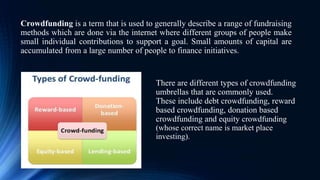
Crowdfunding is a term that is used to generally describe a range of fundraising
methods which are done via the internet where different groups of people make
small individual contributions to support a goal. Small amounts of capital are
accumulated from a large number of people to finance initiatives.
There are different types of crowdfunding
umbrellas that are commonly used.
These include debt crowdfunding, reward
based crowdfunding, donation based
crowdfunding and equity crowdfunding
(whose correct name is market place
investing).
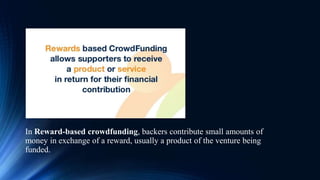
In Reward-based crowdfunding, backers contribute small amounts of
money in exchange of a reward, usually a product of the venture being
funded.
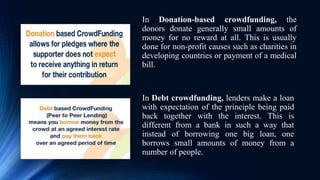
In Donation-based crowdfunding, the
donors donate generally small amounts of
money for no reward at all. This is usually
done for non-profit causes such as charities in
developing countries or payment of a medical
bill.
In Debt crowdfunding, lenders make a loan
with expectation of the principle being paid
back together with the interest. This is
different from a bank in such a way that
instead of borrowing one big loan, one
borrows small amounts of money from a
number of people.
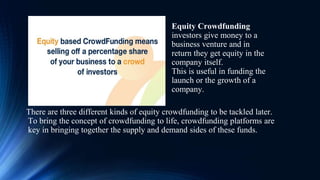
There are three different kinds of equity crowdfunding to be tackled later.
To bring the concept of crowdfunding to life, crowdfunding platforms are
key in bringing together the supply and demand sides of these funds.
Equity Crowdfunding
investors give money to a
business venture and in
return they get equity in the
company itself.
This is useful in funding the
launch or the growth of a
company.
Different platforms give access to different forms of crowdfunding.
For instance, Kickstarter and
Indiegogo are popular platforms
for Reward-based
crowdfunding.
GoFundMe and Crowdrise are
popular platforms for Donation-
based crowdfunding.
On the other hand, common platforms for Equity
Crowdfunding include AngelList, Crowdfunder, Fundable,
EarlyShares, CircleUp, CrowdCube and Seedrs
Equity Crowdfunding/Market Place Investing allows investors
with low income to be able to make small investment in different
business ventures hence spreading the risk through an online special
purpose vehicle called the Market Place Investing Platform. This
platform is used as a broker-dealer where entrepreneurs pay a fee for
their ventures to be advertised to probable investors and once investors
invest, the crowdfunding platform gets a commission from the total
amount of money invested.
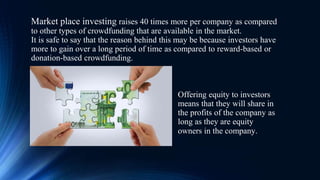
Market place investing raises 40 times more per company as compared
to other types of crowdfunding that are available in the market.
It is safe to say that the reason behind this may be because investors have
more to gain over a long period of time as compared to reward-based or
donation-based crowdfunding.
Offering equity to investors
means that they will share in
the profits of the company as
long as they are equity
owners in the company.
Pioneers note that Market place investing might lead to a revolution
in private capital markets which will redefine permanently how
financial markets work.
Just like any other investment in securities, it is necessary for investors
in the equity crowdfunding platform to be adequately educated to
understand that these are risk-based ventures hence the reason that the
investors are advised to spread their risk over a number of enterprises is
so that a loss in one unsuccessful enterprise can be covered by profits
from another successful one.
The Legal Aspect
It is important to note that due to its structure “there exists a sale of a
security”, market place investing is couched deeply in the
legislative landscape and since it is considered as a sale of a security
market place investing per se has been heavily restricted in Kenya.
It is considered a security because there is exchange of money with
expectation of profit from a common enterprise which depends solely
on efforts of a promoter.
In the Kenyan context there is a legal lacuna between the Companies
Act and the Capital Markets Authority Act.
In the Companies Act it is stated that companies are formed by
subscription of shares which means market place investing can
be applied pre-incorporation so that subscribers can back an
idea or innovation as they form a company to prosecute a
business.
On the other hand the Capital Markets Act states that it is
illegal for private companies to offer shares to the public and
since most market place investing platforms requires that you
have an established legal entity, this “theoretically” closes the
door on the possibility of using market place investing to fund
enterprises.
To circumvent and legally establish equity crowdfunding/market place
investing, an innovation has emerged. Debt-equity crowdfunding.
All enterprises that come to a market place investing platform if they
are not at the pre-incorporation stage will for legal purposes seek to
raise debt to finance their operations.
A limited liability company provides a general debenture charge over
the company and its assets as a first level security for the debt.
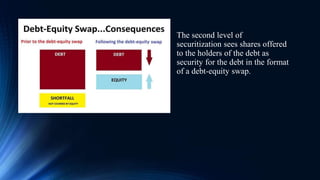
The second level of
securitization sees shares offered
to the holders of the debt as
security for the debt in the format
of a debt-equity swap.
For seed capital, 45% of equity is offered. For venture capital 35% of
equity. And for expansion capital 25% of equity. Control of the company
and its operations is then parceled out through directorships in a manner
that is reflective of the new shareholding.
The company is then given a period in which it is supposed to reach
profitability. That period is then divided into quarters. This period can be
as long as sixty months.
In the first quarter, all profits are reinvested.
In the second quarter, 50% of profits are reinvested with the excess
divided according to shareholding.
• In the third quarter 25% of profits are reinvested with the excess
divided according to shareholding.
• In the final quarter 0% of profits are reinvested with the profits
divided according to shareholding.
• Should the enterprise reach profitability by the second designated
quarter, then at the end of the four quarters, the promoter can seek to
buy-back all the shares at a premium of 1.5% per month for every
month until the end of the fourth designated quarter.
• Should the enterprise fail to do so then equity remains with the debt
holders in perpetuity with the general debenture charge being lifted.
By the agreement of the shareholders, the company can return for another
round of funding after six months have passed since its last funding round.
Structuring
Investments are made on the following criteria:
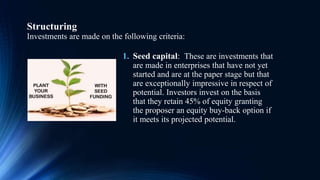
1. Seed capital: These are investments that
are made in enterprises that have not yet
started and are at the paper stage but that
are exceptionally impressive in respect of
potential. Investors invest on the basis
that they retain 45% of equity granting
the proposer an equity buy-back option if
it meets its projected potential.
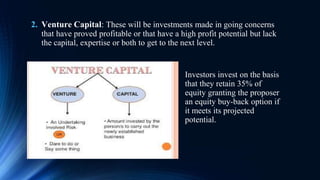
2. Venture Capital: These will be investments made in going concerns
that have proved profitable or that have a high profit potential but lack
the capital, expertise or both to get to the next level.
Investors invest on the basis
that they retain 35% of
equity granting the proposer
an equity buy-back option if
it meets its projected
potential.
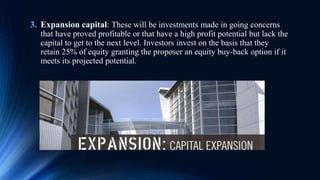
3. Expansion capital: These will be investments made in going concerns
that have proved profitable or that have a high profit potential but lack the
capital to get to the next level. Investors invest on the basis that they
retain 25% of equity granting the proposer an equity buy-back option if it
meets its projected potential.
Online special purpose vehicles [SPVs] called market place
investment platform [MPI-P] are used to broker-dealer where
entrepreneurs pay a fees for their ventures to be advertised to probable
investors and once investors invest, the [MPI-P] charge a 10%
successful funding fee or if the enterprise deserves technical assistance
then it would charge a 5% successful funding fee and retain 5% of
equity.
The Role of the MPI-P's includes the following:
MPI-P's unite startups and growing companies with investors. The
business ventures pay a fee to have their proposal put up on the
platforms and marketed to all investors on the platform. Investors who
are interested in the venture will then direct interest to the ventures
advertised.
2. MPI-P's announce equity offerings and they also reveal
risks by virtue of what is known as deal grading and deal
terms. Deal grading is a critical assessment done by
qualified persons contracted by the MPI-P's to provide such
assessments.
It is necessary for investors to know that what they are
getting into is a risk-based venture and they may profit or
lose just like in any other security.
3. The platform ensures that it educates the investors on the
platform so that they do not invest blindly.
3. MPI-P's enable potential investors to collaborate with each
other on deal selection and due diligence in an open and
coordinated manner. This goes a long way in enabling the
investors make sound decisions regarding which ventures
they should put their money into.
4. MPI-P's facilitate investment transactions. Once an investor
wants to invest in an enterprise, they then show that intention
via an expression of interest.
Once they have done so, they go ahead and invest money in
the venture. The money is deposited in the platform’s bank
account and held in trust by the platform until such a time
that all the legal caveats for a safe and secure investment are
in place and investors have firm control over the operations
and finances of the venture being invested in.
5. MPI-P's fills the gap left in funding of new concepts that banks
fail to fund because of the notion that the ideas are perceived as
unproven ideas.
6. MPI-P's allows the entrepreneur to accomplish funding in a
matter of weeks or days, sometimes hours, at a relatively little
cost.
How does a MPI-P work?
The general model followed by MPI-P's is as follows:
• The entrepreneur who wants to raise investment funds prepares
the process of raising funds by becoming familiar with the
terms of the MPI-P that they intend to use.
• The entrepreneur goes through a preparation period and pre-
crowd activities which include an application to be listed on
the MPI-P's and an in depth review of the terms and
conditions of the MPI-P's.
• The MPI-P's will then request due diligence of the issuer in
accordance with its terms and conditions at the application
stage. All documentation and answers provided by the issuer
are available to the investors on the platform.
• The entrepreneur then uploads all due diligence and all
information that has been requested for by the MPI-P's.
• Officers of the MPI-P review information and determine the
entrepreneur will be listed.
• If the officers agree, the entrepreneur is listed.
• The entrepreneur then uploads the pitch video and business
plan.
• The investment opportunity is reviewed by investors on the
platform and they decide whether to invest.
• At the end of the funding round typically 30 – 45 days,
closing documents are signed by the platform as a
representative of the investors who have expressed interest in
investing in the venture.
• The investor provides the monies for investment via the
platform that acts as an escrow agent, after expressing
interest to invest. These monies are held in the escrow
agents account till the funding phase is over and all legal
processes are concluded.
• The entrepreneur closes the capital raised and releases all
closing documents to the entrepreneur to the escrow holder.
• The MPI-P releases the funds to the entrepreneur
subtracting the fees for the MPI-P and legal fees.
• The escrow holder avails to the investors all closing
documents general debenture charge, share certificates
copy with all communication from the company.
• The company conducts its first AGM with the new
shareholders.
The way forward?
Market place investing is a viable option to increase the
opportunities available for middle income Kenyans to invest in
a way that enables them to spread their risk, supplement their
income by creating passive income streams and generate wealth
by holding equity in companies that can attract private equity,
multi-nationals and even make it to the stock exchange.
On the flip side the time has come to give Kenyan entrepreneurs a
way to raise the capital that they need to finance the innovations
and ideas that will drive the economy of the future and create the
jobs that our nation so desperately needs.
How Do I Use Niinue?
The most important thing to do is to read the information pack.
Once you have read the information pack, then after registration,
to use the tutorial and the material in the incubator, before you
proceed to the investment window and attempt to invest.

Entrepreneur information pack (5) (1)

  • 2.
    Why Niinue? To speakto Kenyan youth is to experience entrepreneurship based on innovation at its best. Yet the young Kenyan entrepreneur still experiences huge difficulties raising the capital to fund their ideas, innovations and budding enterprises. Niinue provides an avenue for serious young entrepreneurs, who are looking for capital and the following to be able to actualize their dreams:
  • 3.
    ● Capital tofinance your innovation or your business idea. ● For your idea to be financed not by a bank loan. ● For a capital source that can fund more than one round of investment. ● For stress-free capital.
  • 4.
    Why Niinue? • Forcapital that understands the risk involved in enterprise. • Partner(s) who add value to the proposition not just cash. • For capital that comes with growth opportunities.
  • 5.
    Why Niinue? •For capitalthat gives you a free hand to execute your vision after understanding it. •For capital that gives you the ability to be a market leader. •For capital that understands the need for flexibility in the growth of enterprises. •For capital that is patient •For capital that is keen on the return on investment but also wants to see the business grow. •For capital that comes with genuine partners
  • 6.
    Why Niinue? ● Itis for this reason that Niinue was created. To give those who fit into this segment the capacity to raise the capital they require from partners that fit their needs.
  • 7.
    Niinue is aMarketplace Investment Platform executing a Debt-Equity Crowd Funding model. What is a marketplace investment platform? What Is Debt Equity Crowdfunding?
  • 8.
    • The commonthread in marketplace investing is the use of technology to reduce costs and friction for both entrepreneurs and investors and create a transparent process. Investments are made in a data-rich context where both parties see relevant comparison data for valuation and competition not unlike what happens in public markets. • Kenya is not unique in the fact that those who seek money for investment purposes are unable to obtain the capital they require.
  • 9.
    • There isalso a growing entrepreneurial minded middle class that is hungry for investment opportunities that pay a healthy return that enables them to be able to supplement their incomes, cushion them against shocks and to gradually accumulate wealth to improve their quality of life while building a nest-egg for their retirement.
  • 10.
    What is uniquein the Kenyan context is that the necessary interventions are not emerging to deal with this problem. Banks lend based on security and not against the idea or its inherent potential. Venture capital hasn’t taken off in Kenya. The rules to run a venture capital fund were written without looking at the reality on the ground and merely for the purposes of having regulatory legislation. Kenyan law in this critical area is not reflective of the needs on the ground and did not emerge organically.
  • 11.
    Rather it wascopy pasted from foreign jurisdictions and delivered wholesale. Private equity though it may not lack the resources to provide finances to drive innovation in Kenya, it is completely inaccessible to the vast majority of the generators of the innovative ideas that change the marketplace and drive the economy. On the demand side to speak of Kenyan youth is to experience entrepreneurship at its best. An entire generation appears to have learnt from the generation before them. The public and private sectors combined are only creating some 40,000 permanent and pensionable jobs a year against a total annual youth output from the school system of 250,000.
  • 12.
    With only 16%of their age mates managing to get jobs, Kenyan youth have been forced into entrepreneurship to survive by the old English saying “necessity is the mother of invention”. Kenyan youth have taken to enterprise with gusto innovating at every juncture and making a living and growing businesses in the most difficult of circumstances. Most of them with no more than a high school diploma dare to dream big and innovate with little technical assistance or capital, learning what they can as they go along and using the internet as their key resource base. “85-90% of all start-ups by Kenyan youth are the mundane run of the mill imitations that one finds in the market place all across the world. 10-15% of start-ups are real gems that simply lack that capital and advice to become targets for acquisition by multinational corporations, private equity or stars on the Nairobi Stock Exchange.
  • 13.
    Starved of capitaland a listening ear, many of them will die within the first 18 months of operation on their shoe string budgets. What is even more startling is “on average, return on investment for these 10-15% of high potential start-ups is 260% plus per annum in the first year, dropping to 140-170% in the second year with investments and innovations in agriculture that are usually scalable, leading the way with returns of 310% per annum consistently for the first two years”. In a survey of 2,331 youth surveyed over two years ending in 2015 the major complaint of 94% was that “youth don’t need loans. Youth need capital and advice.” To be told this is a bad project or bad plan and why. This is a good project or a good plan but this is what you will need to do take it to the next level.
  • 14.
    “Things like theyouth development fund won’t help us. That money can only help imitators not innovators because it is structured like bank debt even if it is interest-free and it doesn’t grow with the business. You get Kshs 100,000 and that is it. When you need Kshs 250,000 to take the business to the next stage, they have no capacity to extend any more capital to you.” The survey identified some 315 startups that had “the potential to transform their communities, that used replicable problem solving techniques and technology in a fashion that was not only scalable but also profitable; with each requiring no more than US$ 5,000 in three rounds of funding to reach profitability, financial stability and commercial scalability.”
  • 15.
    If all ofthem were invested in at a cost of Kshs157,500,000, the report estimates that the “combined value of all the start-ups together after twenty- four months would be Kshs 1,700,000,000 with the potential to attract private equity worth 30% of that to keep them going” A 300% return on valuation. On the supply side 95% of middle and upper class Kenyans are making entrepreneurial investments to supplement their daily incomes and as a way of building savings for their retirement. The results of these investments however are extremely worrying. 80% of all investments made by this category of investors are no longer commercially viable within 18 months. The balance of 20% will struggle on for another 18 months with only 2% surviving after 36 months usually only through additional injections of capital.
  • 16.
    What are thereasons for this extremely high failure rate? 1. Most investors who are making these investments are simply investors and not entrepreneurs and lack the skill set, the knowledge and the time to make these enterprises succeed.
  • 17.
    At the sametime, the business fails to develop the ability to sustain itself with business owner developing an emotional connection to the business that creates an unhealthy dependency. 2. Money is the problem and the solution at the same time. They don’t make investments, they throw money at investments and hope they will work creating a situation where money is continually needed to keep things going which eventually leads to a situation where they run out of capital or suffer from capital fatigue when the business most needs it.
  • 18.
    3. Just likethe vast majority of the population they are imitators and not innovators and simply get into the business because they have seen others in it without realizing that 300 others are doing exactly what they are doing driving margins down and eventually making them non existent. 4. Instead of pooling capital to spread their risk, they finance businesses individually so when an enterprise collapses it collapses with all their cash. 5. The fail to litmus test their idea with critical minds to point out the flaws in their plans, most never write a business plan for themselves, most have no projection when the business will break even and they completely ignore the importance of sales in driving revenues while putting all their stock in marketing and advertising.
  • 19.
    • As aresult of the difficulties that many have as investor – entrepreneurs, by the end of their second investment, most move towards the safety of real estate and land banking. Whereas land banking is safe for capital gains, more and more investors in land are targeting virgin areas which means that sales where people have land banked are increasingly getting harder to dispose of even as paper valuations rise. • Real estate on the other hand, though a safe investment, rarely pays more than a paltry 8-10% return per annum before land rates and income tax bringing returns back down to the 5-6% region. It makes more sense and is less of a headache to put your money in a fixed deposit account than to buy land.
  • 20.
    Our connection asa nation to real estate is driven by maxims like “the rich invest in real estate”, “real estate is a safe investment” and “real estate is a smart way to grow rich” ignoring the fact that real estate “the rich save via real estate” with their main aim being to reap via capital gains over extremely long periods and that those who invest in real estate for these long periods generally have a higher and more stable income. The Kenyan middle income investor is stuck between a rock and a hard place. Invest individually in tricky risky self-funded investments, the stock exchange that is either stagnant or in decline, buy unit trusts or insurance company backed investments whose returns are paltry or invest in real estate where there is safety and capital gains but poor returns along the way and an arduous sale process to realize those returns.
  • 21.
    A real solution: Therehas to be a middle way that allows the Kenyan investor to make exponential returns and allows the best and brightest Kenyan start-ups and going concerns to obtain the capital they require to generate the value and returns that they so clearly have the potential to. Three examples come to mind as we walk down this road: • First Chartered Securities • Transcentury and •Centum Investments. These are picked as opposed to the current private equity concerns in Kenya because these were indigenous initiatives financed wholly indigenously.
  • 22.
    • First CharteredSecurities was created by a group of friends who were spread across the private and public sectors who decided to pool capital and make strategic equity investments. Though their monthly contributions were small, they were able by continually invest in enterprises to take advantage of opportunities as they arose and to build a veritable empire over 30 years that bestrides finance, insurance and real estate which holds among its prize possessions the NIC Bank Group and The Insurance Corporation of East Africa. • Transcentury followed on the heels of First Chartered Securities imitating their investment philosophy and systems based management policies, bringing together 29 friends with steady monthly contributions that were funneled into private equity. They now boast among its prize possessions: East African Cables, Avery (East Africa) Limited, Kewberg and Civicon, and has expanded its investment writ to cover not only Kenya but southern Africa as well.
  • 23.
    • Centum Investments,which is the rebranded Industrial and Commercial Development Corporation Investments Limited (ICDCI) was created as an arm of government that allowed for Kenyans to pool their capital and invest in new opportunities that were emerging after independence. ICDCI created UAP Insurance and Carbacid and currently Centum holds in its portfolio K-Rep Bank, Amu Power, Genesis Kenya Investment Management Limited, Kenya Wine Agencies, AON Insurance Brokers, Two Rivers Mall and NAS Servair. The founder shareholders of these three companies are all billionaires and among Kenya’s top 100 in wealth with their investments having paid measurable life changing returns within 5 years. As successful as these modes have been most Kenyans know nothing about them and continue to think individuality in investment is the way to go.
  • 24.
    Today however, eventhough private equity exists, it is mostly foreign funded capital placed in local venture capital funds that is invested along the lines of multinational or global concerns with very little indigenous focus. As opposed to investing based purely on returns, private equity in Kenya is investing based on global trends because the owners of the capital are largely unaware of the opportunities that exist on the ground in Kenya and are therefore risk averse in respect of them.
  • 25.
    What Kenya requiresis a new indigenous private equity solution whose investment focus is on high quality scalable investments that solve problems or reduce costs. That takes advantage of the opportunities available on the ground to build a portal that harnesses the vast quantities of capital currently being wasted in investment experiments by Kenya's ever expanding middle class knowing that the investments they make will have the potential to generate great wealth for themselves and to transform Kenya. That solution is marketplace investing, specifically Niinue.
  • 26.
    Crowdfunding is aterm that is used to generally describe a range of fundraising methods which are done via the internet where different groups of people make small individual contributions to support a goal. Small amounts of capital are accumulated from a large number of people to finance initiatives. There are different types of crowdfunding umbrellas that are commonly used. These include debt crowdfunding, reward based crowdfunding, donation based crowdfunding and equity crowdfunding (whose correct name is market place investing).
  • 27.
    In Reward-based crowdfunding,backers contribute small amounts of money in exchange of a reward, usually a product of the venture being funded.
  • 28.
    In Donation-based crowdfunding,the donors donate generally small amounts of money for no reward at all. This is usually done for non-profit causes such as charities in developing countries or payment of a medical bill. In Debt crowdfunding, lenders make a loan with expectation of the principle being paid back together with the interest. This is different from a bank in such a way that instead of borrowing one big loan, one borrows small amounts of money from a number of people.
  • 29.
    There are threedifferent kinds of equity crowdfunding to be tackled later. To bring the concept of crowdfunding to life, crowdfunding platforms are key in bringing together the supply and demand sides of these funds. Equity Crowdfunding investors give money to a business venture and in return they get equity in the company itself. This is useful in funding the launch or the growth of a company.
  • 30.
    Different platforms giveaccess to different forms of crowdfunding. For instance, Kickstarter and Indiegogo are popular platforms for Reward-based crowdfunding. GoFundMe and Crowdrise are popular platforms for Donation- based crowdfunding. On the other hand, common platforms for Equity Crowdfunding include AngelList, Crowdfunder, Fundable, EarlyShares, CircleUp, CrowdCube and Seedrs
  • 31.
    Equity Crowdfunding/Market PlaceInvesting allows investors with low income to be able to make small investment in different business ventures hence spreading the risk through an online special purpose vehicle called the Market Place Investing Platform. This platform is used as a broker-dealer where entrepreneurs pay a fee for their ventures to be advertised to probable investors and once investors invest, the crowdfunding platform gets a commission from the total amount of money invested.
  • 32.
    Market place investingraises 40 times more per company as compared to other types of crowdfunding that are available in the market. It is safe to say that the reason behind this may be because investors have more to gain over a long period of time as compared to reward-based or donation-based crowdfunding. Offering equity to investors means that they will share in the profits of the company as long as they are equity owners in the company.
  • 33.
    Pioneers note thatMarket place investing might lead to a revolution in private capital markets which will redefine permanently how financial markets work. Just like any other investment in securities, it is necessary for investors in the equity crowdfunding platform to be adequately educated to understand that these are risk-based ventures hence the reason that the investors are advised to spread their risk over a number of enterprises is so that a loss in one unsuccessful enterprise can be covered by profits from another successful one.
  • 34.
    The Legal Aspect Itis important to note that due to its structure “there exists a sale of a security”, market place investing is couched deeply in the legislative landscape and since it is considered as a sale of a security market place investing per se has been heavily restricted in Kenya. It is considered a security because there is exchange of money with expectation of profit from a common enterprise which depends solely on efforts of a promoter.
  • 35.
    In the Kenyancontext there is a legal lacuna between the Companies Act and the Capital Markets Authority Act. In the Companies Act it is stated that companies are formed by subscription of shares which means market place investing can be applied pre-incorporation so that subscribers can back an idea or innovation as they form a company to prosecute a business. On the other hand the Capital Markets Act states that it is illegal for private companies to offer shares to the public and since most market place investing platforms requires that you have an established legal entity, this “theoretically” closes the door on the possibility of using market place investing to fund enterprises.
  • 36.
    To circumvent andlegally establish equity crowdfunding/market place investing, an innovation has emerged. Debt-equity crowdfunding. All enterprises that come to a market place investing platform if they are not at the pre-incorporation stage will for legal purposes seek to raise debt to finance their operations. A limited liability company provides a general debenture charge over the company and its assets as a first level security for the debt.
  • 37.
    The second levelof securitization sees shares offered to the holders of the debt as security for the debt in the format of a debt-equity swap.
  • 38.
    For seed capital,45% of equity is offered. For venture capital 35% of equity. And for expansion capital 25% of equity. Control of the company and its operations is then parceled out through directorships in a manner that is reflective of the new shareholding. The company is then given a period in which it is supposed to reach profitability. That period is then divided into quarters. This period can be as long as sixty months. In the first quarter, all profits are reinvested. In the second quarter, 50% of profits are reinvested with the excess divided according to shareholding.
  • 39.
    • In thethird quarter 25% of profits are reinvested with the excess divided according to shareholding. • In the final quarter 0% of profits are reinvested with the profits divided according to shareholding. • Should the enterprise reach profitability by the second designated quarter, then at the end of the four quarters, the promoter can seek to buy-back all the shares at a premium of 1.5% per month for every month until the end of the fourth designated quarter. • Should the enterprise fail to do so then equity remains with the debt holders in perpetuity with the general debenture charge being lifted.
  • 40.
    By the agreementof the shareholders, the company can return for another round of funding after six months have passed since its last funding round.
  • 41.
    Structuring Investments are madeon the following criteria: 1. Seed capital: These are investments that are made in enterprises that have not yet started and are at the paper stage but that are exceptionally impressive in respect of potential. Investors invest on the basis that they retain 45% of equity granting the proposer an equity buy-back option if it meets its projected potential.
  • 42.
    2. Venture Capital:These will be investments made in going concerns that have proved profitable or that have a high profit potential but lack the capital, expertise or both to get to the next level. Investors invest on the basis that they retain 35% of equity granting the proposer an equity buy-back option if it meets its projected potential.
  • 43.
    3. Expansion capital:These will be investments made in going concerns that have proved profitable or that have a high profit potential but lack the capital to get to the next level. Investors invest on the basis that they retain 25% of equity granting the proposer an equity buy-back option if it meets its projected potential.
  • 44.
    Online special purposevehicles [SPVs] called market place investment platform [MPI-P] are used to broker-dealer where entrepreneurs pay a fees for their ventures to be advertised to probable investors and once investors invest, the [MPI-P] charge a 10% successful funding fee or if the enterprise deserves technical assistance then it would charge a 5% successful funding fee and retain 5% of equity. The Role of the MPI-P's includes the following: MPI-P's unite startups and growing companies with investors. The business ventures pay a fee to have their proposal put up on the platforms and marketed to all investors on the platform. Investors who are interested in the venture will then direct interest to the ventures advertised.
  • 45.
    2. MPI-P's announceequity offerings and they also reveal risks by virtue of what is known as deal grading and deal terms. Deal grading is a critical assessment done by qualified persons contracted by the MPI-P's to provide such assessments. It is necessary for investors to know that what they are getting into is a risk-based venture and they may profit or lose just like in any other security. 3. The platform ensures that it educates the investors on the platform so that they do not invest blindly.
  • 46.
    3. MPI-P's enablepotential investors to collaborate with each other on deal selection and due diligence in an open and coordinated manner. This goes a long way in enabling the investors make sound decisions regarding which ventures they should put their money into. 4. MPI-P's facilitate investment transactions. Once an investor wants to invest in an enterprise, they then show that intention via an expression of interest. Once they have done so, they go ahead and invest money in the venture. The money is deposited in the platform’s bank account and held in trust by the platform until such a time that all the legal caveats for a safe and secure investment are in place and investors have firm control over the operations and finances of the venture being invested in.
  • 47.
    5. MPI-P's fillsthe gap left in funding of new concepts that banks fail to fund because of the notion that the ideas are perceived as unproven ideas. 6. MPI-P's allows the entrepreneur to accomplish funding in a matter of weeks or days, sometimes hours, at a relatively little cost. How does a MPI-P work? The general model followed by MPI-P's is as follows: • The entrepreneur who wants to raise investment funds prepares the process of raising funds by becoming familiar with the terms of the MPI-P that they intend to use.
  • 48.
    • The entrepreneurgoes through a preparation period and pre- crowd activities which include an application to be listed on the MPI-P's and an in depth review of the terms and conditions of the MPI-P's. • The MPI-P's will then request due diligence of the issuer in accordance with its terms and conditions at the application stage. All documentation and answers provided by the issuer are available to the investors on the platform. • The entrepreneur then uploads all due diligence and all information that has been requested for by the MPI-P's.
  • 49.
    • Officers ofthe MPI-P review information and determine the entrepreneur will be listed. • If the officers agree, the entrepreneur is listed. • The entrepreneur then uploads the pitch video and business plan. • The investment opportunity is reviewed by investors on the platform and they decide whether to invest. • At the end of the funding round typically 30 – 45 days, closing documents are signed by the platform as a representative of the investors who have expressed interest in investing in the venture.
  • 50.
    • The investorprovides the monies for investment via the platform that acts as an escrow agent, after expressing interest to invest. These monies are held in the escrow agents account till the funding phase is over and all legal processes are concluded. • The entrepreneur closes the capital raised and releases all closing documents to the entrepreneur to the escrow holder. • The MPI-P releases the funds to the entrepreneur subtracting the fees for the MPI-P and legal fees. • The escrow holder avails to the investors all closing documents general debenture charge, share certificates copy with all communication from the company. • The company conducts its first AGM with the new shareholders.
  • 51.
    The way forward? Marketplace investing is a viable option to increase the opportunities available for middle income Kenyans to invest in a way that enables them to spread their risk, supplement their income by creating passive income streams and generate wealth by holding equity in companies that can attract private equity, multi-nationals and even make it to the stock exchange.
  • 52.
    On the flipside the time has come to give Kenyan entrepreneurs a way to raise the capital that they need to finance the innovations and ideas that will drive the economy of the future and create the jobs that our nation so desperately needs. How Do I Use Niinue? The most important thing to do is to read the information pack. Once you have read the information pack, then after registration, to use the tutorial and the material in the incubator, before you proceed to the investment window and attempt to invest.