The Financial Plan
1
Entrepreneurship
The Financial Plan
10-2
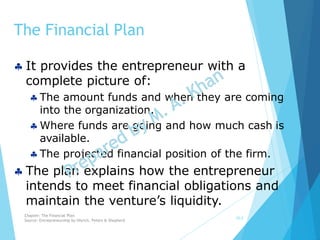
 It provides the entrepreneur with a
complete picture of:
 The amount funds and when they are coming
into the organization.
 Where funds are going and how much cash is
available.
 The projected financial position of the firm.
 The plan explains how the entrepreneur
intends to meet financial obligations and
maintain the venture’s liquidity.
Chapter: The Financial Plan
Source: Entrepreneurship by Hisrich, Peters & Shepherd
Operating and Capital Budgets
10-3
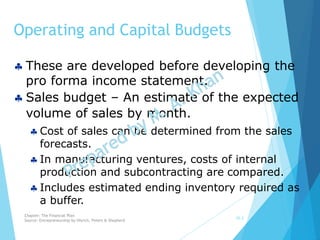
 These are developed before developing the
pro forma income statement.
 Sales budget – An estimate of the expected
volume of sales by month.
 Cost of sales can be determined from the sales
forecasts.
 In manufacturing ventures, costs of internal
production and subcontracting are compared.
 Includes estimated ending inventory required as
a buffer.
Chapter: The Financial Plan
Source: Entrepreneurship by Hisrich, Peters & Shepherd
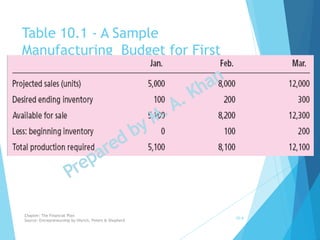
Table 10.1 - A Sample
Manufacturing Budget for First
Three Months
10-4
Chapter: The Financial Plan
Source: Entrepreneurship by Hisrich, Peters & Shepherd
 Operating costs:
 Includes fixed expenses incurred regardless of
sales volume.
 Variable expenses must be linked to strategy in
the business plan.
 Capital budgets provide a basis for
evaluating expenditures that will impact the
business for more than one year.
Operating and Capital Budgets
10-5
Chapter: The Financial Plan
Source: Entrepreneurship by Hisrich, Peters & Shepherd
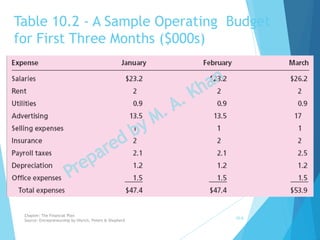
Table 10.2 - A Sample Operating Budget
for First Three Months ($000s)
10-6
Chapter: The Financial Plan
Source: Entrepreneurship by Hisrich, Peters & Shepherd
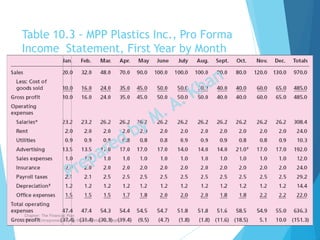
Pro Forma Income Statements
10-7
 Pro forma income - Projected net profit
calculated from projected revenue minus
projected costs and expenses.
 Sales by month is calculated first.
Basis of the figures - Marketing research, industry
sales, trial experience, forecasting, and financial data
on similar start-ups.
 Projections of all operating expenses for each of
the months during the first year should be
made.
Chapter: The Financial Plan
Source: Entrepreneurship by Hisrich, Peters & Shepherd
 Increasing selling expenses as sales increase
should be taken into account.
 Changes in expenses during the first year can
necessitate month-by-month illustration.
 Increase in individual expenses need to be
reflected in the first year’s pro forma income
statement.
 Projections should be made for years 2 and 3 as
well; consider expenses that are likely to remain
stable over time.
Pro Forma Income Statements (cont.)
10-8
Chapter: The Financial Plan
Source: Entrepreneurship by Hisrich, Peters & Shepherd
Table 10.3 - MPP Plastics Inc., Pro Forma
Income Statement, First Year by Month
($000s)
10-9
Chapter: The Financial Plan
Source: Entrepreneurship by Hisrich, Peters & Shepherd
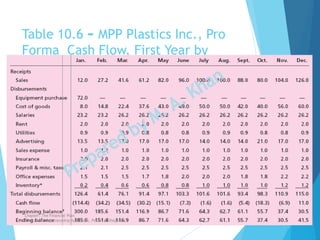
Pro Forma Cash Flow
10-10
 Projected cash available calculated from
projected cash accumulations minus
projected cash disbursements.
 It is not the same as profit.
 Sales may not be regarded as cash.
 Use of profit as a measure of success may be
deceiving if there is significant negative cash
flow.
 Cash flow can be projected using the indirect or
direct method.
Chapter: The Financial Plan
Source: Entrepreneurship by Hisrich, Peters & Shepherd
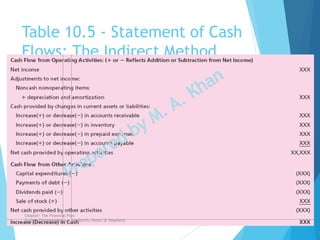
Table 10.5 - Statement of Cash
Flows: The Indirect Method
10-11
Chapter: The Financial Plan
Source: Entrepreneurship by Hisrich, Peters & Shepherd
 Entrepreneurs must make monthly
projections of cash.
 If disbursements are greater than receipts -
entrepreneur must either borrow funds or have
cash in a bank.
 Large positive cash flows need to be invested or
deposited in a bank for periods when
disbursements are greater than receipts.
 Determining the exact monthly receipts and
disbursements is difficult.
 Pro forma cash flow is based on best
estimates.
Pro Forma Cash Flow (cont.)
10-12
Chapter: The Financial Plan
Source: Entrepreneurship by Hisrich, Peters & Shepherd
Table 10.6 - MPP Plastics Inc., Pro
Forma Cash Flow, First Year by
Month ($000s)
10-13
Chapter: The Financial Plan
Source: Entrepreneurship by Hisrich, Peters & Shepherd
Pro Forma Balance Sheet
10-14
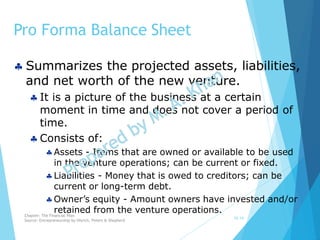
 Summarizes the projected assets, liabilities,
and net worth of the new venture.
 It is a picture of the business at a certain
moment in time and does not cover a period of
time.
 Consists of:
Assets - Items that are owned or available to be used
in the venture operations; can be current or fixed.
Liabilities - Money that is owed to creditors; can be
current or long-term debt.
Owner’s equity - Amount owners have invested and/or
retained from the venture operations.Chapter: The Financial Plan
Source: Entrepreneurship by Hisrich, Peters & Shepherd
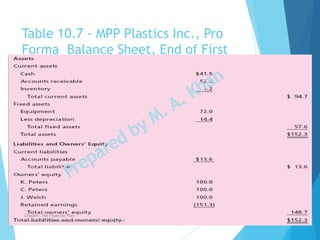
Table 10.7 - MPP Plastics Inc., Pro
Forma Balance Sheet, End of First
Year ($000s)
10-15
Chapter: The Financial Plan
Source: Entrepreneurship by Hisrich, Peters & Shepherd
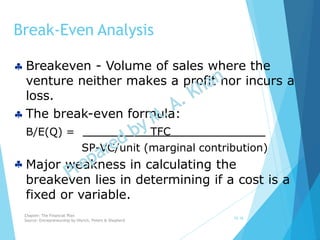
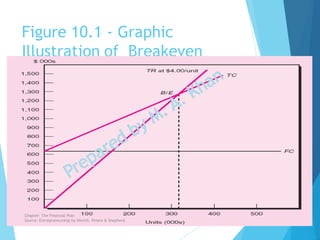
 Breakeven - Volume of sales where the
venture neither makes a profit nor incurs a
loss.
 The break-even formula:
Break-Even Analysis
10-16
B/E(Q) = TFC
SP-VC/unit (marginal contribution)
 Major weakness in calculating the
breakeven lies in determining if a cost is a
fixed or variable.
Chapter: The Financial Plan
Source: Entrepreneurship by Hisrich, Peters & Shepherd
Figure 10.1 - Graphic
Illustration of Breakeven
10-17
Chapter: The Financial Plan
Source: Entrepreneurship by Hisrich, Peters & Shepherd
Pro Forma Sources
and Applications of Funds
10-18
 Sources:
 Operations.
 New investments.
 Long-term borrowing.
 Sale of assets.
 Uses/ Applications:
 Increase assets.
 Retire long-term liabilities.
 Reduce owner or stockholders’ equity.
 Pay dividends.Chapter: The Financial Plan
Source: Entrepreneurship by Hisrich, Peters & Shepherd
10-19
Software Packages
 A spreadsheet program (Microsoft Excel) is
most suitable for completing pro forma
statements.
 Helps present different scenarios and assess
their impact on the pro forma statements.
 A simple and easy to use software is useful
in the start-up stage.
 Software packages vary in price and
complexity.
Chapter: The Financial Plan
Source: Entrepreneurship by Hisrich, Peters & Shepherd
10-19

Financing plan

  • 1.
  • 2.
    The Financial Plan 10-2 It provides the entrepreneur with a complete picture of:  The amount funds and when they are coming into the organization.  Where funds are going and how much cash is available.  The projected financial position of the firm.  The plan explains how the entrepreneur intends to meet financial obligations and maintain the venture’s liquidity. Chapter: The Financial Plan Source: Entrepreneurship by Hisrich, Peters & Shepherd
  • 3.
    Operating and CapitalBudgets 10-3  These are developed before developing the pro forma income statement.  Sales budget – An estimate of the expected volume of sales by month.  Cost of sales can be determined from the sales forecasts.  In manufacturing ventures, costs of internal production and subcontracting are compared.  Includes estimated ending inventory required as a buffer. Chapter: The Financial Plan Source: Entrepreneurship by Hisrich, Peters & Shepherd
  • 4.
    Table 10.1 -A Sample Manufacturing Budget for First Three Months 10-4 Chapter: The Financial Plan Source: Entrepreneurship by Hisrich, Peters & Shepherd
  • 5.
     Operating costs: Includes fixed expenses incurred regardless of sales volume.  Variable expenses must be linked to strategy in the business plan.  Capital budgets provide a basis for evaluating expenditures that will impact the business for more than one year. Operating and Capital Budgets 10-5 Chapter: The Financial Plan Source: Entrepreneurship by Hisrich, Peters & Shepherd
  • 6.
    Table 10.2 -A Sample Operating Budget for First Three Months ($000s) 10-6 Chapter: The Financial Plan Source: Entrepreneurship by Hisrich, Peters & Shepherd
  • 7.
    Pro Forma IncomeStatements 10-7  Pro forma income - Projected net profit calculated from projected revenue minus projected costs and expenses.  Sales by month is calculated first. Basis of the figures - Marketing research, industry sales, trial experience, forecasting, and financial data on similar start-ups.  Projections of all operating expenses for each of the months during the first year should be made. Chapter: The Financial Plan Source: Entrepreneurship by Hisrich, Peters & Shepherd
  • 8.
     Increasing sellingexpenses as sales increase should be taken into account.  Changes in expenses during the first year can necessitate month-by-month illustration.  Increase in individual expenses need to be reflected in the first year’s pro forma income statement.  Projections should be made for years 2 and 3 as well; consider expenses that are likely to remain stable over time. Pro Forma Income Statements (cont.) 10-8 Chapter: The Financial Plan Source: Entrepreneurship by Hisrich, Peters & Shepherd
  • 9.
    Table 10.3 -MPP Plastics Inc., Pro Forma Income Statement, First Year by Month ($000s) 10-9 Chapter: The Financial Plan Source: Entrepreneurship by Hisrich, Peters & Shepherd
  • 10.
    Pro Forma CashFlow 10-10  Projected cash available calculated from projected cash accumulations minus projected cash disbursements.  It is not the same as profit.  Sales may not be regarded as cash.  Use of profit as a measure of success may be deceiving if there is significant negative cash flow.  Cash flow can be projected using the indirect or direct method. Chapter: The Financial Plan Source: Entrepreneurship by Hisrich, Peters & Shepherd
  • 11.
    Table 10.5 -Statement of Cash Flows: The Indirect Method 10-11 Chapter: The Financial Plan Source: Entrepreneurship by Hisrich, Peters & Shepherd
  • 12.
     Entrepreneurs mustmake monthly projections of cash.  If disbursements are greater than receipts - entrepreneur must either borrow funds or have cash in a bank.  Large positive cash flows need to be invested or deposited in a bank for periods when disbursements are greater than receipts.  Determining the exact monthly receipts and disbursements is difficult.  Pro forma cash flow is based on best estimates. Pro Forma Cash Flow (cont.) 10-12 Chapter: The Financial Plan Source: Entrepreneurship by Hisrich, Peters & Shepherd
  • 13.
    Table 10.6 -MPP Plastics Inc., Pro Forma Cash Flow, First Year by Month ($000s) 10-13 Chapter: The Financial Plan Source: Entrepreneurship by Hisrich, Peters & Shepherd
  • 14.
    Pro Forma BalanceSheet 10-14  Summarizes the projected assets, liabilities, and net worth of the new venture.  It is a picture of the business at a certain moment in time and does not cover a period of time.  Consists of: Assets - Items that are owned or available to be used in the venture operations; can be current or fixed. Liabilities - Money that is owed to creditors; can be current or long-term debt. Owner’s equity - Amount owners have invested and/or retained from the venture operations.Chapter: The Financial Plan Source: Entrepreneurship by Hisrich, Peters & Shepherd
  • 15.
    Table 10.7 -MPP Plastics Inc., Pro Forma Balance Sheet, End of First Year ($000s) 10-15 Chapter: The Financial Plan Source: Entrepreneurship by Hisrich, Peters & Shepherd
  • 16.
     Breakeven -Volume of sales where the venture neither makes a profit nor incurs a loss.  The break-even formula: Break-Even Analysis 10-16 B/E(Q) = TFC SP-VC/unit (marginal contribution)  Major weakness in calculating the breakeven lies in determining if a cost is a fixed or variable. Chapter: The Financial Plan Source: Entrepreneurship by Hisrich, Peters & Shepherd
  • 17.
    Figure 10.1 -Graphic Illustration of Breakeven 10-17 Chapter: The Financial Plan Source: Entrepreneurship by Hisrich, Peters & Shepherd
  • 18.
    Pro Forma Sources andApplications of Funds 10-18  Sources:  Operations.  New investments.  Long-term borrowing.  Sale of assets.  Uses/ Applications:  Increase assets.  Retire long-term liabilities.  Reduce owner or stockholders’ equity.  Pay dividends.Chapter: The Financial Plan Source: Entrepreneurship by Hisrich, Peters & Shepherd
  • 19.
    10-19 Software Packages  Aspreadsheet program (Microsoft Excel) is most suitable for completing pro forma statements.  Helps present different scenarios and assess their impact on the pro forma statements.  A simple and easy to use software is useful in the start-up stage.  Software packages vary in price and complexity. Chapter: The Financial Plan Source: Entrepreneurship by Hisrich, Peters & Shepherd 10-19