SME Finance – a Global
Perspective
Matthew Gamser
Head, SME Finance Forum
Kathmandu
12 April 2013
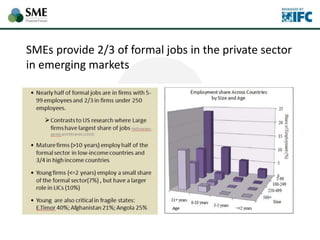
SMEs provide 2/3 of formal jobs in the private sector
in emerging markets
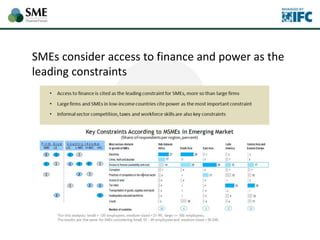
SMEs consider access to finance and power as the
leading constraints
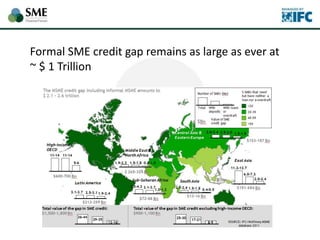
Formal SME credit gap remains as large as ever at
~ $ 1 Trillion
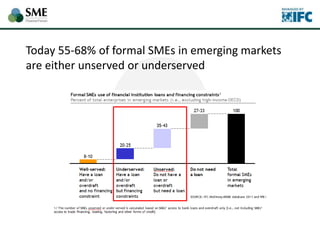
Today 55-68% of formal SMEs in emerging markets
are either unserved or underserved
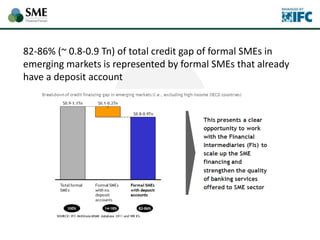
82-86% (~ 0.8-0.9 Tn) of total credit gap of formal SMEs in
emerging markets is represented by formal SMEs that already
have a deposit account
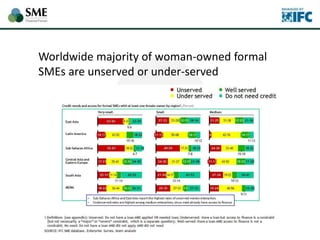
Worldwide majority of woman-owned formal
SMEs are unserved or under-served
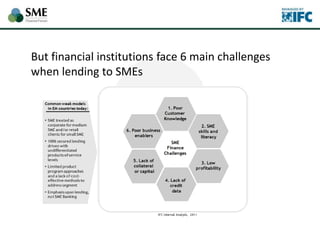
But financial institutions face 6 main challenges
when lending to SMEs
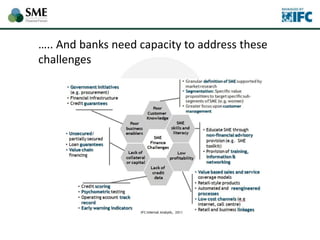
….. And banks need capacity to address these
challenges
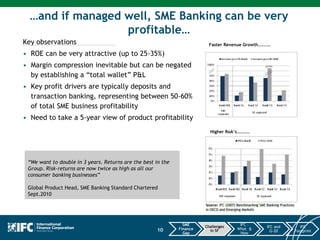
…and if managed well, SME Banking can be very
profitable…
Key observations
• ROE can be very attractive (up to 25-35%)
• Margin compression inevitable but can be negated
by establishing a “total wallet” P&L
• Key profit drivers are typically deposits and
transaction banking, representing between 50-60%
of total SME business profitability
• Need to take a 5-year view of product profitability
“We want to double in 3 years. Returns are the best in the
Group. Risk-returns are now twice as high as all our
consumer banking businesses”
Global Product Head, SME Banking Standard Chartered
Sept.2010
Faster Revenue Growth………..
Higher RoA’s………..
10
SME
Finance
Gap
Challenges
in SF
IFC –
What &
How
IFC and
G-20
IFC
Footprint
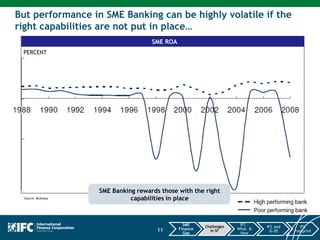
But performance in SME Banking can be highly volatile if the
right capabilities are not put in place…
SME ROA
PERCENT
SME Banking rewards those with the right
capabilities in placeSource: Mckinsey
11
SME
Finance
Gap
Challenges
in SF
IFC –
What &
How
IFC and
G-20
IFC
Footprint
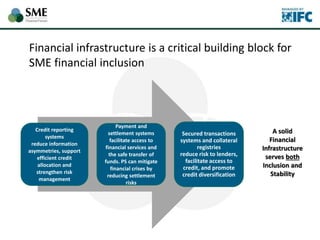
Financial infrastructure is a critical building block for
SME financial inclusion
Credit reporting
systems
reduce information
asymmetries, support
efficient credit
allocation and
strengthen risk
management
Payment and
settlement systems
facilitate access to
financial services and
the safe transfer of
funds. PS can mitigate
financial crises by
reducing settlement
risks
Secured transactions
systems and collateral
registries
reduce risk to lenders,
facilitate access to
credit, and promote
credit diversification
A solid
Financial
Infrastructure
serves both
Inclusion and
Stability
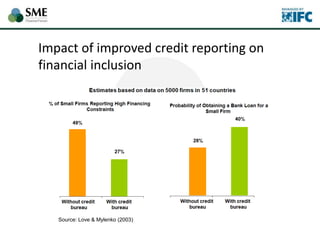
Impact of improved credit reporting on
financial inclusion
Source: Love & Mylenko (2003)
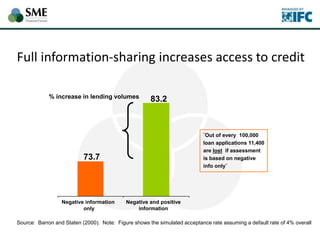
Full information-sharing increases access to credit
¨Out of every 100,000
loan applications 11,400
are lost if assessment
is based on negative
info only¨
% increase in lending volumes
73.7
83.2
Negative information
only
Negative and positive
information
Source: Barron and Staten (2000). Note: Figure shows the simulated acceptance rate assuming a default rate of 4% overall
MSME and Payments
• More electronic transactions lower information costs
• More electronic transactions save time and money for firms
• More electronic transactions offer alternative portfolio
management options
Issues:
• Payments data availability
• Movable assets/secured transactions rights/regulations
• Inter-operability
• Financial institution capacity/awareness
16
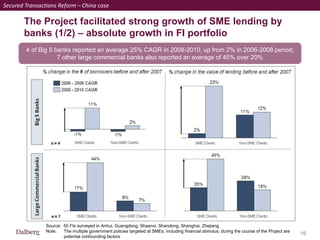
The Project facilitated strong growth of SME lending by
banks (1/2) – absolute growth in FI portfolio
Secured Transactions Reform – China case
Source: 50 FIs surveyed in Anhui, Guangdong, Shaanxi, Shandong, Shanghai, Zhejiang
Note: The multiple government policies targeted at SMEs, including financial stimulus, during the course of the Project are
potential confounding factors
4 of Big 5 banks reported an average 25% CAGR in 2008-2010, up from 2% in 2006-2008 period;
7 other large commercial banks also reported an average of 45% over 20%
17
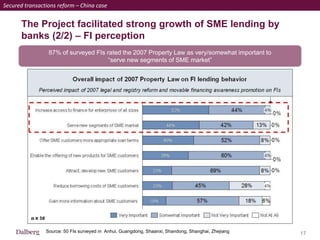
The Project facilitated strong growth of SME lending by
banks (2/2) – FI perception
87% of surveyed FIs rated the 2007 Property Law as very/somewhat important to
“serve new segments of SME market”
Secured transactions reform – China case
Source: 50 FIs surveyed in Anhui, Guangdong, Shaanxi, Shandong, Shanghai, Zhejiang
18
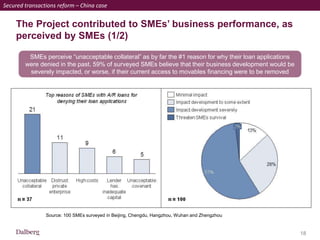
The Project contributed to SMEs’ business performance, as
perceived by SMEs (1/2)
Source: 100 SMEs surveyed in Beijing, Chengdu, Hangzhou, Wuhan and Zhengzhou
SMEs perceive “unacceptable collateral” as by far the #1 reason for why their loan applications
were denied in the past. 59% of surveyed SMEs believe that their business development would be
severely impacted, or worse, if their current access to movables financing were to be removed
Secured transactions reform – China case
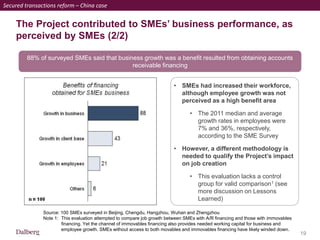
The Project contributed to SMEs’ business performance, as
perceived by SMEs (2/2)
Source: 100 SMEs surveyed in Beijing, Chengdu, Hangzhou, Wuhan and Zhengzhou
Note 1: This evaluation attempted to compare job growth between SMEs with A/R financing and those with immovables
financing. Yet the channel of immovables financing also provides needed working capital for business and
employee growth. SMEs without access to both movables and immovables financing have likely winded down.
88% of surveyed SMEs said that business growth was a benefit resulted from obtaining accounts
receivable financing
19
Secured transactions reform – China case
• SMEs had increased their workforce,
although employee growth was not
perceived as a high benefit area
• The 2011 median and average
growth rates in employees were
7% and 36%, respectively,
according to the SME Survey
• However, a different methodology is
needed to qualify the Project’s impact
on job creation
• This evaluation lacks a control
group for valid comparison1 (see
more discussion on Lessons
Learned)
Suppliers
Pakistan
Suppliers India
Suppliers
Bangladesh
Suppliers
Vietnam
Suppliers
Brazil
Buyer
SCF
Delivery
Solution/
Platform
Receivables
purchase from
Suppliers
Suppliers,
Other EM
Suppliers
US
Suppliers
Germany
Suppliers
Japan
Buyer acceptance
Payment of discounted
proceeds
Request for finance
Payment on Invoice Due Date
Accepts request
and initiates
payment
Funded Participation or
Guarantee coverage on
Buyer and country risk
$ Fees
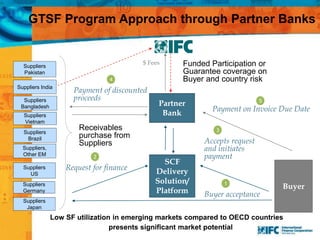
GTSF Program Approach through Partner Banks
Partner
Bank
1
2
3
4
5
Low SF utilization in emerging markets compared to OECD countries
presents significant market potential
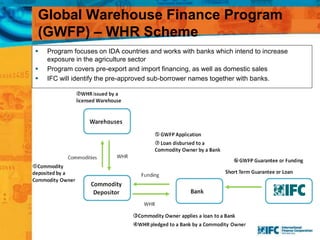
Global Warehouse Finance Program
(GWFP) – WHR Scheme
 Program focuses on IDA countries and works with banks which intend to increase
exposure in the agriculture sector
 Program covers pre-export and import financing, as well as domestic sales
 IFC will identify the pre-approved sub-borrower names together with banks.
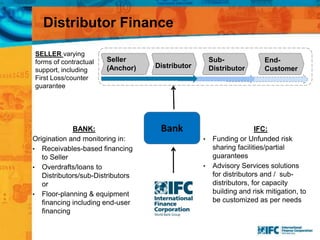
Distributor Finance
IFC:
• Funding or Unfunded risk
sharing facilities/partial
guarantees
• Advisory Services solutions
for distributors and / sub-
distributors, for capacity
building and risk mitigation, to
be customized as per needs
BANK:
Origination and monitoring in:
• Receivables-based financing
to Seller
• Overdrafts/loans to
Distributors/sub-Distributors
or
• Floor-planning & equipment
financing including end-user
financing
End-
Customer
SELLER varying
forms of contractual
support, including
First Loss/counter
guarantee
Distributor
Seller
(Anchor)
Sub-
Distributor
Bank
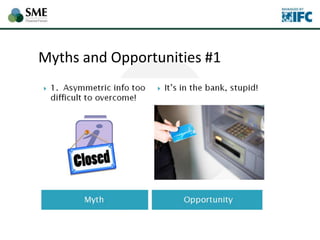
Myths and Opportunities #1
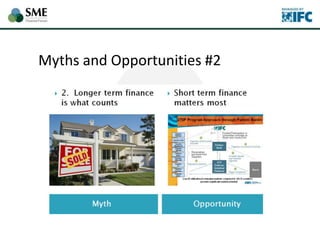
Myths and Opportunities #2
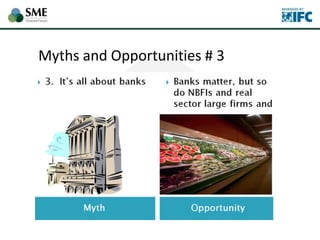
Myths and Opportunities # 3
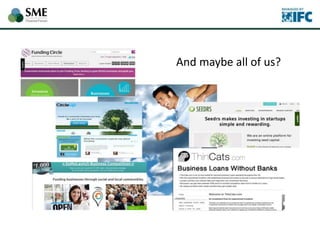
And maybe all of us?
On the Web at www.smefinanceforum.org
LinkedIn Group: SME Finance Forum
Twitter: @SMEFinanceForum

SME Finance--a Global Perspective

  • 1.
    SME Finance –a Global Perspective Matthew Gamser Head, SME Finance Forum Kathmandu 12 April 2013
  • 2.
    SMEs provide 2/3of formal jobs in the private sector in emerging markets
  • 3.
    SMEs consider accessto finance and power as the leading constraints
  • 4.
    Formal SME creditgap remains as large as ever at ~ $ 1 Trillion
  • 5.
    Today 55-68% offormal SMEs in emerging markets are either unserved or underserved
  • 6.
    82-86% (~ 0.8-0.9Tn) of total credit gap of formal SMEs in emerging markets is represented by formal SMEs that already have a deposit account
  • 7.
    Worldwide majority ofwoman-owned formal SMEs are unserved or under-served
  • 8.
    But financial institutionsface 6 main challenges when lending to SMEs
  • 9.
    ….. And banksneed capacity to address these challenges
  • 10.
    …and if managedwell, SME Banking can be very profitable… Key observations • ROE can be very attractive (up to 25-35%) • Margin compression inevitable but can be negated by establishing a “total wallet” P&L • Key profit drivers are typically deposits and transaction banking, representing between 50-60% of total SME business profitability • Need to take a 5-year view of product profitability “We want to double in 3 years. Returns are the best in the Group. Risk-returns are now twice as high as all our consumer banking businesses” Global Product Head, SME Banking Standard Chartered Sept.2010 Faster Revenue Growth……….. Higher RoA’s……….. 10 SME Finance Gap Challenges in SF IFC – What & How IFC and G-20 IFC Footprint
  • 11.
    But performance inSME Banking can be highly volatile if the right capabilities are not put in place… SME ROA PERCENT SME Banking rewards those with the right capabilities in placeSource: Mckinsey 11 SME Finance Gap Challenges in SF IFC – What & How IFC and G-20 IFC Footprint
  • 12.
    Financial infrastructure isa critical building block for SME financial inclusion Credit reporting systems reduce information asymmetries, support efficient credit allocation and strengthen risk management Payment and settlement systems facilitate access to financial services and the safe transfer of funds. PS can mitigate financial crises by reducing settlement risks Secured transactions systems and collateral registries reduce risk to lenders, facilitate access to credit, and promote credit diversification A solid Financial Infrastructure serves both Inclusion and Stability
  • 13.
    Impact of improvedcredit reporting on financial inclusion Source: Love & Mylenko (2003)
  • 14.
    Full information-sharing increasesaccess to credit ¨Out of every 100,000 loan applications 11,400 are lost if assessment is based on negative info only¨ % increase in lending volumes 73.7 83.2 Negative information only Negative and positive information Source: Barron and Staten (2000). Note: Figure shows the simulated acceptance rate assuming a default rate of 4% overall
  • 15.
    MSME and Payments •More electronic transactions lower information costs • More electronic transactions save time and money for firms • More electronic transactions offer alternative portfolio management options Issues: • Payments data availability • Movable assets/secured transactions rights/regulations • Inter-operability • Financial institution capacity/awareness
  • 16.
    16 The Project facilitatedstrong growth of SME lending by banks (1/2) – absolute growth in FI portfolio Secured Transactions Reform – China case Source: 50 FIs surveyed in Anhui, Guangdong, Shaanxi, Shandong, Shanghai, Zhejiang Note: The multiple government policies targeted at SMEs, including financial stimulus, during the course of the Project are potential confounding factors 4 of Big 5 banks reported an average 25% CAGR in 2008-2010, up from 2% in 2006-2008 period; 7 other large commercial banks also reported an average of 45% over 20%
  • 17.
    17 The Project facilitatedstrong growth of SME lending by banks (2/2) – FI perception 87% of surveyed FIs rated the 2007 Property Law as very/somewhat important to “serve new segments of SME market” Secured transactions reform – China case Source: 50 FIs surveyed in Anhui, Guangdong, Shaanxi, Shandong, Shanghai, Zhejiang
  • 18.
    18 The Project contributedto SMEs’ business performance, as perceived by SMEs (1/2) Source: 100 SMEs surveyed in Beijing, Chengdu, Hangzhou, Wuhan and Zhengzhou SMEs perceive “unacceptable collateral” as by far the #1 reason for why their loan applications were denied in the past. 59% of surveyed SMEs believe that their business development would be severely impacted, or worse, if their current access to movables financing were to be removed Secured transactions reform – China case
  • 19.
    The Project contributedto SMEs’ business performance, as perceived by SMEs (2/2) Source: 100 SMEs surveyed in Beijing, Chengdu, Hangzhou, Wuhan and Zhengzhou Note 1: This evaluation attempted to compare job growth between SMEs with A/R financing and those with immovables financing. Yet the channel of immovables financing also provides needed working capital for business and employee growth. SMEs without access to both movables and immovables financing have likely winded down. 88% of surveyed SMEs said that business growth was a benefit resulted from obtaining accounts receivable financing 19 Secured transactions reform – China case • SMEs had increased their workforce, although employee growth was not perceived as a high benefit area • The 2011 median and average growth rates in employees were 7% and 36%, respectively, according to the SME Survey • However, a different methodology is needed to qualify the Project’s impact on job creation • This evaluation lacks a control group for valid comparison1 (see more discussion on Lessons Learned)
  • 20.
    Suppliers Pakistan Suppliers India Suppliers Bangladesh Suppliers Vietnam Suppliers Brazil Buyer SCF Delivery Solution/ Platform Receivables purchase from Suppliers Suppliers, OtherEM Suppliers US Suppliers Germany Suppliers Japan Buyer acceptance Payment of discounted proceeds Request for finance Payment on Invoice Due Date Accepts request and initiates payment Funded Participation or Guarantee coverage on Buyer and country risk $ Fees GTSF Program Approach through Partner Banks Partner Bank 1 2 3 4 5 Low SF utilization in emerging markets compared to OECD countries presents significant market potential
  • 21.
    Global Warehouse FinanceProgram (GWFP) – WHR Scheme  Program focuses on IDA countries and works with banks which intend to increase exposure in the agriculture sector  Program covers pre-export and import financing, as well as domestic sales  IFC will identify the pre-approved sub-borrower names together with banks.
  • 22.
    Distributor Finance IFC: • Fundingor Unfunded risk sharing facilities/partial guarantees • Advisory Services solutions for distributors and / sub- distributors, for capacity building and risk mitigation, to be customized as per needs BANK: Origination and monitoring in: • Receivables-based financing to Seller • Overdrafts/loans to Distributors/sub-Distributors or • Floor-planning & equipment financing including end-user financing End- Customer SELLER varying forms of contractual support, including First Loss/counter guarantee Distributor Seller (Anchor) Sub- Distributor Bank
  • 23.
  • 24.
  • 25.
  • 26.
  • 27.
    On the Webat www.smefinanceforum.org LinkedIn Group: SME Finance Forum Twitter: @SMEFinanceForum