FINANCIAL STATEMENTS
PRESENTATION
On
FINANCIAL STATEMENTS
By
ASIM KULKARNI
Financial Statement [Introduction]
• There are three types of financial statements which are frequently used.
• It is used to address the needs of external stakeholders i.e. suppliers, investors,
and other people who are interested in the performance of the company but don’t
work for the company.
• Balance sheet – summarizes firm’s financial position at a specific point in time.
• Income statement – summarizes financial performance over a given period of time.
• Statement of Cash Flows – explains how cash is acquired or spent.
Balance Sheet
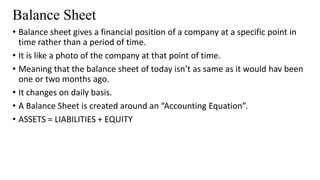
• Balance sheet gives a financial position of a company at a specific point in
time rather than a period of time.
• It is like a photo of the company at that point of time.
• Meaning that the balance sheet of today isn’t as same as it would hav been
one or two months ago.
• It changes on daily basis.
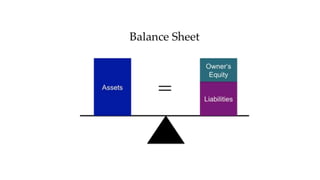
• A Balance Sheet is created around an “Accounting Equation”.
• ASSETS = LIABILITIES + EQUITY
Assets, Liabilities, Equity
• Assets tells you how much in-hand cash, inventory, real estate and
PPE the company has.
• Assets are also things that company owns that have certain value.
• Liability means legal responsibility. Here Liabilities mean how much
debt does the company owe to the other company or bank or credit
union.
• Example would be loan from a bank or credit union or bonds which
banks issue in the name of company.
• Anything leftover is called Equity or Owner’s Equity.
• The people who bought the stocks of a company have a residual claim
on Assets.
• Equity is also called the net worth of the company.
Assets, Liabilities, Equity (cont’d)
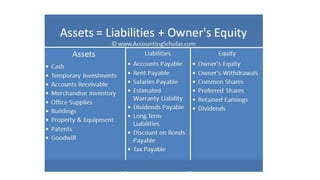
• The terms which fall under Assets are cash, amount receivable,
inventory, PPE(plant property & equipment).
• The terms which fall under Liabilities are accounts payable, wages
payable, bank loan.
• The terms which fall under Equity are common stock, retained stock.
Income Statement and Cash Flow Statement
• It is profit and loss statement.
• It does exactly as it’s name suggests i.e. it gives you summary of the
revenue and the expenses generated by a company over a reporting
period.
• The cash flow statement also has an intuitive name and tells us how
much actual cash and cash equivalent entered and left the company
over the reporting period.
• As an investor you have valid reason to be sceptical when the company
claims to have higher profits but there hasn’t been any increase in cash
flow.
Conclusion/Summary
• A Balance Sheet is in instant picture of a business.
• A Balance Sheet is comprised of two main sections (Assets – Liabilities
& Equity).
• It allows us to see how riskier a business is!
Financial Statements Presentation

Financial Statements Presentation

  • 1.
  • 2.
    Financial Statement [Introduction] •There are three types of financial statements which are frequently used. • It is used to address the needs of external stakeholders i.e. suppliers, investors, and other people who are interested in the performance of the company but don’t work for the company. • Balance sheet – summarizes firm’s financial position at a specific point in time. • Income statement – summarizes financial performance over a given period of time. • Statement of Cash Flows – explains how cash is acquired or spent.
  • 3.
    Balance Sheet • Balancesheet gives a financial position of a company at a specific point in time rather than a period of time. • It is like a photo of the company at that point of time. • Meaning that the balance sheet of today isn’t as same as it would hav been one or two months ago. • It changes on daily basis. • A Balance Sheet is created around an “Accounting Equation”. • ASSETS = LIABILITIES + EQUITY
  • 6.
    Assets, Liabilities, Equity •Assets tells you how much in-hand cash, inventory, real estate and PPE the company has. • Assets are also things that company owns that have certain value. • Liability means legal responsibility. Here Liabilities mean how much debt does the company owe to the other company or bank or credit union. • Example would be loan from a bank or credit union or bonds which banks issue in the name of company. • Anything leftover is called Equity or Owner’s Equity. • The people who bought the stocks of a company have a residual claim on Assets. • Equity is also called the net worth of the company.
  • 7.
    Assets, Liabilities, Equity(cont’d) • The terms which fall under Assets are cash, amount receivable, inventory, PPE(plant property & equipment). • The terms which fall under Liabilities are accounts payable, wages payable, bank loan. • The terms which fall under Equity are common stock, retained stock.
  • 8.
    Income Statement andCash Flow Statement • It is profit and loss statement. • It does exactly as it’s name suggests i.e. it gives you summary of the revenue and the expenses generated by a company over a reporting period. • The cash flow statement also has an intuitive name and tells us how much actual cash and cash equivalent entered and left the company over the reporting period. • As an investor you have valid reason to be sceptical when the company claims to have higher profits but there hasn’t been any increase in cash flow.
  • 9.
    Conclusion/Summary • A BalanceSheet is in instant picture of a business. • A Balance Sheet is comprised of two main sections (Assets – Liabilities & Equity). • It allows us to see how riskier a business is!

Editor's Notes

  • #7 Equity = retained earning + (stock offering/bonds)
  • #8 Depreciation is calculated on PPE
  • #9 CFS tells if the profit numbers are believable.
  • #10 For minimum risk Equity should always be greater than Liabilities