Financial Statements and Reporting
The End Product of Accounting
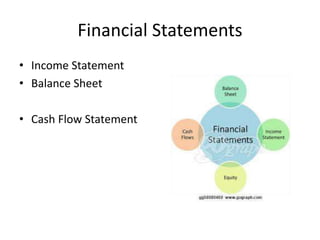
Financial Statements
• Income Statement
• Balance Sheet
• Cash Flow Statement
Who looks at them?
• Internal & External (to
the Company)
• Management
• Competitors
– benchmarking
• Investors
• Bankers
Management
• Internal information
• How are we doing?
• Performance
• Many divisional and
department Managers
have “P&L” responsibility
• P&L means Profit and
Loss
• They have to make money
for the company
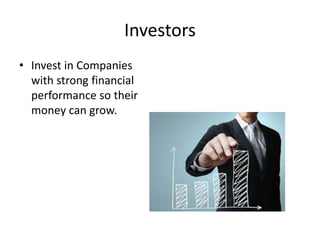
Investors
• Invest in Companies
with strong financial
performance so their
money can grow.
Bankers
• Credit Analysis
• Debt Coverage Ratios
• Financial Statement
Analysis
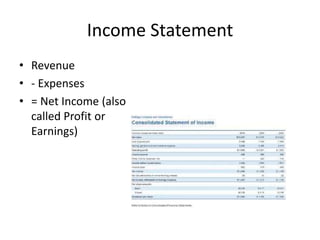
Income Statement
• Revenue
• - Expenses
• = Net Income (also
called Profit or
Earnings)
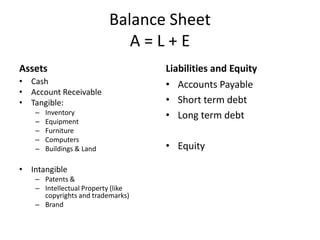
Balance Sheet
A = L + E
Assets
• Cash
• Account Receivable
• Tangible:
– Inventory
– Equipment
– Furniture
– Computers
– Buildings & Land
• Intangible
– Patents &
– Intellectual Property (like
copyrights and trademarks)
– Brand
Liabilities and Equity
• Accounts Payable
• Short term debt
• Long term debt
• Equity
Analysis
• Performance Ratios
• Assets to Liabilities
• Profits as % of Sales
• Quick ratio
– Current Assets/Current
Liabilities
• Net Income/Employee
• Sales/Square Foot
• Inventory Turnover
• Liquidity
Liquidity & Solvency
• Liquidity is cash on hand;
Solvency is ability to pay
debts
• How quickly you can turn an
asset into cash
• Cash is King
• On the balance sheet,
assets are ranked by
liquidity
• How much cash do you
have on hand
• What are the current
obligations? (Liabilities)
Reporting
• Prepare Financial
Statements and Notes
• Auditing/Rules
– CPAs Certified Public
Accounting
– GAAP Generally Accepted
Accounting Principals
– FASB Financial Accounting
Standards Board
• Regulatory/Government
– Securities and Exchange
Commission
Where to find Financial Statements
• Publicly traded
companies
• SEC.gov
• Websites of companies
• Investor Websites
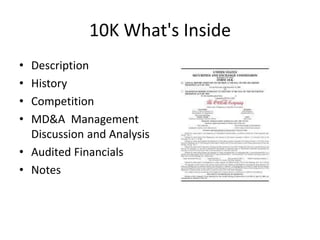
10K What's Inside
• Description
• History
• Competition
• MD&A Management
Discussion and Analysis
• Audited Financials
• Notes
Financial Statements and Reporting

Financial Statements and Reporting

  • 1.
    Financial Statements andReporting The End Product of Accounting
  • 2.
    Financial Statements • IncomeStatement • Balance Sheet • Cash Flow Statement
  • 3.
    Who looks atthem? • Internal & External (to the Company) • Management • Competitors – benchmarking • Investors • Bankers
  • 4.
    Management • Internal information •How are we doing? • Performance • Many divisional and department Managers have “P&L” responsibility • P&L means Profit and Loss • They have to make money for the company
  • 5.
    Investors • Invest inCompanies with strong financial performance so their money can grow.
  • 6.
    Bankers • Credit Analysis •Debt Coverage Ratios • Financial Statement Analysis
  • 7.
    Income Statement • Revenue •- Expenses • = Net Income (also called Profit or Earnings)
  • 8.
    Balance Sheet A =L + E Assets • Cash • Account Receivable • Tangible: – Inventory – Equipment – Furniture – Computers – Buildings & Land • Intangible – Patents & – Intellectual Property (like copyrights and trademarks) – Brand Liabilities and Equity • Accounts Payable • Short term debt • Long term debt • Equity
  • 9.
    Analysis • Performance Ratios •Assets to Liabilities • Profits as % of Sales • Quick ratio – Current Assets/Current Liabilities • Net Income/Employee • Sales/Square Foot • Inventory Turnover • Liquidity
  • 10.
    Liquidity & Solvency •Liquidity is cash on hand; Solvency is ability to pay debts • How quickly you can turn an asset into cash • Cash is King • On the balance sheet, assets are ranked by liquidity • How much cash do you have on hand • What are the current obligations? (Liabilities)
  • 11.
    Reporting • Prepare Financial Statementsand Notes • Auditing/Rules – CPAs Certified Public Accounting – GAAP Generally Accepted Accounting Principals – FASB Financial Accounting Standards Board • Regulatory/Government – Securities and Exchange Commission
  • 12.
    Where to findFinancial Statements • Publicly traded companies • SEC.gov • Websites of companies • Investor Websites
  • 13.
    10K What's Inside •Description • History • Competition • MD&A Management Discussion and Analysis • Audited Financials • Notes