Rabinder K. Koul
Managing Director and Head of Risk Services
Gateway Partners
Financial engineering is the quantitative and
technical development of financial strategies and
products. Financial engineers design, create, and
implement new financial instruments, models,
and processes to solve problems in finance,
allowing them to take advantage of new financial
opportunities.
Structured products are securities that combine the
features of a fixed income security with the
characteristics of a derivative transaction. Structured
products are investments that are fully customized to
meet specific objectives such as capital protection,
diversification, yield enhancement, leverage, and regular
income with access to non-traditional asset classes
among others.
In their simplest form, structured products offer investors full or
partial capital protection coupled with an equity-linked
performance and a variable degree of leverage.
Generally a structured product contains two components:
 A fixed income security that includes protection of a certain
percentage of the initial investment
 An instrument similar to an option on some underlying
asset class
The underlying asset class for structured products can be a
single asset or a basket of multiple assets.
Thus, the additional performance is dependent upon the
performance of the underlying asset class or basket of multiple
asset classes as is specified by the structured product.
The choice of the underlying asset class depends upon the
market outlook of the investor and the object of the product
design.
Due to the above conditions, structured products are prime
candidates for financial engineering.
As previously mentioned, structured products have two
components:
Risk free component - the risk free component is
guaranteed to return whole or part of the initial
capital. The principal portion is normally returned
only at the maturity of the contract.
Option exposure on some underlying single asset
or basket of assets
During the life of structured assets, both risk free
components as well as option components have
exposure to certain market risk factors:
Volatility
Underlying asset value
Dividends
Interest rates
Time to maturity
Classification of structured products can be based on an
underlying basket of single asset classes such as:
Interest rate linked products
Equity, equity index, equity basket, or equity index
basket indexed linked products
Foreign exchange or basket of foreign exchange
linked products
Commodity linked products
Classification of structured products can also be
based on the type of option that is part of the
structured asset:
Plain Vanilla Options
Exotic Options
Plain vanilla options can be further classified as:
Classic Options - simple call and put options with
well known return functions
Corridor Options - the pay out is dependent on the
underlying being quoted within a specified range
Guaranteed Options - similar to corridor option
product, but includes fixed minimum payments
that are guaranteed to the investor.
Turbo Options
The payout of a turbo product is doubled if the underlying is
quoted within a certain price range at maturity. This is the turbo
effect. There are three possibilities at maturity. If, for example, L
and K are lower and upper reference prices, then at maturity, if:
St fixing ≤ L, the product is redeemed in shares
L < St fixing < K, a cash settlement with s (2 St fixing - L)
occurs
K ≤ St fixing, the maximum amount s (2K - L) will be paid
Exotic options can be further classified as:
Barrier Products
Knock-in Products
Knock-out
Rainbow Products
Structured products that are linked to different asset classes
provide:
100% or large percentage of principal capital protection
depending upon investor needs. This is provided
independent of the performance of the underlying asset or
its index class.
In addition, it provides the potential for higher returns if
certain conditions are met. This is achieved by investing a
portion of capital in a derivative instrument like an option.
OPTION
BOND
ASSET
LINKED
NOTE
PAYOFF
Principal
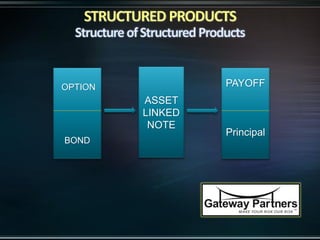
The diagram shows that a structured product linked to an asset class
has:
A bond type investment - this guarantees the protection of a
certain percentage of the principal, which returns the
guaranteed principal at maturity,
An option/swap type instrument with payoff
 Either zero coupon if the underlying has not satisfied the
conditions of the structure
 Or participation rate times the changes in the underlying
asset if the conditions of the structure are met
The bond component of a structured product is the most
important part. It is also the major part of any structured
product. The bond component ensures that the investor will
receive the agreed upon amount of the investment at
maturity. The agreed amount can be 100 % of the invested
capital or it can also include partial protection depending upon
the product. Structured products in general have the
characteristics of a zero coupon bond but they may have
annual or semi-annual coupon payments.
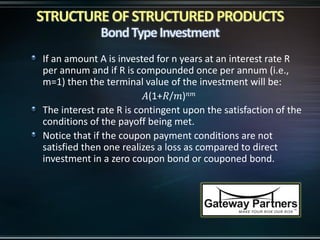
If an amount A is invested for n years at an interest rate R
per annum and if R is compounded once per annum (i.e.,
m=1) then the terminal value of the investment will be:
𝐴(1+𝑅/𝑚) 𝑛𝑚
The interest rate R is contingent upon the satisfaction of the
conditions of the payoff being met.
Notice that if the coupon payment conditions are not
satisfied then one realizes a loss as compared to direct
investment in a zero coupon bond or couponed bond.
The maturity of the bond type component is same as that of
the structured product. The maturity period of the
structured product is generally short. It can vary anywhere
between 1-4 years.
Structured products can contain call back features under
certain conditions such as when the price meets the
condition of coupon payment. In this case, the coupon is
paid and the structure is called back. The bond type
component also matures and the guaranteed principal is
returned.
The option component provides the opportunity of a payoff for
structured products. The two types of options are:
Call Options - these are embedded in structured products if
the outlook for the value of the underlying asset class is
rising.
Put Options - these are embedded in structured products if
the outlook for the value of the underlying asset class is
falling.
The option component is also the risky part of any structured
product since the payoff depends on the performance of the
underlying.
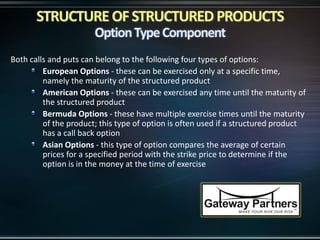
Both calls and puts can belong to the following four types of options:
European Options - these can be exercised only at a specific time,
namely the maturity of the structured product
American Options - these can be exercised any time until the maturity of
the structured product
Bermuda Options - these have multiple exercise times until the maturity
of the product; this type of option is often used if a structured product
has a call back option
Asian Options - this type of option compares the average of certain
prices for a specified period with the strike price to determine if the
option is in the money at the time of exercise
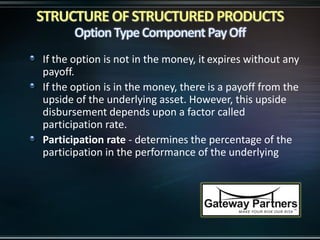
If the option is not in the money, it expires without any
payoff.
If the option is in the money, there is a payoff from the
upside of the underlying asset. However, this upside
disbursement depends upon a factor called
participation rate.
Participation rate - determines the percentage of the
participation in the performance of the underlying
Participation rate is not set prior to expiry of issuance period. It
depends upon the issuing costs of the product and the value of
embedded option.
With participation rate PR, issue price of the product IP, service
costs SC, present value of the bond PB, and price of the option
component OP, participation rate is calculated as follows:
PR = [(IP – SC- PB)/ OP] X 100
Participation rate is also called Gearing.
PR = [(IP – SC- PB)/ OP] X 100
One can see that the level of interest rate, volatility of the
asset, price of underlying asset, and type of option all affect
the participation rate.
Commodity Linked Callable Structured Products
Consider a basket of three equally weighted USD denominated
commodities: WTI (West Texas Intermediate) oil, copper, and aluminum.
Assume the principal capital is 100% guaranteed.
Assume the product maturity to be three years, beginning 10 October
2012 and ending 9 Oct 2015.
Since the product is callable as soon as the coupon gets paid, the bond
matures as soon as the product is called.
Thus, the option on the basket is a Bermuda option.
Coupon payments are once a year.
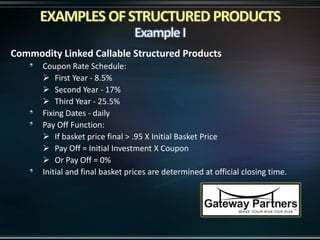
Commodity Linked Callable Structured Products
Coupon Rate Schedule:
 First Year - 8.5%
 Second Year - 17%
 Third Year - 25.5%
Fixing Dates - daily
Pay Off Function:
 If basket price final > .95 X Initial Basket Price
 Pay Off = Initial Investment X Coupon
 Or Pay Off = 0%
Initial and final basket prices are determined at official closing time.
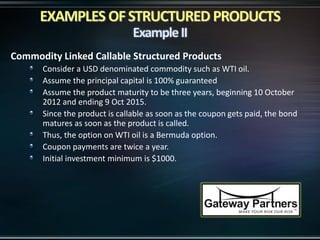
Commodity Linked Callable Structured Products
Consider a USD denominated commodity such as WTI oil.
Assume the principal capital is 100% guaranteed
Assume the product maturity to be three years, beginning 10 October
2012 and ending 9 Oct 2015.
Since the product is callable as soon as the coupon gets paid, the bond
matures as soon as the product is called.
Thus, the option on WTI oil is a Bermuda option.
Coupon payments are twice a year.
Initial investment minimum is $1000.
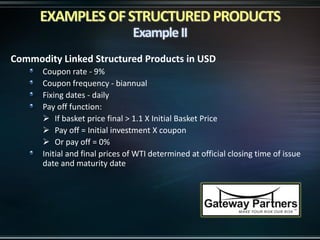
Commodity Linked Structured Products in USD
Coupon rate - 9%
Coupon frequency - biannual
Fixing dates - daily
Pay off function:
 If basket price final > 1.1 X Initial Basket Price
 Pay off = Initial investment X coupon
 Or pay off = 0%
Initial and final prices of WTI determined at official closing time of issue
date and maturity date
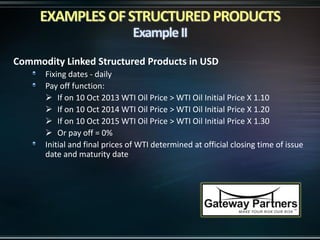
Commodity Linked Structured Products in USD
Fixing dates - daily
Pay off function:
 If on 10 Oct 2013 WTI Oil Price > WTI Oil Initial Price X 1.10
 If on 10 Oct 2014 WTI Oil Price > WTI Oil Initial Price X 1.20
 If on 10 Oct 2015 WTI Oil Price > WTI Oil Initial Price X 1.30
 Or pay off = 0%
Initial and final prices of WTI determined at official closing time of issue
date and maturity date

Financial Engineering & Structured Products

  • 1.
    Rabinder K. Koul ManagingDirector and Head of Risk Services Gateway Partners
  • 2.
    Financial engineering isthe quantitative and technical development of financial strategies and products. Financial engineers design, create, and implement new financial instruments, models, and processes to solve problems in finance, allowing them to take advantage of new financial opportunities.
  • 3.
    Structured products aresecurities that combine the features of a fixed income security with the characteristics of a derivative transaction. Structured products are investments that are fully customized to meet specific objectives such as capital protection, diversification, yield enhancement, leverage, and regular income with access to non-traditional asset classes among others.
  • 4.
    In their simplestform, structured products offer investors full or partial capital protection coupled with an equity-linked performance and a variable degree of leverage. Generally a structured product contains two components:  A fixed income security that includes protection of a certain percentage of the initial investment  An instrument similar to an option on some underlying asset class
  • 5.
    The underlying assetclass for structured products can be a single asset or a basket of multiple assets. Thus, the additional performance is dependent upon the performance of the underlying asset class or basket of multiple asset classes as is specified by the structured product. The choice of the underlying asset class depends upon the market outlook of the investor and the object of the product design. Due to the above conditions, structured products are prime candidates for financial engineering.
  • 6.
    As previously mentioned,structured products have two components: Risk free component - the risk free component is guaranteed to return whole or part of the initial capital. The principal portion is normally returned only at the maturity of the contract. Option exposure on some underlying single asset or basket of assets
  • 7.
    During the lifeof structured assets, both risk free components as well as option components have exposure to certain market risk factors: Volatility Underlying asset value Dividends Interest rates Time to maturity
  • 8.
    Classification of structuredproducts can be based on an underlying basket of single asset classes such as: Interest rate linked products Equity, equity index, equity basket, or equity index basket indexed linked products Foreign exchange or basket of foreign exchange linked products Commodity linked products
  • 9.
    Classification of structuredproducts can also be based on the type of option that is part of the structured asset: Plain Vanilla Options Exotic Options
  • 10.
    Plain vanilla optionscan be further classified as: Classic Options - simple call and put options with well known return functions Corridor Options - the pay out is dependent on the underlying being quoted within a specified range Guaranteed Options - similar to corridor option product, but includes fixed minimum payments that are guaranteed to the investor. Turbo Options
  • 11.
    The payout ofa turbo product is doubled if the underlying is quoted within a certain price range at maturity. This is the turbo effect. There are three possibilities at maturity. If, for example, L and K are lower and upper reference prices, then at maturity, if: St fixing ≤ L, the product is redeemed in shares L < St fixing < K, a cash settlement with s (2 St fixing - L) occurs K ≤ St fixing, the maximum amount s (2K - L) will be paid
  • 12.
    Exotic options canbe further classified as: Barrier Products Knock-in Products Knock-out Rainbow Products
  • 13.
    Structured products thatare linked to different asset classes provide: 100% or large percentage of principal capital protection depending upon investor needs. This is provided independent of the performance of the underlying asset or its index class. In addition, it provides the potential for higher returns if certain conditions are met. This is achieved by investing a portion of capital in a derivative instrument like an option.
  • 14.
  • 15.
    The diagram showsthat a structured product linked to an asset class has: A bond type investment - this guarantees the protection of a certain percentage of the principal, which returns the guaranteed principal at maturity, An option/swap type instrument with payoff  Either zero coupon if the underlying has not satisfied the conditions of the structure  Or participation rate times the changes in the underlying asset if the conditions of the structure are met
  • 16.
    The bond componentof a structured product is the most important part. It is also the major part of any structured product. The bond component ensures that the investor will receive the agreed upon amount of the investment at maturity. The agreed amount can be 100 % of the invested capital or it can also include partial protection depending upon the product. Structured products in general have the characteristics of a zero coupon bond but they may have annual or semi-annual coupon payments.
  • 17.
    If an amountA is invested for n years at an interest rate R per annum and if R is compounded once per annum (i.e., m=1) then the terminal value of the investment will be: 𝐴(1+𝑅/𝑚) 𝑛𝑚 The interest rate R is contingent upon the satisfaction of the conditions of the payoff being met. Notice that if the coupon payment conditions are not satisfied then one realizes a loss as compared to direct investment in a zero coupon bond or couponed bond.
  • 18.
    The maturity ofthe bond type component is same as that of the structured product. The maturity period of the structured product is generally short. It can vary anywhere between 1-4 years. Structured products can contain call back features under certain conditions such as when the price meets the condition of coupon payment. In this case, the coupon is paid and the structure is called back. The bond type component also matures and the guaranteed principal is returned.
  • 19.
    The option componentprovides the opportunity of a payoff for structured products. The two types of options are: Call Options - these are embedded in structured products if the outlook for the value of the underlying asset class is rising. Put Options - these are embedded in structured products if the outlook for the value of the underlying asset class is falling. The option component is also the risky part of any structured product since the payoff depends on the performance of the underlying.
  • 20.
    Both calls andputs can belong to the following four types of options: European Options - these can be exercised only at a specific time, namely the maturity of the structured product American Options - these can be exercised any time until the maturity of the structured product Bermuda Options - these have multiple exercise times until the maturity of the product; this type of option is often used if a structured product has a call back option Asian Options - this type of option compares the average of certain prices for a specified period with the strike price to determine if the option is in the money at the time of exercise
  • 21.
    If the optionis not in the money, it expires without any payoff. If the option is in the money, there is a payoff from the upside of the underlying asset. However, this upside disbursement depends upon a factor called participation rate. Participation rate - determines the percentage of the participation in the performance of the underlying
  • 22.
    Participation rate isnot set prior to expiry of issuance period. It depends upon the issuing costs of the product and the value of embedded option. With participation rate PR, issue price of the product IP, service costs SC, present value of the bond PB, and price of the option component OP, participation rate is calculated as follows: PR = [(IP – SC- PB)/ OP] X 100 Participation rate is also called Gearing.
  • 23.
    PR = [(IP– SC- PB)/ OP] X 100 One can see that the level of interest rate, volatility of the asset, price of underlying asset, and type of option all affect the participation rate.
  • 24.
    Commodity Linked CallableStructured Products Consider a basket of three equally weighted USD denominated commodities: WTI (West Texas Intermediate) oil, copper, and aluminum. Assume the principal capital is 100% guaranteed. Assume the product maturity to be three years, beginning 10 October 2012 and ending 9 Oct 2015. Since the product is callable as soon as the coupon gets paid, the bond matures as soon as the product is called. Thus, the option on the basket is a Bermuda option. Coupon payments are once a year.
  • 25.
    Commodity Linked CallableStructured Products Coupon Rate Schedule:  First Year - 8.5%  Second Year - 17%  Third Year - 25.5% Fixing Dates - daily Pay Off Function:  If basket price final > .95 X Initial Basket Price  Pay Off = Initial Investment X Coupon  Or Pay Off = 0% Initial and final basket prices are determined at official closing time.
  • 26.
    Commodity Linked CallableStructured Products Consider a USD denominated commodity such as WTI oil. Assume the principal capital is 100% guaranteed Assume the product maturity to be three years, beginning 10 October 2012 and ending 9 Oct 2015. Since the product is callable as soon as the coupon gets paid, the bond matures as soon as the product is called. Thus, the option on WTI oil is a Bermuda option. Coupon payments are twice a year. Initial investment minimum is $1000.
  • 27.
    Commodity Linked StructuredProducts in USD Coupon rate - 9% Coupon frequency - biannual Fixing dates - daily Pay off function:  If basket price final > 1.1 X Initial Basket Price  Pay off = Initial investment X coupon  Or pay off = 0% Initial and final prices of WTI determined at official closing time of issue date and maturity date
  • 28.
    Commodity Linked StructuredProducts in USD Fixing dates - daily Pay off function:  If on 10 Oct 2013 WTI Oil Price > WTI Oil Initial Price X 1.10  If on 10 Oct 2014 WTI Oil Price > WTI Oil Initial Price X 1.20  If on 10 Oct 2015 WTI Oil Price > WTI Oil Initial Price X 1.30  Or pay off = 0% Initial and final prices of WTI determined at official closing time of issue date and maturity date