LEGISLATION AND
HUMAN RESOURCES
EMPLOYMENT PROTECTION
 Governments often pass legislation to protect people at
work. Without such protection some businesses would
exploit their workers. For example, they might pay low
wages, make them work long hours, deny them
employment rights, discriminate against certain groups
and dismiss them unfairly. In addition to providing a
healthy and safe working environment businesses have
other legal obligations.
Contract of employment
 Workers are entitled (tienen derecho) to a contract of
employment. This is a legally agreement between the
employer and the employee. It is likely to contain details
such as the start date, terms of employment, job title and
duties, place and hours of work, pay and holyday
entitlement, pension and sickness absence, termination
conditions and details relating to disciplinary, dismissal
and grievances procedures (procedimiento de quejas).
Discrimination
 Businesses have to make a choice when recruiting staff or
selecting employees for promotion or training. Choosing one
person rather than another is known as discrimination. If a
business chooses a person because they are more experienced
and better qualified than another, this would be legal. However,
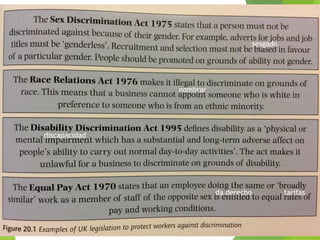
it is illegal in most countries to discriminate on grounds of gender,
race, disability, sexual orientation or age. When employing and
promoting people, employers must base their decisions on the
ability of candidates, and not whether they are male or female,
for example. Many countries have legislation to protect groups
from this kind of discrimination.
 Businesses can suffer if they are seen to discriminate. They may:
 Be involved in expensive legal battles.
 Fail to recruit or promote the best staff for the post.
 De-motivate certain sections of the workforce.
 Create unnecessary tension or conflict between employees.
Unfair dismissal
 Sometimes workers are dismissed unfairly. For instance, if
workers are dismissed for joining a trade union or because
they are considered too old or because they try to exercise
their legal rights, they may have grounds (motivos) to
claim unfair dismissal. If an employment tribunal finds
that a worker has been unfairly dismissed, it has the
power to reinstate (reintegrar) that worker.
sesgado
nombrar
discapacidad
da derecho tarifas
Real Case I
 Graham Watkins was recruited by
Glenhawk Ltd, a market research
agency. He was told that his salary
would be $46,000 pa and the hours
of work would be 36 per week.
This was stated clearly in his
contract of employment. However,
after seven months Graham was
told that he would have to work
one a month on a Saturday
morning for four hours due to
pressure of work. However,
Graham said that he always took
his children swimming every
Saturday morning and that he
would not be able to break this
commitment. He was then
threatened with the sack “if he
didn`t pull his weight for the good
of the firm” by his senior manager.
1. Examine wheter Glenhawk
has the right to sack
Grahan for refusing to
work on Saturday
mornings in this case.
The pay and hours of work
will be clarified in a
contract of employemnt.
1. What other details might
be included?
 Graham Watkins fue contratado por
Glenhawk Ltd, una agencia de
investigación de mercado . Le
dijeron que su salario sería de $
46,000 pa y las horas de trabajo
serían 36 por semana. Esto se
indicó claramente en su contrato de
trabajo. Sin embargo, después de
siete meses le dijeron a Graham
que tendría que trabajar uno por
mes un sábado por la mañana
durante cuatro horas debido a la
presión del trabajo. Sin embargo,
Graham dijo que siempre llevaba a
sus hijos a nadar todos los sábados
por la mañana y que no podría
romper este compromiso. Luego
fue amenazado con el saqueo "si
no tiraba de su peso por el bien de
la empresa" por su gerente
1. Examine si Glenhawk tiene
derecho a despedir a Grahan por
negarse a trabajar los sábados por
la mañana en este caso
La paga y las horas de trabajo se
aclararán en un contrato de
empleado.
1. ¿Qué otros detalles podrían estar
incluidos?
HEALTH AND SAFETY WORK
⚫ In many occupations the workplace can be a dangerous environment.
Because of the danger to employees in all businesses, governments aim to
protect workers by passing legislation which forces businesses to provide a
safe and healthy workplace.
⚫ This facilities involve:
− Providing and maintaining adequate safety equipment and protective clothing
such as fire extinguishers, protective overalls, hard hats, ear plugs and safety
goggles.
− Ensuring workers have enough space to do their jobs.
− Guaranteeing a hygienic environment with adequate toilet and washing facilities.
− Maintaining workplace temperatures and reasonable noise levels.
− Providing protection from hazardous substances.
− Providing protection from violence bullying threats and stress inn the workplace.
− Providing adequate breaks for rest.
⚫ In many countries legislation exists to protect people at
work. For example, in UK the Health and Safety at Work
Act was passed in 1974. This requires businesses to
prepare a written statement of their general policy on
health and safety.
⚫ Businesses also have to provide training, information,
instruction an supervision to ensure the health and safety
workers. Many businesses also follow codes of practice to
meet health and safety standards at work. Finally, health
and safety inspectors have the right to enter business
premises to ensure that health and safety measures are in
place and are being carried out by businesses and
employees.
Real Case II In India, it is reckoned that nearly
50,000 people die from work-
related accidents or illness every
year. In New Delhi in July 2009, a
partially constructed bridge on the
flagship metro Project collapsed
and six people were killed and
several others injured. It emerged
later that more tan 90 workers had
died in accidents during the
construction of the metro in the
last ten years.
 There is legislation in India to
regulate health and safety in
mining, factories, construction and
agriculture, but this is not always
enforced. Existing laws are also out
of date and the enforcement
agencies do not have clearly
defined areas of authority. This
often leads to confusion and lack
of enforcement. To combat the
problem, KC Gupta, the head of
the National Safety Council of India
(NSCI)m said that there was a need
for a comprehensive law like
Britain`s Health and Safety at Work
Act, 1974. This covers everything
from offices to building sites and
gives enforcement officers Powers
of prosecution.
1. What evidence is there to suggest
that health and safety provision
for workers in India is inadequate?
2. Why is health and safety
legislation not working in India?
 En India, se calcula que casi 50,000
personas mueren por accidentes o
enfermedades relacionadas con el
trabajo cada año. En Nueva Delhi,
en julio de 2009, se derrumbó un
puente parcialmente construido en
el proyecto emblemático del
metro, y seis personas murieron y
varias resultaron heridas. Más
tarde, más de 90 trabajadores
murieron en accidentes durante la
construcción del metro en los
últimos diez años.
 Existe legislación en la India para
regular la salud y la seguridad en la
minería, las fábricas, la
construcción y la agricultura, pero
esto no siempre se aplica. Las
leyes existentes también están
desactualizadas y las agencias de
aplicación no tienen áreas de
autoridad claramente definidas.
Esto a menudo conduce a confusión
y falta de cumplimiento. Para
combatir el problema, KC Gupta,
el jefe del Consejo Nacional de
Seguridad de la India (NSCI) dijo
que era necesario contar con una
ley integral como la Ley de Salud y
Seguridad en el Trabajo de Gran
Bretaña de 1974. Esto abarca
desde oficinas, hasta la
construcción de sitios y otorga a
los agentes de ejecución facultades
de enjuiciamiento.
 ¿Qué evidencia hay para
sugerir que la provisión de
salud y seguridad para los
trabajadores en India es
inadecuada?
 ¿Por qué la legislación de
salud y seguridad no
funciona en India?
..
OTHER LEGISLATION
⚫ A range of employment legislation (rango de
legislación laboral) gives workers other rights,
some of which are outlined (esbozados) below:
− Maternity and paternity leave when children are born.
− Sickness pay during illness.
− A legal minimum wage (salario).
− The right to join a trade union.
− A limit to the number of hours working during a week.
− An explanation of the rules of conduct and what will
happen if they are broken.
KEY TERMS
⚫ Contract of employment. A written agreement between
an employer and an employee in which each has certain
obligations.
⚫ Discrimination. Favouring one person over another. For
example, in the EU it is unlawful to discriminate on
grounds of race, gender, age and disability.
⚫ Employment tribunal. A court which deals with cases
involving disputes between employers and employees.
⚫ Unfair dismissal. Where a worker is dismissed illegally by
a business.

Legislation and human resources. 2020 2021

  • 1.
  • 2.
    EMPLOYMENT PROTECTION  Governmentsoften pass legislation to protect people at work. Without such protection some businesses would exploit their workers. For example, they might pay low wages, make them work long hours, deny them employment rights, discriminate against certain groups and dismiss them unfairly. In addition to providing a healthy and safe working environment businesses have other legal obligations.
  • 3.
    Contract of employment Workers are entitled (tienen derecho) to a contract of employment. This is a legally agreement between the employer and the employee. It is likely to contain details such as the start date, terms of employment, job title and duties, place and hours of work, pay and holyday entitlement, pension and sickness absence, termination conditions and details relating to disciplinary, dismissal and grievances procedures (procedimiento de quejas).
  • 4.
    Discrimination  Businesses haveto make a choice when recruiting staff or selecting employees for promotion or training. Choosing one person rather than another is known as discrimination. If a business chooses a person because they are more experienced and better qualified than another, this would be legal. However, it is illegal in most countries to discriminate on grounds of gender, race, disability, sexual orientation or age. When employing and promoting people, employers must base their decisions on the ability of candidates, and not whether they are male or female, for example. Many countries have legislation to protect groups from this kind of discrimination.  Businesses can suffer if they are seen to discriminate. They may:  Be involved in expensive legal battles.  Fail to recruit or promote the best staff for the post.  De-motivate certain sections of the workforce.  Create unnecessary tension or conflict between employees.
  • 5.
    Unfair dismissal  Sometimesworkers are dismissed unfairly. For instance, if workers are dismissed for joining a trade union or because they are considered too old or because they try to exercise their legal rights, they may have grounds (motivos) to claim unfair dismissal. If an employment tribunal finds that a worker has been unfairly dismissed, it has the power to reinstate (reintegrar) that worker.
  • 6.
  • 7.
    Real Case I Graham Watkins was recruited by Glenhawk Ltd, a market research agency. He was told that his salary would be $46,000 pa and the hours of work would be 36 per week. This was stated clearly in his contract of employment. However, after seven months Graham was told that he would have to work one a month on a Saturday morning for four hours due to pressure of work. However, Graham said that he always took his children swimming every Saturday morning and that he would not be able to break this commitment. He was then threatened with the sack “if he didn`t pull his weight for the good of the firm” by his senior manager. 1. Examine wheter Glenhawk has the right to sack Grahan for refusing to work on Saturday mornings in this case. The pay and hours of work will be clarified in a contract of employemnt. 1. What other details might be included?
  • 8.
     Graham Watkinsfue contratado por Glenhawk Ltd, una agencia de investigación de mercado . Le dijeron que su salario sería de $ 46,000 pa y las horas de trabajo serían 36 por semana. Esto se indicó claramente en su contrato de trabajo. Sin embargo, después de siete meses le dijeron a Graham que tendría que trabajar uno por mes un sábado por la mañana durante cuatro horas debido a la presión del trabajo. Sin embargo, Graham dijo que siempre llevaba a sus hijos a nadar todos los sábados por la mañana y que no podría romper este compromiso. Luego fue amenazado con el saqueo "si no tiraba de su peso por el bien de la empresa" por su gerente 1. Examine si Glenhawk tiene derecho a despedir a Grahan por negarse a trabajar los sábados por la mañana en este caso La paga y las horas de trabajo se aclararán en un contrato de empleado. 1. ¿Qué otros detalles podrían estar incluidos?
  • 9.
    HEALTH AND SAFETYWORK ⚫ In many occupations the workplace can be a dangerous environment. Because of the danger to employees in all businesses, governments aim to protect workers by passing legislation which forces businesses to provide a safe and healthy workplace. ⚫ This facilities involve: − Providing and maintaining adequate safety equipment and protective clothing such as fire extinguishers, protective overalls, hard hats, ear plugs and safety goggles. − Ensuring workers have enough space to do their jobs. − Guaranteeing a hygienic environment with adequate toilet and washing facilities. − Maintaining workplace temperatures and reasonable noise levels. − Providing protection from hazardous substances. − Providing protection from violence bullying threats and stress inn the workplace. − Providing adequate breaks for rest.
  • 10.
    ⚫ In manycountries legislation exists to protect people at work. For example, in UK the Health and Safety at Work Act was passed in 1974. This requires businesses to prepare a written statement of their general policy on health and safety. ⚫ Businesses also have to provide training, information, instruction an supervision to ensure the health and safety workers. Many businesses also follow codes of practice to meet health and safety standards at work. Finally, health and safety inspectors have the right to enter business premises to ensure that health and safety measures are in place and are being carried out by businesses and employees.
  • 11.
    Real Case IIIn India, it is reckoned that nearly 50,000 people die from work- related accidents or illness every year. In New Delhi in July 2009, a partially constructed bridge on the flagship metro Project collapsed and six people were killed and several others injured. It emerged later that more tan 90 workers had died in accidents during the construction of the metro in the last ten years.  There is legislation in India to regulate health and safety in mining, factories, construction and agriculture, but this is not always enforced. Existing laws are also out of date and the enforcement agencies do not have clearly defined areas of authority. This often leads to confusion and lack of enforcement. To combat the problem, KC Gupta, the head of the National Safety Council of India (NSCI)m said that there was a need for a comprehensive law like Britain`s Health and Safety at Work Act, 1974. This covers everything from offices to building sites and gives enforcement officers Powers of prosecution. 1. What evidence is there to suggest that health and safety provision for workers in India is inadequate? 2. Why is health and safety legislation not working in India?
  • 12.
     En India,se calcula que casi 50,000 personas mueren por accidentes o enfermedades relacionadas con el trabajo cada año. En Nueva Delhi, en julio de 2009, se derrumbó un puente parcialmente construido en el proyecto emblemático del metro, y seis personas murieron y varias resultaron heridas. Más tarde, más de 90 trabajadores murieron en accidentes durante la construcción del metro en los últimos diez años.  Existe legislación en la India para regular la salud y la seguridad en la minería, las fábricas, la construcción y la agricultura, pero esto no siempre se aplica. Las leyes existentes también están desactualizadas y las agencias de aplicación no tienen áreas de autoridad claramente definidas. Esto a menudo conduce a confusión y falta de cumplimiento. Para combatir el problema, KC Gupta, el jefe del Consejo Nacional de Seguridad de la India (NSCI) dijo que era necesario contar con una ley integral como la Ley de Salud y Seguridad en el Trabajo de Gran Bretaña de 1974. Esto abarca desde oficinas, hasta la construcción de sitios y otorga a los agentes de ejecución facultades de enjuiciamiento.  ¿Qué evidencia hay para sugerir que la provisión de salud y seguridad para los trabajadores en India es inadecuada?  ¿Por qué la legislación de salud y seguridad no funciona en India? ..
  • 13.
    OTHER LEGISLATION ⚫ Arange of employment legislation (rango de legislación laboral) gives workers other rights, some of which are outlined (esbozados) below: − Maternity and paternity leave when children are born. − Sickness pay during illness. − A legal minimum wage (salario). − The right to join a trade union. − A limit to the number of hours working during a week. − An explanation of the rules of conduct and what will happen if they are broken.
  • 14.
    KEY TERMS ⚫ Contractof employment. A written agreement between an employer and an employee in which each has certain obligations. ⚫ Discrimination. Favouring one person over another. For example, in the EU it is unlawful to discriminate on grounds of race, gender, age and disability. ⚫ Employment tribunal. A court which deals with cases involving disputes between employers and employees. ⚫ Unfair dismissal. Where a worker is dismissed illegally by a business.