PREPARATION OF ORGANIC
FERTILIZER FROM BIODEGRADABLE
WASTES
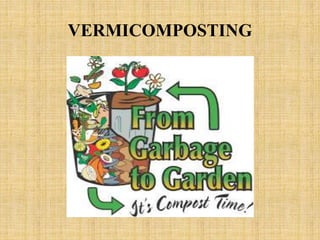
VERMICOMPOSTING
INTRODUCTION
 In recent years, it is no doubt that in India, where on one side pollution is
increasing day by day due to accumulation of organic waste and on the other
side there is a great shortage of organic manure.
 It has been estimated that India, as a whole, generates as much as 25 million
tonnes of urban solid waste of diverse composition per year. Solid waste
comprises of both organic and inorganic matter.
 Under the present condition of environmental degradation, vermicomposting
technology is the best way to meet all the requirements of the society. This is a
process of recycling trash/agricultural wastes in an efficient and eco-friendly
manner in order to produce quality compost.
 Organic wastes can be broken down and fragmented rapidly by earthworms,
resulting in a stable non-toxic material with good structure, which has a
potentially high economic value and also acts as a soil conditioner for plant
growth.
 It is a type of composting in which worms eat and metabolize organic matter
that comprises to a better end product known as Vermicast (commonly called as
BLACK GOLD) which has a stuff of nutrients that can be directly incorporated
into the soil to help with plant fertilization, soil enrichment and soil stability.
LITERATURE REVIEW
• Production of Earthworm casts – As explained by Edwards (1995),
earthworms ingest organic matter and egest it as much finer particles after
passing through a grinding gizzard that they all possess. Worms feed on the
microorganisms that grow upon the organic material. During this process,
N, P and Ca mineralized. Worms die at temperatures higher than 35oC, and
they process Organic Matter best at temperature between 15 and 25oC, and
a moisture of 70 to 90%. Different materials are mixed before processing
for faster results and a better product. Also worms have a limited tolerance
to some chemicals. The most commonly used earthworm is Eisina fetida
and the best results are obtained by using raised beds, feedstock is added at
the top and casts are collected at the bottom through mesh floors. In 25
kinds of vegetables, fruits or ornamentals casts did better than compost or
commercial potting mixes. (Edwards, 1995). There's scientific evidence
that human pathogens do not survive the vermicomposting process
(Edwards and Bohlen, 1995).
LITERATURE REVIEW
• Singh et al. (2013) studied the effect of vermicompost obtained from
biodegraded distillation waste on the soil properties and essential oil yield
of Pogostemon cablin (patchouli). In a field trial, five treatments viz.
control, bio- inoculants enriched vermicompost, bio-inoculants enriched
compost, vermicompost and recommended dose of chemical fertilizers
were given to patchouli plants. In the treatment with bio-inoculants
enriched vermicompost, oil yield was higher than all the other four
treatments. Application of bio-inoculants enriched vermicompost also
reduced the percentage disease index of the plants. Its application also
improved physical and chemical properties of the soil. Hence, in this study,
bio-inoculated vermicompost obtained from distillation waste proved to be
better than chemical fertilizer.
OBJECTIVE
 From an environmental point of view, organic fertilizers will:
– Overcome soil degradation and improve soil fertility.
– Get rid of the huge organic wastes that may contaminate the environment.
 From an economical point of view, organic fertilizers will:
– Minimizes the money spent on importing the huge amounts of chemical
fertilizers.
– Increase income due to the recycling of waste materials
OBJECTIVE
 From a social point of view, organic fertilizers will:
– Improve the social status of the individuals and the community.
– Create motivation for people to live in the countryside by providing job
opportunities and business plans.
 From a hygienic point of view, organic fertilizers will:
– Produce chemical-free crops which will improve people's health.
– Reduce the danger of lung diseases and other diseases resulting from
burning the organic wastes in the field
MATERIALS
1. COLLECTION OF
VEGETABLE AND
FRUIT WASTES:
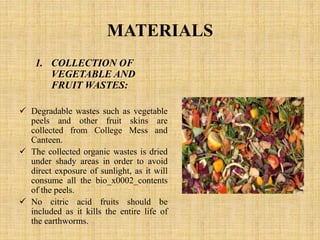
 Degradable wastes such as vegetable
peels and other fruit skins are
collected from College Mess and
Canteen.
 The collected organic wastes is dried
under shady areas in order to avoid
direct exposure of sunlight, as it will
consume all the bio_x0002_contents
of the peels.
 No citric acid fruits should be
included as it kills the entire life of
the earthworms.
2. COLLECTION OF BEDDING STOCKS AND DRY COW
DUNG:
 Bedding materials such as Pebbles, Sand, Soil, Neem leaves, Cartons,
Coconut Fibres, Rice husk, Straw, Egg shells, Litters, Vegetable peels, Fruit
skins (Banana peels) etc.,
– Pebbles are purchased from India Mart, with a quantity of 25Kg.
– Sand is collected from the constructional area of our college premises
– Soil is taken from the garden of our house.
– Neem leaves, Litters, Grasses are collected from the lawn near to
Bhavani Reference Point.
– Rice husk, Straw are collected from nearby houses surrounding our
college.
– Vegetable peels and Fruit skin such as Banana peels, Egg shells, Cartons,
– Coconut Fibres are collected from the Canteen and Hostel Mess.
Dry Cow Dung is collected from the cricket ground near to our college
premises, where many cows will graze the grass and it will excrete its
wastages and that will be dumped to the corner of the ground.
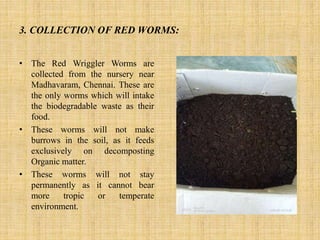
3. COLLECTION OF RED WORMS:
• The Red Wriggler Worms are
collected from the nursery near
Madhavaram, Chennai. These are
the only worms which will intake
the biodegradable waste as their
food.
• These worms will not make
burrows in the soil, as it feeds
exclusively on decomposting
Organic matter.
• These worms will not stay
permanently as it cannot bear
more tropic or temperate
environment.
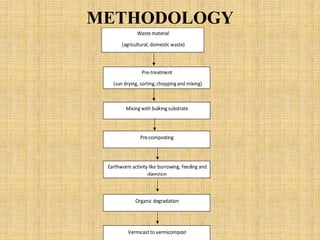
METHODOLOGY
Waste material
(agricultural, domestic waste)
Pre-treatment
(sun drying, sorting,choppingand mixing)
Mixing with bulking substrate
Pre-composting
Earthworm activity like burrowing, feeding and
digestion
Organic degradation
Vermicast to vermicompost
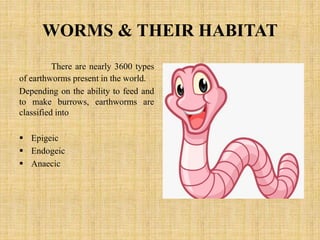
WORMS & THEIR HABITAT
There are nearly 3600 types
of earthworms present in the world.
Depending on the ability to feed and
to make burrows, earthworms are
classified into
 Epigeic
 Endogeic
 Anaecic
Worms used in vermicomposting
production
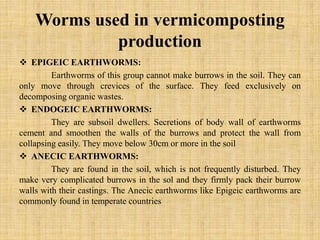
 EPIGEIC EARTHWORMS:
Earthworms of this group cannot make burrows in the soil. They can
only move through crevices of the surface. They feed exclusively on
decomposing organic wastes.
 ENDOGEIC EARTHWORMS:
They are subsoil dwellers. Secretions of body wall of earthworms
cement and smoothen the walls of the burrows and protect the wall from
collapsing easily. They move below 30cm or more in the soil
 ANECIC EARTHWORMS:
They are found in the soil, which is not frequently disturbed. They
make very complicated burrows in the sol and they firmly pack their burrow
walls with their castings. The Anecic earthworms like Epigeic earthworms are
commonly found in temperate countries
PREFERRED TYPE OF
EARTHWORM FOR OUR PROJECT
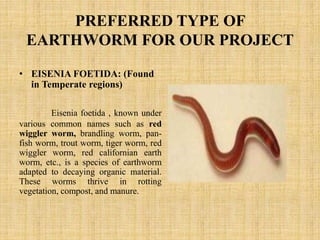
• EISENIA FOETIDA: (Found
in Temperate regions)
Eisenia foetida , known under
various common names such as red
wiggler worm, brandling worm, pan-
fish worm, trout worm, tiger worm, red
wiggler worm, red californian earth
worm, etc., is a species of earthworm
adapted to decaying organic material.
These worms thrive in rotting
vegetation, compost, and manure.
PROCESS DESCRIPTION
Preferred Method for the
Project: (Tanks above the
Ground):
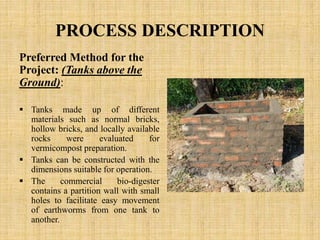
 Tanks made up of different
materials such as normal bricks,
hollow bricks, and locally available
rocks were evaluated for
vermicompost preparation.
 Tanks can be constructed with the
dimensions suitable for operation.
 The commercial bio-digester
contains a partition wall with small
holes to facilitate easy movement
of earthworms from one tank to
another.
SITE SELECTION
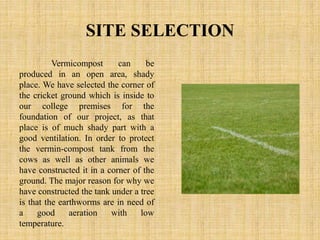
Vermicompost can be
produced in an open area, shady
place. We have selected the corner of
the cricket ground which is inside to
our college premises for the
foundation of our project, as that
place is of much shady part with a
good ventilation. In order to protect
the vermin-compost tank from the
cows as well as other animals we
have constructed it in a corner of the
ground. The major reason for why we
have constructed the tank under a tree
is that the earthworms are in need of
a good aeration with low
temperature.
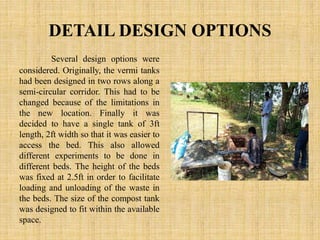
DETAIL DESIGN OPTIONS
Several design options were
considered. Originally, the vermi tanks
had been designed in two rows along a
semi-circular corridor. This had to be
changed because of the limitations in
the new location. Finally it was
decided to have a single tank of 3ft
length, 2ft width so that it was easier to
access the bed. This also allowed
different experiments to be done in
different beds. The height of the beds
was fixed at 2.5ft in order to facilitate
loading and unloading of the waste in
the beds. The size of the compost tank
was designed to fit within the available
space.
PREPARATION
• For vermicomposting the basic needs are Vegetable and Fruit scraps i.e.,
organic waste, space or house for earthworm and water for moisture
control.
• For the preparation of food for earthworm, following steps should be
carried out.
1) Collect the organic waste and sorting is must.
2) Cut the large pieces of organic waste to about 1 cubic inch in size.
3) Mix the waste with other bedding materials if necessary.
The vegetable waste is rich in Nitrogen so mix it with waste that is
rich in Carbon such as sawdust, rice husk, paper, and wastes that have much
carbon are added with rich nitrogen contents such as fresh cow dung etc. The
mixing percentage of carbonaceous material should be 10 %.
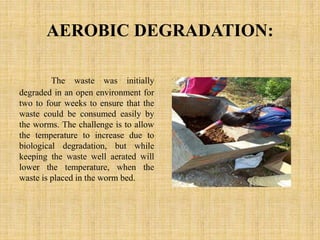
AEROBIC DEGRADATION:
The waste was initially
degraded in an open environment for
two to four weeks to ensure that the
waste could be consumed easily by
the worms. The challenge is to allow
the temperature to increase due to
biological degradation, but while
keeping the waste well aerated will
lower the temperature, when the
waste is placed in the worm bed.
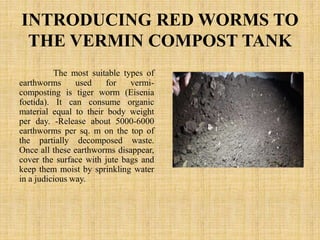
INTRODUCING RED WORMS TO
THE VERMIN COMPOST TANK
The most suitable types of
earthworms used for vermi-
composting is tiger worm (Eisenia
foetida). It can consume organic
material equal to their body weight
per day. -Release about 5000-6000
earthworms per sq. m on the top of
the partially decomposed waste.
Once all these earthworms disappear,
cover the surface with jute bags and
keep them moist by sprinkling water
in a judicious way.
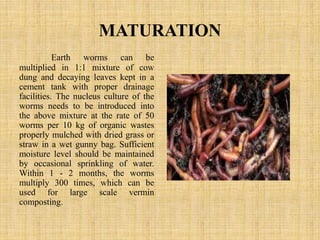
MATURATION
Earth worms can be
multiplied in 1:1 mixture of cow
dung and decaying leaves kept in a
cement tank with proper drainage
facilities. The nucleus culture of the
worms needs to be introduced into
the above mixture at the rate of 50
worms per 10 kg of organic wastes
properly mulched with dried grass or
straw in a wet gunny bag. Sufficient
moisture level should be maintained
by occasional sprinkling of water.
Within 1 - 2 months, the worms
multiply 300 times, which can be
used for large scale vermin
composting.
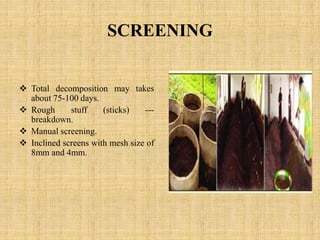
SCREENING
 Total decomposition may takes
about 75-100 days.
 Rough stuff (sticks) ---
breakdown.
 Manual screening.
 Inclined screens with mesh size of
8mm and 4mm.
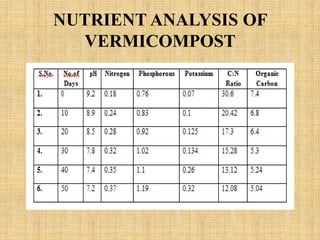
NUTRIENT ANALYSIS OF
VERMICOMPOST
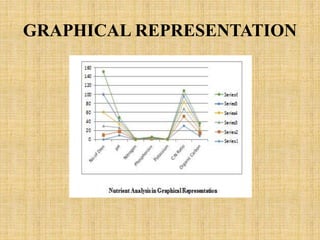
GRAPHICAL REPRESENTATION
RESULT AND DISCUSSION
 PH Value decreases.
 Nitrogen content increases.
 Phosphrous content increases.
 Pottassium content increases.
 NPK content will increases.
 Nutrient concentration increases.
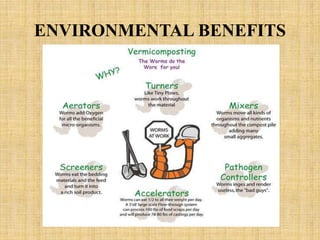
ENVIRONMENTAL BENEFITS
NPK Values of Vermicompost
Vermicompost is an excellent soil additive made up of digested
compost. Worm castings are much higher in nutrients and microbial life and
therefore, are considered as a higher value product. Worm castings contain up
to 5 times the plant available nutrients. It not only adds microbial organisms
and nutrients that have long lasting residual effects, it also modulates structure
to the existing soil, increases water retention capacity. Vermicompost contains
an average of 1.5% - 2.2% N, 1.8% - 2.2% P and 1.0% - 1.5% K. The organic
carbon is ranging from 9.15 to 17.98 and contains micronutrients Nitrogen,
phosphorus, and potassium are represented by N, P, and K, to conform to
standard commercial practice in labelling fertilizers.
ADVANTAGES OF
VERMICOMPOST
• Provides excellent effect on overall plant growth.
• Easy to apply ,handle and store.
• Improves soil structure, texture,aeration,water holding capacity and
prevents soil erosion.
• Contains Earthworm cocoons – increases the population and activity of
earthworm in the soil.
• It prevents the nutrient losses.
• It contains valuable vitamins.
• It neutralizes the soil protection.
REFRENCES
• Alok Bharadwaj Dept. of Biotechnology, G.L.A. Institute of Professional
Studies, Mathura (U.P.). Management of Kitchen Waste Material through
Vermicomposting. Vo l(1)2010, 176,177.
• Fatchi and Shayegan- Journal of Environmental studies ,Vol 36,No.55,Dec
2010.
• Chandan Singh and Azad Hussain-International Journal of Applied and
Pure Science and Agriculture.
• Edwards, C.A: The use of earthworms in the breakdown and management
of organic wastes. Pp. 327-354. In: Earthworm ecology. C. A. Edwards
(Ed.) CRC press, Boco Roton, FL, (1998).
• Latifah Abd Manaf, Mohd KamilYus off,Tengku HanidzaTengk u Ismail,
RostaHarun and HafizanJuahir, “Influences of Bedding Material in
Vermicomposting Process”, International Journal of Biology, 2009, 1(1),
81- 91.
• Pramanik P, Ghosh GK, Ghosal PK, Banik P. 2007. Changes in organic-C,
N, P and K and enzyme activities in vermicompost of biodegradable
organic wastes under liming and microbial inoculants. J Biores Tech 98:
2485-2494.
THANK YOU

Final Project PPT.pptx

  • 1.
    PREPARATION OF ORGANIC FERTILIZERFROM BIODEGRADABLE WASTES
  • 2.
  • 3.
    INTRODUCTION  In recentyears, it is no doubt that in India, where on one side pollution is increasing day by day due to accumulation of organic waste and on the other side there is a great shortage of organic manure.  It has been estimated that India, as a whole, generates as much as 25 million tonnes of urban solid waste of diverse composition per year. Solid waste comprises of both organic and inorganic matter.  Under the present condition of environmental degradation, vermicomposting technology is the best way to meet all the requirements of the society. This is a process of recycling trash/agricultural wastes in an efficient and eco-friendly manner in order to produce quality compost.  Organic wastes can be broken down and fragmented rapidly by earthworms, resulting in a stable non-toxic material with good structure, which has a potentially high economic value and also acts as a soil conditioner for plant growth.  It is a type of composting in which worms eat and metabolize organic matter that comprises to a better end product known as Vermicast (commonly called as BLACK GOLD) which has a stuff of nutrients that can be directly incorporated into the soil to help with plant fertilization, soil enrichment and soil stability.
  • 4.
    LITERATURE REVIEW • Productionof Earthworm casts – As explained by Edwards (1995), earthworms ingest organic matter and egest it as much finer particles after passing through a grinding gizzard that they all possess. Worms feed on the microorganisms that grow upon the organic material. During this process, N, P and Ca mineralized. Worms die at temperatures higher than 35oC, and they process Organic Matter best at temperature between 15 and 25oC, and a moisture of 70 to 90%. Different materials are mixed before processing for faster results and a better product. Also worms have a limited tolerance to some chemicals. The most commonly used earthworm is Eisina fetida and the best results are obtained by using raised beds, feedstock is added at the top and casts are collected at the bottom through mesh floors. In 25 kinds of vegetables, fruits or ornamentals casts did better than compost or commercial potting mixes. (Edwards, 1995). There's scientific evidence that human pathogens do not survive the vermicomposting process (Edwards and Bohlen, 1995).
  • 5.
    LITERATURE REVIEW • Singhet al. (2013) studied the effect of vermicompost obtained from biodegraded distillation waste on the soil properties and essential oil yield of Pogostemon cablin (patchouli). In a field trial, five treatments viz. control, bio- inoculants enriched vermicompost, bio-inoculants enriched compost, vermicompost and recommended dose of chemical fertilizers were given to patchouli plants. In the treatment with bio-inoculants enriched vermicompost, oil yield was higher than all the other four treatments. Application of bio-inoculants enriched vermicompost also reduced the percentage disease index of the plants. Its application also improved physical and chemical properties of the soil. Hence, in this study, bio-inoculated vermicompost obtained from distillation waste proved to be better than chemical fertilizer.
  • 6.
    OBJECTIVE  From anenvironmental point of view, organic fertilizers will: – Overcome soil degradation and improve soil fertility. – Get rid of the huge organic wastes that may contaminate the environment.  From an economical point of view, organic fertilizers will: – Minimizes the money spent on importing the huge amounts of chemical fertilizers. – Increase income due to the recycling of waste materials
  • 7.
    OBJECTIVE  From asocial point of view, organic fertilizers will: – Improve the social status of the individuals and the community. – Create motivation for people to live in the countryside by providing job opportunities and business plans.  From a hygienic point of view, organic fertilizers will: – Produce chemical-free crops which will improve people's health. – Reduce the danger of lung diseases and other diseases resulting from burning the organic wastes in the field
  • 8.
    MATERIALS 1. COLLECTION OF VEGETABLEAND FRUIT WASTES:  Degradable wastes such as vegetable peels and other fruit skins are collected from College Mess and Canteen.  The collected organic wastes is dried under shady areas in order to avoid direct exposure of sunlight, as it will consume all the bio_x0002_contents of the peels.  No citric acid fruits should be included as it kills the entire life of the earthworms.
  • 9.
    2. COLLECTION OFBEDDING STOCKS AND DRY COW DUNG:  Bedding materials such as Pebbles, Sand, Soil, Neem leaves, Cartons, Coconut Fibres, Rice husk, Straw, Egg shells, Litters, Vegetable peels, Fruit skins (Banana peels) etc., – Pebbles are purchased from India Mart, with a quantity of 25Kg. – Sand is collected from the constructional area of our college premises – Soil is taken from the garden of our house. – Neem leaves, Litters, Grasses are collected from the lawn near to Bhavani Reference Point. – Rice husk, Straw are collected from nearby houses surrounding our college. – Vegetable peels and Fruit skin such as Banana peels, Egg shells, Cartons, – Coconut Fibres are collected from the Canteen and Hostel Mess. Dry Cow Dung is collected from the cricket ground near to our college premises, where many cows will graze the grass and it will excrete its wastages and that will be dumped to the corner of the ground.
  • 10.
    3. COLLECTION OFRED WORMS: • The Red Wriggler Worms are collected from the nursery near Madhavaram, Chennai. These are the only worms which will intake the biodegradable waste as their food. • These worms will not make burrows in the soil, as it feeds exclusively on decomposting Organic matter. • These worms will not stay permanently as it cannot bear more tropic or temperate environment.
  • 11.
    METHODOLOGY Waste material (agricultural, domesticwaste) Pre-treatment (sun drying, sorting,choppingand mixing) Mixing with bulking substrate Pre-composting Earthworm activity like burrowing, feeding and digestion Organic degradation Vermicast to vermicompost
  • 12.
    WORMS & THEIRHABITAT There are nearly 3600 types of earthworms present in the world. Depending on the ability to feed and to make burrows, earthworms are classified into  Epigeic  Endogeic  Anaecic
  • 13.
    Worms used invermicomposting production  EPIGEIC EARTHWORMS: Earthworms of this group cannot make burrows in the soil. They can only move through crevices of the surface. They feed exclusively on decomposing organic wastes.  ENDOGEIC EARTHWORMS: They are subsoil dwellers. Secretions of body wall of earthworms cement and smoothen the walls of the burrows and protect the wall from collapsing easily. They move below 30cm or more in the soil  ANECIC EARTHWORMS: They are found in the soil, which is not frequently disturbed. They make very complicated burrows in the sol and they firmly pack their burrow walls with their castings. The Anecic earthworms like Epigeic earthworms are commonly found in temperate countries
  • 14.
    PREFERRED TYPE OF EARTHWORMFOR OUR PROJECT • EISENIA FOETIDA: (Found in Temperate regions) Eisenia foetida , known under various common names such as red wiggler worm, brandling worm, pan- fish worm, trout worm, tiger worm, red wiggler worm, red californian earth worm, etc., is a species of earthworm adapted to decaying organic material. These worms thrive in rotting vegetation, compost, and manure.
  • 15.
    PROCESS DESCRIPTION Preferred Methodfor the Project: (Tanks above the Ground):  Tanks made up of different materials such as normal bricks, hollow bricks, and locally available rocks were evaluated for vermicompost preparation.  Tanks can be constructed with the dimensions suitable for operation.  The commercial bio-digester contains a partition wall with small holes to facilitate easy movement of earthworms from one tank to another.
  • 16.
    SITE SELECTION Vermicompost canbe produced in an open area, shady place. We have selected the corner of the cricket ground which is inside to our college premises for the foundation of our project, as that place is of much shady part with a good ventilation. In order to protect the vermin-compost tank from the cows as well as other animals we have constructed it in a corner of the ground. The major reason for why we have constructed the tank under a tree is that the earthworms are in need of a good aeration with low temperature.
  • 17.
    DETAIL DESIGN OPTIONS Severaldesign options were considered. Originally, the vermi tanks had been designed in two rows along a semi-circular corridor. This had to be changed because of the limitations in the new location. Finally it was decided to have a single tank of 3ft length, 2ft width so that it was easier to access the bed. This also allowed different experiments to be done in different beds. The height of the beds was fixed at 2.5ft in order to facilitate loading and unloading of the waste in the beds. The size of the compost tank was designed to fit within the available space.
  • 18.
    PREPARATION • For vermicompostingthe basic needs are Vegetable and Fruit scraps i.e., organic waste, space or house for earthworm and water for moisture control. • For the preparation of food for earthworm, following steps should be carried out. 1) Collect the organic waste and sorting is must. 2) Cut the large pieces of organic waste to about 1 cubic inch in size. 3) Mix the waste with other bedding materials if necessary. The vegetable waste is rich in Nitrogen so mix it with waste that is rich in Carbon such as sawdust, rice husk, paper, and wastes that have much carbon are added with rich nitrogen contents such as fresh cow dung etc. The mixing percentage of carbonaceous material should be 10 %.
  • 19.
    AEROBIC DEGRADATION: The wastewas initially degraded in an open environment for two to four weeks to ensure that the waste could be consumed easily by the worms. The challenge is to allow the temperature to increase due to biological degradation, but while keeping the waste well aerated will lower the temperature, when the waste is placed in the worm bed.
  • 20.
    INTRODUCING RED WORMSTO THE VERMIN COMPOST TANK The most suitable types of earthworms used for vermi- composting is tiger worm (Eisenia foetida). It can consume organic material equal to their body weight per day. -Release about 5000-6000 earthworms per sq. m on the top of the partially decomposed waste. Once all these earthworms disappear, cover the surface with jute bags and keep them moist by sprinkling water in a judicious way.
  • 21.
    MATURATION Earth worms canbe multiplied in 1:1 mixture of cow dung and decaying leaves kept in a cement tank with proper drainage facilities. The nucleus culture of the worms needs to be introduced into the above mixture at the rate of 50 worms per 10 kg of organic wastes properly mulched with dried grass or straw in a wet gunny bag. Sufficient moisture level should be maintained by occasional sprinkling of water. Within 1 - 2 months, the worms multiply 300 times, which can be used for large scale vermin composting.
  • 22.
    SCREENING  Total decompositionmay takes about 75-100 days.  Rough stuff (sticks) --- breakdown.  Manual screening.  Inclined screens with mesh size of 8mm and 4mm.
  • 23.
  • 24.
  • 25.
    RESULT AND DISCUSSION PH Value decreases.  Nitrogen content increases.  Phosphrous content increases.  Pottassium content increases.  NPK content will increases.  Nutrient concentration increases.
  • 26.
  • 27.
    NPK Values ofVermicompost Vermicompost is an excellent soil additive made up of digested compost. Worm castings are much higher in nutrients and microbial life and therefore, are considered as a higher value product. Worm castings contain up to 5 times the plant available nutrients. It not only adds microbial organisms and nutrients that have long lasting residual effects, it also modulates structure to the existing soil, increases water retention capacity. Vermicompost contains an average of 1.5% - 2.2% N, 1.8% - 2.2% P and 1.0% - 1.5% K. The organic carbon is ranging from 9.15 to 17.98 and contains micronutrients Nitrogen, phosphorus, and potassium are represented by N, P, and K, to conform to standard commercial practice in labelling fertilizers.
  • 28.
    ADVANTAGES OF VERMICOMPOST • Providesexcellent effect on overall plant growth. • Easy to apply ,handle and store. • Improves soil structure, texture,aeration,water holding capacity and prevents soil erosion. • Contains Earthworm cocoons – increases the population and activity of earthworm in the soil. • It prevents the nutrient losses. • It contains valuable vitamins. • It neutralizes the soil protection.
  • 29.
    REFRENCES • Alok BharadwajDept. of Biotechnology, G.L.A. Institute of Professional Studies, Mathura (U.P.). Management of Kitchen Waste Material through Vermicomposting. Vo l(1)2010, 176,177. • Fatchi and Shayegan- Journal of Environmental studies ,Vol 36,No.55,Dec 2010. • Chandan Singh and Azad Hussain-International Journal of Applied and Pure Science and Agriculture. • Edwards, C.A: The use of earthworms in the breakdown and management of organic wastes. Pp. 327-354. In: Earthworm ecology. C. A. Edwards (Ed.) CRC press, Boco Roton, FL, (1998). • Latifah Abd Manaf, Mohd KamilYus off,Tengku HanidzaTengk u Ismail, RostaHarun and HafizanJuahir, “Influences of Bedding Material in Vermicomposting Process”, International Journal of Biology, 2009, 1(1), 81- 91. • Pramanik P, Ghosh GK, Ghosal PK, Banik P. 2007. Changes in organic-C, N, P and K and enzyme activities in vermicompost of biodegradable organic wastes under liming and microbial inoculants. J Biores Tech 98: 2485-2494.
  • 30.