FINAL PROJECT
Proposed solution on
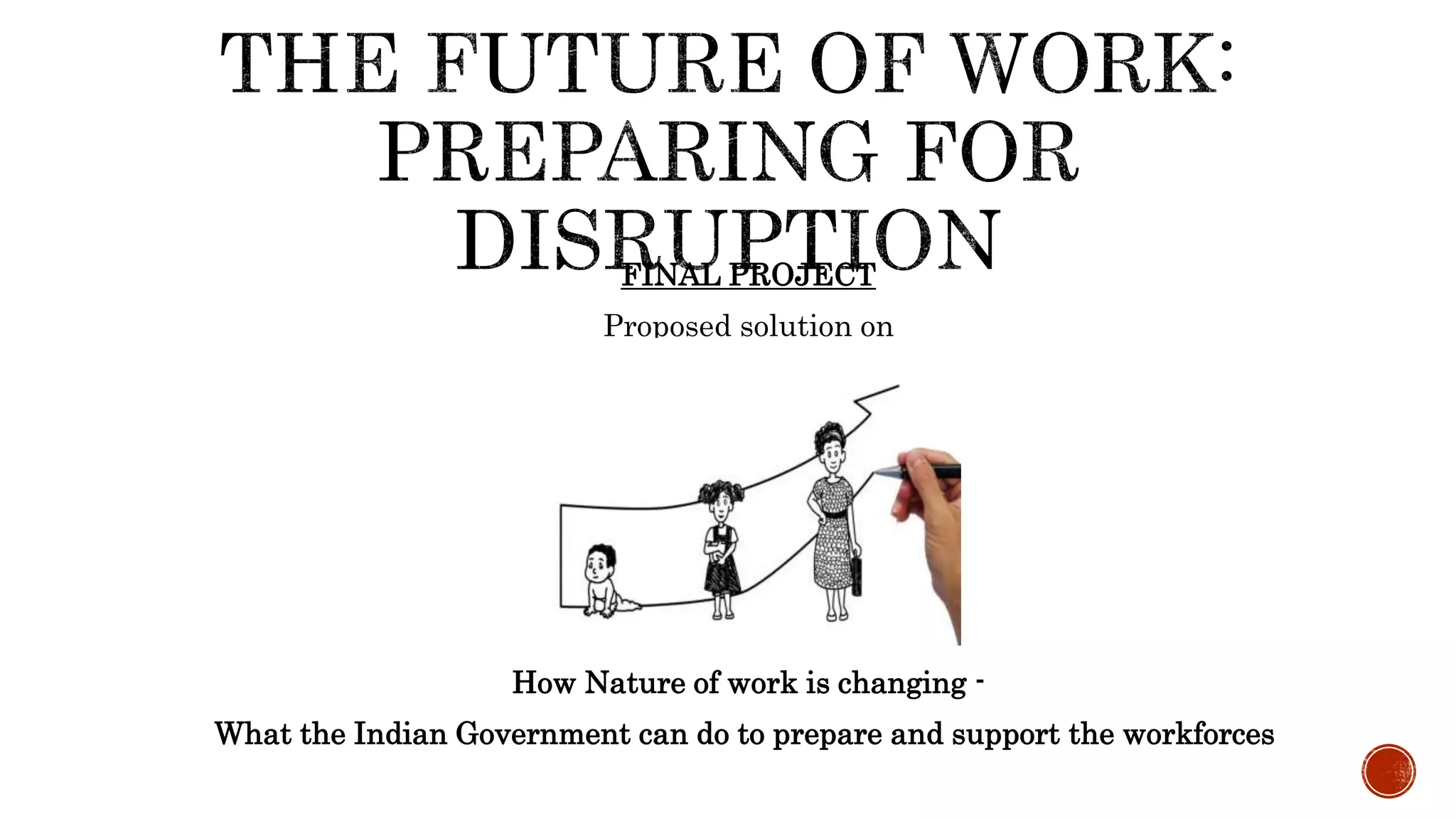
How Nature of work is changing -
What the Indian Government can do to prepare and support the workforces
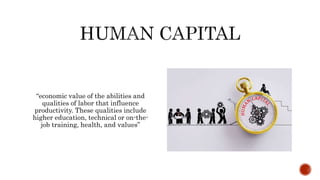
“economic value of the abilities and
qualities of labor that influence
productivity. These qualities include
higher education, technical or on-the-
job training, health, and values”
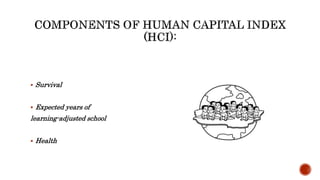
 Survival
 Expected years of
learning-adjusted school
 Health
Education creates wealth in two ways:
1) Families headed by educated parents earn more than those without college
degrees. It gives the children a head start in life. They can provide for better
schooling and receive better education themselves, and
2) Education improves the upward-mobility effect. Once the child earns a diploma,
the entire family becomes wealthier. The study found it boosted family wealth by 20
spots in the rankings.
Health plays an important role in human capital formation for the following
reasons:
 Only a healthy person can perform to his/her full potential.
 A healthy person can do the work in a more effective manner.
 A healthy person can contribute to the growth and development of the economy by
doing productive work.
 An unhealthy person becomes a liability for an organization.
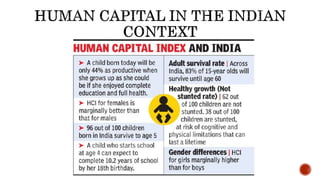
 Nearly 60% of children born today will be, at best, only half as productive as they
could be with complete education and full health. This reflects a serious human
capital crisis, with strong implications for economic growth and the world’s
collective ability to end extreme poverty by 2030.
 Gaps in human capital are at risk of widening amid rapid global changes in
technology, demography, fragility, and climate.
How Nature of Work is Changing
 One of the most talked about subject off late has been how machines might take
over human job.
 And it is statistically true that more than 40% of jobs currently being done by
Indians have not existed couple of decades before.
 This trend is expected to be continuing with Automation entering every single
area with every single day.
 Restaurants, Hospitals, Retails shops, Driverless Cars – are some of the areas
where AI has made an impact, inturn replacing lot of Jobs and in many more
industries as well.
 India does not had a position called Software Developer couple of decades ago but
now we have 30% of our workforce in this profession.
 Contrary to popular belief Automation by itself is not acting as a threat to Jobs
across India.
 Statistically, we could see decline in job positions due to Automation but new Jobs
being created in different areas.
 The real threat more than automation inorder to reclaim new jobs is creating ones
with required qualities – Innovation.
 Any new Job positions that is to be created will require the workforce to have the
ability to Innovate, capacity to learn, practice the habit of continuous learning.
 So the real challenge is - to innovate, to learn; for that we need to have a platform
that gives priority / equipping workforce to adopt.
 Acknowledging that Nature of Work is changing alone cannot suffice. We need to
understand what is the real threat and how to overcome it.
 More the Automation in Workplace, more the necessity to innovate to keep Jobs
created elsewhere.
 There lies the challenge which starts from the very beginning – Health &
Education. The most important components to be considered for preparing
ourselves.
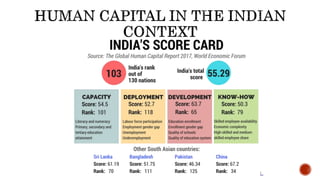
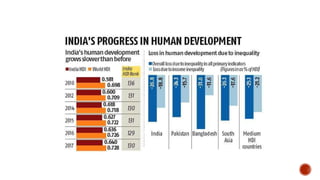
 The datas related to these parameters are not encouraging from Indian Context.
 Compared to several developing countries, India lags way behind especially
considering the potential and the workforce it shields.
 Historical data show that sewage and clean water interventions together accounted for a large
share of the decline in child mortality in Massachusetts between 1880 and 1920.
 Research suggests that the large wave of compulsory school reforms that took place across
Europe in the mid-20th century made people more tolerant of immigrants than they were
before.14 Social capital in turn is associated with higher economic growth.
 In Mexico, the benefits of increased labor productivity resulting from the 1994 North American
Free Trade Agreement (NAFTA) have been concentrated among more skilled workers.
Developing socio-behavioral skills such as an aptitude for teamwork, empathy, conflict
resolution, and relationship management enlarges a person’s human capital. Globalized and
automated economies put a higher premium on human capabilities that cannot be fully
mimicked by machines.
 Health is an important component of human capital. In Nigeria, a program providing malaria
testing and treatment increased workers’ earnings by 10 percent in just a few weeks.
 Proper nutrition in utero and in early childhood improves children’s physical and mental well-
being. Evidence from the United Kingdom revealed that schoolchildren who had healthier diets
significantly increased their achievements in English and science.
 A two-year conditional cash transfer program in Malawi targeting adolescent girls and young
women produced a large increase in educational attainment and a sustained reduction in the
total number of births in girls who were out of school at the start of the program. These benefits
persisted after the program ended.
 In the Philippines, young people were offered a voluntary commitment program in which money
they had placed in a savings account was returned to them only if they passed a smoking
cessation test. The program saw a significant reduction in smoking.
 In Nepal, investments in sanitation are contributing significantly to preventing anemia.
 Housing programs improve the education and labor market outcomes of the most
disadvantaged by changing the quality of the peers with whom they interact. The
earlier children are exposed to better-off neighbors, the stronger are the effects.
 Although people with a basic education earn more than people with no education,
labor market returns for a basic education are not realized until 10–15 years after
these investments are made. This is even truer of investments in early childhood
education. In Jamaica, providing toddlers with psychosocial stimulation increased
earnings by 25 percent, but these returns only materialized 20 years later.
 Twaweza, a Tanzanian organization, launched a survey to assess children’s basic
literacy and numeracy. The dismal results—released in 2011—showed that only 3 in
10 third-grade students had mastered secondgrade numeracy, and even fewer could
read a second-grade story. The World Bank’s own Service Delivery Indicators, released
around the same time, shone a spotlight on the low levels of teacher competence and
high levels of absenteeism in Tanzania.
The benefits of human capital transcend private returns, extending to others and across
generations. Despite the larger supply of educated workers, returns to investments in
education have increased since 2000. Returns to education are especially high when
technology is changing—people with higher human capital adapt faster to technological
change.
 Human capital complements physical capital in the production process and is an
important input to technological innovation and long-run growth. As a result, between
10 and 30 percent of per capita gross domestic product (GDP) differences is
attributable to cross-country differences in human capital. This percentage could be
even higher when considering the quality of education or the interactions between
workers with different skills. And not to be overlooked, by generating higher incomes,
human capital accelerates the demographic transition and reduces poverty.
 Deworming one child decreases the chances of other children becoming infected with
worms, which in turn sets those children up for better learning and higher wages.
Maternal education, through better prenatal care, improves infant health.
 Programs can improve people’s incentives to invest in human capital when they make
its long-term benefits salient or provide mechanisms to make good choices binding.
Young people may not want to stay in school or take care of their health because they
lack self-control or do not fully appreciate the benefits of education and good health.
However, when they receive information about human capital it has big effects on
their behavior.
 Ensuring access to a quality education closes early gaps in cognitive and
sociobehavioral skills. By the age of 3, children from low-income families have heard
30 million fewer words than their more affluent peers. As children turn into teenagers,
interventions to close these gaps become more expensive. Evidence suggests that, for
governments seeking to invest wisely in human capital, there is no better possibility
than investing in the first thousand days of a child’s life. Without such interventions
early in life, it is more likely that a spiral of increasing inequality will ensue:
subsequent public investments in education and health are more likely to benefit
people who start out better off.
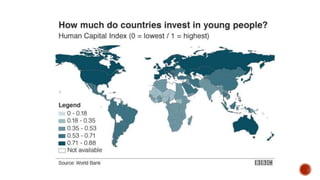
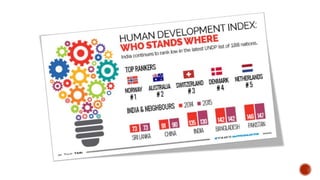
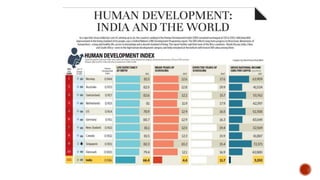
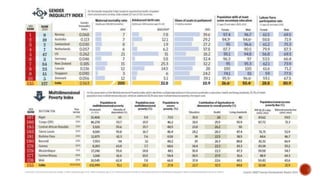
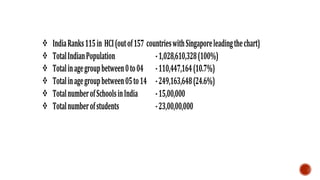
 IndiaRanks115in HCI(outof157 countrieswithSingaporeleadingthechart)
 TotalIndianPopulation -1,028,610,328(100%)
 Totalinagegroupbetween0to04 -110,447,164(10.7%)
 Totalinagegroupbetween05to14 -249,163,648(24.6%)
 TotalnumberofSchoolsinIndia -15,00,000
 Totalnumberofstudents -23,00,00,000
 Though the comparative numbers on Infant Mortality looks better compared to other countries, on micro
level it still is not benefited the rural and lower middle income group.
 No serious efforts seen on the early health benefits to look after the issues of stunting and malnutrition in
kids less than 5 years age is not uncommon
 Serious Braindrain in Healthcare professionals gives us the grim story on the Healthcare Infrastructure
 With close to 25 mn in age group between 0 to 15, school education still doesn’t look have been benefitting
on the low to middle income group. The HCI numbers puts in poor light on the same.
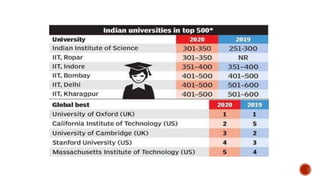
 With Close to million universities/ colleges, hardly any in the top 100 universities in the globe says a lot on
the quality of our education in a comparative sense.
 Investment in human capital still is considered as a luxury without realising the serious complication it
may put us all in or the cost of inaction which we might face.
 A first step is improving the quality of basic administrative data in education and
health. Only one in six governments publish annual education monitoring reports.
Just 100 countries or so report reasonably complete and up-to-date data on net
enrollment rates at different levels of education to the UNESCO Institute for
Statistics—the body tasked with compiling this data internationally.
 As the nature of work changes, human capital becomes more important. Yet
significant gaps in human capital persist across the world. These gaps manifested
in low education and health outcomes hurt the future productivity of workers and
future competitiveness of economies.
 To address this issue, governments must seek remedies. However, because of the
long time needed for human capital investments to yield economic returns, the
political incentives for human capital investments are often missing. The Human
Capital Project aims to create not just these incentives, but also the policy
guidance for more and better investments in human capital.

Final project (future of works)

  • 1.
    FINAL PROJECT Proposed solutionon How Nature of work is changing - What the Indian Government can do to prepare and support the workforces
  • 2.
    “economic value ofthe abilities and qualities of labor that influence productivity. These qualities include higher education, technical or on-the- job training, health, and values”
  • 4.
     Survival  Expectedyears of learning-adjusted school  Health
  • 5.
    Education creates wealthin two ways: 1) Families headed by educated parents earn more than those without college degrees. It gives the children a head start in life. They can provide for better schooling and receive better education themselves, and 2) Education improves the upward-mobility effect. Once the child earns a diploma, the entire family becomes wealthier. The study found it boosted family wealth by 20 spots in the rankings.
  • 7.
    Health plays animportant role in human capital formation for the following reasons:  Only a healthy person can perform to his/her full potential.  A healthy person can do the work in a more effective manner.  A healthy person can contribute to the growth and development of the economy by doing productive work.  An unhealthy person becomes a liability for an organization.
  • 8.
     Nearly 60%of children born today will be, at best, only half as productive as they could be with complete education and full health. This reflects a serious human capital crisis, with strong implications for economic growth and the world’s collective ability to end extreme poverty by 2030.  Gaps in human capital are at risk of widening amid rapid global changes in technology, demography, fragility, and climate.
  • 10.
    How Nature ofWork is Changing
  • 11.
     One ofthe most talked about subject off late has been how machines might take over human job.  And it is statistically true that more than 40% of jobs currently being done by Indians have not existed couple of decades before.  This trend is expected to be continuing with Automation entering every single area with every single day.  Restaurants, Hospitals, Retails shops, Driverless Cars – are some of the areas where AI has made an impact, inturn replacing lot of Jobs and in many more industries as well.  India does not had a position called Software Developer couple of decades ago but now we have 30% of our workforce in this profession.
  • 12.
     Contrary topopular belief Automation by itself is not acting as a threat to Jobs across India.  Statistically, we could see decline in job positions due to Automation but new Jobs being created in different areas.  The real threat more than automation inorder to reclaim new jobs is creating ones with required qualities – Innovation.  Any new Job positions that is to be created will require the workforce to have the ability to Innovate, capacity to learn, practice the habit of continuous learning.  So the real challenge is - to innovate, to learn; for that we need to have a platform that gives priority / equipping workforce to adopt.
  • 13.
     Acknowledging thatNature of Work is changing alone cannot suffice. We need to understand what is the real threat and how to overcome it.  More the Automation in Workplace, more the necessity to innovate to keep Jobs created elsewhere.  There lies the challenge which starts from the very beginning – Health & Education. The most important components to be considered for preparing ourselves.  The datas related to these parameters are not encouraging from Indian Context.  Compared to several developing countries, India lags way behind especially considering the potential and the workforce it shields.
  • 19.
     Historical datashow that sewage and clean water interventions together accounted for a large share of the decline in child mortality in Massachusetts between 1880 and 1920.  Research suggests that the large wave of compulsory school reforms that took place across Europe in the mid-20th century made people more tolerant of immigrants than they were before.14 Social capital in turn is associated with higher economic growth.  In Mexico, the benefits of increased labor productivity resulting from the 1994 North American Free Trade Agreement (NAFTA) have been concentrated among more skilled workers. Developing socio-behavioral skills such as an aptitude for teamwork, empathy, conflict resolution, and relationship management enlarges a person’s human capital. Globalized and automated economies put a higher premium on human capabilities that cannot be fully mimicked by machines.  Health is an important component of human capital. In Nigeria, a program providing malaria testing and treatment increased workers’ earnings by 10 percent in just a few weeks.
  • 20.
     Proper nutritionin utero and in early childhood improves children’s physical and mental well- being. Evidence from the United Kingdom revealed that schoolchildren who had healthier diets significantly increased their achievements in English and science.  A two-year conditional cash transfer program in Malawi targeting adolescent girls and young women produced a large increase in educational attainment and a sustained reduction in the total number of births in girls who were out of school at the start of the program. These benefits persisted after the program ended.  In the Philippines, young people were offered a voluntary commitment program in which money they had placed in a savings account was returned to them only if they passed a smoking cessation test. The program saw a significant reduction in smoking.  In Nepal, investments in sanitation are contributing significantly to preventing anemia.
  • 21.
     Housing programsimprove the education and labor market outcomes of the most disadvantaged by changing the quality of the peers with whom they interact. The earlier children are exposed to better-off neighbors, the stronger are the effects.  Although people with a basic education earn more than people with no education, labor market returns for a basic education are not realized until 10–15 years after these investments are made. This is even truer of investments in early childhood education. In Jamaica, providing toddlers with psychosocial stimulation increased earnings by 25 percent, but these returns only materialized 20 years later.  Twaweza, a Tanzanian organization, launched a survey to assess children’s basic literacy and numeracy. The dismal results—released in 2011—showed that only 3 in 10 third-grade students had mastered secondgrade numeracy, and even fewer could read a second-grade story. The World Bank’s own Service Delivery Indicators, released around the same time, shone a spotlight on the low levels of teacher competence and high levels of absenteeism in Tanzania.
  • 22.
    The benefits ofhuman capital transcend private returns, extending to others and across generations. Despite the larger supply of educated workers, returns to investments in education have increased since 2000. Returns to education are especially high when technology is changing—people with higher human capital adapt faster to technological change.  Human capital complements physical capital in the production process and is an important input to technological innovation and long-run growth. As a result, between 10 and 30 percent of per capita gross domestic product (GDP) differences is attributable to cross-country differences in human capital. This percentage could be even higher when considering the quality of education or the interactions between workers with different skills. And not to be overlooked, by generating higher incomes, human capital accelerates the demographic transition and reduces poverty.  Deworming one child decreases the chances of other children becoming infected with worms, which in turn sets those children up for better learning and higher wages. Maternal education, through better prenatal care, improves infant health.
  • 23.
     Programs canimprove people’s incentives to invest in human capital when they make its long-term benefits salient or provide mechanisms to make good choices binding. Young people may not want to stay in school or take care of their health because they lack self-control or do not fully appreciate the benefits of education and good health. However, when they receive information about human capital it has big effects on their behavior.  Ensuring access to a quality education closes early gaps in cognitive and sociobehavioral skills. By the age of 3, children from low-income families have heard 30 million fewer words than their more affluent peers. As children turn into teenagers, interventions to close these gaps become more expensive. Evidence suggests that, for governments seeking to invest wisely in human capital, there is no better possibility than investing in the first thousand days of a child’s life. Without such interventions early in life, it is more likely that a spiral of increasing inequality will ensue: subsequent public investments in education and health are more likely to benefit people who start out better off.
  • 25.
     IndiaRanks115in HCI(outof157countrieswithSingaporeleadingthechart)  TotalIndianPopulation -1,028,610,328(100%)  Totalinagegroupbetween0to04 -110,447,164(10.7%)  Totalinagegroupbetween05to14 -249,163,648(24.6%)  TotalnumberofSchoolsinIndia -15,00,000  Totalnumberofstudents -23,00,00,000
  • 26.
     Though thecomparative numbers on Infant Mortality looks better compared to other countries, on micro level it still is not benefited the rural and lower middle income group.  No serious efforts seen on the early health benefits to look after the issues of stunting and malnutrition in kids less than 5 years age is not uncommon  Serious Braindrain in Healthcare professionals gives us the grim story on the Healthcare Infrastructure  With close to 25 mn in age group between 0 to 15, school education still doesn’t look have been benefitting on the low to middle income group. The HCI numbers puts in poor light on the same.  With Close to million universities/ colleges, hardly any in the top 100 universities in the globe says a lot on the quality of our education in a comparative sense.  Investment in human capital still is considered as a luxury without realising the serious complication it may put us all in or the cost of inaction which we might face.
  • 27.
     A firststep is improving the quality of basic administrative data in education and health. Only one in six governments publish annual education monitoring reports. Just 100 countries or so report reasonably complete and up-to-date data on net enrollment rates at different levels of education to the UNESCO Institute for Statistics—the body tasked with compiling this data internationally.  As the nature of work changes, human capital becomes more important. Yet significant gaps in human capital persist across the world. These gaps manifested in low education and health outcomes hurt the future productivity of workers and future competitiveness of economies.  To address this issue, governments must seek remedies. However, because of the long time needed for human capital investments to yield economic returns, the political incentives for human capital investments are often missing. The Human Capital Project aims to create not just these incentives, but also the policy guidance for more and better investments in human capital.