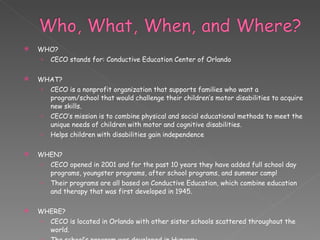
WHO? CECO stands for: Conductive Education Center of Orlando  WHAT? CECO is a nonprofit organization that supports families who want a program/school that would challenge their children’s motor disabilities to acquire new skills.  CECO’s mission is to combine physical and social educational methods to meet the unique needs of children with motor and cognitive disabilities. Helps children with disabilities gain independence  WHEN? CECO opened in 2001 and for the past 10 years they have added full school day programs, youngster programs, after school programs, and summer camp! Their programs are all based on Conductive Education, which combine education and therapy that was first developed in 1945. WHERE? CECO is located in Orlando with other sister schools scattered throughout the world. The school’s program was developed in Hungary
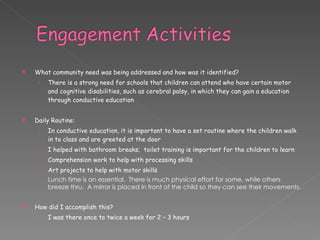
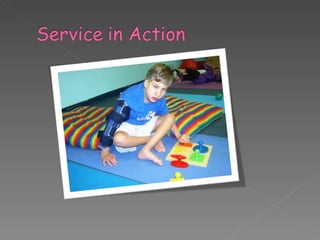
What community need was being addressed and how was it identified? There is a strong need for schools that children can attend who have certain motor and cognitive disabilities, such as cerebral palsy, in which they can gain a education through conductive education Daily Routine: In conductive education, it is important to have a set routine where the children walk in to class and are greeted at the door I helped with bathroom breaks;  toilet training is important for the children to learn Comprehension work to help with processing skills Art projects to help with motor skills Lunch time is an essential.  There is much physical effort for some, while others breeze thru.  A mirror is placed in front of the child so they can see their movements. How did I accomplish this? I was there once to twice a week for 2 – 3 hours
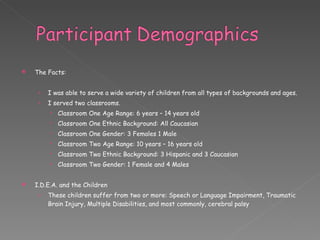
The Facts: I was able to serve a wide variety of children from all types of backgrounds and ages. I served two classrooms. Classroom One Age Range: 6 years – 14 years old Classroom One Ethnic Background: All Caucasian  Classroom One Gender: 3 Females 1 Male Classroom Two Age Range: 10 years – 16 years old Classroom Two Ethnic Background: 3 Hispanic and 3 Caucasian Classroom Two Gender: 1 Female and 4 Males I.D.E.A. and the Children These children suffer from two or more: Speech or Language Impairment, Traumatic Brain Injury, Multiple Disabilities, and most commonly, cerebral palsy
 
Personally, I was thrilled to work with children who have disabilities.  I have to be honest that I was a little nervous just because I am not accustomed to working in a conducive environment.  I of course felt a sense of fulfillment and knowing that I could help kids who are normally “left behind” just solidified my personal reasons for becoming an exceptional educator.  The impact of realizing these children will continue to strive to reach their potential, but 9 out of 10 will always need assistance; I want to be their assistant and teacher.
I completed this service learning project for my EEX2010 class.  Throughout the semester, I learned three topics that related to my 15 hours of service learning: Learning disabilities and reading, using strategies for them to learn, and technology for the disabled.  I learned that 85% of those who are disabled cannot read nor have major problems with this skill.  While at CECO I helped with a reading comprehension activity in which I needed to read for the child because he couldn’t speak, but used his eyes to select the right answers.  Secondly I learned a few strategies of how to work with the disabled.  One was use learning tools and aids, which the children used at CECO.  For example, during lunch time some had the suction cupped bars to help them hold their selves up.  Finally I learned that technology can be quite beneficial to those with disabilities.  A few of my students used laptops for education purposes or the electronic voice command.  In the future I can use these concepts I learned and gained from class and the service learning experience to better enrich my students.
I have always been “big” in volunteering for various organizations and still plan on doing so.  I don’t just volunteer to the disabled, but I volunteer to those who need an extra hand.  Providing an extra hand or a little of your time allows those in our society with or without disabilities an understanding that their not alone in this world and they have other people who care and want to help them succeed.  Service learning I feel is a great method of learning because you can “get” and learn something about your community and its members that you might not already know.  I know I will continue to serve my community and encourage my peers and educators to be committed to help others.  Doing so will help open your eyes to others who are completely different, but you’ll soon see how similar we all are.
I am confident that CECO has given me more of an incentive to further my future goal, which is to become an Art Therapist.  I love working with those who need help or an extra hand, and I I love to do so through art.  Working with these children gave me inspiration to not only work with emotional distraught children, but those with motor and cognitive disabilities as well.

Final presentation gorski, christina

  • 1.
  • 2.
    WHO? CECO standsfor: Conductive Education Center of Orlando WHAT? CECO is a nonprofit organization that supports families who want a program/school that would challenge their children’s motor disabilities to acquire new skills. CECO’s mission is to combine physical and social educational methods to meet the unique needs of children with motor and cognitive disabilities. Helps children with disabilities gain independence WHEN? CECO opened in 2001 and for the past 10 years they have added full school day programs, youngster programs, after school programs, and summer camp! Their programs are all based on Conductive Education, which combine education and therapy that was first developed in 1945. WHERE? CECO is located in Orlando with other sister schools scattered throughout the world. The school’s program was developed in Hungary
  • 3.
    What community needwas being addressed and how was it identified? There is a strong need for schools that children can attend who have certain motor and cognitive disabilities, such as cerebral palsy, in which they can gain a education through conductive education Daily Routine: In conductive education, it is important to have a set routine where the children walk in to class and are greeted at the door I helped with bathroom breaks; toilet training is important for the children to learn Comprehension work to help with processing skills Art projects to help with motor skills Lunch time is an essential. There is much physical effort for some, while others breeze thru. A mirror is placed in front of the child so they can see their movements. How did I accomplish this? I was there once to twice a week for 2 – 3 hours
  • 4.
    The Facts: Iwas able to serve a wide variety of children from all types of backgrounds and ages. I served two classrooms. Classroom One Age Range: 6 years – 14 years old Classroom One Ethnic Background: All Caucasian Classroom One Gender: 3 Females 1 Male Classroom Two Age Range: 10 years – 16 years old Classroom Two Ethnic Background: 3 Hispanic and 3 Caucasian Classroom Two Gender: 1 Female and 4 Males I.D.E.A. and the Children These children suffer from two or more: Speech or Language Impairment, Traumatic Brain Injury, Multiple Disabilities, and most commonly, cerebral palsy
  • 5.
  • 6.
    Personally, I wasthrilled to work with children who have disabilities. I have to be honest that I was a little nervous just because I am not accustomed to working in a conducive environment. I of course felt a sense of fulfillment and knowing that I could help kids who are normally “left behind” just solidified my personal reasons for becoming an exceptional educator. The impact of realizing these children will continue to strive to reach their potential, but 9 out of 10 will always need assistance; I want to be their assistant and teacher.
  • 7.
    I completed thisservice learning project for my EEX2010 class. Throughout the semester, I learned three topics that related to my 15 hours of service learning: Learning disabilities and reading, using strategies for them to learn, and technology for the disabled. I learned that 85% of those who are disabled cannot read nor have major problems with this skill. While at CECO I helped with a reading comprehension activity in which I needed to read for the child because he couldn’t speak, but used his eyes to select the right answers. Secondly I learned a few strategies of how to work with the disabled. One was use learning tools and aids, which the children used at CECO. For example, during lunch time some had the suction cupped bars to help them hold their selves up. Finally I learned that technology can be quite beneficial to those with disabilities. A few of my students used laptops for education purposes or the electronic voice command. In the future I can use these concepts I learned and gained from class and the service learning experience to better enrich my students.
  • 8.
    I have alwaysbeen “big” in volunteering for various organizations and still plan on doing so. I don’t just volunteer to the disabled, but I volunteer to those who need an extra hand. Providing an extra hand or a little of your time allows those in our society with or without disabilities an understanding that their not alone in this world and they have other people who care and want to help them succeed. Service learning I feel is a great method of learning because you can “get” and learn something about your community and its members that you might not already know. I know I will continue to serve my community and encourage my peers and educators to be committed to help others. Doing so will help open your eyes to others who are completely different, but you’ll soon see how similar we all are.
  • 9.
    I am confidentthat CECO has given me more of an incentive to further my future goal, which is to become an Art Therapist. I love working with those who need help or an extra hand, and I I love to do so through art. Working with these children gave me inspiration to not only work with emotional distraught children, but those with motor and cognitive disabilities as well.