Teachers in Action
Service Learning Project
Vania Norman & Caitlin London
Conductive Education Center of Orlando (CECO)
CECO is a non-profit private school dedicated to
serving students from 18 months through
adulthood with neurological motor disabilities
ranging from Spina Bifida and Cerebral Palsy to
progressive disorders like Parkinson’s. Whether
the student is enrolled in a youngster program
specially designed to encourage students to meet
developmental milestones, or an adult program
that focuses on advancing the students’ daily
living skills, all CECO programs embody five key
characteristics:
● Daily Routine
● Program Development
● Motivation
● Group Work
● Facilitation
Developing a Project
For our project, we wanted to focus on serving participants of a school-aged summer camp
customized to fit the unique needs of its students. The main goals of the program is to help
improve fine and gross motor skills while facilitating social and physical independence. We
wanted to design a project to help educators at CECO meet these objectives, and made a specific
personal goal to incorporate art and an academic lesson to encourage both creativity and critical
thinking.
Day 1 (July 8, 2019)
1. First, we met with CECO’s Recruitment Outreach Manager, Nathan Reese.
2. We took a tour of the school and met the staff. The school was very organized and it was very clear that
the staff was familiar with all of the students. They greeted them warmly as they entered the color coded
classrooms often using nicknames.
3. We sat down with Nathan to discuss CECO’s general mission and challenges of their students.
4. We discussed our proposal with Nathan, and he decided it was best to work with an upcoming after school
program for students from 12-20 years old.
5. We took notes on his suggested modifications.
6. We volunteered for remaining school hours to build rapport with students and to learn first hand about
their interests and abilities to ensure our project was realistic and inclusive
7. We took time to discuss Fourth of July to see what the students knew about it. Those who answered had
more background knowledge on the topic than either of us thought.
Students at CECO work not only to
expand their knowledge in
traditional academic subjects, but also
to improve their range of motion and
build strength in stiff muscles in this
gym.   
Two students having an absolute blast
racing each other to class!
He was unable to choose which color
he wanted to paint with, so he went
with all of them.
Day 1 Reflection
Day 1 taught us the importance and value of having specialized schools to help students
who have disabilities. These students were welcomed, understood, and fully appreciated. Their
specific needs were met and they were treated with compassion. It seems rather common that
when one speaks to a student with a disability, there is a tendency to assume less intelligence.
That is far from the truth. These students were witty, bright, open, and knowledgeable.
Day 2 (July 9, 2019)
1. We began by volunteering in the morning again to further get to know the students and the
school
2. When students took their break for a one-hour lunch, Vania prepped our big project by pre-
cutting figures we needed for our art project while Caitlin made a quick store run for last
minute supplies.
3. The last half hour before the end of the day, we met with the 4 teacher’s assistants that
would help us that afternoon. We gave them an overview of the general directions and
supplies before showing them a visual of what the finished project should look like.
4. Between 2:00 and 2:15, we greeted the 4 students that entered who would take part in the
day’s after school program and our TIA project.
Day 2 Continued...
5. Caitlin read Independence Day, a short 32 page book that covered the historical
significance of the holiday.
6. Afterwards, she asked questions about the content of the reading. For example, “What
document was signed on July 4, 1776 in Philadelphia?” Throughout the reading, the teacher’s assistants
were observed correcting the student’s posture and encouraging the students to pay attention.
However, when the first student was asked this question he confidently replied with the correct answer.
7. As Caitlin read, Vania set up supplies in front of each student and their assistant.
Afterwards, she gave a short lecture on symbols in American culture that relate to the holiday. Some of
them included the flag, liberty bell, and Uncle Sam. Finally, we started the art projects and the
students began to make the Uncle Sam masks.
Reading the book about Independence Day to the students
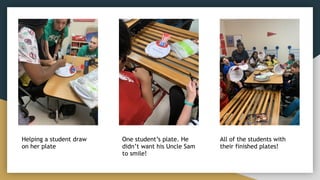
Helping a student draw
on her plate
One student’s plate. He
didn’t want his Uncle Sam
to smile!
All of the students with
their finished plates!
Day 2 Reflection
After this day, we both left feeling like we got to know the kids a little bit better. Those who were
vocal were lively, funny, curious, and loved to share things with us. One of the students was telins
us a bunch of different world records, like one about the most time spent playing video games.
There is obviously a huge contrast between how a day would run in a general classroom education
versus the classroom we were in, but the similarities were also very prevalent. At the end of the
day, children are children. They are curious. They want to learn, share, and be loved and
respected.
What We Learned
One of the biggest things we were able to take from this was how dedicated teachers are. As
future teachers, we have a dedication and desire to serve our students and community, but there
is something extra special about teachers who help guide students with disabilities through
schooling. There is such a true love, care, and respect for these students, as well as a “people-
first” language used. There is a genuine patience that these teachers exude around their
students, they never rush them or show frustrations, they just support them in any way they
need. Another thing we learned is that while asking an organization if they need help and
coordinating a project can feel intimidating, it is worth so much more than any perceived fear.
These schools and programs want, need, and gladly accept any help and contribution that can be
offered.
Hours
Day 1 July 8th 8am-4pm (8 Hours)
Day 2 July 9th 8am-4pm(8 Hours)
Conductive Education Center of Orlando
931 S Semoran Blvd Ste. 220
Winter Park, Fl 32792

TIA

  • 1.
    Teachers in Action ServiceLearning Project Vania Norman & Caitlin London
  • 2.
    Conductive Education Centerof Orlando (CECO) CECO is a non-profit private school dedicated to serving students from 18 months through adulthood with neurological motor disabilities ranging from Spina Bifida and Cerebral Palsy to progressive disorders like Parkinson’s. Whether the student is enrolled in a youngster program specially designed to encourage students to meet developmental milestones, or an adult program that focuses on advancing the students’ daily living skills, all CECO programs embody five key characteristics: ● Daily Routine ● Program Development ● Motivation ● Group Work ● Facilitation
  • 3.
    Developing a Project Forour project, we wanted to focus on serving participants of a school-aged summer camp customized to fit the unique needs of its students. The main goals of the program is to help improve fine and gross motor skills while facilitating social and physical independence. We wanted to design a project to help educators at CECO meet these objectives, and made a specific personal goal to incorporate art and an academic lesson to encourage both creativity and critical thinking.
  • 4.
    Day 1 (July8, 2019) 1. First, we met with CECO’s Recruitment Outreach Manager, Nathan Reese. 2. We took a tour of the school and met the staff. The school was very organized and it was very clear that the staff was familiar with all of the students. They greeted them warmly as they entered the color coded classrooms often using nicknames. 3. We sat down with Nathan to discuss CECO’s general mission and challenges of their students. 4. We discussed our proposal with Nathan, and he decided it was best to work with an upcoming after school program for students from 12-20 years old. 5. We took notes on his suggested modifications. 6. We volunteered for remaining school hours to build rapport with students and to learn first hand about their interests and abilities to ensure our project was realistic and inclusive 7. We took time to discuss Fourth of July to see what the students knew about it. Those who answered had more background knowledge on the topic than either of us thought.
  • 5.
    Students at CECOwork not only to expand their knowledge in traditional academic subjects, but also to improve their range of motion and build strength in stiff muscles in this gym.    Two students having an absolute blast racing each other to class! He was unable to choose which color he wanted to paint with, so he went with all of them.
  • 6.
    Day 1 Reflection Day1 taught us the importance and value of having specialized schools to help students who have disabilities. These students were welcomed, understood, and fully appreciated. Their specific needs were met and they were treated with compassion. It seems rather common that when one speaks to a student with a disability, there is a tendency to assume less intelligence. That is far from the truth. These students were witty, bright, open, and knowledgeable.
  • 7.
    Day 2 (July9, 2019) 1. We began by volunteering in the morning again to further get to know the students and the school 2. When students took their break for a one-hour lunch, Vania prepped our big project by pre- cutting figures we needed for our art project while Caitlin made a quick store run for last minute supplies. 3. The last half hour before the end of the day, we met with the 4 teacher’s assistants that would help us that afternoon. We gave them an overview of the general directions and supplies before showing them a visual of what the finished project should look like. 4. Between 2:00 and 2:15, we greeted the 4 students that entered who would take part in the day’s after school program and our TIA project.
  • 8.
    Day 2 Continued... 5.Caitlin read Independence Day, a short 32 page book that covered the historical significance of the holiday. 6. Afterwards, she asked questions about the content of the reading. For example, “What document was signed on July 4, 1776 in Philadelphia?” Throughout the reading, the teacher’s assistants were observed correcting the student’s posture and encouraging the students to pay attention. However, when the first student was asked this question he confidently replied with the correct answer. 7. As Caitlin read, Vania set up supplies in front of each student and their assistant. Afterwards, she gave a short lecture on symbols in American culture that relate to the holiday. Some of them included the flag, liberty bell, and Uncle Sam. Finally, we started the art projects and the students began to make the Uncle Sam masks.
  • 9.
    Reading the bookabout Independence Day to the students
  • 10.
    Helping a studentdraw on her plate One student’s plate. He didn’t want his Uncle Sam to smile! All of the students with their finished plates!
  • 11.
    Day 2 Reflection Afterthis day, we both left feeling like we got to know the kids a little bit better. Those who were vocal were lively, funny, curious, and loved to share things with us. One of the students was telins us a bunch of different world records, like one about the most time spent playing video games. There is obviously a huge contrast between how a day would run in a general classroom education versus the classroom we were in, but the similarities were also very prevalent. At the end of the day, children are children. They are curious. They want to learn, share, and be loved and respected.
  • 12.
    What We Learned Oneof the biggest things we were able to take from this was how dedicated teachers are. As future teachers, we have a dedication and desire to serve our students and community, but there is something extra special about teachers who help guide students with disabilities through schooling. There is such a true love, care, and respect for these students, as well as a “people- first” language used. There is a genuine patience that these teachers exude around their students, they never rush them or show frustrations, they just support them in any way they need. Another thing we learned is that while asking an organization if they need help and coordinating a project can feel intimidating, it is worth so much more than any perceived fear. These schools and programs want, need, and gladly accept any help and contribution that can be offered.
  • 13.
    Hours Day 1 July8th 8am-4pm (8 Hours) Day 2 July 9th 8am-4pm(8 Hours) Conductive Education Center of Orlando 931 S Semoran Blvd Ste. 220 Winter Park, Fl 32792