Professional Practice

                   Communication
It involves a systematic and continuous process of
telling, listening and understanding.
               faces of communication;
                        1.Sender
                       2.Reciever
                     3.Information
                      4.Behaviour
Purpose of Communication
1.    Communication is needed in the area of orientation to make people
      acquainted with the colleagues, superiors and with company’s rules and
      regulations.
2.    It is needed to enable employees perform their functions effectively.
3.    It is needed to teach employees personal safety on the job.
4.    Communication helps the manager in his decision process.
5.    It helps in promoting co-operation and industrial peace.
6.    It increases managerial efficiency.
7.   A manager can convey his ideas, feelings and
      decisions to the workers whereas the workers
      can convey their responses, feelings,
      problems, complaints to the manager.
8.   It also helps to clear out misunderstanding
       between manager and workers.
9.   It helps in integrating group efforts.
Forms & Types of Communication
•    Broadly speaking, there can be three forms
     of Communication
1)   Oral
2)   Written
3)   Non-verbal
4)   Para verbal
5)   Symbols, codes
6)   Silence
7)   Propaganda, Rumour
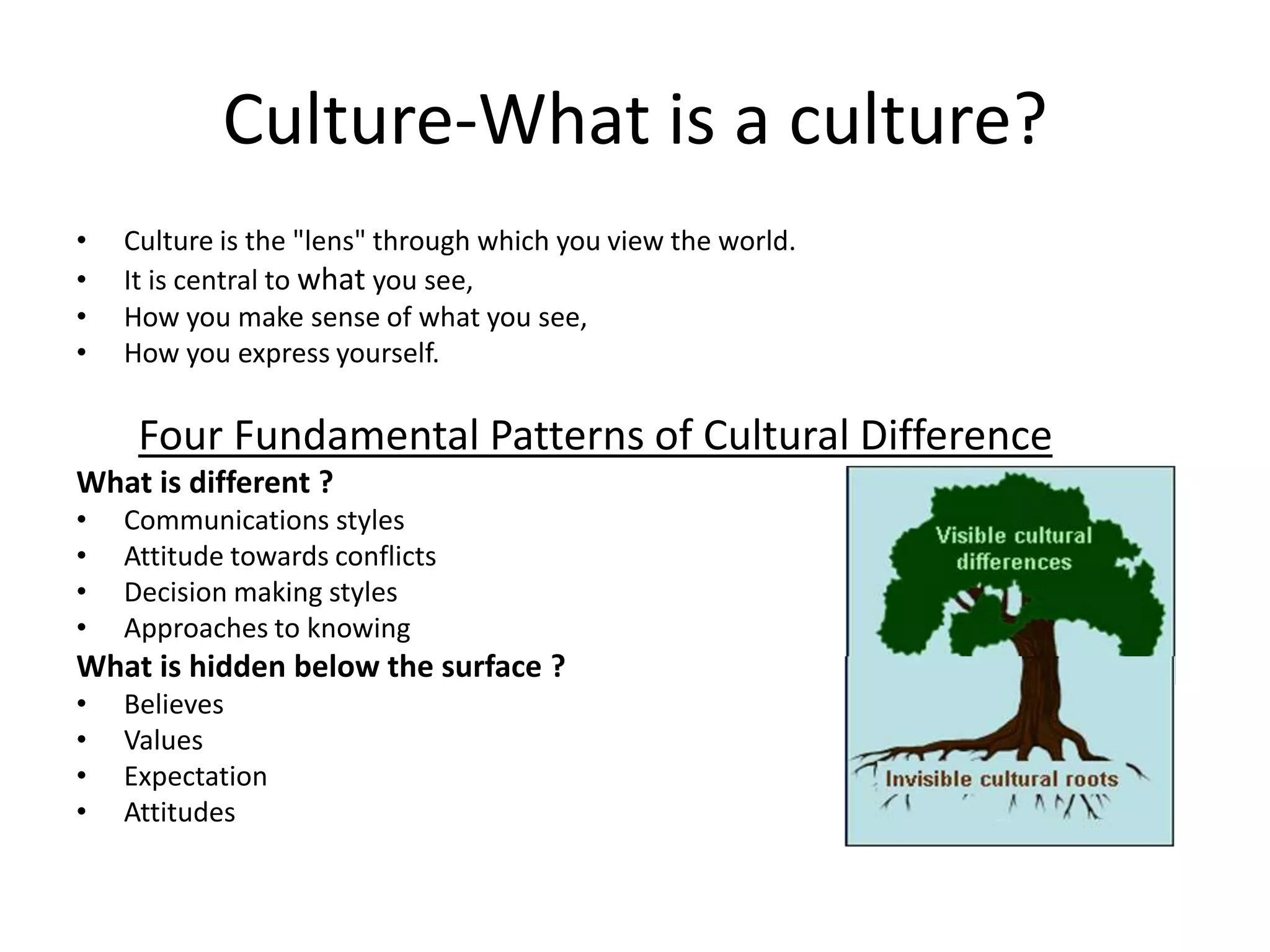
Culture-What is a culture?
•   Culture is the "lens" through which you view the world.
•   It is central to what you see,
•   How you make sense of what you see,
•   How you express yourself.

     Four Fundamental Patterns of Cultural Difference
What is different ?
•   Communications styles
•   Attitude towards conflicts
•   Decision making styles
•   Approaches to knowing
What is hidden below the surface ?
•   Believes
•   Values
•   Expectation
•   Attitudes
Verbal Communication Differences
• Words
• Voice

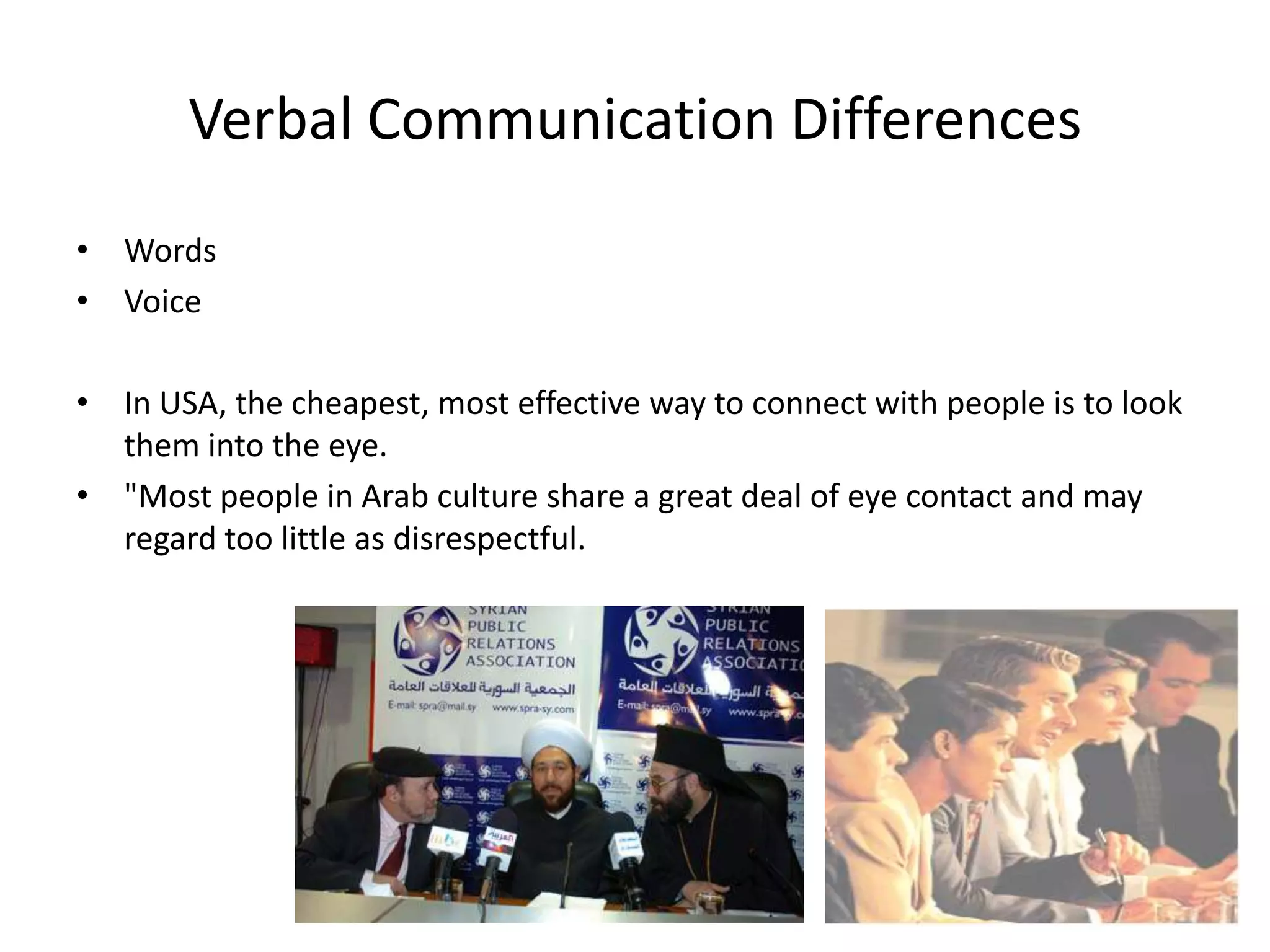
• In USA, the cheapest, most effective way to connect with people is to look
  them into the eye.
• "Most people in Arab culture share a great deal of eye contact and may
  regard too little as disrespectful.
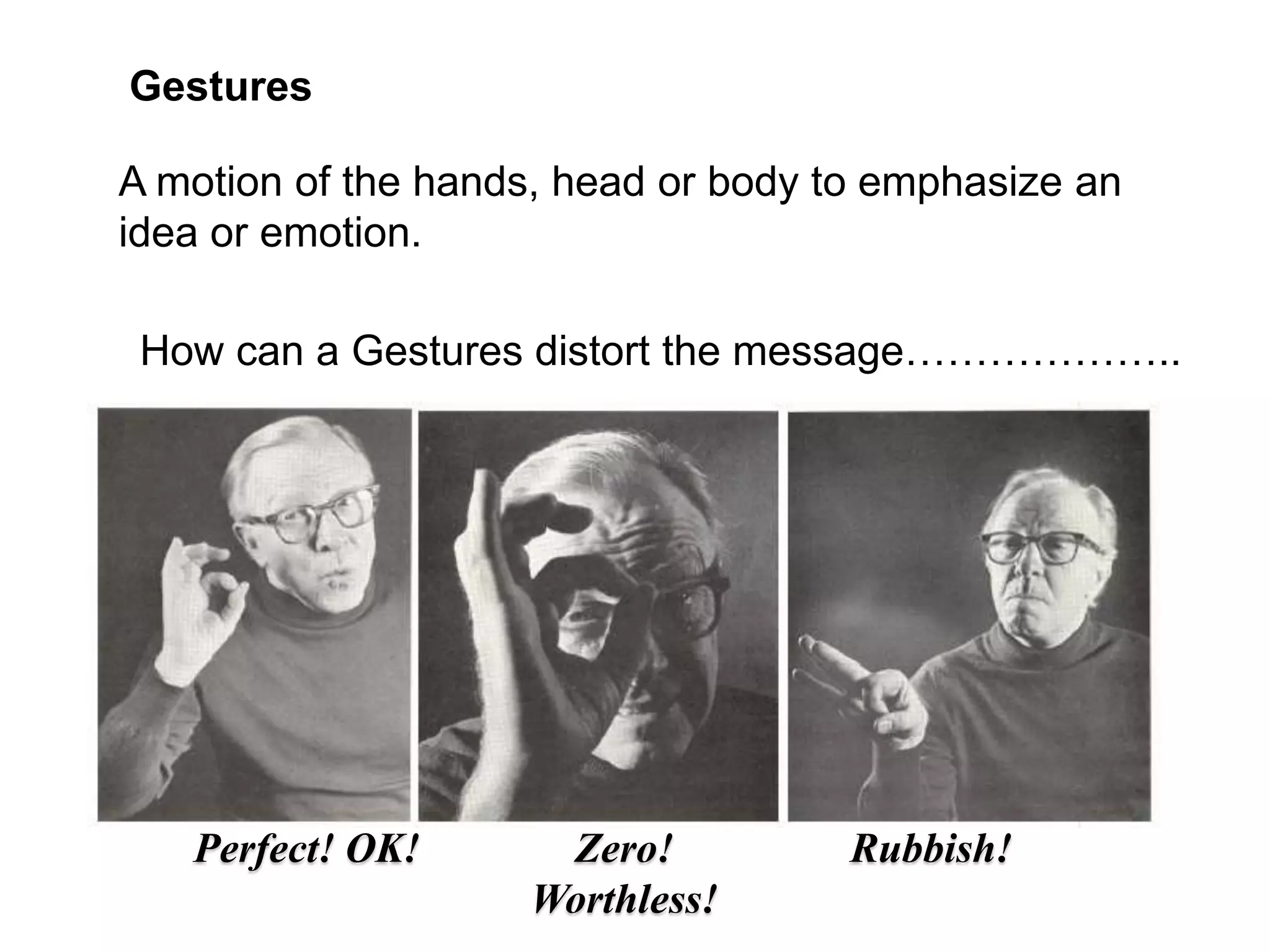
Gestures

A motion of the hands, head or body to emphasize an
idea or emotion.

 How can a Gestures distort the message………………..


   Perfect! OK!      Zero!           Rubbish!
                    Worthless!
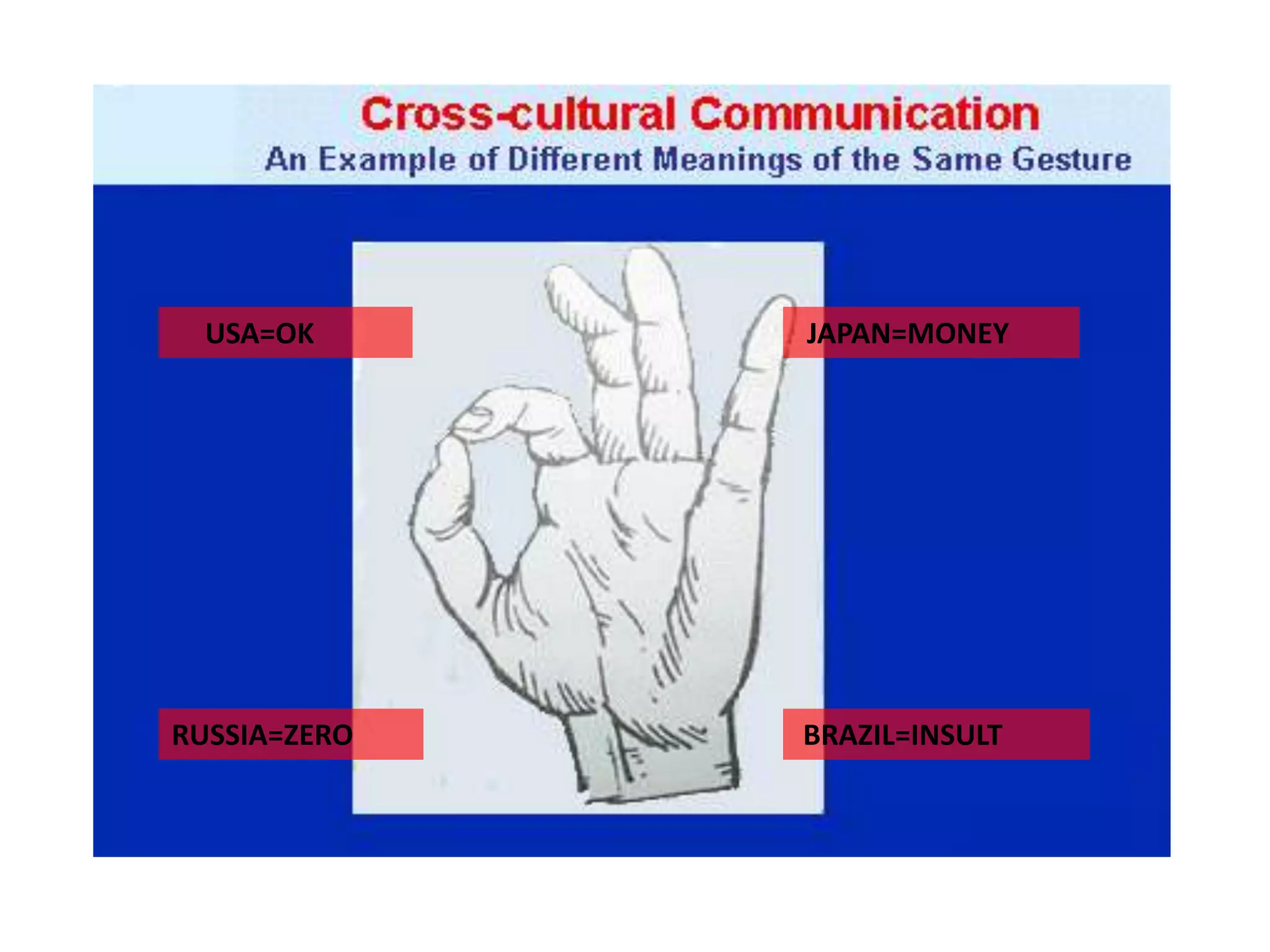
USA=OK      JAPAN=MONEY


RUSSIA=ZERO   BRAZIL=INSULT
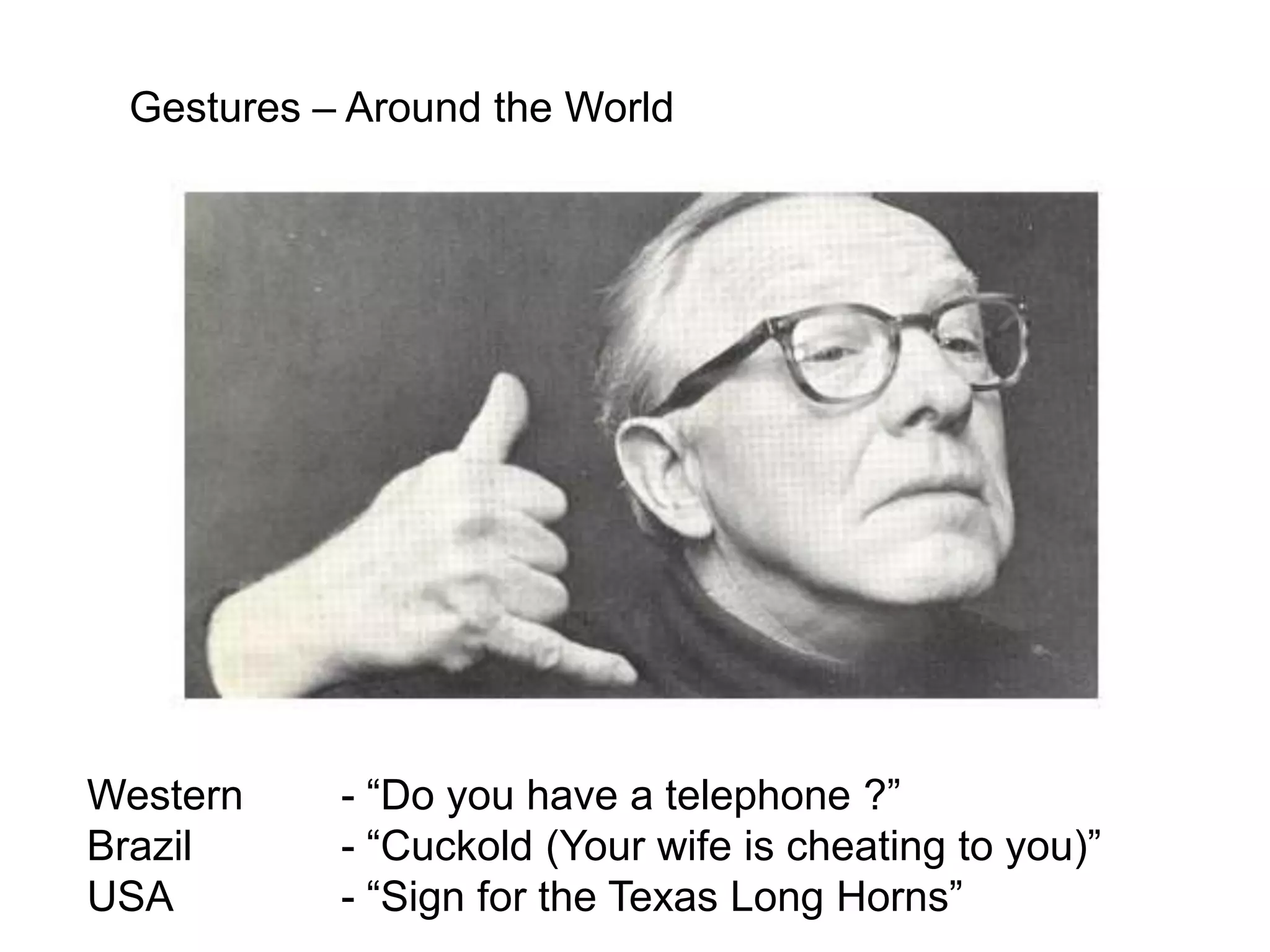
Gestures – Around the World


Western    - “Do you have a telephone ?”
Brazil     - “Cuckold (Your wife is cheating to you)”
USA        - “Sign for the Texas Long Horns”
Business Writing
What is business writing?
• A wide range of different writing jobs and
  formats including both internal
  communication within the company or
  organization and external communication
  interfacing with the public or other
  organizations on behalf of the company or
  organization
What does it include?
•   Letters & Memos
•   Proposals & Reports
•   Power Point Presentations
•   Newsletters
•   Press releases
•   Marketing brochures ,Copywriting ,web copy
•   Blogging
•   Resumes and job applications
•   Emails
•   Faxes
•   Minutes of a Meeting
Letters and Memos
• The primary difference between Business Letters and Business Memos is
  the intended reader.
   – Letters are usually between two businesses or the business and the
      client. They are more detailed and formal
   – Memos are usually internal i.e. within the organization. They are
      shorter and more informal
Proposal
• A Proposal can be of one page or many but the basic structure comprises
  of Introduction, the proposed solution, Cost & Statement of Request
Reports
• A report can cover many different areas with different purposes. These
  can be
   – Progress Reports
       • Report of the work accomplished within a specific time period
   – Feasibility Reports
       • Evaluation report of a proposal designed to determine the
         difficulty of carrying out a designated task
   – Research Reports
       • It is the compilation of findings from a piece of research
Power Point Presentations
•   Power point presentations are often based on proposals and reports,
    employing a visual presentation of the most striking points of the information
    to be imparted, combined with a speech delivered by the presenter.
Newsletters
•   Newsletters are generally written for the company employees, clients or
    customers. They are written in a journalistic style. While being interesting and
    informative they also convey the management’s message or promotions in
    entertaining and readable articles.
Press Releases
•   Headline: an attention grabbing statement of the main point of the story.
•   5 Ws and an H: The first paragraph condense the whole story by telling Who
    What When Where Why and How
•   Body: Expand on the story, but keep everything on one page.
•   Contact details: They give full details about the organisation putting the story
    out, and the full contact details of the person who can give journalists more
    information (names, addresses, website, telephone, e-mail etc)
•   End: The press release is generally concluded with ###
Marketing Brochure, Copywriting and Web Copy
• These are written from the point of view of highlighting the
  products or services of the organizations. Marketing
  brochures, copywriting, and web copy all require skills in sales
  or promotional writing.
Blogging
• A new development in Business Writing the emergence of
  Blogs or Web Logs. Many companies are realising the
  potential of blogs for promoting their company or their
  products and therefore professional writers are being hired
  for writing the blogs of the company
Resumes & Job Applications
• These are used by professionals for the purpose of soliciting jobs
  and new opportunities by communicating their competencies and
  experiences to companies in an clear and concise manner.
Emails
• It has become an important part of business communication
  in recent times. Messages as email can be sent over great
  distances in minimal time.
• As a general rule the content should not be more than a
  couple of paragraphs. Anything longer should be sent as
  attachment.
• Grammar and spelling ARE important in business email
• Appropriate use of cc and bcc where required
Faxes
• It is the short form of Facsimile (exact copy). Fax is a
  document sent over the telephone line. In spite of the
  emergence of emails, Fax is still an important form of business
  communication because
   – It is easier to handwrite than to type
   – Since emails are not signed at times sometimes they are
       unacceptable in business communication
• Minutes of meeting
• The written minutes of a meeting are a meeting report that is
  sent after the meeting, it states what was said and decided
  during the meeting. The minutes contain the date of the
  meeting, as well as the initials and names of the people who
  attended
• Meeting minutes also show who is responsible for carrying
  out action. In a column on the right-hand side, we put the
  person's initials in bold to show that he or she will perform
  the action.
PRESENTATION PRINCIPLES
Presenting : Presenting means not only to present but also as seen. Whether
you are a nervious beginner or a pro in search of fresh idea, you need
presenting skills to create and deliver powerful presentations.
Speaking : Speaking is a process of speaking to a group of people in a
structured manner intended to inform, influence or entertain the listners. For eg
simply transmiting imformation, motivating people to act, or simply yelling a
story. It is closely allied to presenting, although later has more commercial
connotation.
Orating : Speaking with skill in a formal or bombastic manner is Orating.
Good orator should be able to change the emotions of their listeners, not just
inform them.
 Is a good speaker necessarily a good presenter?
   Good speaker are knowledgeable about their topics but lack the extra enthusiasm
    and love. They may be thinking about what he or she is going to do after the
    presentation, i wonder if they like me etc. Great presenters love their topic and
present
    with passion and a feeling of heart.they are completely focused on listeners and the
    message they are delivering. They forget about themselves and are completely
    involved in the movement.
PREPARING FOR PRESENTATION
•   Six Practical steps in Preparing Presentation.
•   Step 1 : Define your objective.
•   Step 2 : Understand the Audience.
•   Step 3 : Decide what to say
•   Step 4 : Get Organised.
•   Step 5 : Develop Effective Visuals.
•   Step 6 : Rehearse
What is Ethics?
• MEANING OF ETHICS :
    The word “ethics” is derived from the Greek word
   “ethos”, which refers to character.

• Some years ago, sociologist Raymond Baumhart asked business
  people, "What does ethics mean to you?" Among their replies were
  the following:

• 1."Ethics has to do with what my feelings tell me is right or wrong."
  2."Ethics has to do with my religious beliefs."
  3."Being ethical is doing what the law requires."
  4."Ethics consists of the standards of behavior our society accepts."
  5."I don't know what the word means."
• These replies might be typical of our own. The meaning of "ethics"
  is hard to pin down, and the views many people have about ethics
  are shaky.
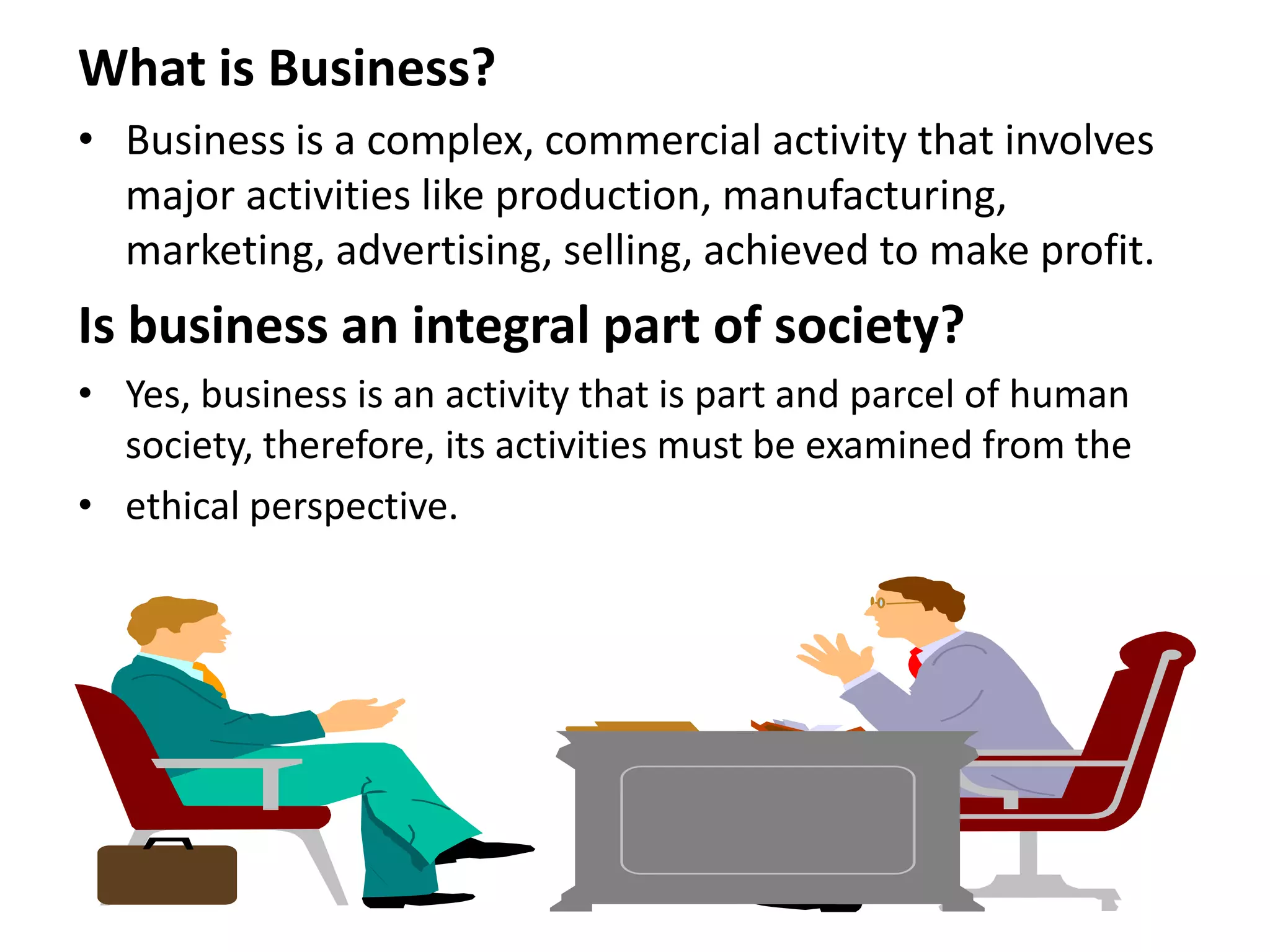
What is Business?
• Business is a complex, commercial activity that involves
  major activities like production, manufacturing,
  marketing, advertising, selling, achieved to make profit.
Is business an integral part of society?
• Yes, business is an activity that is part and parcel of human
  society, therefore, its activities must be examined from the
• ethical perspective.
Reference :-
• Rashmi Gulati ma’am
Thank you

Final pp

  • 1.
    Professional Practice Communication It involves a systematic and continuous process of telling, listening and understanding. faces of communication; 1.Sender 2.Reciever 3.Information 4.Behaviour
  • 2.
    Purpose of Communication 1. Communication is needed in the area of orientation to make people acquainted with the colleagues, superiors and with company’s rules and regulations. 2. It is needed to enable employees perform their functions effectively. 3. It is needed to teach employees personal safety on the job. 4. Communication helps the manager in his decision process. 5. It helps in promoting co-operation and industrial peace. 6. It increases managerial efficiency. 7. A manager can convey his ideas, feelings and decisions to the workers whereas the workers can convey their responses, feelings, problems, complaints to the manager. 8. It also helps to clear out misunderstanding between manager and workers. 9. It helps in integrating group efforts.
  • 3.
    Forms & Typesof Communication • Broadly speaking, there can be three forms of Communication 1) Oral 2) Written 3) Non-verbal 4) Para verbal 5) Symbols, codes 6) Silence 7) Propaganda, Rumour
  • 5.
    Culture-What is aculture? • Culture is the "lens" through which you view the world. • It is central to what you see, • How you make sense of what you see, • How you express yourself. Four Fundamental Patterns of Cultural Difference What is different ? • Communications styles • Attitude towards conflicts • Decision making styles • Approaches to knowing What is hidden below the surface ? • Believes • Values • Expectation • Attitudes
  • 6.
    Verbal Communication Differences •Words • Voice • In USA, the cheapest, most effective way to connect with people is to look them into the eye. • "Most people in Arab culture share a great deal of eye contact and may regard too little as disrespectful.
  • 7.
    Gestures A motion ofthe hands, head or body to emphasize an idea or emotion. How can a Gestures distort the message……………….. Perfect! OK! Zero! Rubbish! Worthless!
  • 8.
    USA=OK JAPAN=MONEY RUSSIA=ZERO BRAZIL=INSULT
  • 9.
    Gestures – Aroundthe World Western - “Do you have a telephone ?” Brazil - “Cuckold (Your wife is cheating to you)” USA - “Sign for the Texas Long Horns”
  • 10.
    Business Writing What isbusiness writing? • A wide range of different writing jobs and formats including both internal communication within the company or organization and external communication interfacing with the public or other organizations on behalf of the company or organization
  • 11.
    What does itinclude? • Letters & Memos • Proposals & Reports • Power Point Presentations • Newsletters • Press releases • Marketing brochures ,Copywriting ,web copy • Blogging • Resumes and job applications • Emails • Faxes • Minutes of a Meeting
  • 12.
    Letters and Memos •The primary difference between Business Letters and Business Memos is the intended reader. – Letters are usually between two businesses or the business and the client. They are more detailed and formal – Memos are usually internal i.e. within the organization. They are shorter and more informal Proposal • A Proposal can be of one page or many but the basic structure comprises of Introduction, the proposed solution, Cost & Statement of Request Reports • A report can cover many different areas with different purposes. These can be – Progress Reports • Report of the work accomplished within a specific time period – Feasibility Reports • Evaluation report of a proposal designed to determine the difficulty of carrying out a designated task – Research Reports • It is the compilation of findings from a piece of research
  • 13.
    Power Point Presentations • Power point presentations are often based on proposals and reports, employing a visual presentation of the most striking points of the information to be imparted, combined with a speech delivered by the presenter. Newsletters • Newsletters are generally written for the company employees, clients or customers. They are written in a journalistic style. While being interesting and informative they also convey the management’s message or promotions in entertaining and readable articles. Press Releases • Headline: an attention grabbing statement of the main point of the story. • 5 Ws and an H: The first paragraph condense the whole story by telling Who What When Where Why and How • Body: Expand on the story, but keep everything on one page. • Contact details: They give full details about the organisation putting the story out, and the full contact details of the person who can give journalists more information (names, addresses, website, telephone, e-mail etc) • End: The press release is generally concluded with ###
  • 14.
    Marketing Brochure, Copywritingand Web Copy • These are written from the point of view of highlighting the products or services of the organizations. Marketing brochures, copywriting, and web copy all require skills in sales or promotional writing. Blogging • A new development in Business Writing the emergence of Blogs or Web Logs. Many companies are realising the potential of blogs for promoting their company or their products and therefore professional writers are being hired for writing the blogs of the company
  • 15.
    Resumes & JobApplications • These are used by professionals for the purpose of soliciting jobs and new opportunities by communicating their competencies and experiences to companies in an clear and concise manner. Emails • It has become an important part of business communication in recent times. Messages as email can be sent over great distances in minimal time. • As a general rule the content should not be more than a couple of paragraphs. Anything longer should be sent as attachment. • Grammar and spelling ARE important in business email • Appropriate use of cc and bcc where required
  • 16.
    Faxes • It isthe short form of Facsimile (exact copy). Fax is a document sent over the telephone line. In spite of the emergence of emails, Fax is still an important form of business communication because – It is easier to handwrite than to type – Since emails are not signed at times sometimes they are unacceptable in business communication • Minutes of meeting • The written minutes of a meeting are a meeting report that is sent after the meeting, it states what was said and decided during the meeting. The minutes contain the date of the meeting, as well as the initials and names of the people who attended • Meeting minutes also show who is responsible for carrying out action. In a column on the right-hand side, we put the person's initials in bold to show that he or she will perform the action.
  • 17.
    PRESENTATION PRINCIPLES Presenting :Presenting means not only to present but also as seen. Whether you are a nervious beginner or a pro in search of fresh idea, you need presenting skills to create and deliver powerful presentations. Speaking : Speaking is a process of speaking to a group of people in a structured manner intended to inform, influence or entertain the listners. For eg simply transmiting imformation, motivating people to act, or simply yelling a story. It is closely allied to presenting, although later has more commercial connotation. Orating : Speaking with skill in a formal or bombastic manner is Orating. Good orator should be able to change the emotions of their listeners, not just inform them.  Is a good speaker necessarily a good presenter? Good speaker are knowledgeable about their topics but lack the extra enthusiasm and love. They may be thinking about what he or she is going to do after the presentation, i wonder if they like me etc. Great presenters love their topic and present with passion and a feeling of heart.they are completely focused on listeners and the message they are delivering. They forget about themselves and are completely involved in the movement.
  • 18.
    PREPARING FOR PRESENTATION • Six Practical steps in Preparing Presentation. • Step 1 : Define your objective. • Step 2 : Understand the Audience. • Step 3 : Decide what to say • Step 4 : Get Organised. • Step 5 : Develop Effective Visuals. • Step 6 : Rehearse
  • 19.
    What is Ethics? •MEANING OF ETHICS : The word “ethics” is derived from the Greek word “ethos”, which refers to character. • Some years ago, sociologist Raymond Baumhart asked business people, "What does ethics mean to you?" Among their replies were the following: • 1."Ethics has to do with what my feelings tell me is right or wrong." 2."Ethics has to do with my religious beliefs." 3."Being ethical is doing what the law requires." 4."Ethics consists of the standards of behavior our society accepts." 5."I don't know what the word means." • These replies might be typical of our own. The meaning of "ethics" is hard to pin down, and the views many people have about ethics are shaky.
  • 20.
    What is Business? •Business is a complex, commercial activity that involves major activities like production, manufacturing, marketing, advertising, selling, achieved to make profit. Is business an integral part of society? • Yes, business is an activity that is part and parcel of human society, therefore, its activities must be examined from the • ethical perspective.
  • 21.
  • 22.