Renewable
  Preserve, Protect,
  Energy
  and Sustain


                       By: Yavnika
                       Kumar
Content
 Introduction to Person Project
 Introduction to Renewable Energy
 Background
 Types of Renewable Energy
 Advantages
 Disadvantages
 IEA (International Energy Agency)
 The Future
 Help
 Facts
 References
Introduction to Personal
  Project
           Being a Grade 10 student at the American International School of Mozambique,
I am required to do my Personal Project to complete the MYP curriculum before moving on
to IB. I have chosen the environment as my topic for my personal project and I have
researched on renewable energy. I have always tried to preserve nature because I
understand the importance of maintaining our environment. There have been numerous
occasions where our society has been very careless about sustaining resources. In the
coming years, the future generation of our world will be facing tremendous amounts of
adversities if we do not start to preserve mother nature immediately. Several countries and
organizations have already started to support this cause and have also started to take
action. Our society has to start using renewable energy at any cost.
           My aim for this project to enlighten people on why it is crucial to understand the
relevance of this topic. I will be discussing several advantages of renewable energy. I will
try to give advice on the basis of what I have learnt and researched about until now. If I
succeed in educating people on renewable energy, I will have achieved my goal.
Introduction to
    Renewable Energy
   Energy has two main forms: nonrenewable energy and renewable energy.
   “Nonrenewable energy is a natural resource which cannot be reproduced, grown,
    generated, or used on a scale which can sustain its consumption rate, once depleted
    there is no more available for future needs.”(en.wikipedia.org)
   “Renewable Energy is any naturally occurring, theoretically inexhaustible source of
    energy, as biomass, solar, wind, tidal, wave, and hydroelectric power, that is not derived
    from fossil or nuclear fuel.” (dictionary.reference.com)
   In simple words, renewable energy is energy which can be reused whereas
    nonrenewable energy is energy which cannot be reused.
   Our resources such as coal and petroleum will soon be depleted and unless we already
    have a well – developed energy production system, our world might not survive such
    circumstances. (climatepedia.org)
   The rate at which we are consuming sources of energy is growing consistently and the
    prices of energy resources have also risen due to their decreasing abundance.
    (climatepedia.org)
   A relevant portion of our world is dependent on jobs pertaining to resources and if these
    people lose their jobs due to the curtailing energy sources, it will only add to the world’s
    economic crisis where thousands of people are still unemployed. (climatepedia.org)
   At this point of time, it is important to begin saving energy in any way we can to reduce
    the impacts of the diminishing resources in the future. (climatepedia.org)
History and
Background

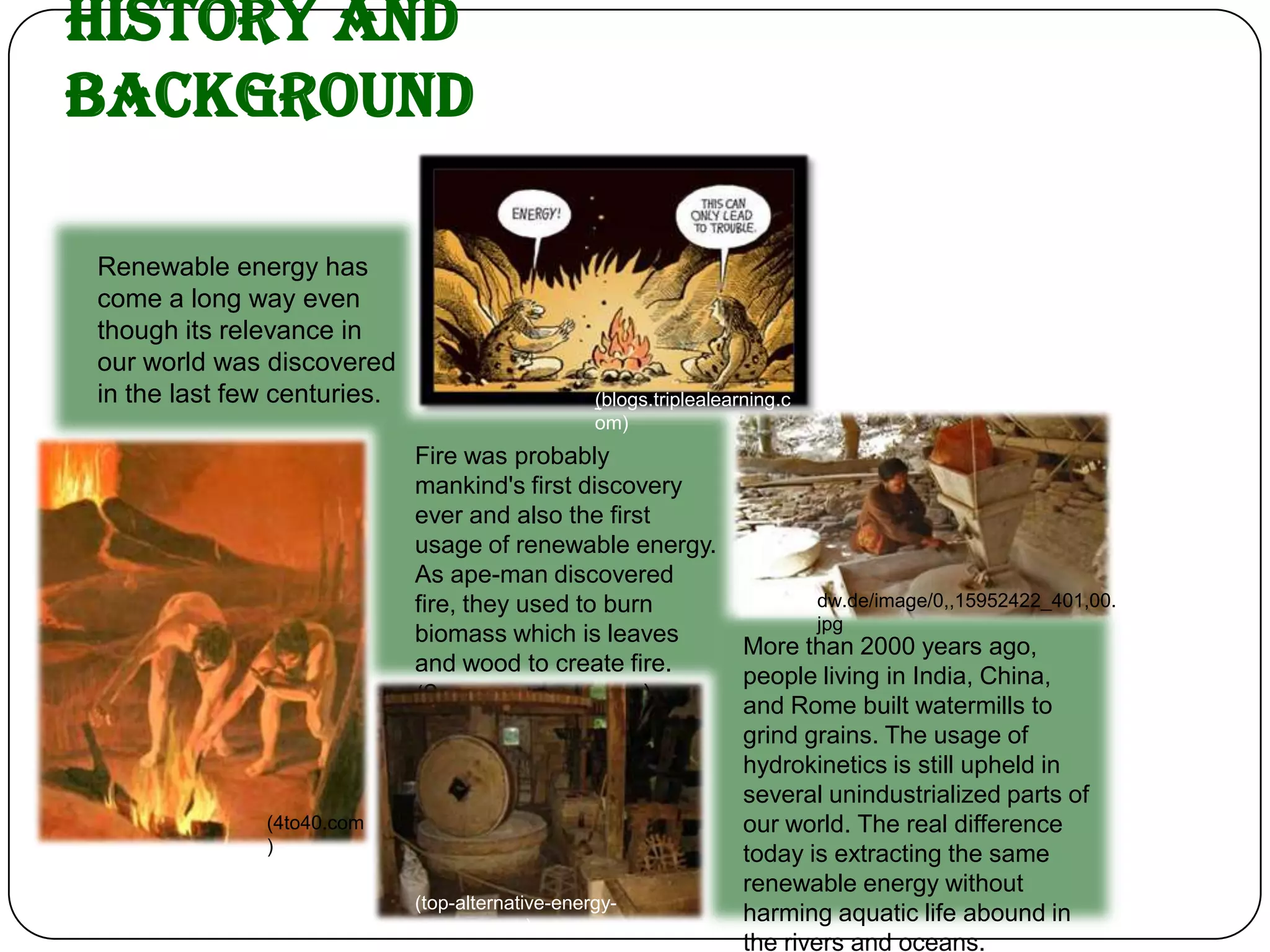
Renewable energy has
come a long way even
though its relevance in
our world was discovered
in the last few centuries.                        (blogs.triplealearning.c
                                                  om)
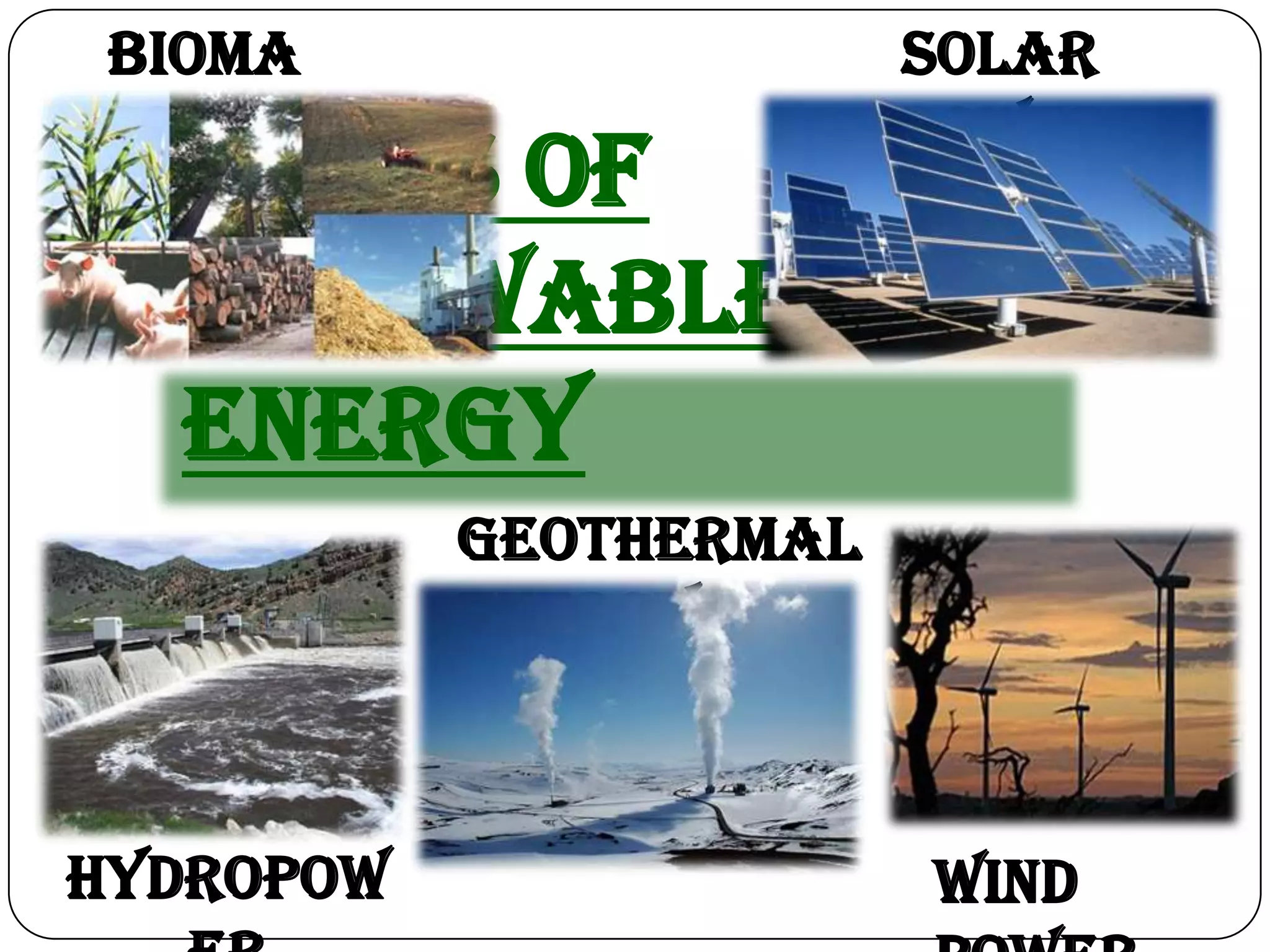
                             Fire was probably
                             mankind's first discovery
                             ever and also the first
                             usage of renewable energy.
                             As ape-man discovered
                             fire, they used to burn                         dw.de/image/0,,15952422_401,00.
                                                                             jpg
                             biomass which is leaves
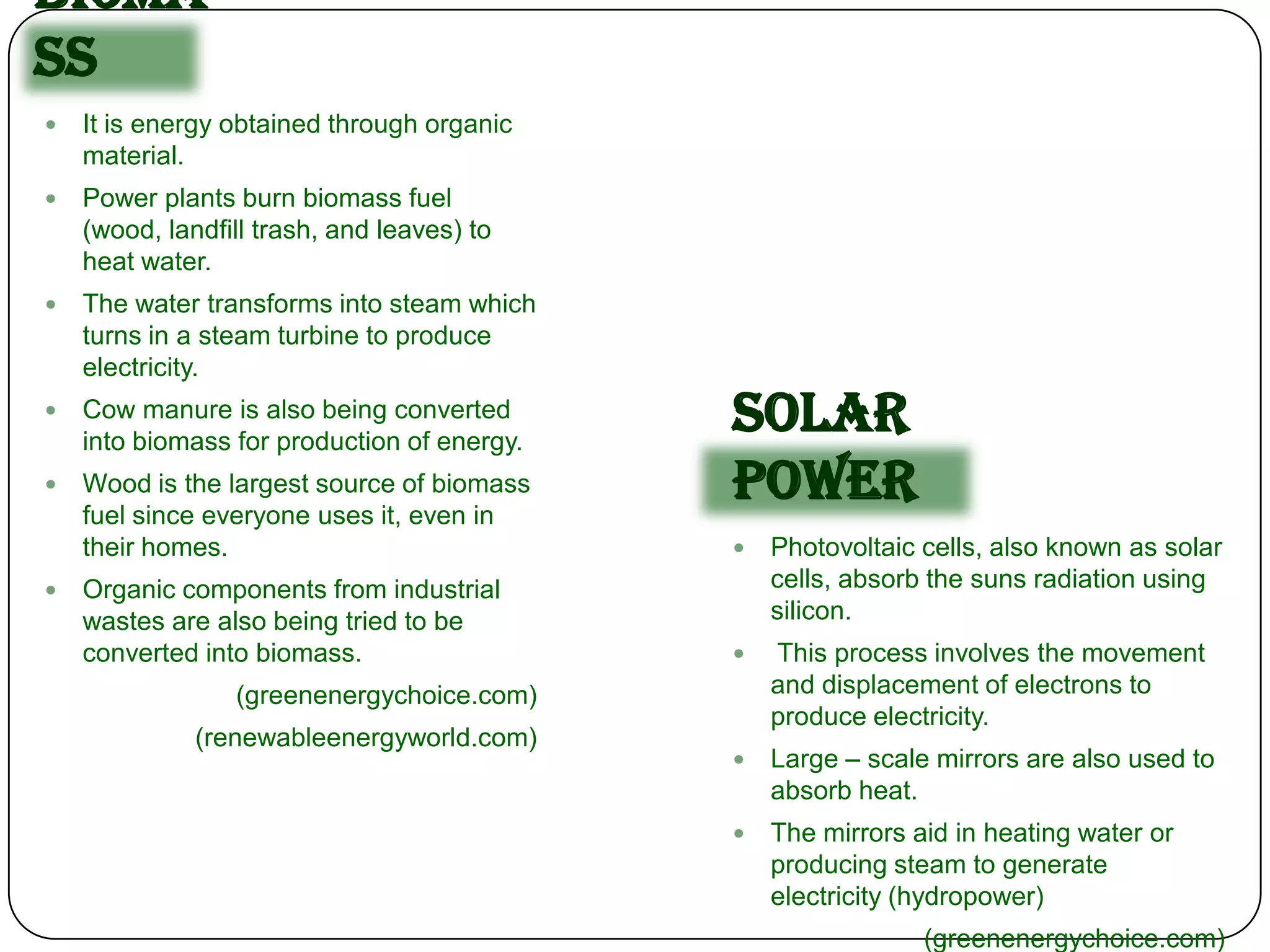
                                                                    More than 2000 years ago,
                             and wood to create fire.
                                                                    people living in India, China,
                             (2greenenergy.com)                     and Rome built watermills to
                                                                    grind grains. The usage of
                                                                    hydrokinetics is still upheld in
                                                                    several unindustrialized parts of
              (4to40.com                                            our world. The real difference
              )                                                     today is extracting the same
                                                                    renewable energy without
                             (top-alternative-energy-
                             sources.com)
                                                                    harming aquatic life abound in
                                                                    the rivers and oceans.
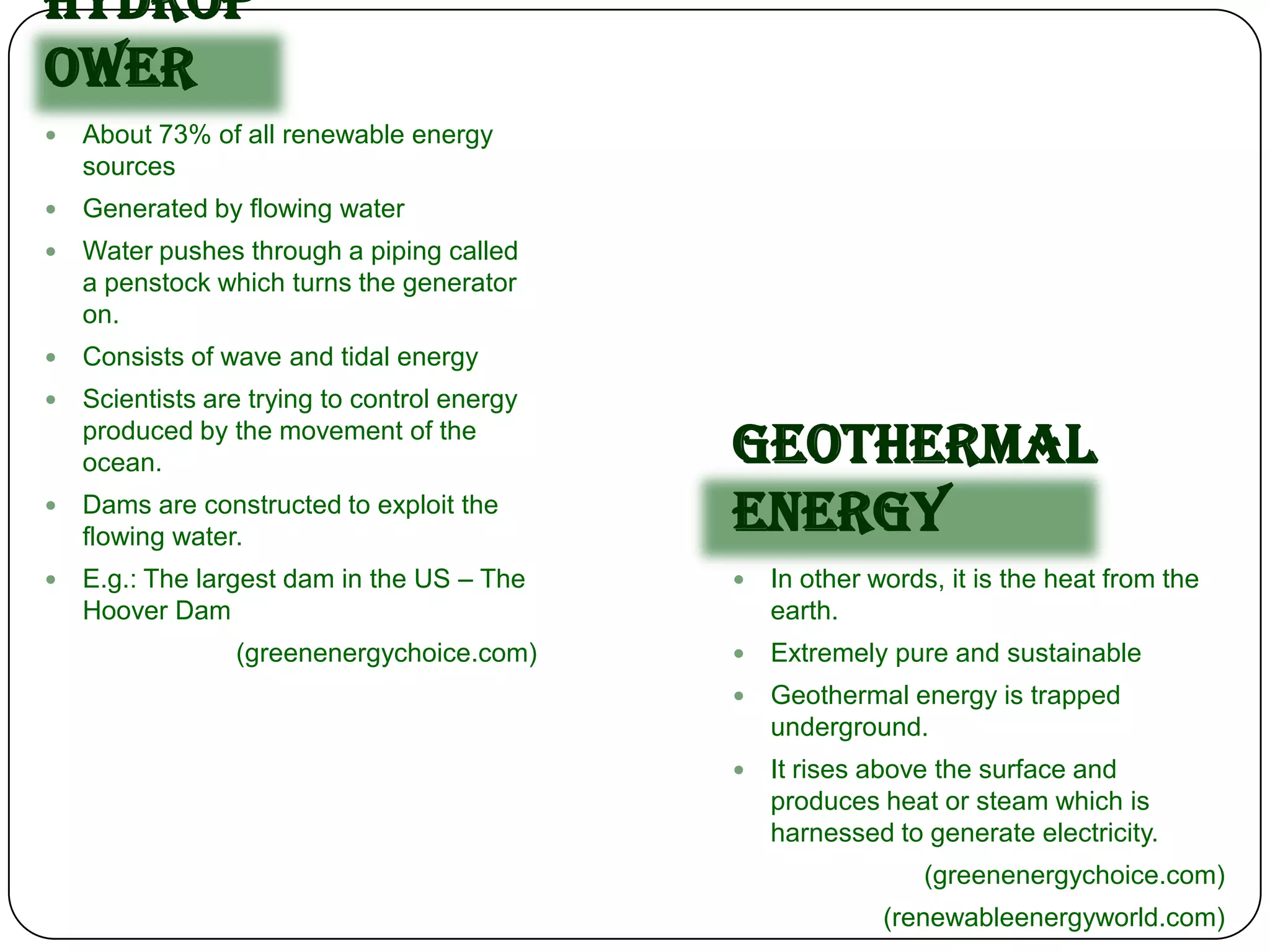
Bioma                  Solar
 ss                     Power
  Types of
  Renewable
  Energy
           Geothermal
           Energy


Hydropow                Wind
Bioma
ss
   It is energy obtained through organic
    material.
   Power plants burn biomass fuel
    (wood, landfill trash, and leaves) to
    heat water.
   The water transforms into steam which
    turns in a steam turbine to produce
    electricity.
   Cow manure is also being converted
    into biomass for production of energy.
                                             Solar
   Wood is the largest source of biomass
    fuel since everyone uses it, even in
                                             Power
    their homes.                                Photovoltaic cells, also known as solar
   Organic components from industrial           cells, absorb the suns radiation using
    wastes are also being tried to be            silicon.
    converted into biomass.                     This process involves the movement
                 (greenenergychoice.com)         and displacement of electrons to
                                                 produce electricity.
              (renewableenergyworld.com)
                                                Large – scale mirrors are also used to
                                                 absorb heat.
                                                The mirrors aid in heating water or
                                                 producing steam to generate
                                                 electricity (hydropower)
                                                              (greenenergychoice.com)
Hydrop
ower
   About 73% of all renewable energy
    sources
   Generated by flowing water
   Water pushes through a piping called
    a penstock which turns the generator
    on.
   Consists of wave and tidal energy
   Scientists are trying to control energy
    produced by the movement of the
    ocean.                                    Geothermal
   Dams are constructed to exploit the
    flowing water.
                                              Energy
   E.g.: The largest dam in the US – The        In other words, it is the heat from the
    Hoover Dam                                    earth.
                 (greenenergychoice.com)         Extremely pure and sustainable
                                                 Geothermal energy is trapped
                                                  underground.
                                                 It rises above the surface and
                                                  produces heat or steam which is
                                                  harnessed to generate electricity.
                                                               (greenenergychoice.com)
                                                            (renewableenergyworld.com)
Wind Power                                 Oth
   A simple process which involves the
                                           ers
    movement of wind turbines to
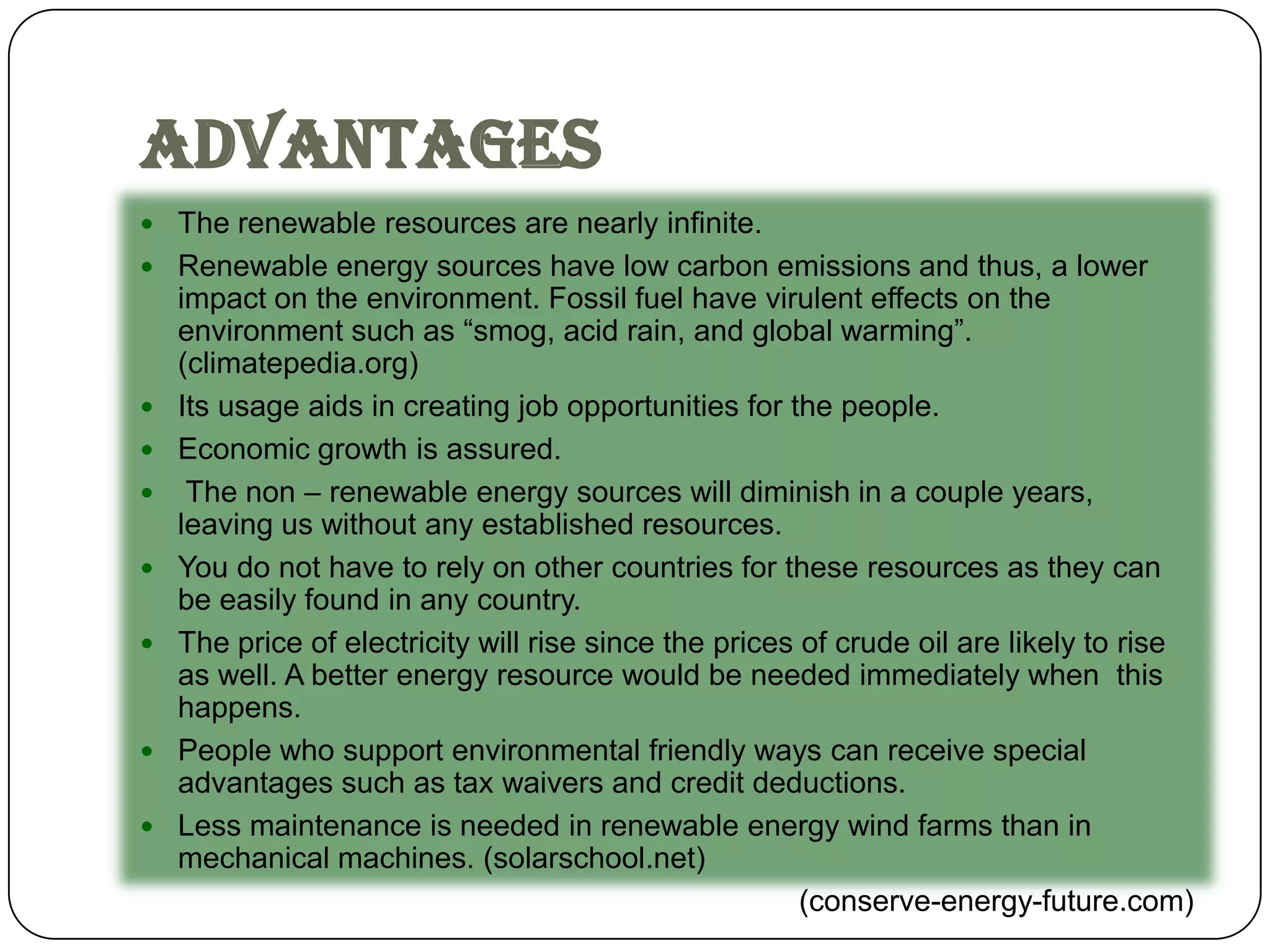
                                              Ocean energy:
    produce energy.
                                           -   It produces two types of energy –
   The energy is supplied into a              thermal and mechanical energy.
    generator which is converted once      -   Thermal energy is obtained from the
    again into electricity.                    suns rays on the surface of the water.
   The electricity is stored in power     -   Mechanical energy is obtained
    grids supplied to the power station.       through the tides and waves of the
                                               ocean.
   Wind power had the most potential      -   The ocean is the world’s largest
    since there is a huge amount of            sunlight collector since it covers 70%
    land including consistent wind             of the earth.
    movements.                             -   Energy is stored using hot vapors
                                               from the warm water of the ocean.
               (greenenergychoice.com)
                                           -   In some systems, the water is boiled
                                               and the steam is collected through
                                               turbines which is converted into
                                               energy.
                                           -   In mechanical energy, the tides are
                                               controlled by the gravitational pull of
                                               the moon, and the waves are
                                               controlled by wave.
                                           -   Mechanical devices are used for the
                                               energy created by the waves and
                                               tides.
Advantages
 The renewable resources are nearly infinite.
 Renewable energy sources have low carbon emissions and thus, a lower
    impact on the environment. Fossil fuel have virulent effects on the
    environment such as “smog, acid rain, and global warming”.
    (climatepedia.org)
   Its usage aids in creating job opportunities for the people.
   Economic growth is assured.
    The non – renewable energy sources will diminish in a couple years,
    leaving us without any established resources.
   You do not have to rely on other countries for these resources as they can
    be easily found in any country.
   The price of electricity will rise since the prices of crude oil are likely to rise
    as well. A better energy resource would be needed immediately when this
    happens.
   People who support environmental friendly ways can receive special
    advantages such as tax waivers and credit deductions.
   Less maintenance is needed in renewable energy wind farms than in
    mechanical machines. (solarschool.net)
                                                        (conserve-energy-future.com)
Disadvant
ages
 Sunlight is only found during the daytime which makes it
    inconvenient to use at night.
   Geothermal energy has damaging side effects since if the toxins
    found in the surface of the earth emerge, they can become
    hazardous.
   The initial costs of setting up a plant are quite expensive.
   The cost of the construction of dams is not cheap.
   Wildlife and the natural flow of water is affected by the construction
    of dams.
   Wind energy is not as reliable as it seems since an ideal location
    must be chosen to create the wind farm.
   The wind farms will most certainly have an impact on the bird
    population since they can prove to be fatal.
   It might be a bit difficult to produce a large amount of energy which
    will sustain a large population.
   Renewable energy depends on the weather greatly which makes it
    difficult to obtain during different circumstances. An example would
    be the necessity of rain to produce energy in hydroelectric dams. A
    clear sky would be needed for solar energy. (solarschools.net)
IEA (International Energy
Agency)
        Based in Paris, it is a self-governed
        organization which was established in 1974
        due to the oil crisis which occurred in 1973. It
        serves as an informational source about the
        international energy sectors. There are 28
        member states but it cooperates with non-
        members as well such as India, China, and
        Russia. Its main focus has been summarized in
        the 3E’s or three policies which are energy
        security, economic development, and
        environmental protection.
        Energy security is the promotion of flexibility
        and diversity in all energy sectors.
        Environmental awareness handles the
        knowledge of climate changes and problems
        acquainted with it. Engagement worldwide is
        the collaboration of member states, the
        producers and consumers, to resolve energy
The Future
 “The future belongs to renewable energy” (Brad
    Collins, Executive Director of the American Solar Energy
    Society)
   The advantages of renewable energy sources must overrule the
    disadvantages of the non – renewable energy sources.
   Our future generations will suffer a lot if we do not take action
    immediately.
   We must realize that energy is precious and that an equilibrium
    is required in all aspects of life. We must use renewable in
    abundance and non – renewable energy sources in limitations.
   We will save quite a lot of money if we implement environmental
    friendly ideas.
   We will be able to effectively reduce air pollution which is a
    growing concern in today’s world.
                                                      (botany.uwc.ac.za)
Help
    You can help by doing the following:
 -   Replace regular incandescent light bulbs with fluorescent light bulb.
 -   Clean and replace your air conditioners filters.
 -   Purchase energy efficient and environmental friendly appliances and products
     only.
 -   Do not leave your appliance on stand – by. Turn them off when not needed.
 -   Defrost freezers on a regular bases so that they do not consume too much
     energy.
 -   Use the washing machine and dishwasher when they are full. It saves energy by
     not turning them on and off several times to wash dished/clothes.
 -   Take a shower instead of a bath. Saves water.
 -   Less hot water should be used. Too much energy is required to heat the water.
 -   Use clothing lines instead of dryers to dry your clothes.
 -   Recycle as much as you can.
 -   Reuse shopping bags.
 -   Plant trees and increase the oxygen intake in your house.
 -   Consume locally planted food. It will save fuel and increase the economic growth
     of your community.
 -   Buy organic food to remove as much as 580 pounds of carbon dioxide from the
References (websites):
WEBSITES:
   A Brief History of Renewable Energy. N.d. Photograph. 2 Green Energy. By Http://2greenenergy.com. Web. 2 Dec. 2012.
    <http://2greenenergy.com/wp-content/uploads/2011/10/infographic1.png>.
   Brown Paper Bag. "The Advantages and Disadvantages of Renewable Energy." Renewable Energy:. N.p., n.d. Web. 02 Dec. 2012.
    <http://www.solarschools.net/resources/stuff/advantages_and_disadvantages.aspx>.
   Climatepedia.org. "Renewable Energy: Knowledge." Renewable Energy. N.p., n.d. Web. 02 Dec. 2012.
    <http://www.climatepedia.org/Renewable-Energy>.
   Conserve Energy Future. "What Is Energy?" Renewable & Non-Renewable Energy Sources. N.p., n.d. Web. 02 Dec. 2012.
    <http://www.conserve-energy-future.com/>.
   Department of Energy., and National Renewable Energy Laboratory. "Ocean Energy." RE News RSS. N.p., n.d. Web. 02 Dec. 2012.
    <http://www.renewableenergyworld.com/rea/tech/ocean-energy>.
   Energy and Development Group. "The Importance of Saving Energy." The Importance of Saving Energy. N.p., n.d. Web. 02 Dec. 2012.
    <http://www.botany.uwc.ac.za/inforeep/energy2.htm>.
   Groce, Pam. "Renewable Energy Fact Sheets." Renewable Energy Fact Sheets. SECO, n.d. Web. 02 Dec. 2012.
    <http://www.infinitepower.org/factsheets.htm>.
   Http://lightbulbs.org/. "Light Bulbs." Light Bulbs. WordPress, n.d. Web. 02 Dec. 2012. <http://lightbulbs.org/50-ways-to-conserve-energy>.
   IEA.org. "Related Content." IEA. N.p., n.d. Web. 02 Dec. 2012. <http://www.iea.org/aboutus/whatwedo/>.
   National Renewable Energy Laboratory, and Department of Energy. "Ocean Energy." RE News RSS. N.p., n.d. Web. 02 Dec. 2012.
    <http://www.renewableenergyworld.com/rea/tech/ocean-energy>.
   Natural Resources Defense Council. "Renewable Energy For America: Harvesting the Benefits of Homegrown, Renewable Energy." What Is
    Renewable Energy, Types of Renewable Energy Sources. N.p., n.d. Web. 02 Dec. 2012. <http://www.nrdc.org/energy/renewables/>.
   Schwartz, Ariel. "CleanTechnica." CleanTechnica. N.p., n.d. Web. 02 Dec. 2012. <http://cleantechnica.com/2008/07/29/4-reasons-why-germany-
    is-a-renewable-energy-success-story/>.
   Scorecard, Power. "20 THINGS YOU CAN DO TO CONSERVE ENERGY." 20 THINGS YOU CAN DO TO CONSERVE ENERGY. Green Living
    Magazine, n.d. Web. 02 Dec. 2012. <http://www.ecomall.com/greenshopping/20things.htm>.
   Walker, Cameron. "The Future of Alternative Energy." National Geographic. National Geographic Society, 24 Oct. 2004. Web. 02 Dec. 2012.
    <http://news.nationalgeographic.com/news/2004/10/1028_041028_alternative_energy.html>.
   WhiteFence. "Renewable Energy: What Are My Options?" Types of Renewable Energy. N.p., n.d. Web. 02 Dec. 2012.
    <http://www.greenenergychoice.com/green-guide/renewable-energy-types.html>.
References (images):
   4to40.com. Discovery of Fire. Digital image. 4to40.com - Science. Websolvent, n.d. Web. 2 Dec. 2012.
    <http://www.4to40.com/images/science/fire/discovery_of_fire.jpg>.
   Conserve-energy-future.com. Digital image. Conserve Energy Furture. N.p., n.d. Web. 2 Dec. 2012.
    <http://www.conserve-energy-future.com/SolarEnergy.php>.
   Dept. of Natural Resources & Conservation. Hydropower. Digital image. DNRC Water Resources Division.
    Mt.gov, n.d. Web. 2 Dec. 2012. <http://www.dnrc.mt.gov/wrd/water_proj/hydro/hydropower.asp>.
   Northtrade.com. Geothermal Energy. Digital image. The Norwegian Trade Portal. N.p., 9 Apr. 2012. Web. 2
    Dec. 2012. <http://www.nortrade.com/sectors/publications/cases/geothermal-energy/>.
   Schulke, Birgitta. A New Start for Old Mills. Digital image. Deutsche Welle. N.p., 25 May 2012. Web. 2 Dec.
    2012. <http://www.dw.de/image/0,,15952422_401,00.jpg>.
   Solarpowernotes.com. Biomass Energy Sources Throught out the World. Digital image. Solar Power Notes.
    N.p., n.d. Web. 2 Dec. 2012. <http://www.solarpowernotes.com/renewable-energy/biomass-energy/biomass-
    energy.html#.ULt_ueSR_5F>.
   Top-Alternative-Energy-Sources.com. The Watermill. Digital image. Alternative Energy Sources Naturally
    Better Energy! SBI, n.d. Web. 2 Dec. 2012. <http://www.top-alternative-energy-sources.com/watermill.html>.
   Triple a Ble. What’s Cooking? – The Evolution of Modern Man. Digital image. Triple A Learning. N.p., 13 Nov.
    2011. Web. 2 Dec. 2012. <http://blogs.triplealearning.com/wp-content/uploads/2011/11/discovery-of-fire.jpg>.

Final pp

  • 1.
    Renewable Preserve,Protect, Energy and Sustain By: Yavnika Kumar
  • 2.
    Content  Introduction toPerson Project  Introduction to Renewable Energy  Background  Types of Renewable Energy  Advantages  Disadvantages  IEA (International Energy Agency)  The Future  Help  Facts  References
  • 3.
    Introduction to Personal Project Being a Grade 10 student at the American International School of Mozambique, I am required to do my Personal Project to complete the MYP curriculum before moving on to IB. I have chosen the environment as my topic for my personal project and I have researched on renewable energy. I have always tried to preserve nature because I understand the importance of maintaining our environment. There have been numerous occasions where our society has been very careless about sustaining resources. In the coming years, the future generation of our world will be facing tremendous amounts of adversities if we do not start to preserve mother nature immediately. Several countries and organizations have already started to support this cause and have also started to take action. Our society has to start using renewable energy at any cost. My aim for this project to enlighten people on why it is crucial to understand the relevance of this topic. I will be discussing several advantages of renewable energy. I will try to give advice on the basis of what I have learnt and researched about until now. If I succeed in educating people on renewable energy, I will have achieved my goal.
  • 4.
    Introduction to Renewable Energy  Energy has two main forms: nonrenewable energy and renewable energy.  “Nonrenewable energy is a natural resource which cannot be reproduced, grown, generated, or used on a scale which can sustain its consumption rate, once depleted there is no more available for future needs.”(en.wikipedia.org)  “Renewable Energy is any naturally occurring, theoretically inexhaustible source of energy, as biomass, solar, wind, tidal, wave, and hydroelectric power, that is not derived from fossil or nuclear fuel.” (dictionary.reference.com)  In simple words, renewable energy is energy which can be reused whereas nonrenewable energy is energy which cannot be reused.  Our resources such as coal and petroleum will soon be depleted and unless we already have a well – developed energy production system, our world might not survive such circumstances. (climatepedia.org)  The rate at which we are consuming sources of energy is growing consistently and the prices of energy resources have also risen due to their decreasing abundance. (climatepedia.org)  A relevant portion of our world is dependent on jobs pertaining to resources and if these people lose their jobs due to the curtailing energy sources, it will only add to the world’s economic crisis where thousands of people are still unemployed. (climatepedia.org)  At this point of time, it is important to begin saving energy in any way we can to reduce the impacts of the diminishing resources in the future. (climatepedia.org)
  • 5.
    History and Background Renewable energyhas come a long way even though its relevance in our world was discovered in the last few centuries. (blogs.triplealearning.c om) Fire was probably mankind's first discovery ever and also the first usage of renewable energy. As ape-man discovered fire, they used to burn dw.de/image/0,,15952422_401,00. jpg biomass which is leaves More than 2000 years ago, and wood to create fire. people living in India, China, (2greenenergy.com) and Rome built watermills to grind grains. The usage of hydrokinetics is still upheld in several unindustrialized parts of (4to40.com our world. The real difference ) today is extracting the same renewable energy without (top-alternative-energy- sources.com) harming aquatic life abound in the rivers and oceans.
  • 6.
    Bioma Solar ss Power Types of Renewable Energy Geothermal Energy Hydropow Wind
  • 7.
    Bioma ss  It is energy obtained through organic material.  Power plants burn biomass fuel (wood, landfill trash, and leaves) to heat water.  The water transforms into steam which turns in a steam turbine to produce electricity.  Cow manure is also being converted into biomass for production of energy. Solar  Wood is the largest source of biomass fuel since everyone uses it, even in Power their homes.  Photovoltaic cells, also known as solar  Organic components from industrial cells, absorb the suns radiation using wastes are also being tried to be silicon. converted into biomass.  This process involves the movement (greenenergychoice.com) and displacement of electrons to produce electricity. (renewableenergyworld.com)  Large – scale mirrors are also used to absorb heat.  The mirrors aid in heating water or producing steam to generate electricity (hydropower) (greenenergychoice.com)
  • 8.
    Hydrop ower  About 73% of all renewable energy sources  Generated by flowing water  Water pushes through a piping called a penstock which turns the generator on.  Consists of wave and tidal energy  Scientists are trying to control energy produced by the movement of the ocean. Geothermal  Dams are constructed to exploit the flowing water. Energy  E.g.: The largest dam in the US – The  In other words, it is the heat from the Hoover Dam earth. (greenenergychoice.com)  Extremely pure and sustainable  Geothermal energy is trapped underground.  It rises above the surface and produces heat or steam which is harnessed to generate electricity. (greenenergychoice.com) (renewableenergyworld.com)
  • 9.
    Wind Power Oth  A simple process which involves the ers movement of wind turbines to  Ocean energy: produce energy. - It produces two types of energy –  The energy is supplied into a thermal and mechanical energy. generator which is converted once - Thermal energy is obtained from the again into electricity. suns rays on the surface of the water.  The electricity is stored in power - Mechanical energy is obtained grids supplied to the power station. through the tides and waves of the ocean.  Wind power had the most potential - The ocean is the world’s largest since there is a huge amount of sunlight collector since it covers 70% land including consistent wind of the earth. movements. - Energy is stored using hot vapors from the warm water of the ocean. (greenenergychoice.com) - In some systems, the water is boiled and the steam is collected through turbines which is converted into energy. - In mechanical energy, the tides are controlled by the gravitational pull of the moon, and the waves are controlled by wave. - Mechanical devices are used for the energy created by the waves and tides.
  • 10.
    Advantages  The renewableresources are nearly infinite.  Renewable energy sources have low carbon emissions and thus, a lower impact on the environment. Fossil fuel have virulent effects on the environment such as “smog, acid rain, and global warming”. (climatepedia.org)  Its usage aids in creating job opportunities for the people.  Economic growth is assured.  The non – renewable energy sources will diminish in a couple years, leaving us without any established resources.  You do not have to rely on other countries for these resources as they can be easily found in any country.  The price of electricity will rise since the prices of crude oil are likely to rise as well. A better energy resource would be needed immediately when this happens.  People who support environmental friendly ways can receive special advantages such as tax waivers and credit deductions.  Less maintenance is needed in renewable energy wind farms than in mechanical machines. (solarschool.net) (conserve-energy-future.com)
  • 11.
    Disadvant ages  Sunlight isonly found during the daytime which makes it inconvenient to use at night.  Geothermal energy has damaging side effects since if the toxins found in the surface of the earth emerge, they can become hazardous.  The initial costs of setting up a plant are quite expensive.  The cost of the construction of dams is not cheap.  Wildlife and the natural flow of water is affected by the construction of dams.  Wind energy is not as reliable as it seems since an ideal location must be chosen to create the wind farm.  The wind farms will most certainly have an impact on the bird population since they can prove to be fatal.  It might be a bit difficult to produce a large amount of energy which will sustain a large population.  Renewable energy depends on the weather greatly which makes it difficult to obtain during different circumstances. An example would be the necessity of rain to produce energy in hydroelectric dams. A clear sky would be needed for solar energy. (solarschools.net)
  • 12.
    IEA (International Energy Agency) Based in Paris, it is a self-governed organization which was established in 1974 due to the oil crisis which occurred in 1973. It serves as an informational source about the international energy sectors. There are 28 member states but it cooperates with non- members as well such as India, China, and Russia. Its main focus has been summarized in the 3E’s or three policies which are energy security, economic development, and environmental protection. Energy security is the promotion of flexibility and diversity in all energy sectors. Environmental awareness handles the knowledge of climate changes and problems acquainted with it. Engagement worldwide is the collaboration of member states, the producers and consumers, to resolve energy
  • 13.
    The Future  “Thefuture belongs to renewable energy” (Brad Collins, Executive Director of the American Solar Energy Society)  The advantages of renewable energy sources must overrule the disadvantages of the non – renewable energy sources.  Our future generations will suffer a lot if we do not take action immediately.  We must realize that energy is precious and that an equilibrium is required in all aspects of life. We must use renewable in abundance and non – renewable energy sources in limitations.  We will save quite a lot of money if we implement environmental friendly ideas.  We will be able to effectively reduce air pollution which is a growing concern in today’s world. (botany.uwc.ac.za)
  • 14.
    Help  You can help by doing the following: - Replace regular incandescent light bulbs with fluorescent light bulb. - Clean and replace your air conditioners filters. - Purchase energy efficient and environmental friendly appliances and products only. - Do not leave your appliance on stand – by. Turn them off when not needed. - Defrost freezers on a regular bases so that they do not consume too much energy. - Use the washing machine and dishwasher when they are full. It saves energy by not turning them on and off several times to wash dished/clothes. - Take a shower instead of a bath. Saves water. - Less hot water should be used. Too much energy is required to heat the water. - Use clothing lines instead of dryers to dry your clothes. - Recycle as much as you can. - Reuse shopping bags. - Plant trees and increase the oxygen intake in your house. - Consume locally planted food. It will save fuel and increase the economic growth of your community. - Buy organic food to remove as much as 580 pounds of carbon dioxide from the
  • 15.
    References (websites): WEBSITES:  A Brief History of Renewable Energy. N.d. Photograph. 2 Green Energy. By Http://2greenenergy.com. Web. 2 Dec. 2012. <http://2greenenergy.com/wp-content/uploads/2011/10/infographic1.png>.  Brown Paper Bag. "The Advantages and Disadvantages of Renewable Energy." Renewable Energy:. N.p., n.d. Web. 02 Dec. 2012. <http://www.solarschools.net/resources/stuff/advantages_and_disadvantages.aspx>.  Climatepedia.org. "Renewable Energy: Knowledge." Renewable Energy. N.p., n.d. Web. 02 Dec. 2012. <http://www.climatepedia.org/Renewable-Energy>.  Conserve Energy Future. "What Is Energy?" Renewable & Non-Renewable Energy Sources. N.p., n.d. Web. 02 Dec. 2012. <http://www.conserve-energy-future.com/>.  Department of Energy., and National Renewable Energy Laboratory. "Ocean Energy." RE News RSS. N.p., n.d. Web. 02 Dec. 2012. <http://www.renewableenergyworld.com/rea/tech/ocean-energy>.  Energy and Development Group. "The Importance of Saving Energy." The Importance of Saving Energy. N.p., n.d. Web. 02 Dec. 2012. <http://www.botany.uwc.ac.za/inforeep/energy2.htm>.  Groce, Pam. "Renewable Energy Fact Sheets." Renewable Energy Fact Sheets. SECO, n.d. Web. 02 Dec. 2012. <http://www.infinitepower.org/factsheets.htm>.  Http://lightbulbs.org/. "Light Bulbs." Light Bulbs. WordPress, n.d. Web. 02 Dec. 2012. <http://lightbulbs.org/50-ways-to-conserve-energy>.  IEA.org. "Related Content." IEA. N.p., n.d. Web. 02 Dec. 2012. <http://www.iea.org/aboutus/whatwedo/>.  National Renewable Energy Laboratory, and Department of Energy. "Ocean Energy." RE News RSS. N.p., n.d. Web. 02 Dec. 2012. <http://www.renewableenergyworld.com/rea/tech/ocean-energy>.  Natural Resources Defense Council. "Renewable Energy For America: Harvesting the Benefits of Homegrown, Renewable Energy." What Is Renewable Energy, Types of Renewable Energy Sources. N.p., n.d. Web. 02 Dec. 2012. <http://www.nrdc.org/energy/renewables/>.  Schwartz, Ariel. "CleanTechnica." CleanTechnica. N.p., n.d. Web. 02 Dec. 2012. <http://cleantechnica.com/2008/07/29/4-reasons-why-germany- is-a-renewable-energy-success-story/>.  Scorecard, Power. "20 THINGS YOU CAN DO TO CONSERVE ENERGY." 20 THINGS YOU CAN DO TO CONSERVE ENERGY. Green Living Magazine, n.d. Web. 02 Dec. 2012. <http://www.ecomall.com/greenshopping/20things.htm>.  Walker, Cameron. "The Future of Alternative Energy." National Geographic. National Geographic Society, 24 Oct. 2004. Web. 02 Dec. 2012. <http://news.nationalgeographic.com/news/2004/10/1028_041028_alternative_energy.html>.  WhiteFence. "Renewable Energy: What Are My Options?" Types of Renewable Energy. N.p., n.d. Web. 02 Dec. 2012. <http://www.greenenergychoice.com/green-guide/renewable-energy-types.html>.
  • 16.
    References (images):  4to40.com. Discovery of Fire. Digital image. 4to40.com - Science. Websolvent, n.d. Web. 2 Dec. 2012. <http://www.4to40.com/images/science/fire/discovery_of_fire.jpg>.  Conserve-energy-future.com. Digital image. Conserve Energy Furture. N.p., n.d. Web. 2 Dec. 2012. <http://www.conserve-energy-future.com/SolarEnergy.php>.  Dept. of Natural Resources & Conservation. Hydropower. Digital image. DNRC Water Resources Division. Mt.gov, n.d. Web. 2 Dec. 2012. <http://www.dnrc.mt.gov/wrd/water_proj/hydro/hydropower.asp>.  Northtrade.com. Geothermal Energy. Digital image. The Norwegian Trade Portal. N.p., 9 Apr. 2012. Web. 2 Dec. 2012. <http://www.nortrade.com/sectors/publications/cases/geothermal-energy/>.  Schulke, Birgitta. A New Start for Old Mills. Digital image. Deutsche Welle. N.p., 25 May 2012. Web. 2 Dec. 2012. <http://www.dw.de/image/0,,15952422_401,00.jpg>.  Solarpowernotes.com. Biomass Energy Sources Throught out the World. Digital image. Solar Power Notes. N.p., n.d. Web. 2 Dec. 2012. <http://www.solarpowernotes.com/renewable-energy/biomass-energy/biomass- energy.html#.ULt_ueSR_5F>.  Top-Alternative-Energy-Sources.com. The Watermill. Digital image. Alternative Energy Sources Naturally Better Energy! SBI, n.d. Web. 2 Dec. 2012. <http://www.top-alternative-energy-sources.com/watermill.html>.  Triple a Ble. What’s Cooking? – The Evolution of Modern Man. Digital image. Triple A Learning. N.p., 13 Nov. 2011. Web. 2 Dec. 2012. <http://blogs.triplealearning.com/wp-content/uploads/2011/11/discovery-of-fire.jpg>.