Public Involvement WorkshopPublic Involvement Workshop
March 20, 2014March 20, 2014
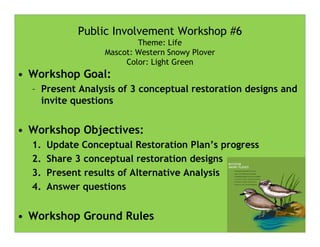
• Workshop Goal:
– Present Analysis of 3 conceptual restoration designs and
invite questions
• Workshop Objectives:
Public Involvement Workshop #6
Theme: Life
Mascot: Western Snowy Plover
Color: Light Green
• Workshop Objectives:
1. Update Conceptual Restoration Plan’s progress
2. Share 3 conceptual restoration designs
3. Present results of Alternative Analysis
4. Answer questions
• Workshop Ground Rules
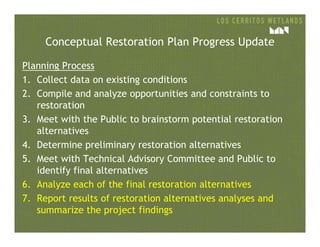
Conceptual Restoration Plan Progress Update
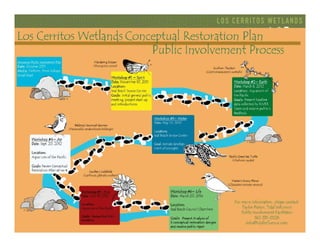
Planning Process
1. Collect data on existing conditions
2. Compile and analyze opportunities and constraints to
restoration
3. Meet with the Public to brainstorm potential restoration3. Meet with the Public to brainstorm potential restoration
alternatives
4. Determine preliminary restoration alternatives
5. Meet with Technical Advisory Committee and Public to
identify final alternatives
6. Analyze each of the final restoration alternatives
7. Report results of restoration alternatives analyses and
summarize the project findings
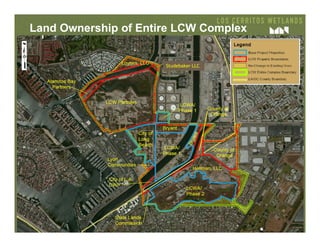
Land Ownership of Entire LCW Complex
Studebaker LLC
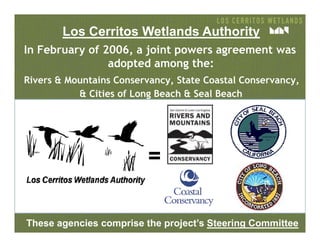
In February of 2006, a joint powers agreement was
adopted among the:
Rivers & Mountains Conservancy, State Coastal Conservancy,
& Cities of Long Beach & Seal Beach
Los Cerritos Wetlands Authority
=
These agencies comprise the project’s Steering Committee
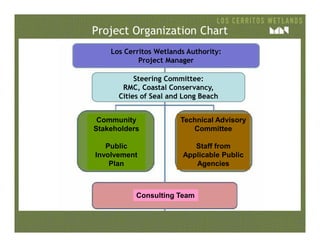
Project Organization Chart
Community Technical Advisory
Steering Committee:
RMC, Coastal Conservancy,
Cities of Seal and Long Beach
Los Cerritos Wetlands Authority:
Project Manager
Consulting Team
Community
Stakeholders
Public
Involvement
Plan
Technical Advisory
Committee
Staff from
Applicable Public
Agencies
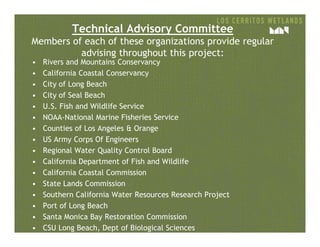
Technical Advisory Committee
Members of each of these organizations provide regular
advising throughout this project:
• Rivers and Mountains Conservancy
• California Coastal Conservancy
• City of Long Beach
• City of Seal Beach
• U.S. Fish and Wildlife Service
• NOAA-National Marine Fisheries Service
• Counties of Los Angeles & Orange• Counties of Los Angeles & Orange
• US Army Corps Of Engineers
• Regional Water Quality Control Board
• California Department of Fish and Wildlife
• California Coastal Commission
• State Lands Commission
• Southern California Water Resources Research Project
• Port of Long Beach
• Santa Monica Bay Restoration Commission
• CSU Long Beach, Dept of Biological Sciences
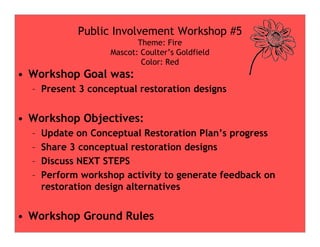
• Workshop Goal was:
– Present 3 conceptual restoration designs
• Workshop Objectives:
Public Involvement Workshop #5
Theme: Fire
Mascot: Coulter’s Goldfield
Color: Red
• Workshop Objectives:
– Update on Conceptual Restoration Plan’s progress
– Share 3 conceptual restoration designs
– Discuss NEXT STEPS
– Perform workshop activity to generate feedback on
restoration design alternatives
• Workshop Ground Rules
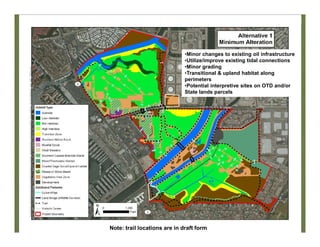
Alt 1
•Minor changes to existing oil infrastructure
•Utilize/improve existing tidal connections
•Minor grading
•Transitional & upland habitat along
perimeters
•Potential interpretive sites on OTD and/or
State lands parcels
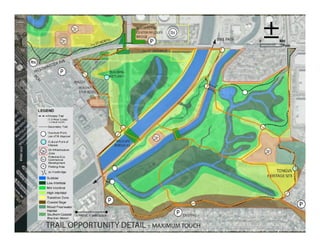
Note: trail locations are in draft form
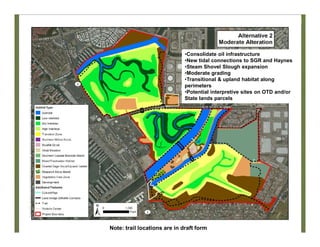
Alt 2
•Consolidate oil infrastructure
•New tidal connections to SGR and Haynes
•Steam Shovel Slough expansion
•Moderate grading
•Transitional & upland habitat along
perimeters
•Potential interpretive sites on OTD and/or
State lands parcels
Note: trail locations are in draft form
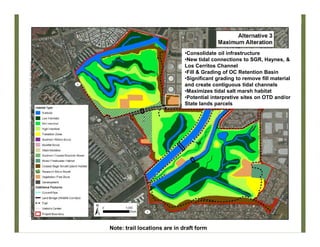
Alt 3
•Consolidate oil infrastructure
•New tidal connections to SGR, Haynes, &
Los Cerritos Channel
•Fill & Grading of OC Retention Basin
•Significant grading to remove fill material
and create contiguous tidal channels
•Maximizes tidal salt marsh habitat
•Potential interpretive sites on OTD and/or
State lands parcels
Note: trail locations are in draft form
Alternatives Analyses
Primary processes analyzed and reported tonight are:
• Hydrology
• Habitat
• Public access
Additional items addressed in the reportAdditional items addressed in the report
• Preliminary engineering designs
• Infrastructure changes
• Phasing
• Possible construction methods
• Maintenance
• Consistency with project goals and objectives
Results of the Analyses
• Hydrology – Chris Webb
• Habitat – Matt James
• Public Access/Interpretive Opportunities – Clark Stevens• Public Access/Interpretive Opportunities – Clark Stevens
Hydrology
Moffatt & Nichol
Chris Webb
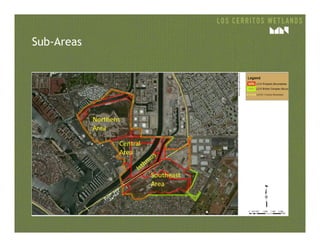
Sub-Areas
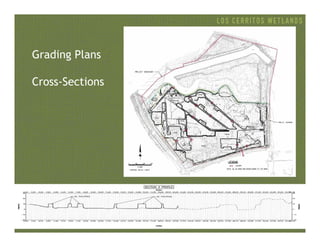
Grading Plans
Cross-Sections
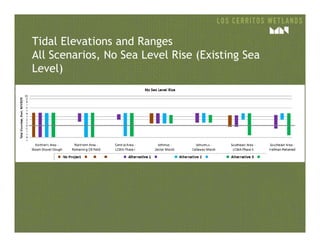
Tidal Elevations and Ranges
All Scenarios, No Sea Level Rise (Existing Sea
Level)
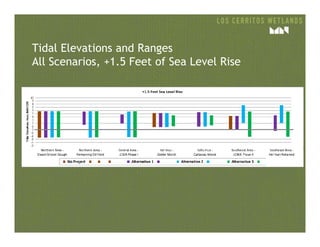
Tidal Elevations and Ranges
All Scenarios, +1.5 Feet of Sea Level Rise
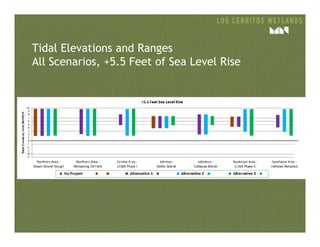
Tidal Elevations and Ranges
All Scenarios, +5.5 Feet of Sea Level Rise
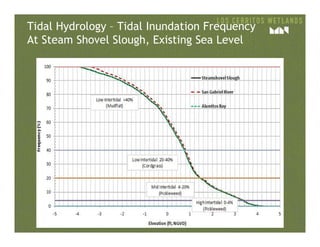
Tidal Hydrology – Tidal Inundation Frequency
At Steam Shovel Slough, Existing Sea Level
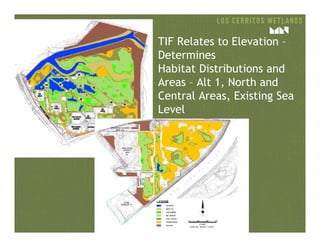
TIF Relates to Elevation –
Determines
Habitat Distributions and
Areas – Alt 1, North and
Central Areas, Existing Sea
Level
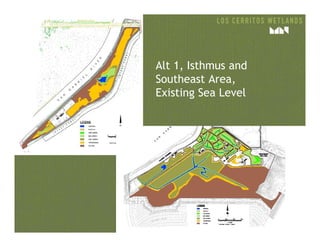
Alt 1, Isthmus and
Southeast Area,
Existing Sea Level
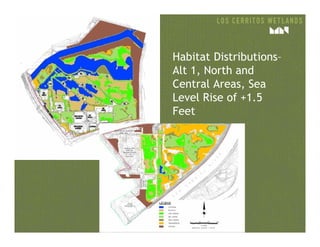
Habitat Distributions–
Alt 1, North and
Central Areas, Sea
Level Rise of +1.5
Feet
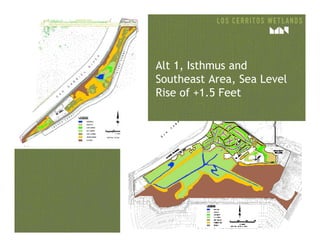
Alt 1, Isthmus and
Southeast Area, Sea Level
Rise of +1.5 Feet
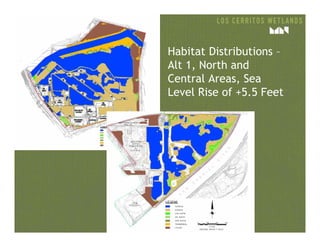
Habitat Distributions –
Alt 1, North and
Central Areas, Sea
Level Rise of +5.5 Feet
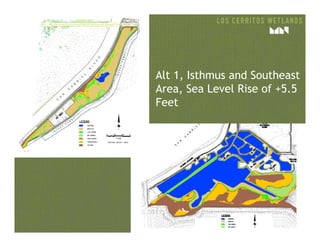
Alt 1, Isthmus and Southeast
Area, Sea Level Rise of +5.5
Feet
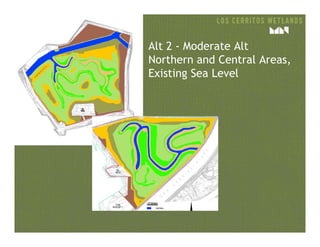
Alt 2 - Moderate Alt
Northern and Central Areas,
Existing Sea Level
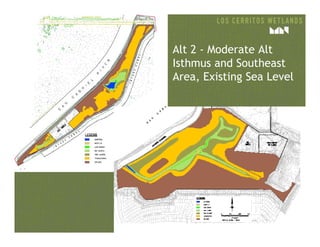
Alt 2 - Moderate Alt
Isthmus and Southeast
Area, Existing Sea Level
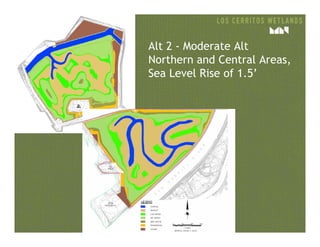
Alt 2 - Moderate Alt
Northern and Central Areas,
Sea Level Rise of 1.5’
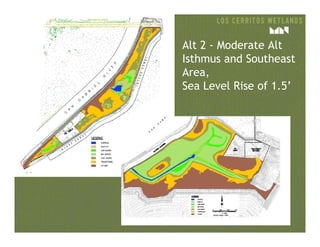
Alt 2 - Moderate Alt
Isthmus and Southeast
Area,
Sea Level Rise of 1.5’
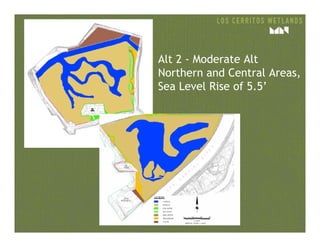
Alt 2 - Moderate Alt
Northern and Central Areas,
Sea Level Rise of 5.5’
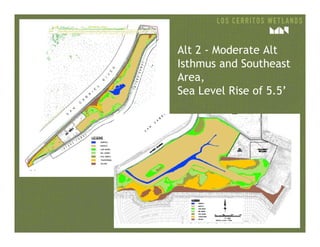
Alt 2 - Moderate Alt
Isthmus and Southeast
Area,
Sea Level Rise of 5.5’
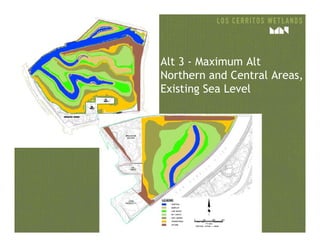
Alt 3 - Maximum Alt
Northern and Central Areas,
Existing Sea Level
Alt 3 - Maximum Alt
Isthmus and Southeast
Area,
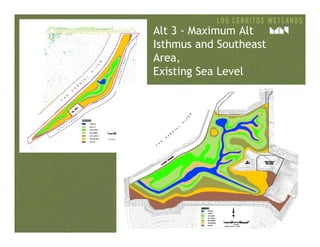
Existing Sea Level
Alt 3 - Maximum Alt
Northern and Central Areas,
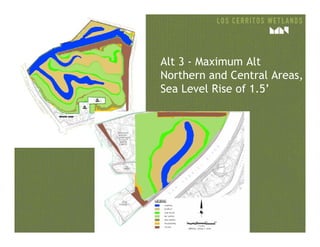
Sea Level Rise of 1.5’
Alt 3 - Maximum Alt
Isthmus and Southeast
Area,
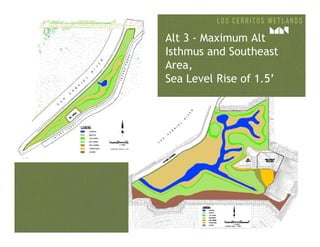
Sea Level Rise of 1.5’
Alt 3 - Maximum Alt
Northern and Central Areas,
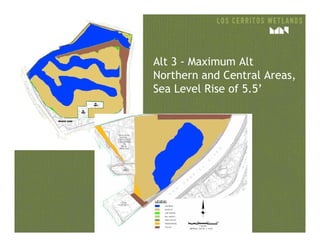
Sea Level Rise of 5.5’
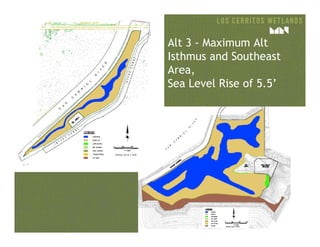
Alt 3 - Maximum Alt
Isthmus and Southeast
Area,
Sea Level Rise of 5.5’
Tidal Hydrology Data Used to Analyze Habitat
• Habitat Distributions
• Habitat Areas
• Habitat Evolution Under Sea Level Rise
Habitats
Coastal Restoration Consultants
Matt James and Dave Hubbard
Habitat Modeling
• Practical questions
– How does SLR affect habitat distributions?
– How does plumbing affect habitats?
– How do alternatives differ?
• Philosophical questions
– What is the ideal mix of habitats today?
– In 50yrs?
– In 100yrs?
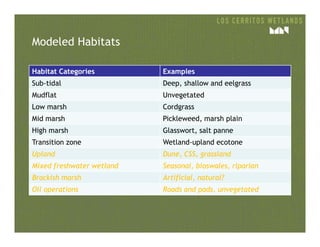
Modeled Habitats
Habitat Categories Examples
Sub-tidal Deep, shallow and eelgrass
Mudflat Unvegetated
Low marsh Cordgrass
Mid marsh Pickleweed, marsh plain
High marsh Glasswort, salt panne
Transition zone Wetland-upland ecotone
Upland Dune, CSS, grassland
Mixed freshwater wetland Seasonal, bioswales, riparian
Brackish marsh Artificial, natural?
Oil operations Roads and pads, unvegetated
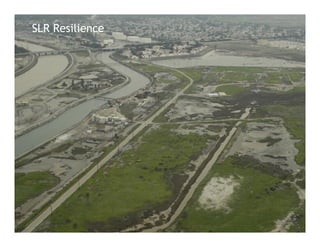
SLR Resilience
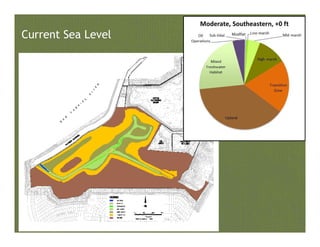
Current Sea Level
+1.5 Feet SLR
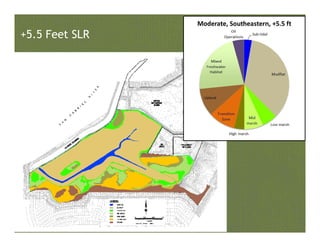
+5.5 Feet SLR
Lesson #1: Sea Level Rise
• Moderate SLR
– Topography sufficient to provide resilience
– Thoughtful grading of adjacent uplands
• Significant SLR
– Topography not sufficient for adaption to 5.5 ft. of SLR– Topography not sufficient for adaption to 5.5 ft. of SLR
– Big temporal tradeoffs – wetlands now or in the future
– Sedimentation will be needed to preserve current salt marshes
over the next 100 years
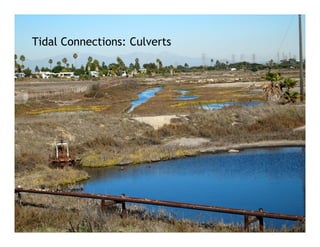
Tidal Connections: Culverts
-4	
-3	
-2	
-1	
0	
1	
2	
3	
4	
5	
6	
0	 50	 100	 150	 200	 250	 300	 350	 400	 450	 500	
Series1	
Series2	
Series3	
6	
8	
10	
12	
Series1	
Series2	
Current Sea Level
+5.5 ft. SLR
-5	
-4	
0	
2	
4	
6	
0	 50	 100	 150	 200	 250	 300	 350	 400	 450	 500	
Series2	
Series3	
+1.5 ft. SLR
San Gabriel River
Node 2
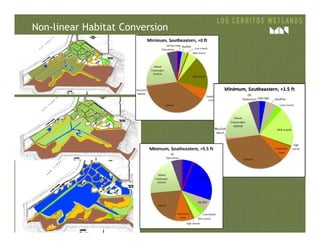
Non-linear Habitat Conversion
Lesson #2: Culverts
• Must be carefully designed
• Likely to lead to muted and perched tides
– Culvert size and invert elevation
– Narrowing and elimination of habitat zones
• Adequate designs now might not be adequate with SLR• Adequate designs now might not be adequate with SLR
• Habitat conversion may not behave linearly with SLR
(models may not be sufficient)
• Open channels generally don’t have these issues
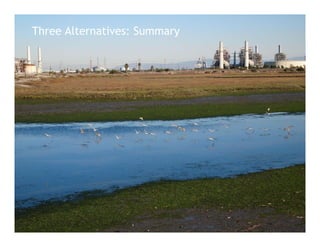
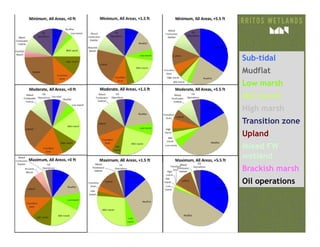
Three Alternatives: Summary
Sub-tidal
Mudflat
Low marsh
Mid marsh
High marsh
Transition zoneTransition zone
Upland
Mixed FW
wetland
Brackish marsh
Oil operations
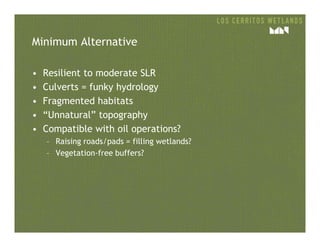
Minimum Alternative
• Resilient to moderate SLR
• Culverts = funky hydrology
• Fragmented habitats
• “Unnatural” topography
• Compatible with oil operations?• Compatible with oil operations?
– Raising roads/pads = filling wetlands?
– Vegetation-free buffers?
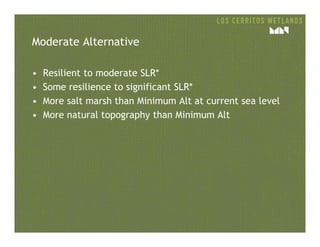
Moderate Alternative
• Resilient to moderate SLR*
• Some resilience to significant SLR*
• More salt marsh than Minimum Alt at current sea level
• More natural topography than Minimum Alt
Maximum Alternative
• Maximization of salt marsh habitat
• Most sub-tidal and mudflat
• Generally steep wetland-upland transitions
• Significant loss of high marsh and transition habitat
with moderate SLRwith moderate SLR
• Significant loss of vegetated marsh with significant SLR
Lesson #3: Preferred Alternative?
• Best design is probably a blending of different aspects of
different alternatives
• Not all possibilities captured
– More sub-tidal (fish, turtles, some birds)
– Entire levee removal– Entire levee removal
– Hydro connection between north and central areas
Lots of Project-specific Fine Tuning Still Needed
• Soil contamination
• Soil texture
– Will it need to be amended? Import good soil?
• Groundwater
• Beneficial re-use of graded soils on site?• Beneficial re-use of graded soils on site?
Public Access
New West Land Company
Clark Stevens
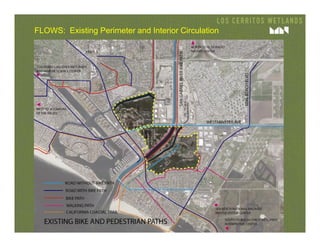
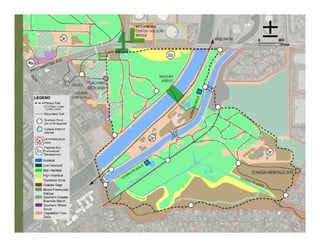
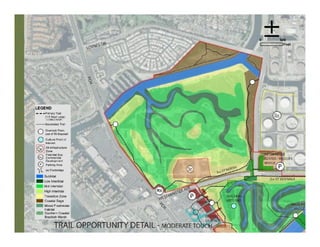
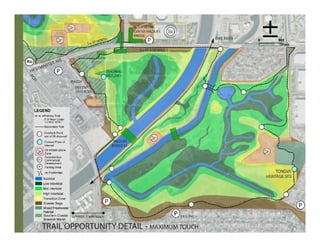
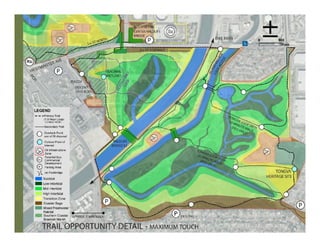
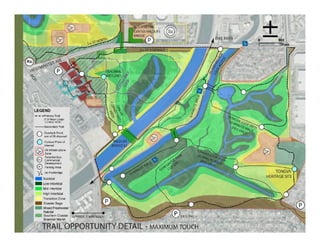
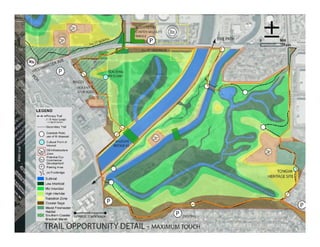
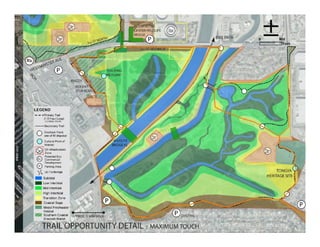
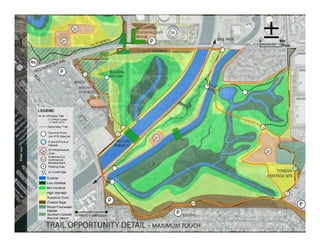
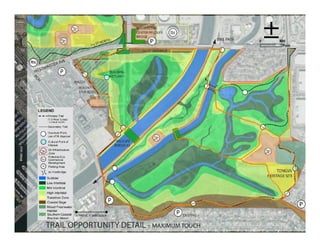
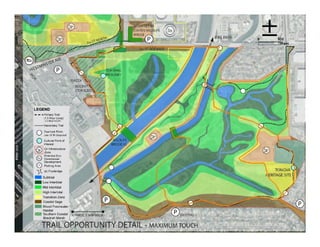
FLOWS: Existing Perimeter and Interior Circulation
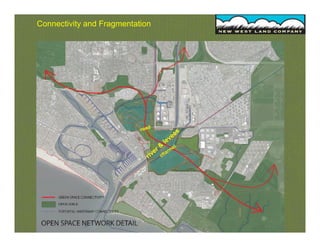
Connectivity and Fragmentation
Urban connectivity primary
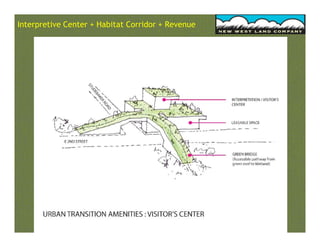
Interpretive Center + Habitat Corridor + Revenue
Urban connectivity primary
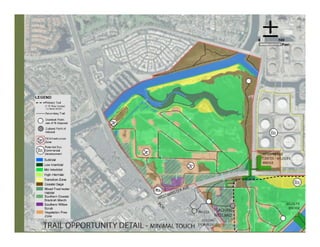
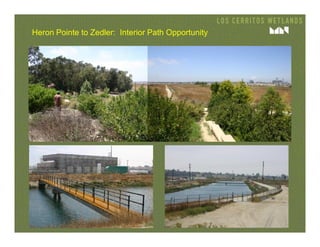
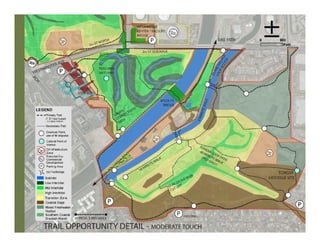
Heron Pointe to Zedler: Interior Path Opportunity
Habitat function primary
Urban connectivity primary
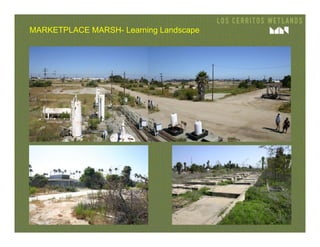
FLOW + IDENTITY: Blurring the Boundaries
MARKETPLACE MARSH- Learning Landscape
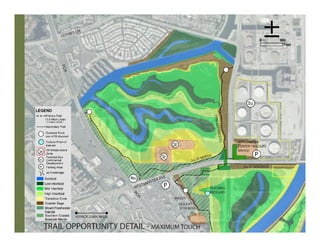
Habitat function primary
Urban connectivity primary
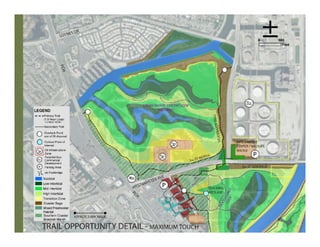
Habitat function primary
Urban connectivity primary
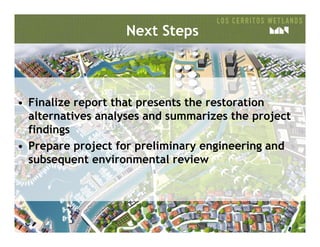
Next Steps
• Finalize report that presents the restoration
alternatives analyses and summarizes the project
findingsfindings
• Prepare project for preliminary engineering and
subsequent environmental review
Intoloscerritoswetlands.org
Closing / Leave BehindFinal Questions?Final Questions?
Visit:
intoloscerritoswetlands.org
or
Contact:
info@tidalinfluence.com

LCW Conceptual Restoration Workshop #6

  • 1.
    Public Involvement WorkshopPublicInvolvement Workshop March 20, 2014March 20, 2014
  • 2.
    • Workshop Goal: –Present Analysis of 3 conceptual restoration designs and invite questions • Workshop Objectives: Public Involvement Workshop #6 Theme: Life Mascot: Western Snowy Plover Color: Light Green • Workshop Objectives: 1. Update Conceptual Restoration Plan’s progress 2. Share 3 conceptual restoration designs 3. Present results of Alternative Analysis 4. Answer questions • Workshop Ground Rules
  • 3.
    Conceptual Restoration PlanProgress Update Planning Process 1. Collect data on existing conditions 2. Compile and analyze opportunities and constraints to restoration 3. Meet with the Public to brainstorm potential restoration3. Meet with the Public to brainstorm potential restoration alternatives 4. Determine preliminary restoration alternatives 5. Meet with Technical Advisory Committee and Public to identify final alternatives 6. Analyze each of the final restoration alternatives 7. Report results of restoration alternatives analyses and summarize the project findings
  • 4.
    Land Ownership ofEntire LCW Complex Studebaker LLC
  • 5.
    In February of2006, a joint powers agreement was adopted among the: Rivers & Mountains Conservancy, State Coastal Conservancy, & Cities of Long Beach & Seal Beach Los Cerritos Wetlands Authority = These agencies comprise the project’s Steering Committee
  • 6.
    Project Organization Chart CommunityTechnical Advisory Steering Committee: RMC, Coastal Conservancy, Cities of Seal and Long Beach Los Cerritos Wetlands Authority: Project Manager Consulting Team Community Stakeholders Public Involvement Plan Technical Advisory Committee Staff from Applicable Public Agencies
  • 7.
    Technical Advisory Committee Membersof each of these organizations provide regular advising throughout this project: • Rivers and Mountains Conservancy • California Coastal Conservancy • City of Long Beach • City of Seal Beach • U.S. Fish and Wildlife Service • NOAA-National Marine Fisheries Service • Counties of Los Angeles & Orange• Counties of Los Angeles & Orange • US Army Corps Of Engineers • Regional Water Quality Control Board • California Department of Fish and Wildlife • California Coastal Commission • State Lands Commission • Southern California Water Resources Research Project • Port of Long Beach • Santa Monica Bay Restoration Commission • CSU Long Beach, Dept of Biological Sciences
  • 11.
    • Workshop Goalwas: – Present 3 conceptual restoration designs • Workshop Objectives: Public Involvement Workshop #5 Theme: Fire Mascot: Coulter’s Goldfield Color: Red • Workshop Objectives: – Update on Conceptual Restoration Plan’s progress – Share 3 conceptual restoration designs – Discuss NEXT STEPS – Perform workshop activity to generate feedback on restoration design alternatives • Workshop Ground Rules
  • 12.
    Alt 1 •Minor changesto existing oil infrastructure •Utilize/improve existing tidal connections •Minor grading •Transitional & upland habitat along perimeters •Potential interpretive sites on OTD and/or State lands parcels Note: trail locations are in draft form
  • 13.
    Alt 2 •Consolidate oilinfrastructure •New tidal connections to SGR and Haynes •Steam Shovel Slough expansion •Moderate grading •Transitional & upland habitat along perimeters •Potential interpretive sites on OTD and/or State lands parcels Note: trail locations are in draft form
  • 14.
    Alt 3 •Consolidate oilinfrastructure •New tidal connections to SGR, Haynes, & Los Cerritos Channel •Fill & Grading of OC Retention Basin •Significant grading to remove fill material and create contiguous tidal channels •Maximizes tidal salt marsh habitat •Potential interpretive sites on OTD and/or State lands parcels Note: trail locations are in draft form
  • 15.
    Alternatives Analyses Primary processesanalyzed and reported tonight are: • Hydrology • Habitat • Public access Additional items addressed in the reportAdditional items addressed in the report • Preliminary engineering designs • Infrastructure changes • Phasing • Possible construction methods • Maintenance • Consistency with project goals and objectives
  • 16.
    Results of theAnalyses • Hydrology – Chris Webb • Habitat – Matt James • Public Access/Interpretive Opportunities – Clark Stevens• Public Access/Interpretive Opportunities – Clark Stevens
  • 17.
  • 18.
  • 19.
  • 20.
    Tidal Elevations andRanges All Scenarios, No Sea Level Rise (Existing Sea Level)
  • 21.
    Tidal Elevations andRanges All Scenarios, +1.5 Feet of Sea Level Rise
  • 22.
    Tidal Elevations andRanges All Scenarios, +5.5 Feet of Sea Level Rise
  • 23.
    Tidal Hydrology –Tidal Inundation Frequency At Steam Shovel Slough, Existing Sea Level
  • 24.
    TIF Relates toElevation – Determines Habitat Distributions and Areas – Alt 1, North and Central Areas, Existing Sea Level
  • 25.
    Alt 1, Isthmusand Southeast Area, Existing Sea Level
  • 26.
    Habitat Distributions– Alt 1,North and Central Areas, Sea Level Rise of +1.5 Feet
  • 27.
    Alt 1, Isthmusand Southeast Area, Sea Level Rise of +1.5 Feet
  • 28.
    Habitat Distributions – Alt1, North and Central Areas, Sea Level Rise of +5.5 Feet
  • 29.
    Alt 1, Isthmusand Southeast Area, Sea Level Rise of +5.5 Feet
  • 30.
    Alt 2 -Moderate Alt Northern and Central Areas, Existing Sea Level
  • 31.
    Alt 2 -Moderate Alt Isthmus and Southeast Area, Existing Sea Level
  • 32.
    Alt 2 -Moderate Alt Northern and Central Areas, Sea Level Rise of 1.5’
  • 33.
    Alt 2 -Moderate Alt Isthmus and Southeast Area, Sea Level Rise of 1.5’
  • 34.
    Alt 2 -Moderate Alt Northern and Central Areas, Sea Level Rise of 5.5’
  • 35.
    Alt 2 -Moderate Alt Isthmus and Southeast Area, Sea Level Rise of 5.5’
  • 36.
    Alt 3 -Maximum Alt Northern and Central Areas, Existing Sea Level
  • 37.
    Alt 3 -Maximum Alt Isthmus and Southeast Area, Existing Sea Level
  • 38.
    Alt 3 -Maximum Alt Northern and Central Areas, Sea Level Rise of 1.5’
  • 39.
    Alt 3 -Maximum Alt Isthmus and Southeast Area, Sea Level Rise of 1.5’
  • 40.
    Alt 3 -Maximum Alt Northern and Central Areas, Sea Level Rise of 5.5’
  • 41.
    Alt 3 -Maximum Alt Isthmus and Southeast Area, Sea Level Rise of 5.5’
  • 42.
    Tidal Hydrology DataUsed to Analyze Habitat • Habitat Distributions • Habitat Areas • Habitat Evolution Under Sea Level Rise
  • 43.
  • 44.
    Habitat Modeling • Practicalquestions – How does SLR affect habitat distributions? – How does plumbing affect habitats? – How do alternatives differ? • Philosophical questions – What is the ideal mix of habitats today? – In 50yrs? – In 100yrs?
  • 45.
    Modeled Habitats Habitat CategoriesExamples Sub-tidal Deep, shallow and eelgrass Mudflat Unvegetated Low marsh Cordgrass Mid marsh Pickleweed, marsh plain High marsh Glasswort, salt panne Transition zone Wetland-upland ecotone Upland Dune, CSS, grassland Mixed freshwater wetland Seasonal, bioswales, riparian Brackish marsh Artificial, natural? Oil operations Roads and pads, unvegetated
  • 46.
  • 47.
  • 48.
  • 49.
  • 50.
    Lesson #1: SeaLevel Rise • Moderate SLR – Topography sufficient to provide resilience – Thoughtful grading of adjacent uplands • Significant SLR – Topography not sufficient for adaption to 5.5 ft. of SLR– Topography not sufficient for adaption to 5.5 ft. of SLR – Big temporal tradeoffs – wetlands now or in the future – Sedimentation will be needed to preserve current salt marshes over the next 100 years
  • 51.
  • 52.
    -4 -3 -2 -1 0 1 2 3 4 5 6 0 50 100 150 200 250 300 350 400 450 500 Series1 Series2 Series3 6 8 10 12 Series1 Series2 Current Sea Level +5.5 ft. SLR -5 -4 0 2 4 6 0 50 100 150 200 250 300 350 400 450 500 Series2 Series3 +1.5 ft. SLR San Gabriel River Node 2
  • 53.
  • 54.
    Lesson #2: Culverts •Must be carefully designed • Likely to lead to muted and perched tides – Culvert size and invert elevation – Narrowing and elimination of habitat zones • Adequate designs now might not be adequate with SLR• Adequate designs now might not be adequate with SLR • Habitat conversion may not behave linearly with SLR (models may not be sufficient) • Open channels generally don’t have these issues
  • 55.
  • 56.
    Sub-tidal Mudflat Low marsh Mid marsh Highmarsh Transition zoneTransition zone Upland Mixed FW wetland Brackish marsh Oil operations
  • 57.
    Minimum Alternative • Resilientto moderate SLR • Culverts = funky hydrology • Fragmented habitats • “Unnatural” topography • Compatible with oil operations?• Compatible with oil operations? – Raising roads/pads = filling wetlands? – Vegetation-free buffers?
  • 58.
    Moderate Alternative • Resilientto moderate SLR* • Some resilience to significant SLR* • More salt marsh than Minimum Alt at current sea level • More natural topography than Minimum Alt
  • 59.
    Maximum Alternative • Maximizationof salt marsh habitat • Most sub-tidal and mudflat • Generally steep wetland-upland transitions • Significant loss of high marsh and transition habitat with moderate SLRwith moderate SLR • Significant loss of vegetated marsh with significant SLR
  • 60.
    Lesson #3: PreferredAlternative? • Best design is probably a blending of different aspects of different alternatives • Not all possibilities captured – More sub-tidal (fish, turtles, some birds) – Entire levee removal– Entire levee removal – Hydro connection between north and central areas
  • 61.
    Lots of Project-specificFine Tuning Still Needed • Soil contamination • Soil texture – Will it need to be amended? Import good soil? • Groundwater • Beneficial re-use of graded soils on site?• Beneficial re-use of graded soils on site?
  • 62.
    Public Access New WestLand Company Clark Stevens
  • 63.
    FLOWS: Existing Perimeterand Interior Circulation
  • 64.
  • 65.
  • 66.
    Interpretive Center +Habitat Corridor + Revenue
  • 67.
  • 68.
    Heron Pointe toZedler: Interior Path Opportunity
  • 70.
  • 71.
  • 72.
    FLOW + IDENTITY:Blurring the Boundaries
  • 73.
  • 74.
  • 75.
  • 76.
  • 77.
  • 78.
  • 79.
  • 86.
    Next Steps • Finalizereport that presents the restoration alternatives analyses and summarizes the project findingsfindings • Prepare project for preliminary engineering and subsequent environmental review
  • 87.
  • 88.
    Closing / LeaveBehindFinal Questions?Final Questions? Visit: intoloscerritoswetlands.org or Contact: info@tidalinfluence.com