P u b lic In v o lv e m e n t W o r k s h o p
           M a y 10 t h , 2 0 12
Public Involvement Workshop #3
                         Theme: Water
                Mascot: Pacific Green Sea Turtle
                          Color: Blue
• Workshop Goal:
 Initiate development of Conceptual Restoration Alternative
 Designs


• Workshop Objectives:
  – Update on Conceptual Restoration Plan’s progress
  – Introduce Conceptual Restoration Alternative design
    process
  – Perform workshop activity to initiate discussion of
    potential restoration alternatives


• Workshop Groundrules
Public Involvement Workshop #3

 Workshop      Outline
• Summary of Previous Workshops
• Conceptual Restoration Plan Progress Update
  - Overview of Conceptual Restoration Plan scope and progress
   – Review of opportunities and constraints
   – Discussion of alternative design conceptualization process
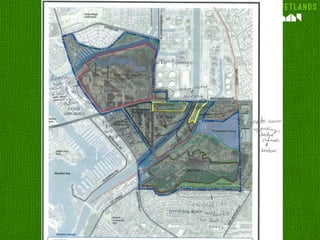
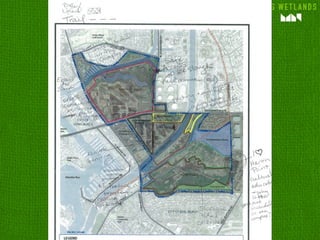
3. Public Feedback Activity
• Participants develop restoration “bubble diagrams” indicating
   areas needing:
   – Lots of restoration attention
   – Less restoration attention
   – Little restoration attention
4. Next Steps
   -Review of workshop
   -Next workshop topics, time, and location
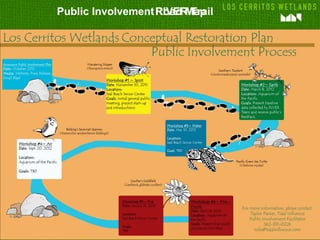
Public Involvement RIVER Trail
                   Road Map
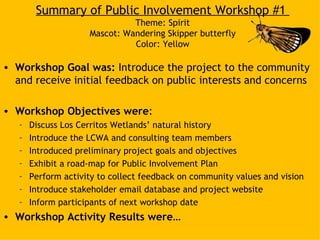
Summary of Public Involvement Workshop #1
                               Theme: Spirit
                     Mascot: Wandering Skipper butterfly
                               Color: Yellow

• Workshop Goal was: Introduce the project to the community
  and receive initial feedback on public interests and concerns

• Workshop Objectives were:
   –   Discuss Los Cerritos Wetlands’ natural history
   –   Introduce the LCWA and consulting team members
   –   Introduced preliminary project goals and objectives
   –   Exhibit a road-map for Public Involvement Plan
   –   Perform activity to collect feedback on community values and vision
   –   Introduce stakeholder email database and project website
   –   Inform participants of next workshop date
• Workshop Activity Results were…
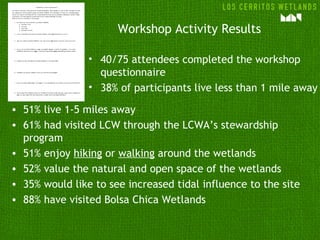
Workshop Activity Results

                • 40/75 attendees completed the workshop
                  questionnaire
                • 38% of participants live less than 1 mile away

• 51% live 1-5 miles away
• 61% had visited LCW through the LCWA’s stewardship
  program
• 51% enjoy hiking or walking around the wetlands
• 52% value the natural and open space of the wetlands
• 35% would like to see increased tidal influence to the site
• 88% have visited Bolsa Chica Wetlands
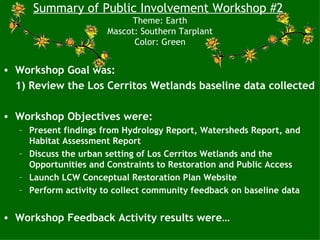
Summary of Public Involvement Workshop #2
                            Theme: Earth
                       Mascot: Southern Tarplant
                             Color: Green


• Workshop Goal was:
  1) Review the Los Cerritos Wetlands baseline data collected

• Workshop Objectives were:
   – Present findings from Hydrology Report, Watersheds Report, and
     Habitat Assessment Report
   – Discuss the urban setting of Los Cerritos Wetlands and the
     Opportunities and Constraints to Restoration and Public Access
   – Launch LCW Conceptual Restoration Plan Website
   – Perform activity to collect community feedback on baseline data


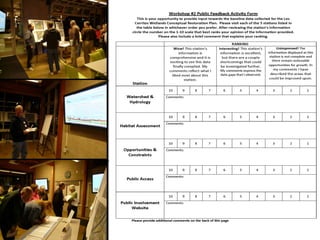
• Workshop Feedback Activity results were…
Workshop Activity Results
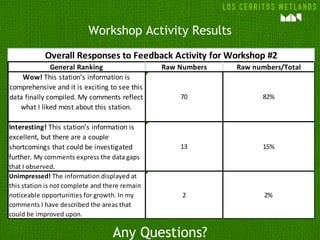
            Overall Responses to Feedback Activity for Workshop #2
              General Ranking                   Raw Numbers   Raw numbers/Total
    Wow! This station’s information is
comprehensive and it is exciting to see this
data finally compiled. My comments reflect          70              82%
   what I liked most about this station.

Interesting! This station’s information is
excellent, but there are a couple
shortcomings that could be investigated             13              15%
further. My comments express the data gaps
that I observed.
Unimpressed! The information displayed at
this station is not complete and there remain
noticeable opportunities for growth. In my           2               2%
comments I have described the areas that
could be improved upon.

                                   Any Questions?
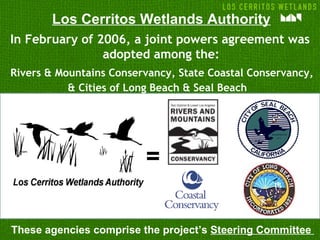
Los Cerritos Wetlands Authority
In February of 2006, a joint powers agreement was
                adopted among the:
Rivers & Mountains Conservancy, State Coastal Conservancy,
           & Cities of Long Beach & Seal Beach


                         =

These agencies comprise the project’s Steering Committee
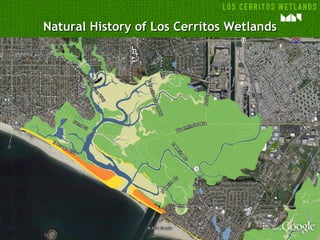
Natural History of Los Cerritos Wetlands
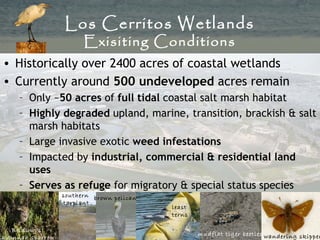
Los Cerritos Wetlands
                     Exisiting Conditions
 • Historically over 2400 acres of coastal wetlands
 • Currently around 500 undeveloped acres remain
     – Only ~50 acres of full tidal coastal salt marsh habitat
     – Highly degraded upland, marine, transition, brackish & salt
       marsh habitats
     – Large invasive exotic weed infestations
     – Impacted by industrial, commercial & residential land
       uses
     – Serves as refuge for migratory & special status species
       specialsouthern brown pelican
                concern
               tarplant
                                    least
                                    terns

    Belding’s
                                            mudflat tiger beetles wandering skipper
savannah sparrow
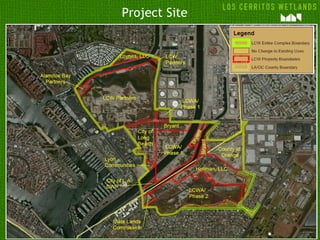
Project Site
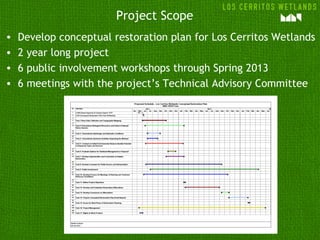
Project Scope
•   Develop conceptual restoration plan for Los Cerritos Wetlands
•   2 year long project
•   6 public involvement workshops through Spring 2013
•   6 meetings with the project’s Technical Advisory Committee
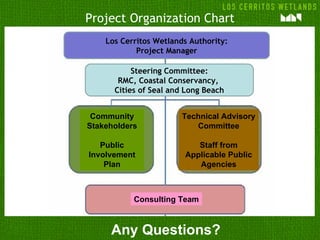
Project Organization Chart
    Los Cerritos Wetlands Authority:
            Project Manager

           Steering Committee:
       RMC, Coastal Conservancy,
      Cities of Seal and Long Beach


 Community              Technical Advisory
Stakeholders               Committee

   Public                  Staff from
Involvement             Applicable Public
    Plan                   Agencies


           Consulting Team


     Any Questions?
Conceptual Restoration Alterative Design Process

• Collect data on existing conditions
• Compile and analyze opportunities and constraints to
  restoration
• Meet with the Public to brainstorm potential restoration
  alternatives
• Determine preliminary restoration alternatives
• Meet with Technical Advisory Committee and Public to
  identify final alternatives
• Analyze each of the final restoration alternatives
• Work with all stakeholders to determine the preferred
  restoration alternative
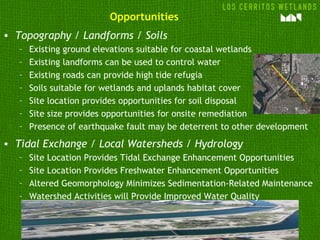
Opportunities
• Topography / Landforms / Soils
   –   Existing ground elevations suitable for coastal wetlands
   –   Existing landforms can be used to control water
   –   Existing roads can provide high tide refugia
   –   Soils suitable for wetlands and uplands habitat cover
   –   Site location provides opportunities for soil disposal
   –   Site size provides opportunities for onsite remediation
   –   Presence of earthquake fault may be deterrent to other development
• Tidal Exchange / Local Watersheds / Hydrology
   –   Site Location Provides Tidal Exchange Enhancement Opportunities
   –   Site Location Provides Freshwater Enhancement Opportunities
   –   Altered Geomorphology Minimizes Sedimentation-Related Maintenance
   –   Watershed Activities will Provide Improved Water Quality
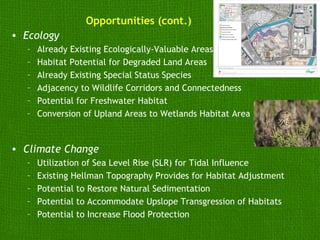
Opportunities (cont.)
• Ecology
  –   Already Existing Ecologically-Valuable Areas
  –   Habitat Potential for Degraded Land Areas
  –   Already Existing Special Status Species
  –   Adjacency to Wildlife Corridors and Connectedness
  –   Potential for Freshwater Habitat
  –   Conversion of Upland Areas to Wetlands Habitat Area


• Climate Change
  –   Utilization of Sea Level Rise (SLR) for Tidal Influence
  –   Existing Hellman Topography Provides for Habitat Adjustment
  –   Potential to Restore Natural Sedimentation
  –   Potential to Accommodate Upslope Transgression of Habitats
  –   Potential to Increase Flood Protection
Opportunities (cont.)
• Infrastructure
   – Lease Agreements Include Reconfiguration of Oil Infrastructure
   – LCWA-Owned Property Includes the San Gabriel River Levees
• Human Interaction
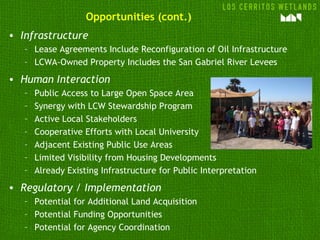
   –   Public Access to Large Open Space Area
   –   Synergy with LCW Stewardship Program
   –   Active Local Stakeholders
   –   Cooperative Efforts with Local University
   –   Adjacent Existing Public Use Areas
   –   Limited Visibility from Housing Developments
   –   Already Existing Infrastructure for Public Interpretation
• Regulatory / Implementation
   – Potential for Additional Land Acquisition
   – Potential Funding Opportunities
   – Potential for Agency Coordination
Constraints

• Topography / Landforms / Soils
   –   Historical Land Uses have Altered Natural Topography
   –   Landform Changes Limit Natural Processes
   –   Existing Soil Quality Limits Restoration Success
   –   Earthquake Fault may Constrain Oil Infrastructure Reconfiguration
       and/or Cause Damage to the Wetlands


• Tidal Exchange / Local Watersheds / Hydrology
   –   Human Disturbance has Altered Tidal Exchange
   –   Human Disturbance has Altered Freshwater Hydrologic Functioning
   –   Human Disturbance has Altered Geomorphology
   –   Poor Water Quality can Impair Restoration Success
Constraints (cont.)

• Ecology
   – Protection of Existing Sensitive Habitat Resources
   – Simplified Food Webs
• Climate Change
   –   SLR will Modify Habitat Proportions
   –   Steep Perimeters will Only Support Narrow Habitat Bands
   –   Natural Sediment Supply is Limited
   –   Limited Areas for Upslope Transgression of Habitats
   –   SLR and Flooding Risk
• Infrastructure
   –   Incorporation of Existing and Future-Remaining Oil Infrastructure
   –   Fragmentation and Encroachment by Roadways
   –   Protection of Existing Flood Control Systems
   –   Fragmentation and Encroachment by Utilities
Constraints (cont.)
• Human Interaction
   –   Habitat Sensitivity to Urban Surroundings
   –   Onsite Homeless Encampments
   –   Maintaining Positive Public Perception
   –   Potential Impacts to Surrounding Neighborhoods
   –   Archaeological Resource Protection
• Regulatory / Implementation
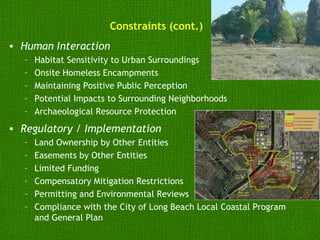
   –   Land Ownership by Other Entities
   –   Easements by Other Entities
   –   Limited Funding
   –   Compensatory Mitigation Restrictions
   –   Permitting and Environmental Reviews
   –   Compliance with the City of Long Beach Local Coastal Program
       and General Plan
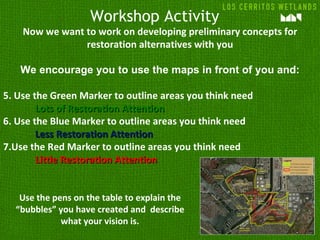
Workshop Activity
    Now we want to work on developing preliminary concepts for
                restoration alternatives with you

   We encourage you to use the maps in front of you and:

5. Use the Green Marker to outline areas you think need
        Lots of Restoration Attention
6. Use the Blue Marker to outline areas you think need
        Less Restoration Attention
7.Use the Red Marker to outline areas you think need
        Little Restoration Attention


   Use the pens on the table to explain the
  “bubbles” you have created and describe
             what your vision is.
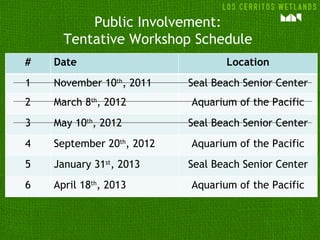
Public Involvement:
      Tentative Workshop Schedule
#   Date                          Location
1   November 10th, 2011    Seal Beach Senior Center
2   March 8th, 2012        Aquarium of the Pacific
3   May 10th, 2012         Seal Beach Senior Center
4   September 20th, 2012   Aquarium of the Pacific
5   January 31st, 2013     Seal Beach Senior Center
6   April 18th, 2013       Aquarium of the Pacific
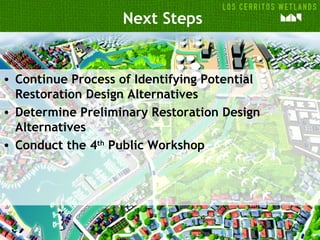
Next Steps


• Continue Process of Identifying Potential
  Restoration Design Alternatives
• Determine Preliminary Restoration Design
  Alternatives
• Conduct the 4th Public Workshop
Closing / Leave Behind
Final Questions?
Final Questions?


         Contact:
 info@tidalinfluence.com

LCW Conceptual Restoration Workshop #3

  • 1.
    P u blic In v o lv e m e n t W o r k s h o p M a y 10 t h , 2 0 12
  • 2.
    Public Involvement Workshop#3 Theme: Water Mascot: Pacific Green Sea Turtle Color: Blue • Workshop Goal: Initiate development of Conceptual Restoration Alternative Designs • Workshop Objectives: – Update on Conceptual Restoration Plan’s progress – Introduce Conceptual Restoration Alternative design process – Perform workshop activity to initiate discussion of potential restoration alternatives • Workshop Groundrules
  • 3.
    Public Involvement Workshop#3  Workshop Outline • Summary of Previous Workshops • Conceptual Restoration Plan Progress Update - Overview of Conceptual Restoration Plan scope and progress – Review of opportunities and constraints – Discussion of alternative design conceptualization process 3. Public Feedback Activity • Participants develop restoration “bubble diagrams” indicating areas needing: – Lots of restoration attention – Less restoration attention – Little restoration attention 4. Next Steps -Review of workshop -Next workshop topics, time, and location
  • 4.
  • 5.
    Summary of PublicInvolvement Workshop #1 Theme: Spirit Mascot: Wandering Skipper butterfly Color: Yellow • Workshop Goal was: Introduce the project to the community and receive initial feedback on public interests and concerns • Workshop Objectives were: – Discuss Los Cerritos Wetlands’ natural history – Introduce the LCWA and consulting team members – Introduced preliminary project goals and objectives – Exhibit a road-map for Public Involvement Plan – Perform activity to collect feedback on community values and vision – Introduce stakeholder email database and project website – Inform participants of next workshop date • Workshop Activity Results were…
  • 6.
    Workshop Activity Results • 40/75 attendees completed the workshop questionnaire • 38% of participants live less than 1 mile away • 51% live 1-5 miles away • 61% had visited LCW through the LCWA’s stewardship program • 51% enjoy hiking or walking around the wetlands • 52% value the natural and open space of the wetlands • 35% would like to see increased tidal influence to the site • 88% have visited Bolsa Chica Wetlands
  • 9.
    Summary of PublicInvolvement Workshop #2 Theme: Earth Mascot: Southern Tarplant Color: Green • Workshop Goal was: 1) Review the Los Cerritos Wetlands baseline data collected • Workshop Objectives were: – Present findings from Hydrology Report, Watersheds Report, and Habitat Assessment Report – Discuss the urban setting of Los Cerritos Wetlands and the Opportunities and Constraints to Restoration and Public Access – Launch LCW Conceptual Restoration Plan Website – Perform activity to collect community feedback on baseline data • Workshop Feedback Activity results were…
  • 11.
    Workshop Activity Results Overall Responses to Feedback Activity for Workshop #2 General Ranking Raw Numbers Raw numbers/Total Wow! This station’s information is comprehensive and it is exciting to see this data finally compiled. My comments reflect 70 82% what I liked most about this station. Interesting! This station’s information is excellent, but there are a couple shortcomings that could be investigated 13 15% further. My comments express the data gaps that I observed. Unimpressed! The information displayed at this station is not complete and there remain noticeable opportunities for growth. In my 2 2% comments I have described the areas that could be improved upon. Any Questions?
  • 12.
    Los Cerritos WetlandsAuthority In February of 2006, a joint powers agreement was adopted among the: Rivers & Mountains Conservancy, State Coastal Conservancy, & Cities of Long Beach & Seal Beach = These agencies comprise the project’s Steering Committee
  • 13.
    Natural History ofLos Cerritos Wetlands
  • 14.
    Los Cerritos Wetlands Exisiting Conditions • Historically over 2400 acres of coastal wetlands • Currently around 500 undeveloped acres remain – Only ~50 acres of full tidal coastal salt marsh habitat – Highly degraded upland, marine, transition, brackish & salt marsh habitats – Large invasive exotic weed infestations – Impacted by industrial, commercial & residential land uses – Serves as refuge for migratory & special status species specialsouthern brown pelican concern tarplant least terns Belding’s mudflat tiger beetles wandering skipper savannah sparrow
  • 15.
  • 16.
    Project Scope • Develop conceptual restoration plan for Los Cerritos Wetlands • 2 year long project • 6 public involvement workshops through Spring 2013 • 6 meetings with the project’s Technical Advisory Committee
  • 17.
    Project Organization Chart Los Cerritos Wetlands Authority: Project Manager Steering Committee: RMC, Coastal Conservancy, Cities of Seal and Long Beach Community Technical Advisory Stakeholders Committee Public Staff from Involvement Applicable Public Plan Agencies Consulting Team Any Questions?
  • 18.
    Conceptual Restoration AlterativeDesign Process • Collect data on existing conditions • Compile and analyze opportunities and constraints to restoration • Meet with the Public to brainstorm potential restoration alternatives • Determine preliminary restoration alternatives • Meet with Technical Advisory Committee and Public to identify final alternatives • Analyze each of the final restoration alternatives • Work with all stakeholders to determine the preferred restoration alternative
  • 19.
    Opportunities • Topography /Landforms / Soils – Existing ground elevations suitable for coastal wetlands – Existing landforms can be used to control water – Existing roads can provide high tide refugia – Soils suitable for wetlands and uplands habitat cover – Site location provides opportunities for soil disposal – Site size provides opportunities for onsite remediation – Presence of earthquake fault may be deterrent to other development • Tidal Exchange / Local Watersheds / Hydrology – Site Location Provides Tidal Exchange Enhancement Opportunities – Site Location Provides Freshwater Enhancement Opportunities – Altered Geomorphology Minimizes Sedimentation-Related Maintenance – Watershed Activities will Provide Improved Water Quality
  • 20.
    Opportunities (cont.) • Ecology – Already Existing Ecologically-Valuable Areas – Habitat Potential for Degraded Land Areas – Already Existing Special Status Species – Adjacency to Wildlife Corridors and Connectedness – Potential for Freshwater Habitat – Conversion of Upland Areas to Wetlands Habitat Area • Climate Change – Utilization of Sea Level Rise (SLR) for Tidal Influence – Existing Hellman Topography Provides for Habitat Adjustment – Potential to Restore Natural Sedimentation – Potential to Accommodate Upslope Transgression of Habitats – Potential to Increase Flood Protection
  • 21.
    Opportunities (cont.) • Infrastructure – Lease Agreements Include Reconfiguration of Oil Infrastructure – LCWA-Owned Property Includes the San Gabriel River Levees • Human Interaction – Public Access to Large Open Space Area – Synergy with LCW Stewardship Program – Active Local Stakeholders – Cooperative Efforts with Local University – Adjacent Existing Public Use Areas – Limited Visibility from Housing Developments – Already Existing Infrastructure for Public Interpretation • Regulatory / Implementation – Potential for Additional Land Acquisition – Potential Funding Opportunities – Potential for Agency Coordination
  • 22.
    Constraints • Topography /Landforms / Soils – Historical Land Uses have Altered Natural Topography – Landform Changes Limit Natural Processes – Existing Soil Quality Limits Restoration Success – Earthquake Fault may Constrain Oil Infrastructure Reconfiguration and/or Cause Damage to the Wetlands • Tidal Exchange / Local Watersheds / Hydrology – Human Disturbance has Altered Tidal Exchange – Human Disturbance has Altered Freshwater Hydrologic Functioning – Human Disturbance has Altered Geomorphology – Poor Water Quality can Impair Restoration Success
  • 23.
    Constraints (cont.) • Ecology – Protection of Existing Sensitive Habitat Resources – Simplified Food Webs • Climate Change – SLR will Modify Habitat Proportions – Steep Perimeters will Only Support Narrow Habitat Bands – Natural Sediment Supply is Limited – Limited Areas for Upslope Transgression of Habitats – SLR and Flooding Risk • Infrastructure – Incorporation of Existing and Future-Remaining Oil Infrastructure – Fragmentation and Encroachment by Roadways – Protection of Existing Flood Control Systems – Fragmentation and Encroachment by Utilities
  • 24.
    Constraints (cont.) • HumanInteraction – Habitat Sensitivity to Urban Surroundings – Onsite Homeless Encampments – Maintaining Positive Public Perception – Potential Impacts to Surrounding Neighborhoods – Archaeological Resource Protection • Regulatory / Implementation – Land Ownership by Other Entities – Easements by Other Entities – Limited Funding – Compensatory Mitigation Restrictions – Permitting and Environmental Reviews – Compliance with the City of Long Beach Local Coastal Program and General Plan
  • 25.
    Workshop Activity Now we want to work on developing preliminary concepts for restoration alternatives with you We encourage you to use the maps in front of you and: 5. Use the Green Marker to outline areas you think need Lots of Restoration Attention 6. Use the Blue Marker to outline areas you think need Less Restoration Attention 7.Use the Red Marker to outline areas you think need Little Restoration Attention Use the pens on the table to explain the “bubbles” you have created and describe what your vision is.
  • 26.
    Public Involvement: Tentative Workshop Schedule # Date Location 1 November 10th, 2011 Seal Beach Senior Center 2 March 8th, 2012 Aquarium of the Pacific 3 May 10th, 2012 Seal Beach Senior Center 4 September 20th, 2012 Aquarium of the Pacific 5 January 31st, 2013 Seal Beach Senior Center 6 April 18th, 2013 Aquarium of the Pacific
  • 27.
    Next Steps • ContinueProcess of Identifying Potential Restoration Design Alternatives • Determine Preliminary Restoration Design Alternatives • Conduct the 4th Public Workshop
  • 28.
    Closing / LeaveBehind Final Questions? Final Questions? Contact: info@tidalinfluence.com

Editor's Notes

  • #3 Insert Green Sea Turtle and Workshop color
  • #10 Insert Green Sea Turtle and Workshop color