EDU 505 – Contemporary Issues in Education
COURSE DESCRIPTION
Examines theory, research, and practices relating to critical
issues faced by educators today. Discusses contemporary
concerns in American and global education: National and local
initiatives in education, the evolving relationship between
schools and communities, impacts of public policy on the
educational enterprise, and current social, political, economic,
and legal issues influencing schools are explored from
American and global perspectives. Evaluates the future of
education in both industrial and developing countries, including
growth of learning needs and inequities both within and
between countries. Emphasizes problem identification, analysis,
and remediation, with the latter focusing on “best of breed”
innovative practices.
INSTRUCTIONAL MATERIALS
Required Resources – Textbook
Tozer, S. E., Senese, G., & Violas, P. C. (2013). School and
society: Historical and contemporary perspectives (7th ed.).
New York, NY: McGraw-Hill.
Required Resources – Articles
Baker, B., Sciarra, D., & Farrie, D. (2014). Is School Funding
Fair? A National Report Card. Retrieved from
http://www.schoolfundingfairness.org/National_Report_Card_2
014.pdf
Baker, B., & Corcoran, S. (2012). The Stealth Inequities of
School Funding: How State and Local School Finance Systems
Perpetuate Inequitable Student Spending. Center for American
Progress. Retrieved from
https://www.americanprogress.org/issues/education/report/2012/
09/19/38189/the-stealth-inequities-of-school-funding/
Brackemyre, T. (2012). Education to the Masses: The Rise of
Public Education in Early America. History Scene. Retrieved
from
http://www.ushistoryscene.com/uncategorized/riseofpubliceduca
tion/
Cobb, N. (2014). Climate, Culture and Collaboration: The Key
to Creating Safe and Supportive Schools. Techniques:
Connecting Education and Careers. Retrieved from:
http://eds.b.ebscohost.com/eds/pdfviewer/pdfviewer?sid=1bde4a
76-6090-47af-8294-
13f37c6936c7%40sessionmgr110&vid=16&hid=112
Gardner, H. (2011). To improve U.S. education, it’s time to
treat teachers as professionals. The Washington Post. Retrieved
from http://www.washingtonpost.com/national/on-leadership/to-
improve-us-education-its-time-to-treat-teachers-as-
professionals/2011/07/18/gIQA8oh2LI_story.html
Garrity, C., & Jens, K. (1997). Bully Proofing Your School:
Creating a Positive Climate. Intervention in School & Clinic.
Retrieved from
http://eds.b.ebscohost.com/eds/detail/detail?vid=2&sid=1bde4a7
6-6090-47af-8294-
13f37c6936c7%40sessionmgr110&hid=112&bdata=JnNpdGU9Z
WRzLWxpdmUmc2NvcGU9c2l0ZQ%3d%3d#db=a9h&AN=9703
123351
Hiler, T., & Hatalsky, L.(2014). TEACH Grant Trap: Program
to Encourage Young People to Teach Falls Short. Third Way.
Retrieved from http://www.thirdway.org/memo/teach-grant-
trap-program-to-encourage-young-people-to-teach-falls-short
Hinduja, S., & Patchin, J. (2015). Cyberbullying Legislation
and Case Law: Implications for School Policy and Practice.
Retrieved from http://www.cyberbullying.us/cyberbullying-
legal-issues.pdf
Indiana University School of Education (2011). Recent School
Reform Efforts and Examples of Success in IPS: A Research
Brief. Retrieved from
http://education.iupui.edu/CUME/pdf/IPS-Reforms-and-
Success-Final-Brief.pdf
Klein, A., & Camera, L. (2015). NCLB Rewrite Could Target
Mandate on Annual Tests. Education Week. Retrieved from
http://www.edweek.org/ew/articles/2015/01/09/nclb-rewrite-
could-target-mandate-on-annual.html
Leachman, M., & Mai, C. (2014). Most States Funding Schools
Less Than Before the Recession. Center on Budget and Policy
Priorities. Retrieved from
http://www.cbpp.org/cms/?fa=view&id=4011
Madison, B. L. (2015). Quantitative Literacy and the Common
Core State Standards in Mathematics. Scholar Commons.
Retrieved from
http://eds.a.ebscohost.com/eds/pdfviewer/pdfviewer?vid=2&sid
=0f8862b1-989a-4c06-873b-
f0a5d252b9d9%40sessionmgr4002&hid=4113
NEA Common Core State Standards Toolkit. National Education
Association. Retrieved from
http://www.nea.org/assets/docs/Common-Core-State-Standards-
Toolkit.pdf
Noguera, P. (2014). Responding to the Challenges Confronting
Black and Latino Males: The Role of Public Policy in
Countering the “Crisis” and Promoting Success. InMotion
Magazine. Retrieved from
http://www.inmotionmagazine.com/er13/pn_call_roleofpublic.ht
ml
Noguera, P. (2012). The Achievement Gap and the Schools We
Need: Creating the Conditions Where Race and Class No Longer
Predict Student Achievement. InMotion Magazine. Retrieved
from http://www.inmotionmagazine.com/er12/pn_achvgap.html
Noguera, P. (2012). “Saving” Black and Latino Boys. InMotion
Magazine. Retrieved from
http://www.inmotionmagazine.com/er12/pn_saving.html
Strauss, V. (2013). Will charter schools survive the confusing
charter movement? The Washington Post. Retrieved from
http://www.washingtonpost.com/blogs/answer-
sheet/wp/2013/04/03/will-charter-schools-survive-the-
confusing-charter-movement/
What is Cyberbullying? (2015). Stopbullying.gov. Retrieved
from http://www.stopbullying.gov/cyberbullying/what-is-
it/index.html
Wolfe, A. (2015). A Critique of ‘The Common Core is a Change
for the Better’. ASA Journal of Scholarship and Practice.
Retrieved from
http://eds.a.ebscohost.com/eds/detail/detail?vid=3&sid=0f8862b
1-989a-4c06-873b-
f0a5d252b9d9%40sessionmgr4002&hid=4113&bdata=JnNpdGU
9ZWRzLWxpdmUmc2NvcGU9c2l0ZQ%3d%3d#db=eue&AN=10
0670256
Supplemental Resources and Strayer University Library Online
Databases
A comprehensive list of supplemental resources and Strayer
University Library Online databases that are recommended and /
or useful for this course can be found at the end of this course
guide, in the Faculty Notes section.
COURSE LEARNING OUTCOMES
1. Examine the historical context of contemporary issues in
education.
2. Analyze how educational theories and practices impact
contemporary issues in education.
3. Identify components of educational perspectives that will
serve as the foundation for students’ philosophy of education.
4. Survey and analyze issues facing the changing demographics
of education.
5. Evaluate the impact of technological change on contemporary
issues in education.
6. Critique issues related to teaching, learning, and assessment
within schools.
7. Analyze methods of the procurement, management, and
accountability of funding sources for schools.
8. Use technology and information resources to research
contemporary issues in education.
9. Write clearly and concisely about contemporary issues in
education using proper writing mechanics.
COURSE TOOLS AND TUTORIALS
The following tools and tutorials are resources for this course
and will help you succeed at exploring research articles. They
should be completed within the first week.
· Complete the tutorial in the Course Tools tab in your course
shell and the required quiz in Week 1 entitled “Genius
Navigator” to earn your Genius Navigator Badge.
WEEKLY COURSE SCHEDULE
The standard requirement for a 4.5 credit hour course is for
students to spend 13.5 hours in weekly work. This includes
preparation, activities, and evaluation regardless of delivery
mode.
Week
Preparation, Activities, and Evaluation
1
Preparation
· Reading(s)
· Chapter 1: Introduction: Understanding School and Society
· Chapter 2: Liberty and Literacy: The Jeffersonian Ideal
· Brackemyre, T. (2012) Education to the Masses: The Rise of
Public Education in Early America. History Scene. Retrieved
from http://ushistoryscene.com/article/rise-of-public-education/
· Complete the Course Tools and Tutorials in your course shell
Activities
· Course Expectations and Introductions
· Discussion (20 points)
Evaluation
· Genius Navigator Quiz (10 points)
2
Preparation
· Reading(s)
· Chapter 3: School as a Public Institution: The Common-School
Era
· Chapter 10: Teaching in a Public Institution: The
Professionalization Movement
· Gardner, H. (2011). To improve U.S. education, it’s time to
treat teachers as professionals. The Washington Post. Retrieved
from http://www.washingtonpost.com/national/on-leadership/to-
improve-us-education-its-time-to-treat-teachers-as-
professionals/2011/07/18/gIQA8oh2LI_story.html
· Case Study
· Terms of Endearment, located in the online course shell
Activities
· Discussion (20 points)
Evaluation
· None
3
Preparation
· Reading(s)
· Chapter 4: Social Diversity and Differentiated Schooling: The
Progressive Era
· Chapter 6: Diversity and Equity: Schooling and African
Americans
· Chapter 7: Diversity and Equity: Schooling and American
Indians
· Noguera, P. (2014) Responding to the Challenges Confronting
Black and Latino Males: The Role of Public Policy in
Countering the “Crisis” and Promoting Success. InMotion
Magazine. Retrieved from
http://www.inmotionmagazine.com/er13/pn_call_roleofpublic.ht
ml
· Noguera, P. (2012) The Achievement Gap and the Schools We
Need: Creating the Conditions Where Race and Class No Longer
Predict Student Achievement. InMotion Magazine. Retrieved
from http://www.inmotionmagazine.com/er12/pn_achvgap.html
· Noguera, P. (2012) “Saving” Black and Latino Boys. InMotion
Magazine. Retrieved from
http://www.inmotionmagazine.com/er12/pn_saving.html
Activities
· Discussion (20 points)
Evaluation
· Assignment 1: Case Study – Terms of Endearment (260 points)
4
Preparation
· Reading(s)
· Chapter 5: Diversity and Equity Today: Schooling Girls and
Women
· Chapter 12: Diversity and Equity Today: Defining the
Challenge
· Chapter 13: Diversity and Equity Today: Meeting the
Challenge
Activities
· Discussion (20 points)
Evaluation
· None
5
Preparation
· Reading(s)
· Chapter 8: National School Reform: The Early Cold War Era
· Hiler, T., & Hatalsky, L. Erickson (2014). TEACH Grant Trap:
Program to Encourage Young People to Teach Falls Short. Third
Way. Retrieved from http://www.thirdway.org/memo/teach-
grant-trap-program-to-encourage-young-people-to-teach-falls-
short
· Indiana University School of Education (2011). Recent School
Reform Efforts and Examples of Success in IPS: A Research
Brief. Retrieved from
http://education.iupui.edu/CUME/pdf/IPS-Reforms-and-
Success-Final-Brief.pdf
· Strauss, V. (2013). Will charter schools survive the confusing
charter movement? The Washington Post. Retrieved from
http://www.washingtonpost.com/blogs/answer-
sheet/wp/2013/04/03/will-charter-schools-survive-the-
confusing-charter-movement/
· Case Study
· Turn It Around!, located in the online course shell
Activities
· Discussion (20 points)
Evaluation
· None
6
Preparation
· Reading(s)
· Chapter 11: Differentiated Schooling, Labor Market
Preparation, and Contemporary School Reform: The Post-Cold
War Era
· Klein, A., & Camera, L. (2015). NCLB Rewrite Could Target
Mandate on Annual Tests. Education Week. Retrieved from
http://www.edweek.org/ew/articles/2015/01/09/nclb-rewrite-
could-target-mandate-on-annual.html
· Video
· Review the video titled “No Child Left Behind: A Decade of
Failure”
(3 min 42 s), located in the online course shell. You may also
view the video at
https://www.youtube.com/watch?v=Q0WUqNO0qo4.
Activities
· Discussion (20 points)
Evaluation
· Assignment 2: Case Study – Turn It Around! (260 points)
7
Preparation
· Reading(s)
· NEA Common Core State Standards Toolkit. National
Education Association. Retrieved from
http://www.nea.org/assets/docs/Common-Core-State-Standards-
Toolkit.pdf .
· Madison, B. L. (2015) Quantitative Literacy and the Common
Core State Standards in Mathematics. Scholar Commons.
Retrieved from
http://eds.a.ebscohost.com/eds/pdfviewer/pdfviewer?vid=2&sid
=0f8862b1-989a-4c06-873b-
f0a5d252b9d9%40sessionmgr4002&hid=4113
· Wolfe, A. (2015) A Critique of ‘The Common Core is a
Change for the Better’. ASA Journal of Scholarship and
Practice. Retrieved from
http://eds.a.ebscohost.com/eds/detail/detail?vid=3&sid=0f8862b
1-989a-4c06-873b-
f0a5d252b9d9%40sessionmgr4002&hid=4113&bdata=JnNpdGU
9ZWRzLWxpdmUmc2NvcGU9c2l0ZQ%3d%3d#db=eue&AN=10
0670256
Activities
· Discussion (20 points)
Evaluation
· None
8
Preparation
· Reading(s)
· Baker, B., Sciarra, D., & Farrie, D. (2014). Is School Funding
Fair? A National Report Card. Retrieved from
http://www.schoolfundingfairness.org/National_Report_Card_2
014.pdf
· Baker, B., & Corcoran, S. (2012). The Stealth Inequities of
School Funding: How State and Local School Finance Systems
Perpetuate Inequitable Student Spending. Center for American
Progress. Retrieved from
https://www.americanprogress.org/issues/education/report/2012/
09/19/38189/the-stealth-inequities-of-school-funding/
· Leachman, M. & Mai, C. (2014). Most States Funding Schools
Less Than Before the Recession. Center on Budget and Policy
Priorities. Retrieved from
http://www.cbpp.org/cms/?fa=view&id=4011
Activities
· Discussion (20 points)
Evaluation
· None
9
Preparation
· Reading(s)
· Garrity, C., & Jens, K. (1997). Bully Proofing Your School:
Creating a Positive Climate. Intervention in School & Clinic.
Retrieved from
http://eds.b.ebscohost.com/eds/detail/detail?vid=2&sid=1bde4a7
6-6090-47af-8294-
13f37c6936c7%40sessionmgr110&hid=112&bdata=JnNpdGU9Z
WRzLWxpdmUmc2NvcGU9c2l0ZQ%3d%3d#db=a9h&AN=9703
123351
· Cobb, N. (2014). Climate, Culture and Collaboration: The Key
to Creating Safe and Supportive Schools. Techniques:
Connecting Education and Careers. Retrieved from:
http://eds.b.ebscohost.com/eds/pdfviewer/pdfviewer?sid=1bde4a
76-6090-47af-8294-
13f37c6936c7%40sessionmgr110&vid=16&hid=112
Activities
· Discussion (20 points)
Evaluation
· None
10
Preparation
· Reading(s)
· What is Cyberbullying? (2015) Stopbullying.gov. Retrieved
from http://www.stopbullying.gov/cyberbullying/what-is-
it/index.html
· Hinduja, S, and Patchin, J. (2015). Cyberbullying Legislation
and Case Law: Implications for School Policy and Practice.
Retrieved from http://www.cyberbullying.us/cyberbullying-
legal-issues.pdf
Activities
· Discussion (20 points)
Evaluation
· Assignment 3: How Can We Stop Bullying / Cyberbullying
Now? (260 points)
11
Preparation
· Reading(s): None
Activities
· Discussion (10 points)
Evaluation
· None
GRADING SCALE – GRADUATE
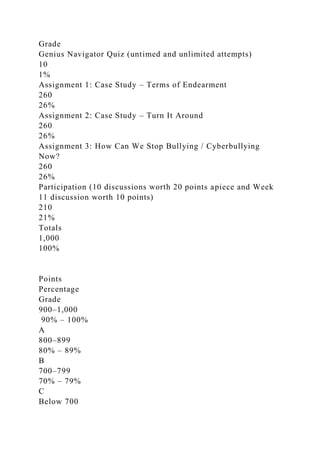
Assignment
Total Points
% of
Grade
Genius Navigator Quiz (untimed and unlimited attempts)
10
1%
Assignment 1: Case Study – Terms of Endearment
260
26%
Assignment 2: Case Study – Turn It Around
260
26%
Assignment 3: How Can We Stop Bullying / Cyberbullying
Now?
260
26%
Participation (10 discussions worth 20 points apiece and Week
11 discussion worth 10 points)
210
21%
Totals
1,000
100%
Points
Percentage
Grade
900–1,000
90% – 100%
A
800–899
80% – 89%
B
700–799
70% – 79%
C
Below 700
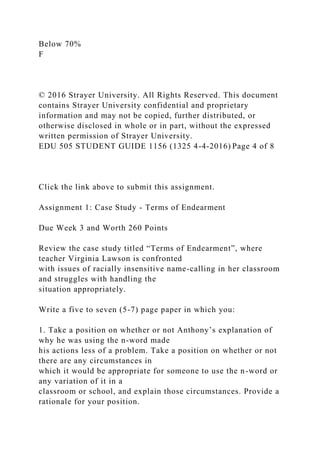
Below 70%
F
© 2016 Strayer University. All Rights Reserved. This document
contains Strayer University confidential and proprietary
information and may not be copied, further distributed, or
otherwise disclosed in whole or in part, without the expressed
written permission of Strayer University.
EDU 505 STUDENT GUIDE 1156 (1325 4-4-2016) Page 4 of 8
Click the link above to submit this assignment.
Assignment 1: Case Study - Terms of Endearment
Due Week 3 and Worth 260 Points
Review the case study titled “Terms of Endearment”, where
teacher Virginia Lawson is confronted
with issues of racially insensitive name-calling in her classroom
and struggles with handling the
situation appropriately.
Write a five to seven (5-7) page paper in which you:
1. Take a position on whether or not Anthony’s explanation of
why he was using the n-word made
his actions less of a problem. Take a position on whether or not
there are any circumstances in
which it would be appropriate for someone to use the n-word or
any variation of it in a
classroom or school, and explain those circumstances. Provide a
rationale for your position.
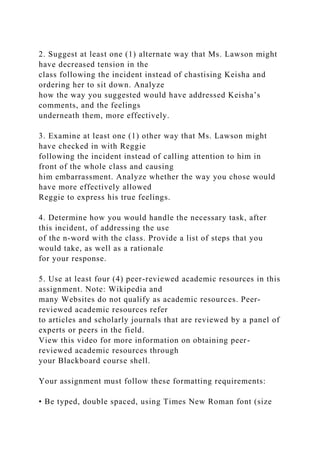
2. Suggest at least one (1) alternate way that Ms. Lawson might
have decreased tension in the
class following the incident instead of chastising Keisha and
ordering her to sit down. Analyze
how the way you suggested would have addressed Keisha’s
comments, and the feelings
underneath them, more effectively.
3. Examine at least one (1) other way that Ms. Lawson might
have checked in with Reggie
following the incident instead of calling attention to him in
front of the whole class and causing
him embarrassment. Analyze whether the way you chose would
have more effectively allowed
Reggie to express his true feelings.
4. Determine how you would handle the necessary task, after
this incident, of addressing the use
of the n-word with the class. Provide a list of steps that you
would take, as well as a rationale
for your response.
5. Use at least four (4) peer-reviewed academic resources in this
assignment. Note: Wikipedia and
many Websites do not qualify as academic resources. Peer-
reviewed academic resources refer
to articles and scholarly journals that are reviewed by a panel of
experts or peers in the field.
View this video for more information on obtaining peer-
reviewed academic resources through
your Blackboard course shell.
Your assignment must follow these formatting requirements:
• Be typed, double spaced, using Times New Roman font (size
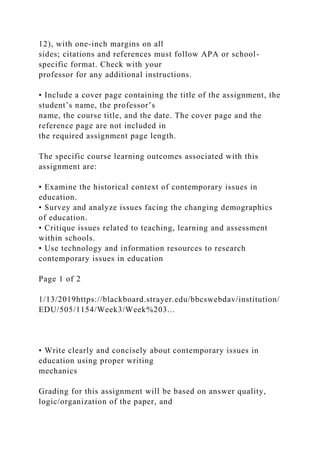
12), with one-inch margins on all
sides; citations and references must follow APA or school-
specific format. Check with your
professor for any additional instructions.
• Include a cover page containing the title of the assignment, the
student’s name, the professor’s
name, the course title, and the date. The cover page and the
reference page are not included in
the required assignment page length.
The specific course learning outcomes associated with this
assignment are:
• Examine the historical context of contemporary issues in
education.
• Survey and analyze issues facing the changing demographics
of education.
• Critique issues related to teaching, learning and assessment
within schools.
• Use technology and information resources to research
contemporary issues in education
Page 1 of 2
1/13/2019https://blackboard.strayer.edu/bbcswebdav/institution/
EDU/505/1154/Week3/Week%203...
• Write clearly and concisely about contemporary issues in
education using proper writing
mechanics
Grading for this assignment will be based on answer quality,
logic/organization of the paper, and
language and writing skills. Click here to review the rubric for
this assignment.
Page 2 of 2
1/13/2019https://blackboard.strayer.edu/bbcswebdav/institution/
EDU/505/1154/Week3/Week%203...

EDU 505 – Contemporary Issues in EducationCOURSE DESCRIPTION.docx

  • 1.
    EDU 505 –Contemporary Issues in Education COURSE DESCRIPTION Examines theory, research, and practices relating to critical issues faced by educators today. Discusses contemporary concerns in American and global education: National and local initiatives in education, the evolving relationship between schools and communities, impacts of public policy on the educational enterprise, and current social, political, economic, and legal issues influencing schools are explored from American and global perspectives. Evaluates the future of education in both industrial and developing countries, including growth of learning needs and inequities both within and between countries. Emphasizes problem identification, analysis, and remediation, with the latter focusing on “best of breed” innovative practices. INSTRUCTIONAL MATERIALS Required Resources – Textbook Tozer, S. E., Senese, G., & Violas, P. C. (2013). School and society: Historical and contemporary perspectives (7th ed.). New York, NY: McGraw-Hill. Required Resources – Articles Baker, B., Sciarra, D., & Farrie, D. (2014). Is School Funding Fair? A National Report Card. Retrieved from http://www.schoolfundingfairness.org/National_Report_Card_2 014.pdf Baker, B., & Corcoran, S. (2012). The Stealth Inequities of School Funding: How State and Local School Finance Systems Perpetuate Inequitable Student Spending. Center for American Progress. Retrieved from
  • 2.
    https://www.americanprogress.org/issues/education/report/2012/ 09/19/38189/the-stealth-inequities-of-school-funding/ Brackemyre, T. (2012).Education to the Masses: The Rise of Public Education in Early America. History Scene. Retrieved from http://www.ushistoryscene.com/uncategorized/riseofpubliceduca tion/ Cobb, N. (2014). Climate, Culture and Collaboration: The Key to Creating Safe and Supportive Schools. Techniques: Connecting Education and Careers. Retrieved from: http://eds.b.ebscohost.com/eds/pdfviewer/pdfviewer?sid=1bde4a 76-6090-47af-8294- 13f37c6936c7%40sessionmgr110&vid=16&hid=112 Gardner, H. (2011). To improve U.S. education, it’s time to treat teachers as professionals. The Washington Post. Retrieved from http://www.washingtonpost.com/national/on-leadership/to- improve-us-education-its-time-to-treat-teachers-as- professionals/2011/07/18/gIQA8oh2LI_story.html Garrity, C., & Jens, K. (1997). Bully Proofing Your School: Creating a Positive Climate. Intervention in School & Clinic. Retrieved from http://eds.b.ebscohost.com/eds/detail/detail?vid=2&sid=1bde4a7 6-6090-47af-8294- 13f37c6936c7%40sessionmgr110&hid=112&bdata=JnNpdGU9Z WRzLWxpdmUmc2NvcGU9c2l0ZQ%3d%3d#db=a9h&AN=9703 123351 Hiler, T., & Hatalsky, L.(2014). TEACH Grant Trap: Program to Encourage Young People to Teach Falls Short. Third Way. Retrieved from http://www.thirdway.org/memo/teach-grant- trap-program-to-encourage-young-people-to-teach-falls-short
  • 3.
    Hinduja, S., &Patchin, J. (2015). Cyberbullying Legislation and Case Law: Implications for School Policy and Practice. Retrieved from http://www.cyberbullying.us/cyberbullying- legal-issues.pdf Indiana University School of Education (2011). Recent School Reform Efforts and Examples of Success in IPS: A Research Brief. Retrieved from http://education.iupui.edu/CUME/pdf/IPS-Reforms-and- Success-Final-Brief.pdf Klein, A., & Camera, L. (2015). NCLB Rewrite Could Target Mandate on Annual Tests. Education Week. Retrieved from http://www.edweek.org/ew/articles/2015/01/09/nclb-rewrite- could-target-mandate-on-annual.html Leachman, M., & Mai, C. (2014). Most States Funding Schools Less Than Before the Recession. Center on Budget and Policy Priorities. Retrieved from http://www.cbpp.org/cms/?fa=view&id=4011 Madison, B. L. (2015). Quantitative Literacy and the Common Core State Standards in Mathematics. Scholar Commons. Retrieved from http://eds.a.ebscohost.com/eds/pdfviewer/pdfviewer?vid=2&sid =0f8862b1-989a-4c06-873b- f0a5d252b9d9%40sessionmgr4002&hid=4113 NEA Common Core State Standards Toolkit. National Education Association. Retrieved from http://www.nea.org/assets/docs/Common-Core-State-Standards- Toolkit.pdf Noguera, P. (2014). Responding to the Challenges Confronting Black and Latino Males: The Role of Public Policy in Countering the “Crisis” and Promoting Success. InMotion
  • 4.
    Magazine. Retrieved from http://www.inmotionmagazine.com/er13/pn_call_roleofpublic.ht ml Noguera,P. (2012). The Achievement Gap and the Schools We Need: Creating the Conditions Where Race and Class No Longer Predict Student Achievement. InMotion Magazine. Retrieved from http://www.inmotionmagazine.com/er12/pn_achvgap.html Noguera, P. (2012). “Saving” Black and Latino Boys. InMotion Magazine. Retrieved from http://www.inmotionmagazine.com/er12/pn_saving.html Strauss, V. (2013). Will charter schools survive the confusing charter movement? The Washington Post. Retrieved from http://www.washingtonpost.com/blogs/answer- sheet/wp/2013/04/03/will-charter-schools-survive-the- confusing-charter-movement/ What is Cyberbullying? (2015). Stopbullying.gov. Retrieved from http://www.stopbullying.gov/cyberbullying/what-is- it/index.html Wolfe, A. (2015). A Critique of ‘The Common Core is a Change for the Better’. ASA Journal of Scholarship and Practice. Retrieved from http://eds.a.ebscohost.com/eds/detail/detail?vid=3&sid=0f8862b 1-989a-4c06-873b- f0a5d252b9d9%40sessionmgr4002&hid=4113&bdata=JnNpdGU 9ZWRzLWxpdmUmc2NvcGU9c2l0ZQ%3d%3d#db=eue&AN=10 0670256 Supplemental Resources and Strayer University Library Online Databases A comprehensive list of supplemental resources and Strayer University Library Online databases that are recommended and / or useful for this course can be found at the end of this course
  • 5.
    guide, in theFaculty Notes section. COURSE LEARNING OUTCOMES 1. Examine the historical context of contemporary issues in education. 2. Analyze how educational theories and practices impact contemporary issues in education. 3. Identify components of educational perspectives that will serve as the foundation for students’ philosophy of education. 4. Survey and analyze issues facing the changing demographics of education. 5. Evaluate the impact of technological change on contemporary issues in education. 6. Critique issues related to teaching, learning, and assessment within schools. 7. Analyze methods of the procurement, management, and accountability of funding sources for schools. 8. Use technology and information resources to research contemporary issues in education. 9. Write clearly and concisely about contemporary issues in education using proper writing mechanics. COURSE TOOLS AND TUTORIALS The following tools and tutorials are resources for this course and will help you succeed at exploring research articles. They should be completed within the first week. · Complete the tutorial in the Course Tools tab in your course shell and the required quiz in Week 1 entitled “Genius Navigator” to earn your Genius Navigator Badge. WEEKLY COURSE SCHEDULE The standard requirement for a 4.5 credit hour course is for students to spend 13.5 hours in weekly work. This includes
  • 6.
    preparation, activities, andevaluation regardless of delivery mode. Week Preparation, Activities, and Evaluation 1 Preparation · Reading(s) · Chapter 1: Introduction: Understanding School and Society · Chapter 2: Liberty and Literacy: The Jeffersonian Ideal · Brackemyre, T. (2012) Education to the Masses: The Rise of Public Education in Early America. History Scene. Retrieved from http://ushistoryscene.com/article/rise-of-public-education/ · Complete the Course Tools and Tutorials in your course shell Activities · Course Expectations and Introductions · Discussion (20 points) Evaluation · Genius Navigator Quiz (10 points) 2 Preparation · Reading(s) · Chapter 3: School as a Public Institution: The Common-School Era · Chapter 10: Teaching in a Public Institution: The Professionalization Movement · Gardner, H. (2011). To improve U.S. education, it’s time to treat teachers as professionals. The Washington Post. Retrieved from http://www.washingtonpost.com/national/on-leadership/to- improve-us-education-its-time-to-treat-teachers-as- professionals/2011/07/18/gIQA8oh2LI_story.html · Case Study · Terms of Endearment, located in the online course shell Activities · Discussion (20 points) Evaluation · None
  • 7.
    3 Preparation · Reading(s) · Chapter4: Social Diversity and Differentiated Schooling: The Progressive Era · Chapter 6: Diversity and Equity: Schooling and African Americans · Chapter 7: Diversity and Equity: Schooling and American Indians · Noguera, P. (2014) Responding to the Challenges Confronting Black and Latino Males: The Role of Public Policy in Countering the “Crisis” and Promoting Success. InMotion Magazine. Retrieved from http://www.inmotionmagazine.com/er13/pn_call_roleofpublic.ht ml · Noguera, P. (2012) The Achievement Gap and the Schools We Need: Creating the Conditions Where Race and Class No Longer Predict Student Achievement. InMotion Magazine. Retrieved from http://www.inmotionmagazine.com/er12/pn_achvgap.html · Noguera, P. (2012) “Saving” Black and Latino Boys. InMotion Magazine. Retrieved from http://www.inmotionmagazine.com/er12/pn_saving.html Activities · Discussion (20 points) Evaluation · Assignment 1: Case Study – Terms of Endearment (260 points) 4 Preparation · Reading(s) · Chapter 5: Diversity and Equity Today: Schooling Girls and Women · Chapter 12: Diversity and Equity Today: Defining the Challenge · Chapter 13: Diversity and Equity Today: Meeting the Challenge Activities
  • 8.
    · Discussion (20points) Evaluation · None 5 Preparation · Reading(s) · Chapter 8: National School Reform: The Early Cold War Era · Hiler, T., & Hatalsky, L. Erickson (2014). TEACH Grant Trap: Program to Encourage Young People to Teach Falls Short. Third Way. Retrieved from http://www.thirdway.org/memo/teach- grant-trap-program-to-encourage-young-people-to-teach-falls- short · Indiana University School of Education (2011). Recent School Reform Efforts and Examples of Success in IPS: A Research Brief. Retrieved from http://education.iupui.edu/CUME/pdf/IPS-Reforms-and- Success-Final-Brief.pdf · Strauss, V. (2013). Will charter schools survive the confusing charter movement? The Washington Post. Retrieved from http://www.washingtonpost.com/blogs/answer- sheet/wp/2013/04/03/will-charter-schools-survive-the- confusing-charter-movement/ · Case Study · Turn It Around!, located in the online course shell Activities · Discussion (20 points) Evaluation · None 6 Preparation · Reading(s) · Chapter 11: Differentiated Schooling, Labor Market Preparation, and Contemporary School Reform: The Post-Cold War Era · Klein, A., & Camera, L. (2015). NCLB Rewrite Could Target Mandate on Annual Tests. Education Week. Retrieved from
  • 9.
    http://www.edweek.org/ew/articles/2015/01/09/nclb-rewrite- could-target-mandate-on-annual.html · Video · Reviewthe video titled “No Child Left Behind: A Decade of Failure” (3 min 42 s), located in the online course shell. You may also view the video at https://www.youtube.com/watch?v=Q0WUqNO0qo4. Activities · Discussion (20 points) Evaluation · Assignment 2: Case Study – Turn It Around! (260 points) 7 Preparation · Reading(s) · NEA Common Core State Standards Toolkit. National Education Association. Retrieved from http://www.nea.org/assets/docs/Common-Core-State-Standards- Toolkit.pdf . · Madison, B. L. (2015) Quantitative Literacy and the Common Core State Standards in Mathematics. Scholar Commons. Retrieved from http://eds.a.ebscohost.com/eds/pdfviewer/pdfviewer?vid=2&sid =0f8862b1-989a-4c06-873b- f0a5d252b9d9%40sessionmgr4002&hid=4113 · Wolfe, A. (2015) A Critique of ‘The Common Core is a Change for the Better’. ASA Journal of Scholarship and Practice. Retrieved from http://eds.a.ebscohost.com/eds/detail/detail?vid=3&sid=0f8862b 1-989a-4c06-873b- f0a5d252b9d9%40sessionmgr4002&hid=4113&bdata=JnNpdGU 9ZWRzLWxpdmUmc2NvcGU9c2l0ZQ%3d%3d#db=eue&AN=10 0670256 Activities · Discussion (20 points) Evaluation
  • 10.
    · None 8 Preparation · Reading(s) ·Baker, B., Sciarra, D., & Farrie, D. (2014). Is School Funding Fair? A National Report Card. Retrieved from http://www.schoolfundingfairness.org/National_Report_Card_2 014.pdf · Baker, B., & Corcoran, S. (2012). The Stealth Inequities of School Funding: How State and Local School Finance Systems Perpetuate Inequitable Student Spending. Center for American Progress. Retrieved from https://www.americanprogress.org/issues/education/report/2012/ 09/19/38189/the-stealth-inequities-of-school-funding/ · Leachman, M. & Mai, C. (2014). Most States Funding Schools Less Than Before the Recession. Center on Budget and Policy Priorities. Retrieved from http://www.cbpp.org/cms/?fa=view&id=4011 Activities · Discussion (20 points) Evaluation · None 9 Preparation · Reading(s) · Garrity, C., & Jens, K. (1997). Bully Proofing Your School: Creating a Positive Climate. Intervention in School & Clinic. Retrieved from http://eds.b.ebscohost.com/eds/detail/detail?vid=2&sid=1bde4a7 6-6090-47af-8294- 13f37c6936c7%40sessionmgr110&hid=112&bdata=JnNpdGU9Z WRzLWxpdmUmc2NvcGU9c2l0ZQ%3d%3d#db=a9h&AN=9703 123351 · Cobb, N. (2014). Climate, Culture and Collaboration: The Key to Creating Safe and Supportive Schools. Techniques: Connecting Education and Careers. Retrieved from:
  • 11.
    http://eds.b.ebscohost.com/eds/pdfviewer/pdfviewer?sid=1bde4a 76-6090-47af-8294- 13f37c6936c7%40sessionmgr110&vid=16&hid=112 Activities · Discussion (20points) Evaluation · None 10 Preparation · Reading(s) · What is Cyberbullying? (2015) Stopbullying.gov. Retrieved from http://www.stopbullying.gov/cyberbullying/what-is- it/index.html · Hinduja, S, and Patchin, J. (2015). Cyberbullying Legislation and Case Law: Implications for School Policy and Practice. Retrieved from http://www.cyberbullying.us/cyberbullying- legal-issues.pdf Activities · Discussion (20 points) Evaluation · Assignment 3: How Can We Stop Bullying / Cyberbullying Now? (260 points) 11 Preparation · Reading(s): None Activities · Discussion (10 points) Evaluation · None GRADING SCALE – GRADUATE Assignment Total Points % of
  • 12.
    Grade Genius Navigator Quiz(untimed and unlimited attempts) 10 1% Assignment 1: Case Study – Terms of Endearment 260 26% Assignment 2: Case Study – Turn It Around 260 26% Assignment 3: How Can We Stop Bullying / Cyberbullying Now? 260 26% Participation (10 discussions worth 20 points apiece and Week 11 discussion worth 10 points) 210 21% Totals 1,000 100% Points Percentage Grade 900–1,000 90% – 100% A 800–899 80% – 89% B 700–799 70% – 79% C Below 700
  • 13.
    Below 70% F © 2016Strayer University. All Rights Reserved. This document contains Strayer University confidential and proprietary information and may not be copied, further distributed, or otherwise disclosed in whole or in part, without the expressed written permission of Strayer University. EDU 505 STUDENT GUIDE 1156 (1325 4-4-2016) Page 4 of 8 Click the link above to submit this assignment. Assignment 1: Case Study - Terms of Endearment Due Week 3 and Worth 260 Points Review the case study titled “Terms of Endearment”, where teacher Virginia Lawson is confronted with issues of racially insensitive name-calling in her classroom and struggles with handling the situation appropriately. Write a five to seven (5-7) page paper in which you: 1. Take a position on whether or not Anthony’s explanation of why he was using the n-word made his actions less of a problem. Take a position on whether or not there are any circumstances in which it would be appropriate for someone to use the n-word or any variation of it in a classroom or school, and explain those circumstances. Provide a rationale for your position.
  • 14.
    2. Suggest atleast one (1) alternate way that Ms. Lawson might have decreased tension in the class following the incident instead of chastising Keisha and ordering her to sit down. Analyze how the way you suggested would have addressed Keisha’s comments, and the feelings underneath them, more effectively. 3. Examine at least one (1) other way that Ms. Lawson might have checked in with Reggie following the incident instead of calling attention to him in front of the whole class and causing him embarrassment. Analyze whether the way you chose would have more effectively allowed Reggie to express his true feelings. 4. Determine how you would handle the necessary task, after this incident, of addressing the use of the n-word with the class. Provide a list of steps that you would take, as well as a rationale for your response. 5. Use at least four (4) peer-reviewed academic resources in this assignment. Note: Wikipedia and many Websites do not qualify as academic resources. Peer- reviewed academic resources refer to articles and scholarly journals that are reviewed by a panel of experts or peers in the field. View this video for more information on obtaining peer- reviewed academic resources through your Blackboard course shell. Your assignment must follow these formatting requirements: • Be typed, double spaced, using Times New Roman font (size
  • 15.
    12), with one-inchmargins on all sides; citations and references must follow APA or school- specific format. Check with your professor for any additional instructions. • Include a cover page containing the title of the assignment, the student’s name, the professor’s name, the course title, and the date. The cover page and the reference page are not included in the required assignment page length. The specific course learning outcomes associated with this assignment are: • Examine the historical context of contemporary issues in education. • Survey and analyze issues facing the changing demographics of education. • Critique issues related to teaching, learning and assessment within schools. • Use technology and information resources to research contemporary issues in education Page 1 of 2 1/13/2019https://blackboard.strayer.edu/bbcswebdav/institution/ EDU/505/1154/Week3/Week%203... • Write clearly and concisely about contemporary issues in education using proper writing mechanics Grading for this assignment will be based on answer quality, logic/organization of the paper, and
  • 16.
    language and writingskills. Click here to review the rubric for this assignment. Page 2 of 2 1/13/2019https://blackboard.strayer.edu/bbcswebdav/institution/ EDU/505/1154/Week3/Week%203...