Documentation 101Why we documentTypes of documentationCreating a Works Cited list in MLACreating in-text citations
Why Document?Acknowledging sources prevents plagiarismthe unacknowledged use of someone else's information, research or ideas, words, or illustrationsDocumentation prevents a number of undesirable consequences“0” grade on the assignment, F in the course, suspension, and at the extreme, expulsion Citing Sources is professional and ethicalconveys to the reader that the writer has taken the time to consult and consider a mix of viewpoints on a given topic before providing his/her own synthesis. adds to the quality of the paper.Is ethical and responsibleWhen students give credit where credit is due they are also practicing ethical, responsible Imagine the consequences of being caught stealing someone else's work or ideas at the workplace.
Types of Documentation MLA – Modern Languages Association used for literature and fine arts essays. APA-American Psychological Association used for social science, humanities, and scientific essaysThese are the most common in post secondary undergraduate programs.
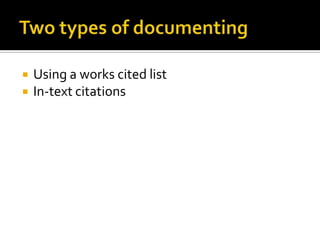
Two types of documentingUsing a works cited listIn-text citations
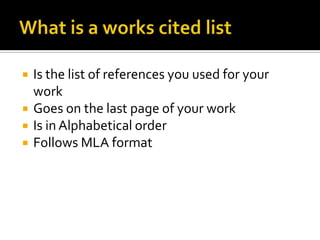
What is a works cited listIs the list of references you used for your workGoes on the last page of your workIs in Alphabetical orderFollows MLA format
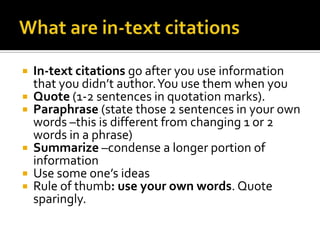
What are in-text citationsIn-text citations go after you use information that you didn’t author. You use them when you Quote (1-2 sentences in quotation marks).Paraphrase (state those 2 sentences in your own words –this is different from changing 1 or 2 words in a phrase)Summarize –condense a longer portion of informationUse some one’s ideasRule of thumb: use your own words. Quote sparingly.
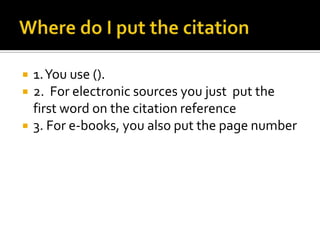
Where do I put the citation1. You use (). 2.  For electronic sources you just  put the first word on the citation reference3. For e-books, you also put the page number
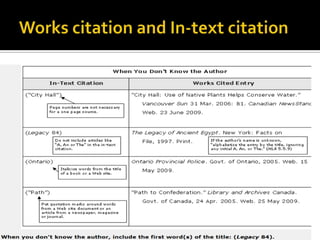
Works citation and In-text citation
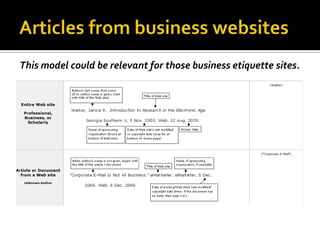
Articles from business websitesThis model could be relevant for those business etiquette sites.
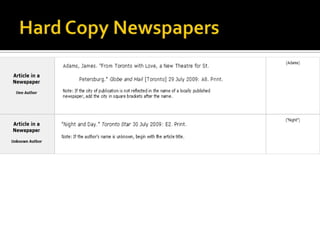
Hard Copy Newspapers
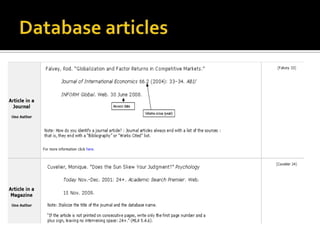
Database articles
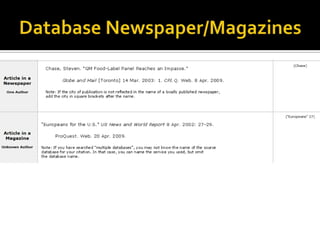
Database Newspaper/Magazines
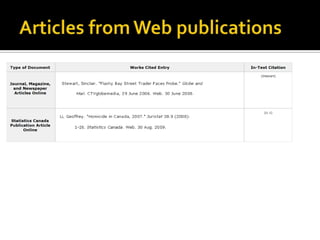
Articles from Web publications
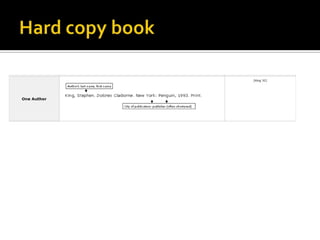
Hard copy book
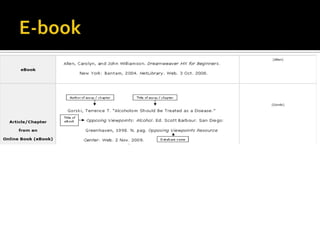
E-book
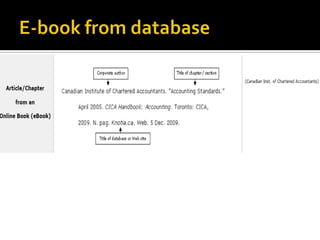
E-book from database
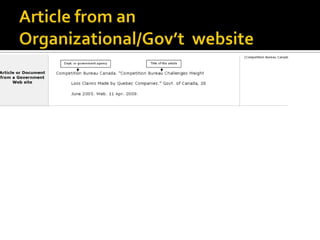
Article from an Organizational/Gov’t  website
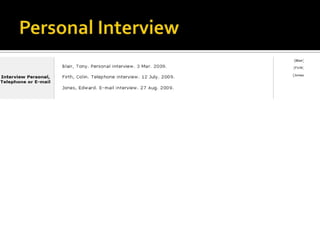
Personal Interview

Documentation 101

  • 1.
    Documentation 101Why wedocumentTypes of documentationCreating a Works Cited list in MLACreating in-text citations
  • 2.
    Why Document?Acknowledging sourcesprevents plagiarismthe unacknowledged use of someone else's information, research or ideas, words, or illustrationsDocumentation prevents a number of undesirable consequences“0” grade on the assignment, F in the course, suspension, and at the extreme, expulsion Citing Sources is professional and ethicalconveys to the reader that the writer has taken the time to consult and consider a mix of viewpoints on a given topic before providing his/her own synthesis. adds to the quality of the paper.Is ethical and responsibleWhen students give credit where credit is due they are also practicing ethical, responsible Imagine the consequences of being caught stealing someone else's work or ideas at the workplace.
  • 3.
    Types of DocumentationMLA – Modern Languages Association used for literature and fine arts essays. APA-American Psychological Association used for social science, humanities, and scientific essaysThese are the most common in post secondary undergraduate programs.
  • 4.
    Two types ofdocumentingUsing a works cited listIn-text citations
  • 5.
    What is aworks cited listIs the list of references you used for your workGoes on the last page of your workIs in Alphabetical orderFollows MLA format
  • 6.
    What are in-textcitationsIn-text citations go after you use information that you didn’t author. You use them when you Quote (1-2 sentences in quotation marks).Paraphrase (state those 2 sentences in your own words –this is different from changing 1 or 2 words in a phrase)Summarize –condense a longer portion of informationUse some one’s ideasRule of thumb: use your own words. Quote sparingly.
  • 7.
    Where do Iput the citation1. You use (). 2. For electronic sources you just put the first word on the citation reference3. For e-books, you also put the page number
  • 8.
    Works citation andIn-text citation
  • 9.
    Articles from businesswebsitesThis model could be relevant for those business etiquette sites.
  • 10.
  • 11.
  • 12.
  • 13.
    Articles from Webpublications
  • 14.
  • 15.
  • 16.
  • 17.
    Article from anOrganizational/Gov’t website
  • 18.