SCHOOOL OF ARCHITECTURE BUILDING AND DESIGN (SABD)
BACHELOR OF SCIENCE (hons) IN ARCHITECTURE
ARC 61303 THEORIES OF ARCHITECTURE & URBANISM
PROJECT II: COMPARATIVE ANALYSIS ESSAY
NEHRU BAZAR ROAD, JAIPUR, INDIA
&
JALAN BESAR, KLANG
NAME: CARLSON KO
STUDENT ID: 0319564
TUTOR: MR NICHOLAS
2
CONTENTS
INTRODUCTION
BACKGROUND
o URBAN BACKGROUND
o RESPONSE TO TROPICAL CLIMATE
o ECONOMY AND STREETSCAPE
o URBAN CULTURE AND SOCIETY
CONCLUSION
REFERENCES
3
INTRODUCTION
In this comparative analysis essay, findings from Project 1 (Case Study) and the local
site research from Design Studio V are to be analysed beside each other. The main
framework of this analysis is built upon the similarities and differences based on the
patterns of social activities, types of ‘contact points’ and the varying degrees of contact
intensity between the two cities.
Although both cities are placed around the same context of urban landscaped, they
differ in terms of their physical environment which is a factor that influences the activities to
a varying degree and in many different ways. This essay is focused basically on the outdoor
activities and the number of physical conditions that influence them. These activities will
then spark the life between the buildings. This is what Gehl suggest the concept of varying
degrees of contact intensity as the basis or outline of various contact forms.
In summary, outdoor activities that are in public spaces can be divided into three
categories which is necessary activities, optional activities and also social activities. Each of
these activities placed different demands on the physical environment.
4
BACKGROUND
NEHRU BAZAR ROAD
Nehru Bazar road is a busy vehicular road in Jaipur, let me introduce Jaipur. Jaipur is
Rajasthan’s biggest city and its capital. It is known as the “Pink City” due to the distinct
colour of its buildings, coated during the visit of the Prince of Wales in 1905-06. Jaipur is
known for its fascinating monuments and colourful markets as it is for its gorgeous
handloom garments and wonderfully laid out gardens. Along with Delhi and Agra, Jaipur
forms the Golden Triangle of Indian tourism.
Nehru Bazar is a market and a “biggest selling point” that worked in standard
Rajasthani style and houses endless shops that are prevalent for the foot wears, sacks,
prepared to wear articles of clothing, family things, packs and endowments.
Some notable landmarks that can be seen like Sawan Bhado Park, Museum of Gem
and Jewellery and the Ajmeri Gates.
JALAN BESAR, KLANG
Jalan Besar is a major one-way road that stretches from Jalan Dato Hamzah. Many
notable roads are connected to Jalan Besar but not the Lebuhraya Persekutuan, but there
are 3 road that are able to come to Jalan Besar easily from the 3 major places which is Port
Klang, Bandar Bukit Tinggi and also Kampung Jawa.
Jalan Besar is flanked by historical buildings with distinctive facades, but most of the
buildings did not preserved well which leads to nobody staying in the building. Narrow alleys
between the shops are often used as transitional spaces while some alleys come with a
relatively gloomy and ominous environment. There is also small street food behind that is
quite popular. In Jalan Besar, there is also Little India near by which sells clothes, eatery and
many more.
5
Notable landmarks Jalan Besar such as Mahkamah Klang, Masjid India Klang, Stesen
Komuter Klang and another mosque called Masjid Bandar Diraja Klang. Stesen Komuter
Klang is one of the oldest in Klang and how it shapes the area.
6
URBAN LANDSCAPES
Urban landscapes are the physical characteristics that constitutes a certain place,
city or town. With that Nehru Bazar Road and Jalan Besar Both share similar and dissimilar
traits.
NEHRU BAZAR ROAD
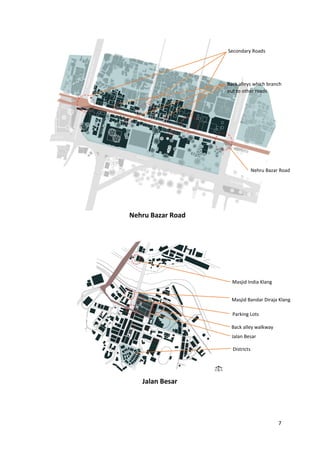
When locals refer to Nehru Bazar road, they will have an image of busy vehicular
road and with equal bustling roadside movement comes to mind. Thus, when observed as a
pattern from a macro scale, the diffusion of movement is apparent from the vehicular main
road to the smaller pedestrian way alongside it. The side streets also become a long road
that meander for pedestrian only, some branching out repeatedly, forming district areas of
various sizes, which are all placed in Nehru Bazar. Besides connecting the surrounding
districts, the small side streets or back alley also function as shortcuts (mostly walking and
bike but not for large vehicles) from Nehru Bazar Road to its main roads, Chaura Rasta Road,
Mi Road and also Kishanpole Bazar Road a distance away due to the presence of districts.
From this urban pattern, a number of different economic and districts are created,
all contributing to form a colourful and complete landscape of Nehru Bazar Road.
JALAN BESAR
Similarity, with Jalan Besar, the congested vehicular road framed by the pedestrian
activities on the sidewalk comes to mind, but when observed from a macro scale, adjacent
roads like Lebuhraya Persekutuan are located much closer to Jalan Besar. Jalan Besar is also
connected with several back alleys or so called “lorongs” by Malaysian for the locals. These
alleys are much shorter than the ones in Nehru Bazar and it also mainly functions as a
shortcut way for pedestrian which they feel safer and doesn’t have so much noise pollution
behind the alleys. Economic and social focused nodes are located alongside Jalan Besar, at
the ground level and entrances of the buildings spilling out to immediate sidewalk.
From the urban landscape, street activities are more point focused rather than
spreading out over the district.
7
Nehru Bazar Road
Jalan Besar
Nehru Bazar Road
Back alleys which branch
out to other roads
Secondary Roads
Jalan Besar
Back alley walkway
Masjid Bandar Diraja Klang
Masjid India Klang
Districts
Parking Lots
8
RESPONSE TO TROPICAL CLIMATE
The weather in India is monsoon and rainy season, lasting from July to September.
The season is dominated by the humid southwest summer monsoon, which slowly sweeps
across the country beginning in late May or early June. As India claims as one of the hottest
cities. Overall, it is unrelenting simply because it doesn’t cool significantly at night.
Weather in Kuala Lumpur is also quite similar to India, the monsoon and rainy
season/ With temperature fluctuating around 27 to 35 degrees maybe more throughout the
year, hot and humid weather is expected with also a fair amount of rain all year round. As
observed on site, the busiest traffic is along Jalan Besar which is in the morning and also
evening when the weather is not that bad. People usually be indoors for work, business in
the afternoon or lunch and head back indoors later on. Shoppers and also tourist tend to
begin their tour or shopping in the morning or evening when the weather is cooler or much
better.
Along the Nehru Bazar Road, the buildings are all set back to make space for
pedestrian sidewalk, for the shoppers, tourist and also pedestrians. The sidewalk is the only
way for the shoppers, tourist and also pedestrians getting from one place to another,
regardless the weather. It has not many trees for shading, just five-foot walkways for people
to walk which might make the walkway kind of congested in the afternoon, this allow
pedestrians to have shading devices also as a buffer zone. When the building is paired with
overhang roofs for buildings, it allows pedestrians have more space to circulate and even
more cosy shopfronts are created with the presence of shading and proximities.
So, the five-foot walkway also gives an excellent function for the shop owners, which
allows them to display their goods at the walkway, it also functions as a temporary shelter
for the pedestrians. To escape the scorching sun, pedestrians will simply enter the five-foot
walkway in the afternoon for a short rest or shelter, but in the morning, some of them will
eventually walk outside the five foot walkway or beside the roads. Shopkeepers often pull
up a stool to sit in front of their shops to mingle amongst each other under the shades when
they have no customers. Acquaintances to close friendships are the type of contact forms
created, due to the potential activities.
9
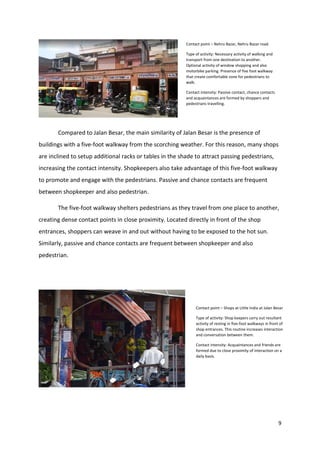
Compared to Jalan Besar, the main similarity of Jalan Besar is the presence of
buildings with a five-foot walkway from the scorching weather. For this reason, many shops
are inclined to setup additional racks or tables in the shade to attract passing pedestrians,
increasing the contact intensity. Shopkeepers also take advantage of this five-foot walkway
to promote and engage with the pedestrians. Passive and chance contacts are frequent
between shopkeeper and also pedestrian.
The five-foot walkway shelters pedestrians as they travel from one place to another,
creating dense contact points in close proximity. Located directly in front of the shop
entrances, shoppers can weave in and out without having to be exposed to the hot sun.
Similarly, passive and chance contacts are frequent between shopkeeper and also
pedestrian.
Contact point – Nehru Bazar, Nehru Bazar road.
Type of activity: Necessary activity of walking and
transport from one destination to another.
Optional activity of window shopping and also
motorbike parking. Presence of five foot walkway
that create comfortable zone for pedestrians to
walk.
Contact intensity: Passive contact, chance contacts
and acquaintances are formed by shoppers and
pedestrians travelling.
Contact point – Shops at Little India at Jalan Besar
Type of activity: Shop keepers carry out resultant
activity of resting in five-foot walkways in front of
shop entrances. This routine increases interaction
and conversation between them.
Contact intensity: Acquaintances and friends are
formed due to close proximity of interaction on a
daily basis.
10
Lastly, temporary food and retail
stalls / carts along Nehru Bazar are also
affected heavily by the tropical climate.
Most stalls are set up under the shade
of buildings, while some are sheltered
by umbrellas that also help create
contact points due to a more cooling
walking space experience. This
phenomenon creates more area for
optional activities which are shopping
and browsing. To avoid direct exposure
from the sun, several stalls are set up at back alleys or side lanes.
Similar to the footways, pavements that are supposed to facilitate human traffic are
ironically avoided due to its direct exposure to harsh weather. One thing about both of
these places is, there are no seating areas for pedestrian. Lastly, growth of trees and shrubs
along Jalan Besar are too small and inconsistent to play a big part in shading pedestrians.
Due to these reasons, the necessary activity of travelling place to place decreases in
efficiency.
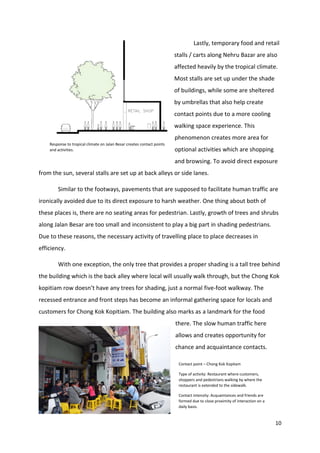
With one exception, the only tree that provides a proper shading is a tall tree behind
the building which is the back alley where local will usually walk through, but the Chong Kok
kopitiam row doesn’t have any trees for shading, just a normal five-foot walkway. The
recessed entrance and front steps has become an informal gathering space for locals and
customers for Chong Kok Kopitiam. The building also marks as a landmark for the food
there. The slow human traffic here
allows and creates opportunity for
chance and acquaintance contacts.
Response to tropical climate on Jalan Besar creates contact points
and activities.
Contact point – Chong Kok Kopitam
Type of activity: Restaurant where customers,
shoppers and pedestrians walking by where the
restaurant is extended to the sidewalk.
Contact intensity: Acquaintances and friends are
formed due to close proximity of interaction on a
daily basis.
11
ECONOMY AND STREETSCAPE
City streetscaped are first and foremost places is an assemblage of people rather
than economic and political units. The fact that it complicates the study of urban economics.
Looking more closely at the land use on these two sites, the spatial organization of activities
on street level must be analysed.
The main similarity is that commerce is the major economy for both Nehru Bazar
Road and Jalan Besar. Crowds from different parts of the cities flock the streets with the
intention of buying and spending. In Nehru Bazar Road, people tend to visit different
districts for their well-known specialities, whereas in Jalan Besar, economic typologies are
very much textile based, but nodes are more point based.
During daytime at Jalan Besar, the main commercial activities are located in the front
of the shops where customers have their meal for breakfast and also some are there to wait
for their seats. The contact intensity is high, involving passive and chance contacts, as
existing crowds draw more people to the restaurant. Friends and acquaintances are also
created due to the personal activities. Along the road, textile wholesalers, cloth shops, Tip
bits shops all scales make up the economy of Jalan Besar. Some working community that
takes train in the morning, usually need to walk pass Jalan Besar straight to the KTM station.
In terms of informal and temporary stalls, both Nehru Bazar and Jalan Besar share
similarities and also differences. On the Nehru Bazar Road, the percentage of stalls selling
street food is one of the highest followed by retail such as clothing and fabrics. Some of
these stalls are located behind the back alley, where there are big trees as shading devices
and spaces that are not used. Typically, most of the stalls are arranged along the sidewalks
for easier engagement for pedestrians as they pass.
Whereas on Jalan Besar, a higher percentage of temporary stall complement the
existing economy mostly selling street food, or a small food stall by using the space as their
restaurant. Compared to the Nehru Bazar road, the stalls are different in terms of pattern
they started from Lorong or back alleys and are segregated along the sidewalks.
12
Lastly, the walkability and experience of the streetscaped with both the roads. At
Nehru Bazar Road, consistent five-foot walkways line both side of the buildings. Due to
several slow lanes of vehicles, the pedestrians there just walk through the road without any
safety precautions.
Jalan Besar pace is much faster pace which the roads are much busier and more
vehicles. The roads around Jalan Besar are highways, which there are also zebra crossing
available for pedestrian safety. In addition to that, some of the locals are observed creating
their own informal spots to pause and wait to cross the road. Furthermore, parked vehicles
along Jalan Besar, and some double parked slows down the traffic. This phenomenon forms
a small concentration of people, leading to passive contacts.
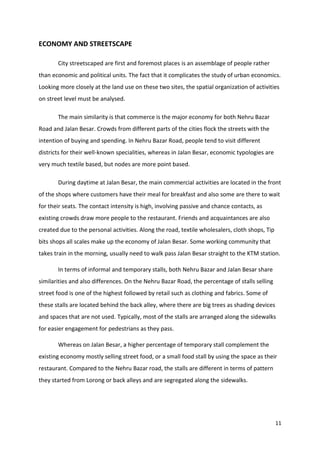
Contact point – Alley beside Nehru Bazar
Type of activity: Stalls are branched out to the alley
to bring pedestrians in and how it can
communicate.
Contact intensity: Passive, chance of contacts and
acquaintances.
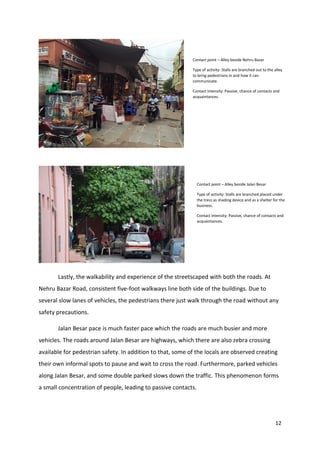
Contact point – Alley beside Jalan Besar
Type of activity: Stalls are branched placed under
the tress as shading device and as a shelter for the
business.
Contact intensity: Passive, chance of contacts and
acquaintances.
13
URBAN CULTURE AND SOCIETY
Urban culture is the behavioural pattern of various types of urban areas. It refers to
a culture placed and rooted in an urban space, a space from which the culture has
originated and manifested itself in a manner strictly related to the spatial characteristics of
the specific given urban context. Analysis of urban culture and its society can affect or
exhibit how well educated they are, how healthy they are and usually have a strong
correlation to what they value.
From once renowned street for the transportation and as a city, Jalan Besar has been
forgotten by the people. Most youngsters move out to the cities. The large number of
foreign / migrant workers at Jalan Besar has changed the cultural scene entirely. The
economy of the street used to run by Chinese owners. But now, gentrification is a
developing phenomenon as foreign workers are hired as shop keepers, instead of locals. The
interaction between the foreigners and the locals are kept to the minimal, observed through
optional activities such as shopping and just buying food. As for the locals only stay
temporarily for retail reasins and mostly is the elderly. Chance and passive contacts are the
most common among the two types of community In Jalan Besar. Resultant activities are
rare or one sided, and does nothing to straighten social bonds, as locals have a perception
of foreigners being threatening and rough people and people also feel unsafe at night.
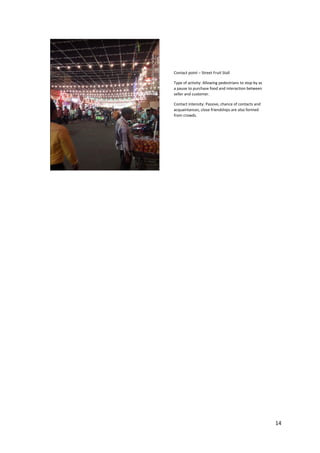
For Nehru Bazar, the night market and during night it is still happening in Nehru
Bazar but not Jalan Besar, keeping in trend the lights that lights up the street, this bazar
attracts a high percentage of families. The close proximity of stalls and welcoming
atmosphere increase the interaction between stall operator and also the customer.
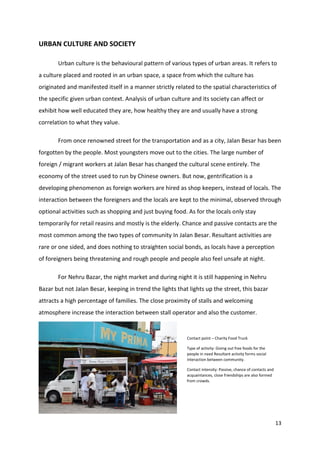
Contact point – Charity Food Truck
Type of activity: Giving out free foods for the
people in need Resultant activity forms social
interaction between community.
Contact intensity: Passive, chance of contacts and
acquaintances, close friendships are also formed
from crowds.
14
Contact point – Street Fruit Stall
Type of activity: Allowing pedestrians to stop by as
a pause to purchase food and interaction between
seller and customer.
Contact intensity: Passive, chance of contacts and
acquaintances, close friendships are also formed
from crowds.
15
CONCLUSION
To conclude, Jalan Besar and Nehru Bazar Road are quite similar overall but not
during night time: both are commercial streets mostly targeted at community, shoppers and
also tourist. Though it is supported with slightly different activities and contact intensities,
the habits and intentions of people in both areas are kind of similar.
When analysed from a closer perspective, Nehru Bazar provides a much more
cultural atmosphere at a smaller scale, whereas Jalan Besar is much more modern. Nehru
Bazar provides greater intimacy and cultural connection but Jalan Besar is much more
walkable.
The life between building at both sides are greatly similar overall but both have their
own qualities when experienced personally.
16
REFERENCES
• This, L. L. (Ed.). (2017, December 19). Jaipur Shopping | Best places to shop in India.
Retrieved June 18, 2017, from https://www.youtube.com/watch?v=sHNm7ukgyWs
• T. S. (2015, December 12). 10 places to visit in Klang. Retrieved June 18, 2018, from
https://www.roughguides.com/special-features/living-the-past-the-ancient-professions-of-
old-delhi-2/
• V. W. (2017, January 26). 10 Unique Things to Do in Klang, Malaysia. Retrieved June 18,
2018, from https://www.theislanddrum.com/unique-klang-sightseeing/
• T. A. (2018, May 31). Jalan Besar Macro. Retrieved June 18, 2018, from
https://docs.google.com/presentation/d/1d3Ag35Y54_kyDyxHt8a7YG9VDM-
h0_xRIvLcr5gh08s/edit#slide=id.g36c1a35adb_0_0

Final comparative essay (print)

  • 1.
    SCHOOOL OF ARCHITECTUREBUILDING AND DESIGN (SABD) BACHELOR OF SCIENCE (hons) IN ARCHITECTURE ARC 61303 THEORIES OF ARCHITECTURE & URBANISM PROJECT II: COMPARATIVE ANALYSIS ESSAY NEHRU BAZAR ROAD, JAIPUR, INDIA & JALAN BESAR, KLANG NAME: CARLSON KO STUDENT ID: 0319564 TUTOR: MR NICHOLAS
  • 2.
    2 CONTENTS INTRODUCTION BACKGROUND o URBAN BACKGROUND oRESPONSE TO TROPICAL CLIMATE o ECONOMY AND STREETSCAPE o URBAN CULTURE AND SOCIETY CONCLUSION REFERENCES
  • 3.
    3 INTRODUCTION In this comparativeanalysis essay, findings from Project 1 (Case Study) and the local site research from Design Studio V are to be analysed beside each other. The main framework of this analysis is built upon the similarities and differences based on the patterns of social activities, types of ‘contact points’ and the varying degrees of contact intensity between the two cities. Although both cities are placed around the same context of urban landscaped, they differ in terms of their physical environment which is a factor that influences the activities to a varying degree and in many different ways. This essay is focused basically on the outdoor activities and the number of physical conditions that influence them. These activities will then spark the life between the buildings. This is what Gehl suggest the concept of varying degrees of contact intensity as the basis or outline of various contact forms. In summary, outdoor activities that are in public spaces can be divided into three categories which is necessary activities, optional activities and also social activities. Each of these activities placed different demands on the physical environment.
  • 4.
    4 BACKGROUND NEHRU BAZAR ROAD NehruBazar road is a busy vehicular road in Jaipur, let me introduce Jaipur. Jaipur is Rajasthan’s biggest city and its capital. It is known as the “Pink City” due to the distinct colour of its buildings, coated during the visit of the Prince of Wales in 1905-06. Jaipur is known for its fascinating monuments and colourful markets as it is for its gorgeous handloom garments and wonderfully laid out gardens. Along with Delhi and Agra, Jaipur forms the Golden Triangle of Indian tourism. Nehru Bazar is a market and a “biggest selling point” that worked in standard Rajasthani style and houses endless shops that are prevalent for the foot wears, sacks, prepared to wear articles of clothing, family things, packs and endowments. Some notable landmarks that can be seen like Sawan Bhado Park, Museum of Gem and Jewellery and the Ajmeri Gates. JALAN BESAR, KLANG Jalan Besar is a major one-way road that stretches from Jalan Dato Hamzah. Many notable roads are connected to Jalan Besar but not the Lebuhraya Persekutuan, but there are 3 road that are able to come to Jalan Besar easily from the 3 major places which is Port Klang, Bandar Bukit Tinggi and also Kampung Jawa. Jalan Besar is flanked by historical buildings with distinctive facades, but most of the buildings did not preserved well which leads to nobody staying in the building. Narrow alleys between the shops are often used as transitional spaces while some alleys come with a relatively gloomy and ominous environment. There is also small street food behind that is quite popular. In Jalan Besar, there is also Little India near by which sells clothes, eatery and many more.
  • 5.
    5 Notable landmarks JalanBesar such as Mahkamah Klang, Masjid India Klang, Stesen Komuter Klang and another mosque called Masjid Bandar Diraja Klang. Stesen Komuter Klang is one of the oldest in Klang and how it shapes the area.
  • 6.
    6 URBAN LANDSCAPES Urban landscapesare the physical characteristics that constitutes a certain place, city or town. With that Nehru Bazar Road and Jalan Besar Both share similar and dissimilar traits. NEHRU BAZAR ROAD When locals refer to Nehru Bazar road, they will have an image of busy vehicular road and with equal bustling roadside movement comes to mind. Thus, when observed as a pattern from a macro scale, the diffusion of movement is apparent from the vehicular main road to the smaller pedestrian way alongside it. The side streets also become a long road that meander for pedestrian only, some branching out repeatedly, forming district areas of various sizes, which are all placed in Nehru Bazar. Besides connecting the surrounding districts, the small side streets or back alley also function as shortcuts (mostly walking and bike but not for large vehicles) from Nehru Bazar Road to its main roads, Chaura Rasta Road, Mi Road and also Kishanpole Bazar Road a distance away due to the presence of districts. From this urban pattern, a number of different economic and districts are created, all contributing to form a colourful and complete landscape of Nehru Bazar Road. JALAN BESAR Similarity, with Jalan Besar, the congested vehicular road framed by the pedestrian activities on the sidewalk comes to mind, but when observed from a macro scale, adjacent roads like Lebuhraya Persekutuan are located much closer to Jalan Besar. Jalan Besar is also connected with several back alleys or so called “lorongs” by Malaysian for the locals. These alleys are much shorter than the ones in Nehru Bazar and it also mainly functions as a shortcut way for pedestrian which they feel safer and doesn’t have so much noise pollution behind the alleys. Economic and social focused nodes are located alongside Jalan Besar, at the ground level and entrances of the buildings spilling out to immediate sidewalk. From the urban landscape, street activities are more point focused rather than spreading out over the district.
  • 7.
    7 Nehru Bazar Road JalanBesar Nehru Bazar Road Back alleys which branch out to other roads Secondary Roads Jalan Besar Back alley walkway Masjid Bandar Diraja Klang Masjid India Klang Districts Parking Lots
  • 8.
    8 RESPONSE TO TROPICALCLIMATE The weather in India is monsoon and rainy season, lasting from July to September. The season is dominated by the humid southwest summer monsoon, which slowly sweeps across the country beginning in late May or early June. As India claims as one of the hottest cities. Overall, it is unrelenting simply because it doesn’t cool significantly at night. Weather in Kuala Lumpur is also quite similar to India, the monsoon and rainy season/ With temperature fluctuating around 27 to 35 degrees maybe more throughout the year, hot and humid weather is expected with also a fair amount of rain all year round. As observed on site, the busiest traffic is along Jalan Besar which is in the morning and also evening when the weather is not that bad. People usually be indoors for work, business in the afternoon or lunch and head back indoors later on. Shoppers and also tourist tend to begin their tour or shopping in the morning or evening when the weather is cooler or much better. Along the Nehru Bazar Road, the buildings are all set back to make space for pedestrian sidewalk, for the shoppers, tourist and also pedestrians. The sidewalk is the only way for the shoppers, tourist and also pedestrians getting from one place to another, regardless the weather. It has not many trees for shading, just five-foot walkways for people to walk which might make the walkway kind of congested in the afternoon, this allow pedestrians to have shading devices also as a buffer zone. When the building is paired with overhang roofs for buildings, it allows pedestrians have more space to circulate and even more cosy shopfronts are created with the presence of shading and proximities. So, the five-foot walkway also gives an excellent function for the shop owners, which allows them to display their goods at the walkway, it also functions as a temporary shelter for the pedestrians. To escape the scorching sun, pedestrians will simply enter the five-foot walkway in the afternoon for a short rest or shelter, but in the morning, some of them will eventually walk outside the five foot walkway or beside the roads. Shopkeepers often pull up a stool to sit in front of their shops to mingle amongst each other under the shades when they have no customers. Acquaintances to close friendships are the type of contact forms created, due to the potential activities.
  • 9.
    9 Compared to JalanBesar, the main similarity of Jalan Besar is the presence of buildings with a five-foot walkway from the scorching weather. For this reason, many shops are inclined to setup additional racks or tables in the shade to attract passing pedestrians, increasing the contact intensity. Shopkeepers also take advantage of this five-foot walkway to promote and engage with the pedestrians. Passive and chance contacts are frequent between shopkeeper and also pedestrian. The five-foot walkway shelters pedestrians as they travel from one place to another, creating dense contact points in close proximity. Located directly in front of the shop entrances, shoppers can weave in and out without having to be exposed to the hot sun. Similarly, passive and chance contacts are frequent between shopkeeper and also pedestrian. Contact point – Nehru Bazar, Nehru Bazar road. Type of activity: Necessary activity of walking and transport from one destination to another. Optional activity of window shopping and also motorbike parking. Presence of five foot walkway that create comfortable zone for pedestrians to walk. Contact intensity: Passive contact, chance contacts and acquaintances are formed by shoppers and pedestrians travelling. Contact point – Shops at Little India at Jalan Besar Type of activity: Shop keepers carry out resultant activity of resting in five-foot walkways in front of shop entrances. This routine increases interaction and conversation between them. Contact intensity: Acquaintances and friends are formed due to close proximity of interaction on a daily basis.
  • 10.
    10 Lastly, temporary foodand retail stalls / carts along Nehru Bazar are also affected heavily by the tropical climate. Most stalls are set up under the shade of buildings, while some are sheltered by umbrellas that also help create contact points due to a more cooling walking space experience. This phenomenon creates more area for optional activities which are shopping and browsing. To avoid direct exposure from the sun, several stalls are set up at back alleys or side lanes. Similar to the footways, pavements that are supposed to facilitate human traffic are ironically avoided due to its direct exposure to harsh weather. One thing about both of these places is, there are no seating areas for pedestrian. Lastly, growth of trees and shrubs along Jalan Besar are too small and inconsistent to play a big part in shading pedestrians. Due to these reasons, the necessary activity of travelling place to place decreases in efficiency. With one exception, the only tree that provides a proper shading is a tall tree behind the building which is the back alley where local will usually walk through, but the Chong Kok kopitiam row doesn’t have any trees for shading, just a normal five-foot walkway. The recessed entrance and front steps has become an informal gathering space for locals and customers for Chong Kok Kopitiam. The building also marks as a landmark for the food there. The slow human traffic here allows and creates opportunity for chance and acquaintance contacts. Response to tropical climate on Jalan Besar creates contact points and activities. Contact point – Chong Kok Kopitam Type of activity: Restaurant where customers, shoppers and pedestrians walking by where the restaurant is extended to the sidewalk. Contact intensity: Acquaintances and friends are formed due to close proximity of interaction on a daily basis.
  • 11.
    11 ECONOMY AND STREETSCAPE Citystreetscaped are first and foremost places is an assemblage of people rather than economic and political units. The fact that it complicates the study of urban economics. Looking more closely at the land use on these two sites, the spatial organization of activities on street level must be analysed. The main similarity is that commerce is the major economy for both Nehru Bazar Road and Jalan Besar. Crowds from different parts of the cities flock the streets with the intention of buying and spending. In Nehru Bazar Road, people tend to visit different districts for their well-known specialities, whereas in Jalan Besar, economic typologies are very much textile based, but nodes are more point based. During daytime at Jalan Besar, the main commercial activities are located in the front of the shops where customers have their meal for breakfast and also some are there to wait for their seats. The contact intensity is high, involving passive and chance contacts, as existing crowds draw more people to the restaurant. Friends and acquaintances are also created due to the personal activities. Along the road, textile wholesalers, cloth shops, Tip bits shops all scales make up the economy of Jalan Besar. Some working community that takes train in the morning, usually need to walk pass Jalan Besar straight to the KTM station. In terms of informal and temporary stalls, both Nehru Bazar and Jalan Besar share similarities and also differences. On the Nehru Bazar Road, the percentage of stalls selling street food is one of the highest followed by retail such as clothing and fabrics. Some of these stalls are located behind the back alley, where there are big trees as shading devices and spaces that are not used. Typically, most of the stalls are arranged along the sidewalks for easier engagement for pedestrians as they pass. Whereas on Jalan Besar, a higher percentage of temporary stall complement the existing economy mostly selling street food, or a small food stall by using the space as their restaurant. Compared to the Nehru Bazar road, the stalls are different in terms of pattern they started from Lorong or back alleys and are segregated along the sidewalks.
  • 12.
    12 Lastly, the walkabilityand experience of the streetscaped with both the roads. At Nehru Bazar Road, consistent five-foot walkways line both side of the buildings. Due to several slow lanes of vehicles, the pedestrians there just walk through the road without any safety precautions. Jalan Besar pace is much faster pace which the roads are much busier and more vehicles. The roads around Jalan Besar are highways, which there are also zebra crossing available for pedestrian safety. In addition to that, some of the locals are observed creating their own informal spots to pause and wait to cross the road. Furthermore, parked vehicles along Jalan Besar, and some double parked slows down the traffic. This phenomenon forms a small concentration of people, leading to passive contacts. Contact point – Alley beside Nehru Bazar Type of activity: Stalls are branched out to the alley to bring pedestrians in and how it can communicate. Contact intensity: Passive, chance of contacts and acquaintances. Contact point – Alley beside Jalan Besar Type of activity: Stalls are branched placed under the tress as shading device and as a shelter for the business. Contact intensity: Passive, chance of contacts and acquaintances.
  • 13.
    13 URBAN CULTURE ANDSOCIETY Urban culture is the behavioural pattern of various types of urban areas. It refers to a culture placed and rooted in an urban space, a space from which the culture has originated and manifested itself in a manner strictly related to the spatial characteristics of the specific given urban context. Analysis of urban culture and its society can affect or exhibit how well educated they are, how healthy they are and usually have a strong correlation to what they value. From once renowned street for the transportation and as a city, Jalan Besar has been forgotten by the people. Most youngsters move out to the cities. The large number of foreign / migrant workers at Jalan Besar has changed the cultural scene entirely. The economy of the street used to run by Chinese owners. But now, gentrification is a developing phenomenon as foreign workers are hired as shop keepers, instead of locals. The interaction between the foreigners and the locals are kept to the minimal, observed through optional activities such as shopping and just buying food. As for the locals only stay temporarily for retail reasins and mostly is the elderly. Chance and passive contacts are the most common among the two types of community In Jalan Besar. Resultant activities are rare or one sided, and does nothing to straighten social bonds, as locals have a perception of foreigners being threatening and rough people and people also feel unsafe at night. For Nehru Bazar, the night market and during night it is still happening in Nehru Bazar but not Jalan Besar, keeping in trend the lights that lights up the street, this bazar attracts a high percentage of families. The close proximity of stalls and welcoming atmosphere increase the interaction between stall operator and also the customer. Contact point – Charity Food Truck Type of activity: Giving out free foods for the people in need Resultant activity forms social interaction between community. Contact intensity: Passive, chance of contacts and acquaintances, close friendships are also formed from crowds.
  • 14.
    14 Contact point –Street Fruit Stall Type of activity: Allowing pedestrians to stop by as a pause to purchase food and interaction between seller and customer. Contact intensity: Passive, chance of contacts and acquaintances, close friendships are also formed from crowds.
  • 15.
    15 CONCLUSION To conclude, JalanBesar and Nehru Bazar Road are quite similar overall but not during night time: both are commercial streets mostly targeted at community, shoppers and also tourist. Though it is supported with slightly different activities and contact intensities, the habits and intentions of people in both areas are kind of similar. When analysed from a closer perspective, Nehru Bazar provides a much more cultural atmosphere at a smaller scale, whereas Jalan Besar is much more modern. Nehru Bazar provides greater intimacy and cultural connection but Jalan Besar is much more walkable. The life between building at both sides are greatly similar overall but both have their own qualities when experienced personally.
  • 16.
    16 REFERENCES • This, L.L. (Ed.). (2017, December 19). Jaipur Shopping | Best places to shop in India. Retrieved June 18, 2017, from https://www.youtube.com/watch?v=sHNm7ukgyWs • T. S. (2015, December 12). 10 places to visit in Klang. Retrieved June 18, 2018, from https://www.roughguides.com/special-features/living-the-past-the-ancient-professions-of- old-delhi-2/ • V. W. (2017, January 26). 10 Unique Things to Do in Klang, Malaysia. Retrieved June 18, 2018, from https://www.theislanddrum.com/unique-klang-sightseeing/ • T. A. (2018, May 31). Jalan Besar Macro. Retrieved June 18, 2018, from https://docs.google.com/presentation/d/1d3Ag35Y54_kyDyxHt8a7YG9VDM- h0_xRIvLcr5gh08s/edit#slide=id.g36c1a35adb_0_0