Downloaded 105 times

![Appointment of Liquidator[Sec. 448]Official Liquidator attached to the High Court or District Court becomes the liquidator of the companyConducts winding up and other duties as Court may impose3](https://image.slidesharecdn.com/final-100926140351-phpapp02/85/Final-3-320.jpg)

![Powers of liquidator [Sec. 457]To institute or defend any suit, prosecution, or other legal proceeding, civil or criminal, in the name and on behalf of the company;5](https://image.slidesharecdn.com/final-100926140351-phpapp02/85/Final-5-320.jpg)
![Powers of liquidator [Cont.]Case: Gleitlager(India) (P) Ltd v Killick Nixon Ltd.In computing the period for suits on behalf of the company, the period from the date of commencement of winding up to the date of the order and one year from the date of such order is excluded [S 458-A]. The extension is available only for suits on behalf of the company and not on behalf of the secured creditor6](https://image.slidesharecdn.com/final-100926140351-phpapp02/85/Final-6-320.jpg)
![Powers of liquidator [Cont.]2. To carry on the business of the company so far as may be necessary for the beneficial winding up of the company;7](https://image.slidesharecdn.com/final-100926140351-phpapp02/85/Final-7-320.jpg)
![Powers of liquidator [Cont.]Case: Alexander Ward& Co. v Samyang National Co. This has been held to include the power to ratify acts which, when in being, the company would have the power to perform. Summons for the arrest of a ship on behalf of a company which was without directors at the time, were ratified by the liquidator. The ratification was held to be binding8](https://image.slidesharecdn.com/final-100926140351-phpapp02/85/Final-8-320.jpg)
![Powers of liquidator [Cont.]3. To sell the immovable and movable property and actionable claims of the company by public auction or private contract, with power to transfer the whole thereof to any person or body corporate, or to sell the same in parcels;Bank of India v Bharat Electrical Industries Ltd: confirmation of sale at a low price as against the original reserve price3(i). to sell whole to the undertaking of the company as a going concern;9](https://image.slidesharecdn.com/final-100926140351-phpapp02/85/Final-9-320.jpg)
![Powers of liquidator [Cont.]4. To rise on the security of the assets of the company any money requisite;5. To do all such other things as may be necessary for winding up the affairs of the company and distributing its assets.10](https://image.slidesharecdn.com/final-100926140351-phpapp02/85/Final-10-320.jpg)

![Powers: Without the sanction [Cont.]4. Draw, accept or endorse any negotiable instruments on behalf of the company5. To take out, in his official name, letters of administration on any deceased contributory and to so, in his official name, any other act necessary for obtaining payment of any money due from the contributory or his estate6. To appoint an agent to so any business which the liquidator is unable to do himself12](https://image.slidesharecdn.com/final-100926140351-phpapp02/85/Final-12-320.jpg)
![Powers: Without the sanction [Cont.]A liquidator :Can issue a notice to persons to submit SOA (Statement Of Affairs)Can call any person to record any statementHave separate bank account for each sale of proceedHas to present to the court twice a year accounts13](https://image.slidesharecdn.com/final-100926140351-phpapp02/85/Final-13-320.jpg)
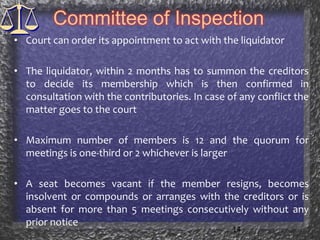


![Disclaimer of Onerous Property[Sec. 535]Onerous Property ≈ White ElephantLand burdened with covenantsShares in companiesUnsaleable propertyUnprofitable contractDuty of the court to help liquidator to get rid of “Onerous Property”Case: RakaCorpn (P) Ltd.18](https://image.slidesharecdn.com/final-100926140351-phpapp02/85/Final-18-320.jpg)
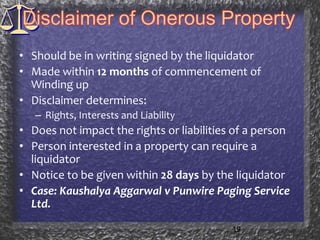







1) A liquidator is appointed to wind up a company's affairs and administer its assets for the benefit of creditors and shareholders. The liquidator's powers include instituting legal proceedings, carrying on the company's business, and selling the company's property and assets. 2) A provisional liquidator may be appointed before a winding up order if the company's assets are at risk of being diverted or if the company is non-functioning with accumulating debts. 3) The liquidator can disclaim onerous property like unprofitable contracts or unsaleable assets within 12 months to relieve the company of future obligations or losses.


