WINDING UP OFA COMPANY
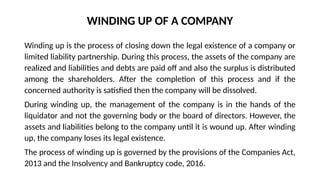
Winding up is the process of closing down the legal existence of a company or
limited liability partnership. During this process, the assets of the company are
realized and liabilities and debts are paid off and also the surplus is distributed
among the shareholders. After the completion of this process and if the
concerned authority is satisfied then the company will be dissolved.
During winding up, the management of the company is in the hands of the
liquidator and not the governing body or the board of directors. However, the
assets and liabilities belong to the company until it is wound up. After winding
up, the company loses its legal existence.
The process of winding up is governed by the provisions of the Companies Act,
2013 and the Insolvency and Bankruptcy code, 2016.
3.
Continued…
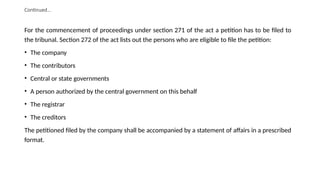
For the commencementof proceedings under section 271 of the act a petition has to be filed to
the tribunal. Section 272 of the act lists out the persons who are eligible to file the petition:
• The company
• The contributors
• Central or state governments
• A person authorized by the central government on this behalf
• The registrar
• The creditors
The petitioned filed by the company shall be accompanied by a statement of affairs in a prescribed
format.
4.
VOLUNTARY WINDING UP
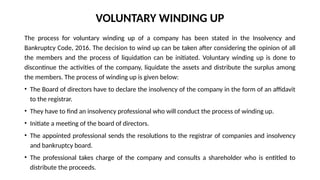
Theprocess for voluntary winding up of a company has been stated in the Insolvency and
Bankruptcy Code, 2016. The decision to wind up can be taken after considering the opinion of all
the members and the process of liquidation can be initiated. Voluntary winding up is done to
discontinue the activities of the company, liquidate the assets and distribute the surplus among
the members. The process of winding up is given below:
• The Board of directors have to declare the insolvency of the company in the form of an affidavit
to the registrar.
• They have to find an insolvency professional who will conduct the process of winding up.
• Initiate a meeting of the board of directors.
• The appointed professional sends the resolutions to the registrar of companies and insolvency
and bankruptcy board.
• The professional takes charge of the company and consults a shareholder who is entitled to
distribute the proceeds.
5.
Continued…
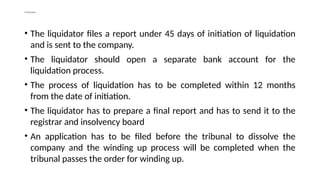
• The liquidatorfiles a report under 45 days of initiation of liquidation
and is sent to the company.
• The liquidator should open a separate bank account for the
liquidation process.
• The process of liquidation has to be completed within 12 months
from the date of initiation.
• The liquidator has to prepare a final report and has to send it to the
registrar and insolvency board
• An application has to be filed before the tribunal to dissolve the
company and the winding up process will be completed when the
tribunal passes the order for winding up.
7.
Creditors Voluntary WindingUp
This type of Winding up cannot takes place without the approval of
creditors. This kind of winding up comes in picture when company has
defaulted in filling declaration of solvency. A meeting of members and
creditors simultaneously must be called and conducted after passing of
resolution of voluntary liquidation in board meeting, for taking approval
on the same. The members must approve the scheme by passing
special resolution. Then the creditors meeting will be held for their
approval. The creditors will proceed with appointing a liquidator of
their choice who will take charge of the winding up process. The
liquidator will take in control of all the assets of the company and will
settle the claims of the creditors.
8.
Continued…
According to recentamendments, Section 59 of Insolvency and bankruptcy code,2016 governs
Voluntary winding up. The procedure is as follows-
• Board meeting is conducted in which voluntary winding up is proposed.
• A declaration is filed by majority of directors, that either company has no debts, or they will be
able to pay debts in full by realizing its assets. The company does not aim to defraud any
person along with the declaration, following attachments should be filed with ROC –
1. Audited financial statements and record of business operations of the company for previous 2
years or for period since its incorporation whichever is later.
2. A report of valuation of assets of the company, prepared by a registered valuer.
• Within 4 weeks of passing of declaration by the directors, shareholders must approve the
proposal scheme of voluntary winding up by passing a special resolution.
• Any debt is due to any person by the company, creditors holding 2/3rd
in value of debt must
approve such resolution. A voluntary winding up for a company deemed to begin on the date
when resolution is passed.
9.
Tribunal while passingthe order of winding up, shall appoint an official liquidator or liquidator from the panel maintained under sub section
(2) as the company liquidator [section 275(1)]. Terms and conditions relating to the appointment of the liquidator, fee to be paid will be
specified by the tribunal. The liquidator must file a declaration in prescribed form within 7 days of its appointment disclosing conflict of
interest, if any.
Powers and Functions of Liquidator (section 290)
• To sell whole of the undertaking of a company as a going concern.
• To obtain any professional assistance or appoint any professional to discharge its duties for protection of assets of the company or to
defend their rights.
• To inspect any records or returns of the company, filed with registrar or any other authority.
• To invite and settle claims of creditors and employees.
• To carry on business for the beneficial winding up of the company.
• To do all acts in the name and behalf of the company.
Liquidator has also got powers to access the information systems, for proof of the claims made by creditors. To gather information regarding
debtors’ financial position and its operations. This information can be gathered from the database maintained by the board, agency of
government and even from the registrar of companies. If creditors want any details regarding the financial affairs of the debtor, the liquidator
is bound to provide details within seven days of receiving request.



![Tribunal while passing the order of winding up, shall appoint an official liquidator or liquidator from the panel maintained under sub section
(2) as the company liquidator [section 275(1)]. Terms and conditions relating to the appointment of the liquidator, fee to be paid will be
specified by the tribunal. The liquidator must file a declaration in prescribed form within 7 days of its appointment disclosing conflict of
interest, if any.
Powers and Functions of Liquidator (section 290)
• To sell whole of the undertaking of a company as a going concern.
• To obtain any professional assistance or appoint any professional to discharge its duties for protection of assets of the company or to
defend their rights.
• To inspect any records or returns of the company, filed with registrar or any other authority.
• To invite and settle claims of creditors and employees.
• To carry on business for the beneficial winding up of the company.
• To do all acts in the name and behalf of the company.
Liquidator has also got powers to access the information systems, for proof of the claims made by creditors. To gather information regarding
debtors’ financial position and its operations. This information can be gathered from the database maintained by the board, agency of
government and even from the registrar of companies. If creditors want any details regarding the financial affairs of the debtor, the liquidator
is bound to provide details within seven days of receiving request.](https://image.slidesharecdn.com/messi-250720070227-c5cc8b6a/85/SEBI-appointments-term-penalties-power-9-320.jpg)