Winding Up Winding up/liquidation represents the last stage in company’s life. It is a proceeding by which a company is dissolved. The company’s assets are disposed of , the debts are paid off out of the realised assets , and the surplus , if any is then distributed among the members in proportion to their holdings in the company
Modes of Winding Up There are two modes of winding up of a company. Winding up by the Tribunal Voluntary winding up which may be (a) members’ voluntary winding up  OR (b) creditors’ voluntary winding up
Winding Up by Tribunal The is also known as compulsory winding up and a company may be wound up in the following cases. Special resolution of the company Default in delivering the statutory report to the Registrar Failure to commence/suspension of business Reduction in membership Inability to pay its debts Just and equitable
Petition An application to the Tribunal for the winding up of a company is made by a petition . This may be presented in following cases: Petition by the company Petition by any creditor/creditors Petition by any contributory/contributories Petition by Registrar Petition by central Government
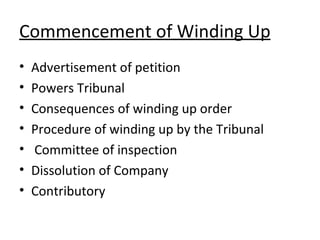
Commencement of Winding Up Advertisement of petition Powers Tribunal Consequences of winding up order Procedure of winding up by the Tribunal Committee of inspection Dissolution of Company Contributory
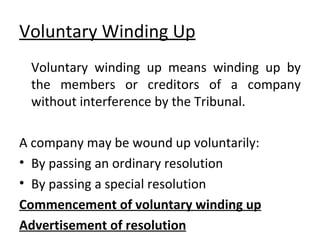
Voluntary Winding Up Voluntary winding up means winding up by the members or creditors of a company without interference by the Tribunal. A company may be wound up voluntarily: By passing an ordinary resolution By passing a special resolution Commencement of voluntary winding up Advertisement of resolution
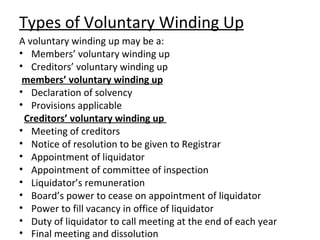
Types of Voluntary Winding Up A voluntary winding up may be a: Members’ voluntary winding up Creditors’ voluntary winding up members’ voluntary winding up Declaration of solvency Provisions applicable Creditors’ voluntary winding up   Meeting of creditors Notice of resolution to be given to Registrar Appointment of liquidator Appointment of committee of inspection Liquidator’s remuneration Board’s power to cease on appointment of liquidator Power to fill vacancy in office of liquidator Duty of liquidator to call meeting at the end of each year Final meeting and dissolution
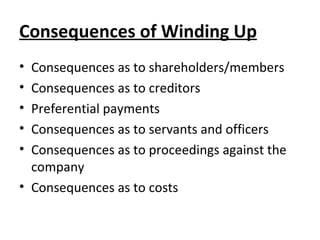
Consequences of Winding Up Consequences as to shareholders/members Consequences as to creditors Preferential payments Consequences as to servants and officers Consequences as to proceedings against the company Consequences as to costs

Winding up

  • 1.
    Winding Up Windingup/liquidation represents the last stage in company’s life. It is a proceeding by which a company is dissolved. The company’s assets are disposed of , the debts are paid off out of the realised assets , and the surplus , if any is then distributed among the members in proportion to their holdings in the company
  • 2.
    Modes of WindingUp There are two modes of winding up of a company. Winding up by the Tribunal Voluntary winding up which may be (a) members’ voluntary winding up OR (b) creditors’ voluntary winding up
  • 3.
    Winding Up byTribunal The is also known as compulsory winding up and a company may be wound up in the following cases. Special resolution of the company Default in delivering the statutory report to the Registrar Failure to commence/suspension of business Reduction in membership Inability to pay its debts Just and equitable
  • 4.
    Petition An applicationto the Tribunal for the winding up of a company is made by a petition . This may be presented in following cases: Petition by the company Petition by any creditor/creditors Petition by any contributory/contributories Petition by Registrar Petition by central Government
  • 5.
    Commencement of WindingUp Advertisement of petition Powers Tribunal Consequences of winding up order Procedure of winding up by the Tribunal Committee of inspection Dissolution of Company Contributory
  • 6.
    Voluntary Winding UpVoluntary winding up means winding up by the members or creditors of a company without interference by the Tribunal. A company may be wound up voluntarily: By passing an ordinary resolution By passing a special resolution Commencement of voluntary winding up Advertisement of resolution
  • 7.
    Types of VoluntaryWinding Up A voluntary winding up may be a: Members’ voluntary winding up Creditors’ voluntary winding up members’ voluntary winding up Declaration of solvency Provisions applicable Creditors’ voluntary winding up Meeting of creditors Notice of resolution to be given to Registrar Appointment of liquidator Appointment of committee of inspection Liquidator’s remuneration Board’s power to cease on appointment of liquidator Power to fill vacancy in office of liquidator Duty of liquidator to call meeting at the end of each year Final meeting and dissolution
  • 8.
    Consequences of WindingUp Consequences as to shareholders/members Consequences as to creditors Preferential payments Consequences as to servants and officers Consequences as to proceedings against the company Consequences as to costs