Types of liquidation
•Creditors' voluntary liquidation: When a company is insolvent and creditors think it can't be saved.
• Members' voluntary liquidation: When a company is solvent and shareholders agree to liquidate.
• Compulsory liquidation: When the NCLT orders a company to liquidate and can a winding up order
because it can't pay its debts.
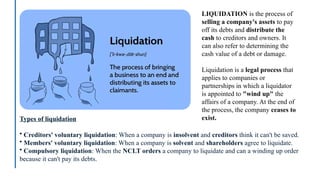
LIQUIDATION is the process of
selling a company's assets to pay
off its debts and distribute the
cash to creditors and owners. It
can also refer to determining the
cash value of a debt or damage.
Liquidation is a legal process that
applies to companies or
partnerships in which a liquidator
is appointed to "wind up" the
affairs of a company. At the end of
the process, the company ceases to
exist.
3.
Section 33
Initiation OfLiquidation
Adjudicating Authority can pass an order to
liquidate a Corporate Debtor if:
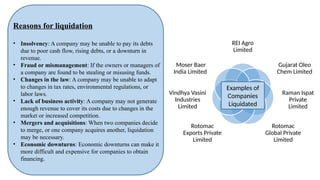
a) Resolution Plan is not received by AA before:
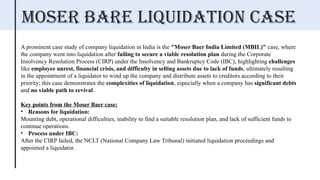
• Expiry of CIRP period, or
• Maximum period for completion of CIRP u/s 12 has been completed, or
• Maximum period (90 days) of Fast Track CIRP u/s 56 has been expired.
b) AA rejects the resolution plan u/s 31 for non- compliance.
c) Resolution Professional during CIRP communicates to AA that COC by >= 66% voting share has taken
the decision to liquidate the Corporate Debtor.
d) Resolution plan is approved by AA u/s 31 but its terms are contravened by Corporate Debtor and any
person whose interest are prejudicially affected makes an application to AA for liquidation order.
On passing an order for liquidation, AA shall:
• Issue a public announcement that the Corporate Debtor is in liquidation, and
• Require such order of liquidation to be sent to the authority under which Corporate Debtor is registered.
4.
No suitsor other legal proceedings shall be instituted by or against the Corporate Debtor. (However, suits may
be initiated by the liquidator on behalf of the Corporate Debtor with the prior approval of the Adjudicating
Authority.)
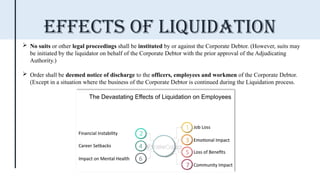
Order shall be deemed notice of discharge to the officers, employees and workmen of the Corporate Debtor.
(Except in a situation where the business of the Corporate Debtor is continued during the Liquidation process.
Effects of liquidation
5.
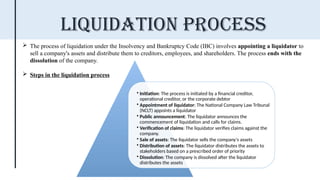
The processof liquidation under the Insolvency and Bankruptcy Code (IBC) involves appointing a liquidator to
sell a company's assets and distribute them to creditors, employees, and shareholders. The process ends with the
dissolution of the company.
Steps in the liquidation process
Liquidation Process
• Initiation: The process is initiated by a financial creditor,
operational creditor, or the corporate debtor
• Appointment of liquidator: The National Company Law Tribunal
(NCLT) appoints a liquidator
• Public announcement: The liquidator announces the
commencement of liquidation and calls for claims.
• Verification of claims: The liquidator verifies claims against the
company.
• Sale of assets: The liquidator sells the company's assets
• Distribution of assets: The liquidator distributes the assets to
stakeholders based on a prescribed order of priority
• Dissolution: The company is dissolved after the liquidator
distributes the assets
6.
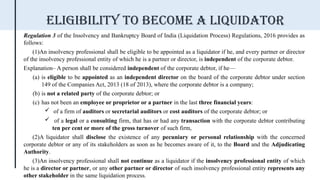
Regulation 3 ofthe Insolvency and Bankruptcy Board of India (Liquidation Process) Regulations, 2016 provides as
follows:
(1)An insolvency professional shall be eligible to be appointed as a liquidator if he, and every partner or director
of the insolvency professional entity of which he is a partner or director, is independent of the corporate debtor.
Explanation– A person shall be considered independent of the corporate debtor, if he—
(a) is eligible to be appointed as an independent director on the board of the corporate debtor under section
149 of the Companies Act, 2013 (18 of 2013), where the corporate debtor is a company;
(b) is not a related party of the corporate debtor; or
(c) has not been an employee or proprietor or a partner in the last three financial years:
of a firm of auditors or secretarial auditors or cost auditors of the corporate debtor; or
of a legal or a consulting firm, that has or had any transaction with the corporate debtor contributing
ten per cent or more of the gross turnover of such firm,
(2)A liquidator shall disclose the existence of any pecuniary or personal relationship with the concerned
corporate debtor or any of its stakeholders as soon as he becomes aware of it, to the Board and the Adjudicating
Authority.
(3)An insolvency professional shall not continue as a liquidator if the insolvency professional entity of which
he is a director or partner, or any other partner or director of such insolvency professional entity represents any
other stakeholder in the same liquidation process.
Eligibility to become a liquidator
7.
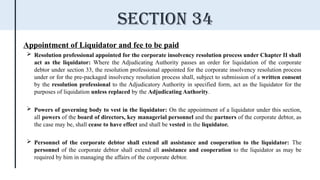
Appointment of Liquidatorand fee to be paid
Resolution professional appointed for the corporate insolvency resolution process under Chapter II shall
act as the liquidator: Where the Adjudicating Authority passes an order for liquidation of the corporate
debtor under section 33, the resolution professional appointed for the corporate insolvency resolution process
under or for the pre-packaged insolvency resolution process shall, subject to submission of a written consent
by the resolution professional to the Adjudicatory Authority in specified form, act as the liquidator for the
purposes of liquidation unless replaced by the Adjudicating Authority.
Powers of governing body to vest in the liquidator: On the appointment of a liquidator under this section,
all powers of the board of directors, key managerial personnel and the partners of the corporate debtor, as
the case may be, shall cease to have effect and shall be vested in the liquidator.
Personnel of the corporate debtor shall extend all assistance and cooperation to the liquidator: The
personnel of the corporate debtor shall extend all assistance and cooperation to the liquidator as may be
required by him in managing the affairs of the corporate debtor.
Section 34
8.
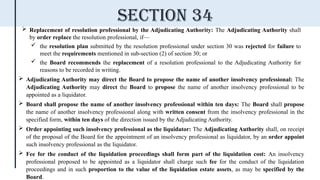
Replacement ofresolution professional by the Adjudicating Authority: The Adjudicating Authority shall
by order replace the resolution professional, if—
the resolution plan submitted by the resolution professional under section 30 was rejected for failure to
meet the requirements mentioned in sub-section (2) of section 30; or
the Board recommends the replacement of a resolution professional to the Adjudicating Authority for
reasons to be recorded in writing.
Adjudicating Authority may direct the Board to propose the name of another insolvency professional: The
Adjudicating Authority may direct the Board to propose the name of another insolvency professional to be
appointed as a liquidator.
Board shall propose the name of another insolvency professional within ten days: The Board shall propose
the name of another insolvency professional along with written consent from the insolvency professional in the
specified form, within ten days of the direction issued by the Adjudicating Authority.
Order appointing such insolvency professional as the liquidator: The Adjudicating Authority shall, on receipt
of the proposal of the Board for the appointment of an insolvency professional as liquidator, by an order appoint
such insolvency professional as the liquidator.
Fee for the conduct of the liquidation proceedings shall form part of the liquidation cost: An insolvency
professional proposed to be appointed as a liquidator shall charge such fee for the conduct of the liquidation
proceedings and in such proportion to the value of the liquidation estate assets, as may be specified by the
Board.
Section 34
9.
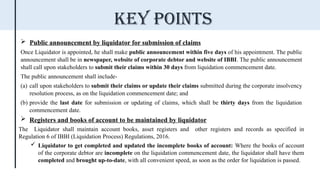
Public announcementby liquidator for submission of claims
Once Liquidator is appointed, he shall make public announcement within five days of his appointment. The public
announcement shall be in newspaper, website of corporate debtor and website of IBBI. The public announcement
shall call upon stakeholders to submit their claims within 30 days from liquidation commencement date.
The public announcement shall include-
(a) call upon stakeholders to submit their claims or update their claims submitted during the corporate insolvency
resolution process, as on the liquidation commencement date; and
(b) provide the last date for submission or updating of claims, which shall be thirty days from the liquidation
commencement date.
Registers and books of account to be maintained by liquidator
The Liquidator shall maintain account books, asset registers and other registers and records as specified in
Regulation 6 of IBBI (Liquidation Process) Regulations, 2016.
Liquidator to get completed and updated the incomplete books of account: Where the books of account
of the corporate debtor are incomplete on the liquidation commencement date, the liquidator shall have them
completed and brought up-to-date, with all convenient speed, as soon as the order for liquidation is passed.
Key points
10.
Prescribed booksand registers to be preserved at least for 8 years: The liquidator shall maintain the
following registers and books, as may be applicable, in relation to the liquidation of the corporate debtor, and
shall preserve them for a period of eight years after the dissolution of the corporate debtor—
a) Cash Book;
b) Ledger;
c) Bank Ledger;
d) Register of Fixed Assets and Inventories;
e) Securities and Investment Register;
f) Register of Book Debts and Outstanding Debts; etc.
Books and registers may be modified in form to fit the facts and circumstances: The registers and books may be
maintained with such modifications as the liquidator may deem fit in the facts and circumstances of the liquidation
process.
Receipts of all payments and expenses: The liquidator shall keep receipts for all payments made or expenses
incurred by him.
Key points
11.
Assets whichwill not form part of liquidation assets
As per section 36(4), the following shall not be included in the liquidation estate assets and shall not be used for
recovery in the liquidation:—
assets owned by a third party which are in possession of the corporate debtor, including—
a) assets held in trust for any third party; bailment contracts;
b) all sums due to any workman or employee from the provident fund, the pension fund and the
gratuity fund. "Workman" shall have the same meaning as assigned to it in section 2(s) of the
Industrial Disputes Act, 1947 - section 3(36);
c) other contractual arrangements which do not stipulate transfer of title but only use of the assets;
and
personal assets of any shareholder or partner of a corporate debtor as the case may be provided such assets
are not held on account of avoidance transactions that may be avoided under this Chapter;
assets of any Indian or foreign subsidiary of the corporate debtor; or
any other assets as may be specified by the Board.
Key points
12.
Asset SaleReport
Asset Sale Report shall be prepared as specified in Regulation 36 of IBBI (Liquidation Process) Regulations, 2016
which provides as follows:
On sale of an asset, the liquidator shall prepare an asset sale report in respect of said asset, to be enclosed with
the Progress Reports, containing—
(a) the realized value;
(b) cost of realization, if any;
(c) the manner and mode of sale;
(d) if the value realized is less than the value in the asset memorandum, the reasons for the same;
(e) the person to whom the sale is made; and
(f) any other details of the sale.
Key points
13.
Submission ofproof of claims to Liquidator
Regulation 16 as substituted by the Insolvency and Bankruptcy Board of India (Liquidation Process) (Amendment)
Regulations, 2019, w.e.f. 25-7-2019 provides that:
(1) A person who claims to be a stakeholder, shall submit its claim, or update its claim submitted during the corporate
insolvency resolution process, including interest, if any, on or before the last date mentioned in the public
announcement.
(2) A person shall prove its claim for debt or dues to him, including interest, if any, as on the liquidation
commencement date. Further, the proof of claims shall be submitted to Liquidator as follows —
Operational Creditor - Operational Creditor (other than a workman or employee) shall submit proof of
claims in person, by post or electronically as contained in IBBI (Liquidation Process) Regulations, 2016,
with details specified in Regulation 17.
The existence of debt due to an operational creditor under this Regulation may be proved on the basis of—
• the records available with an information utility, if any; or
• other relevant documents which adequately establish the debt, including any or all of the following—
i. a contract for the supply of goods and services with corporate debtor;
ii. an invoice demanding payment for the goods and services supplied to the corporate debtor
iii. an order of a court or tribunal that has adjudicated upon the non payment of a debt, if any; and
iv. financial accounts.
Submission of proof of claims
14.
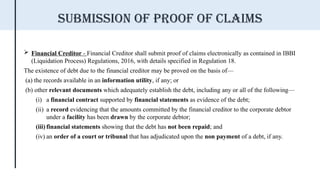
Financial Creditor- Financial Creditor shall submit proof of claims electronically as contained in IBBI
(Liquidation Process) Regulations, 2016, with details specified in Regulation 18.
The existence of debt due to the financial creditor may be proved on the basis of—
(a) the records available in an information utility, if any; or
(b) other relevant documents which adequately establish the debt, including any or all of the following—
(i) a financial contract supported by financial statements as evidence of the debt;
(ii) a record evidencing that the amounts committed by the financial creditor to the corporate debtor
under a facility has been drawn by the corporate debtor;
(iii) financial statements showing that the debt has not been repaid; and
(iv) an order of a court or tribunal that has adjudicated upon the non payment of a debt, if any.
Submission of proof of claims
15.
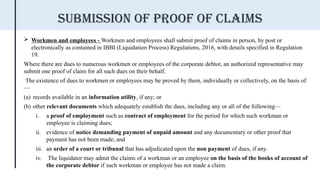
Workmen andemployees - Workmen and employees shall submit proof of claims in person, by post or
electronically as contained in IBBI (Liquidation Process) Regulations, 2016, with details specified in Regulation
19.
Where there are dues to numerous workmen or employees of the corporate debtor, an authorized representative may
submit one proof of claim for all such dues on their behalf.
The existence of dues to workmen or employees may be proved by them, individually or collectively, on the basis of
—
(a) records available in an information utility, if any; or
(b) other relevant documents which adequately establish the dues, including any or all of the following—
i. a proof of employment such as contract of employment for the period for which such workman or
employee is claiming dues;
ii. evidence of notice demanding payment of unpaid amount and any documentary or other proof that
payment has not been made; and
iii. an order of a court or tribunal that has adjudicated upon the non payment of dues, if any.
iv. The liquidator may admit the claims of a workman or an employee on the basis of the books of account of
the corporate debtor if such workman or employee has not made a claim.
Submission of proof of claims
16.
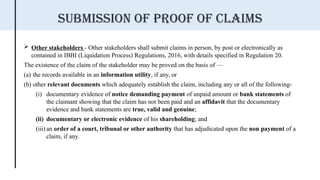
Other stakeholders- Other stakeholders shall submit claims in person, by post or electronically as
contained in IBBI (Liquidation Process) Regulations, 2016, with details specified in Regulation 20.
The existence of the claim of the stakeholder may be proved on the basis of —
(a) the records available in an information utility, if any, or
(b) other relevant documents which adequately establish the claim, including any or all of the following-
(i) documentary evidence of notice demanding payment of unpaid amount or bank statements of
the claimant showing that the claim has not been paid and an affidavit that the documentary
evidence and bank statements are true, valid and genuine;
(ii) documentary or electronic evidence of his shareholding; and
(iii) an order of a court, tribunal or other authority that has adjudicated upon the non payment of a
claim, if any.
Submission of proof of claims
17.
Consolidation ofClaims
(1)Receive or collect the claims of creditors within a period of thirty days: The liquidator shall receive or
collect the claims of creditors within a period of thirty days from the date of the commencement of the
liquidation process - section 38(1).
(2)Submission of claim by the financial creditor: A financial creditor may submit a claim to the liquidator
by providing a record of such claim with an information utility. However, where the information relating to the
claim is not recorded in the information utility, the financial creditor may submit claim with supporting
documents to prove the claim in the same manner as provided for the submission of claims for the operational
creditor under sub-section (3) [section 38(2)].
(3)Submission of claim by an operation creditor: An operational creditor may submit a claim to the
liquidator in manner, along with supporting documents required to prove the claim as may be specified by the
Board [section 38(3)].
(4)Submission of claim by financial cum operational creditor: A creditor who is partly a financial
creditor and partly an operational creditor shall submit claims to the liquidator to the extent of his financial debt
in the manner provided in section 38(2) and to the extent of his operational debt under section 38(3) [section
38(4)].
(5)Withdrawal or variation of claim within 14 days: A creditor may withdraw or vary his claim under this
section within fourteen days of its submission [section 38(5)].
Verification of claims
18.
Mode ofsale
The liquidator shall ordinarily sell the assets of the corporate debtor through an auction. Regulation 33 of IBBI
(Liquidation Process) Regulations, 2016 in this regard are as follows:
Private sale in certain cases
The liquidator may sell the assets of the corporate debtor by means of private sale in the manner specified in
Schedule I when:
(a) the asset is perishable
(b) the asset is likely to deteriorate in value significantly if not sold immediately
(c) the asset is sold at a price higher than the reserve price of a failed auction; or
(d) the prior permission of the Adjudicating Authority has been obtained for such sale:
The liquidator shall not sell the assets, without prior permission of the Adjudicating Authority, by way
of private sale to:
(e) a related party of the corporate debtor
(f) his related party; or
(g) any professional appointed by him.
Sale of assets of cd
19.
No salein case of collusion between buyers
The liquidator shall not proceed with the sale of an asset if he has reason to believe that there is any
collusion between the buyers, or the corporate debtor's related parties and buyers, or the creditors and the
buyer, and shall submit a report to the Adjudicating Authority in this regard, seeking appropriate orders
against the colluding parties.
All money to be paid into bank account except petty cash
The liquidator shall open a bank account in the name of the corporate debtor followed by the words 'in
liquidation', in a scheduled bank, for the receipt of all moneys due to the corporate debtor.
The liquidator shall deposit in the bank account opened-
(1) all moneys, including cheques and demand drafts received by him as the liquidator of the corporate
debtor, and the realizations of each day shall be deposited into the bank account without any deduction not
later than the next working day - Regulation 41(2).
Cash upto Rs. one lakh for petty expenses
The liquidator may maintain a cash of one lakh rupees or such higher amount as may be permitted by the
Adjudicating Authority to meet liquidation costs - Regulation 41(3).
Key points
20.
Section 53(1)provides that notwithstanding anything to the contrary contained in any law enacted by the
Parliament or any State Legislature for the time being in force, the proceeds from the sale of the liquidation
assets shall be distributed in the following order of priority and within such period and in such manner as
may be specified, namely :—
a) the insolvency resolution process costs and the liquidation costs paid in full;
b) the following debts which shall rank equally between and among the following:—
i) workmen's dues for the period of twenty-four months preceding the liquidation commencement
date; and
ii) debts owed to a secured creditor in the event such secured creditor has relinquished security.
c) wages and any unpaid dues owed to employees other than workmen for the period of twelve months
preceding the liquidation commencement date;
d) financial debts owed to unsecured creditors;
Distribution of assets sold
21.
e) the followingdues shall rank equally between and among the following:—
i) any amount due to the Central Government and the State Government including the amount to be
received on account of the Consolidated Fund of India and the Consolidated Fund of a State, if any, in
respect of the whole or any part of the period of two years preceding the liquidation commencement
date;
ii) debts owed to a secured creditor for any amount unpaid following the enforcement of security
interest;
f) Any remaining debts and dues;
g) Preference shareholders, if any;
h) Equity shareholders or partners, as the case may be
A liquidator shall deposit the amount of unclaimed dividend, if any, and undistributed proceeds, if any,
in a liquidation process along with any income earned thereon till the date of deposit into the Corporate
Liquidation Account.
Any amount deposited into the Corporate Liquidation Account in pursuance of this regulation, which
remains unclaimed or undistributed for a period of fifteen years from the date of order of dissolution of
the corporate debtor and any amount of income or interest received or earned in the Corporate
Liquidation Account shall be transferred to the Consolidated Fund of India.
Distribution of assets sold
22.
Dissolution of theCorporate Debtor
Where the assets of the corporate debtor have been completely liquidated, the liquidator shall make an
application to the Adjudicating Authority for the dissolution of such corporate debtor - section 54(1).
The Adjudicating Authority shall on application filed by the liquidator under sub-section (1) order that the
corporate debtor shall be dissolved from the date of that order and the corporate debtor shall be dissolved
accordingly - section 54(2).
A copy of an order of Adjudicating Authority under section 54(2) shall within seven days from the date of such
order, be forwarded to the authority with which the corporate debtor is registered - section 54(3).
Section 54
23.
REI Agro
Limited
Gujarat Oleo
ChemLimited
Raman Ispat
Private
Limited
Rotomac
Global Private
Limited
Rotomac
Exports Private
Limited
Vindhya Vasini
Industries
Limited
Moser Baer
India Limited
Reasons for liquidation
• Insolvency: A company may be unable to pay its debts
due to poor cash flow, rising debts, or a downturn in
revenue.
• Fraud or mismanagement: If the owners or managers of
a company are found to be stealing or misusing funds.
• Changes in the law: A company may be unable to adapt
to changes in tax rates, environmental regulations, or
labor laws.
• Lack of business activity: A company may not generate
enough revenue to cover its costs due to changes in the
market or increased competition.
• Mergers and acquisitions: When two companies decide
to merge, or one company acquires another, liquidation
may be necessary.
• Economic downturns: Economic downturns can make it
more difficult and expensive for companies to obtain
financing.
Examples of
Companies
Liquidated
24.
A prominent casestudy of company liquidation in India is the "Moser Baer India Limited (MBIL)" case, where
the company went into liquidation after failing to secure a viable resolution plan during the Corporate
Insolvency Resolution Process (CIRP) under the Insolvency and Bankruptcy Code (IBC), highlighting challenges
like employee unrest, financial crisis, and difficulty in selling assets due to lack of funds, ultimately resulting
in the appointment of a liquidator to wind up the company and distribute assets to creditors according to their
priority; this case demonstrates the complexities of liquidation, especially when a company has significant debts
and no viable path to revival.
Key points from the Moser Baer case:
• Reasons for liquidation:
Mounting debt, operational difficulties, inability to find a suitable resolution plan, and lack of sufficient funds to
continue operations.
• Process under IBC:
After the CIRP failed, the NCLT (National Company Law Tribunal) initiated liquidation proceedings and
appointed a liquidator.
MOSER BARE LIQUIDATION Case

![ Consolidation of Claims
(1)Receive or collect the claims of creditors within a period of thirty days: The liquidator shall receive or
collect the claims of creditors within a period of thirty days from the date of the commencement of the
liquidation process - section 38(1).
(2)Submission of claim by the financial creditor: A financial creditor may submit a claim to the liquidator
by providing a record of such claim with an information utility. However, where the information relating to the
claim is not recorded in the information utility, the financial creditor may submit claim with supporting
documents to prove the claim in the same manner as provided for the submission of claims for the operational
creditor under sub-section (3) [section 38(2)].
(3)Submission of claim by an operation creditor: An operational creditor may submit a claim to the
liquidator in manner, along with supporting documents required to prove the claim as may be specified by the
Board [section 38(3)].
(4)Submission of claim by financial cum operational creditor: A creditor who is partly a financial
creditor and partly an operational creditor shall submit claims to the liquidator to the extent of his financial debt
in the manner provided in section 38(2) and to the extent of his operational debt under section 38(3) [section
38(4)].
(5)Withdrawal or variation of claim within 14 days: A creditor may withdraw or vary his claim under this
section within fourteen days of its submission [section 38(5)].
Verification of claims](https://image.slidesharecdn.com/session4-250412111934-41c1beeb/85/Session-and-the-task-t-ek-ha-jaisa-ishit-17-320.jpg)