Copyright © 2012 Pearson Prentice Hall.
All rights reserved.
Chapter 9
The Cost
of Capital
© 2012 Pearson Prentice Hall. All rights reserved. 9-2
Overview of the Cost of Capital
• The cost of capital represents the firm’s cost of financing, and is
the minimum rate of return that a project must earn to increase firm
value.
– Financial managers are ethically bound to only invest in projects that they
expect to exceed the cost of capital.
– The cost of capital reflects the entirety of the firm’s financing activities.
• Most firms attempt to maintain an optimal mix of debt and equity
financing.
– To capture all of the relevant financing costs, assuming some desired mix of
financing, we need to look at the overall cost of capital rather than just the
cost of any single source of financing.
© 2012 Pearson Prentice Hall. All rights reserved. 9-3
Overview of the Cost of Capital
(cont.)
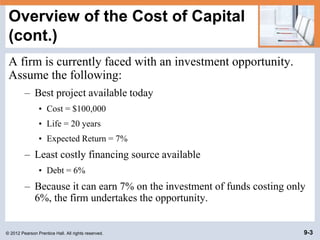
A firm is currently faced with an investment opportunity.
Assume the following:
– Best project available today
• Cost = $100,000
• Life = 20 years
• Expected Return = 7%
– Least costly financing source available
• Debt = 6%
– Because it can earn 7% on the investment of funds costing only
6%, the firm undertakes the opportunity.
© 2012 Pearson Prentice Hall. All rights reserved. 9-4
Overview of the Cost of Capital
(cont.)
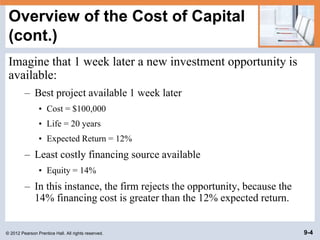
Imagine that 1 week later a new investment opportunity is
available:
– Best project available 1 week later
• Cost = $100,000
• Life = 20 years
• Expected Return = 12%
– Least costly financing source available
• Equity = 14%
– In this instance, the firm rejects the opportunity, because the
14% financing cost is greater than the 12% expected return.
© 2012 Pearson Prentice Hall. All rights reserved. 9-5
Overview of the Cost of Capital
(cont.)
What if instead the firm used a combined cost of financing?
– Assuming that a 50–50 mix of debt and equity is targeted, the
weighted average cost here would be:
(0.50  6% debt) + (0.50  14% equity) = 10%
– With this average cost of financing, the first opportunity would
have been rejected (7% expected return < 10% weighted
average cost), and the second would have been accepted
(12% expected return > 10% weighted average cost).
© 2012 Pearson Prentice Hall. All rights reserved. 9-6
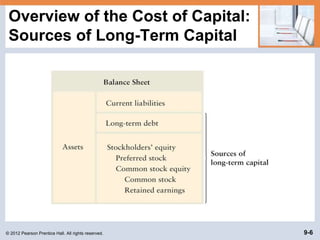
Overview of the Cost of Capital:
Sources of Long-Term Capital
© 2012 Pearson Prentice Hall. All rights reserved. 9-7
Cost of Long-Term Debt
• The pretax cost of debt is the financing cost associated with new
funds through long-term borrowing.
– Typically, the funds are raised through the sale of corporate bonds.
• Net proceeds are the funds actually received by the firm from the
sale of a security.
• Flotation costs are the total costs of issuing and selling a security.
They include two components:
1. Underwriting costs—compensation earned by investment bankers for
selling the security.
2. Administrative costs—issuer expenses such as legal, accounting, and
printing.
© 2012 Pearson Prentice Hall. All rights reserved. 9-8
Cost of Long-Term Debt (cont.)
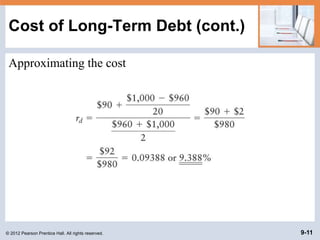
Duchess Corporation, a major hardware manufacturer, is
contemplating selling $10 million worth of 20-year, 9%
coupon bonds with a par value of $1,000. Because current
market interest rates are greater than 9%, the firm must sell
the bonds at $980. Flotation costs are 2% or $20. The net
proceeds to the firm for each bond is therefore $960
($980 – $20).
© 2012 Pearson Prentice Hall. All rights reserved. 9-9
Cost of Long-Term Debt (cont.)
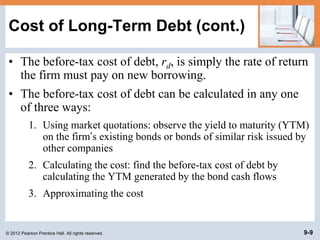
• The before-tax cost of debt, rd, is simply the rate of return
the firm must pay on new borrowing.
• The before-tax cost of debt can be calculated in any one
of three ways:
1. Using market quotations: observe the yield to maturity (YTM)
on the firm’s existing bonds or bonds of similar risk issued by
other companies
2. Calculating the cost: find the before-tax cost of debt by
calculating the YTM generated by the bond cash flows
3. Approximating the cost
© 2012 Pearson Prentice Hall. All rights reserved. 9-10
Cost of Long-Term Debt (cont.)
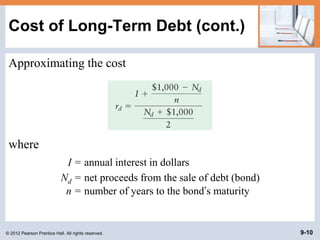
Approximating the cost
where
I = annual interest in dollars
Nd = net proceeds from the sale of debt (bond)
n = number of years to the bond’s maturity
© 2012 Pearson Prentice Hall. All rights reserved. 9-11
Cost of Long-Term Debt (cont.)
Approximating the cost
© 2012 Pearson Prentice Hall. All rights reserved. 9-12
Cost of Long-Term Debt:
After-Tax Cost of Debt
• The interest payments paid to bondholders are tax
deductable for the firm, so the interest expense on debt
reduces the firm’s taxable income and, therefore, the
firm’s tax liability.
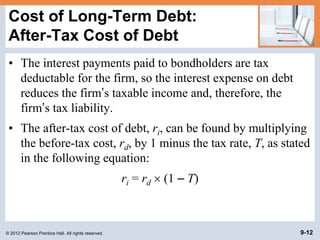
• The after-tax cost of debt, ri, can be found by multiplying
the before-tax cost, rd, by 1 minus the tax rate, T, as stated
in the following equation:
ri = rd  (1 – T)
© 2012 Pearson Prentice Hall. All rights reserved. 9-13
Cost of Long-Term Debt:
After-Tax Cost of Debt (cont.)
Duchess Corporation has a 40% tax rate. Using the 9.452%
before-tax debt cost calculated above, we find an after-tax
cost of debt of 5.6% [9.4%  (1 – 0.40)].
Typically, the cost of long-term debt for a given firm is less
than the cost of preferred or common stock, partly because
of the tax deductibility of interest.
© 2012 Pearson Prentice Hall. All rights reserved. 9-14
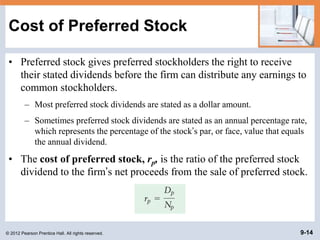
Cost of Preferred Stock
• Preferred stock gives preferred stockholders the right to receive
their stated dividends before the firm can distribute any earnings to
common stockholders.
– Most preferred stock dividends are stated as a dollar amount.
– Sometimes preferred stock dividends are stated as an annual percentage rate,
which represents the percentage of the stock’s par, or face, value that equals
the annual dividend.
• The cost of preferred stock, rp, is the ratio of the preferred stock
dividend to the firm’s net proceeds from the sale of preferred stock.
© 2012 Pearson Prentice Hall. All rights reserved. 9-15
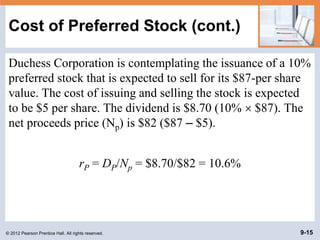
Cost of Preferred Stock (cont.)
Duchess Corporation is contemplating the issuance of a 10%
preferred stock that is expected to sell for its $87-per share
value. The cost of issuing and selling the stock is expected
to be $5 per share. The dividend is $8.70 (10%  $87). The
net proceeds price (Np) is $82 ($87 – $5).
rP = DP/Np = $8.70/$82 = 10.6%
© 2012 Pearson Prentice Hall. All rights reserved. 9-16
Cost of Common Stock
• The cost of common stock is the return required on the
stock by investors in the marketplace.
• There are two forms of common stock financing:
1. retained earnings
2. new issues of common stock
• The cost of common stock equity, rs, is the rate at which
investors discount the expected dividends of the firm to
determine its share value.
© 2012 Pearson Prentice Hall. All rights reserved. 9-17
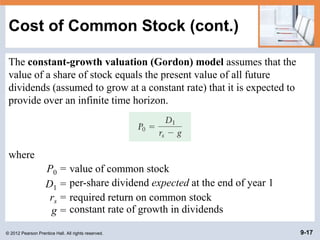
Cost of Common Stock (cont.)
The constant-growth valuation (Gordon) model assumes that the
value of a share of stock equals the present value of all future
dividends (assumed to grow at a constant rate) that it is expected to
provide over an infinite time horizon.
where
P0 = value of common stock
D1 = per-share dividend expected at the end of year 1
rs = required return on common stock
g = constant rate of growth in dividends
© 2012 Pearson Prentice Hall. All rights reserved. 9-18
Cost of Common Stock (cont.)
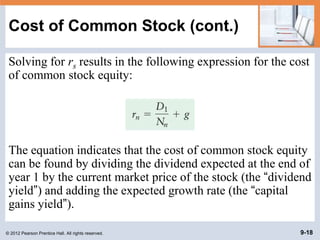
Solving for rs results in the following expression for the cost
of common stock equity:
The equation indicates that the cost of common stock equity
can be found by dividing the dividend expected at the end of
year 1 by the current market price of the stock (the “dividend
yield”) and adding the expected growth rate (the “capital
gains yield”).
© 2012 Pearson Prentice Hall. All rights reserved. 9-19
Cost of Common Stock (cont.)
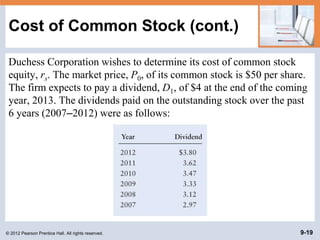
Duchess Corporation wishes to determine its cost of common stock
equity, rs. The market price, P0, of its common stock is $50 per share.
The firm expects to pay a dividend, D1, of $4 at the end of the coming
year, 2013. The dividends paid on the outstanding stock over the past
6 years (2007–2012) were as follows:
© 2012 Pearson Prentice Hall. All rights reserved. 9-20
Cost of Common Stock (cont.)
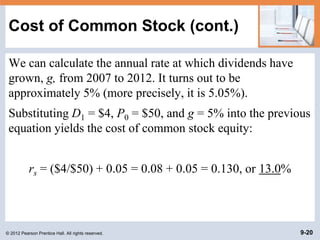
We can calculate the annual rate at which dividends have
grown, g, from 2007 to 2012. It turns out to be
approximately 5% (more precisely, it is 5.05%).
Substituting D1 = $4, P0 = $50, and g = 5% into the previous
equation yields the cost of common stock equity:
rs = ($4/$50) + 0.05 = 0.08 + 0.05 = 0.130, or 13.0%
© 2012 Pearson Prentice Hall. All rights reserved. 9-21
Cost of Common Stock (cont.)
The capital asset pricing model (CAPM) describes the
relationship between the required return, rs, and the
nondiversifiable risk of the firm as measured by the beta
coefficient, b.
rs = RF + [b  (rm – RF)]
where
RF = risk-free rate of return
rm = market return; return on the market portfolio of assets
© 2012 Pearson Prentice Hall. All rights reserved. 9-22
Cost of Common Stock (cont.)
Duchess Corporation now wishes to calculate its cost of
common stock equity, rs, by using the capital asset pricing
model. The firm’s investment advisors and its own analysts
indicate that the risk-free rate, RF, equals 7%; the firm’s
beta, b, equals 1.5; and the market return, rm, equals 11%.
Substituting these values into the CAPM, the company
estimates the cost of common stock equity, rs, to be:
rs = 7.0% + [1.5  (11.0% – 7.0%)] = 7.0% + 6.0% = 13.0%
© 2012 Pearson Prentice Hall. All rights reserved. 9-23
Cost of Common Stock (cont.)
• The CAPM technique differs from the constant-growth
valuation model in that it directly considers the firm’s
risk, as reflected by beta, in determining the required
return or cost of common stock equity.
• The constant-growth model does not look at risk; it uses
the market price, P0, as a reflection of the expected risk–
return preference of investors in the marketplace.
• The constant-growth valuation and CAPM techniques for
finding rs are theoretically equivalent, though in practice
estimates from the two methods do not always agree.
© 2012 Pearson Prentice Hall. All rights reserved. 9-24
Cost of Common Stock (cont.)
• Another difference is that when the constant-growth
valuation model is used to find the cost of common stock
equity, it can easily be adjusted for flotation costs to find
the cost of new common stock; the CAPM does not
provide a simple adjustment mechanism.
• The difficulty in adjusting the cost of common stock
equity calculated by using CAPM occurs because in its
common form the model does not include the market
price, P0, a variable needed to make such an adjustment.
© 2012 Pearson Prentice Hall. All rights reserved. 9-25
Cost of Common Stock:
Cost of Retained Earnings
The cost of retained earnings, rr, is the same as the cost of
an equivalent fully subscribed issue of additional common
stock, which is equal to the cost of common stock equity, rs.
rr = rs
The cost of retained earnings for Duchess Corporation was
actually calculated in the preceding examples: It is equal to
the cost of common stock equity. Thus rr equals 13.0%.
© 2012 Pearson Prentice Hall. All rights reserved. 9-26
Matter of Fact
Retained Earnings vs. Reinvesting Earnings
– Technically, if a stockholder received dividends and wished to
invest them in additional shares of the firm’s stock, he or she
would first have to pay personal taxes on the dividends and then
pay brokerage fees before acquiring additional shares.
– By using pt as the average stockholder’s personal tax rate
and bf as the average brokerage fees stated as a percentage,
we can specify the cost of retained earnings, rr, as
rr = rs  (1 – pt)  (1 – bf).
© 2012 Pearson Prentice Hall. All rights reserved. 9-27
Cost of Common Stock: Cost of
New Issues of Common Stock
• The cost of a new issue of common stock, rn, is the cost
of common stock, net of underpricing and associated
flotation costs.
• New shares are underpriced if the stock is sold at a price
below its current market price, P0.
© 2012 Pearson Prentice Hall. All rights reserved. 9-28
Cost of Common Stock: Cost of New
Issues of Common Stock (cont.)
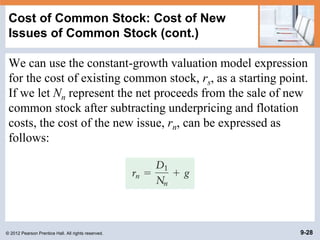
We can use the constant-growth valuation model expression
for the cost of existing common stock, rs, as a starting point.
If we let Nn represent the net proceeds from the sale of new
common stock after subtracting underpricing and flotation
costs, the cost of the new issue, rn, can be expressed as
follows:
© 2012 Pearson Prentice Hall. All rights reserved. 9-29
Cost of Common Stock: Cost of New
Issues of Common Stock (cont.)
• The net proceeds from sale of new common stock, Nn,
will be less than the current market price, P0.
• Therefore, the cost of new issues, rn, will always be
greater than the cost of existing issues, rs, which is equal
to the cost of retained earnings, rr.
• The cost of new common stock is normally greater than
any other long-term financing cost.
© 2012 Pearson Prentice Hall. All rights reserved. 9-30
Cost of Common Stock: Cost of New
Issues of Common Stock (cont.)
To determine its cost of new common stock, rn, Duchess
Corporation has estimated that on average, new shares can
be sold for $47. The $3-per-share underpricing is due to the
competitive nature of the market. A second cost associated
with a new issue is flotation costs of $2.50 per share that
would be paid to issue and sell the new shares. The total
underpricing and flotation costs per share are therefore
$5.50.
rn = ($4.00/$44.50) + 0.05 = 0.09 + 0.05 = 0.140, or 14.0%
© 2012 Pearson Prentice Hall. All rights reserved. 9-31
Weighted Average Cost of
Capital
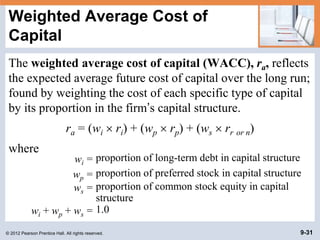
The weighted average cost of capital (WACC), ra, reflects
the expected average future cost of capital over the long run;
found by weighting the cost of each specific type of capital
by its proportion in the firm’s capital structure.
ra = (wi  ri) + (wp  rp) + (ws  rr or n)
where
wi = proportion of long-term debt in capital structure
wp = proportion of preferred stock in capital structure
ws = proportion of common stock equity in capital
structure
wi + wp + ws = 1.0
© 2012 Pearson Prentice Hall. All rights reserved. 9-32
Weighted Average Cost of
Capital (cont.)
Three important points should be noted in the equation for ra:
1. For computational convenience, it is best to convert the weights into decimal
form and leave the individual costs in percentage terms.
2. The weights must be non-negative and sum to 1.0. Simply stated, WACC
must account for all financing costs within the firm’s capital structure.
3. The firm’s common stock equity weight, ws, is multiplied by either the cost
of retained earnings, rr, or the cost of new common stock, rn. Which cost is
used depends on whether the firm’s common stock equity will be financed
using retained earnings, rr, or new common stock, rn.
© 2012 Pearson Prentice Hall. All rights reserved. 9-33
Weighted Average Cost of
Capital (cont.)
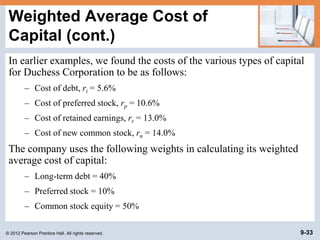
In earlier examples, we found the costs of the various types of capital
for Duchess Corporation to be as follows:
– Cost of debt, ri = 5.6%
– Cost of preferred stock, rp = 10.6%
– Cost of retained earnings, rr = 13.0%
– Cost of new common stock, rn = 14.0%
The company uses the following weights in calculating its weighted
average cost of capital:
– Long-term debt = 40%
– Preferred stock = 10%
– Common stock equity = 50%
© 2012 Pearson Prentice Hall. All rights reserved. 9-34
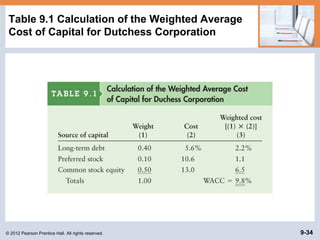
Table 9.1 Calculation of the Weighted Average
Cost of Capital for Dutchess Corporation

FIN Chapter 9.ppt

  • 1.
    Copyright © 2012Pearson Prentice Hall. All rights reserved. Chapter 9 The Cost of Capital
  • 2.
    © 2012 PearsonPrentice Hall. All rights reserved. 9-2 Overview of the Cost of Capital • The cost of capital represents the firm’s cost of financing, and is the minimum rate of return that a project must earn to increase firm value. – Financial managers are ethically bound to only invest in projects that they expect to exceed the cost of capital. – The cost of capital reflects the entirety of the firm’s financing activities. • Most firms attempt to maintain an optimal mix of debt and equity financing. – To capture all of the relevant financing costs, assuming some desired mix of financing, we need to look at the overall cost of capital rather than just the cost of any single source of financing.
  • 3.
    © 2012 PearsonPrentice Hall. All rights reserved. 9-3 Overview of the Cost of Capital (cont.) A firm is currently faced with an investment opportunity. Assume the following: – Best project available today • Cost = $100,000 • Life = 20 years • Expected Return = 7% – Least costly financing source available • Debt = 6% – Because it can earn 7% on the investment of funds costing only 6%, the firm undertakes the opportunity.
  • 4.
    © 2012 PearsonPrentice Hall. All rights reserved. 9-4 Overview of the Cost of Capital (cont.) Imagine that 1 week later a new investment opportunity is available: – Best project available 1 week later • Cost = $100,000 • Life = 20 years • Expected Return = 12% – Least costly financing source available • Equity = 14% – In this instance, the firm rejects the opportunity, because the 14% financing cost is greater than the 12% expected return.
  • 5.
    © 2012 PearsonPrentice Hall. All rights reserved. 9-5 Overview of the Cost of Capital (cont.) What if instead the firm used a combined cost of financing? – Assuming that a 50–50 mix of debt and equity is targeted, the weighted average cost here would be: (0.50  6% debt) + (0.50  14% equity) = 10% – With this average cost of financing, the first opportunity would have been rejected (7% expected return < 10% weighted average cost), and the second would have been accepted (12% expected return > 10% weighted average cost).
  • 6.
    © 2012 PearsonPrentice Hall. All rights reserved. 9-6 Overview of the Cost of Capital: Sources of Long-Term Capital
  • 7.
    © 2012 PearsonPrentice Hall. All rights reserved. 9-7 Cost of Long-Term Debt • The pretax cost of debt is the financing cost associated with new funds through long-term borrowing. – Typically, the funds are raised through the sale of corporate bonds. • Net proceeds are the funds actually received by the firm from the sale of a security. • Flotation costs are the total costs of issuing and selling a security. They include two components: 1. Underwriting costs—compensation earned by investment bankers for selling the security. 2. Administrative costs—issuer expenses such as legal, accounting, and printing.
  • 8.
    © 2012 PearsonPrentice Hall. All rights reserved. 9-8 Cost of Long-Term Debt (cont.) Duchess Corporation, a major hardware manufacturer, is contemplating selling $10 million worth of 20-year, 9% coupon bonds with a par value of $1,000. Because current market interest rates are greater than 9%, the firm must sell the bonds at $980. Flotation costs are 2% or $20. The net proceeds to the firm for each bond is therefore $960 ($980 – $20).
  • 9.
    © 2012 PearsonPrentice Hall. All rights reserved. 9-9 Cost of Long-Term Debt (cont.) • The before-tax cost of debt, rd, is simply the rate of return the firm must pay on new borrowing. • The before-tax cost of debt can be calculated in any one of three ways: 1. Using market quotations: observe the yield to maturity (YTM) on the firm’s existing bonds or bonds of similar risk issued by other companies 2. Calculating the cost: find the before-tax cost of debt by calculating the YTM generated by the bond cash flows 3. Approximating the cost
  • 10.
    © 2012 PearsonPrentice Hall. All rights reserved. 9-10 Cost of Long-Term Debt (cont.) Approximating the cost where I = annual interest in dollars Nd = net proceeds from the sale of debt (bond) n = number of years to the bond’s maturity
  • 11.
    © 2012 PearsonPrentice Hall. All rights reserved. 9-11 Cost of Long-Term Debt (cont.) Approximating the cost
  • 12.
    © 2012 PearsonPrentice Hall. All rights reserved. 9-12 Cost of Long-Term Debt: After-Tax Cost of Debt • The interest payments paid to bondholders are tax deductable for the firm, so the interest expense on debt reduces the firm’s taxable income and, therefore, the firm’s tax liability. • The after-tax cost of debt, ri, can be found by multiplying the before-tax cost, rd, by 1 minus the tax rate, T, as stated in the following equation: ri = rd  (1 – T)
  • 13.
    © 2012 PearsonPrentice Hall. All rights reserved. 9-13 Cost of Long-Term Debt: After-Tax Cost of Debt (cont.) Duchess Corporation has a 40% tax rate. Using the 9.452% before-tax debt cost calculated above, we find an after-tax cost of debt of 5.6% [9.4%  (1 – 0.40)]. Typically, the cost of long-term debt for a given firm is less than the cost of preferred or common stock, partly because of the tax deductibility of interest.
  • 14.
    © 2012 PearsonPrentice Hall. All rights reserved. 9-14 Cost of Preferred Stock • Preferred stock gives preferred stockholders the right to receive their stated dividends before the firm can distribute any earnings to common stockholders. – Most preferred stock dividends are stated as a dollar amount. – Sometimes preferred stock dividends are stated as an annual percentage rate, which represents the percentage of the stock’s par, or face, value that equals the annual dividend. • The cost of preferred stock, rp, is the ratio of the preferred stock dividend to the firm’s net proceeds from the sale of preferred stock.
  • 15.
    © 2012 PearsonPrentice Hall. All rights reserved. 9-15 Cost of Preferred Stock (cont.) Duchess Corporation is contemplating the issuance of a 10% preferred stock that is expected to sell for its $87-per share value. The cost of issuing and selling the stock is expected to be $5 per share. The dividend is $8.70 (10%  $87). The net proceeds price (Np) is $82 ($87 – $5). rP = DP/Np = $8.70/$82 = 10.6%
  • 16.
    © 2012 PearsonPrentice Hall. All rights reserved. 9-16 Cost of Common Stock • The cost of common stock is the return required on the stock by investors in the marketplace. • There are two forms of common stock financing: 1. retained earnings 2. new issues of common stock • The cost of common stock equity, rs, is the rate at which investors discount the expected dividends of the firm to determine its share value.
  • 17.
    © 2012 PearsonPrentice Hall. All rights reserved. 9-17 Cost of Common Stock (cont.) The constant-growth valuation (Gordon) model assumes that the value of a share of stock equals the present value of all future dividends (assumed to grow at a constant rate) that it is expected to provide over an infinite time horizon. where P0 = value of common stock D1 = per-share dividend expected at the end of year 1 rs = required return on common stock g = constant rate of growth in dividends
  • 18.
    © 2012 PearsonPrentice Hall. All rights reserved. 9-18 Cost of Common Stock (cont.) Solving for rs results in the following expression for the cost of common stock equity: The equation indicates that the cost of common stock equity can be found by dividing the dividend expected at the end of year 1 by the current market price of the stock (the “dividend yield”) and adding the expected growth rate (the “capital gains yield”).
  • 19.
    © 2012 PearsonPrentice Hall. All rights reserved. 9-19 Cost of Common Stock (cont.) Duchess Corporation wishes to determine its cost of common stock equity, rs. The market price, P0, of its common stock is $50 per share. The firm expects to pay a dividend, D1, of $4 at the end of the coming year, 2013. The dividends paid on the outstanding stock over the past 6 years (2007–2012) were as follows:
  • 20.
    © 2012 PearsonPrentice Hall. All rights reserved. 9-20 Cost of Common Stock (cont.) We can calculate the annual rate at which dividends have grown, g, from 2007 to 2012. It turns out to be approximately 5% (more precisely, it is 5.05%). Substituting D1 = $4, P0 = $50, and g = 5% into the previous equation yields the cost of common stock equity: rs = ($4/$50) + 0.05 = 0.08 + 0.05 = 0.130, or 13.0%
  • 21.
    © 2012 PearsonPrentice Hall. All rights reserved. 9-21 Cost of Common Stock (cont.) The capital asset pricing model (CAPM) describes the relationship between the required return, rs, and the nondiversifiable risk of the firm as measured by the beta coefficient, b. rs = RF + [b  (rm – RF)] where RF = risk-free rate of return rm = market return; return on the market portfolio of assets
  • 22.
    © 2012 PearsonPrentice Hall. All rights reserved. 9-22 Cost of Common Stock (cont.) Duchess Corporation now wishes to calculate its cost of common stock equity, rs, by using the capital asset pricing model. The firm’s investment advisors and its own analysts indicate that the risk-free rate, RF, equals 7%; the firm’s beta, b, equals 1.5; and the market return, rm, equals 11%. Substituting these values into the CAPM, the company estimates the cost of common stock equity, rs, to be: rs = 7.0% + [1.5  (11.0% – 7.0%)] = 7.0% + 6.0% = 13.0%
  • 23.
    © 2012 PearsonPrentice Hall. All rights reserved. 9-23 Cost of Common Stock (cont.) • The CAPM technique differs from the constant-growth valuation model in that it directly considers the firm’s risk, as reflected by beta, in determining the required return or cost of common stock equity. • The constant-growth model does not look at risk; it uses the market price, P0, as a reflection of the expected risk– return preference of investors in the marketplace. • The constant-growth valuation and CAPM techniques for finding rs are theoretically equivalent, though in practice estimates from the two methods do not always agree.
  • 24.
    © 2012 PearsonPrentice Hall. All rights reserved. 9-24 Cost of Common Stock (cont.) • Another difference is that when the constant-growth valuation model is used to find the cost of common stock equity, it can easily be adjusted for flotation costs to find the cost of new common stock; the CAPM does not provide a simple adjustment mechanism. • The difficulty in adjusting the cost of common stock equity calculated by using CAPM occurs because in its common form the model does not include the market price, P0, a variable needed to make such an adjustment.
  • 25.
    © 2012 PearsonPrentice Hall. All rights reserved. 9-25 Cost of Common Stock: Cost of Retained Earnings The cost of retained earnings, rr, is the same as the cost of an equivalent fully subscribed issue of additional common stock, which is equal to the cost of common stock equity, rs. rr = rs The cost of retained earnings for Duchess Corporation was actually calculated in the preceding examples: It is equal to the cost of common stock equity. Thus rr equals 13.0%.
  • 26.
    © 2012 PearsonPrentice Hall. All rights reserved. 9-26 Matter of Fact Retained Earnings vs. Reinvesting Earnings – Technically, if a stockholder received dividends and wished to invest them in additional shares of the firm’s stock, he or she would first have to pay personal taxes on the dividends and then pay brokerage fees before acquiring additional shares. – By using pt as the average stockholder’s personal tax rate and bf as the average brokerage fees stated as a percentage, we can specify the cost of retained earnings, rr, as rr = rs  (1 – pt)  (1 – bf).
  • 27.
    © 2012 PearsonPrentice Hall. All rights reserved. 9-27 Cost of Common Stock: Cost of New Issues of Common Stock • The cost of a new issue of common stock, rn, is the cost of common stock, net of underpricing and associated flotation costs. • New shares are underpriced if the stock is sold at a price below its current market price, P0.
  • 28.
    © 2012 PearsonPrentice Hall. All rights reserved. 9-28 Cost of Common Stock: Cost of New Issues of Common Stock (cont.) We can use the constant-growth valuation model expression for the cost of existing common stock, rs, as a starting point. If we let Nn represent the net proceeds from the sale of new common stock after subtracting underpricing and flotation costs, the cost of the new issue, rn, can be expressed as follows:
  • 29.
    © 2012 PearsonPrentice Hall. All rights reserved. 9-29 Cost of Common Stock: Cost of New Issues of Common Stock (cont.) • The net proceeds from sale of new common stock, Nn, will be less than the current market price, P0. • Therefore, the cost of new issues, rn, will always be greater than the cost of existing issues, rs, which is equal to the cost of retained earnings, rr. • The cost of new common stock is normally greater than any other long-term financing cost.
  • 30.
    © 2012 PearsonPrentice Hall. All rights reserved. 9-30 Cost of Common Stock: Cost of New Issues of Common Stock (cont.) To determine its cost of new common stock, rn, Duchess Corporation has estimated that on average, new shares can be sold for $47. The $3-per-share underpricing is due to the competitive nature of the market. A second cost associated with a new issue is flotation costs of $2.50 per share that would be paid to issue and sell the new shares. The total underpricing and flotation costs per share are therefore $5.50. rn = ($4.00/$44.50) + 0.05 = 0.09 + 0.05 = 0.140, or 14.0%
  • 31.
    © 2012 PearsonPrentice Hall. All rights reserved. 9-31 Weighted Average Cost of Capital The weighted average cost of capital (WACC), ra, reflects the expected average future cost of capital over the long run; found by weighting the cost of each specific type of capital by its proportion in the firm’s capital structure. ra = (wi  ri) + (wp  rp) + (ws  rr or n) where wi = proportion of long-term debt in capital structure wp = proportion of preferred stock in capital structure ws = proportion of common stock equity in capital structure wi + wp + ws = 1.0
  • 32.
    © 2012 PearsonPrentice Hall. All rights reserved. 9-32 Weighted Average Cost of Capital (cont.) Three important points should be noted in the equation for ra: 1. For computational convenience, it is best to convert the weights into decimal form and leave the individual costs in percentage terms. 2. The weights must be non-negative and sum to 1.0. Simply stated, WACC must account for all financing costs within the firm’s capital structure. 3. The firm’s common stock equity weight, ws, is multiplied by either the cost of retained earnings, rr, or the cost of new common stock, rn. Which cost is used depends on whether the firm’s common stock equity will be financed using retained earnings, rr, or new common stock, rn.
  • 33.
    © 2012 PearsonPrentice Hall. All rights reserved. 9-33 Weighted Average Cost of Capital (cont.) In earlier examples, we found the costs of the various types of capital for Duchess Corporation to be as follows: – Cost of debt, ri = 5.6% – Cost of preferred stock, rp = 10.6% – Cost of retained earnings, rr = 13.0% – Cost of new common stock, rn = 14.0% The company uses the following weights in calculating its weighted average cost of capital: – Long-term debt = 40% – Preferred stock = 10% – Common stock equity = 50%
  • 34.
    © 2012 PearsonPrentice Hall. All rights reserved. 9-34 Table 9.1 Calculation of the Weighted Average Cost of Capital for Dutchess Corporation