Social Media for
Business
Communication
Chapter 8
© 2016 by McGraw-Hill Education. This is proprietary material solely for authorized instructor use. Not authorized for sale or distribution in any
manner. This document may not be copied, scanned, duplicated, forwarded, distributed, or posted on a website, in whole or part.
Chapter Overview
Characteristics of the Social Age
Effective communication with blogs, wikis,
and forums
Blogs for external communication
Online reputation
Ethical use of social media
© 2016 by McGraw-Hill Education. This is proprietary material solely for authorized instructor use. Not authorized for sale or distribution in any
manner. This document may not be copied, scanned, duplicated, forwarded, distributed, or posted on a website, in whole or part.
8-2
Learning Objectives
LO8.1 Explain characteristics of the emerging
Social Age.
LO8.2 Use blogs, wikis, forums, and other social
tools for effective communication within
organizations.
LO8.3 Create blogs for effective external
communications.
LO8.4 Build a credible online reputation.
LO8.5 Describe the ethical use of social media
for work.
© 2016 by McGraw-Hill Education. This is proprietary material solely for authorized instructor use. Not authorized for sale or distribution in any
manner. This document may not be copied, scanned, duplicated, forwarded, distributed, or posted on a website, in whole or part.
8-3
The Evolving Workplace
© 2016 by McGraw-Hill Education. This is proprietary material solely for authorized instructor use. Not authorized for sale or distribution in any
manner. This document may not be copied, scanned, duplicated, forwarded, distributed, or posted on a website, in whole or part.
8-4
Communicating in the Workplace in
the Social Age
Social Age
an era in which people engage in networked
communication, collaborate across boundaries,
and solve problems communally.
© 2016 by McGraw-Hill Education. This is proprietary material solely for authorized instructor use. Not authorized for sale or distribution in any
manner. This document may not be copied, scanned, duplicated, forwarded, distributed, or posted on a website, in whole or part.
8-5
Characteristics of the Social Age
Web 1.0
most Web pages were read-only and static
Web 2.0
read-write Web, where users interact extensively
with Web pages—authoring content, expressing
opinions, and customizing and editing Web
content among other things
© 2016 by McGraw-Hill Education. This is proprietary material solely for authorized instructor use. Not authorized for sale or distribution in any
manner. This document may not be copied, scanned, duplicated, forwarded, distributed, or posted on a website, in whole or part.
8-6
Comparisons Between
User 1.0 and User 2.0
© 2016 by McGraw-Hill Education. This is proprietary material solely for authorized instructor use. Not authorized for sale or distribution in any
manner. This document may not be copied, scanned, duplicated, forwarded, distributed, or posted on a website, in whole or part.
8-7
Characteristics of the Social Age
Increasingly, companies are adopting social
networking platforms that contain Web 2.0
communication tools
These platforms contain many of the features
available on social networking websites: user
profiles, microblogs, blogs, wikis, and file
uploading.
© 2016 by McGraw-Hill Education. This is proprietary material solely for authorized instructor use. Not authorized for sale or distribution in any
manner. This document may not be copied, scanned, duplicated, forwarded, distributed, or posted on a website, in whole or part.
8-8
Benefits and Challenges of Social
Media in the Workplace
© 2016 by McGraw-Hill Education. This is proprietary material solely for authorized instructor use. Not authorized for sale or distribution in any
manner. This document may not be copied, scanned, duplicated, forwarded, distributed, or posted on a website, in whole or part.
8-9
Using Social Media Tools for
Communication within Organizations
Organize Your Dashboard to Control Your
Communication and Information Flow
Create a Complete and Professional Profile
Use Blogs for Team Communication
Use Wikis for Team Communication
Use Forums to Discuss Ideas
Other Social Media Tools
© 2016 by McGraw-Hill Education. This is proprietary material solely for authorized instructor use. Not authorized for sale or distribution in any
manner. This document may not be copied, scanned, duplicated, forwarded, distributed, or posted on a website, in whole or part.
8-10
Return on Investment for
Internal Social Media
© 2016 by McGraw-Hill Education. This is proprietary material solely for authorized instructor use. Not authorized for sale or distribution in any
manner. This document may not be copied, scanned, duplicated, forwarded, distributed, or posted on a website, in whole or part.
8-11
Organize Your Dashboard to Control Your
Communication and Information Flow
Nearly all social software systems contain a
dashboard, your front page when you log in to
the system, which operates as your
communication hub.
In most cases, you can customize the
dashboard to display the features that most
interest you.
© 2016 by McGraw-Hill Education. This is proprietary material solely for authorized instructor use. Not authorized for sale or distribution in any
manner. This document may not be copied, scanned, duplicated, forwarded, distributed, or posted on a website, in whole or part.
8-12
Sample Dashboard with
Enterprise Social Software
© 2016 by McGraw-Hill Education. This is proprietary material solely for authorized instructor use. Not authorized for sale or distribution in any
manner. This document may not be copied, scanned, duplicated, forwarded, distributed, or posted on a website, in whole or part.
8-13
Use Blogs for Team Communication
Microblogs (such as Twitter)
shorter blogs that contain just a few sentences,
are part of most enterprise social networking
platforms
tools for broadcasting announcements and
urgent information
© 2016 by McGraw-Hill Education. This is proprietary material solely for authorized instructor use. Not authorized for sale or
distribution in any manner. This document may not be copied, scanned, duplicated, forwarded, distributed, or posted on a website, in 8-14
Use Blogs for Team Communication
Team blogs
typically organized around formal work teams,
and
Project blogs
organized around particular projects that
generally involve temporary teams.
© 2016 by McGraw-Hill Education. This is proprietary material solely for authorized instructor use. Not authorized for sale or distribution in any
manner. This document may not be copied, scanned, duplicated, forwarded, distributed, or posted on a website, in whole or part.
8-15
Sample Team Blog
© 2016 by McGraw-Hill Education. This is proprietary material solely for authorized instructor use. Not authorized for sale or distribution in any
manner. This document may not be copied, scanned, duplicated, forwarded, distributed, or posted on a website, in whole or part.
8-16
Use Wikis for Team Communication
Wikis
collections of pages that anyone with approved
access can edit, thus lending themselves to
collaborative writing.
allow employees to collaborate and participate in
decision making more easily, creatively, and
effectively
create a culture of transparency, simplicity, and
openness
© 2016 by McGraw-Hill Education. This is proprietary material solely for authorized instructor use. Not authorized for sale or distribution in
any manner. This document may not be copied, scanned, duplicated, forwarded, distributed, or posted on a website, in whole or part.
8-17
Sample Wiki in Edit Mode
© 2016 by McGraw-Hill Education. This is proprietary material solely for authorized instructor use. Not authorized for sale or distribution in any
manner. This document may not be copied, scanned, duplicated, forwarded, distributed, or posted on a website, in whole or part.
8-18
Use Forums to Discuss Ideas
Avoid leading posts
Avoid ignoring competing points of views
Avoid strong, rigid language
Avoid complaining
Avoid blaming
Avoid off-topic points
Avoid excessively short or lengthy posts
Avoid sarcasm
© 2016 by McGraw-Hill Education. This is proprietary material solely for authorized instructor use. Not authorized for sale or distribution in any
manner. This document may not be copied, scanned, duplicated, forwarded, distributed, or posted on a website, in whole or part.
8-19
Using Forums to Improve
Team Productivity
Read your peers’ comments completely and
carefully
State the purpose of the forum clearly
Use flexible, open, and inviting language
Build on the ideas of others and pose
questions
Show appreciation for your teammates and
their ideas
© 2016 by McGraw-Hill Education. This is proprietary material solely for authorized instructor use. Not authorized for sale or distribution in any
manner. This document may not be copied, scanned, duplicated, forwarded, distributed, or posted on a website, in whole or part.
8-20
Using Forums to Improve
Team Productivity
Participate often
Meet in real time for touchy points
Summarize and, as appropriate, identify next
steps
Talk with your team about ways to make
forums help your decision making and
coordination
© 2016 by McGraw-Hill Education. This is proprietary material solely for authorized instructor use. Not authorized for sale or distribution in any
manner. This document may not be copied, scanned, duplicated, forwarded, distributed, or posted on a website, in whole or part.
8-21
Forum Examples
© 2016 by McGraw-Hill Education. This is proprietary material solely for authorized instructor use. Not authorized for sale or distribution in any
manner. This document may not be copied, scanned, duplicated, forwarded, distributed, or posted on a website, in whole or part.
8-22
Write Posts for Your Organization
 The primary goal of blogs for organizations is
effective public relations (PR)
 PR is fundamentally about building relationships
with employees, customers, communities, the
media, and other stakeholders
 A primary goal of building these relationships is
to improve corporate reputation or credibility.
© 2016 by McGraw-Hill Education. This is proprietary material solely for authorized instructor use. Not authorized for sale or distribution in any
manner. This document may not be copied, scanned, duplicated, forwarded, distributed, or posted on a website, in whole or part.
8-23
Corporate Reputation
Corporate reputation
an intangible asset that allows the company to
better manage the expectations and needs of its
various stakeholders, creating differentiation and
barriers vis-à-vis its competitors
the intellectual, emotional and behavioral
response as to whether or not the
communications and actions of an organization
resonate with their needs and interests
© 2016 by McGraw-Hill Education. This is proprietary material solely for authorized instructor use. Not authorized for sale or distribution in any
manner. This document may not be copied, scanned, duplicated, forwarded, distributed, or posted on a website, in whole or part.
8-24
A Press-Release Style Blog Post
© 2016 by McGraw-Hill Education. This is proprietary material solely for authorized instructor use. Not authorized for sale or distribution in any
manner. This document may not be copied, scanned, duplicated, forwarded, distributed, or posted on a website, in whole or part.
8-25
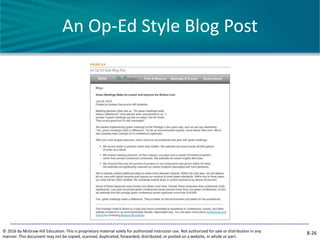
An Op-Ed Style Blog Post
© 2016 by McGraw-Hill Education. This is proprietary material solely for authorized instructor use. Not authorized for sale or distribution in any
manner. This document may not be copied, scanned, duplicated, forwarded, distributed, or posted on a website, in whole or part.
8-26
Guidelines for Using Social Media in
the Workplace
Be an Active Contributor and Participate Often
Listen and Learn
Focus on Content
Make Your Content Accessible
Make Your Messages Authentic and Friendly
Be Responsive and Help Others
Respect Boundaries
© 2016 by McGraw-Hill Education. This is proprietary material solely for authorized instructor use. Not authorized for sale or distribution in any
manner. This document may not be copied, scanned, duplicated, forwarded, distributed, or posted on a website, in whole or part.
8-27
Managing Your Online Reputation
Personal brand
A unique set of professional skills and attributes
that others associate with you
© 2016 by McGraw-Hill Education. This is proprietary material solely for authorized instructor use. Not authorized for sale or distribution in any
manner. This document may not be copied, scanned, duplicated, forwarded, distributed, or posted on a website, in whole or part.
8-28
Developing a Credible
Online Reputation
© 2016 by McGraw-Hill Education. This is proprietary material solely for authorized instructor use. Not authorized for sale or distribution in any
manner. This document may not be copied, scanned, duplicated, forwarded, distributed, or posted on a website, in whole or part.
8-29
Use Social Media Ethically
Much more than your online reputation is at
stake with social media use; the reputation and
performance of your company is at stake as well
The line between what you believe is private use
of social media and your role as an employee can
be murky, since your private actions can damage
your employer and hurt your career.
© 2016 by McGraw-Hill Education. This is proprietary material solely for authorized instructor use. Not authorized for sale or distribution in any
manner. This document may not be copied, scanned, duplicated, forwarded, distributed, or posted on a website, in whole or part.
8-30
Example of Social Media Guidelines
© 2016 by McGraw-Hill Education. This is proprietary material solely for authorized instructor use. Not authorized for sale or distribution in any
manner. This document may not be copied, scanned, duplicated, forwarded, distributed, or posted on a website, in whole or part.
8-31
Chapter Takeaways
Characteristics of the Social Age
Effective communication with blogs, wikis,
and forums
Blogs for external communication
Online reputation
Ethical use of social media
© 2016 by McGraw-Hill Education. This is proprietary material solely for authorized instructor use. Not authorized for sale or distribution in any
manner. This document may not be copied, scanned, duplicated, forwarded, distributed, or posted on a website, in whole or part.
8-32

8152206.ppt

  • 1.
    Social Media for Business Communication Chapter8 © 2016 by McGraw-Hill Education. This is proprietary material solely for authorized instructor use. Not authorized for sale or distribution in any manner. This document may not be copied, scanned, duplicated, forwarded, distributed, or posted on a website, in whole or part.
  • 2.
    Chapter Overview Characteristics ofthe Social Age Effective communication with blogs, wikis, and forums Blogs for external communication Online reputation Ethical use of social media © 2016 by McGraw-Hill Education. This is proprietary material solely for authorized instructor use. Not authorized for sale or distribution in any manner. This document may not be copied, scanned, duplicated, forwarded, distributed, or posted on a website, in whole or part. 8-2
  • 3.
    Learning Objectives LO8.1 Explaincharacteristics of the emerging Social Age. LO8.2 Use blogs, wikis, forums, and other social tools for effective communication within organizations. LO8.3 Create blogs for effective external communications. LO8.4 Build a credible online reputation. LO8.5 Describe the ethical use of social media for work. © 2016 by McGraw-Hill Education. This is proprietary material solely for authorized instructor use. Not authorized for sale or distribution in any manner. This document may not be copied, scanned, duplicated, forwarded, distributed, or posted on a website, in whole or part. 8-3
  • 4.
    The Evolving Workplace ©2016 by McGraw-Hill Education. This is proprietary material solely for authorized instructor use. Not authorized for sale or distribution in any manner. This document may not be copied, scanned, duplicated, forwarded, distributed, or posted on a website, in whole or part. 8-4
  • 5.
    Communicating in theWorkplace in the Social Age Social Age an era in which people engage in networked communication, collaborate across boundaries, and solve problems communally. © 2016 by McGraw-Hill Education. This is proprietary material solely for authorized instructor use. Not authorized for sale or distribution in any manner. This document may not be copied, scanned, duplicated, forwarded, distributed, or posted on a website, in whole or part. 8-5
  • 6.
    Characteristics of theSocial Age Web 1.0 most Web pages were read-only and static Web 2.0 read-write Web, where users interact extensively with Web pages—authoring content, expressing opinions, and customizing and editing Web content among other things © 2016 by McGraw-Hill Education. This is proprietary material solely for authorized instructor use. Not authorized for sale or distribution in any manner. This document may not be copied, scanned, duplicated, forwarded, distributed, or posted on a website, in whole or part. 8-6
  • 7.
    Comparisons Between User 1.0and User 2.0 © 2016 by McGraw-Hill Education. This is proprietary material solely for authorized instructor use. Not authorized for sale or distribution in any manner. This document may not be copied, scanned, duplicated, forwarded, distributed, or posted on a website, in whole or part. 8-7
  • 8.
    Characteristics of theSocial Age Increasingly, companies are adopting social networking platforms that contain Web 2.0 communication tools These platforms contain many of the features available on social networking websites: user profiles, microblogs, blogs, wikis, and file uploading. © 2016 by McGraw-Hill Education. This is proprietary material solely for authorized instructor use. Not authorized for sale or distribution in any manner. This document may not be copied, scanned, duplicated, forwarded, distributed, or posted on a website, in whole or part. 8-8
  • 9.
    Benefits and Challengesof Social Media in the Workplace © 2016 by McGraw-Hill Education. This is proprietary material solely for authorized instructor use. Not authorized for sale or distribution in any manner. This document may not be copied, scanned, duplicated, forwarded, distributed, or posted on a website, in whole or part. 8-9
  • 10.
    Using Social MediaTools for Communication within Organizations Organize Your Dashboard to Control Your Communication and Information Flow Create a Complete and Professional Profile Use Blogs for Team Communication Use Wikis for Team Communication Use Forums to Discuss Ideas Other Social Media Tools © 2016 by McGraw-Hill Education. This is proprietary material solely for authorized instructor use. Not authorized for sale or distribution in any manner. This document may not be copied, scanned, duplicated, forwarded, distributed, or posted on a website, in whole or part. 8-10
  • 11.
    Return on Investmentfor Internal Social Media © 2016 by McGraw-Hill Education. This is proprietary material solely for authorized instructor use. Not authorized for sale or distribution in any manner. This document may not be copied, scanned, duplicated, forwarded, distributed, or posted on a website, in whole or part. 8-11
  • 12.
    Organize Your Dashboardto Control Your Communication and Information Flow Nearly all social software systems contain a dashboard, your front page when you log in to the system, which operates as your communication hub. In most cases, you can customize the dashboard to display the features that most interest you. © 2016 by McGraw-Hill Education. This is proprietary material solely for authorized instructor use. Not authorized for sale or distribution in any manner. This document may not be copied, scanned, duplicated, forwarded, distributed, or posted on a website, in whole or part. 8-12
  • 13.
    Sample Dashboard with EnterpriseSocial Software © 2016 by McGraw-Hill Education. This is proprietary material solely for authorized instructor use. Not authorized for sale or distribution in any manner. This document may not be copied, scanned, duplicated, forwarded, distributed, or posted on a website, in whole or part. 8-13
  • 14.
    Use Blogs forTeam Communication Microblogs (such as Twitter) shorter blogs that contain just a few sentences, are part of most enterprise social networking platforms tools for broadcasting announcements and urgent information © 2016 by McGraw-Hill Education. This is proprietary material solely for authorized instructor use. Not authorized for sale or distribution in any manner. This document may not be copied, scanned, duplicated, forwarded, distributed, or posted on a website, in 8-14
  • 15.
    Use Blogs forTeam Communication Team blogs typically organized around formal work teams, and Project blogs organized around particular projects that generally involve temporary teams. © 2016 by McGraw-Hill Education. This is proprietary material solely for authorized instructor use. Not authorized for sale or distribution in any manner. This document may not be copied, scanned, duplicated, forwarded, distributed, or posted on a website, in whole or part. 8-15
  • 16.
    Sample Team Blog ©2016 by McGraw-Hill Education. This is proprietary material solely for authorized instructor use. Not authorized for sale or distribution in any manner. This document may not be copied, scanned, duplicated, forwarded, distributed, or posted on a website, in whole or part. 8-16
  • 17.
    Use Wikis forTeam Communication Wikis collections of pages that anyone with approved access can edit, thus lending themselves to collaborative writing. allow employees to collaborate and participate in decision making more easily, creatively, and effectively create a culture of transparency, simplicity, and openness © 2016 by McGraw-Hill Education. This is proprietary material solely for authorized instructor use. Not authorized for sale or distribution in any manner. This document may not be copied, scanned, duplicated, forwarded, distributed, or posted on a website, in whole or part. 8-17
  • 18.
    Sample Wiki inEdit Mode © 2016 by McGraw-Hill Education. This is proprietary material solely for authorized instructor use. Not authorized for sale or distribution in any manner. This document may not be copied, scanned, duplicated, forwarded, distributed, or posted on a website, in whole or part. 8-18
  • 19.
    Use Forums toDiscuss Ideas Avoid leading posts Avoid ignoring competing points of views Avoid strong, rigid language Avoid complaining Avoid blaming Avoid off-topic points Avoid excessively short or lengthy posts Avoid sarcasm © 2016 by McGraw-Hill Education. This is proprietary material solely for authorized instructor use. Not authorized for sale or distribution in any manner. This document may not be copied, scanned, duplicated, forwarded, distributed, or posted on a website, in whole or part. 8-19
  • 20.
    Using Forums toImprove Team Productivity Read your peers’ comments completely and carefully State the purpose of the forum clearly Use flexible, open, and inviting language Build on the ideas of others and pose questions Show appreciation for your teammates and their ideas © 2016 by McGraw-Hill Education. This is proprietary material solely for authorized instructor use. Not authorized for sale or distribution in any manner. This document may not be copied, scanned, duplicated, forwarded, distributed, or posted on a website, in whole or part. 8-20
  • 21.
    Using Forums toImprove Team Productivity Participate often Meet in real time for touchy points Summarize and, as appropriate, identify next steps Talk with your team about ways to make forums help your decision making and coordination © 2016 by McGraw-Hill Education. This is proprietary material solely for authorized instructor use. Not authorized for sale or distribution in any manner. This document may not be copied, scanned, duplicated, forwarded, distributed, or posted on a website, in whole or part. 8-21
  • 22.
    Forum Examples © 2016by McGraw-Hill Education. This is proprietary material solely for authorized instructor use. Not authorized for sale or distribution in any manner. This document may not be copied, scanned, duplicated, forwarded, distributed, or posted on a website, in whole or part. 8-22
  • 23.
    Write Posts forYour Organization  The primary goal of blogs for organizations is effective public relations (PR)  PR is fundamentally about building relationships with employees, customers, communities, the media, and other stakeholders  A primary goal of building these relationships is to improve corporate reputation or credibility. © 2016 by McGraw-Hill Education. This is proprietary material solely for authorized instructor use. Not authorized for sale or distribution in any manner. This document may not be copied, scanned, duplicated, forwarded, distributed, or posted on a website, in whole or part. 8-23
  • 24.
    Corporate Reputation Corporate reputation anintangible asset that allows the company to better manage the expectations and needs of its various stakeholders, creating differentiation and barriers vis-à-vis its competitors the intellectual, emotional and behavioral response as to whether or not the communications and actions of an organization resonate with their needs and interests © 2016 by McGraw-Hill Education. This is proprietary material solely for authorized instructor use. Not authorized for sale or distribution in any manner. This document may not be copied, scanned, duplicated, forwarded, distributed, or posted on a website, in whole or part. 8-24
  • 25.
    A Press-Release StyleBlog Post © 2016 by McGraw-Hill Education. This is proprietary material solely for authorized instructor use. Not authorized for sale or distribution in any manner. This document may not be copied, scanned, duplicated, forwarded, distributed, or posted on a website, in whole or part. 8-25
  • 26.
    An Op-Ed StyleBlog Post © 2016 by McGraw-Hill Education. This is proprietary material solely for authorized instructor use. Not authorized for sale or distribution in any manner. This document may not be copied, scanned, duplicated, forwarded, distributed, or posted on a website, in whole or part. 8-26
  • 27.
    Guidelines for UsingSocial Media in the Workplace Be an Active Contributor and Participate Often Listen and Learn Focus on Content Make Your Content Accessible Make Your Messages Authentic and Friendly Be Responsive and Help Others Respect Boundaries © 2016 by McGraw-Hill Education. This is proprietary material solely for authorized instructor use. Not authorized for sale or distribution in any manner. This document may not be copied, scanned, duplicated, forwarded, distributed, or posted on a website, in whole or part. 8-27
  • 28.
    Managing Your OnlineReputation Personal brand A unique set of professional skills and attributes that others associate with you © 2016 by McGraw-Hill Education. This is proprietary material solely for authorized instructor use. Not authorized for sale or distribution in any manner. This document may not be copied, scanned, duplicated, forwarded, distributed, or posted on a website, in whole or part. 8-28
  • 29.
    Developing a Credible OnlineReputation © 2016 by McGraw-Hill Education. This is proprietary material solely for authorized instructor use. Not authorized for sale or distribution in any manner. This document may not be copied, scanned, duplicated, forwarded, distributed, or posted on a website, in whole or part. 8-29
  • 30.
    Use Social MediaEthically Much more than your online reputation is at stake with social media use; the reputation and performance of your company is at stake as well The line between what you believe is private use of social media and your role as an employee can be murky, since your private actions can damage your employer and hurt your career. © 2016 by McGraw-Hill Education. This is proprietary material solely for authorized instructor use. Not authorized for sale or distribution in any manner. This document may not be copied, scanned, duplicated, forwarded, distributed, or posted on a website, in whole or part. 8-30
  • 31.
    Example of SocialMedia Guidelines © 2016 by McGraw-Hill Education. This is proprietary material solely for authorized instructor use. Not authorized for sale or distribution in any manner. This document may not be copied, scanned, duplicated, forwarded, distributed, or posted on a website, in whole or part. 8-31
  • 32.
    Chapter Takeaways Characteristics ofthe Social Age Effective communication with blogs, wikis, and forums Blogs for external communication Online reputation Ethical use of social media © 2016 by McGraw-Hill Education. This is proprietary material solely for authorized instructor use. Not authorized for sale or distribution in any manner. This document may not be copied, scanned, duplicated, forwarded, distributed, or posted on a website, in whole or part. 8-32

Editor's Notes

  • #3 Chapter overview Characteristics of the Social Age Effective communication with blogs, wikis, and forums Blogs for external communication Online reputation Ethical use of social media
  • #4 LO8.1 Explain characteristics of the emerging Social Age. LO8.2 Use blogs, wikis, forums, and other social tools for effective communication within organizations. LO8.3 Create blogs for effective external communications. LO8.4 Build a credible online reputation. LO8.5 Describe the ethical use of social media for work.
  • #5 Many relatively inexpensive, Internet-based communication tools used in business—social networking, blogs, wikis, discussion forums—are driving profound changes in how people connect and collaborate in the workplace. These changes are so profound that workplace culture is moving into a new era: from the Information Age to the Social Age (see Figure 8.1 ).
  • #6 The Social Age is an era in which people engage in networked communication, collaborate across boundaries, and solve problems communally. However, even though the communication technologies that have paved the way for the Social Age are changing rapidly (in months and years), workplace culture is relatively slow to change (in years and decades).
  • #7 The evolution of the Internet during the past 15 years from Web 1.0 to Web 2.0 platforms is the primary driver of the Social Age. In the original Internet, referred to as Web 1.0, most Web pages were read-only and static. As the Internet evolved, referred to as Web 2.0, what emerged was the read-write Web, where users interact extensively with Web pages—authoring content, expressing opinions, and customizing and editing Web content among other things.
  • #8 User 1.0 refers to an individual who primarily uses and prefers Web 1.0 tools, whereas User 2.0 refers to an individual who primarily uses and prefers Web 2.0 tools (see Table 8.1 ).
  • #9 Increasingly, companies are adopting social networking platforms that contain Web 2.0 communication tools (also called enterprise social software and Enterprise 2.0 ) in the workplace. These platforms contain many of the features available on social networking websites: user profiles, microblogs, blogs, wikis, and file uploading. They often include a variety of other communication and collaboration tools as well, including online audio and video calls, shared work spaces, calendars, and private messaging (or email) systems.
  • #10 The emerging work culture associated with the Social Age presents many benefits to companies and business professionals in the context of team and networked communication (see Table 8.2 ).
  • #11 In this section, we briefly touch on several of the social software tools you can expect to use in the workplace: user profiles, blogs, wikis, and discussion forums (usually simply called forums). We focus on these tools for a few reasons. They are among the most widely used and most effective social tools, and they involve significant written communication. Organize Your Dashboard to Control Your Communication and Information Flow Create a Complete and Professional Profile Use Blogs for Team Communication Use Wikis for Team Communication Use Forums to Discuss Ideas Other Social Media Tools
  • #12 In Table 8.3, you can see results of a study by IBM about returns on investment from social media. You will notice that social networking (with user profiles as the foundation for establishing connections), blogs and wikis are among the most valuable social tools in terms of productivity gains, reduction in IT costs, and increase in revenues.
  • #13 Nearly all social software systems contain a dashboard, your front page when you log in to the system, which operates as your communication hub. In most cases, you can customize the dashboard to display the features that most interest you. Think about setting up your dashboard to access messages and information that will help you work efficiently and avoid distractions.
  • #14 For example, notice Figure 8.2, which shows Andrea Garcia’s dashboard. She displays status updates of other team members so she can see what they are working on. She also wants to know how often other team members are using the social software (upper-right panel), and she subscribes to a business news service (lower-right panel).
  • #15 Blogs are posts that are arranged chronologically, similar to a journal format. Traditionally, most blogs have included entries by just one or a few individuals, although many provide the option for reader comments. Microblogs (such as Twitter), shorter blogs that contain just a few sentences, are part of most enterprise social networking platforms. Microblogs are tools for broadcasting announcements and urgent information. Members of a network can also use them to ask questions that need immediate responses.
  • #16 Organizations are increasingly using team blogs and project blogs (many-to-many communication). Team blogs are typically organized around formal work teams, and project blogs are organized around particular projects that generally involve temporary teams. Team and project blogs are excellent ways to place all of the team’s communications in a single place, such as updates, progress reports, problem-solving discussions, project timelines and goals, announcements, and a variety of other coordination tasks.
  • #17 A short example of a team blog is provided in Figure 8.3, where the Prestigio marketing team is describing and coordinating activities.
  • #18 Wikis are collections of pages that anyone with approved access can edit, thus lending themselves to collaborative writing. Users can add, remove, and change content. Wikis allow employees to collaborate and participate in decision making more easily, creatively, and effectively. They create a culture of transparency, simplicity, and openness.
  • #19 An example of a wiki in editing mode is provided in Figure 8.4 , where Kip Yamada is directly editing a survey report that Jeff Anderton originally set up and posted.
  • #20 Generally, you should help your teams avoid the following actions that hinder productive team communication: Avoid leading posts Avoid ignoring competing points of views Avoid strong, rigid language Avoid complaining Avoid blaming Avoid off-topic points Avoid excessively short or lengthy posts Avoid sarcasm
  • #21 You can use a variety of strategies to make forums effective ways for your teams to produce better work. Consider the following strategies: Read your peers’ comments completely and carefully State the purpose of the forum clearly Use flexible, open, and inviting language Build on the ideas of others and pose questions Show appreciation for your teammates and their ideas
  • #22 Also consider the following: Participate often Meet in real time for touchy points Summarize and, as appropriate, identify next steps Talk with your team about ways to make forums help your decision making and coordination
  • #23 Figure 8.5 displays an abbreviated discussion forum that is not effective. In the effective forum in Figure 8.6, you can see that the forum subject is posed as a clear, specific question.
  • #24 The primary goal of blogs for organizations is effective public relations (PR). Traditionally, PR was viewed as media relations, and the primary vehicles for PR messages were press releases. In other words, PR is fundamentally about building relationships with employees, customers, communities, the media, and other stakeholders. A primary goal of building these relationships is to improve corporate reputation or credibility.
  • #25 A primary goal of building these relationships is to improve corporate reputation or credibility. Elliot Schreiber, one of the foremost authorities on public relations, recently defined corporate reputation on the Institute for Public Relations website: From the perspective of the organization, reputation is an intangible asset that allows the company to better manage the expectations and needs of its various stakeholders, creating differentiation and barriers vis-à-vis its competitors. From the perspective of stakeholders, reputation is the intellectual, emotional and behavioral response as to whether or not the communications and actions of an organization resonate with their needs and interests
  • #26 Typically, minor PR announcements are just 100 to 300 words, and major announcements are generally 500 to 800 words. You can see an example of this type of blog post in Figure 8.7.
  • #27 Now, however, the op-ed style is common on corporate blogs, where business leaders can regularly share their opinions and experiences. You can see an example of this type of op-ed in Figure 8.8.
  • #28 Many communication tools fall under the social media platform. Generally, you can apply the following advice to any of them: Be an Active Contributor and Participate Often Listen and Learn Focus on Content Make Your Content Accessible Make Your Messages Authentic and Friendly Be Responsive and Help Others Respect Boundaries
  • #29 Think carefully about developing a personal brand in a professional sense—a unique set of professional skills and attributes that others associate with you. In the final chapter of this book, when we turn to job applications, we discuss the notion of promoting your personal brand in more detail
  • #30 Take a few minutes to think about Table 8.4. You will notice a variety of positive meta messages and related reputations. You can see that these meta messages and reputations are grouped into four areas: personal and private; professional and private; personal and public; and professional and public. In each domain of your online communications, you should think about the meta messages you would like to send so that you build a credible reputation.
  • #31 As these various examples illustrate, much more than your online reputation is at stake with social media use; the reputation and performance of your company is at stake as well. The line between what you believe is private use of social media and your role as an employee can be murky, since your private actions can damage your employer and hurt your career. In short, constantly try to understand evolving norms for social media use in a professional context. For your own protection and that of your company, become familiar with your company’s acceptable-use policies for social networking websites
  • #32 Coca-Cola recently compiled a set of social media guidelines (see Figure 8.13). Notice the principles of appropriate social media use.
  • #33 Chapter takeaways Characteristics of the Social Age Effective communication with blogs, wikis, and forums Blogs for external communication Online reputation Ethical use of social media