Communicating for
Results
9e
5
Key Ideas
•Defining nonverbal
communication
•Types of nonverbal
communication
•Role of nonverbal symbols
•Improving nonverbal skills
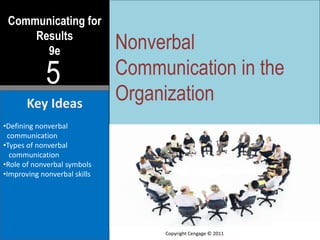
Nonverbal
Communication in the
Organization
1
Copyright Cengage © 2011
Consider this …
Aspects of nonverbal communication
make it possible . . . For receivers to be
mistaken in interpreting a message,
especially if the receiver perceives that
message as having been sent on purpose.
A shrug meant to convey “I don’t know”
may have been interpreted as “I don’t
care.”
Hickson, Stacks, & Moore, Nonverbal Communication, Roxbury, 2004, p. 15
2
Copyright Cengage © 2011
Non-Verbal Misunderstanding
 Read or describe the case study
 Answer the following questions:
Who was most responsible for the misunderstanding?
Which type of gesture best describes the hook ‘em horns
sign?
How important a role a misunderstanding over a gesture
such as this one would play in international affairs.
3
Copyright Cengage © 2011
Hook ‘em Horns Case Study
Nonverbal Defined
…all intentional and unintentional
messages that are not written, spoken,
or sounded.
ThinkStock
LLC/Index
Stock
Imagery
4
Copyright Cengage © 2011
Culture & Nonverbal Behavior
 Technical Level —Rules are
openly and knowingly stated
 Formal Level—rules known;
reasons not known
 Informal Level—neither rules nor
reasons known; behaviors
unconsciously learned
Three levels of culture . . .
NOVA
Development
5
Copyright Cengage © 2011
Nonverbal Communication
 Facial expressions & eye contact
 Body movements & gestures
 Clothing & personal appearance
 Distance & personal space
 Physical environment
 Time
Types include . . .
6
Copyright Cengage © 2011
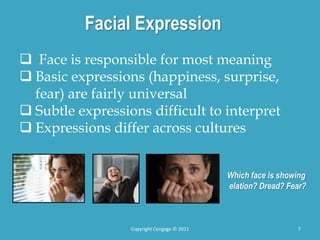
Facial Expression
 Face is responsible for most meaning
 Basic expressions (happiness, surprise,
fear) are fairly universal
 Subtle expressions difficult to interpret
 Expressions differ across cultures
7
Copyright Cengage © 2011
Which face is showing
elation? Dread? Fear?
Eye Contact
 Shows interest and attentiveness
 Signals wish to participate
 Controls & persuades others
In American culture . . .
8
Copyright Cengage © 2011
Movements & Gestures
 Emblems
 Illustrators
 Regulators
 Adaptors
Types include . . .
Which type of gesture is
this Police Officer
using?
Ronald
Martinez/Getty
Images
9
Copyright Cengage © 2011
Clothing & Appearance
 Determines credibility, persuasiveness,
status & hiring decisions
 Affects public perception of organizations
 Is problematic (i.e., Casual Confusion
Syndrome)
 Dress-down basics recommended
Appropriate business & professional clothing . . .
Christopher
Robbins
10
Copyright Cengage © 2011
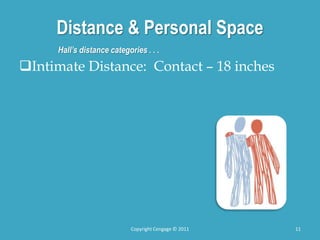
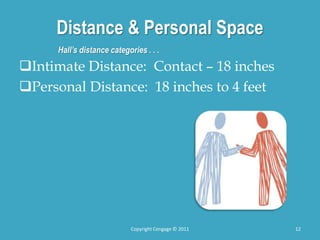
Distance & Personal Space
Intimate Distance: Contact – 18 inches
Copyright Cengage © 2011 11
Hall’s distance categories . . .
Distance & Personal Space
Intimate Distance: Contact – 18 inches
Personal Distance: 18 inches to 4 feet
Copyright Cengage © 2011 12
Hall’s distance categories . . .
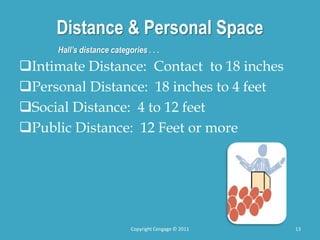
Distance & Personal Space
Intimate Distance: Contact to 18 inches
Personal Distance: 18 inches to 4 feet
Social Distance: 4 to 12 feet
Public Distance: 12 Feet or more
Copyright Cengage © 2011 13
Hall’s distance categories . . .
Physical Environment
Reveals the characteristics of the owner
Color affects emotional response
Lighting and room size alter
communication
Odor can stir emotions
Ergonomics can affect
physical well-being
Copyright Cengage © 2011 14
Time
Most business conducted on
informal level
Status determines sequences of
lateness
Time spent signals significance
Perceptions of time depend on
cultural background
NOVA
Development
15
Copyright Cengage © 2011
Revising the Case Study
What specific types of
non-verbal
communication could
have helped President
Bush and the government
officials defuse the
misunderstanding over
Bush’s use of the hook
‘em horns gesture?
Copyright Cengage © 2011 16
Nonverbal Status Symbols
Include . . .
 Clothing (i.e., tie & jacket)
 Darker colors
 Office size, location, & interior
arrangement
 Powerful nonverbal behaviors
 Time
 Gestures What gives this office status?
NOVA
Development
17
Copyright Cengage © 2011
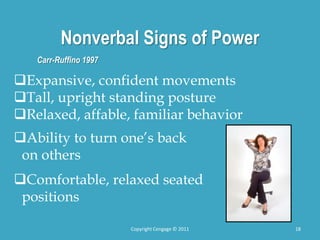
Nonverbal Signs of Power
Expansive, confident movements
Tall, upright standing posture
Relaxed, affable, familiar behavior
Ability to turn one’s back
on others
Comfortable, relaxed seated
positions
18
Copyright Cengage © 2011
Carr-Ruffino 1997
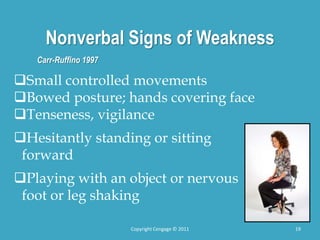
Nonverbal Signs of Weakness
Small controlled movements
Bowed posture; hands covering face
Tenseness, vigilance
Hesitantly standing or sitting
forward
Playing with an object or nervous
foot or leg shaking
19
Copyright Cengage © 2011
Carr-Ruffino 1997
Culture Shock
International cultures often use
unexpected nonverbal symbols and
meanings.
Inadequate training given to expatriates:
--65% companies provide no training
--40% return home before scheduled time
Result: Culture shock!
And international business transactions . . .
AP/Wide
World
Photos
20
Copyright Cengage © 2011
Expectancy Violations Theory
How people respond when nonverbal
expectations are not met
Involved all nonverbal behaviors
Expectations are violated more when
people come from a culture we are not
familiar with
Copyright Cengage © 2011 21
According to Burgoon’s theory . . .
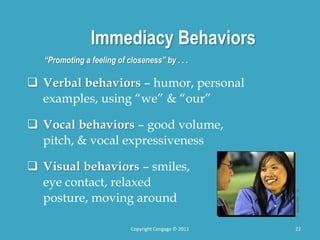
Immediacy Behaviors
 Verbal behaviors – humor, personal
examples, using “we” & “our”
 Vocal behaviors – good volume,
pitch, & vocal expressiveness
 Visual behaviors – smiles,
eye contact, relaxed
posture, moving around
“Promoting a feeling of closeness” by . . .
©
Jason
Harr
is
22
Copyright Cengage © 2011
Improving Nonverbal Skills
Develop awareness of nonverbal differences
Do not judge others according to own
nonverbal meanings
Do not assign nonverbal meanings out of
context
Observe your nonverbal behavior on
videotape or ask others for feedback
23
Copyright Cengage © 2011
Communicating for
Results
9e
5
Key Ideas
•Defining nonverbal
communication
•Types of nonverbal
communication
•Role of nonverbal symbols
•Improving nonverbal skills
Nonverbal
Communication in the
Organization
24
Copyright Cengage © 2011

chapter5.ppt

  • 1.
    Communicating for Results 9e 5 Key Ideas •Definingnonverbal communication •Types of nonverbal communication •Role of nonverbal symbols •Improving nonverbal skills Nonverbal Communication in the Organization 1 Copyright Cengage © 2011
  • 2.
    Consider this … Aspectsof nonverbal communication make it possible . . . For receivers to be mistaken in interpreting a message, especially if the receiver perceives that message as having been sent on purpose. A shrug meant to convey “I don’t know” may have been interpreted as “I don’t care.” Hickson, Stacks, & Moore, Nonverbal Communication, Roxbury, 2004, p. 15 2 Copyright Cengage © 2011
  • 3.
    Non-Verbal Misunderstanding  Reador describe the case study  Answer the following questions: Who was most responsible for the misunderstanding? Which type of gesture best describes the hook ‘em horns sign? How important a role a misunderstanding over a gesture such as this one would play in international affairs. 3 Copyright Cengage © 2011 Hook ‘em Horns Case Study
  • 4.
    Nonverbal Defined …all intentionaland unintentional messages that are not written, spoken, or sounded. ThinkStock LLC/Index Stock Imagery 4 Copyright Cengage © 2011
  • 5.
    Culture & NonverbalBehavior  Technical Level —Rules are openly and knowingly stated  Formal Level—rules known; reasons not known  Informal Level—neither rules nor reasons known; behaviors unconsciously learned Three levels of culture . . . NOVA Development 5 Copyright Cengage © 2011
  • 6.
    Nonverbal Communication  Facialexpressions & eye contact  Body movements & gestures  Clothing & personal appearance  Distance & personal space  Physical environment  Time Types include . . . 6 Copyright Cengage © 2011
  • 7.
    Facial Expression  Faceis responsible for most meaning  Basic expressions (happiness, surprise, fear) are fairly universal  Subtle expressions difficult to interpret  Expressions differ across cultures 7 Copyright Cengage © 2011 Which face is showing elation? Dread? Fear?
  • 8.
    Eye Contact  Showsinterest and attentiveness  Signals wish to participate  Controls & persuades others In American culture . . . 8 Copyright Cengage © 2011
  • 9.
    Movements & Gestures Emblems  Illustrators  Regulators  Adaptors Types include . . . Which type of gesture is this Police Officer using? Ronald Martinez/Getty Images 9 Copyright Cengage © 2011
  • 10.
    Clothing & Appearance Determines credibility, persuasiveness, status & hiring decisions  Affects public perception of organizations  Is problematic (i.e., Casual Confusion Syndrome)  Dress-down basics recommended Appropriate business & professional clothing . . . Christopher Robbins 10 Copyright Cengage © 2011
  • 11.
    Distance & PersonalSpace Intimate Distance: Contact – 18 inches Copyright Cengage © 2011 11 Hall’s distance categories . . .
  • 12.
    Distance & PersonalSpace Intimate Distance: Contact – 18 inches Personal Distance: 18 inches to 4 feet Copyright Cengage © 2011 12 Hall’s distance categories . . .
  • 13.
    Distance & PersonalSpace Intimate Distance: Contact to 18 inches Personal Distance: 18 inches to 4 feet Social Distance: 4 to 12 feet Public Distance: 12 Feet or more Copyright Cengage © 2011 13 Hall’s distance categories . . .
  • 14.
    Physical Environment Reveals thecharacteristics of the owner Color affects emotional response Lighting and room size alter communication Odor can stir emotions Ergonomics can affect physical well-being Copyright Cengage © 2011 14
  • 15.
    Time Most business conductedon informal level Status determines sequences of lateness Time spent signals significance Perceptions of time depend on cultural background NOVA Development 15 Copyright Cengage © 2011
  • 16.
    Revising the CaseStudy What specific types of non-verbal communication could have helped President Bush and the government officials defuse the misunderstanding over Bush’s use of the hook ‘em horns gesture? Copyright Cengage © 2011 16
  • 17.
    Nonverbal Status Symbols Include. . .  Clothing (i.e., tie & jacket)  Darker colors  Office size, location, & interior arrangement  Powerful nonverbal behaviors  Time  Gestures What gives this office status? NOVA Development 17 Copyright Cengage © 2011
  • 18.
    Nonverbal Signs ofPower Expansive, confident movements Tall, upright standing posture Relaxed, affable, familiar behavior Ability to turn one’s back on others Comfortable, relaxed seated positions 18 Copyright Cengage © 2011 Carr-Ruffino 1997
  • 19.
    Nonverbal Signs ofWeakness Small controlled movements Bowed posture; hands covering face Tenseness, vigilance Hesitantly standing or sitting forward Playing with an object or nervous foot or leg shaking 19 Copyright Cengage © 2011 Carr-Ruffino 1997
  • 20.
    Culture Shock International culturesoften use unexpected nonverbal symbols and meanings. Inadequate training given to expatriates: --65% companies provide no training --40% return home before scheduled time Result: Culture shock! And international business transactions . . . AP/Wide World Photos 20 Copyright Cengage © 2011
  • 21.
    Expectancy Violations Theory Howpeople respond when nonverbal expectations are not met Involved all nonverbal behaviors Expectations are violated more when people come from a culture we are not familiar with Copyright Cengage © 2011 21 According to Burgoon’s theory . . .
  • 22.
    Immediacy Behaviors  Verbalbehaviors – humor, personal examples, using “we” & “our”  Vocal behaviors – good volume, pitch, & vocal expressiveness  Visual behaviors – smiles, eye contact, relaxed posture, moving around “Promoting a feeling of closeness” by . . . © Jason Harr is 22 Copyright Cengage © 2011
  • 23.
    Improving Nonverbal Skills Developawareness of nonverbal differences Do not judge others according to own nonverbal meanings Do not assign nonverbal meanings out of context Observe your nonverbal behavior on videotape or ask others for feedback 23 Copyright Cengage © 2011
  • 24.
    Communicating for Results 9e 5 Key Ideas •Definingnonverbal communication •Types of nonverbal communication •Role of nonverbal symbols •Improving nonverbal skills Nonverbal Communication in the Organization 24 Copyright Cengage © 2011