
FILM ALGORITHM
ByHrishikesh Pujari (449)
Shekhar Pulawale (450)
INTRODUCTION
 Film making, referred commonly as
film production, is the process which
describes how actually a film is made.
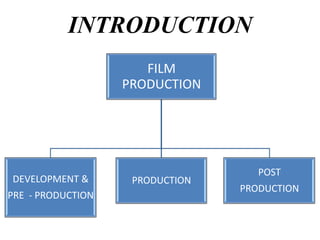
 The process involves mainly 3 sub –
processes i.e. the film production is
primarily divided into 3 parts. They
are-
INTRODUCTION
FILM
PRODUCTION

DEVELOPMENT &
PRE - PRODUCTION

PRODUCTION

POST
PRODUCTION
DEVELOPMENT
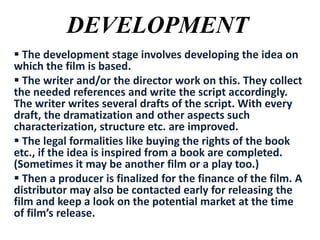
 The development stage involves developing the idea on
which the film is based.
 The writer and/or the director work on this. They collect
the needed references and write the script accordingly.
The writer writes several drafts of the script. With every
draft, the dramatization and other aspects such
characterization, structure etc. are improved.
 The legal formalities like buying the rights of the book
etc., if the idea is inspired from a book are completed.
(Sometimes it may be another film or a play too.)
 Then a producer is finalized for the finance of the film. A
distributor may also be contacted early for releasing the
film and keep a look on the potential market at the time
of film’s release.
PRE - PRODUCTION
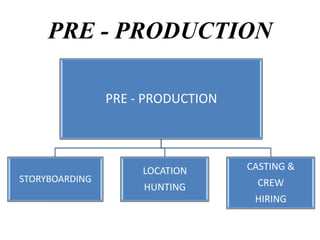
PRE - PRODUCTION

STORYBOARDING

LOCATION

CASTING &

HUNTING

CREW

HIRING
PRE - PRODUCTION
 Storyboarding- Storyboarding is a visualizing method
that creates a blueprint of what the shot sequence
should be. The visual images are drawn or made by
programs such as Photoshop. There may also be a
written caption as needed for each shot.
 A film storyboard is essentially a large comic of the
film or some section of the film produced beforehand
to help film directors, cinematographers and television
commercial advertising clients visualize the scenes and
find potential problems before they occur.
Often storyboards include arrows or instructions that
indicate movement.
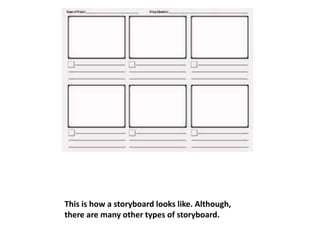
This is how a storyboard looks like. Although,
there are many other types of storyboard.
PRE - PRODUCTION
 Location Hunting- There is a team associated
with this. The team searches and visits
different locations as required by the script.
 They study all the aspects of the location
like the weather and the climatic conditions
(during the shoot), the basic facilities available,
nearest hotels etc.
 Sometimes, it is not possible to choose
natural locations due to various reasons.
Hence, artificial setting is preferred.
PRE – PRODUCTION

 Casting & Crew Hiring- The actors, who are going to
play the characters in film are cast, through a process
called audition & screen test.
 Factors considered here are the nature & behavior of
the script, the audiences’ demand and the capability of
the actors.
 The production house hires a crew. The nature of the
film, and the budget, determine the size and type of
crew used during filmmaking. Most of the times a cast
and crew of hundreds is employed.
The other members of the crew are Unit Production
Manager, Assistant Director(s), Casting Director, Location
Manager, DoP, DoA, Make – Up men, Costume Designer,
Choreographer, Action Master, Spot Boys, Light Boys etc.
PRODUCTION
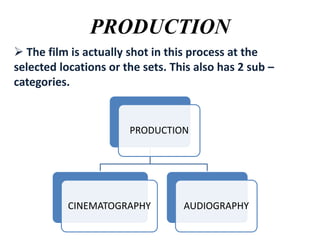
 The film is actually shot in this process at the
selected locations or the sets. This also has 2 sub –
categories.

PRODUCTION

CINEMATOGRAPHY

AUDIOGRAPHY
PRODUCTION
Cinematography- It is the art of motion picture photography. To
be precise, what we see in the theatre, is all due to
cinematography.
The light plays the most important role in cinematography. The
clarity of the picture depends upon the light. Every frame shot
requires adequate light. Sometimes artificial lights are created in
order to provide sufficient light.
Various aspects related to Cinematography areAperture
Light
Focus
Lenses
DEVELPOMENT
 Audiography- It is concerned with the sound of the film (not to be
confused with music composition).
 The audiographer supervises the entire audiography of the film.
The production sound mixer is the head of the sound department
during the production stage of filmmaking. They record and mix the
audio on set - dialogue, presence and sound effects in
mono and ambience in stereo. They work with the boom operator,
Director, DoA, DoP, and First AD.
The sound designer creates the aural conception of the
film, working with the supervising sound editor. On some
productions the sound designer plays the role of a director of
audiography.
The composer creates new music for the film (usually not until
post-production).
PRODUCTION
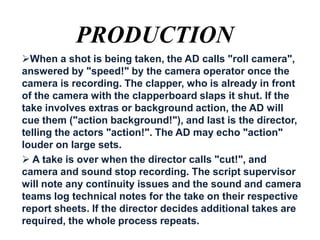
When a shot is being taken, the AD calls "roll camera",
answered by "speed!" by the camera operator once the
camera is recording. The clapper, who is already in front
of the camera with the clapperboard slaps it shut. If the
take involves extras or background action, the AD will
cue them ("action background!"), and last is the director,
telling the actors "action!". The AD may echo "action"
louder on large sets.
 A take is over when the director calls "cut!", and
camera and sound stop recording. The script supervisor
will note any continuity issues and the sound and camera
teams log technical notes for the take on their respective
report sheets. If the director decides additional takes are
required, the whole process repeats.
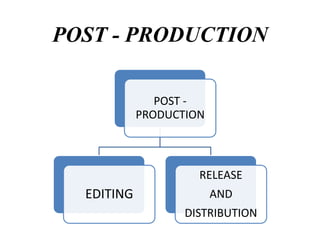
POST - PRODUCTION
POST PRODUCTION

RELEASE

EDITING

AND
DISTRIBUTION
EDITING
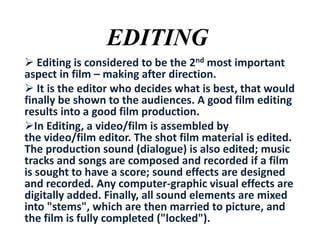
 Editing is considered to be the 2nd most important
aspect in film – making after direction.
 It is the editor who decides what is best, that would
finally be shown to the audiences. A good film editing
results into a good film production.
In Editing, a video/film is assembled by
the video/film editor. The shot film material is edited.
The production sound (dialogue) is also edited; music
tracks and songs are composed and recorded if a film
is sought to have a score; sound effects are designed
and recorded. Any computer-graphic visual effects are
digitally added. Finally, all sound elements are mixed
into "stems", which are then married to picture, and
the film is fully completed ("locked").
PROMOTION
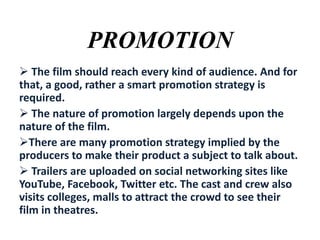
 The film should reach every kind of audience. And for
that, a good, rather a smart promotion strategy is
required.
 The nature of promotion largely depends upon the
nature of the film.
There are many promotion strategy implied by the
producers to make their product a subject to talk about.
 Trailers are uploaded on social networking sites like
YouTube, Facebook, Twitter etc. The cast and crew also
visits colleges, malls to attract the crowd to see their
film in theatres.
RELEASE
AND
DISTRIBUTION
This is the final stage, where the film is released
to cinemas or, occasionally, to consumer media
(DVD, VCD, VHS, Blue-ray) or direct download from
a provider. The film is duplicated as required and
distributed to cinemas for exhibition (screening).
Press kits, posters, and other advertising materials
are published and the film is advertised
and promoted.
THANK YOU!

Film Making Algorithm..just a basic idea about what film making actually involves.

  • 1.
    FILM ALGORITHM ByHrishikesh Pujari(449) Shekhar Pulawale (450)
  • 2.
    INTRODUCTION  Film making,referred commonly as film production, is the process which describes how actually a film is made.  The process involves mainly 3 sub – processes i.e. the film production is primarily divided into 3 parts. They are-
  • 3.
    INTRODUCTION FILM PRODUCTION DEVELOPMENT & PRE -PRODUCTION PRODUCTION POST PRODUCTION
  • 4.
    DEVELOPMENT  The developmentstage involves developing the idea on which the film is based.  The writer and/or the director work on this. They collect the needed references and write the script accordingly. The writer writes several drafts of the script. With every draft, the dramatization and other aspects such characterization, structure etc. are improved.  The legal formalities like buying the rights of the book etc., if the idea is inspired from a book are completed. (Sometimes it may be another film or a play too.)  Then a producer is finalized for the finance of the film. A distributor may also be contacted early for releasing the film and keep a look on the potential market at the time of film’s release.
  • 5.
    PRE - PRODUCTION PRE- PRODUCTION STORYBOARDING LOCATION CASTING & HUNTING CREW HIRING
  • 6.
    PRE - PRODUCTION Storyboarding- Storyboarding is a visualizing method that creates a blueprint of what the shot sequence should be. The visual images are drawn or made by programs such as Photoshop. There may also be a written caption as needed for each shot.  A film storyboard is essentially a large comic of the film or some section of the film produced beforehand to help film directors, cinematographers and television commercial advertising clients visualize the scenes and find potential problems before they occur. Often storyboards include arrows or instructions that indicate movement.
  • 7.
    This is howa storyboard looks like. Although, there are many other types of storyboard.
  • 8.
    PRE - PRODUCTION Location Hunting- There is a team associated with this. The team searches and visits different locations as required by the script.  They study all the aspects of the location like the weather and the climatic conditions (during the shoot), the basic facilities available, nearest hotels etc.  Sometimes, it is not possible to choose natural locations due to various reasons. Hence, artificial setting is preferred.
  • 9.
    PRE – PRODUCTION Casting & Crew Hiring- The actors, who are going to play the characters in film are cast, through a process called audition & screen test.  Factors considered here are the nature & behavior of the script, the audiences’ demand and the capability of the actors.  The production house hires a crew. The nature of the film, and the budget, determine the size and type of crew used during filmmaking. Most of the times a cast and crew of hundreds is employed. The other members of the crew are Unit Production Manager, Assistant Director(s), Casting Director, Location Manager, DoP, DoA, Make – Up men, Costume Designer, Choreographer, Action Master, Spot Boys, Light Boys etc.
  • 10.
    PRODUCTION  The filmis actually shot in this process at the selected locations or the sets. This also has 2 sub – categories. PRODUCTION CINEMATOGRAPHY AUDIOGRAPHY
  • 11.
    PRODUCTION Cinematography- It isthe art of motion picture photography. To be precise, what we see in the theatre, is all due to cinematography. The light plays the most important role in cinematography. The clarity of the picture depends upon the light. Every frame shot requires adequate light. Sometimes artificial lights are created in order to provide sufficient light. Various aspects related to Cinematography areAperture Light Focus Lenses
  • 12.
    DEVELPOMENT  Audiography- Itis concerned with the sound of the film (not to be confused with music composition).  The audiographer supervises the entire audiography of the film. The production sound mixer is the head of the sound department during the production stage of filmmaking. They record and mix the audio on set - dialogue, presence and sound effects in mono and ambience in stereo. They work with the boom operator, Director, DoA, DoP, and First AD. The sound designer creates the aural conception of the film, working with the supervising sound editor. On some productions the sound designer plays the role of a director of audiography. The composer creates new music for the film (usually not until post-production).
  • 13.
    PRODUCTION When a shotis being taken, the AD calls "roll camera", answered by "speed!" by the camera operator once the camera is recording. The clapper, who is already in front of the camera with the clapperboard slaps it shut. If the take involves extras or background action, the AD will cue them ("action background!"), and last is the director, telling the actors "action!". The AD may echo "action" louder on large sets.  A take is over when the director calls "cut!", and camera and sound stop recording. The script supervisor will note any continuity issues and the sound and camera teams log technical notes for the take on their respective report sheets. If the director decides additional takes are required, the whole process repeats.
  • 14.
    POST - PRODUCTION POSTPRODUCTION RELEASE EDITING AND DISTRIBUTION
  • 15.
    EDITING  Editing isconsidered to be the 2nd most important aspect in film – making after direction.  It is the editor who decides what is best, that would finally be shown to the audiences. A good film editing results into a good film production. In Editing, a video/film is assembled by the video/film editor. The shot film material is edited. The production sound (dialogue) is also edited; music tracks and songs are composed and recorded if a film is sought to have a score; sound effects are designed and recorded. Any computer-graphic visual effects are digitally added. Finally, all sound elements are mixed into "stems", which are then married to picture, and the film is fully completed ("locked").
  • 16.
    PROMOTION  The filmshould reach every kind of audience. And for that, a good, rather a smart promotion strategy is required.  The nature of promotion largely depends upon the nature of the film. There are many promotion strategy implied by the producers to make their product a subject to talk about.  Trailers are uploaded on social networking sites like YouTube, Facebook, Twitter etc. The cast and crew also visits colleges, malls to attract the crowd to see their film in theatres.
  • 17.
    RELEASE AND DISTRIBUTION This is thefinal stage, where the film is released to cinemas or, occasionally, to consumer media (DVD, VCD, VHS, Blue-ray) or direct download from a provider. The film is duplicated as required and distributed to cinemas for exhibition (screening). Press kits, posters, and other advertising materials are published and the film is advertised and promoted.
  • 18.