Film Production Workflow
Created by
Fuad Almwalad
Thanks to Matthew Jones
Production Phases
There are five phases of production
common to most professionally produced
motion pictures. These are:
Development
Pre-production
Production
Postproduction
Distribution
Pre-production
Production
Postproduction
Production Phases
We will concern ourselves with three of
these:
Development
Distribution
Pre-production
Production
Postproduction
Production Phases
We will concern ourselves with three of
these:
Preproduction Phase
In general, the
preproduction phase
encompasses all
aspects of preparation
that are performed
before the camera
starts to roll. Some
aspects of
preproduction include:
Screenwriting
Storyboarding
Funding
Assembling a crew
Casting
Costume Design
Location Scouting
Set Design
Properties (“props”)
Scheduling
Preproduction Phase
Screenplay/Script: The screenplay supplies
the general plan for the production of a
film. There are two types:
The “spec” script
The “shooting” script
Preproduction Phase
The “Spec” (Speculation) Script is the version of a
screenplay that writers distribute to producers in
the hope that it will be “optioned” (i.e. considered
for production). It primarily contains:
Slug-Line (brief description of the setting, e.g. “INT.
ROOM – DAY” which means the interior of a room
during the day)
Business (descriptions of characters/action)
Dialog (the lines intended to be spoken by the actors)
Preproduction Phase
The Shooting Script is a much more detailed
version of the spec script that includes
numbered scenes, specific camera angles
and other technical information. An
example of a page from a shooting script
can be seen on the next slide.
Preproduction Phase
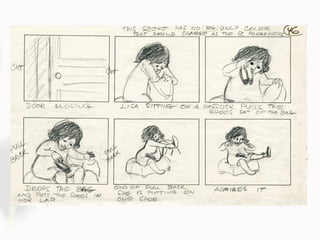
Storyboarding: A storyboard is a series of
drawings intended to represent how the film
will be shot, including how each frame will
be composed and how subject and camera
motion will occur.
The storyboard articulates the mise-en-scene of
the film.
• Mise-en-scene: All of the elements that compose the
shot.
Preproduction Phase
Funding: Films are generally expensive to
produce. Even small independent
productions with unknown actors can cost
hundreds of thousands of dollars. Because
of the level of investment involved, most
films rely on either production companies
(“Hollywood” films) or independent
investors (“Independent” films).
Preproduction Phase
Assembling a Crew: A crew is the group of
workers on a film set who are responsible
for facilitating production (as opposed to
acting). Although large productions may
employ many crew members in many
different departments, there are only a few
basic positions which are detailed later in
the production phase.
Preproduction Phase
Casting: Choosing actors to play roles.
Costume Design: Choosing or designing
the clothing/costumes that the actors wear.
Location Scouting: Choosing the locations
where the film will be shot.
Set Design: Constructing sets where the
film will be shot.
Preproduction Phase
Properties (“Props”): Choosing the tools
and objects used in the film.
Scheduling: Coordinating all aspects
necessary to the production.
Production Phase
The production phase
refers to the period of
time when the film is
actually being shot.
Some aspects of
production include:
Direction
Camera operation
Lighting
Sound recording
Acting
Production Phase
During production, these roles are usually
delegated to the production departments
listed on the next two slides.
Production Phase
Production Departments
Direction
• Director (oversees all aspects of the production)
• Assistant Director (drives the set)
• Second Assistant Director (works with the actors)
Camera
• Cinematographer or DP (oversees camera operation)
• Camera Operator (operates the camera)
• Camera Assistants (loads camera, pulls focus)
• Clapper/Loader (loads film and slates scenes)
Lighting
• Cinematographer (oversees lighting design)
• Gaffer & Electricians (control the lights)
• Key Grip & Grips (control the shadows and do special rigging)
Production Phase
Production Departments (continued)
Sound
• Sound Mixer (records the sound)
• Boom operator (positions the microphone)
• Clapper (displays the clap slate for the camera)
Talent
• Actors (perform before the camera)
Miscellaneous - others
• Production Coordinator (scheduling)
• Continuity “script girl” (watch for continuity errors)
• Make-up Artist (apply make-up to actors)
• Production Assistant (various jobs)
Production Phase
All of the departments and positions
described on the last two slides serve one
goal: to capture the sound and image
necessary to tell the story. Although going
into every detail of production is far beyond
the scope of this course, let’s consider the
“nuts and bolts” that go into filmmaking.
Production Phase
Sound Recording
In traditional film production, sound is recorded
separately from the image. This is known as “double
system” sound recording. Generally speaking, there are
at least four soundtracks in any feature length narrative
film:
• 1 – the dialog track.
• 2 – the room tone track.
• 3 – the music track.
• 4 – the sound effects track.
Production Phase
Sound Recording
Dialog
• In order to record dialog in “double system” film
production, it is necessary to synchronize the movement
of lips with the sound of voices. Simple as this may
seem, achieving it requires precision instrumentation.
• Most modern film sound is recorded digitally.
Production Phase
Sound Recording
Dialog (Continued)
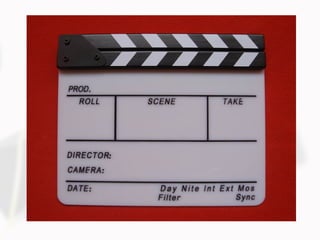
• The function of the “clap slate” or “sticks” (see the
slide after next) is to supply a marking point for
when the synchronization between picture and audio
begins, allowing the editor to accurately align
picture with sound later during post production.
• The first film credited with synchronized sound is
The Jazz Singer (1927).
Production Phase
Sound Recording
Dialog
• There are a series of steps that are taken on a film set in order to
ensure the proper coordination of picture and sound track:
– 1: The director says “quiet on the set” and “roll sound.”
– 2: The sound mixer says “sound speed” when the tape is running
at the correct speed for recording synchronized sound.
– 3: The director calls out “roll camera.”
– 4: The camera operator says “speed” when the film is running at
sound speed (24 frames per second).
– 5: The director calls out “slate” or “marker”
– 6: The clap slate indicating roll, scene, and take is placed before
the camera and read out loud (e.g. “Roll 1, Scene 1, Take 1”).
– 7: The slate is clapped and removed.
– 8: Finally, the director calls “action” to cue the actors.
Production Phase
Sound Recording
Room Tone
• Room tone is recorded silence. Normally, once all of the
dialog is recorded, the sound mixer asks for about a
minute of quiet to record the sound of silence in the
particular setting.
• The reason for recording room tone is that all recordings
have a low level of “noise” in the background and,
during the editing process it is sometimes necessary to
fill in gaps so that there is not an abrupt change in the
tone of the background noise.
Production Phase
Sound Recording
Sound Effects
• For the most part, sound effects are obtained separately
by a “foley” artist who coordinates sound effects in
synchronization with the onscreen action through a
process known as “looping” – where a portion of the film
is repeatedly played to perfect the timing of the sound
effects. This is considered to be part of post-production
which we will cover next.
• Alternatively, for low-budget productions, libraries of
prerecorded sound effects can be used or sounds can be
recorded during production by the sound mixer and
boom operator.
Production Phase
Sound Recording
Music
• Film music is either purchased (if it is not in the
“public domain”) or scored specifically for the
production.
• Music that is scored is done in similar fashion to
foley sound in the sense that film is playing during
the recording session to enhance timing.
Postproduction Phase
The postproduction
phase refers to the
period of time after the
film is shot, but before
it is released in its
final form.
Postproduction
includes:
 Processing and printing of film
 Transferring film to video
 Synchronizing picture and sound
 Creating a rough cut
 Creating a online edit
 Final audio mix
 Film out & release prints
Postproduction Phase
Processing, Printing, and Transferring.
The first few steps of postproduction are
routine, requiring more technical knowledge
than creative decision making:
• Processing: Developing the camera negative.
• Printing: Creating dailies on DVD or a work print
for the director and crew to see
• Transferring: Film transfer or “Telecine” to video
for editing
• Nowadays it is all digital, so it is matter of copy and
paste.
Postproduction Phase
Synchronizing and Assembling
Synchronizing
• Information from the slate and recorded on the
audio tracks is stored at the beginning (“head”)
of each take to allow the scene/take to be easily
identified.
• To synchronize picture with sound, the editor
aligns the beginning of the sound for a given
scene/take with the beginning of the picture for
that take, using the sight and sound of the slate
as a reference point.
Postproduction Phase
Synchronizing and Assembling.
Assembling
• The footage is captured to the editing system
from the video tape or transferred from the
hard drives if it is a digital workflow
• Once the footage is captured, the editor
assembles a rough cut for timing and to
make sure all necessary footage is present
Postproduction Phase
Creative License
Between the rough cut and the online edit is
where all of the creative decisions are made.
• Rough Cut: Places the film in rough sequence from
beginning to end according to the screenplay.
Dialog is in place, but sound effects, and music are
incomplete.
• Online Edit: All of the final editing decisions and
the final soundtrack mix are complete. The film is
ready for final output.
Postproduction Phase
Getting from Rough Cut to Online Edit.
Editing is the arrangement of imagery and
sounds into a sequence that tells the story of the
film.
An editor may arrange based on different
aesthetic styles depending upon the needs of the
story. For example:
• Invisible editing.
• Montage editing.
Postproduction Phase
As more theaters become able to project films
digitally, film prints will become obsolete and
will be replaced with reusable hard drives that
are easily shipped from studio to theater.
The hard drives can be pre-programmed only to
play the film a proscribed number of times
saving the studios billions of dollars a year in
lost revenues and in film printing costs.
The End

Mock presentation2

  • 1.
    Film Production Workflow Createdby Fuad Almwalad Thanks to Matthew Jones
  • 2.
    Production Phases There arefive phases of production common to most professionally produced motion pictures. These are: Development Pre-production Production Postproduction Distribution
  • 3.
    Pre-production Production Postproduction Production Phases We willconcern ourselves with three of these: Development Distribution
  • 4.
  • 5.
    Preproduction Phase In general,the preproduction phase encompasses all aspects of preparation that are performed before the camera starts to roll. Some aspects of preproduction include: Screenwriting Storyboarding Funding Assembling a crew Casting Costume Design Location Scouting Set Design Properties (“props”) Scheduling
  • 6.
    Preproduction Phase Screenplay/Script: Thescreenplay supplies the general plan for the production of a film. There are two types: The “spec” script The “shooting” script
  • 7.
    Preproduction Phase The “Spec”(Speculation) Script is the version of a screenplay that writers distribute to producers in the hope that it will be “optioned” (i.e. considered for production). It primarily contains: Slug-Line (brief description of the setting, e.g. “INT. ROOM – DAY” which means the interior of a room during the day) Business (descriptions of characters/action) Dialog (the lines intended to be spoken by the actors)
  • 9.
    Preproduction Phase The ShootingScript is a much more detailed version of the spec script that includes numbered scenes, specific camera angles and other technical information. An example of a page from a shooting script can be seen on the next slide.
  • 11.
    Preproduction Phase Storyboarding: Astoryboard is a series of drawings intended to represent how the film will be shot, including how each frame will be composed and how subject and camera motion will occur. The storyboard articulates the mise-en-scene of the film. • Mise-en-scene: All of the elements that compose the shot.
  • 14.
    Preproduction Phase Funding: Filmsare generally expensive to produce. Even small independent productions with unknown actors can cost hundreds of thousands of dollars. Because of the level of investment involved, most films rely on either production companies (“Hollywood” films) or independent investors (“Independent” films).
  • 15.
    Preproduction Phase Assembling aCrew: A crew is the group of workers on a film set who are responsible for facilitating production (as opposed to acting). Although large productions may employ many crew members in many different departments, there are only a few basic positions which are detailed later in the production phase.
  • 16.
    Preproduction Phase Casting: Choosingactors to play roles. Costume Design: Choosing or designing the clothing/costumes that the actors wear. Location Scouting: Choosing the locations where the film will be shot. Set Design: Constructing sets where the film will be shot.
  • 17.
    Preproduction Phase Properties (“Props”):Choosing the tools and objects used in the film. Scheduling: Coordinating all aspects necessary to the production.
  • 18.
    Production Phase The productionphase refers to the period of time when the film is actually being shot. Some aspects of production include: Direction Camera operation Lighting Sound recording Acting
  • 19.
    Production Phase During production,these roles are usually delegated to the production departments listed on the next two slides.
  • 20.
    Production Phase Production Departments Direction •Director (oversees all aspects of the production) • Assistant Director (drives the set) • Second Assistant Director (works with the actors) Camera • Cinematographer or DP (oversees camera operation) • Camera Operator (operates the camera) • Camera Assistants (loads camera, pulls focus) • Clapper/Loader (loads film and slates scenes) Lighting • Cinematographer (oversees lighting design) • Gaffer & Electricians (control the lights) • Key Grip & Grips (control the shadows and do special rigging)
  • 21.
    Production Phase Production Departments(continued) Sound • Sound Mixer (records the sound) • Boom operator (positions the microphone) • Clapper (displays the clap slate for the camera) Talent • Actors (perform before the camera) Miscellaneous - others • Production Coordinator (scheduling) • Continuity “script girl” (watch for continuity errors) • Make-up Artist (apply make-up to actors) • Production Assistant (various jobs)
  • 22.
    Production Phase All ofthe departments and positions described on the last two slides serve one goal: to capture the sound and image necessary to tell the story. Although going into every detail of production is far beyond the scope of this course, let’s consider the “nuts and bolts” that go into filmmaking.
  • 23.
    Production Phase Sound Recording Intraditional film production, sound is recorded separately from the image. This is known as “double system” sound recording. Generally speaking, there are at least four soundtracks in any feature length narrative film: • 1 – the dialog track. • 2 – the room tone track. • 3 – the music track. • 4 – the sound effects track.
  • 24.
    Production Phase Sound Recording Dialog •In order to record dialog in “double system” film production, it is necessary to synchronize the movement of lips with the sound of voices. Simple as this may seem, achieving it requires precision instrumentation. • Most modern film sound is recorded digitally.
  • 25.
    Production Phase Sound Recording Dialog(Continued) • The function of the “clap slate” or “sticks” (see the slide after next) is to supply a marking point for when the synchronization between picture and audio begins, allowing the editor to accurately align picture with sound later during post production. • The first film credited with synchronized sound is The Jazz Singer (1927).
  • 26.
    Production Phase Sound Recording Dialog •There are a series of steps that are taken on a film set in order to ensure the proper coordination of picture and sound track: – 1: The director says “quiet on the set” and “roll sound.” – 2: The sound mixer says “sound speed” when the tape is running at the correct speed for recording synchronized sound. – 3: The director calls out “roll camera.” – 4: The camera operator says “speed” when the film is running at sound speed (24 frames per second). – 5: The director calls out “slate” or “marker” – 6: The clap slate indicating roll, scene, and take is placed before the camera and read out loud (e.g. “Roll 1, Scene 1, Take 1”). – 7: The slate is clapped and removed. – 8: Finally, the director calls “action” to cue the actors.
  • 29.
    Production Phase Sound Recording RoomTone • Room tone is recorded silence. Normally, once all of the dialog is recorded, the sound mixer asks for about a minute of quiet to record the sound of silence in the particular setting. • The reason for recording room tone is that all recordings have a low level of “noise” in the background and, during the editing process it is sometimes necessary to fill in gaps so that there is not an abrupt change in the tone of the background noise.
  • 30.
    Production Phase Sound Recording SoundEffects • For the most part, sound effects are obtained separately by a “foley” artist who coordinates sound effects in synchronization with the onscreen action through a process known as “looping” – where a portion of the film is repeatedly played to perfect the timing of the sound effects. This is considered to be part of post-production which we will cover next. • Alternatively, for low-budget productions, libraries of prerecorded sound effects can be used or sounds can be recorded during production by the sound mixer and boom operator.
  • 31.
    Production Phase Sound Recording Music •Film music is either purchased (if it is not in the “public domain”) or scored specifically for the production. • Music that is scored is done in similar fashion to foley sound in the sense that film is playing during the recording session to enhance timing.
  • 32.
    Postproduction Phase The postproduction phaserefers to the period of time after the film is shot, but before it is released in its final form. Postproduction includes:  Processing and printing of film  Transferring film to video  Synchronizing picture and sound  Creating a rough cut  Creating a online edit  Final audio mix  Film out & release prints
  • 33.
    Postproduction Phase Processing, Printing,and Transferring. The first few steps of postproduction are routine, requiring more technical knowledge than creative decision making: • Processing: Developing the camera negative. • Printing: Creating dailies on DVD or a work print for the director and crew to see • Transferring: Film transfer or “Telecine” to video for editing • Nowadays it is all digital, so it is matter of copy and paste.
  • 35.
    Postproduction Phase Synchronizing andAssembling Synchronizing • Information from the slate and recorded on the audio tracks is stored at the beginning (“head”) of each take to allow the scene/take to be easily identified. • To synchronize picture with sound, the editor aligns the beginning of the sound for a given scene/take with the beginning of the picture for that take, using the sight and sound of the slate as a reference point.
  • 36.
    Postproduction Phase Synchronizing andAssembling. Assembling • The footage is captured to the editing system from the video tape or transferred from the hard drives if it is a digital workflow • Once the footage is captured, the editor assembles a rough cut for timing and to make sure all necessary footage is present
  • 37.
    Postproduction Phase Creative License Betweenthe rough cut and the online edit is where all of the creative decisions are made. • Rough Cut: Places the film in rough sequence from beginning to end according to the screenplay. Dialog is in place, but sound effects, and music are incomplete. • Online Edit: All of the final editing decisions and the final soundtrack mix are complete. The film is ready for final output.
  • 38.
    Postproduction Phase Getting fromRough Cut to Online Edit. Editing is the arrangement of imagery and sounds into a sequence that tells the story of the film. An editor may arrange based on different aesthetic styles depending upon the needs of the story. For example: • Invisible editing. • Montage editing.
  • 39.
    Postproduction Phase As moretheaters become able to project films digitally, film prints will become obsolete and will be replaced with reusable hard drives that are easily shipped from studio to theater. The hard drives can be pre-programmed only to play the film a proscribed number of times saving the studios billions of dollars a year in lost revenues and in film printing costs.
  • 40.

Editor's Notes

  • #4 Finding Finance Script development Stars Director Other Key Crew ( DOP – Assistants – Editors ) A script treatment - ten or more pages concerning storylines, characters and locations. Generic profile of film - help investors to “place” film in marketplace (potential audience) Proposed budget - rough guide to price Visual representation of key narrative moments Key personnel - stars, director, DOP, etc Keys of distributing to make investors confidents