Film Language
Primary Concepts
1
What is a Film?
• Conflict and Dialogue of a drama
• Narrative Description of a fiction
• Interplay between light and shade of a
painting
• Movement and rhythm of music
• And above all, its own distinct language of
image and sound
2
Film Form
• Overall structure of the film; how it is constructed
at both the micro and macro levels
• From composition of individual shots (audio-visual
fragments) to their arrangement into scenes,
sequences and finally the entire film
• Macrostructure: composition in scripting
• Microstructure: composition of images, sounds
• the concept of editing and its relationship to the
concept of structure
3
Content
• Content: what is in the film
• Meaning: how meaning is created
• Film as a self-contained text: implicit, explicit and
referential( internal evidence)
• Historical/ social context, about the filmmaker/
place (external evidence)
• ‘film as film’ vs. film in its social context
• ‘what is seen in the picture’- ‘what is put into the
scene’ :the mise-en-scene
4
Mise-en-Scene
• Production design: sets, props and costumes
• Color (present in both production design and
lighting)
• Lighting
• Actors’ performance (including casting and
make-up) and movement
5
Elements of Cinema: Setting
• Setting: Is the scene shot in a studio, sound
stage or “on location”?
• How is the setting integrated into the action
• “The drama on the screen can exist without
actors. A banging door, a leaf in the wind, waves
beating on the shore can heighten the dramatic
effect. Some film masterpieces use man as an
accessory, like an extra, or in counterpoint to
nature, which is the true leading character”
- Andre Bazin
6
Prop
• Prop: an object in the setting that operates
actively in the ongoing action to further the
plot or story line ( a term from theatre); used
to ‘dress’ the set
• props often define the genre
• Art directors design/select sets and décor in a
film
7
Costume
• A variant of the prop
• Tightly connected to the character’s identity
• In period films, costume of that period is
designed to create the era
• Costumes can be iconographic (eg: cowboy
outfit in a Western film, combat uniform in a
War film)
8
Cleopatra
9
Color
• Color is used as an expressive device
• Present in the setting, props, costume of a film, in
the type of lighting used
• In black and white film, the shades of grey convey
moods or set the tone
• nostalgic- sepia tone
• dull colors- lack of life or sadness
• cold or bluish lighting to suggest alienation,
technology
• yellowish tinge to convey comfort
10
Actors’ Performance
• Acting, appearance, gestures, facial
expressions, voice- tone/accent/ type of
dialect, body posture/ movement
• Melodramatic or realistic
• Classical style, Method acting, Natural style
11
Classical/Method/Natural
• Classical acting: obviously mannered
– e.g. Cleopatra, Gladiator, or Mughal E Azam
• Method acting: intense and psychologically driven;
actors create in themselves the thoughts and emotions
of their characters, so as to develop lifelike
performances
– e.g. Ingmar Bergman’s films
• Natural: natural style of acting, there is less affectation
and it is more natural
– e.g. Satyajit Ray’s Pather Panchali
– Vittorio De Sica’s Bicycle Thieves
12
Lighting
• “Light is everything. It expresses ideology,
emotion, color, depth, style. It can efface,
narrate, describe. With the right lighting, the
ugliest face, the most idiotic expression can
radiate with beauty or intelligence.”
Frederico Fellini
13
Lighting (Contd.)
• Intensity, direction, and quality of lighting
have profound impact on the image
– brightly illuminated part of a shot may draw
attention to certain objects/ gestures
– a shadow may conceal a detail or build up
suspense
14
Lighting (Contd.)
• Quality/ intensity: hard or soft lighting
• Direction: frontal lighting, side-lighting,
backlighting, under-lighting or top lighting
• Source: natural light, light coming from the
objects within the frame (visible sources of
light) or extra light sources
15
16
Key Light and Fill Light
• Key: the main light
– usually the strongest
– placed to one side of the camera/subject so that
this side is well lit and the other side has some
shadow
• Fill: secondary light
– softer and less bright
– is placed on the opposite side of the key light
– is used to fill the shadows created by the key
17
Back Light
• Back light:
– is placed behind the subject and lights it from
the rear
– it provides definition and subtle highlights
around the subject's outlines
– helps separate the subject from the
background and provide a three-dimensional
feel
18
Sound
• Diegetic sound: heard from within the film’s diegesis
(a narrative or plot, typically in a film)
– on-screen (emanated from on-screen sound
source)
– off-screen (that which extends to off-screen
space, extra-diegetic)
• Non-diegetic sound: heard outside of the film's
diegesis (such as film scores and voice-overs)
19
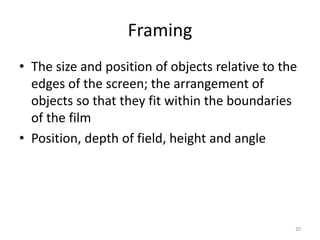
Framing
• The size and position of objects relative to the
edges of the screen; the arrangement of
objects so that they fit within the boundaries
of the film
• Position, depth of field, height and angle
20
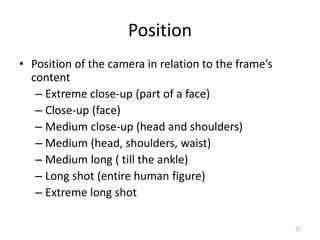
Position
• Position of the camera in relation to the frame’s
content
– Extreme close-up (part of a face)
– Close-up (face)
– Medium close-up (head and shoulders)
– Medium (head, shoulders, waist)
– Medium long ( till the ankle)
– Long shot (entire human figure)
– Extreme long shot
21
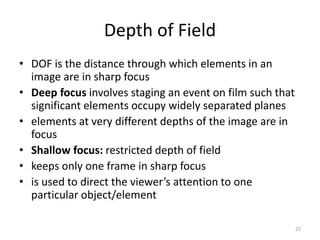
Depth of Field
• DOF is the distance through which elements in an
image are in sharp focus
• Deep focus involves staging an event on film such that
significant elements occupy widely separated planes
• elements at very different depths of the image are in
focus
• Shallow focus: restricted depth of field
• keeps only one frame in sharp focus
• is used to direct the viewer’s attention to one
particular object/element
22
Deep Focus
23
Shallow Focus
24
Height and Angle
• Height of the camera placement
• eye-level: camera at the same height as its
subject
• low angle: the camera is below the subject;
subject gains stature; often suggests power
• high angle: camera is placed above the
subject; the character appears diminished and
subdued; suggests vulnerability
25
Thank You!
26

Film Language_KSB.pptx

  • 1.
  • 2.
    What is aFilm? • Conflict and Dialogue of a drama • Narrative Description of a fiction • Interplay between light and shade of a painting • Movement and rhythm of music • And above all, its own distinct language of image and sound 2
  • 3.
    Film Form • Overallstructure of the film; how it is constructed at both the micro and macro levels • From composition of individual shots (audio-visual fragments) to their arrangement into scenes, sequences and finally the entire film • Macrostructure: composition in scripting • Microstructure: composition of images, sounds • the concept of editing and its relationship to the concept of structure 3
  • 4.
    Content • Content: whatis in the film • Meaning: how meaning is created • Film as a self-contained text: implicit, explicit and referential( internal evidence) • Historical/ social context, about the filmmaker/ place (external evidence) • ‘film as film’ vs. film in its social context • ‘what is seen in the picture’- ‘what is put into the scene’ :the mise-en-scene 4
  • 5.
    Mise-en-Scene • Production design:sets, props and costumes • Color (present in both production design and lighting) • Lighting • Actors’ performance (including casting and make-up) and movement 5
  • 6.
    Elements of Cinema:Setting • Setting: Is the scene shot in a studio, sound stage or “on location”? • How is the setting integrated into the action • “The drama on the screen can exist without actors. A banging door, a leaf in the wind, waves beating on the shore can heighten the dramatic effect. Some film masterpieces use man as an accessory, like an extra, or in counterpoint to nature, which is the true leading character” - Andre Bazin 6
  • 7.
    Prop • Prop: anobject in the setting that operates actively in the ongoing action to further the plot or story line ( a term from theatre); used to ‘dress’ the set • props often define the genre • Art directors design/select sets and décor in a film 7
  • 8.
    Costume • A variantof the prop • Tightly connected to the character’s identity • In period films, costume of that period is designed to create the era • Costumes can be iconographic (eg: cowboy outfit in a Western film, combat uniform in a War film) 8
  • 9.
  • 10.
    Color • Color isused as an expressive device • Present in the setting, props, costume of a film, in the type of lighting used • In black and white film, the shades of grey convey moods or set the tone • nostalgic- sepia tone • dull colors- lack of life or sadness • cold or bluish lighting to suggest alienation, technology • yellowish tinge to convey comfort 10
  • 11.
    Actors’ Performance • Acting,appearance, gestures, facial expressions, voice- tone/accent/ type of dialect, body posture/ movement • Melodramatic or realistic • Classical style, Method acting, Natural style 11
  • 12.
    Classical/Method/Natural • Classical acting:obviously mannered – e.g. Cleopatra, Gladiator, or Mughal E Azam • Method acting: intense and psychologically driven; actors create in themselves the thoughts and emotions of their characters, so as to develop lifelike performances – e.g. Ingmar Bergman’s films • Natural: natural style of acting, there is less affectation and it is more natural – e.g. Satyajit Ray’s Pather Panchali – Vittorio De Sica’s Bicycle Thieves 12
  • 13.
    Lighting • “Light iseverything. It expresses ideology, emotion, color, depth, style. It can efface, narrate, describe. With the right lighting, the ugliest face, the most idiotic expression can radiate with beauty or intelligence.” Frederico Fellini 13
  • 14.
    Lighting (Contd.) • Intensity,direction, and quality of lighting have profound impact on the image – brightly illuminated part of a shot may draw attention to certain objects/ gestures – a shadow may conceal a detail or build up suspense 14
  • 15.
    Lighting (Contd.) • Quality/intensity: hard or soft lighting • Direction: frontal lighting, side-lighting, backlighting, under-lighting or top lighting • Source: natural light, light coming from the objects within the frame (visible sources of light) or extra light sources 15
  • 16.
  • 17.
    Key Light andFill Light • Key: the main light – usually the strongest – placed to one side of the camera/subject so that this side is well lit and the other side has some shadow • Fill: secondary light – softer and less bright – is placed on the opposite side of the key light – is used to fill the shadows created by the key 17
  • 18.
    Back Light • Backlight: – is placed behind the subject and lights it from the rear – it provides definition and subtle highlights around the subject's outlines – helps separate the subject from the background and provide a three-dimensional feel 18
  • 19.
    Sound • Diegetic sound:heard from within the film’s diegesis (a narrative or plot, typically in a film) – on-screen (emanated from on-screen sound source) – off-screen (that which extends to off-screen space, extra-diegetic) • Non-diegetic sound: heard outside of the film's diegesis (such as film scores and voice-overs) 19
  • 20.
    Framing • The sizeand position of objects relative to the edges of the screen; the arrangement of objects so that they fit within the boundaries of the film • Position, depth of field, height and angle 20
  • 21.
    Position • Position ofthe camera in relation to the frame’s content – Extreme close-up (part of a face) – Close-up (face) – Medium close-up (head and shoulders) – Medium (head, shoulders, waist) – Medium long ( till the ankle) – Long shot (entire human figure) – Extreme long shot 21
  • 22.
    Depth of Field •DOF is the distance through which elements in an image are in sharp focus • Deep focus involves staging an event on film such that significant elements occupy widely separated planes • elements at very different depths of the image are in focus • Shallow focus: restricted depth of field • keeps only one frame in sharp focus • is used to direct the viewer’s attention to one particular object/element 22
  • 23.
  • 24.
  • 25.
    Height and Angle •Height of the camera placement • eye-level: camera at the same height as its subject • low angle: the camera is below the subject; subject gains stature; often suggests power • high angle: camera is placed above the subject; the character appears diminished and subdued; suggests vulnerability 25
  • 26.