PRESENTED BY
SURAJ S
P.G. INDUSTRIAL PHARMACY
FILING OF PATENTS
AND
THE ESSENTIAL ELEMENTS OF PATENTING
UNDER THE GUIDANCE OF
DR. AMIT B PATIL
PROGRAM COORDINATOR
INDUSTRIAL PHARMACY
JSSCP
1
TABLE OF CONTENTS:
1. What is a patent and who governs the patent?
2. Who can file a patent application?
3. Where to apply for a patent in India?
4. How to file a patent application?
5. Documents required for filing a patent application
6. Flow chart for getting a patent
7. Steps of filing a patent in India online
8. The essential elements of patenting
9. Conclusion
2
What is a PATENT?
A patent is an exclusive right or rights granted by a government to an inventor for a limited time
period in exchange for the public disclosure of an invention. It allows the inventor to exclude all
others from making, using, or selling their invention for 20 years.
The theory is that patent protection will provide a reward not only for the creation of an
invention, but also for the development of an invention to the point at which it is technologically
feasible and marketable, and that this type of an incentive would promote additional creativity and
encourage companies to continue their development of new technology to the point at which it is
marketable, useful to the public and desirable for the public good.
3
 Who governs the patent?
The Patent system in India is governed by the Patents Act, 1970 (No 39 of 1970) & The
Patents Rules 1972, effective from April 20,1972.
Subsequently, The Patents Act, 1970 is amended effective from January 1, 1995 & The Patents Rules,
1972 is amended effective from June 2, 1999.
4
WHO CAN FILE A PATENT APPLICATION?
In India [Section 6 and 134], the application can be filed either alone or jointly by
:
• The True and first inventor of the invention
• The Assignee
• A Legal Representative
5
Where to apply for a patent in India: 6
HOW TO FILE A PATENT APPLICATION?
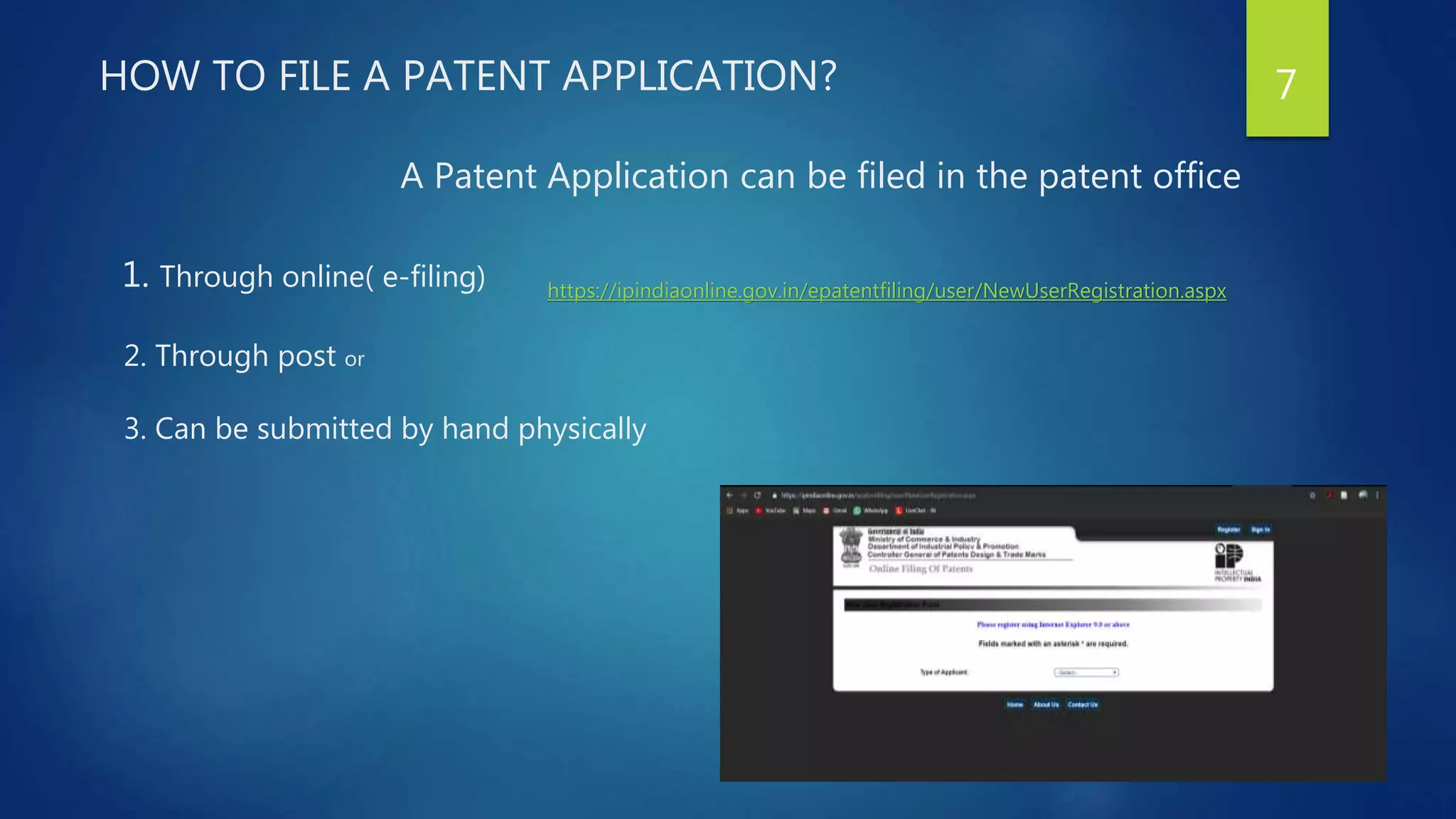
A Patent Application can be filed in the patent office
1. Through online( e-filing)
2. Through post or
3. Can be submitted by hand physically
7
https://ipindiaonline.gov.in/epatentfiling/user/NewUserRegistration.aspx
DOCUMENTS REQUIRED FOR FILING A PATENT APPLICATION
1. Application form [Form 1] :
An application for the grant of patent.
2. Provisional or Complete Specification [Form 2] :
Provisional or complete specification in triplicate. In case if the inventor is at a very early stage
the research and development for his invention, then he can go a for provisional application .
It gives him the following benefits:
* It helps to Secure the filing date
* There is 12 months of time to file complete specification
* The cost is very low .
8
After filing the provisional patent application, The inventor secures the filing date which is
very crucial in patent world. The inventor gets 12 months of time to come up with the complete
specification and up on expiry of 12 months the patent application will be abandoned
When the inventor completes the required documents and his research work is at level
where he can have prototype and experimental results to prove his inventive step then he can file
complete specification with the patent application.
There is an optional step that is filing the provisional specification , if the inventor is at the
stage where he can have complete information about his invention, then he / she can directly go
for complete specification.
9
3. Drawing [in triplicate] (if necessary) :
Drawings or sketches, which require a special illustration of the invention, shall not
appear in the description itself and shall be on separate sheet(s), preferably A4.
4. Abstract of the invention (in triplicate/ 3 copies) :
It is a short paragraph describing the invention in a precise manner. An abstract of
invention has to be produced as a part of the document.
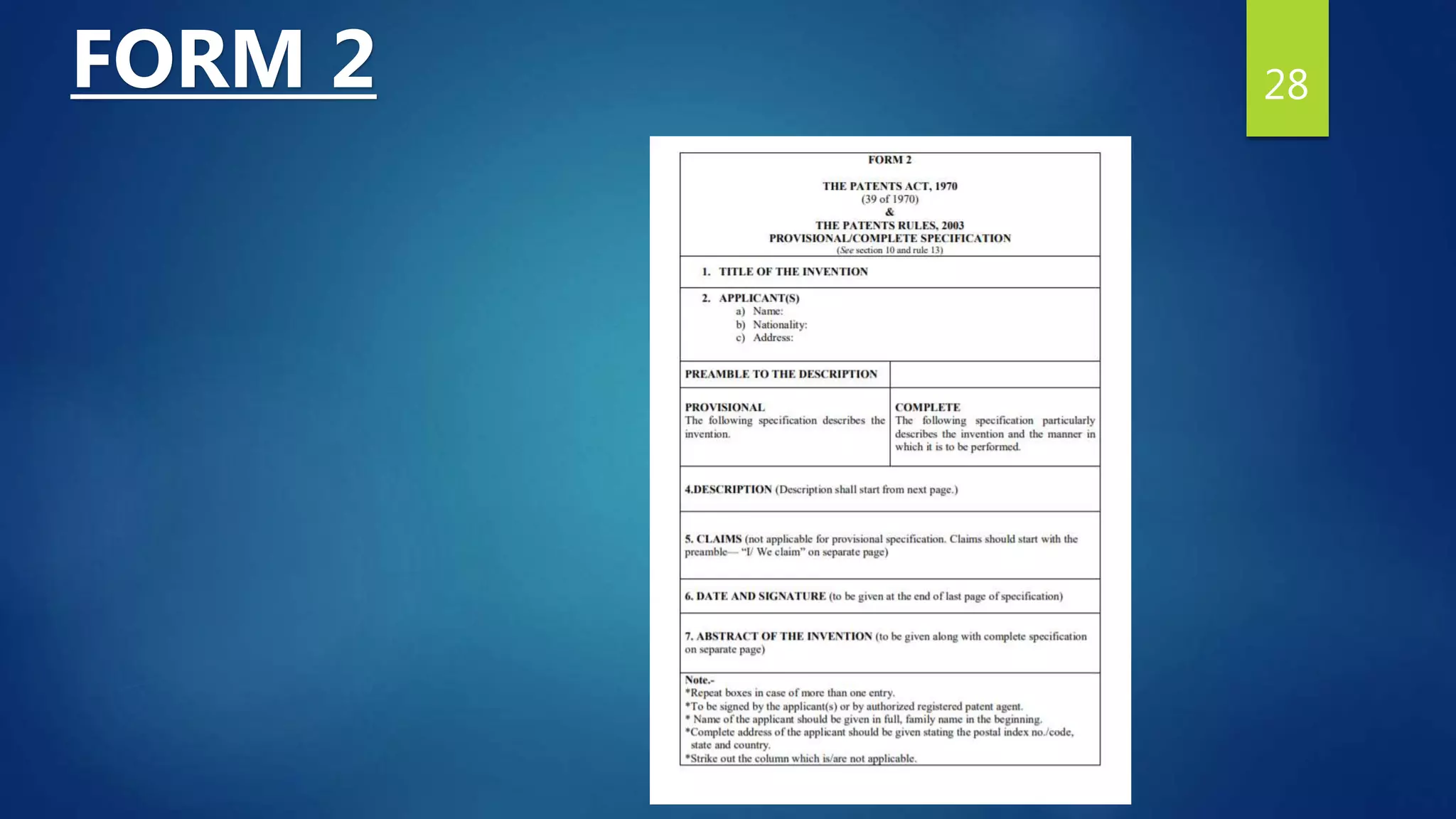
5. Statement and Undertaking [Form 3] :
It is a form in which the applicant ensures the patent officer that no similar inventions are
are made outside India and the inventor shall inform the officer updated about the
corresponding patent applications filed outside within 6 months from the date of filing of such
applications.
10
6. Priority document :
Only if priority date is claimed. Priority date refers to the earliest filing date in a family of
patent applications. It is required for the examination of novelty and inventive step or non-
obviousness for the subsequent application.
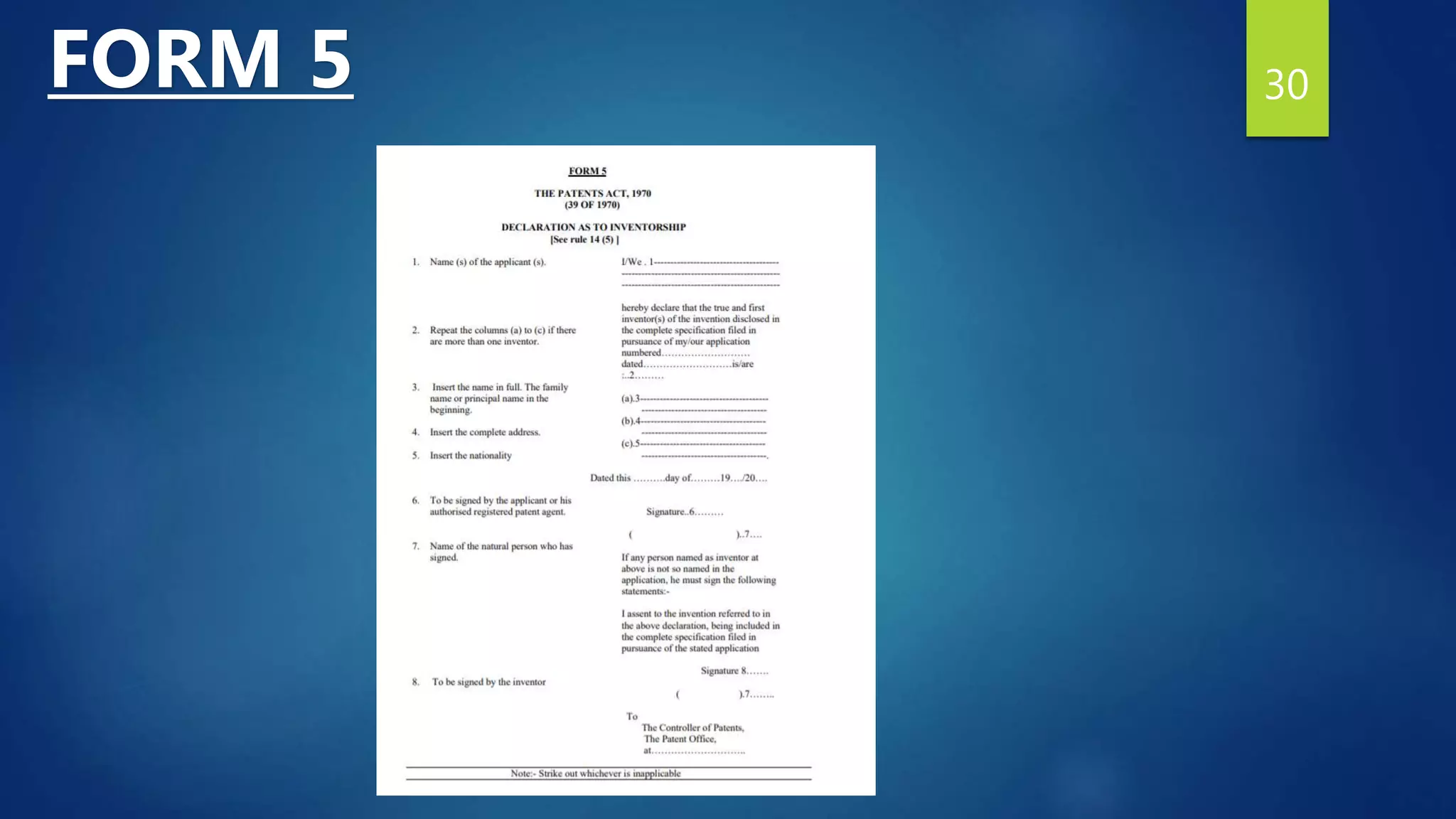
7. Declaration of Inventorship [Form 5] :
Where provisional specification is followed by complete specification or in case of
convention application. The inventor describes that the information given him are true of his
invention.
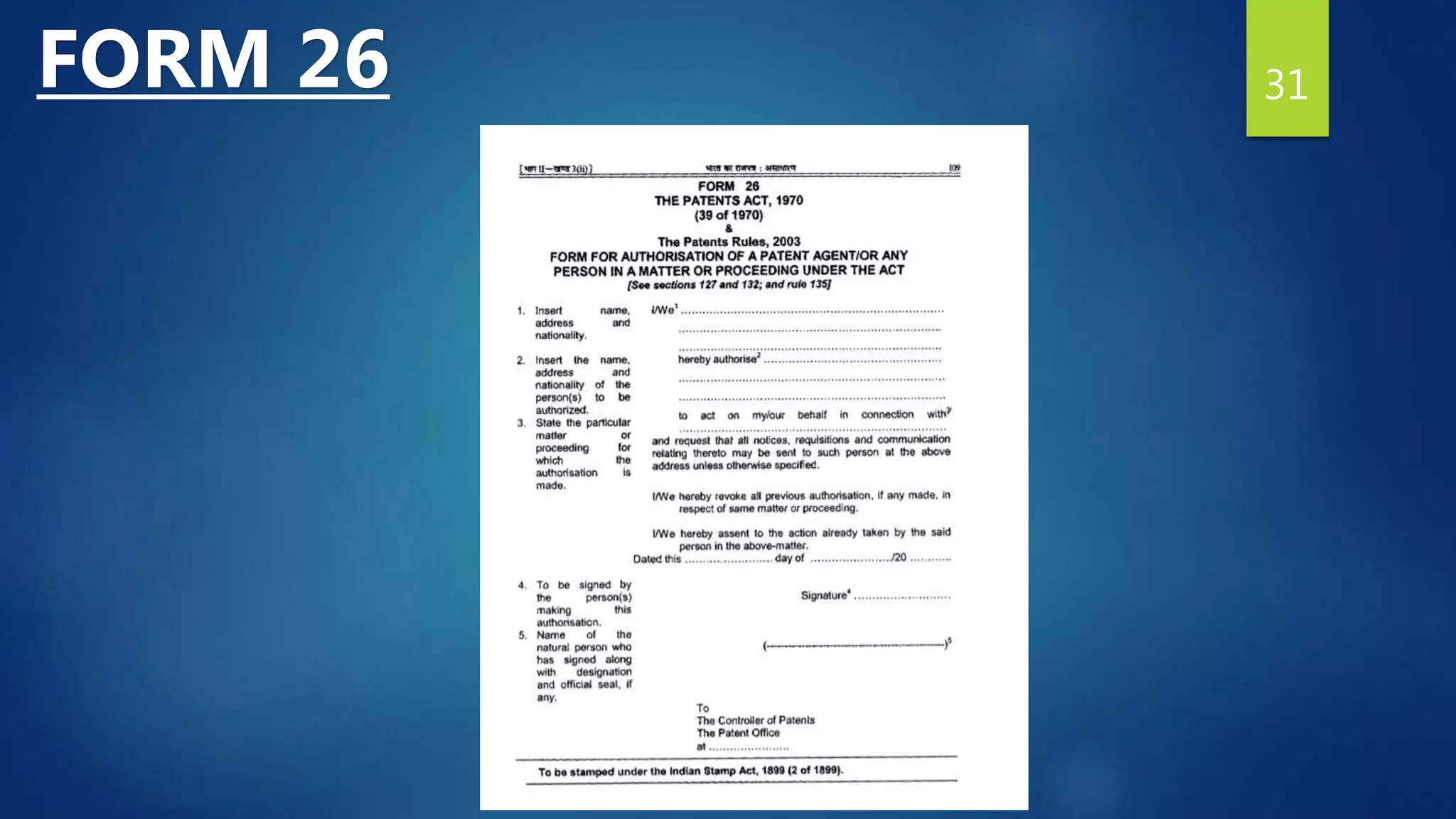
8. Power of Attorney [Form 26] :
Authorization of patent agent or any other person which is also known as POWER OF
ATTORNEY is required if filed through Patent Agent.
9. Fee in Cash/ Local Cheque/ DD/ Online Payment
11
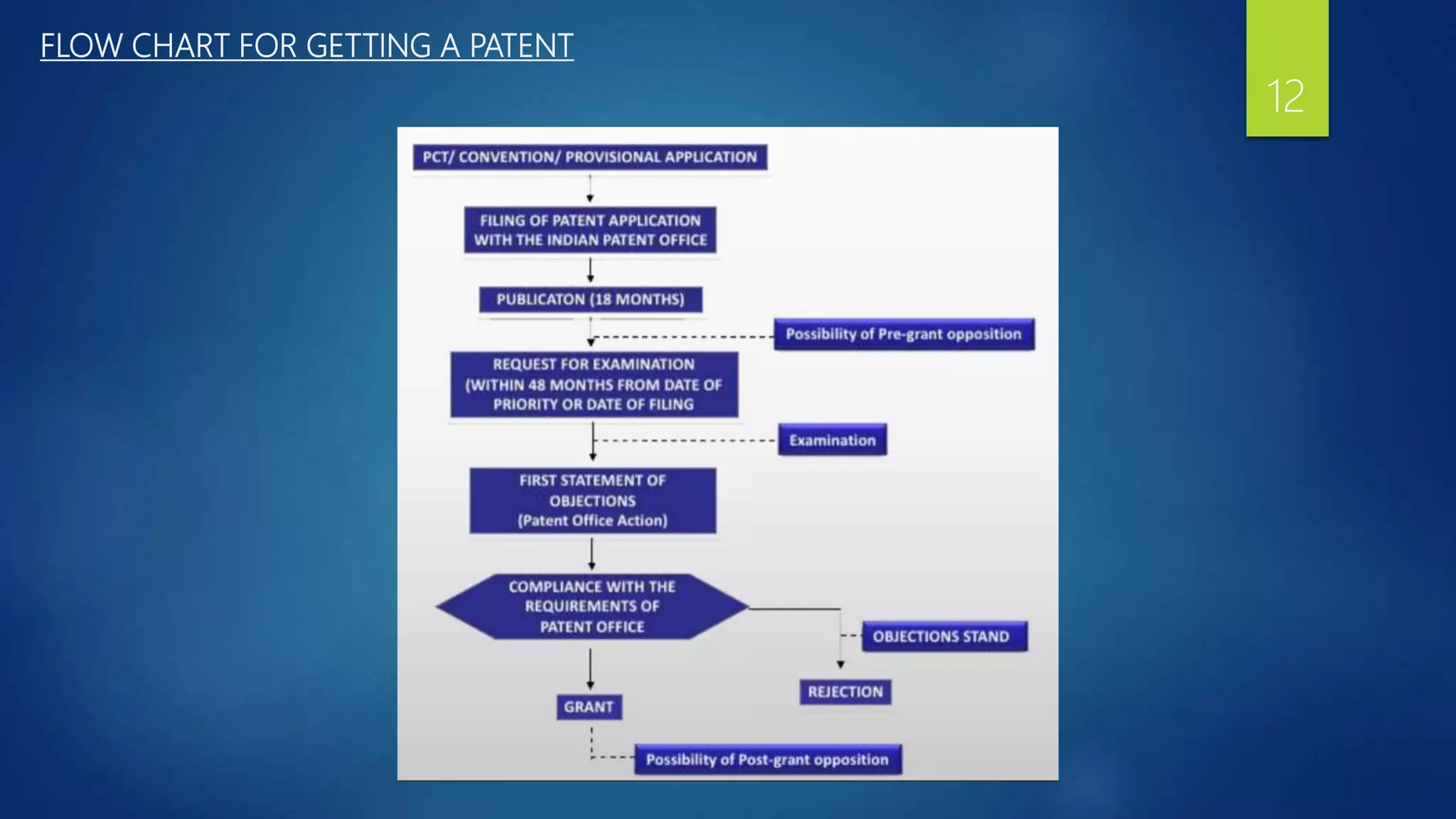
FLOW CHART FOR GETTING A PATENT
12
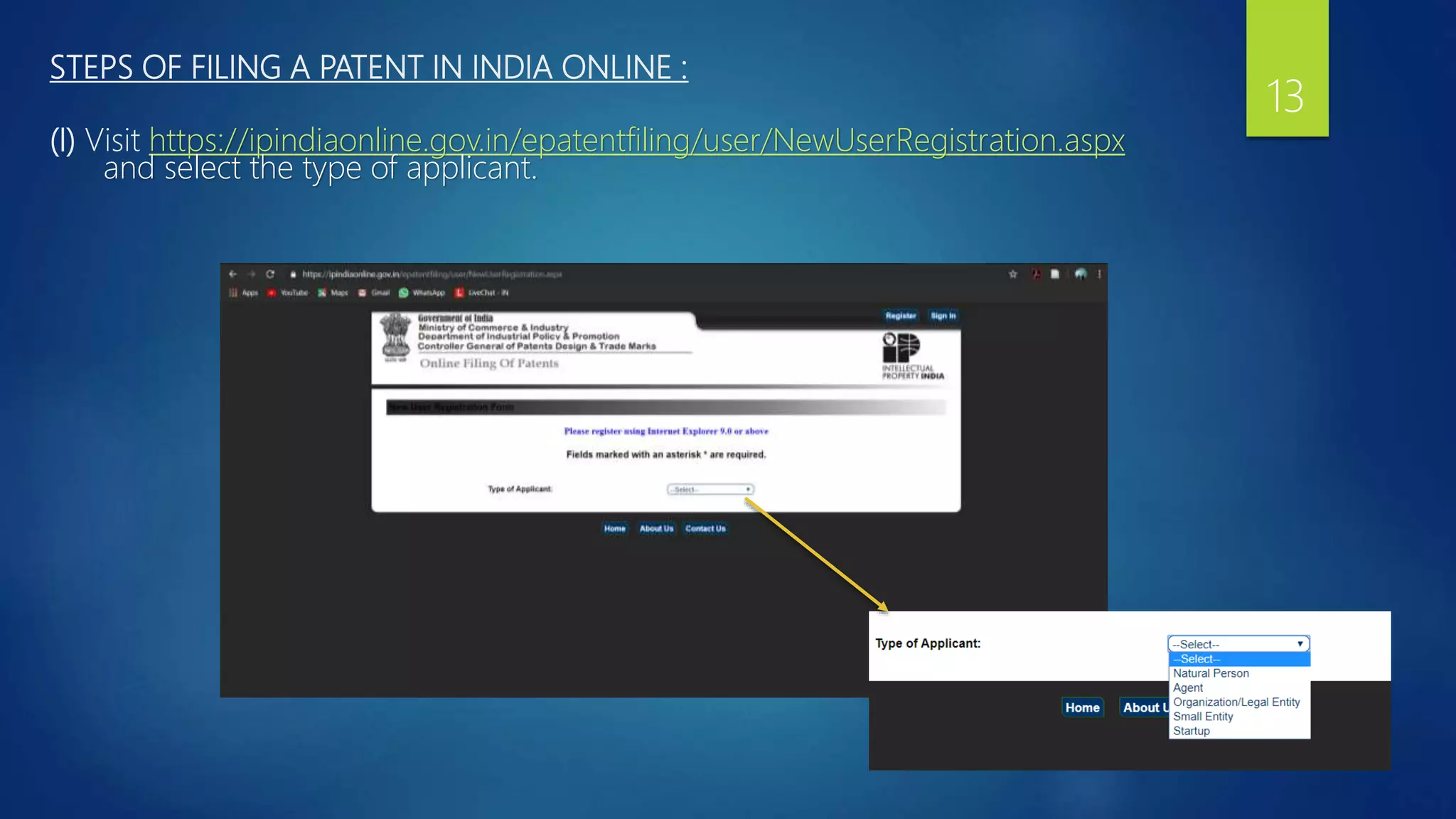
STEPS OF FILING A PATENT IN INDIA ONLINE :
(I) Visit https://ipindiaonline.gov.in/epatentfiling/user/NewUserRegistration.aspx
and select the type of applicant.
13
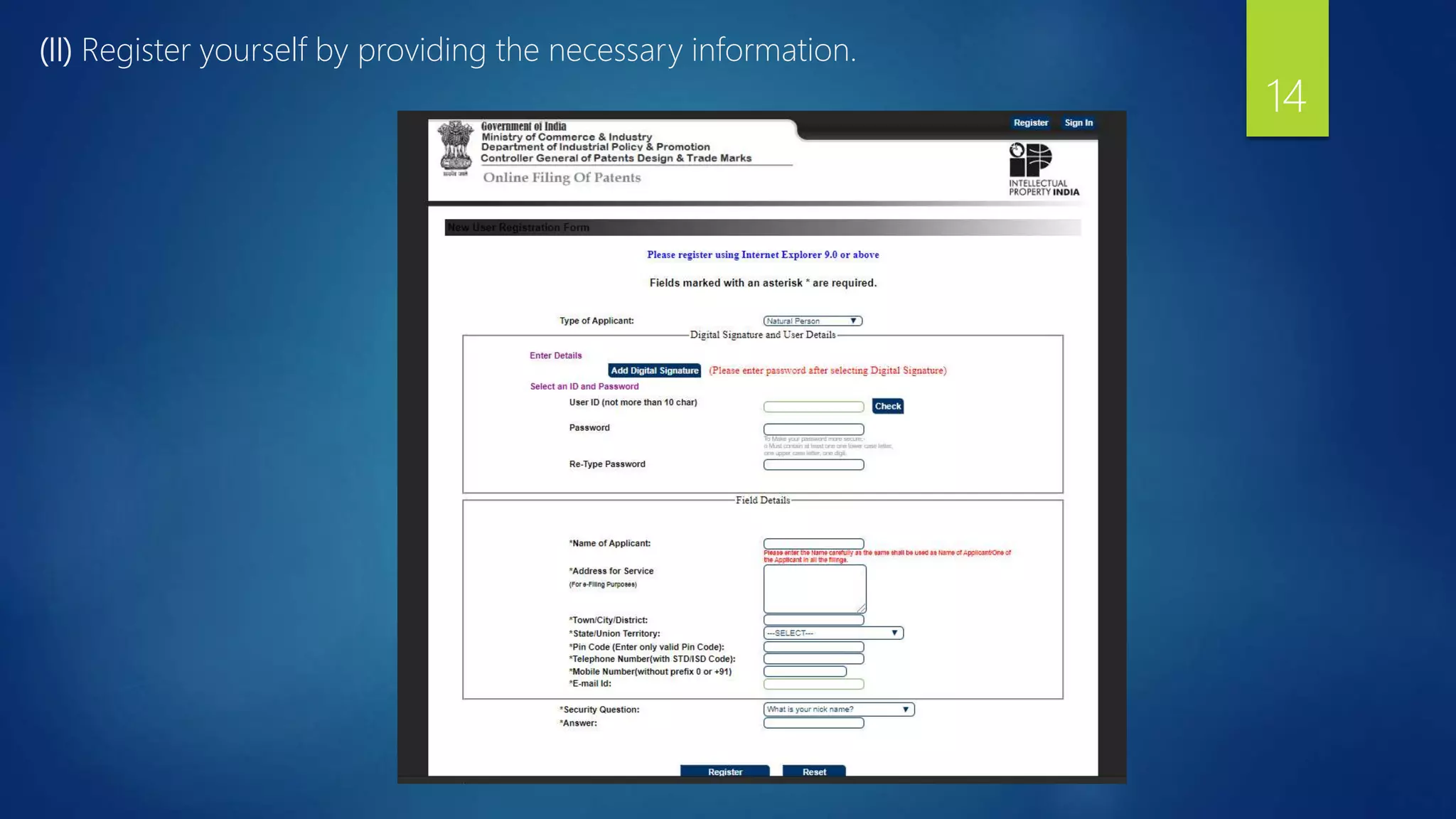
(II) Register yourself by providing the necessary information.
14
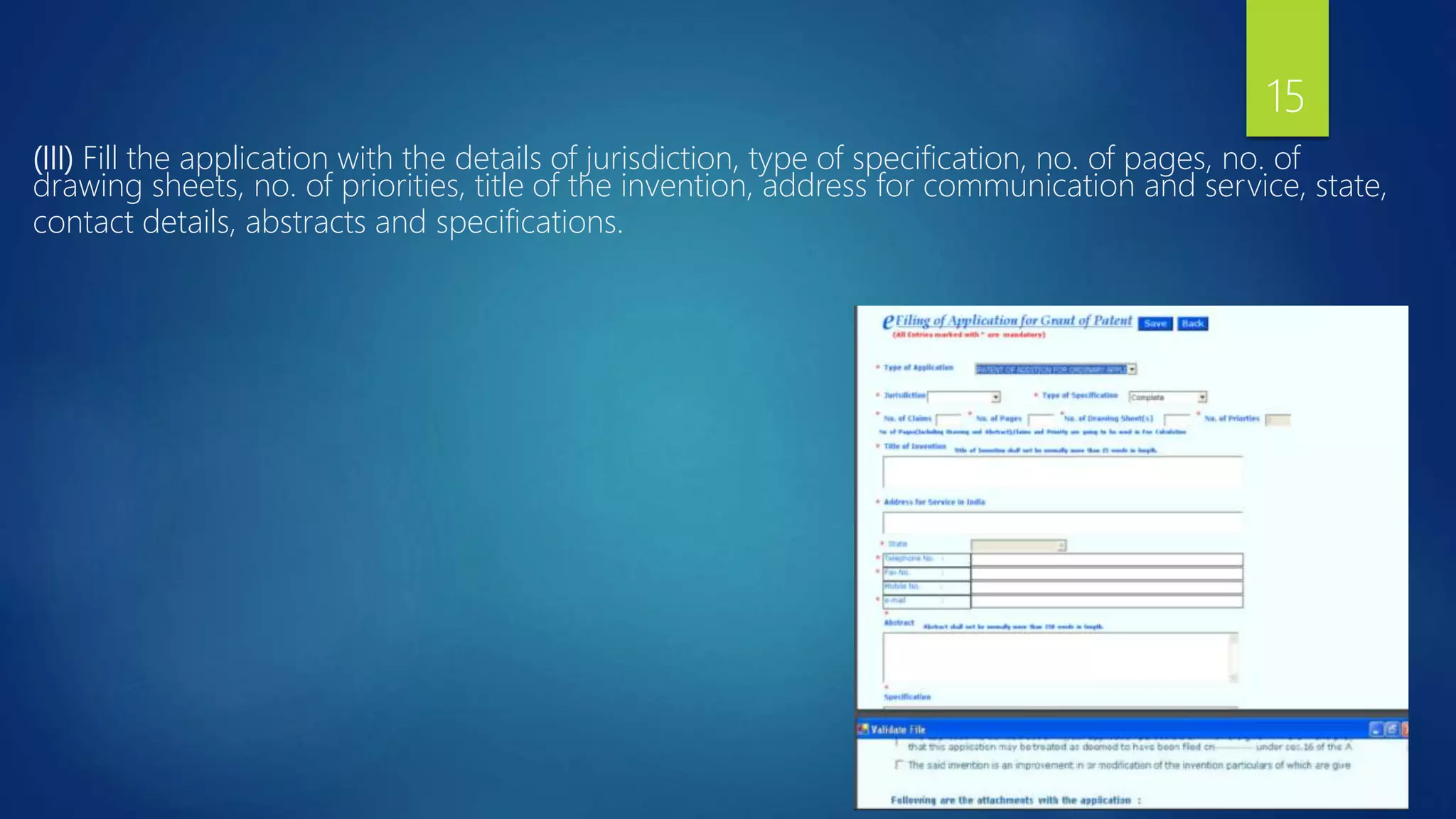
(III) Fill the application with the details of jurisdiction, type of specification, no. of pages, no. of
drawing sheets, no. of priorities, title of the invention, address for communication and service, state,
contact details, abstracts and specifications.
15
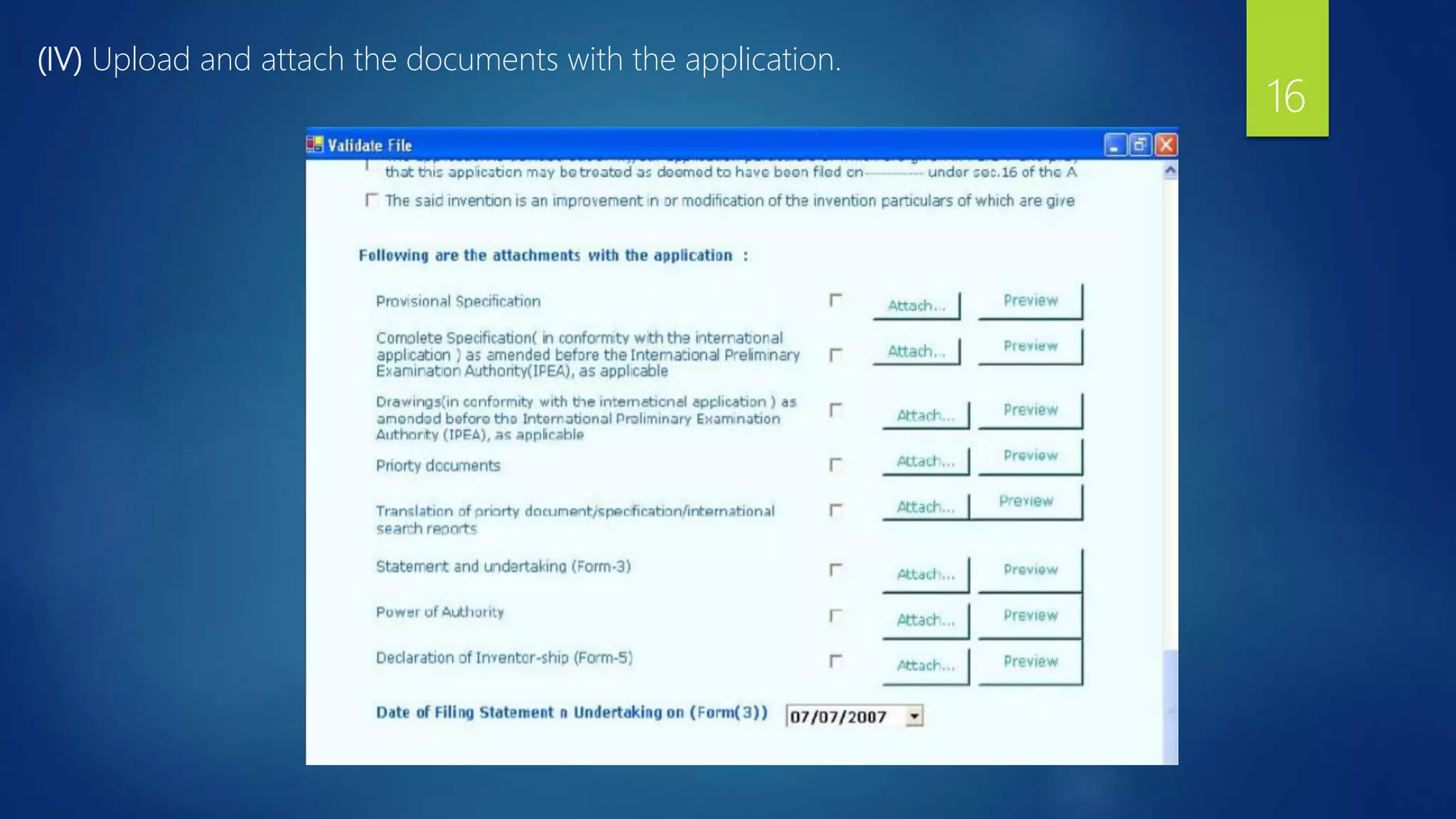
(IV) Upload and attach the documents with the application.
16
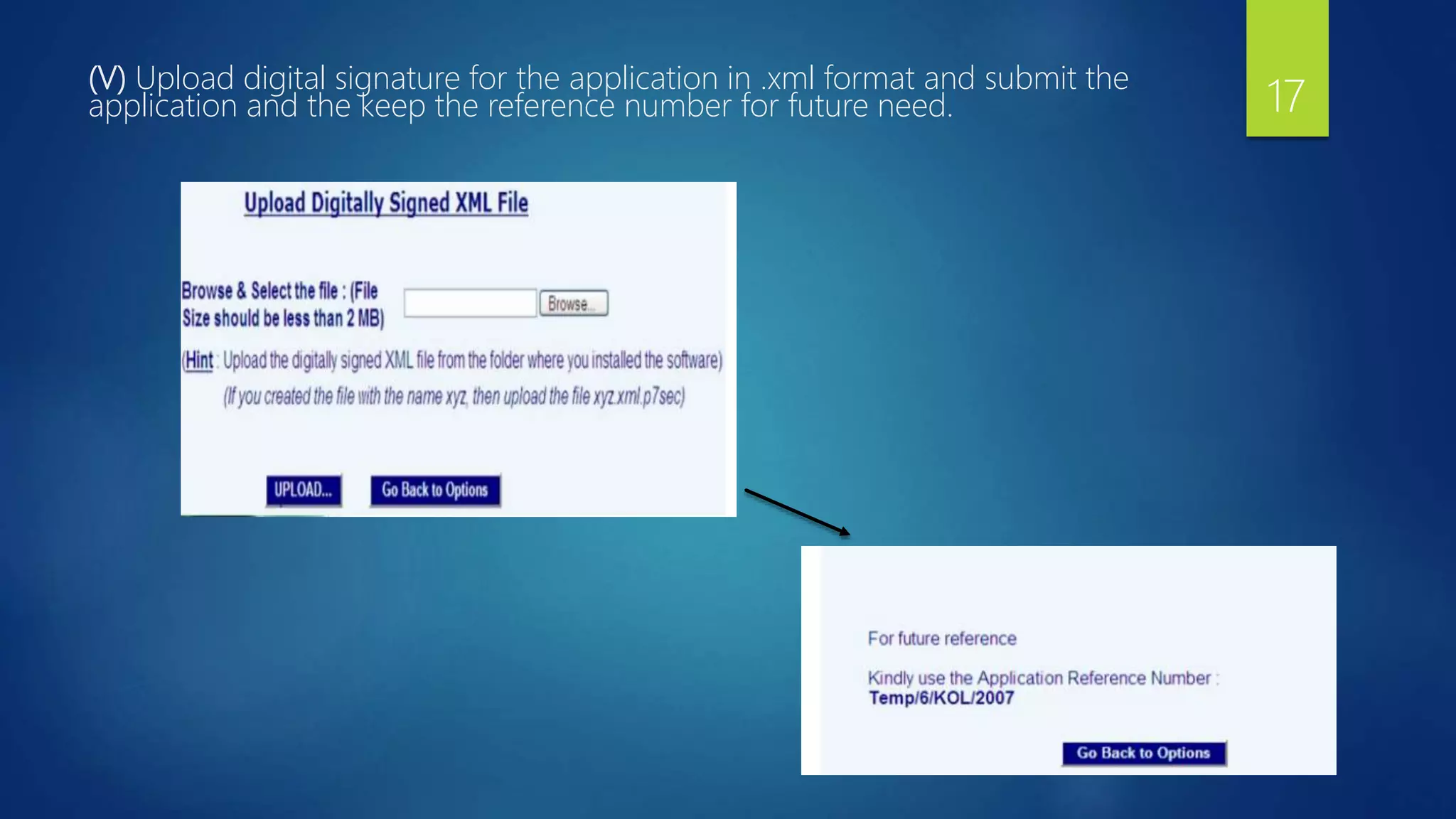
(V) Upload digital signature for the application in .xml format and submit the
application and the keep the reference number for future need. 17
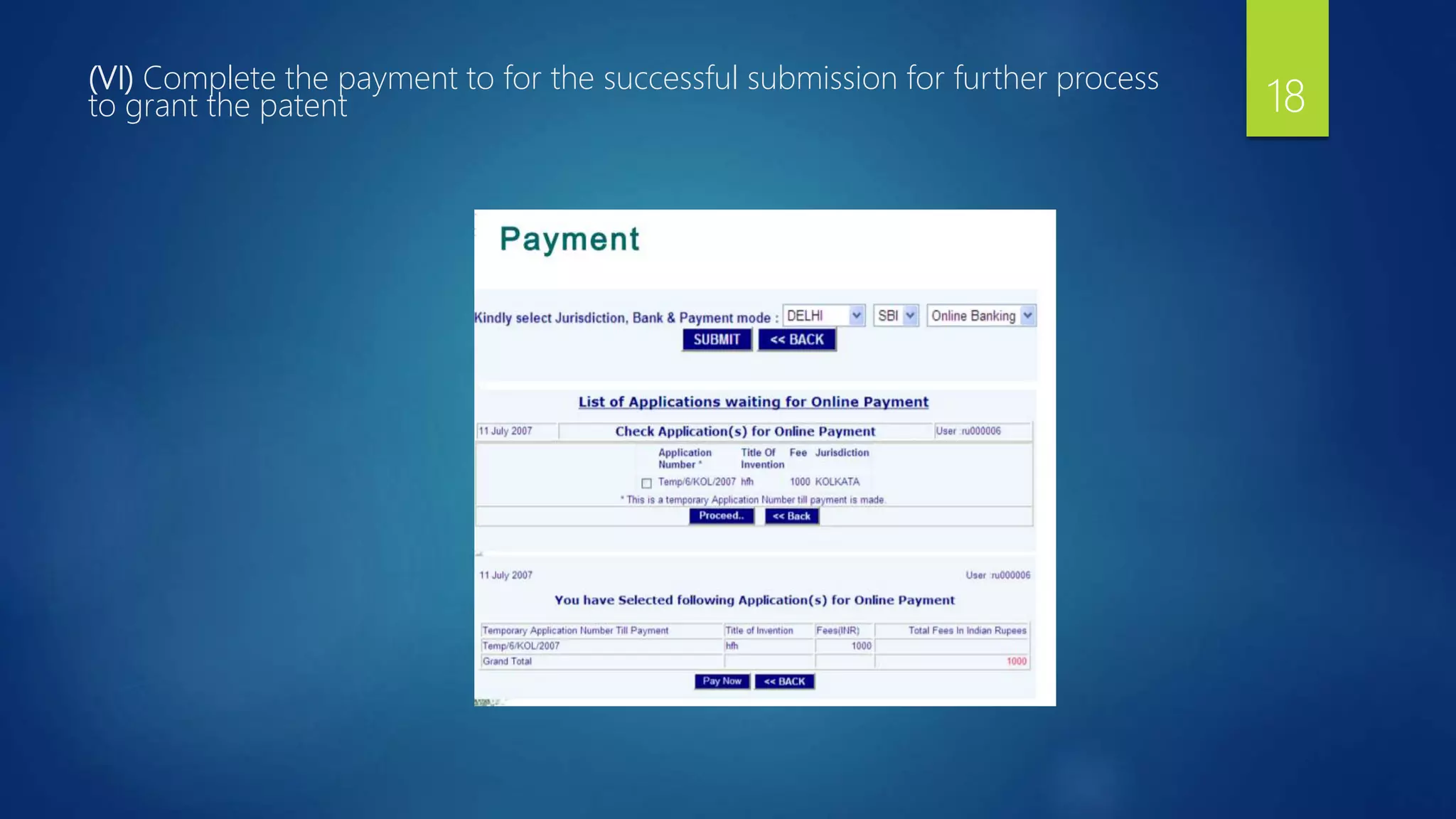
(VI) Complete the payment to for the successful submission for further process
to grant the patent 18
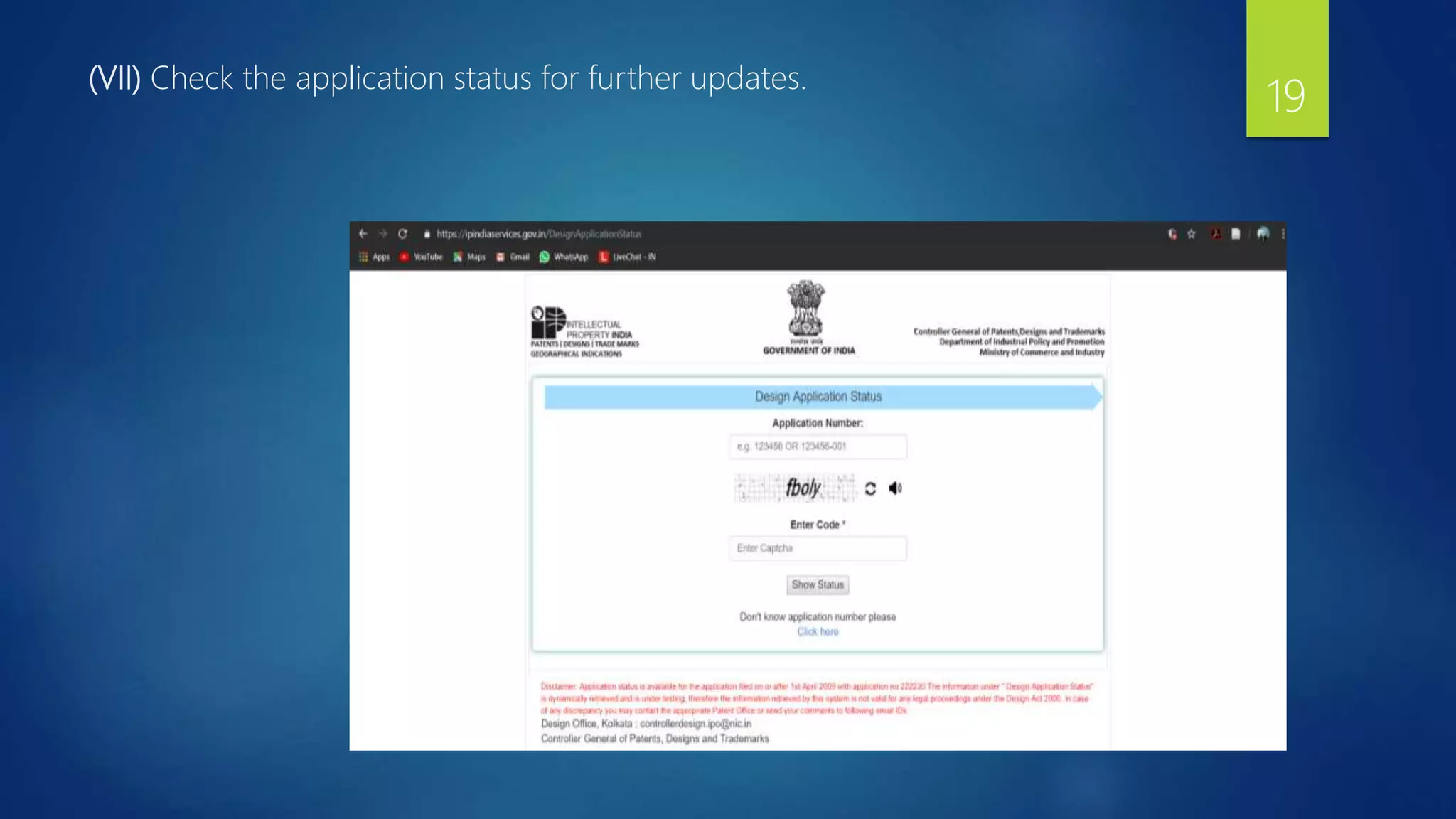
(VII) Check the application status for further updates.
19
THE ESSENTIAL ELEMENTS OF
PATENTING
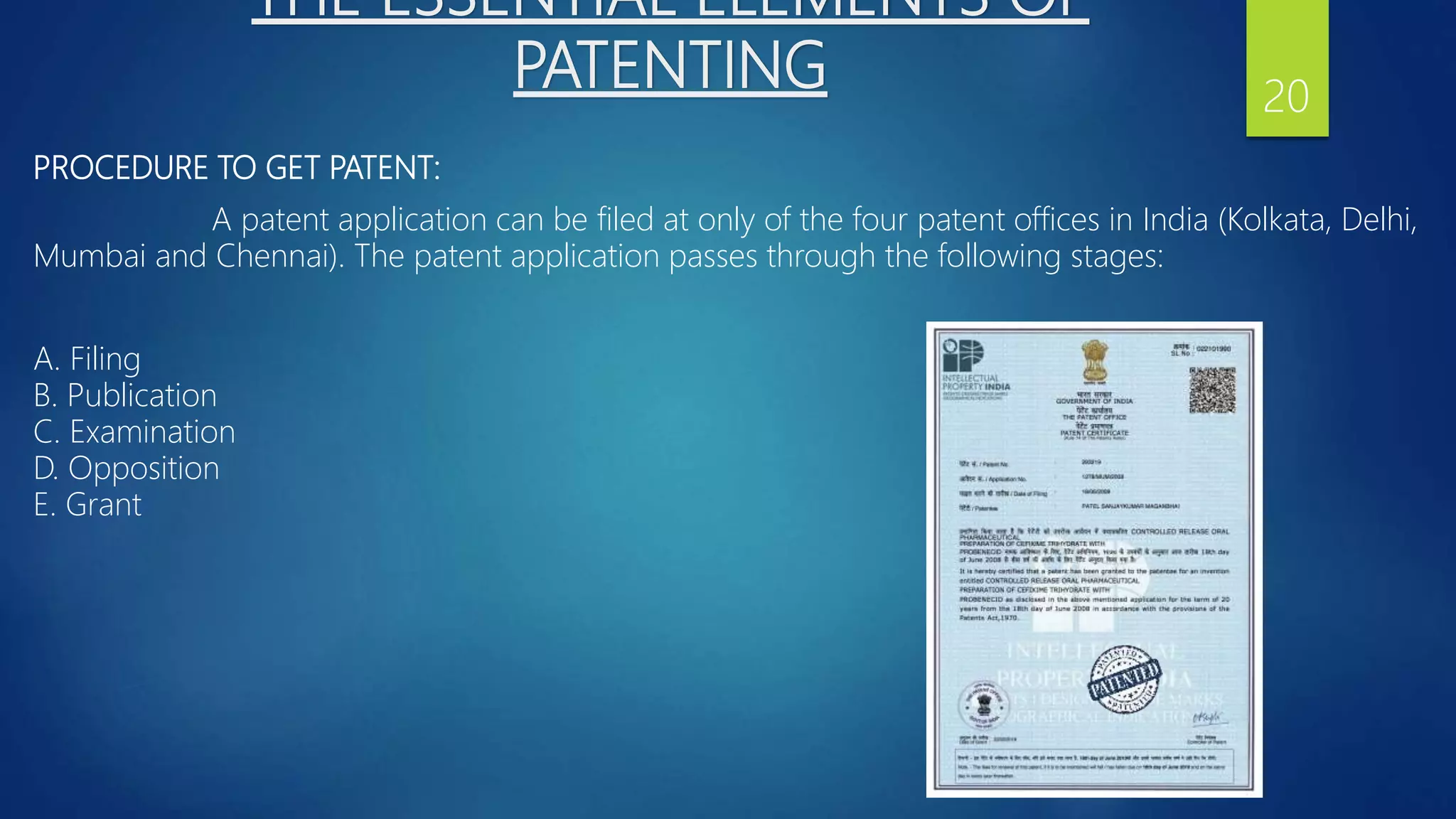
PROCEDURE TO GET PATENT:
A patent application can be filed at only of the four patent offices in India (Kolkata, Delhi,
Mumbai and Chennai). The patent application passes through the following stages:
A. Filing
B. Publication
C. Examination
D. Opposition
E. Grant
20
A. FILING:
The filing consists of The Applicant, The Form of Application and Priority Date.
1. Applicant :
An application for a patent can be filed by the true and first inventor. It can also be filed the
the assignee or legal representative of the inventor. If an application is filed by the assignee, proof
assignment has to be submitted along with the application. The applicant can be national of any
country.
2. Form of application:
Every application shall be accompanied by a provisional or complete specification. Provisional
applications are generally filed at a stage where some experimentation is required to perfect the
invention.
Filing of a provisional specification allows the applicant to get an early application date.
21
A Provisional Specification shall contain:
a. Title
b. Written Description
c. Drawings (if necessary)
d. Sample or model if required.
The complete specification shall contain:
a. Title
b. Abstract
c. Written Description
d. Drawings (where necessary)
e. Sample or Model (if required by the examiner)
f. Enablement and Best Mode
g. Claims
h. Deposit (Microorganisms)
A. TITLE
Title is generally a word or a phrase indicating the content of the invention.
B. ABSTRACT
It is a short paragraph describing the invention in a precise manner.
22
C. WRITTEN DESCRIPTION
This is an important part of the specification. It contains the complete and elaborate description
of the invention.
Written Description generally starts with a background of the invention. The written description
explains the invention clearly and comprehensively, with the help of examples, drawings and models,
where and when required.
D. DRAWINGS
The written description might be supplemented with drawings, where and when required. The
drawings should be clearly labeled and submitted in A4 size paper.
E. SAMPLES OR MODELS
On initiative of the inventor or when required by the patent examiner samples or models might
be submitted to the patent office. Such samples or models will provide a better understanding of the
invention.
23
F. ENABLEMENT AND BEST MODE
The applicant has to enable his invention in order to allow a person with ordinary skill in the art to
make and work the invention and should also describe the best mode of carrying out the invention.
G. CLAIMS
Claims define the metes and bounds of the invention. They are the most important elements in a
specification.
In technical terms, the extent of the protection conferred by a patent, or the protection sought in
a patent application. In other words, the purpose of the claims is to define which subject-matter is
protected by the patent
H. DEPOSIT
If an invention involves microorganisms, which cannot be described by writing. A sample of the
microorganism has to be deposited at an internationally recognized depository. There is an internationally
recognized depository at Chandigarh
24
3. Priority Date :
Priority date is the date of first filing allotted by the patent office to an application. If a
provisional application is followed by a complete application, the priority date shall be date of filing of
the provisional application
Priority date is the date of reference used by the patent to determine the newness of the
invention. If the claimed invention is part of public knowledge before the priority date, it will not be
eligible for a patent.
4. Place of Filing :
Patent Application can be filed at any of the four patent offices in India. Patent Offices are
located at Kolkata, New Delhi, Chennai and Mumbai.
25
5. Documents to be submitted at the time of filing :
The following documents have to be submitted at the time of filing a patent application:
a. Form 1 - Application for the grant of patent.
b. Form 2 - Provisional or Complete Specification.
c. Form 3 - Statement and undertaking by the applicant.
d. Form 5 - Declaration as to inventorship.
e. Form 26 - Authorization of patent agent or any other person.
26
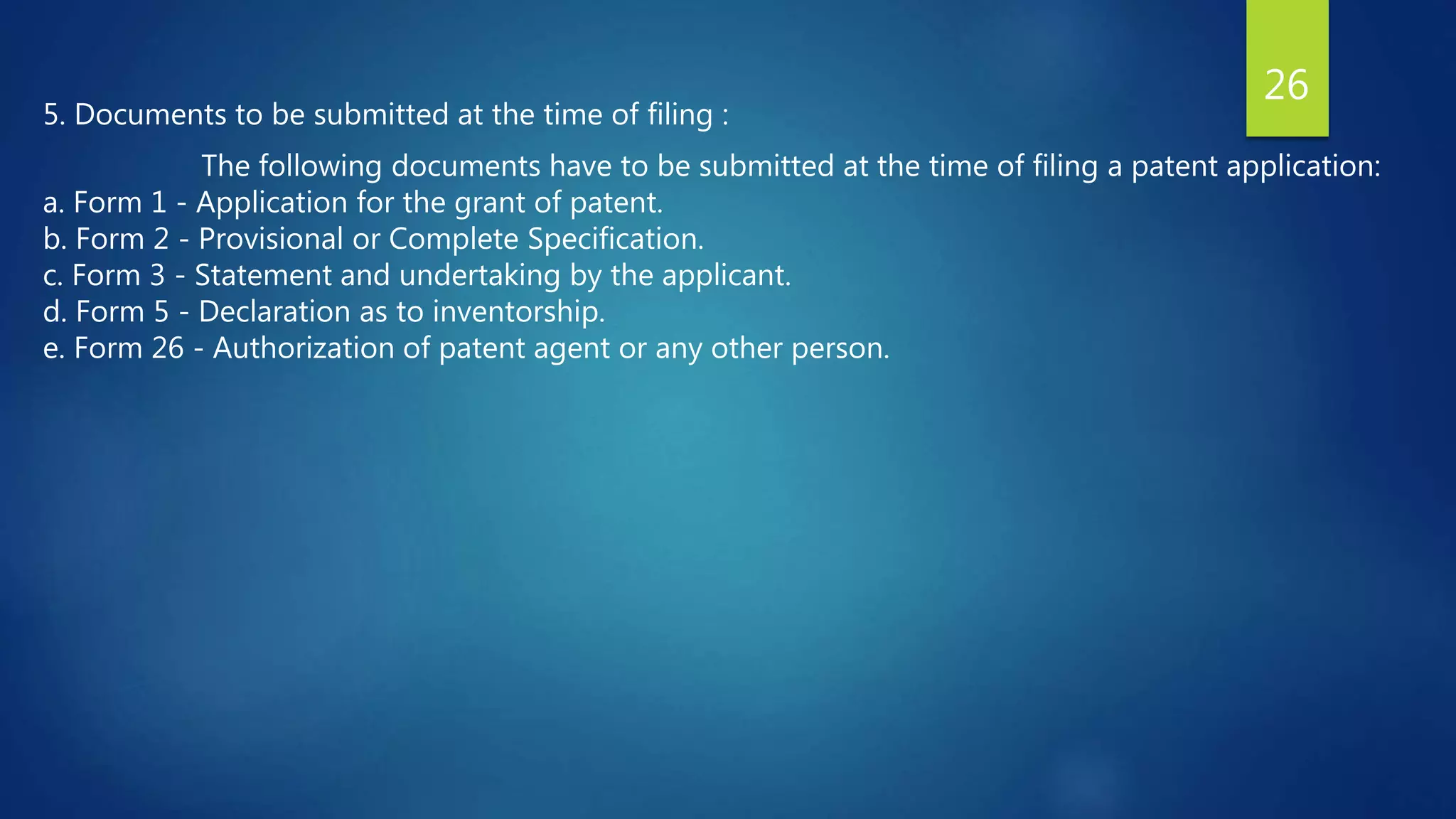
27FORM 1
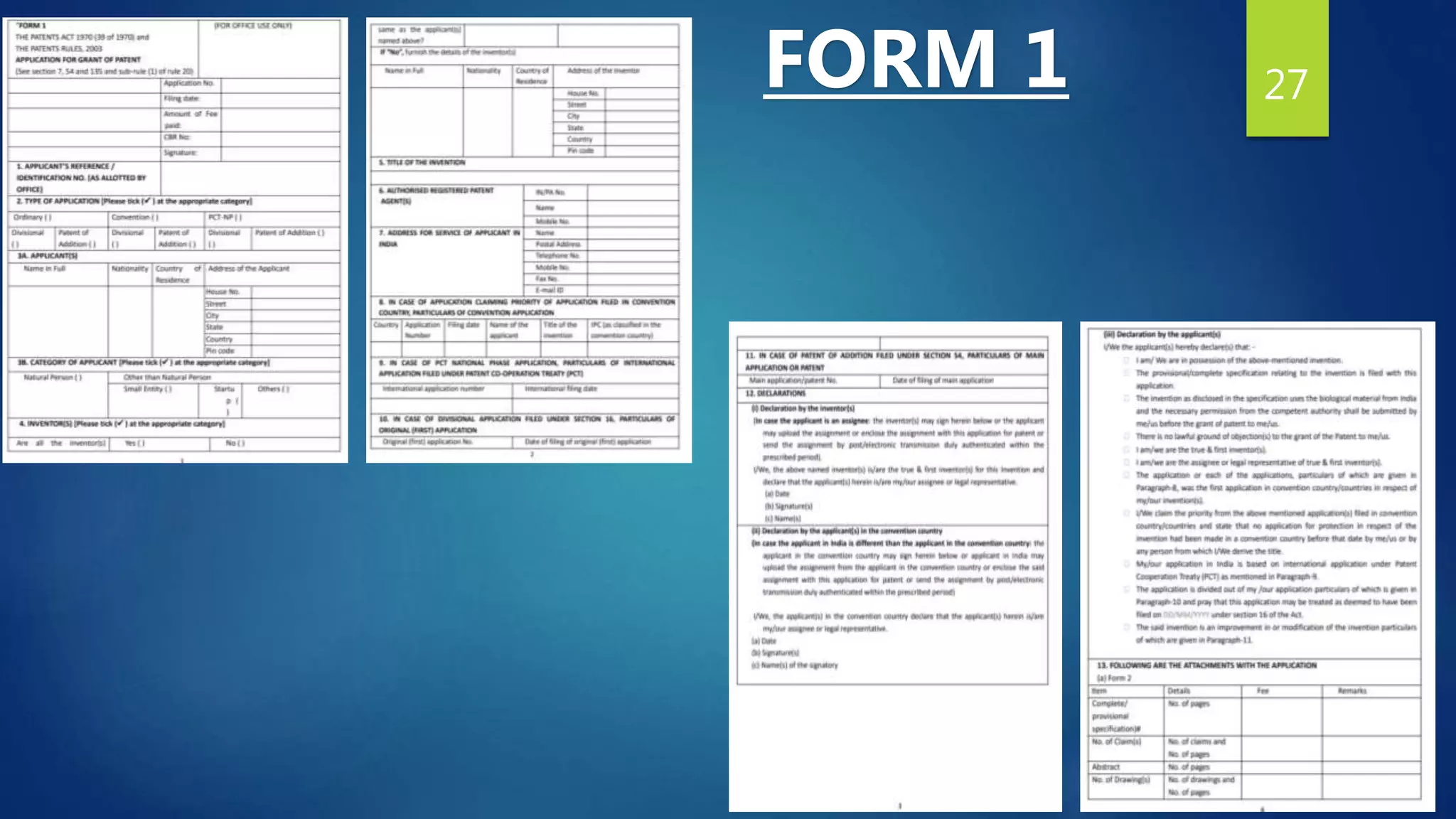
28FORM 2
29FORM 3
30FORM 5
31FORM 26
B. PUBLICATION:
A patent application will be published on expiry of 18 months
after the priority date. It can be published earlier, if such a request is made
the applicant. The application will not be published if directions are given for
secrecy, until the term of those directions expires. It will also not be
if the application is withdrawn 3 months before publication date.
On publication, specification including drawings and deposits shall
be open for public inspection. The rights of the patentee start from the date
of publication but they cannot be enforced until after patent grant.
32
C. EXAMINATION:
1. Request for Examination
The process of examination starts with a request for examination. The request has to be
made within 36 months from the date of priority or filing.
2. Examination
On receiving the request, the controller shall direct the patent application to the Examiner for
examination. To start with, the examiner makes a formal examination by verifying the propriety and
correctness of all documents filed with the application. Later, he verifies the patentability of the
application. The patentability analysis includes all patentability requirements.
After confirming that the application falls within the scope of patentable subject matter, the
examiner conducts a prior art search to check if there is prior art, which anticipates the invention
claimed. He then verifies the existence of inventive step, Industrial application and Enablement &
mode.
33
The examiner will give the examination report within 1 month from the date of reference
by controller and that term shall not exceed 3 months. If the examination report is adverse, the
controller sends a notice to the applicant and gives him an opportunity to correct and if necessary, an
opportunity of hearing.
The Controller might ask the applicant to amend the application in order to proceed
further. If the applicant does not make such changes and does not comply with his requirements, the
application might be rejected.
34
D. OPPOSITION:
1. Pre-grant Opposition
Any person can file an opposition for grant of patent after the application has been published.
Opposition may be filed on any of the following grounds:
a. Non compliance of patentability requirements.
b. Nondisclosure or Wrongful disclosure of genetic resources or traditional knowledge.
2. Post-grant Opposition
Any person can file an opposition within a period 12 months after the grant of a patent. It can be
based on the following grounds:
a. Wrongful obtainment of the invention by the inventor.
b. Publication of the claimed invention before the priority date.
c. Sale or Import of the invention before the priority date.
d. Public use or display of the invention.
e. The invention doesn’t satisfy the patentability requirements.
f. Disclosure of false information to patent office.
g. Application for the invention is not filed within twelve months from the date of convention application.
h. Nondisclosure or wrongful disclosure of the biological source.
i. Invention is anticipated by traditional knowledge.
35
3. Process of Opposition
On receiving a notice of opposition, the controller notifies the patentee. He then constitutes an
Opposition board to deal with the opposition. The Opposition board decides the issues after giving
reasonable opportunity of hearing to both the parties. The Opposition board might invalidate the
patent, require amendments or maintain the status quo. If amendments are required, they have to
made within the prescribed period in order to maintain the patent.
36
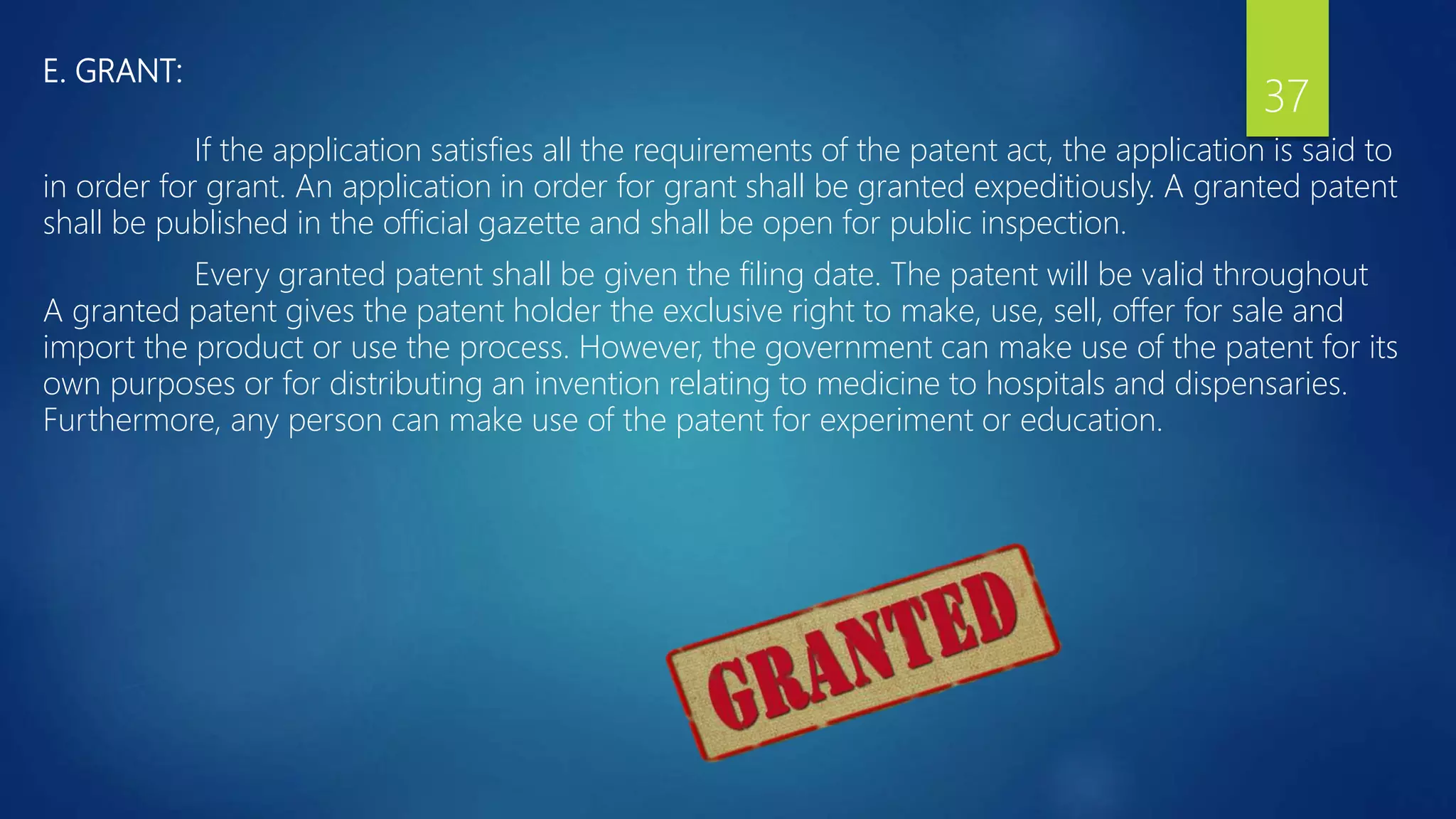
E. GRANT:
If the application satisfies all the requirements of the patent act, the application is said to
in order for grant. An application in order for grant shall be granted expeditiously. A granted patent
shall be published in the official gazette and shall be open for public inspection.
Every granted patent shall be given the filing date. The patent will be valid throughout
A granted patent gives the patent holder the exclusive right to make, use, sell, offer for sale and
import the product or use the process. However, the government can make use of the patent for its
own purposes or for distributing an invention relating to medicine to hospitals and dispensaries.
Furthermore, any person can make use of the patent for experiment or education.
37
CONCLUSION
 A patent can be filed by the inventor, an assignee or a legal representative.
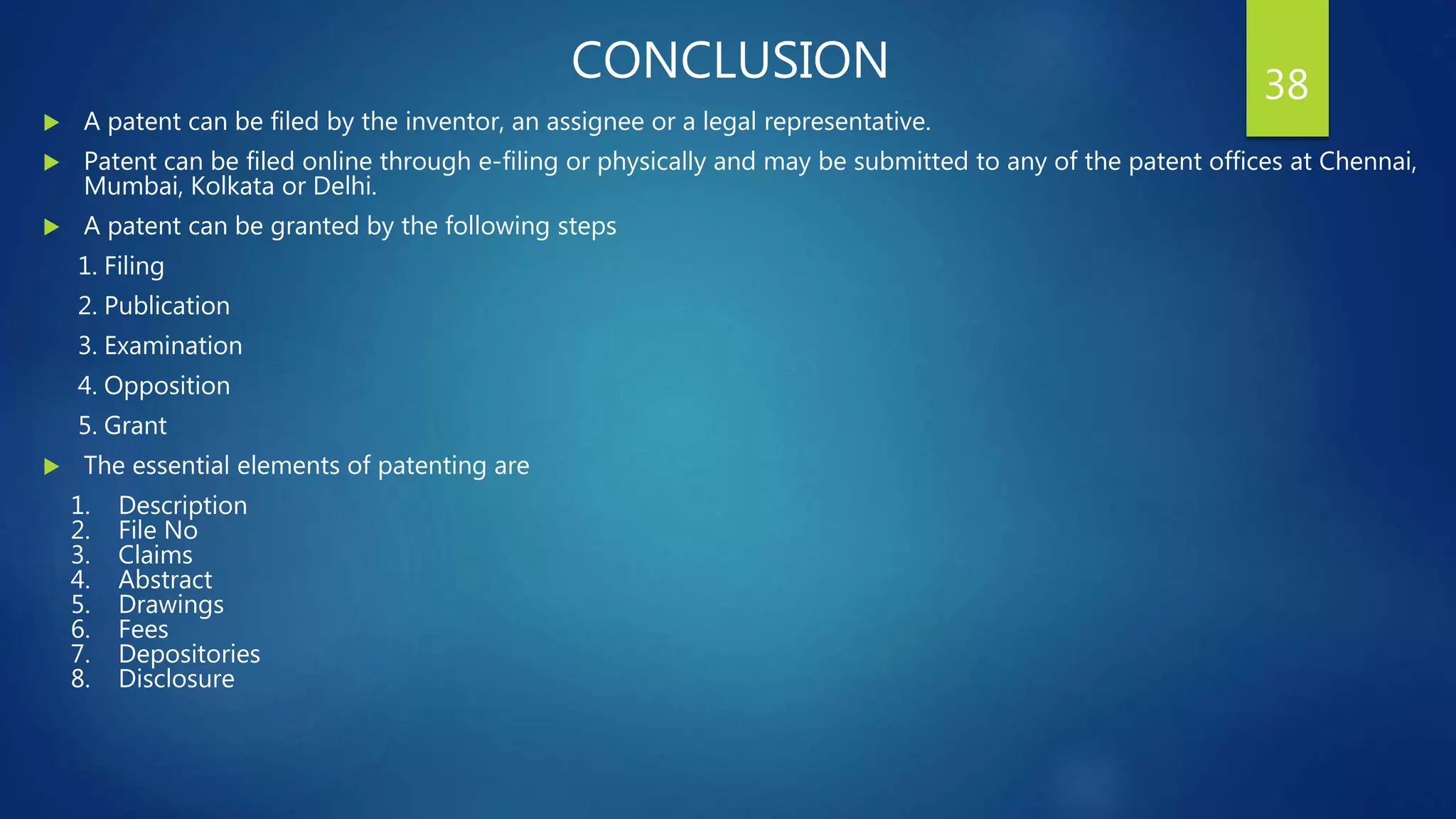
 Patent can be filed online through e-filing or physically and may be submitted to any of the patent offices at Chennai,
Mumbai, Kolkata or Delhi.
 A patent can be granted by the following steps
1. Filing
2. Publication
3. Examination
4. Opposition
5. Grant
 The essential elements of patenting are
1. Description
2. File No
3. Claims
4. Abstract
5. Drawings
6. Fees
7. Depositories
8. Disclosure
38
REFERENCES
1. Https://www.pharmatutor.org/articles/essential-elements-patent?page=1%2C2
2. https://en.wikipedia.org/wiki/Patent_claim
3. https://www.slideshare.net/sumittiwari101/filing-a-patent-process-in-india
4. https://www.legalraasta.com/blog/procedure-patent-filing-india/
5. http://www.ipindia.nic.in/patents.htm
39
40
ANY QUESTIONS ???
41
THANK YOU

FILING OF PATENT AND ESSENTIAL ELEMENTS OF PATENTING

  • 1.
    PRESENTED BY SURAJ S P.G.INDUSTRIAL PHARMACY FILING OF PATENTS AND THE ESSENTIAL ELEMENTS OF PATENTING UNDER THE GUIDANCE OF DR. AMIT B PATIL PROGRAM COORDINATOR INDUSTRIAL PHARMACY JSSCP 1
  • 2.
    TABLE OF CONTENTS: 1.What is a patent and who governs the patent? 2. Who can file a patent application? 3. Where to apply for a patent in India? 4. How to file a patent application? 5. Documents required for filing a patent application 6. Flow chart for getting a patent 7. Steps of filing a patent in India online 8. The essential elements of patenting 9. Conclusion 2
  • 3.
    What is aPATENT? A patent is an exclusive right or rights granted by a government to an inventor for a limited time period in exchange for the public disclosure of an invention. It allows the inventor to exclude all others from making, using, or selling their invention for 20 years. The theory is that patent protection will provide a reward not only for the creation of an invention, but also for the development of an invention to the point at which it is technologically feasible and marketable, and that this type of an incentive would promote additional creativity and encourage companies to continue their development of new technology to the point at which it is marketable, useful to the public and desirable for the public good. 3
  • 4.
     Who governsthe patent? The Patent system in India is governed by the Patents Act, 1970 (No 39 of 1970) & The Patents Rules 1972, effective from April 20,1972. Subsequently, The Patents Act, 1970 is amended effective from January 1, 1995 & The Patents Rules, 1972 is amended effective from June 2, 1999. 4
  • 5.
    WHO CAN FILEA PATENT APPLICATION? In India [Section 6 and 134], the application can be filed either alone or jointly by : • The True and first inventor of the invention • The Assignee • A Legal Representative 5
  • 6.
    Where to applyfor a patent in India: 6
  • 7.
    HOW TO FILEA PATENT APPLICATION? A Patent Application can be filed in the patent office 1. Through online( e-filing) 2. Through post or 3. Can be submitted by hand physically 7 https://ipindiaonline.gov.in/epatentfiling/user/NewUserRegistration.aspx
  • 8.
    DOCUMENTS REQUIRED FORFILING A PATENT APPLICATION 1. Application form [Form 1] : An application for the grant of patent. 2. Provisional or Complete Specification [Form 2] : Provisional or complete specification in triplicate. In case if the inventor is at a very early stage the research and development for his invention, then he can go a for provisional application . It gives him the following benefits: * It helps to Secure the filing date * There is 12 months of time to file complete specification * The cost is very low . 8
  • 9.
    After filing theprovisional patent application, The inventor secures the filing date which is very crucial in patent world. The inventor gets 12 months of time to come up with the complete specification and up on expiry of 12 months the patent application will be abandoned When the inventor completes the required documents and his research work is at level where he can have prototype and experimental results to prove his inventive step then he can file complete specification with the patent application. There is an optional step that is filing the provisional specification , if the inventor is at the stage where he can have complete information about his invention, then he / she can directly go for complete specification. 9
  • 10.
    3. Drawing [intriplicate] (if necessary) : Drawings or sketches, which require a special illustration of the invention, shall not appear in the description itself and shall be on separate sheet(s), preferably A4. 4. Abstract of the invention (in triplicate/ 3 copies) : It is a short paragraph describing the invention in a precise manner. An abstract of invention has to be produced as a part of the document. 5. Statement and Undertaking [Form 3] : It is a form in which the applicant ensures the patent officer that no similar inventions are are made outside India and the inventor shall inform the officer updated about the corresponding patent applications filed outside within 6 months from the date of filing of such applications. 10
  • 11.
    6. Priority document: Only if priority date is claimed. Priority date refers to the earliest filing date in a family of patent applications. It is required for the examination of novelty and inventive step or non- obviousness for the subsequent application. 7. Declaration of Inventorship [Form 5] : Where provisional specification is followed by complete specification or in case of convention application. The inventor describes that the information given him are true of his invention. 8. Power of Attorney [Form 26] : Authorization of patent agent or any other person which is also known as POWER OF ATTORNEY is required if filed through Patent Agent. 9. Fee in Cash/ Local Cheque/ DD/ Online Payment 11
  • 12.
    FLOW CHART FORGETTING A PATENT 12
  • 13.
    STEPS OF FILINGA PATENT IN INDIA ONLINE : (I) Visit https://ipindiaonline.gov.in/epatentfiling/user/NewUserRegistration.aspx and select the type of applicant. 13
  • 14.
    (II) Register yourselfby providing the necessary information. 14
  • 15.
    (III) Fill theapplication with the details of jurisdiction, type of specification, no. of pages, no. of drawing sheets, no. of priorities, title of the invention, address for communication and service, state, contact details, abstracts and specifications. 15
  • 16.
    (IV) Upload andattach the documents with the application. 16
  • 17.
    (V) Upload digitalsignature for the application in .xml format and submit the application and the keep the reference number for future need. 17
  • 18.
    (VI) Complete thepayment to for the successful submission for further process to grant the patent 18
  • 19.
    (VII) Check theapplication status for further updates. 19
  • 20.
    THE ESSENTIAL ELEMENTSOF PATENTING PROCEDURE TO GET PATENT: A patent application can be filed at only of the four patent offices in India (Kolkata, Delhi, Mumbai and Chennai). The patent application passes through the following stages: A. Filing B. Publication C. Examination D. Opposition E. Grant 20
  • 21.
    A. FILING: The filingconsists of The Applicant, The Form of Application and Priority Date. 1. Applicant : An application for a patent can be filed by the true and first inventor. It can also be filed the the assignee or legal representative of the inventor. If an application is filed by the assignee, proof assignment has to be submitted along with the application. The applicant can be national of any country. 2. Form of application: Every application shall be accompanied by a provisional or complete specification. Provisional applications are generally filed at a stage where some experimentation is required to perfect the invention. Filing of a provisional specification allows the applicant to get an early application date. 21
  • 22.
    A Provisional Specificationshall contain: a. Title b. Written Description c. Drawings (if necessary) d. Sample or model if required. The complete specification shall contain: a. Title b. Abstract c. Written Description d. Drawings (where necessary) e. Sample or Model (if required by the examiner) f. Enablement and Best Mode g. Claims h. Deposit (Microorganisms) A. TITLE Title is generally a word or a phrase indicating the content of the invention. B. ABSTRACT It is a short paragraph describing the invention in a precise manner. 22
  • 23.
    C. WRITTEN DESCRIPTION Thisis an important part of the specification. It contains the complete and elaborate description of the invention. Written Description generally starts with a background of the invention. The written description explains the invention clearly and comprehensively, with the help of examples, drawings and models, where and when required. D. DRAWINGS The written description might be supplemented with drawings, where and when required. The drawings should be clearly labeled and submitted in A4 size paper. E. SAMPLES OR MODELS On initiative of the inventor or when required by the patent examiner samples or models might be submitted to the patent office. Such samples or models will provide a better understanding of the invention. 23
  • 24.
    F. ENABLEMENT ANDBEST MODE The applicant has to enable his invention in order to allow a person with ordinary skill in the art to make and work the invention and should also describe the best mode of carrying out the invention. G. CLAIMS Claims define the metes and bounds of the invention. They are the most important elements in a specification. In technical terms, the extent of the protection conferred by a patent, or the protection sought in a patent application. In other words, the purpose of the claims is to define which subject-matter is protected by the patent H. DEPOSIT If an invention involves microorganisms, which cannot be described by writing. A sample of the microorganism has to be deposited at an internationally recognized depository. There is an internationally recognized depository at Chandigarh 24
  • 25.
    3. Priority Date: Priority date is the date of first filing allotted by the patent office to an application. If a provisional application is followed by a complete application, the priority date shall be date of filing of the provisional application Priority date is the date of reference used by the patent to determine the newness of the invention. If the claimed invention is part of public knowledge before the priority date, it will not be eligible for a patent. 4. Place of Filing : Patent Application can be filed at any of the four patent offices in India. Patent Offices are located at Kolkata, New Delhi, Chennai and Mumbai. 25
  • 26.
    5. Documents tobe submitted at the time of filing : The following documents have to be submitted at the time of filing a patent application: a. Form 1 - Application for the grant of patent. b. Form 2 - Provisional or Complete Specification. c. Form 3 - Statement and undertaking by the applicant. d. Form 5 - Declaration as to inventorship. e. Form 26 - Authorization of patent agent or any other person. 26
  • 27.
  • 28.
  • 29.
  • 30.
  • 31.
  • 32.
    B. PUBLICATION: A patentapplication will be published on expiry of 18 months after the priority date. It can be published earlier, if such a request is made the applicant. The application will not be published if directions are given for secrecy, until the term of those directions expires. It will also not be if the application is withdrawn 3 months before publication date. On publication, specification including drawings and deposits shall be open for public inspection. The rights of the patentee start from the date of publication but they cannot be enforced until after patent grant. 32
  • 33.
    C. EXAMINATION: 1. Requestfor Examination The process of examination starts with a request for examination. The request has to be made within 36 months from the date of priority or filing. 2. Examination On receiving the request, the controller shall direct the patent application to the Examiner for examination. To start with, the examiner makes a formal examination by verifying the propriety and correctness of all documents filed with the application. Later, he verifies the patentability of the application. The patentability analysis includes all patentability requirements. After confirming that the application falls within the scope of patentable subject matter, the examiner conducts a prior art search to check if there is prior art, which anticipates the invention claimed. He then verifies the existence of inventive step, Industrial application and Enablement & mode. 33
  • 34.
    The examiner willgive the examination report within 1 month from the date of reference by controller and that term shall not exceed 3 months. If the examination report is adverse, the controller sends a notice to the applicant and gives him an opportunity to correct and if necessary, an opportunity of hearing. The Controller might ask the applicant to amend the application in order to proceed further. If the applicant does not make such changes and does not comply with his requirements, the application might be rejected. 34
  • 35.
    D. OPPOSITION: 1. Pre-grantOpposition Any person can file an opposition for grant of patent after the application has been published. Opposition may be filed on any of the following grounds: a. Non compliance of patentability requirements. b. Nondisclosure or Wrongful disclosure of genetic resources or traditional knowledge. 2. Post-grant Opposition Any person can file an opposition within a period 12 months after the grant of a patent. It can be based on the following grounds: a. Wrongful obtainment of the invention by the inventor. b. Publication of the claimed invention before the priority date. c. Sale or Import of the invention before the priority date. d. Public use or display of the invention. e. The invention doesn’t satisfy the patentability requirements. f. Disclosure of false information to patent office. g. Application for the invention is not filed within twelve months from the date of convention application. h. Nondisclosure or wrongful disclosure of the biological source. i. Invention is anticipated by traditional knowledge. 35
  • 36.
    3. Process ofOpposition On receiving a notice of opposition, the controller notifies the patentee. He then constitutes an Opposition board to deal with the opposition. The Opposition board decides the issues after giving reasonable opportunity of hearing to both the parties. The Opposition board might invalidate the patent, require amendments or maintain the status quo. If amendments are required, they have to made within the prescribed period in order to maintain the patent. 36
  • 37.
    E. GRANT: If theapplication satisfies all the requirements of the patent act, the application is said to in order for grant. An application in order for grant shall be granted expeditiously. A granted patent shall be published in the official gazette and shall be open for public inspection. Every granted patent shall be given the filing date. The patent will be valid throughout A granted patent gives the patent holder the exclusive right to make, use, sell, offer for sale and import the product or use the process. However, the government can make use of the patent for its own purposes or for distributing an invention relating to medicine to hospitals and dispensaries. Furthermore, any person can make use of the patent for experiment or education. 37
  • 38.
    CONCLUSION  A patentcan be filed by the inventor, an assignee or a legal representative.  Patent can be filed online through e-filing or physically and may be submitted to any of the patent offices at Chennai, Mumbai, Kolkata or Delhi.  A patent can be granted by the following steps 1. Filing 2. Publication 3. Examination 4. Opposition 5. Grant  The essential elements of patenting are 1. Description 2. File No 3. Claims 4. Abstract 5. Drawings 6. Fees 7. Depositories 8. Disclosure 38
  • 39.
    REFERENCES 1. Https://www.pharmatutor.org/articles/essential-elements-patent?page=1%2C2 2. https://en.wikipedia.org/wiki/Patent_claim 3.https://www.slideshare.net/sumittiwari101/filing-a-patent-process-in-india 4. https://www.legalraasta.com/blog/procedure-patent-filing-india/ 5. http://www.ipindia.nic.in/patents.htm 39
  • 40.
  • 41.