Developing a file plan
Filing Manual
Aims of this Session
• Understand what a record plan is and how it relates
to file titling
• Understand the concept of functions and activities of
a government body and how they relate to record
plans and file titling
• Introduce PARBICA’s model record plan and the
other toolkit guidelines associated with it
• Get to know the Tuvalu Government Registry Filing
Manual
• Practice using the Record Plan for file titling
• Come up with some ideas for development
Reminder of Recordkeeping Capacity
Question 7: Can the organisation find
particular records when it needs them?
Finding records is easier if you use:
• A file creation and movement register
• Secure storage that only RM staff can access
• A naming and numbering system that all staff
can understand
What is a Record Plan?
• A Record Plan is a type of file titling system.
• Other terms you might have heard are:
– File Index
– File Plan
– Thesaurus
– Business Classification Scheme
Why have a Record Plan?
• Why have a file titling system?
– Otherwise:
• Staff may use their own systems
• Filing can be inconsistent
• Filing may not happen
• Documents might be lost
• Objectives may not be achieved
Why have a Record Plan?
• Records need to be accessible. We need to
be able to find them when we need them.
• This means giving them titles that:
– Reflect what is in the files; and
– Are understandable to the people using the
files
Why have a Record Plan?
Administration – General – Miscellaneous
Why have a Record Plan?
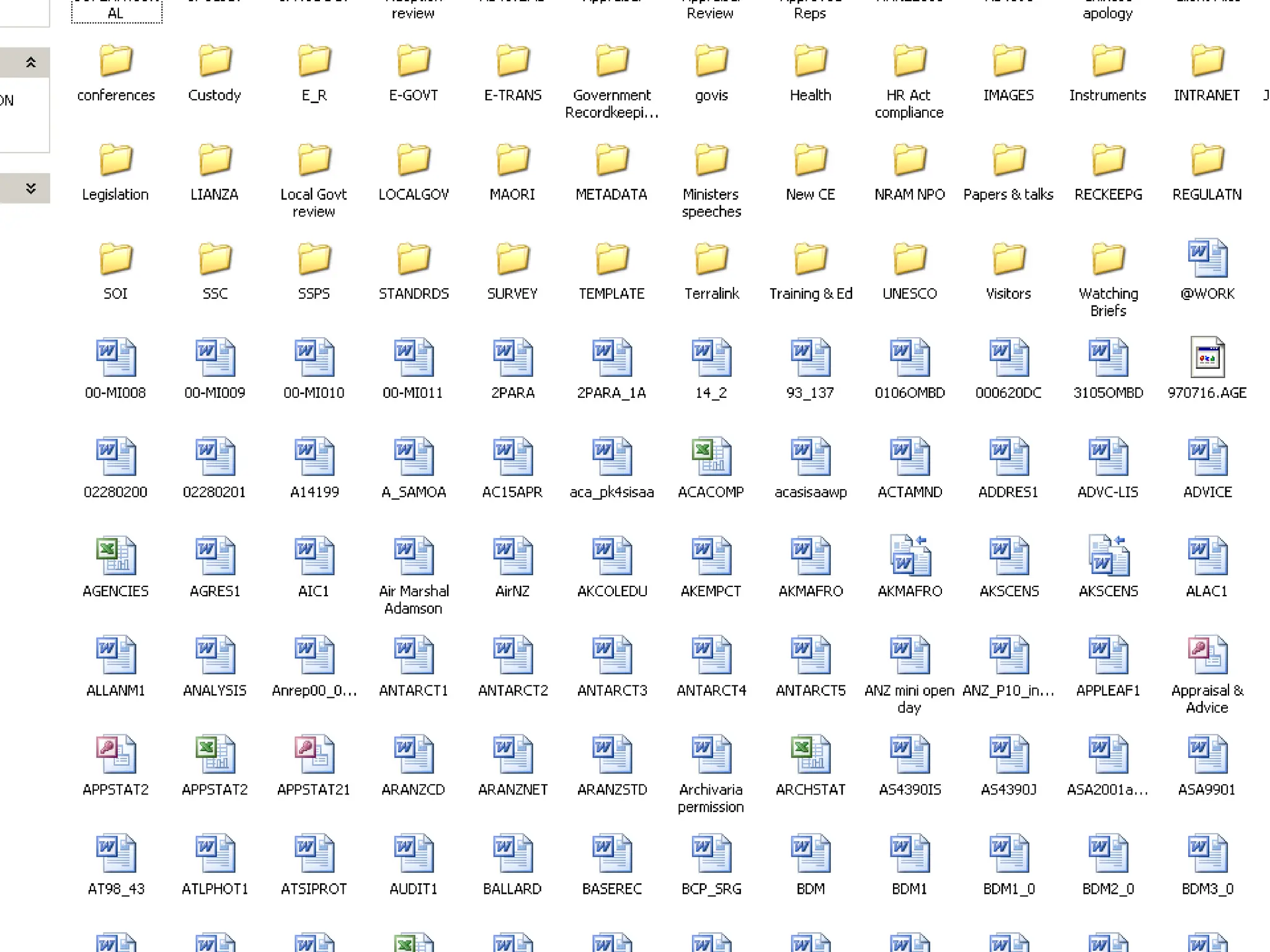
IM Report on ISO15489 Implementation
Why have a Record Plan?
• Record Plans help us to avoid general titles
by:
– Linking file titles to the work that we do;
and
– Providing flexibility to make file titles that
reflect specific tasks and actions
What is a Record Plan?
• Record Plans help us to avoid confusing file
titles by:
– making sure everyone uses the same
words to describe the same thing
Digital Recordkeeping
What is a Record Plan?
• Records are related to the work that we do
• Remember – a record is evidence of a
business transaction
• No work – no records!
• So, it makes sense to base the name of a
record on the business transaction that the
record is evidence of.
What is a Record Plan?
• A Record Plan is a system for creating files
and file titles based on the organisation’s
FUNCTIONS and ACTIVITIES
What is a Record Plan?
• Functions are the broad aims or purposes an
organisation is set up to achieve:
– Part of the Bureau of Public Service
System’s purpose is:
• To provide employment services to government
• To provide training services to government; and
• To monitor the overall performance of the
public service
What is a Record Plan?
• Activities are the groups of processes or
actions the organisation takes to carry out its
functions:
– to fulfil its function of performance
monitoring, the BPSS might:
• Provide advice
• Publish standards
• Request reports
What is a Record Plan?
• A file at the BPSS about providing advice to
Ministries about public service values
statements could be called:
– Performance Monitoring – Advice –
Instructions to Ministries on public service
values
What is a Record Plan?
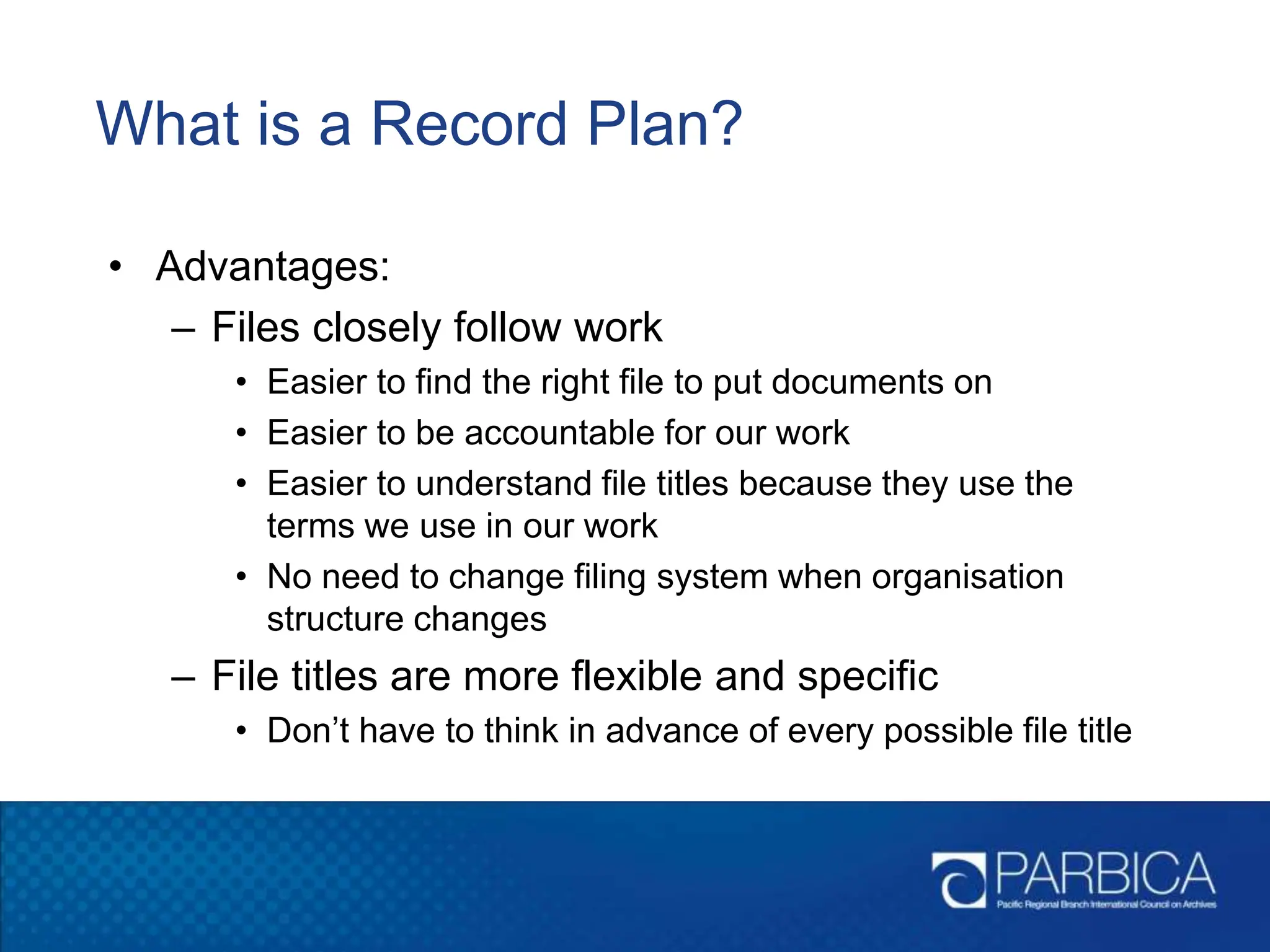
• Advantages:
– Files closely follow work
• Easier to find the right file to put documents on
• Easier to be accountable for our work
• Easier to understand file titles because they use the
terms we use in our work
• No need to change filing system when organisation
structure changes
– File titles are more flexible and specific
• Don’t have to think in advance of every possible file title
Introduction to PARBICA Record Plan:
Reminder of key concepts:
Functions = the broad aims or purposes an
organisation is set up to achieve:
Activities = the groups of processes or actions
the organisation takes to carry out its
functions
Subjects = The specific action or process taking
place documented in the file
Introducing the PARBICA Record Plan
• Record Plans relate to the functions of an
organisation
• Each organisation within government has its own
unique functions,
– only the BPSS sets standards for public service
personnel
– eg only the Passports Office in the Ministry of
State issues passports
• Therefore, each organisation needs its own Record
Plan
Introducing the PARBICA Record Plan
• But… there are some functions that all
government organisations do to help them
carry out their work
– eg financial management: all Ministries
need to carry out tasks to manage their
money, develop budgets, make payments
etc
Introducing the PARBICA Record Plan
• PARBICA has developed a Record Plan for
the functions that all Ministries carry out:
– Asset and Resources Management
– External Relations
– Financial Management
– Information Management
– Personnel and Establishment
– Strategic Management
Introducing the PARBICA Record Plan
• Administrative or Common functions – the
functions that all Ministries carry out to
support their work
– eg all Ministries have to manage their
finances
• Core functions - the functions that only one
Ministry carries out
– eg only the Passports Office in the Ministry
of State issues passports
Introducing the PARBICA Record Plan
• All Ministries manage their staff and
establishments BUT… BPSS has a
special responsibility to manage all public
servants
• All Ministries manage information BUT… the
National Archives has a special responsibility
to manage records about the government
Introducing the PARBICA Record Plan
• Record Plans describe the Functions and
Activities of an organisation
• These headings can also be used to describe
the files that document these Functions and
Activities
• The PARBICA Record Plan also gives
examples of the kinds of records that might
be produced when we carry out these
functions and activities
Reiteration:
Introducing the PARBICA Record Plan
• A Record Plan helps to describe records
consistently so that people can find them
easily
• Because each Ministry’s work is unique, each
Ministry needs its own Record Plan
• Some functions are carried out by all
Ministries, and PARBICA has developed a
Record Plan that can be used by (almost)
anyone for these functions
Related guidelines
• Guideline 4 – model administrative record
plan
• Guideline 5 – advice on how to adapt the
model administrative record plan
• Guideline 6 – developing a record plan for
core functions
Introducing the Tuvalu Government
Filing Manual
Group activity:
Getting to Know the
Group activity
5 groups:
• 3 groups do sections 1-8
• 2 groups do sections 4-17
Each group reports back on:
• 2 things they consider as being the
most important messages; and
• 2 things that they don’t already do
Afternoon Tea
How to use the PARBICA
model record plan for file
titling
How to Use the PARBICA Record Plan
• These are still very broad headings that aren’t much
help on their own as file titles:
– Financial Management – Budgeting
– Asset and Resources Management – Acquisition
• It is usually more efficient to have more specific file
titles:
– so that we can find information quickly
– so that files don’t become hard to manage
How to Use the PARBICA Record Plan
• When we use the PARBICA Record Plan, we
need to develop file titles in three parts:
– Function: eg Asset and Resource
Management
– Activity: eg Acquisition
– Subject: eg Purchase of new photocopiers
How to Use the PARBICA Record Plan
• Step-by-step:
– Decide on a function (first part of the file
title) eg Asset and Resources Management
– Chose an activity from the list for that
function (second part of the file title) eg
Acquisition
– Develop a title that reflects what the
document is about (third part of the file
title) eg Purchase of new photocopiers
Group activity:
Using the PARBICA
Record Plan
Using the Record Plan - Exercises
• Look at each sample document
– Which function?
– Which activity?
– What other information would you put in
the file title?
Ministry of Home Affairs’ experience of
using the PARBICA Record Plan
• Updating the file index
Using the Record Plan - Discussion
• What do you think of the Record Plan?
• Do you think you can use it to improve your
own existing systems?
• What would you need as support for this?
Wrap Up
• Governance is the systems, structures,
processes and rules used to make decisions,
take action, manage resources and monitor
progress
• We need complete, accurate and reliable
records to help us make decisions, take
action and monitor progress
Wrap Up
• 10 steps to good recordkeeping were addressed yesterday.
– Policy
– Senior management support
– Assigned responsibilities
– Training
– Procedures
– Understanding recordkeeping requirements
– ACCESSIBLE RECORDS
– Authorised disposal
– Secure storage
– Performance measures
Wrap Up
• Record Plans help make records accessible
– Good file titles reflect what is in the files;
and
– Are understandable to the people who use
the files
• Using functions and activities helps to make
file titles consistent and understandable over
time
Wrap Up
• All organisations have core functions – the
things they are set up to do
• All organisations also use administrative or
common functions – the work they do to
support their core functions
• Sometimes core functions and common
functions can look very similar – we need to
remember the differences
Wrap up
• PARBICA’s model administrative record plan and the
other toolkit guidelines associated with it can be
adopted or used to help update existing file titling
systems
• The Tuvalu Government Registry Filing Manual is a
resource for guidance on Registry procedures,
including file titling
Actions
• What next?
– What you plan to do using the filing manual
or the Record Plan

File System Manal for Office & personal USe.pptx

  • 1.
    Developing a fileplan Filing Manual
  • 2.
    Aims of thisSession • Understand what a record plan is and how it relates to file titling • Understand the concept of functions and activities of a government body and how they relate to record plans and file titling • Introduce PARBICA’s model record plan and the other toolkit guidelines associated with it • Get to know the Tuvalu Government Registry Filing Manual • Practice using the Record Plan for file titling • Come up with some ideas for development
  • 3.
    Reminder of RecordkeepingCapacity Question 7: Can the organisation find particular records when it needs them? Finding records is easier if you use: • A file creation and movement register • Secure storage that only RM staff can access • A naming and numbering system that all staff can understand
  • 4.
    What is aRecord Plan? • A Record Plan is a type of file titling system. • Other terms you might have heard are: – File Index – File Plan – Thesaurus – Business Classification Scheme
  • 5.
    Why have aRecord Plan? • Why have a file titling system? – Otherwise: • Staff may use their own systems • Filing can be inconsistent • Filing may not happen • Documents might be lost • Objectives may not be achieved
  • 6.
    Why have aRecord Plan? • Records need to be accessible. We need to be able to find them when we need them. • This means giving them titles that: – Reflect what is in the files; and – Are understandable to the people using the files
  • 7.
    Why have aRecord Plan? Administration – General – Miscellaneous
  • 8.
    Why have aRecord Plan? IM Report on ISO15489 Implementation
  • 9.
    Why have aRecord Plan? • Record Plans help us to avoid general titles by: – Linking file titles to the work that we do; and – Providing flexibility to make file titles that reflect specific tasks and actions
  • 10.
    What is aRecord Plan? • Record Plans help us to avoid confusing file titles by: – making sure everyone uses the same words to describe the same thing
  • 11.
  • 14.
    What is aRecord Plan? • Records are related to the work that we do • Remember – a record is evidence of a business transaction • No work – no records! • So, it makes sense to base the name of a record on the business transaction that the record is evidence of.
  • 15.
    What is aRecord Plan? • A Record Plan is a system for creating files and file titles based on the organisation’s FUNCTIONS and ACTIVITIES
  • 16.
    What is aRecord Plan? • Functions are the broad aims or purposes an organisation is set up to achieve: – Part of the Bureau of Public Service System’s purpose is: • To provide employment services to government • To provide training services to government; and • To monitor the overall performance of the public service
  • 17.
    What is aRecord Plan? • Activities are the groups of processes or actions the organisation takes to carry out its functions: – to fulfil its function of performance monitoring, the BPSS might: • Provide advice • Publish standards • Request reports
  • 18.
    What is aRecord Plan? • A file at the BPSS about providing advice to Ministries about public service values statements could be called: – Performance Monitoring – Advice – Instructions to Ministries on public service values
  • 19.
    What is aRecord Plan? • Advantages: – Files closely follow work • Easier to find the right file to put documents on • Easier to be accountable for our work • Easier to understand file titles because they use the terms we use in our work • No need to change filing system when organisation structure changes – File titles are more flexible and specific • Don’t have to think in advance of every possible file title
  • 20.
    Introduction to PARBICARecord Plan: Reminder of key concepts: Functions = the broad aims or purposes an organisation is set up to achieve: Activities = the groups of processes or actions the organisation takes to carry out its functions Subjects = The specific action or process taking place documented in the file
  • 21.
    Introducing the PARBICARecord Plan • Record Plans relate to the functions of an organisation • Each organisation within government has its own unique functions, – only the BPSS sets standards for public service personnel – eg only the Passports Office in the Ministry of State issues passports • Therefore, each organisation needs its own Record Plan
  • 22.
    Introducing the PARBICARecord Plan • But… there are some functions that all government organisations do to help them carry out their work – eg financial management: all Ministries need to carry out tasks to manage their money, develop budgets, make payments etc
  • 23.
    Introducing the PARBICARecord Plan • PARBICA has developed a Record Plan for the functions that all Ministries carry out: – Asset and Resources Management – External Relations – Financial Management – Information Management – Personnel and Establishment – Strategic Management
  • 24.
    Introducing the PARBICARecord Plan • Administrative or Common functions – the functions that all Ministries carry out to support their work – eg all Ministries have to manage their finances • Core functions - the functions that only one Ministry carries out – eg only the Passports Office in the Ministry of State issues passports
  • 25.
    Introducing the PARBICARecord Plan • All Ministries manage their staff and establishments BUT… BPSS has a special responsibility to manage all public servants • All Ministries manage information BUT… the National Archives has a special responsibility to manage records about the government
  • 26.
    Introducing the PARBICARecord Plan • Record Plans describe the Functions and Activities of an organisation • These headings can also be used to describe the files that document these Functions and Activities • The PARBICA Record Plan also gives examples of the kinds of records that might be produced when we carry out these functions and activities
  • 27.
    Reiteration: Introducing the PARBICARecord Plan • A Record Plan helps to describe records consistently so that people can find them easily • Because each Ministry’s work is unique, each Ministry needs its own Record Plan • Some functions are carried out by all Ministries, and PARBICA has developed a Record Plan that can be used by (almost) anyone for these functions
  • 28.
    Related guidelines • Guideline4 – model administrative record plan • Guideline 5 – advice on how to adapt the model administrative record plan • Guideline 6 – developing a record plan for core functions
  • 29.
    Introducing the TuvaluGovernment Filing Manual
  • 30.
  • 31.
    Group activity 5 groups: •3 groups do sections 1-8 • 2 groups do sections 4-17 Each group reports back on: • 2 things they consider as being the most important messages; and • 2 things that they don’t already do
  • 32.
  • 33.
    How to usethe PARBICA model record plan for file titling
  • 34.
    How to Usethe PARBICA Record Plan • These are still very broad headings that aren’t much help on their own as file titles: – Financial Management – Budgeting – Asset and Resources Management – Acquisition • It is usually more efficient to have more specific file titles: – so that we can find information quickly – so that files don’t become hard to manage
  • 35.
    How to Usethe PARBICA Record Plan • When we use the PARBICA Record Plan, we need to develop file titles in three parts: – Function: eg Asset and Resource Management – Activity: eg Acquisition – Subject: eg Purchase of new photocopiers
  • 36.
    How to Usethe PARBICA Record Plan • Step-by-step: – Decide on a function (first part of the file title) eg Asset and Resources Management – Chose an activity from the list for that function (second part of the file title) eg Acquisition – Develop a title that reflects what the document is about (third part of the file title) eg Purchase of new photocopiers
  • 37.
    Group activity: Using thePARBICA Record Plan
  • 38.
    Using the RecordPlan - Exercises • Look at each sample document – Which function? – Which activity? – What other information would you put in the file title?
  • 39.
    Ministry of HomeAffairs’ experience of using the PARBICA Record Plan • Updating the file index
  • 40.
    Using the RecordPlan - Discussion • What do you think of the Record Plan? • Do you think you can use it to improve your own existing systems? • What would you need as support for this?
  • 41.
    Wrap Up • Governanceis the systems, structures, processes and rules used to make decisions, take action, manage resources and monitor progress • We need complete, accurate and reliable records to help us make decisions, take action and monitor progress
  • 42.
    Wrap Up • 10steps to good recordkeeping were addressed yesterday. – Policy – Senior management support – Assigned responsibilities – Training – Procedures – Understanding recordkeeping requirements – ACCESSIBLE RECORDS – Authorised disposal – Secure storage – Performance measures
  • 43.
    Wrap Up • RecordPlans help make records accessible – Good file titles reflect what is in the files; and – Are understandable to the people who use the files • Using functions and activities helps to make file titles consistent and understandable over time
  • 44.
    Wrap Up • Allorganisations have core functions – the things they are set up to do • All organisations also use administrative or common functions – the work they do to support their core functions • Sometimes core functions and common functions can look very similar – we need to remember the differences
  • 45.
    Wrap up • PARBICA’smodel administrative record plan and the other toolkit guidelines associated with it can be adopted or used to help update existing file titling systems • The Tuvalu Government Registry Filing Manual is a resource for guidance on Registry procedures, including file titling
  • 46.
    Actions • What next? –What you plan to do using the filing manual or the Record Plan