

Governance & Records Management Emerson O. St. G. Bryan Information and Document Management Officer Caribbean Regional Negotiating Machinery (CRNM) 2008 February 27
Session Outline: First Things, First… What is a Record Using Records to repel Corruption Electronic Records  07/06/09
First Things, First…
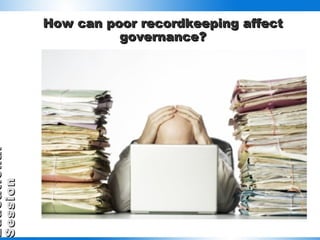
How can poor recordkeeping affect governance?
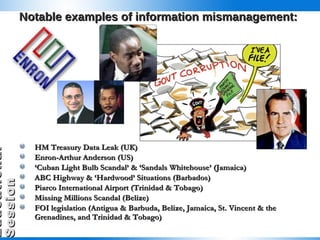
Notable examples of information mismanagement: HM Treasury Data Leak (UK) Enron-Arthur Anderson (US) ‘ Cuban Light Bulb Scandal’ & ‘Sandals Whitehouse’ (Jamaica) ABC Highway & ‘Hardwood’ Situations (Barbados) Piarco International Airport (Trinidad & Tobago) Missing Millions Scandal (Belize) FOI legislation (Antigua & Barbuda, Belize, Jamaica, St. Vincent & the Grenadines, and Trinidad & Tobago)
What is a Record?
Record Can be defined as "Information created, received and maintained as evidence and information by an organization or person, in pursuance of legal obligations or in the transaction of business". (ISO 15489-1, 2001) All recorded information, regardless of media or physical characteristics, made or received and maintained by an organization or institution in pursuance of its legal obligations or in the transaction of its business.  In machine-readable records/ archives, two or more data fields in predetermined order and treated as a unit.  (International Council on Archives General International Standard Archival Description (ISAD(G)) 1993 07/06/09
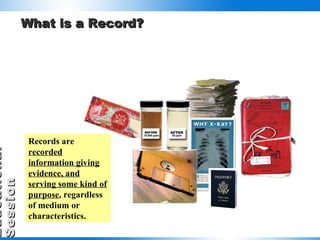
What is a Record? Records are  recorded   information giving evidence, and serving some kind of purpose , regardless of medium or characteristics.
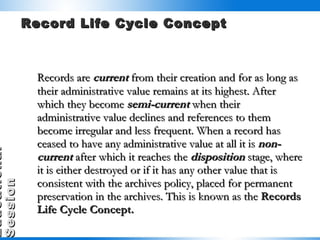
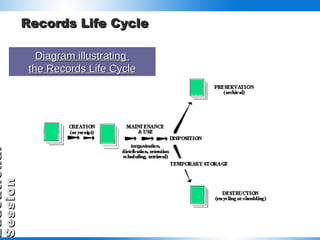
Record Life Cycle Concept Records are  current  from their creation and for as long as their administrative value remains at its highest. After which they become  semi-current  when their administrative value declines and references to them become irregular and less frequent. When a record has ceased to have any administrative value at all it is  non-current  after which it reaches the  disposition  stage, where it is either destroyed or if it has any other value that is consistent with the archives policy, placed for permanent preservation in the archives. This is known as the  Records Life Cycle Concept.
Records Life Cycle Diagram illustrating  the Records Life Cycle
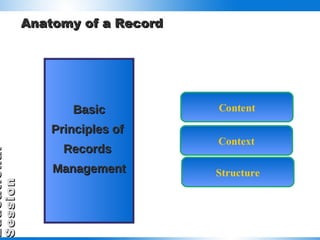
Anatomy of a Record Basic Principles of  Records  Management Content Context Structure
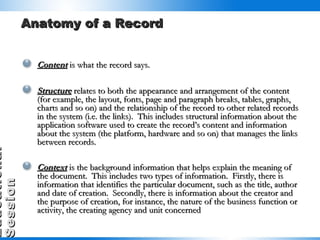
Anatomy of a Record Content  is what the record says. Structure  relates to both the appearance and arrangement of the content (for example, the layout, fonts, page and paragraph breaks, tables, graphs, charts and so on) and the relationship of the record to other related records in the system (i.e. the links).  This includes structural information about the application software used to create the record’s content and information about the system (the platform, hardware and so on) that manages the links between records. Context   is the background information that helps explain the meaning of the document.  This includes two types of information.  Firstly, there is information that identifies the particular document, such as the title, author and date of creation.  Secondly, there is information about the creator and the purpose of creation, for instance, the nature of the business function or activity, the creating agency and unit concerned
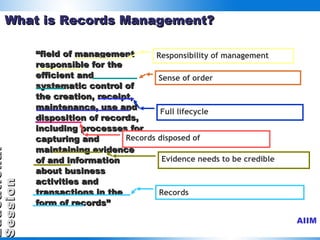
What is Records Management? “ field of management responsible for the efficient and systematic control of the creation, receipt, maintenance, use and disposition of records, including processes for capturing and maintaining evidence of and information about business activities and transactions in the form of records” AIIM Responsibility of management  Sense of order  Full lifecycle Records disposed of Evidence needs to be credible Records
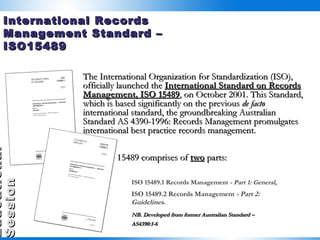
The International Organization for Standardization (ISO), officially launched the  International Standard on Records Management, ISO 15489 , on October 2001. This Standard, which is based significantly on the previous  de facto  international standard, the groundbreaking Australian Standard AS 4390-1996: Records Management promulgates international best practice records management. ISO 15489 comprises of  two  parts: ISO 15489.1 Records Management  - Part 1: General,  ISO 15489.2 Records Management  - Part 2:  Guidelines.   NB. Developed from former Australian Standard –  AS4390:1-6 International Records Management Standard – ISO15489
“ Records management and recordkeeping has to be seen as part of the broader Public Sector Reform agenda, and should not be treated as a separate entity.” Sahr Kpundeh (2002) Governance and Anti-corruption Specialist World Bank Institute
What Exactly is Corruption…?
Definition: Corruption …  behavior on the part of officials in the public sector, whether politicians or civil servants, in which they improperly and unlawfully enrich themselves, or those close to them, by the misuse of the public power entrusted to them. This would include embezzlement of funds, theft of corporate or public property as well as corrupt practices such as bribery, extortion or influence peddling. Transparency International (TI)
Definitions cont’d Corruption The promise, offering or giving to a public official, directly or indirectly, of an undue advantage, for the official himself or herself or another person or entity, in order that the official act or refrain from acting in the exercise of his or her official duties;  The solicitation or acceptance by a public official, directly or indirectly, of an undue advantage, for the official himself or herself or another person or entity, in order that the official act or refrain from acting in the exercise of his or her official duties. Article 8 of the Convention against Transnational Organized Crime
Good Governance "Good governance is epitomized by predictable, open and enlightened policy-making, a bureaucracy imbued with a professional ethos acting in furtherance of the public good, the rule of law, transparent processes, and a strong civil society participating in public affairs. Poor governance (on the other hand) is characterized by arbitrary policy making, unaccountable bureaucracies, unenforced or unjust legal systems, the abuse of executive power, a civil society unengaged in public life, and widespread corruption."  (World Bank,2006)
Using Records to repel Corruption
Information “ Information is critical in governance. It is through it that the government relates with the public. It is thus a bridge between the government and the people.” Charles Nandain (2006) Head, ICT, Library and Coordinator of Makerere University Kenya
Information Information as ‘Power’ to the citizenry Access to information via publishing of government information builds accountability and inclusiveness State monitoring of Information PAC Sittings, Commissions of Enquiry etc. MIS as an Administrative tool in Government Used to monitor routine functions and processes to determine performance and forecasting Integrity Legislation FOI, Declaration of Assets, & Data Protection
Access to Information/ Freedom of Information These laws are currently within five (5) countries of the Caribbean Region: Freedom of Information Act (2000) - Belize Freedom of Information Act (2000) - Trinidad & Tobago  Access to Information (2002) Act – Jamaica Freedom of Information (2003) - St. Vincent & the Grenadines Freedom of Information (2004) – Antigua & Barbuda
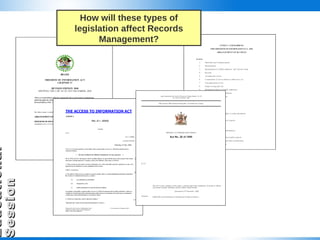
How will these types of legislation affect Records Management?
Access to Information/ Freedom of Information Some of the services under a FOI Act that affect people managing information are that they must:- locate and acquire information promptly upon request; select all types of appropriate media to service the information needs of the organization; assist and co-operate with other staff members within the organization who maintain personal or divisional information files or retrieval systems;   Last but not least… Have the Records in  ORDER
Electronic Records
“ Poor people around the world suffer daily because systems for creating, organizing, disseminating, and preserving accurate and reliable official information have broken down. The situation will be even harder to manage in an electronic environment.” Evidenced-based Governance in the Electronic Age Project  World Bank/ International Records Management Trust
Most of us keep our data/ information on computer systems, therefore, we must ensure that we can:  protect ,  access  and  share  them.  RECORDS MANAGEMENT STANDARDS
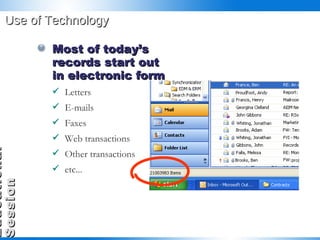
Use of Technology   Most of today’s records start out in electronic form Letters E-mails Faxes Web transactions Other transactions etc...
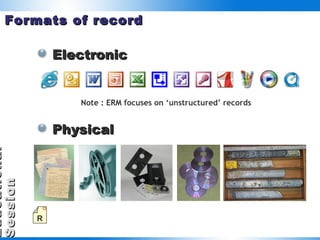
Formats of record Electronic Physical Note : ERM focuses on ‘unstructured’ records  R
Electronic Mail “ Email is a source of risk exposure” Bryant Duhon, Editor AIIM E-Doc Magazine The cost of eDiscovery is often enough to cause a company to settle rather than undergo the financial expenses and loss of productivity involved in this process. Some Standards that address E-Mail: DoD: 5015.2 – section C2.2.4 – Electronic Mail requirements for ERMS ISO: 15489 – clause 9 – RM processes and controls for ERMS ANSI/ARMA 9-2004 – Requirements for managing emails as records
Metadata Metadata is “data about data” or “data concerning data characteristics and relationships” (Rob and Coronel, 1995)  Metadata is a relatively new notion for the archival and records profession.  Interest in metadata stems from the realisation that electronic records do not contain enough contextual information to enable future users to fully understand the record.  Metadata is an attempt to capture this information in a systematic and structured manner that can be stored in electronic format and easily migrated with the record over time.
Metadata may be categorized as: Descriptive:  information describing the content Structural:  information that ties items, such as pages in a book, or documents in case folder Administrative:  information used to manage and control access
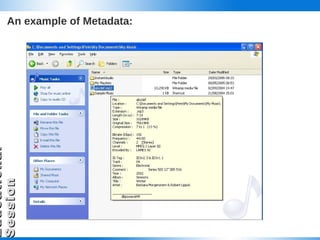
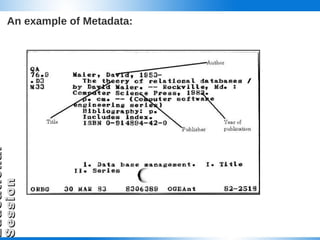
An example of Metadata:
Electronic Records Electronic records and information should also conform to the following basic RM principles: Authenticity  – record can be proven Reliability  – record can be trusted Integrity  – record is complete and unaltered Usability  – record can be located, retrieved, presented and interpreted. See:  ISO: 15489-1:2001, section:7.2
The benefits of goods records are many, but usually it results in: increase efficiency and productivity; protect the organization from litigation; evidence of transactions/ events for audit purposes; preservation of the institutional memory of the organization; facilitation of the resumption of operations in the event of a disaster; and ensuring that employee benefits can be supported via information maintained in personal records .  Government and organizations being accountable to their constituency and stakeholders.   Benefits of Good Recordkeeping
Good Luck!
Any Questions?
Thank You Want to know more About Records?: http://www.lorsonresources.com/seminar1.asp   Contact : Emerson O. Bryan [email_address]   Tel: +1246 430 1677 Fax: +1246 228 9528

E. Bryan - Governance and Records Management

  • 1.
    Governance & RecordsManagement Emerson O. St. G. Bryan Information and Document Management Officer Caribbean Regional Negotiating Machinery (CRNM) 2008 February 27
  • 2.
    Session Outline: FirstThings, First… What is a Record Using Records to repel Corruption Electronic Records 07/06/09
  • 3.
  • 4.
    How can poorrecordkeeping affect governance?
  • 5.
    Notable examples ofinformation mismanagement: HM Treasury Data Leak (UK) Enron-Arthur Anderson (US) ‘ Cuban Light Bulb Scandal’ & ‘Sandals Whitehouse’ (Jamaica) ABC Highway & ‘Hardwood’ Situations (Barbados) Piarco International Airport (Trinidad & Tobago) Missing Millions Scandal (Belize) FOI legislation (Antigua & Barbuda, Belize, Jamaica, St. Vincent & the Grenadines, and Trinidad & Tobago)
  • 6.
    What is aRecord?
  • 7.
    Record Can bedefined as "Information created, received and maintained as evidence and information by an organization or person, in pursuance of legal obligations or in the transaction of business". (ISO 15489-1, 2001) All recorded information, regardless of media or physical characteristics, made or received and maintained by an organization or institution in pursuance of its legal obligations or in the transaction of its business. In machine-readable records/ archives, two or more data fields in predetermined order and treated as a unit. (International Council on Archives General International Standard Archival Description (ISAD(G)) 1993 07/06/09
  • 8.
    What is aRecord? Records are recorded information giving evidence, and serving some kind of purpose , regardless of medium or characteristics.
  • 9.
    Record Life CycleConcept Records are current from their creation and for as long as their administrative value remains at its highest. After which they become semi-current when their administrative value declines and references to them become irregular and less frequent. When a record has ceased to have any administrative value at all it is non-current after which it reaches the disposition stage, where it is either destroyed or if it has any other value that is consistent with the archives policy, placed for permanent preservation in the archives. This is known as the Records Life Cycle Concept.
  • 10.
    Records Life CycleDiagram illustrating the Records Life Cycle
  • 11.
    Anatomy of aRecord Basic Principles of Records Management Content Context Structure
  • 12.
    Anatomy of aRecord Content is what the record says. Structure relates to both the appearance and arrangement of the content (for example, the layout, fonts, page and paragraph breaks, tables, graphs, charts and so on) and the relationship of the record to other related records in the system (i.e. the links). This includes structural information about the application software used to create the record’s content and information about the system (the platform, hardware and so on) that manages the links between records. Context is the background information that helps explain the meaning of the document. This includes two types of information. Firstly, there is information that identifies the particular document, such as the title, author and date of creation. Secondly, there is information about the creator and the purpose of creation, for instance, the nature of the business function or activity, the creating agency and unit concerned
  • 13.
    What is RecordsManagement? “ field of management responsible for the efficient and systematic control of the creation, receipt, maintenance, use and disposition of records, including processes for capturing and maintaining evidence of and information about business activities and transactions in the form of records” AIIM Responsibility of management Sense of order Full lifecycle Records disposed of Evidence needs to be credible Records
  • 14.
    The International Organizationfor Standardization (ISO), officially launched the International Standard on Records Management, ISO 15489 , on October 2001. This Standard, which is based significantly on the previous de facto international standard, the groundbreaking Australian Standard AS 4390-1996: Records Management promulgates international best practice records management. ISO 15489 comprises of two parts: ISO 15489.1 Records Management - Part 1: General, ISO 15489.2 Records Management - Part 2: Guidelines. NB. Developed from former Australian Standard – AS4390:1-6 International Records Management Standard – ISO15489
  • 15.
    “ Records managementand recordkeeping has to be seen as part of the broader Public Sector Reform agenda, and should not be treated as a separate entity.” Sahr Kpundeh (2002) Governance and Anti-corruption Specialist World Bank Institute
  • 16.
    What Exactly isCorruption…?
  • 17.
    Definition: Corruption … behavior on the part of officials in the public sector, whether politicians or civil servants, in which they improperly and unlawfully enrich themselves, or those close to them, by the misuse of the public power entrusted to them. This would include embezzlement of funds, theft of corporate or public property as well as corrupt practices such as bribery, extortion or influence peddling. Transparency International (TI)
  • 18.
    Definitions cont’d CorruptionThe promise, offering or giving to a public official, directly or indirectly, of an undue advantage, for the official himself or herself or another person or entity, in order that the official act or refrain from acting in the exercise of his or her official duties; The solicitation or acceptance by a public official, directly or indirectly, of an undue advantage, for the official himself or herself or another person or entity, in order that the official act or refrain from acting in the exercise of his or her official duties. Article 8 of the Convention against Transnational Organized Crime
  • 19.
    Good Governance "Goodgovernance is epitomized by predictable, open and enlightened policy-making, a bureaucracy imbued with a professional ethos acting in furtherance of the public good, the rule of law, transparent processes, and a strong civil society participating in public affairs. Poor governance (on the other hand) is characterized by arbitrary policy making, unaccountable bureaucracies, unenforced or unjust legal systems, the abuse of executive power, a civil society unengaged in public life, and widespread corruption." (World Bank,2006)
  • 20.
    Using Records torepel Corruption
  • 21.
    Information “ Informationis critical in governance. It is through it that the government relates with the public. It is thus a bridge between the government and the people.” Charles Nandain (2006) Head, ICT, Library and Coordinator of Makerere University Kenya
  • 22.
    Information Information as‘Power’ to the citizenry Access to information via publishing of government information builds accountability and inclusiveness State monitoring of Information PAC Sittings, Commissions of Enquiry etc. MIS as an Administrative tool in Government Used to monitor routine functions and processes to determine performance and forecasting Integrity Legislation FOI, Declaration of Assets, & Data Protection
  • 23.
    Access to Information/Freedom of Information These laws are currently within five (5) countries of the Caribbean Region: Freedom of Information Act (2000) - Belize Freedom of Information Act (2000) - Trinidad & Tobago Access to Information (2002) Act – Jamaica Freedom of Information (2003) - St. Vincent & the Grenadines Freedom of Information (2004) – Antigua & Barbuda
  • 24.
    How will thesetypes of legislation affect Records Management?
  • 25.
    Access to Information/Freedom of Information Some of the services under a FOI Act that affect people managing information are that they must:- locate and acquire information promptly upon request; select all types of appropriate media to service the information needs of the organization; assist and co-operate with other staff members within the organization who maintain personal or divisional information files or retrieval systems; Last but not least… Have the Records in ORDER
  • 26.
  • 27.
    “ Poor peoplearound the world suffer daily because systems for creating, organizing, disseminating, and preserving accurate and reliable official information have broken down. The situation will be even harder to manage in an electronic environment.” Evidenced-based Governance in the Electronic Age Project World Bank/ International Records Management Trust
  • 28.
    Most of uskeep our data/ information on computer systems, therefore, we must ensure that we can: protect , access and share them. RECORDS MANAGEMENT STANDARDS
  • 29.
    Use of Technology Most of today’s records start out in electronic form Letters E-mails Faxes Web transactions Other transactions etc...
  • 30.
    Formats of recordElectronic Physical Note : ERM focuses on ‘unstructured’ records R
  • 31.
    Electronic Mail “Email is a source of risk exposure” Bryant Duhon, Editor AIIM E-Doc Magazine The cost of eDiscovery is often enough to cause a company to settle rather than undergo the financial expenses and loss of productivity involved in this process. Some Standards that address E-Mail: DoD: 5015.2 – section C2.2.4 – Electronic Mail requirements for ERMS ISO: 15489 – clause 9 – RM processes and controls for ERMS ANSI/ARMA 9-2004 – Requirements for managing emails as records
  • 32.
    Metadata Metadata is“data about data” or “data concerning data characteristics and relationships” (Rob and Coronel, 1995) Metadata is a relatively new notion for the archival and records profession. Interest in metadata stems from the realisation that electronic records do not contain enough contextual information to enable future users to fully understand the record. Metadata is an attempt to capture this information in a systematic and structured manner that can be stored in electronic format and easily migrated with the record over time.
  • 33.
    Metadata may becategorized as: Descriptive: information describing the content Structural: information that ties items, such as pages in a book, or documents in case folder Administrative: information used to manage and control access
  • 34.
    An example ofMetadata:
  • 35.
    An example ofMetadata:
  • 36.
    Electronic Records Electronicrecords and information should also conform to the following basic RM principles: Authenticity – record can be proven Reliability – record can be trusted Integrity – record is complete and unaltered Usability – record can be located, retrieved, presented and interpreted. See: ISO: 15489-1:2001, section:7.2
  • 37.
    The benefits ofgoods records are many, but usually it results in: increase efficiency and productivity; protect the organization from litigation; evidence of transactions/ events for audit purposes; preservation of the institutional memory of the organization; facilitation of the resumption of operations in the event of a disaster; and ensuring that employee benefits can be supported via information maintained in personal records . Government and organizations being accountable to their constituency and stakeholders. Benefits of Good Recordkeeping
  • 38.
  • 39.
  • 40.
    Thank You Wantto know more About Records?: http://www.lorsonresources.com/seminar1.asp Contact : Emerson O. Bryan [email_address] Tel: +1246 430 1677 Fax: +1246 228 9528

Editor's Notes