7/24/2014 Gagan Gupta
Project Management is the dynamic process that
utilizes the appropriate resources of the organization
in a controlled and structured manner, to achieve
some clearly defined objectives identified as strategic
needs. It is always conducted within a defined set of
constraints.
7/24/2014 Gagan Gupta
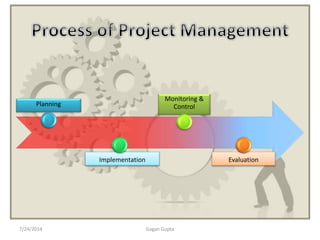
Planning
Implementation
Monitoring &
Control
Evaluation
7/24/2014 Gagan Gupta
• A Project is considered as Failure……
Whenever a project
doesn’t meet to the
expectation of the
Stakeholders.
7/24/2014 Gagan Gupta
• Cost & Time Over-runs
• Quality Degradation
• Frustration & Stress: sometime resulting in people
quitting
• Low Job Satisfaction
• Low Corporate Market Value
• Low Public Opinion
• Negative Media Campaigns
• May even force the company into Closure
7/24/2014 Gagan Gupta
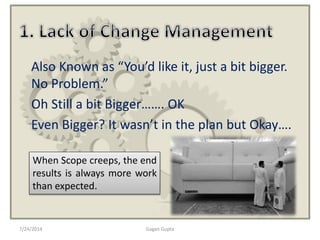
Also Known as “You’d like it, just a bit bigger.
No Problem.”
Oh Still a bit Bigger……. OK
Even Bigger? It wasn’t in the plan but Okay….
7/24/2014 Gagan Gupta
When Scope creeps, the end
results is always more work
than expected.
• Problems:
– The changes that were not initially planned for, are added to project.
– The Project takes longer and costs more than planned and there is no
record of WHY??
• Causes:
– Not having a method to handle or recognize changes.
• What to do:
– Document the change management process to be used and followed
by Project Team.
– Educate the project Team to recognize a change or deviation from the
Plan.
– Follow the Change Management Process.
7/24/2014 Gagan Gupta
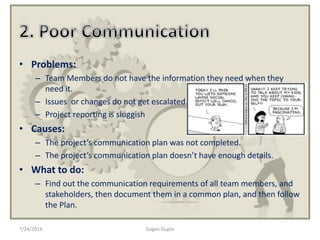
• Problems:
– Team Members do not have the information they need when they
need it.
– Issues or changes do not get escalated.
– Project reporting is sluggish
• Causes:
– The project’s communication plan was not completed.
– The project’s communication plan doesn’t have enough details.
• What to do:
– Find out the communication requirements of all team members, and
stakeholders, then document them in a common plan, and then follow
the Plan.
7/24/2014 Gagan Gupta
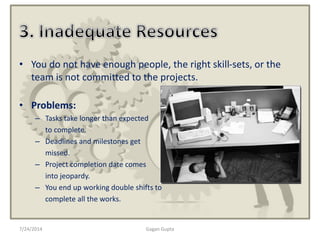
• You do not have enough people, the right skill-sets, or the
team is not committed to the projects.
• Problems:
– Tasks take longer than expected
to complete.
– Deadlines and milestones get
missed.
– Project completion date comes
into jeopardy.
– You end up working double shifts to
complete all the works.
• Causes:
– There was no pre-commitment of resources to the projects.
– The Project was not supported.
– There was no analysis and documentation of all skill-set required.
• What to do:
– Get executives Sponsorship for the project.
– Document which resources and skill-sets are needed to get the job
done.
– Create a plan that gives enough time to get the job done with the
allocated resources.
– Pre-assign the required resources to the team.
7/24/2014 Gagan Gupta
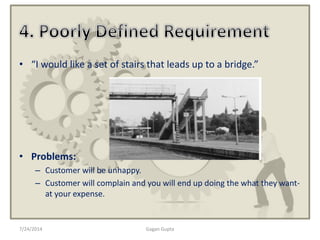
• “I would like a set of stairs that leads up to a bridge.”
• Problems:
– Customer will be unhappy.
– Customer will complain and you will end up doing the what they want-
at your expense.
• Causes:
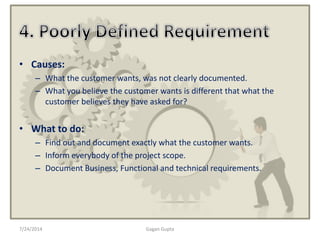
– What the customer wants, was not clearly documented.
– What you believe the customer wants is different that what the
customer believes they have asked for?
• What to do:
– Find out and document exactly what the customer wants.
– Inform everybody of the project scope.
– Document Business, Functional and technical requirements.
7/24/2014 Gagan Gupta
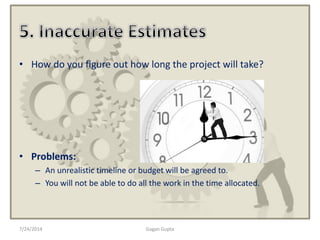
• How do you figure out how long the project will take?
• Problems:
– An unrealistic timeline or budget will be agreed to.
– You will not be able to do all the work in the time allocated.
• Causes:
– No formal estimating method
– Estimate confidence is law.
– Volume of work not understood
• What to do:
– List all the work as well as possible.
– Estimate each work package.
– Add up all work packages.
– Always give answer using a range of dates
7/24/2014 Gagan Gupta
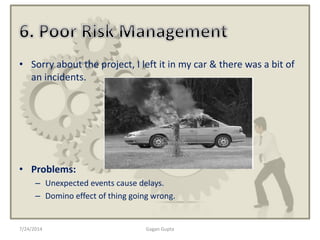
• Sorry about the project, I left it in my car & there was a bit of
an incidents.
• Problems:
– Unexpected events cause delays.
– Domino effect of thing going wrong.
• Causes:
– No Formal Risk Management.
– Just try to predict the big things that can go wrong.
– It’s the sum of the all little things that make a project late.
– Nothing is more stressful than trying to keep on schedule when
unexpected things keep happening.
• What to do:
– List all the work as well as possible.
– Figure out what can go wrong with each piece of work.
– Prioritize each risk as High/ Medium/ Low Probability or impact.
– Sort the list.
– Create a plan to deal with the risks at the top of list.
7/24/2014 Gagan Gupta
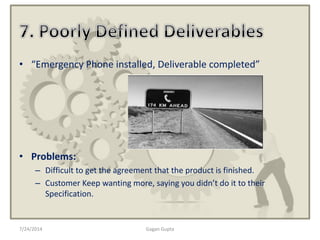
• “Emergency Phone installed, Deliverable completed”
• Problems:
– Difficult to get the agreement that the product is finished.
– Customer Keep wanting more, saying you didn’t do it to their
Specification.
• Causes:
– The Milestones or deliverables were not measurable.
– The customer never told us How many they wanted So we just
assumed 1,
• What to do:
– Ensure Milestones or Deliverables are:
Clearly Defined
Measurable (Quantifiable)
7/24/2014 Gagan Gupta
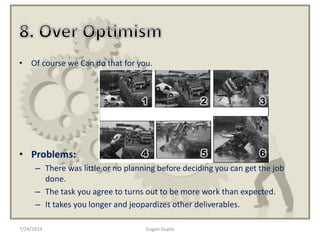
• Of course we Can do that for you.
• Problems:
– There was little or no planning before deciding you can get the job
done.
– The task you agree to turns out to be more work than expected.
– It takes you longer and jeopardizes other deliverables.
• Causes:
– Not enough time spent planning.
– You may have been pressured into giving an answer right then and
there.
– Didn’t have a full understanding of the work involved before
committing.
• What to do:
– Take the time to fully understand the work before agreeing to it.
– Its okay to say the work is not possible or will take too long
– Only agree to work when you’re sure it can be done, this will benefit
you and your managers.
7/24/2014 Gagan Gupta
• Causes:
– You have to do the work and weren’t also given time for project
management.
– Perhaps you only have 10% or 20% allotment for the project
management duties.
• What to do:
– Planning a project is like setting out a roadmap. Without it you will
likely get lost.
– Controlling a project is like driving a car. You have to continuously
watch the road (the Plan) and make little adjustments.
7/24/2014 Gagan Gupta
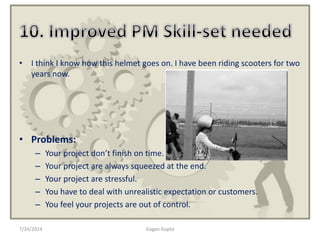
• I think I know how this helmet goes on. I have been riding scooters for two
years now.
• Problems:
– Your project don’t finish on time.
– Your project are always squeezed at the end.
– Your project are stressful.
– You have to deal with unrealistic expectation or customers.
– You feel your projects are out of control.
• Causes:
– People often don’t know what they don’t know.
– Their project are out of control but they don’t know WHY??
– They feel they are doing okay but could benefit from formal project
management education.
• What to do:
– Learn the methods, tools, and techniques successful Project manager
use to initiate, plan, execute and control their projects.
7/24/2014 Gagan Gupta
Presented by Gagan Gupta

File 1 removed slide 2

  • 1.
  • 2.
    Project Management isthe dynamic process that utilizes the appropriate resources of the organization in a controlled and structured manner, to achieve some clearly defined objectives identified as strategic needs. It is always conducted within a defined set of constraints. 7/24/2014 Gagan Gupta
  • 3.
  • 4.
    • A Projectis considered as Failure…… Whenever a project doesn’t meet to the expectation of the Stakeholders. 7/24/2014 Gagan Gupta
  • 5.
    • Cost &Time Over-runs • Quality Degradation • Frustration & Stress: sometime resulting in people quitting • Low Job Satisfaction • Low Corporate Market Value • Low Public Opinion • Negative Media Campaigns • May even force the company into Closure 7/24/2014 Gagan Gupta
  • 6.
  • 7.
    Also Known as“You’d like it, just a bit bigger. No Problem.” Oh Still a bit Bigger……. OK Even Bigger? It wasn’t in the plan but Okay…. 7/24/2014 Gagan Gupta When Scope creeps, the end results is always more work than expected.
  • 8.
    • Problems: – Thechanges that were not initially planned for, are added to project. – The Project takes longer and costs more than planned and there is no record of WHY?? • Causes: – Not having a method to handle or recognize changes. • What to do: – Document the change management process to be used and followed by Project Team. – Educate the project Team to recognize a change or deviation from the Plan. – Follow the Change Management Process. 7/24/2014 Gagan Gupta
  • 9.
    7/24/2014 Gagan Gupta •Problems: – Team Members do not have the information they need when they need it. – Issues or changes do not get escalated. – Project reporting is sluggish • Causes: – The project’s communication plan was not completed. – The project’s communication plan doesn’t have enough details. • What to do: – Find out the communication requirements of all team members, and stakeholders, then document them in a common plan, and then follow the Plan.
  • 10.
    7/24/2014 Gagan Gupta •You do not have enough people, the right skill-sets, or the team is not committed to the projects. • Problems: – Tasks take longer than expected to complete. – Deadlines and milestones get missed. – Project completion date comes into jeopardy. – You end up working double shifts to complete all the works.
  • 11.
    • Causes: – Therewas no pre-commitment of resources to the projects. – The Project was not supported. – There was no analysis and documentation of all skill-set required. • What to do: – Get executives Sponsorship for the project. – Document which resources and skill-sets are needed to get the job done. – Create a plan that gives enough time to get the job done with the allocated resources. – Pre-assign the required resources to the team. 7/24/2014 Gagan Gupta
  • 12.
    7/24/2014 Gagan Gupta •“I would like a set of stairs that leads up to a bridge.” • Problems: – Customer will be unhappy. – Customer will complain and you will end up doing the what they want- at your expense.
  • 13.
    • Causes: – Whatthe customer wants, was not clearly documented. – What you believe the customer wants is different that what the customer believes they have asked for? • What to do: – Find out and document exactly what the customer wants. – Inform everybody of the project scope. – Document Business, Functional and technical requirements. 7/24/2014 Gagan Gupta
  • 14.
    7/24/2014 Gagan Gupta •How do you figure out how long the project will take? • Problems: – An unrealistic timeline or budget will be agreed to. – You will not be able to do all the work in the time allocated.
  • 15.
    • Causes: – Noformal estimating method – Estimate confidence is law. – Volume of work not understood • What to do: – List all the work as well as possible. – Estimate each work package. – Add up all work packages. – Always give answer using a range of dates 7/24/2014 Gagan Gupta
  • 16.
    7/24/2014 Gagan Gupta •Sorry about the project, I left it in my car & there was a bit of an incidents. • Problems: – Unexpected events cause delays. – Domino effect of thing going wrong.
  • 17.
    • Causes: – NoFormal Risk Management. – Just try to predict the big things that can go wrong. – It’s the sum of the all little things that make a project late. – Nothing is more stressful than trying to keep on schedule when unexpected things keep happening. • What to do: – List all the work as well as possible. – Figure out what can go wrong with each piece of work. – Prioritize each risk as High/ Medium/ Low Probability or impact. – Sort the list. – Create a plan to deal with the risks at the top of list. 7/24/2014 Gagan Gupta
  • 18.
    7/24/2014 Gagan Gupta •“Emergency Phone installed, Deliverable completed” • Problems: – Difficult to get the agreement that the product is finished. – Customer Keep wanting more, saying you didn’t do it to their Specification.
  • 19.
    • Causes: – TheMilestones or deliverables were not measurable. – The customer never told us How many they wanted So we just assumed 1, • What to do: – Ensure Milestones or Deliverables are: Clearly Defined Measurable (Quantifiable) 7/24/2014 Gagan Gupta
  • 20.
    7/24/2014 Gagan Gupta •Of course we Can do that for you. • Problems: – There was little or no planning before deciding you can get the job done. – The task you agree to turns out to be more work than expected. – It takes you longer and jeopardizes other deliverables.
  • 21.
    • Causes: – Notenough time spent planning. – You may have been pressured into giving an answer right then and there. – Didn’t have a full understanding of the work involved before committing. • What to do: – Take the time to fully understand the work before agreeing to it. – Its okay to say the work is not possible or will take too long – Only agree to work when you’re sure it can be done, this will benefit you and your managers. 7/24/2014 Gagan Gupta
  • 22.
    • Causes: – Youhave to do the work and weren’t also given time for project management. – Perhaps you only have 10% or 20% allotment for the project management duties. • What to do: – Planning a project is like setting out a roadmap. Without it you will likely get lost. – Controlling a project is like driving a car. You have to continuously watch the road (the Plan) and make little adjustments. 7/24/2014 Gagan Gupta
  • 23.
    7/24/2014 Gagan Gupta •I think I know how this helmet goes on. I have been riding scooters for two years now. • Problems: – Your project don’t finish on time. – Your project are always squeezed at the end. – Your project are stressful. – You have to deal with unrealistic expectation or customers. – You feel your projects are out of control.
  • 24.
    • Causes: – Peopleoften don’t know what they don’t know. – Their project are out of control but they don’t know WHY?? – They feel they are doing okay but could benefit from formal project management education. • What to do: – Learn the methods, tools, and techniques successful Project manager use to initiate, plan, execute and control their projects. 7/24/2014 Gagan Gupta
  • 25.