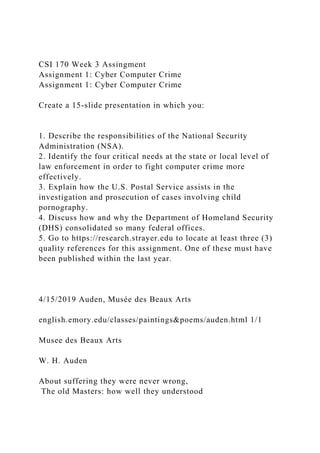
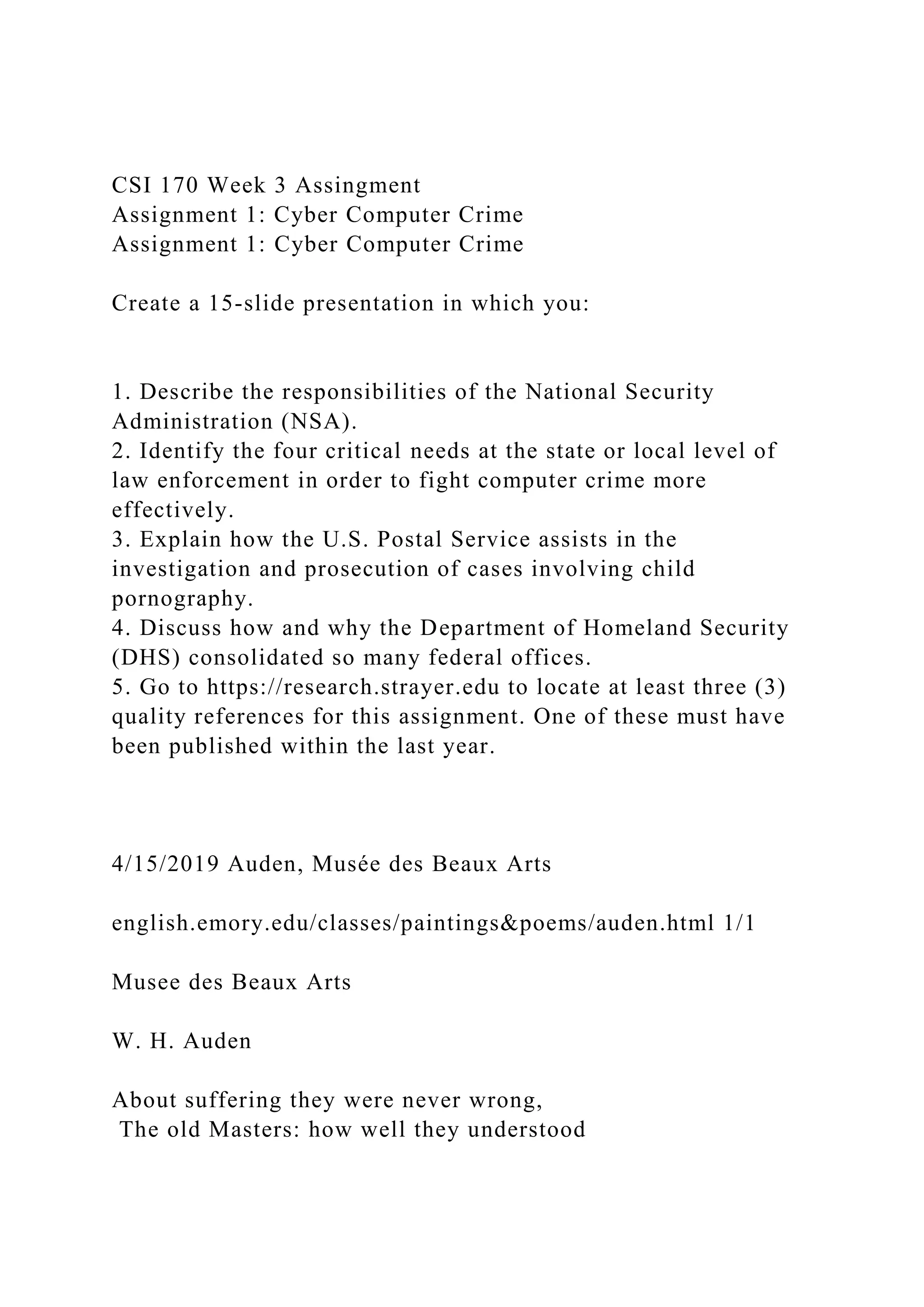
CSI 170 Week 3 Assingment
Assignment 1: Cyber Computer Crime
Create a 15-slide presentation in which you:
1. Describe the responsibilities of the National Security
Administration (NSA).
2. Identify the four critical needs at the state or local level of
law enforcement in order to fight computer crime more
effectively.
3. Explain how the U.S. Postal Service assists in the
investigation and prosecution of cases involving child
pornography.
4. Discuss how and why the Department of Homeland Security
(DHS) consolidated so many federal offices.
5. Go to https://research.strayer.edu to locate at least three (3)
quality references for this assignment. One of these must have
been published within the last year.
4/15/2019 Auden, Musée des Beaux Arts
english.emory.edu/classes/paintings&poems/auden.html 1/1
Musee des Beaux Arts
W. H. Auden
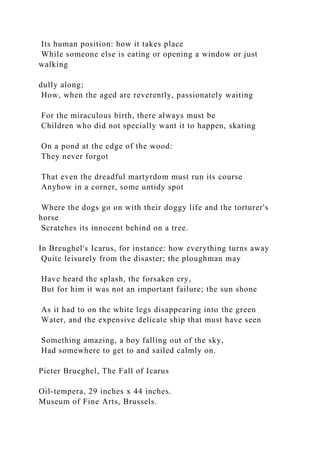
About suffering they were never wrong,
The old Masters: how well they understood
Its human position: how it takes place
While someone else is eating or opening a window or just
walking
dully along;
How, when the aged are reverently, passionately waiting
For the miraculous birth, there always must be
Children who did not specially want it to happen, skating
On a pond at the edge of the wood:
They never forgot
That even the dreadful martyrdom must run its course
Anyhow in a corner, some untidy spot
Where the dogs go on with their doggy life and the torturer's
horse
Scratches its innocent behind on a tree.
In Breughel's Icarus, for instance: how everything turns away
Quite leisurely from the disaster; the ploughman may
Have heard the splash, the forsaken cry,
But for him it was not an important failure; the sun shone
As it had to on the white legs disappearing into the green
Water, and the expensive delicate ship that must have seen
Something amazing, a boy falling out of the sky,
Had somewhere to get to and sailed calmly on.
Pieter Brueghel, The Fall of Icarus
Oil-tempera, 29 inches x 44 inches.
Museum of Fine Arts, Brussels.
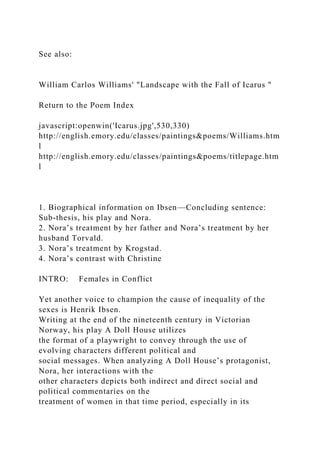
See also:
William Carlos Williams' "Landscape with the Fall of Icarus "
Return to the Poem Index
javascript:openwin('Icarus.jpg',530,330)
http://english.emory.edu/classes/paintings&poems/Williams.htm
l
http://english.emory.edu/classes/paintings&poems/titlepage.htm
l
1. Biographical information on Ibsen—Concluding sentence:
Sub-thesis, his play and Nora.
2. Nora’s treatment by her father and Nora’s treatment by her
husband Torvald.
3. Nora’s treatment by Krogstad.
4. Nora’s contrast with Christine
INTRO: Females in Conflict
Yet another voice to champion the cause of inequality of the
sexes is Henrik Ibsen.
Writing at the end of the nineteenth century in Victorian
Norway, his play A Doll House utilizes
the format of a playwright to convey through the use of
evolving characters different political and
social messages. When analyzing A Doll House’s protagonist,
Nora, her interactions with the
other characters depicts both indirect and direct social and
political commentaries on the
treatment of women in that time period, especially in its
treatment of male dominance over
women and the desire of women to be independent thinkers
deserving of respect (“Henrik
Ibsen”). This is demonstrated through Nora’s treatment by both
her husband and her father, her
dealings with Krogstad, and in her contrast with her friend
Christine.
A DOLL HOUSE JOURNAL ENTRY #15
1. What is the significance of the title?
2. Is Ibsen an early feminist? Explain.
3. How do Christine and Nora compare/contrast?
4. Is Torvald a good man? Is Krogstad a moral man? What role
does Dr. Rank play?
5. How do you feel about Nora abandoning her children?
Gender bias/difference noted in select literature:
Hints about writing an intro. for a discussion of short stories in
terms of gender bias:
1. Tell the readers that short fiction is a genre that conveys
emotion through conflict.
2. The story will be told uniquely by each author.
3. It concerns itself with personal feelings about a subject.
4. When looked at individually, a “gender bias” can be seen.
5. Different sexes will relate material and relate to material in a
different fashion.
6. Provide a thesis for this assignment that deals with our two
works, its two authors, and its different treatment of subject
matter that reflect a difference in gender and the handling of
emotion.
NOTES ON “CAT IN THE RAIN”—Written by Ernest
Hemingway, a male.
1. Told from a third-person point of view—like a camera lens.
2. Description is sparse—bleak, simple—periodic sentences.
(Subject – verb)
3. A war monument is depicted in the midst of a garden.
4. Husband and wife are cold, sterile. She is “the American
wife”
5. She is receiving little attention from husband—he is
preoccupied with reading/alone.
6. She is interested in a cat out in the rain and will go and look
for it.
7. He will go—but rather reluctantly.
8. She is fascinated by the hotel-keeper: his description is cold,
serious, mature, odd—she likes his demeanor about facing his
work. She likes his “big hands.”
9. When she returns—she begins to act more feminine—but
husband doesn’t care.
10. She vents about what she wants—a cat, longer hair,
romantic dining, and fine things.
11. The husband wants her to be quiet and read with him. The
cat is brought to the room at the request of the hotel-keeper.
NOTES ON “SWEAT”—Written by Zora Neale Hurston, a
female.
1. Delia works hard cleaning laundry for the “white folks.”
2. Her husband, Sykes, plays a nasty trick on her by putting
what she thinks is a snake in her laundry basket of clothes.
3. He thinks it’s funny—she is deathly afraid of snakes.
4. After calming down, she notices that the item that scared her
is the bullwhip used to drive his team of mules home.
5. We then learn that he detests her cleaning clothes for “white
folks,” but she reminds him that this is how his belly has been
filled all these 15 years.
6. We also learn that there is another girl, younger and prettier
that has come into the relationship. We also learn that he has
run off on her before and even beaten her.
7. But Delia has become strong—perhaps through the help of
Church.
8. We learn from the men-folk that Sykes is no good, tearing
women down and moving on. Now he’s working on a new gal—
Bertha—who has been in town 3 months, and he has been
paying her room charge.
9. He finally moved a huge rattlesnake in a box into the house.
Delia asks him to remove it, but he refuses. She confesses her
hatred for him and confesses that she has had enough of his
physical and mental abuse.
10. One night when Delia stays longer at church to witness a
“Love Feast” service—Sykes lets the snake loose in the house.
And then the consequence:_____________________________
Works Cited
Hemingway, Ernest. “Cat in the Rain.” Literature for
Composition. Edited by Sylvan Barnet, William
Bruto, and William E. Cain. 10th Edition. New York: Pearson,
2014. 693 – 95. Print.
Hurston, Zora Neale, “Sweat.” Literature for Composition.
Edited by Sylvan Barnet, William
Bruto, and William E. Cain. 10th Edition. New York: Pearson,
2014. 705 – 12. Print.
RESEARCH PAPER OVERVIEW
1. Subjugation of women over time—Thesis (Chopin and Ibsen)
2. Biographical information on Chopin—Concluding sentence:
Sub-thesis, her stories
3. “THE STORY OF AN HOUR”
4. “DESIREE’S BABY”
5. “THE STORM”
6. Biographical information on Ibsen—Concluding sentence:
Sub-thesis, his play and Nora
7. Nora’s treatment by Her father and Nora’s treatment by
Krogstad
8. Nora’s treatment by Torvald
9. Nora’s contrast with Christine
10. Conclusion—what these two writers have done for the
liberation of women
It is an accepted fact that throughout history, women have not
been given the same
opportunities that men have come to enjoy. Not until more
recently has this gap between the sexes
been reduced, thanks to crusaders who championed this
phenomenon. Two such crusaders,
authors, lived during the nineteenth century, when inequality of
the sexes was more obvious and
accepted as part of the established status quo. Sensitive to this
unfair bias that existed, Kate Chopin
and Henrik Ibsen chose to write stories and plays that depicted
this issue in hopes of inspiring others
to see the injustice that prevailed.
Kate Chopin was born in St. Louis, Missouri, in 1850, a time
when death from disease was
prevalent and society was highly conservative. After her father
was killed in a train wreck when the
author was five years old, she resided in her house with her
mother, grandmother, and great-
grandmother, all of whom were widows and rebellious in their
outlook on life. Consequently, it is no
wonder that she grew up to be independent herself. And, when
her husband of fifteen years, Oscar
Chopin, from Louisiana, died from typhoid fever, she took on
the responsibility of rearing her young
six boys by herself without getting remarried and moved back
home to St. Louis (Toth). Her
newfound spirit of independent thinking is reflected in her three
short stories “The Story of an
Hour,” “Desiree’s Baby,” and “The Storm.”
NOTES ON “FAMILY VALUES” ESSAY
I. Intro about importance of family
A. Older people pass down their experience
B. This is important as it keeps values alive and is good for the
future.
C. This can be seen in “Everyday Use,” “Girl,” and “The
Lesson.”
II. “Everyday Use” (1125-1131)
A. Mama is the “teacher.”
B. She must protect Maggie from Dee.
C. Maggie represents the goodness: the purity and innocence of
the country.
D. Dee represents modernization and the city-way of looking at
life.
E. Mama must see to it that the family stays intact.
III. “Girl” (123-124)
A. A mother instructs her daughter about how to act with morals
and dignity.
B. Surviving with everyday chores.
C. Handling the responsibilities of “being seen.”
D. How to act with the opposite sex.
E. How to act in the grocery store.
F. The mother wants her daughter to take pride in herself.
IV. “The Lesson” (654-659)
A. Told from 1st Person point of view - Sylvia narrates
B. Miss Moore must teach the “street kids” how to rise above
their condition.
C. She takes them to F.A.O. Schwarz, Fifth Avenue, NYC.
D. They see items way over-priced for those items’ usefulness
and practicality.
E. Kids learn that it “ain’t fair that there’s inequality.” Sugar
says, “I think that this is not much of a democracy if you ask
me. Equal chance to pursue happiness means an equal crack at
the dough, don’t it?” (659).
F. Sylvia ends with, “but ain’t nobody gonna beat me at nuthin”
(659).
V. Values have been passed along in these three stories from
one generation to the next. There might be clashes here and
there, but “good ultimately survives.”
IN:
Literature for Composition. Edited by Sylvan Barnet, William
Burto, and William E. Cain. 10th Edition.
New York: Pearson, 2014. [total page numbers]. Print.
Introduction:
No two people share the same perception of an object observed.
That being said, what the artist perceives and conveys through
art is not perceived the same way by a poet looking at the same
piece of art. Such is the case in looking at
_____________________________________ and reading
___________________________________. Both deal with the
subject of________________________,
But
_____________________________________________________
___________________________.
The painting:
Background on the painter, time period, and style.
What is the predominant focus?
What is the purpose in painting this piece of art?
The poem:
Background on the poet, time period, and style.
What is the predominant focus?
What is the purpose in writing this poem?
Conclusion:
Two views of the same subject matter.
How do the two compare?
USEFUL/HELPFUL QUOTATIONS FROM THE READINGS
ON FEMALE SUBJUGATION
“The Story of an Hour”
· Society interprets situations differently from the individual’s
reality.
· Women sometimes found themselves in unhappy
relationships—marriage was expected.
· Society supported this lifestyle.
· Consequently many women felt trapped and insignificant in
their daily lives.
· Notable quotations:
“Knowing that Mrs. Mallard was afflicted with a heart trouble,
great care was taken to break to her the news of her husband’s
death” (45). [railroad disaster—Brentley Mallard’s name led the
list of victims.]
“She did not hear the [news] as many women have heard the
same….She was young, with a fair, calm face, whose lines
bespoke repression and even a certain strength” (46).
“There was something coming to her and she was waiting for it,
fearfully….She was beginning to realize this thing that was
approaching to possess her, and she was striving to beat it back
with her will…” (46).
“’Free, free, free!’….There would be no one to live for her
during those coming years; she would live for herself” (46).
“And yet she had loved him—sometimes. Often she had not”
(46).
“’Go away. I am not making myself ill.’ No; she was drinking in
a very elixir of life through that open window” (47).
“When the doctors came they said she died of heart disease—of
joy that kills” (47).
“Desiree’s Baby”
· Interracial relationships do happen and should be understood
and dealt with humanely for the sake of love.
· Women should not be thought guilty based on their gender
alone.
· Love should conquer all.
“My mother, they tell me I am not white. Armand has told me I
am not white. For God’s sake tell them it is not true. You must
know it is not true. I shall die. I must die. I cannot be so
unhappy, and live” (66).
“’My own Desiree: Come home to Valmonde; back to your
mother who loves you. Come with your child” (66).
[In a note found by Armand from Armand’s mother to his
father] “’But above all,’ she wrote, ‘night and day, I thank the
good God for having so arranged our lives that our dear Armand
will never know that his mother, who adores him, belongs to the
race that is cursed with the brand of slavery’” (66).
“The Storm”
· A story of unleashed passion and its instinctual existence.
· This story argues against the “double-standard” that favors
males and sexual promisquity.
· Certain “matters” must be properly handled.
“’Do you remember—in Assumption, Calixta?’ [Alcee] asked in
a low voice broken by passion. Oh! She remembered; for in
Assumption he had kissed her and kissed her; until his senses
would well nigh fail” (II:73).
“They did not heed the crashing torrents, and the roar of the
elements made her laugh as she lay in his arms” (II:73).
“The generous abundance of her passion, without guile or
trickery, was like a white flame which penetrated and found
response in depths of his own sensuous nature that had never
yet been reached” (II:73).
“Bobinot and Bibi began to relax and enjoy themselves, and
when the three seated themselves at the table they laughed much
and so loud that anyone might have heard them as far away as
Laballiere” (III:74)
“Alcee Laballiere wrote to his wife, Clarisse, that night. It was
a loving letter, full of tender solitude. He told her not to hurry
back, but if she and the babies liked it at Biloxi, to stay a month
longer” (IV:74).
“As for Clarisse, she was charmed upon receiving her husband’s
letter….and the first free breath since her marriage seemed to
restore the pleasant liberty of her maiden days. Devoted as she
was to her husband, their intimate conjugal life was something
which she was willing to forego for a while” (V:75).
“So the storm passed and everyone was happy” (V:75).
TRADITION ESSAY
Introduction:
1. Begin with a definition of “tradition” and provide the internal
citation.
2. Then go on to say that tradition is celebrated often in our
lives: give examples, like holidays and maybe religious events.
3. Mention that traditions can have a dangerous side, such as
“hazing” or ______?_________.
4. Mention that the concept of “tradition” is conveyed in two
works specifically—“Mending Wall” by Robert Frost and “The
Lottery” by Shirley Jackson, the message being that traditions
need to be questioned as to their relevance to the present and
their usefulness to a culture.
“Mending Wall”
1. Discuss the tradition that is presented.
2. Discuss the purpose for its inception.
3. Discuss the concern over it.
4. Discuss its probability of continuance.
5. Discuss the author’s overall feelings about this tradition.
“The Lottery”
1. Discuss the tradition that is presented.
2. Discuss the purpose for its inception.
3. Discuss the concern over it.
4. Discuss its probability of continuance.
5. Discuss the author’s overall feelings about this tradition.
Conclusion:
1. Most traditions are undertaken gladly and in good spirits.
2. But they must be questioned.
3. Sometimes change is good—for the better, particularly in
certain conditions.
Works Cited info: Three (3) cites needed. [Use your last essay
for the proper book formats.]
“The Lottery” pages 1238-1243
“Mending Wall” pages 222-223
Definition source is required also
WORK FOR THIS CLASS—ENC 1102—ENUMERATED
ESSAY/ASSIGNMENT NAME/JOURNAL: SOURCES TO
UTILIZE:
1. Favorite Poem (Journal #1) Student choice
2. Assignment: Poem revealing self (J. 2) “THEME
FOR ENGLISH B”
Modeling a poem around Hugh’s work but substituting facts
about oneself.
3. Choices and Consequences: Essay #1( J. 3) “STOPPING BY
WOODS
How does this Frost poem deal with making choices and
accepting consequences. (5 paragraphs)
4. Choices and Consequences: Essay #2 (J.4) “THE ROAD
NOT TAKEN”
How does this Frost poem deal with making choices and
accepting consequences. (5 paragraphs)
5. Tradition Questioned: Essay #3(J. 5 – 6) “MENDING
WALL”/”THE LOTTERY”
How do these two works by Frost and Jackson each deal with
tradition? (4 paragraphs)
6. Fable(J. 7 – 8) ONE PUB. FABLE & ONE CREATED
FABLE—May use a new or an old moral.
Create one fable— must have a new moral or an established
moral with new and original plot.
7. Picture and poem about same subject (J. 9 -10)
PICTURE/POEM Selected Set
Discuss a picture and a poem about that picture. Two different
perspectives. (4 paragraphs)
8. Author’s gender and message (J. 11 – 12) “CAT IN THE
RAIN”/”SWEAT”
How does each portray the gender of its author? (4 paragraphs)
9. A Life-LessonTaught (J. 13 – 15)
“GIRL”/”EVERYDAY USE”/”THE LESSON”
How are adults teaching their children—generation to
generation? (5 paragraphs)
10. Feminist views—KATE CHOPIN (J. 16 – 18) “STORY OF
AN HOUR”/”DESIREE’S BABY”/”THE STORM”
How do these stories reflect the author’s view of women of
the time ? (5 paragraphs)
11. Female in conflict—HENRIK IBSEN (J. - 19) A
DOLL’S HOUSE
How does this work reflect the subjugation of women in
society? (5 paragraphs)
12. Putting Essays 10 and 11 together (Research paper)—
Treatment of women in society of that period in time and the
authors’ criticism of female subjugation. Precise MLA format
stressed with accurate Works Cited. Outline sent recently and
should be closely followed.

CSI 170 Week 3 AssingmentAssignment 1 Cyber Computer CrimeAss.docx

  • 1.
    CSI 170 Week3 Assingment Assignment 1: Cyber Computer Crime Assignment 1: Cyber Computer Crime Create a 15-slide presentation in which you: 1. Describe the responsibilities of the National Security Administration (NSA). 2. Identify the four critical needs at the state or local level of law enforcement in order to fight computer crime more effectively. 3. Explain how the U.S. Postal Service assists in the investigation and prosecution of cases involving child pornography. 4. Discuss how and why the Department of Homeland Security (DHS) consolidated so many federal offices. 5. Go to https://research.strayer.edu to locate at least three (3) quality references for this assignment. One of these must have been published within the last year. 4/15/2019 Auden, Musée des Beaux Arts english.emory.edu/classes/paintings&poems/auden.html 1/1 Musee des Beaux Arts W. H. Auden About suffering they were never wrong, The old Masters: how well they understood
  • 2.
    Its human position:how it takes place While someone else is eating or opening a window or just walking dully along; How, when the aged are reverently, passionately waiting For the miraculous birth, there always must be Children who did not specially want it to happen, skating On a pond at the edge of the wood: They never forgot That even the dreadful martyrdom must run its course Anyhow in a corner, some untidy spot Where the dogs go on with their doggy life and the torturer's horse Scratches its innocent behind on a tree. In Breughel's Icarus, for instance: how everything turns away Quite leisurely from the disaster; the ploughman may Have heard the splash, the forsaken cry, But for him it was not an important failure; the sun shone As it had to on the white legs disappearing into the green Water, and the expensive delicate ship that must have seen Something amazing, a boy falling out of the sky, Had somewhere to get to and sailed calmly on. Pieter Brueghel, The Fall of Icarus Oil-tempera, 29 inches x 44 inches. Museum of Fine Arts, Brussels.
  • 3.
    See also: William CarlosWilliams' "Landscape with the Fall of Icarus " Return to the Poem Index javascript:openwin('Icarus.jpg',530,330) http://english.emory.edu/classes/paintings&poems/Williams.htm l http://english.emory.edu/classes/paintings&poems/titlepage.htm l 1. Biographical information on Ibsen—Concluding sentence: Sub-thesis, his play and Nora. 2. Nora’s treatment by her father and Nora’s treatment by her husband Torvald. 3. Nora’s treatment by Krogstad. 4. Nora’s contrast with Christine INTRO: Females in Conflict Yet another voice to champion the cause of inequality of the sexes is Henrik Ibsen. Writing at the end of the nineteenth century in Victorian Norway, his play A Doll House utilizes the format of a playwright to convey through the use of evolving characters different political and social messages. When analyzing A Doll House’s protagonist, Nora, her interactions with the other characters depicts both indirect and direct social and political commentaries on the treatment of women in that time period, especially in its
  • 4.
    treatment of maledominance over women and the desire of women to be independent thinkers deserving of respect (“Henrik Ibsen”). This is demonstrated through Nora’s treatment by both her husband and her father, her dealings with Krogstad, and in her contrast with her friend Christine. A DOLL HOUSE JOURNAL ENTRY #15 1. What is the significance of the title? 2. Is Ibsen an early feminist? Explain. 3. How do Christine and Nora compare/contrast? 4. Is Torvald a good man? Is Krogstad a moral man? What role does Dr. Rank play? 5. How do you feel about Nora abandoning her children? Gender bias/difference noted in select literature: Hints about writing an intro. for a discussion of short stories in terms of gender bias: 1. Tell the readers that short fiction is a genre that conveys emotion through conflict. 2. The story will be told uniquely by each author. 3. It concerns itself with personal feelings about a subject. 4. When looked at individually, a “gender bias” can be seen. 5. Different sexes will relate material and relate to material in a different fashion. 6. Provide a thesis for this assignment that deals with our two works, its two authors, and its different treatment of subject matter that reflect a difference in gender and the handling of emotion. NOTES ON “CAT IN THE RAIN”—Written by Ernest Hemingway, a male. 1. Told from a third-person point of view—like a camera lens. 2. Description is sparse—bleak, simple—periodic sentences.
  • 5.
    (Subject – verb) 3.A war monument is depicted in the midst of a garden. 4. Husband and wife are cold, sterile. She is “the American wife” 5. She is receiving little attention from husband—he is preoccupied with reading/alone. 6. She is interested in a cat out in the rain and will go and look for it. 7. He will go—but rather reluctantly. 8. She is fascinated by the hotel-keeper: his description is cold, serious, mature, odd—she likes his demeanor about facing his work. She likes his “big hands.” 9. When she returns—she begins to act more feminine—but husband doesn’t care. 10. She vents about what she wants—a cat, longer hair, romantic dining, and fine things. 11. The husband wants her to be quiet and read with him. The cat is brought to the room at the request of the hotel-keeper. NOTES ON “SWEAT”—Written by Zora Neale Hurston, a female. 1. Delia works hard cleaning laundry for the “white folks.” 2. Her husband, Sykes, plays a nasty trick on her by putting what she thinks is a snake in her laundry basket of clothes. 3. He thinks it’s funny—she is deathly afraid of snakes. 4. After calming down, she notices that the item that scared her is the bullwhip used to drive his team of mules home. 5. We then learn that he detests her cleaning clothes for “white folks,” but she reminds him that this is how his belly has been filled all these 15 years. 6. We also learn that there is another girl, younger and prettier that has come into the relationship. We also learn that he has run off on her before and even beaten her. 7. But Delia has become strong—perhaps through the help of Church. 8. We learn from the men-folk that Sykes is no good, tearing women down and moving on. Now he’s working on a new gal—
  • 6.
    Bertha—who has beenin town 3 months, and he has been paying her room charge. 9. He finally moved a huge rattlesnake in a box into the house. Delia asks him to remove it, but he refuses. She confesses her hatred for him and confesses that she has had enough of his physical and mental abuse. 10. One night when Delia stays longer at church to witness a “Love Feast” service—Sykes lets the snake loose in the house. And then the consequence:_____________________________ Works Cited Hemingway, Ernest. “Cat in the Rain.” Literature for Composition. Edited by Sylvan Barnet, William Bruto, and William E. Cain. 10th Edition. New York: Pearson, 2014. 693 – 95. Print. Hurston, Zora Neale, “Sweat.” Literature for Composition. Edited by Sylvan Barnet, William Bruto, and William E. Cain. 10th Edition. New York: Pearson, 2014. 705 – 12. Print. RESEARCH PAPER OVERVIEW 1. Subjugation of women over time—Thesis (Chopin and Ibsen) 2. Biographical information on Chopin—Concluding sentence: Sub-thesis, her stories 3. “THE STORY OF AN HOUR” 4. “DESIREE’S BABY” 5. “THE STORM” 6. Biographical information on Ibsen—Concluding sentence: Sub-thesis, his play and Nora 7. Nora’s treatment by Her father and Nora’s treatment by
  • 7.
    Krogstad 8. Nora’s treatmentby Torvald 9. Nora’s contrast with Christine 10. Conclusion—what these two writers have done for the liberation of women It is an accepted fact that throughout history, women have not been given the same opportunities that men have come to enjoy. Not until more recently has this gap between the sexes been reduced, thanks to crusaders who championed this phenomenon. Two such crusaders, authors, lived during the nineteenth century, when inequality of the sexes was more obvious and accepted as part of the established status quo. Sensitive to this unfair bias that existed, Kate Chopin and Henrik Ibsen chose to write stories and plays that depicted this issue in hopes of inspiring others to see the injustice that prevailed. Kate Chopin was born in St. Louis, Missouri, in 1850, a time when death from disease was prevalent and society was highly conservative. After her father was killed in a train wreck when the author was five years old, she resided in her house with her mother, grandmother, and great- grandmother, all of whom were widows and rebellious in their outlook on life. Consequently, it is no wonder that she grew up to be independent herself. And, when her husband of fifteen years, Oscar Chopin, from Louisiana, died from typhoid fever, she took on the responsibility of rearing her young six boys by herself without getting remarried and moved back home to St. Louis (Toth). Her newfound spirit of independent thinking is reflected in her three short stories “The Story of an
  • 8.
    Hour,” “Desiree’s Baby,”and “The Storm.” NOTES ON “FAMILY VALUES” ESSAY I. Intro about importance of family A. Older people pass down their experience B. This is important as it keeps values alive and is good for the future. C. This can be seen in “Everyday Use,” “Girl,” and “The Lesson.” II. “Everyday Use” (1125-1131) A. Mama is the “teacher.” B. She must protect Maggie from Dee. C. Maggie represents the goodness: the purity and innocence of the country. D. Dee represents modernization and the city-way of looking at life. E. Mama must see to it that the family stays intact. III. “Girl” (123-124) A. A mother instructs her daughter about how to act with morals and dignity. B. Surviving with everyday chores. C. Handling the responsibilities of “being seen.” D. How to act with the opposite sex. E. How to act in the grocery store. F. The mother wants her daughter to take pride in herself. IV. “The Lesson” (654-659) A. Told from 1st Person point of view - Sylvia narrates B. Miss Moore must teach the “street kids” how to rise above their condition. C. She takes them to F.A.O. Schwarz, Fifth Avenue, NYC. D. They see items way over-priced for those items’ usefulness and practicality. E. Kids learn that it “ain’t fair that there’s inequality.” Sugar
  • 9.
    says, “I thinkthat this is not much of a democracy if you ask me. Equal chance to pursue happiness means an equal crack at the dough, don’t it?” (659). F. Sylvia ends with, “but ain’t nobody gonna beat me at nuthin” (659). V. Values have been passed along in these three stories from one generation to the next. There might be clashes here and there, but “good ultimately survives.” IN: Literature for Composition. Edited by Sylvan Barnet, William Burto, and William E. Cain. 10th Edition. New York: Pearson, 2014. [total page numbers]. Print. Introduction: No two people share the same perception of an object observed. That being said, what the artist perceives and conveys through art is not perceived the same way by a poet looking at the same piece of art. Such is the case in looking at _____________________________________ and reading ___________________________________. Both deal with the subject of________________________, But _____________________________________________________ ___________________________. The painting: Background on the painter, time period, and style. What is the predominant focus? What is the purpose in painting this piece of art? The poem: Background on the poet, time period, and style.
  • 10.
    What is thepredominant focus? What is the purpose in writing this poem? Conclusion: Two views of the same subject matter. How do the two compare? USEFUL/HELPFUL QUOTATIONS FROM THE READINGS ON FEMALE SUBJUGATION “The Story of an Hour” · Society interprets situations differently from the individual’s reality. · Women sometimes found themselves in unhappy relationships—marriage was expected. · Society supported this lifestyle. · Consequently many women felt trapped and insignificant in their daily lives. · Notable quotations: “Knowing that Mrs. Mallard was afflicted with a heart trouble, great care was taken to break to her the news of her husband’s death” (45). [railroad disaster—Brentley Mallard’s name led the list of victims.] “She did not hear the [news] as many women have heard the same….She was young, with a fair, calm face, whose lines bespoke repression and even a certain strength” (46). “There was something coming to her and she was waiting for it, fearfully….She was beginning to realize this thing that was approaching to possess her, and she was striving to beat it back with her will…” (46). “’Free, free, free!’….There would be no one to live for her during those coming years; she would live for herself” (46). “And yet she had loved him—sometimes. Often she had not” (46). “’Go away. I am not making myself ill.’ No; she was drinking in
  • 11.
    a very elixirof life through that open window” (47). “When the doctors came they said she died of heart disease—of joy that kills” (47). “Desiree’s Baby” · Interracial relationships do happen and should be understood and dealt with humanely for the sake of love. · Women should not be thought guilty based on their gender alone. · Love should conquer all. “My mother, they tell me I am not white. Armand has told me I am not white. For God’s sake tell them it is not true. You must know it is not true. I shall die. I must die. I cannot be so unhappy, and live” (66). “’My own Desiree: Come home to Valmonde; back to your mother who loves you. Come with your child” (66). [In a note found by Armand from Armand’s mother to his father] “’But above all,’ she wrote, ‘night and day, I thank the good God for having so arranged our lives that our dear Armand will never know that his mother, who adores him, belongs to the race that is cursed with the brand of slavery’” (66). “The Storm” · A story of unleashed passion and its instinctual existence. · This story argues against the “double-standard” that favors males and sexual promisquity. · Certain “matters” must be properly handled. “’Do you remember—in Assumption, Calixta?’ [Alcee] asked in a low voice broken by passion. Oh! She remembered; for in Assumption he had kissed her and kissed her; until his senses would well nigh fail” (II:73).
  • 12.
    “They did notheed the crashing torrents, and the roar of the elements made her laugh as she lay in his arms” (II:73). “The generous abundance of her passion, without guile or trickery, was like a white flame which penetrated and found response in depths of his own sensuous nature that had never yet been reached” (II:73). “Bobinot and Bibi began to relax and enjoy themselves, and when the three seated themselves at the table they laughed much and so loud that anyone might have heard them as far away as Laballiere” (III:74) “Alcee Laballiere wrote to his wife, Clarisse, that night. It was a loving letter, full of tender solitude. He told her not to hurry back, but if she and the babies liked it at Biloxi, to stay a month longer” (IV:74). “As for Clarisse, she was charmed upon receiving her husband’s letter….and the first free breath since her marriage seemed to restore the pleasant liberty of her maiden days. Devoted as she was to her husband, their intimate conjugal life was something which she was willing to forego for a while” (V:75). “So the storm passed and everyone was happy” (V:75). TRADITION ESSAY Introduction: 1. Begin with a definition of “tradition” and provide the internal citation. 2. Then go on to say that tradition is celebrated often in our lives: give examples, like holidays and maybe religious events. 3. Mention that traditions can have a dangerous side, such as “hazing” or ______?_________. 4. Mention that the concept of “tradition” is conveyed in two works specifically—“Mending Wall” by Robert Frost and “The Lottery” by Shirley Jackson, the message being that traditions need to be questioned as to their relevance to the present and their usefulness to a culture. “Mending Wall”
  • 13.
    1. Discuss thetradition that is presented. 2. Discuss the purpose for its inception. 3. Discuss the concern over it. 4. Discuss its probability of continuance. 5. Discuss the author’s overall feelings about this tradition. “The Lottery” 1. Discuss the tradition that is presented. 2. Discuss the purpose for its inception. 3. Discuss the concern over it. 4. Discuss its probability of continuance. 5. Discuss the author’s overall feelings about this tradition. Conclusion: 1. Most traditions are undertaken gladly and in good spirits. 2. But they must be questioned. 3. Sometimes change is good—for the better, particularly in certain conditions. Works Cited info: Three (3) cites needed. [Use your last essay for the proper book formats.] “The Lottery” pages 1238-1243 “Mending Wall” pages 222-223 Definition source is required also WORK FOR THIS CLASS—ENC 1102—ENUMERATED ESSAY/ASSIGNMENT NAME/JOURNAL: SOURCES TO UTILIZE: 1. Favorite Poem (Journal #1) Student choice 2. Assignment: Poem revealing self (J. 2) “THEME FOR ENGLISH B” Modeling a poem around Hugh’s work but substituting facts about oneself. 3. Choices and Consequences: Essay #1( J. 3) “STOPPING BY
  • 14.
    WOODS How does thisFrost poem deal with making choices and accepting consequences. (5 paragraphs) 4. Choices and Consequences: Essay #2 (J.4) “THE ROAD NOT TAKEN” How does this Frost poem deal with making choices and accepting consequences. (5 paragraphs) 5. Tradition Questioned: Essay #3(J. 5 – 6) “MENDING WALL”/”THE LOTTERY” How do these two works by Frost and Jackson each deal with tradition? (4 paragraphs) 6. Fable(J. 7 – 8) ONE PUB. FABLE & ONE CREATED FABLE—May use a new or an old moral. Create one fable— must have a new moral or an established moral with new and original plot. 7. Picture and poem about same subject (J. 9 -10) PICTURE/POEM Selected Set Discuss a picture and a poem about that picture. Two different perspectives. (4 paragraphs) 8. Author’s gender and message (J. 11 – 12) “CAT IN THE RAIN”/”SWEAT” How does each portray the gender of its author? (4 paragraphs) 9. A Life-LessonTaught (J. 13 – 15) “GIRL”/”EVERYDAY USE”/”THE LESSON” How are adults teaching their children—generation to generation? (5 paragraphs) 10. Feminist views—KATE CHOPIN (J. 16 – 18) “STORY OF AN HOUR”/”DESIREE’S BABY”/”THE STORM” How do these stories reflect the author’s view of women of
  • 15.
    the time ?(5 paragraphs) 11. Female in conflict—HENRIK IBSEN (J. - 19) A DOLL’S HOUSE How does this work reflect the subjugation of women in society? (5 paragraphs) 12. Putting Essays 10 and 11 together (Research paper)— Treatment of women in society of that period in time and the authors’ criticism of female subjugation. Precise MLA format stressed with accurate Works Cited. Outline sent recently and should be closely followed.