Objectives
• To understand how to apply critical
approaches for exam questions
• To be able to apply critical approaches to a
short sequence from ‘Fight Club’
• To demonstrate an ability to respond
correctly within written analysis.
Sample exam questions for Section C: ‘Fight Club’
Select one question in your pairs
17. Explore some of the ways in which placing your chosen film
within a broader critical framework has helped to develop your
appreciation and understanding of specific sequences. [30]
17. What does your chosen film reveal about the usefulness of one
or more critical approaches you have applied? [30]
17. How useful has a particular critical approach been in gaining a
deeper understanding and appreciation of your chosen film? [30]
17. In developing a response to your chosen film, how valuable did
you find the application of a specific critical approach? (30)
Critical Approaches
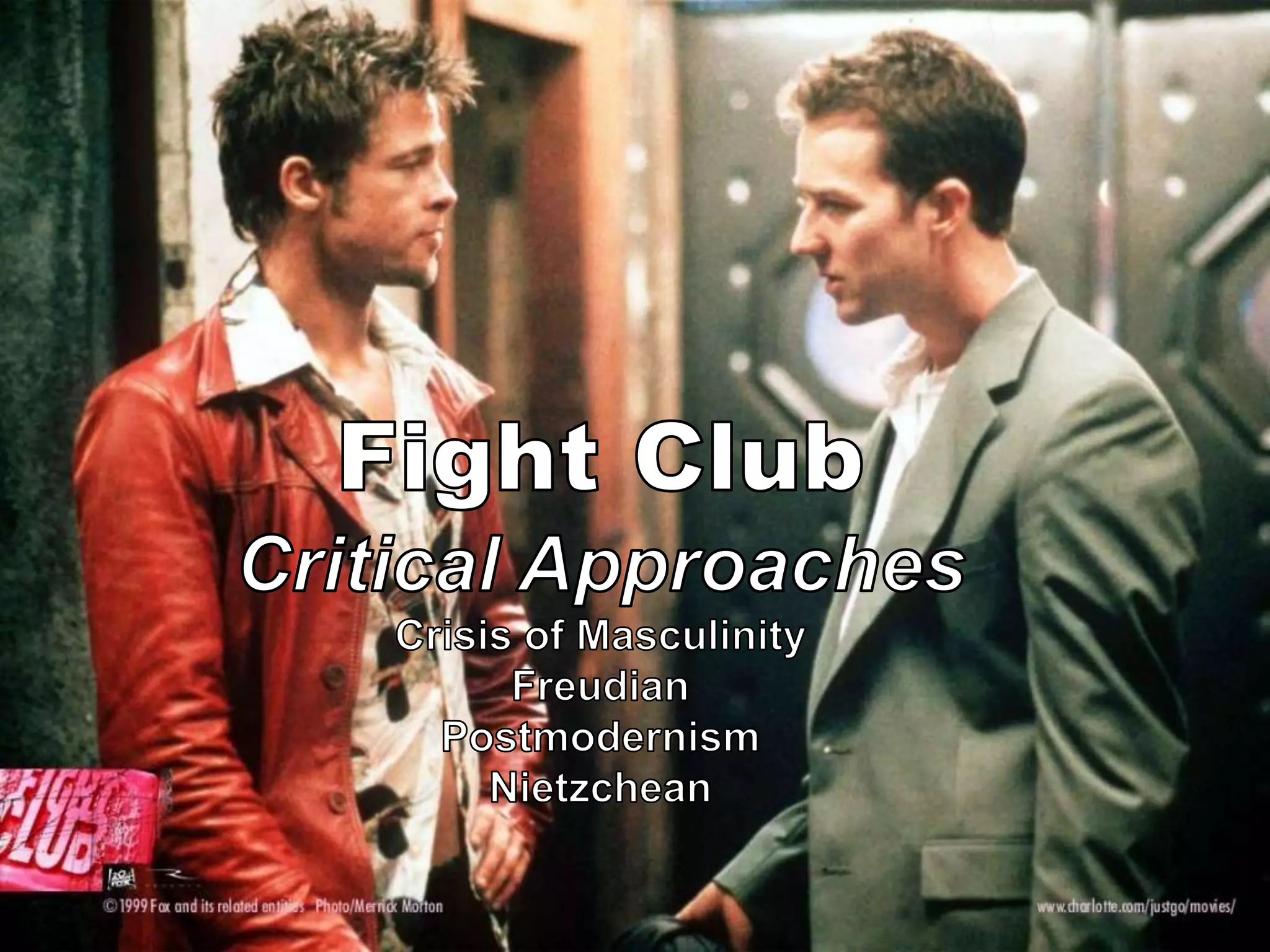
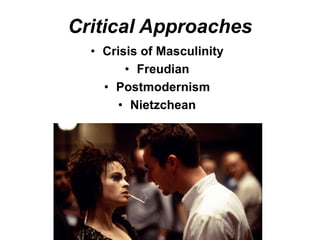
• Crisis of Masculinity
• Freudian
• Postmodernism
• Nietzchean
How to approach your exam answer for Section C:
‘Fight Club’
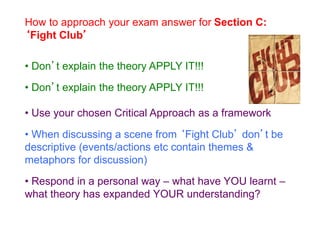
• Don’t explain the theory APPLY IT!!!
• Use your chosen Critical Approach as a framework
• When discussing a scene from ‘Fight Club’ don’t be
descriptive (events/actions etc contain themes &
metaphors for discussion)
• Respond in a personal way – what have YOU learnt –
what theory has expanded YOUR understanding?
Polysemy
For Dick Hebdige polysemy means that, "each text is
seen to generate a potentially infinite range of
meanings," making, according to Richard Middleton,
"any homology, out of the most heterogeneous materials,
possible. The idea of signifying practice — texts not as
communicating or expressing a pre-existing meaning but
as 'positioning subjects' within a process of semiosis —
changes the whole basis of creating social meaning".
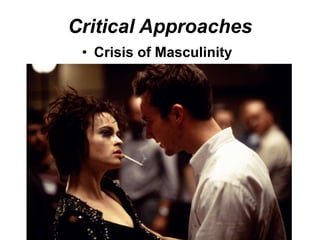
Critical Approaches
• Crisis of Masculinity
Crisis of Masculinity
Cultural critics Henry Giroux and Imre Szeman describe
Fight Club as a failed critique which focuses on the
consumerist culture and how it shapes male identity and
ignores how neoliberal capitalism has dominated and
exploited society.
"Fight Club has nothing substantive to say about the
structural violence of unemployment, job insecurity, cuts
in public spending, and the destruction of institutions
capable of defending social provisions and the public
good. The film is "dangerously seductive" because of
how it offers through Project Mayhem "a possible vision
of a collective response... however disturbing such a
response might be."
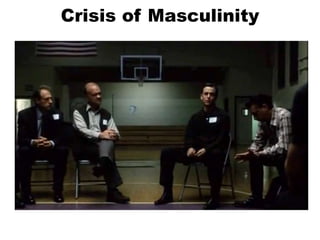
Crisis of Masculinity
Narrator: [voice over] Bob. Bob had bitch tits. This was a support group for
men with testicular cancer. The big moosie slobbering all over me... that was
Bob.
Bob: We're still men.
Narrator: Yes, we're men. Men is what we are. Narrator: [voice over] Eight
months ago, Bob's testicles were removed. Then hormone therapy. He
developed bitch tits because his testosterone was too high and his body upped
the estrogen. And that was where I fit...
Bob: They're gonna have to open my pecs again to drain the fluid.
Narrator: [voice over] Between those huge sweating tits that hung enormous,
the way you'd think of God's as big.
Crisis of Masculinity
The vision, in the form of "regressive, vicious, and
obscene" politics, is presented as the only possible
alternative to defeat contemporary capitalism. Fight Club
is a film that "very powerfully reveals the astonishing
limits of our political imagination", focusing on
masculinity and centering around a "hip, stylishly violent"
narrative.
Critics write, "It tells us very little... about the real
circumstances and causes of our discontent, which lie in
a very different place than in the seeming emasculation
of that social group that wields perhaps the most
concentrated power the world has ever seen—urban,
upper-middle class, white, male technocrats."
Crisis of Masculinity
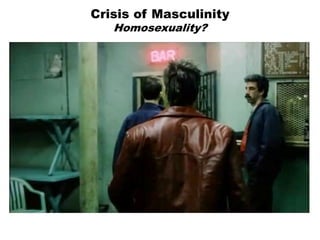
Homosexuality?
Crisis of Masculinity
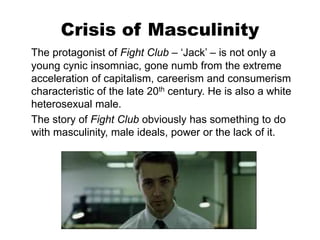
The protagonist of Fight Club – ‘Jack’ – is not only a
young cynic insomniac, gone numb from the extreme
acceleration of capitalism, careerism and consumerism
characteristic of the late 20th century. He is also a white
heterosexual male.
The story of Fight Club obviously has something to do
with masculinity, male ideals, power or the lack of it.
Crisis of Masculinity
Critics outline three main absences in Fight Club's
critique.
• the film assumes that capitalism and consumerism are
"impenetrable", and there cannot be resistance or
struggle against them.
• the film focuses instead on defending "authoritarian
masculinity." The fight clubs' violence are complicit with
the system of commodification that it denounces
because it ties into instant gratification, heightened
competitiveness, and "the market-driven desire" to
dominate and win in fights.
• Fight Club ascribes to a world under the philosophy of
Thomas Hobbes in which cynicism replaces hope.
Crisis of Masculinity
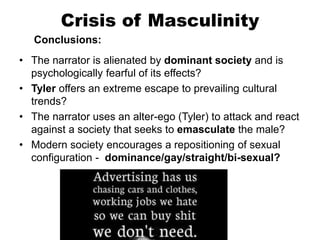
Conclusions:
• The narrator is alienated by dominant society and is
psychologically fearful of its effects?
• Tyler offers an extreme escape to prevailing cultural
trends?
• The narrator uses an alter-ego (Tyler) to attack and react
against a society that seeks to emasculate the male?
• Modern society encourages a repositioning of sexual
configuration - dominance/gay/straight/bi-sexual?
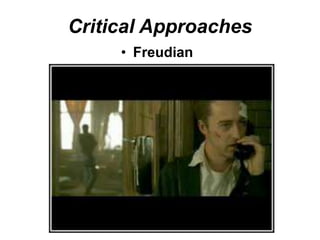
Critical Approaches
• Freudian
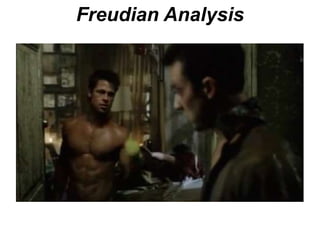
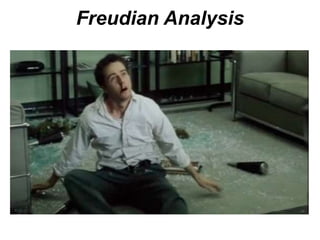
Freudian Analysis
• The Id - Tyler Durden (Unconscious Desires/The 'repressed' - set free
without conscience)
• The Ego - The 'narrator' (The conscious/IKEA lifestyle - comfortable)
• The 'real' Tyler can be found between The Id and The
Ego (one half Ego & one half Id)
• The Superego - Initially: 'The Self-help groups'
• Then: 'The Fight Clubs'
• Then: 'Project Mayhem'
• The Superego will regulate 'pleasure', it will censor the Id, but will also
license it.
• Freud explained his famous model for brain function in the 1927 publication,
The Ego and the Id. Since then, the theory has been explained with
reference to a horse and chariot:
Freudian Analysis
Freudian Analysis
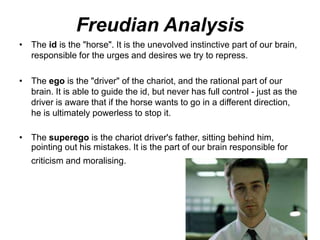
• The id is the "horse". It is the unevolved instinctive part of our brain,
responsible for the urges and desires we try to repress.
• The ego is the "driver" of the chariot, and the rational part of our
brain. It is able to guide the id, but never has full control - just as the
driver is aware that if the horse wants to go in a different direction,
he is ultimately powerless to stop it.
• The superego is the chariot driver's father, sitting behind him,
pointing out his mistakes. It is the part of our brain responsible for
criticism and moralising.
Freudian Analysis
• Id: The most primitive drive, concerned only with
fulfilling pleasure. Has sometimes been referred to as
the irrational and emotional part of the mind. It is often
regarded as being selfish, because it’s concerned
only with its own self-satisfaction. Babies and young
children are often used as examples because they’re
usually driven by the pleasure and instant gratification
principles. Key word: want
Freudian Analysis
• Ego: Based on the reality principle. The ego is capable
of understanding that one’s own desires may vary for
people around (reality), and is willing to make this
consideration. The ego tries to meet the basic needs
of the id but also takes into account the real world.
The ego understands that actions have effects, whether
positive or negative, and tries to balance out thinking
before carrying out decisions/actions. Key word:
balance
Freudian Analysis
• Superego: Based on moral principles instilled by
rearing and moral/ethical restraints placed upon by
caregivers. The superego encompasses an
individual’s ideals, goals, and conscience as well as
society’s. The superego is concerned with what
others will think, and stands in opposition to the id.
The superego acts to perfect and civilise our
behaviour. Key words: morals, compromise
Freudian Analysis
Freudian Analysis
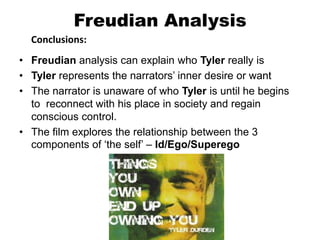
Conclusions:
• Freudian analysis can explain who Tyler really is
• Tyler represents the narrators’ inner desire or want
• The narrator is unaware of who Tyler is until he begins
to reconnect with his place in society and regain
conscious control.
• The film explores the relationship between the 3
components of ‘the self’ – Id/Ego/Superego
Critical Approaches
• Postmodernism
Postmodernism
Postmodernism is a social and cultural concept that has
dominated contemporary theory since the 1950’s. It has
been widely used in film theory as a critical perspective that
allows debate concerning social shifts in contemporary life
and artistic practices in the wake of the decline of
modernism.
Postmodernism
Characteristics of a postmodern text seen within ‘Fight Club’:
Intertextuality – the referencing of other cultural texts; either visually or
verbally within the content of the text
Hybridity - the mixing and/or recycling of pre-existing genres and narratives
to construct new forms or a ‘hybrid’
Simulation - a lack of any sense of reality to the real world
Surface – a text that is more concerned with the superficial and/or devoid of
any depth of meaning
Pastiche – paying ‘homage’ to older texts
Bricolage - the collection of disparate or differing objects to help explain the
nature of the prevailing culture and society
Irony – playfulness with the style, form and/or content of a text
Postmodernism
“We live in a world where there is more and more information, and less
and less meaning.”
― Jean Baudrillard, Simulacra and Simulation
“Americans may have no identity, but they do have wonderful teeth.”
― Jean Baudrillard
“Postmodernity is said to be a culture of fragmentary sensations,
eclectic nostalgia, disposable simulacra, and promiscuous superficiality,
in which the traditionally valued qualities of depth, coherence, meaning,
originality, and authenticity are evacuated or dissolved amid the
random swirl of empty signals.”
― Jean Baudrillard
Postmodernism
Postmodernism
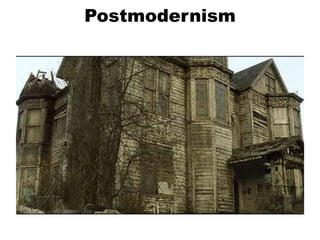
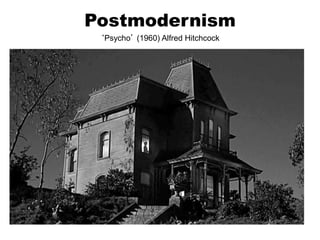
‘Psycho’ (1960) Alfred Hitchcock
Postmodernism
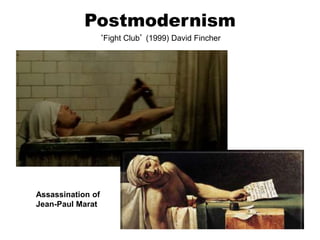
‘Fight Club’ (1999) David Fincher
Assassination of
Jean-Paul Marat
Postmodernism
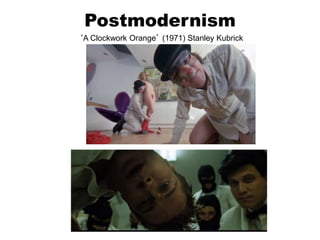
‘A Clockwork Orange’ (1971) Stanley Kubrick
Postmodernism
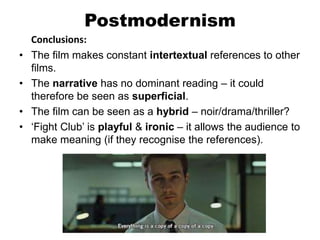
Conclusions:
• The film makes constant intertextual references to other
films.
• The narrative has no dominant reading – it could
therefore be seen as superficial.
• The film can be seen as a hybrid – noir/drama/thriller?
• ‘Fight Club’ is playful & ironic – it allows the audience to
make meaning (if they recognise the references).
Critical Approaches
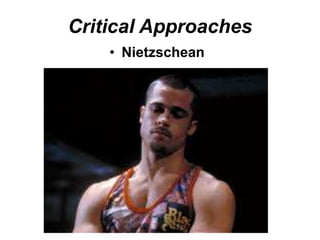
• Nietzschean
Nietzsche
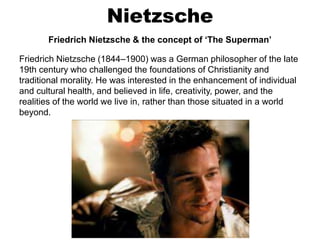
Friedrich Nietzsche & the concept of ‘The Superman’
Friedrich Nietzsche (1844–1900) was a German philosopher of the late
19th century who challenged the foundations of Christianity and
traditional morality. He was interested in the enhancement of individual
and cultural health, and believed in life, creativity, power, and the
realities of the world we live in, rather than those situated in a world
beyond.
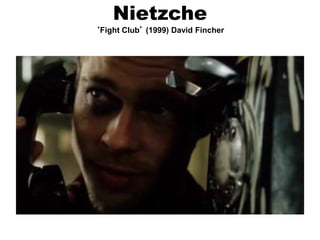
Nietzche
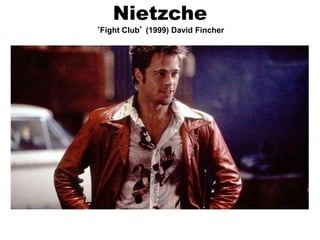
‘Fight Club’ (1999) David Fincher
Nietzsche
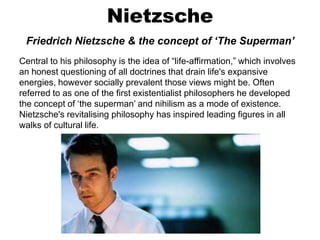
Friedrich Nietzsche & the concept of ‘The Superman’
Central to his philosophy is the idea of “life-affirmation,” which involves
an honest questioning of all doctrines that drain life's expansive
energies, however socially prevalent those views might be. Often
referred to as one of the first existentialist philosophers he developed
the concept of ‘the superman’ and nihilism as a mode of existence.
Nietzsche's revitalising philosophy has inspired leading figures in all
walks of cultural life.
Nietzsche
• Useful quotes: (Apply these quotes to events within the narrative of
‘Fight Club’. They will deepen your understanding of a
Nietzschean philosophical perspective)
• Battle not with monsters, lest ye become a monster, and if you gaze
into the abyss, the abyss gazes also into you.
• Be careful when you fight the monsters, lest you become one.
• Insanity in individuals is something rare - but in groups, parties,
nations and epochs, it is the rule.
• Man is the cruellest animal.
• No price is too high to pay for the privilege of owning yourself.
• Talking much about oneself can also be a means to conceal oneself.
Nietzche
‘Fight Club’ (1999) David Fincher
Nietzsche
• Useful quotes: (Apply these quotes to events within the narrative of
‘Fight Club’. They will deepen your understanding of a
Nietzschean philosophical perspective)
• The individual has always had to struggle to keep from being
overwhelmed by the tribe. If you try it, you will be lonely often, and
sometimes frightened. But no price is too high to pay for the
privilege of owning yourself.
• The visionary lies to himself, the liar only to others.
• When you stare into the abyss the abyss stares back at you.
• You need chaos in your soul to give birth to a dancing star.
• There is always some madness in love. But there is also always
some reason in madness.
Nietzsche
• Useful quotes: (Apply these quotes to events within the narrative of
‘Fight Club’. They will deepen your understanding of a
Nietzschean philosophical perspective)
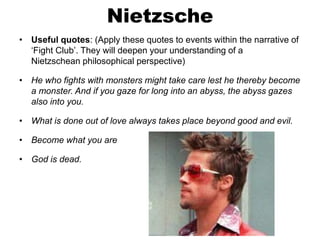
• He who fights with monsters might take care lest he thereby become
a monster. And if you gaze for long into an abyss, the abyss gazes
also into you.
• What is done out of love always takes place beyond good and evil.
• Become what you are
• God is dead.
Nietzschean
Conclusions:
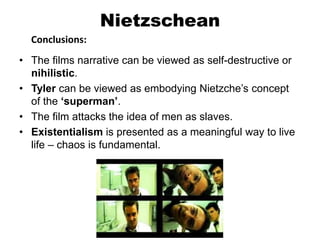
• The films narrative can be viewed as self-destructive or
nihilistic.
• Tyler can be viewed as embodying Nietzche’s concept
of the ‘superman’.
• The film attacks the idea of men as slaves.
• Existentialism is presented as a meaningful way to live
life – chaos is fundamental.
General Questions
17. How useful has a particular critical approach been in gaining a
deeper understanding and appreciation of your chosen film? [30]
• An excellent, detailed and sophisticated knowledge and
understanding of the chosen film.
• A sound understanding of a critical approach, together with an
appreciation of its value in opening up a film for critical analysis and
debate.
• An ability to apply the critical approach in very specific ways to the
chosen film, in the process demonstrating its usefulness and
productivity through telling observations about the film.
• (The very best candidates) may be more circumspect about the
application of the critical approach or, in a comparative study,
discuss how one critical approach was more / less useful than
another.
• A grade candidates will be distinguished by a very good
knowledge and confident understanding of their chosen
films and topic. Points of view will be developed very
effectively with appropriate specialist language a
feature of all film references.
• Quality of written communication will be very good.It will
be fluent, well- structured and accurate, showing signs of
sophistication.
Specific Questions
26. 'Marla is at the root of it,' says Jack in Fight Club. Discuss
what this statement reveals about the film as a whole.[30]
• An excellent, detailed and sophisticated knowledge and
understanding of Fight Club
• Specific knowledge and appreciation of the representation of Marla
– and of the context within which Jack makes the comment quoted
in the question
• An ability to develop an effective discussion in response to the
question making use of the above, moving from the particular to the
general, particularly engaging with questions of gender and
misogyny.
• (The very best candidates) may wish to offer a complex argument
in favour of the film by arguing that Jack’s comment, like much of
the film is satirical, a double bluff.
A Grade example
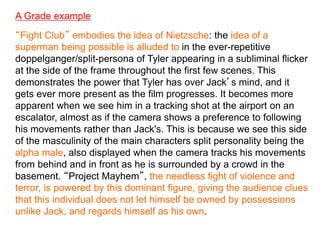
“Fight Club” embodies the idea of Nietzsche: the idea of a
superman being possible is alluded to in the ever-repetitive
doppelganger/split-persona of Tyler appearing in a subliminal flicker
at the side of the frame throughout the first few scenes. This
demonstrates the power that Tyler has over Jack’s mind, and it
gets ever more present as the film progresses. It becomes more
apparent when we see him in a tracking shot at the airport on an
escalator, almost as if the camera shows a preference to following
his movements rather than Jack's. This is because we see this side
of the masculinity of the main characters split personality being the
alpha male, also displayed when the camera tracks his movements
from behind and in front as he is surrounded by a crowd in the
basement. “Project Mayhem”, the needless fight of violence and
terror, is powered by this dominant figure, giving the audience clues
that this individual does not let himself be owned by possessions
unlike Jack, and regards himself as his own.
Objectives
• To understand critical approaches for
exam questions
• To be able to apply critical approaches to a
short sequence from ‘Fight Club’
• To demonstrate an ability to respond
correctly within written analysis.
Good luck!
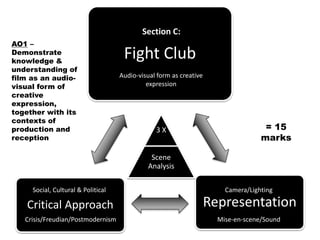
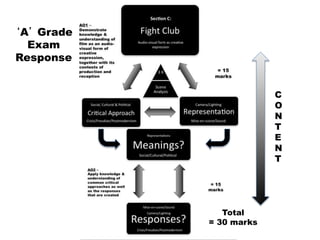
Fight Club
RepresentationCritical Approach
Audio-visual form as creative
expression
Social, Cultural & Political
Crisis/Freudian/Postmodernism
3 X
Scene
Analysis
= 15
marks
AO1 –
Demonstrate
knowledge &
understanding of
film as an audio-
visual form of
creative
expression,
together with its
contexts of
production and
reception
Camera/Lighting
Mise-en-scene/Sound
Section C:
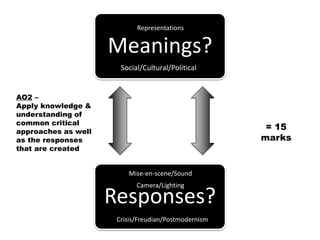
Meanings?
Responses?
Social/Cultural/Political
= 15
marks
AO2 –
Apply knowledge &
understanding of
common critical
approaches as well
as the responses
that are created
Representations
Mise-en-scene/Sound
Camera/Lighting
Crisis/Freudian/Postmodernism
‘A’ Grade
Exam
Response
C
O
N
T
E
N
T
Section B:
Total
= 30 marks

Fightclubcritapproaches

  • 2.
    Objectives • To understandhow to apply critical approaches for exam questions • To be able to apply critical approaches to a short sequence from ‘Fight Club’ • To demonstrate an ability to respond correctly within written analysis.
  • 3.
    Sample exam questionsfor Section C: ‘Fight Club’ Select one question in your pairs 17. Explore some of the ways in which placing your chosen film within a broader critical framework has helped to develop your appreciation and understanding of specific sequences. [30] 17. What does your chosen film reveal about the usefulness of one or more critical approaches you have applied? [30] 17. How useful has a particular critical approach been in gaining a deeper understanding and appreciation of your chosen film? [30] 17. In developing a response to your chosen film, how valuable did you find the application of a specific critical approach? (30)
  • 4.
    Critical Approaches • Crisisof Masculinity • Freudian • Postmodernism • Nietzchean
  • 5.
    How to approachyour exam answer for Section C: ‘Fight Club’ • Don’t explain the theory APPLY IT!!! • Don’t explain the theory APPLY IT!!! • Use your chosen Critical Approach as a framework • When discussing a scene from ‘Fight Club’ don’t be descriptive (events/actions etc contain themes & metaphors for discussion) • Respond in a personal way – what have YOU learnt – what theory has expanded YOUR understanding?
  • 6.
    Polysemy For Dick Hebdigepolysemy means that, "each text is seen to generate a potentially infinite range of meanings," making, according to Richard Middleton, "any homology, out of the most heterogeneous materials, possible. The idea of signifying practice — texts not as communicating or expressing a pre-existing meaning but as 'positioning subjects' within a process of semiosis — changes the whole basis of creating social meaning".
  • 7.
  • 8.
    Crisis of Masculinity Culturalcritics Henry Giroux and Imre Szeman describe Fight Club as a failed critique which focuses on the consumerist culture and how it shapes male identity and ignores how neoliberal capitalism has dominated and exploited society. "Fight Club has nothing substantive to say about the structural violence of unemployment, job insecurity, cuts in public spending, and the destruction of institutions capable of defending social provisions and the public good. The film is "dangerously seductive" because of how it offers through Project Mayhem "a possible vision of a collective response... however disturbing such a response might be."
  • 9.
  • 10.
    Crisis of Masculinity Narrator:[voice over] Bob. Bob had bitch tits. This was a support group for men with testicular cancer. The big moosie slobbering all over me... that was Bob. Bob: We're still men. Narrator: Yes, we're men. Men is what we are. Narrator: [voice over] Eight months ago, Bob's testicles were removed. Then hormone therapy. He developed bitch tits because his testosterone was too high and his body upped the estrogen. And that was where I fit... Bob: They're gonna have to open my pecs again to drain the fluid. Narrator: [voice over] Between those huge sweating tits that hung enormous, the way you'd think of God's as big.
  • 11.
    Crisis of Masculinity Thevision, in the form of "regressive, vicious, and obscene" politics, is presented as the only possible alternative to defeat contemporary capitalism. Fight Club is a film that "very powerfully reveals the astonishing limits of our political imagination", focusing on masculinity and centering around a "hip, stylishly violent" narrative. Critics write, "It tells us very little... about the real circumstances and causes of our discontent, which lie in a very different place than in the seeming emasculation of that social group that wields perhaps the most concentrated power the world has ever seen—urban, upper-middle class, white, male technocrats."
  • 12.
  • 13.
    Crisis of Masculinity Theprotagonist of Fight Club – ‘Jack’ – is not only a young cynic insomniac, gone numb from the extreme acceleration of capitalism, careerism and consumerism characteristic of the late 20th century. He is also a white heterosexual male. The story of Fight Club obviously has something to do with masculinity, male ideals, power or the lack of it.
  • 14.
    Crisis of Masculinity Criticsoutline three main absences in Fight Club's critique. • the film assumes that capitalism and consumerism are "impenetrable", and there cannot be resistance or struggle against them. • the film focuses instead on defending "authoritarian masculinity." The fight clubs' violence are complicit with the system of commodification that it denounces because it ties into instant gratification, heightened competitiveness, and "the market-driven desire" to dominate and win in fights. • Fight Club ascribes to a world under the philosophy of Thomas Hobbes in which cynicism replaces hope.
  • 15.
    Crisis of Masculinity Conclusions: •The narrator is alienated by dominant society and is psychologically fearful of its effects? • Tyler offers an extreme escape to prevailing cultural trends? • The narrator uses an alter-ego (Tyler) to attack and react against a society that seeks to emasculate the male? • Modern society encourages a repositioning of sexual configuration - dominance/gay/straight/bi-sexual?
  • 16.
  • 17.
    Freudian Analysis • TheId - Tyler Durden (Unconscious Desires/The 'repressed' - set free without conscience) • The Ego - The 'narrator' (The conscious/IKEA lifestyle - comfortable) • The 'real' Tyler can be found between The Id and The Ego (one half Ego & one half Id) • The Superego - Initially: 'The Self-help groups' • Then: 'The Fight Clubs' • Then: 'Project Mayhem' • The Superego will regulate 'pleasure', it will censor the Id, but will also license it. • Freud explained his famous model for brain function in the 1927 publication, The Ego and the Id. Since then, the theory has been explained with reference to a horse and chariot:
  • 18.
  • 19.
    Freudian Analysis • Theid is the "horse". It is the unevolved instinctive part of our brain, responsible for the urges and desires we try to repress. • The ego is the "driver" of the chariot, and the rational part of our brain. It is able to guide the id, but never has full control - just as the driver is aware that if the horse wants to go in a different direction, he is ultimately powerless to stop it. • The superego is the chariot driver's father, sitting behind him, pointing out his mistakes. It is the part of our brain responsible for criticism and moralising.
  • 20.
    Freudian Analysis • Id:The most primitive drive, concerned only with fulfilling pleasure. Has sometimes been referred to as the irrational and emotional part of the mind. It is often regarded as being selfish, because it’s concerned only with its own self-satisfaction. Babies and young children are often used as examples because they’re usually driven by the pleasure and instant gratification principles. Key word: want
  • 21.
    Freudian Analysis • Ego:Based on the reality principle. The ego is capable of understanding that one’s own desires may vary for people around (reality), and is willing to make this consideration. The ego tries to meet the basic needs of the id but also takes into account the real world. The ego understands that actions have effects, whether positive or negative, and tries to balance out thinking before carrying out decisions/actions. Key word: balance
  • 22.
    Freudian Analysis • Superego:Based on moral principles instilled by rearing and moral/ethical restraints placed upon by caregivers. The superego encompasses an individual’s ideals, goals, and conscience as well as society’s. The superego is concerned with what others will think, and stands in opposition to the id. The superego acts to perfect and civilise our behaviour. Key words: morals, compromise
  • 23.
  • 24.
    Freudian Analysis Conclusions: • Freudiananalysis can explain who Tyler really is • Tyler represents the narrators’ inner desire or want • The narrator is unaware of who Tyler is until he begins to reconnect with his place in society and regain conscious control. • The film explores the relationship between the 3 components of ‘the self’ – Id/Ego/Superego
  • 25.
  • 26.
    Postmodernism Postmodernism is asocial and cultural concept that has dominated contemporary theory since the 1950’s. It has been widely used in film theory as a critical perspective that allows debate concerning social shifts in contemporary life and artistic practices in the wake of the decline of modernism.
  • 27.
    Postmodernism Characteristics of apostmodern text seen within ‘Fight Club’: Intertextuality – the referencing of other cultural texts; either visually or verbally within the content of the text Hybridity - the mixing and/or recycling of pre-existing genres and narratives to construct new forms or a ‘hybrid’ Simulation - a lack of any sense of reality to the real world Surface – a text that is more concerned with the superficial and/or devoid of any depth of meaning Pastiche – paying ‘homage’ to older texts Bricolage - the collection of disparate or differing objects to help explain the nature of the prevailing culture and society Irony – playfulness with the style, form and/or content of a text
  • 28.
    Postmodernism “We live ina world where there is more and more information, and less and less meaning.” ― Jean Baudrillard, Simulacra and Simulation “Americans may have no identity, but they do have wonderful teeth.” ― Jean Baudrillard “Postmodernity is said to be a culture of fragmentary sensations, eclectic nostalgia, disposable simulacra, and promiscuous superficiality, in which the traditionally valued qualities of depth, coherence, meaning, originality, and authenticity are evacuated or dissolved amid the random swirl of empty signals.” ― Jean Baudrillard
  • 29.
  • 30.
  • 31.
    Postmodernism ‘Fight Club’ (1999)David Fincher Assassination of Jean-Paul Marat
  • 32.
  • 33.
    Postmodernism Conclusions: • The filmmakes constant intertextual references to other films. • The narrative has no dominant reading – it could therefore be seen as superficial. • The film can be seen as a hybrid – noir/drama/thriller? • ‘Fight Club’ is playful & ironic – it allows the audience to make meaning (if they recognise the references).
  • 34.
  • 35.
    Nietzsche Friedrich Nietzsche &the concept of ‘The Superman’ Friedrich Nietzsche (1844–1900) was a German philosopher of the late 19th century who challenged the foundations of Christianity and traditional morality. He was interested in the enhancement of individual and cultural health, and believed in life, creativity, power, and the realities of the world we live in, rather than those situated in a world beyond.
  • 36.
  • 37.
    Nietzsche Friedrich Nietzsche &the concept of ‘The Superman’ Central to his philosophy is the idea of “life-affirmation,” which involves an honest questioning of all doctrines that drain life's expansive energies, however socially prevalent those views might be. Often referred to as one of the first existentialist philosophers he developed the concept of ‘the superman’ and nihilism as a mode of existence. Nietzsche's revitalising philosophy has inspired leading figures in all walks of cultural life.
  • 38.
    Nietzsche • Useful quotes:(Apply these quotes to events within the narrative of ‘Fight Club’. They will deepen your understanding of a Nietzschean philosophical perspective) • Battle not with monsters, lest ye become a monster, and if you gaze into the abyss, the abyss gazes also into you. • Be careful when you fight the monsters, lest you become one. • Insanity in individuals is something rare - but in groups, parties, nations and epochs, it is the rule. • Man is the cruellest animal. • No price is too high to pay for the privilege of owning yourself. • Talking much about oneself can also be a means to conceal oneself.
  • 39.
  • 40.
    Nietzsche • Useful quotes:(Apply these quotes to events within the narrative of ‘Fight Club’. They will deepen your understanding of a Nietzschean philosophical perspective) • The individual has always had to struggle to keep from being overwhelmed by the tribe. If you try it, you will be lonely often, and sometimes frightened. But no price is too high to pay for the privilege of owning yourself. • The visionary lies to himself, the liar only to others. • When you stare into the abyss the abyss stares back at you. • You need chaos in your soul to give birth to a dancing star. • There is always some madness in love. But there is also always some reason in madness.
  • 41.
    Nietzsche • Useful quotes:(Apply these quotes to events within the narrative of ‘Fight Club’. They will deepen your understanding of a Nietzschean philosophical perspective) • He who fights with monsters might take care lest he thereby become a monster. And if you gaze for long into an abyss, the abyss gazes also into you. • What is done out of love always takes place beyond good and evil. • Become what you are • God is dead.
  • 42.
    Nietzschean Conclusions: • The filmsnarrative can be viewed as self-destructive or nihilistic. • Tyler can be viewed as embodying Nietzche’s concept of the ‘superman’. • The film attacks the idea of men as slaves. • Existentialism is presented as a meaningful way to live life – chaos is fundamental.
  • 43.
    General Questions 17. Howuseful has a particular critical approach been in gaining a deeper understanding and appreciation of your chosen film? [30] • An excellent, detailed and sophisticated knowledge and understanding of the chosen film. • A sound understanding of a critical approach, together with an appreciation of its value in opening up a film for critical analysis and debate. • An ability to apply the critical approach in very specific ways to the chosen film, in the process demonstrating its usefulness and productivity through telling observations about the film. • (The very best candidates) may be more circumspect about the application of the critical approach or, in a comparative study, discuss how one critical approach was more / less useful than another.
  • 44.
    • A gradecandidates will be distinguished by a very good knowledge and confident understanding of their chosen films and topic. Points of view will be developed very effectively with appropriate specialist language a feature of all film references. • Quality of written communication will be very good.It will be fluent, well- structured and accurate, showing signs of sophistication.
  • 45.
    Specific Questions 26. 'Marlais at the root of it,' says Jack in Fight Club. Discuss what this statement reveals about the film as a whole.[30] • An excellent, detailed and sophisticated knowledge and understanding of Fight Club • Specific knowledge and appreciation of the representation of Marla – and of the context within which Jack makes the comment quoted in the question • An ability to develop an effective discussion in response to the question making use of the above, moving from the particular to the general, particularly engaging with questions of gender and misogyny. • (The very best candidates) may wish to offer a complex argument in favour of the film by arguing that Jack’s comment, like much of the film is satirical, a double bluff.
  • 46.
    A Grade example “FightClub” embodies the idea of Nietzsche: the idea of a superman being possible is alluded to in the ever-repetitive doppelganger/split-persona of Tyler appearing in a subliminal flicker at the side of the frame throughout the first few scenes. This demonstrates the power that Tyler has over Jack’s mind, and it gets ever more present as the film progresses. It becomes more apparent when we see him in a tracking shot at the airport on an escalator, almost as if the camera shows a preference to following his movements rather than Jack's. This is because we see this side of the masculinity of the main characters split personality being the alpha male, also displayed when the camera tracks his movements from behind and in front as he is surrounded by a crowd in the basement. “Project Mayhem”, the needless fight of violence and terror, is powered by this dominant figure, giving the audience clues that this individual does not let himself be owned by possessions unlike Jack, and regards himself as his own.
  • 47.
    Objectives • To understandcritical approaches for exam questions • To be able to apply critical approaches to a short sequence from ‘Fight Club’ • To demonstrate an ability to respond correctly within written analysis.
  • 48.
  • 49.
    Fight Club RepresentationCritical Approach Audio-visualform as creative expression Social, Cultural & Political Crisis/Freudian/Postmodernism 3 X Scene Analysis = 15 marks AO1 – Demonstrate knowledge & understanding of film as an audio- visual form of creative expression, together with its contexts of production and reception Camera/Lighting Mise-en-scene/Sound Section C:
  • 50.
    Meanings? Responses? Social/Cultural/Political = 15 marks AO2 – Applyknowledge & understanding of common critical approaches as well as the responses that are created Representations Mise-en-scene/Sound Camera/Lighting Crisis/Freudian/Postmodernism
  • 51.