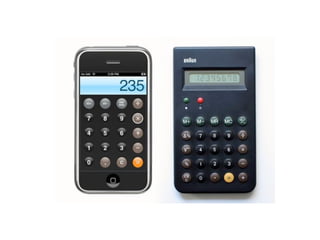
Skeuomorphs in interaction
design: nostalgic ornament
     or affordance ?
      Nicolas Nova | HEAD-Genève
        Sept. 14, 2012 | Unige
[iPhone app camera shutter sound]
Methodology


Series of interview with interface designers

Content analysis of formal (manual) and informal
knowledge (forum discussions, blogposts)

In order to highlight a series of tensions/
contrasted perspectives
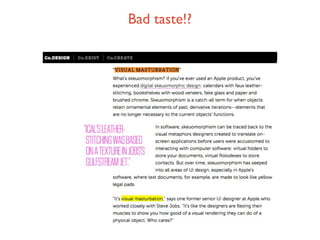
Bad taste!?
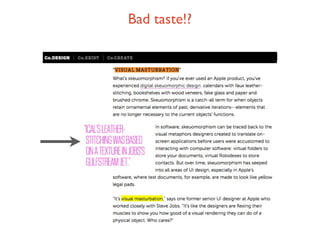
Bad taste!?
Useless


“Icons on a computer are the way they are
because they're a good way to represent the
concept of a block of bytes on the disc, a
concept that many users do not want to have to
engage with. But a calendar is an abstract
concept that people already have an accurate
mental model of, and therefore it doesn't have to
look any particular way at all, especially now that
we're just using a bunch of pixels to do the
presentation.”
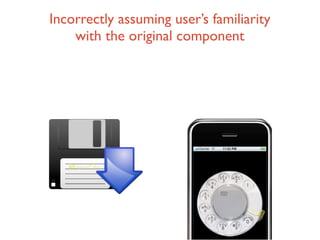
Incorrectly assuming user’s familiarity
    with the original component
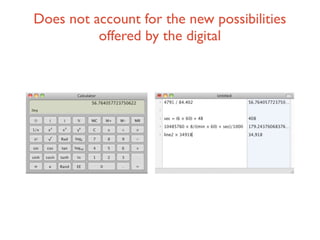
Does not account for the new possibilities
          offered by the digital
Misplaced nostalgia?


“They     attempt     to    comfort     us
(to patronise us) by trying to show how
they relate to physical objects in the real
world when there is no need. How are we
helped to understand what ‘Find My
Friends’ does by the addition of leather
trim?“
BUT
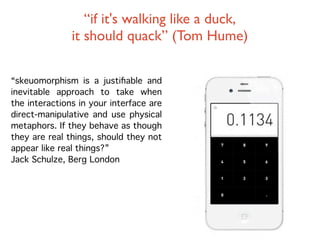
“if it's walking like a duck,
               it should quack” (Tom Hume)

“skeuomorphism is a justifiable and
inevitable approach to take when
the interactions in your interface are
direct-manipulative and use physical
metaphors. If they behave as though
they are real things, should they not
appear like real things?”
Jack Schulze, Berg London
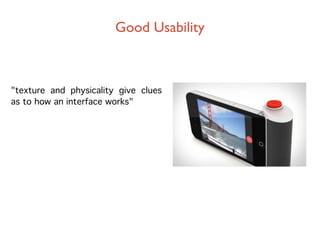
Good Usability


"texture and physicality give clues
as to how an interface works"
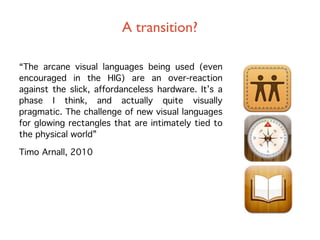
A transition?

“The arcane visual languages being used (even
encouraged in the HIG) are an over-reaction
against the slick, affordanceless hardware. It’s a
phase I think, and actually quite visually
pragmatic. The challenge of new visual languages
for glowing rectangles that are intimately tied to
the physical world”

Timo Arnall, 2010
conclusion


Contrasted perspective, skeuomorphs can be pertinent

   Different user targets, different design strategies

Implicitly: the importance of physical objects in order to
                  create digital interfaces
Thank you          Quote sources
nicolas@hesge.ch
                   http://www.tomhume.org/2012/03/if-its-walking-like-a-duck-it-should-quack.html
                   http://speedbird.wordpress.com/2010/06/25/what-apple-needs-to-do-now/
                   http://www.interaksyon.com/infotech/the-hardest-button-to-button-thoughts-on-interface-design
@nicolasnova       http://www.techiestuffs.com/blog/can-skeuomorphs-be-used-to-enhance-web-page-appearance/
                   http://alexandtheweb.com/blatherings/post.php?s=2012-03-24-skeuomorphic-interfaces-and-something-
                   about-early-renaissance-painting

Skeuomorphs in interaction design: ornament or affordance?

  • 1.
    Skeuomorphs in interaction design:nostalgic ornament or affordance ? Nicolas Nova | HEAD-Genève Sept. 14, 2012 | Unige
  • 5.
    [iPhone app camerashutter sound]
  • 10.
    Methodology Series of interviewwith interface designers Content analysis of formal (manual) and informal knowledge (forum discussions, blogposts) In order to highlight a series of tensions/ contrasted perspectives
  • 11.
  • 12.
  • 13.
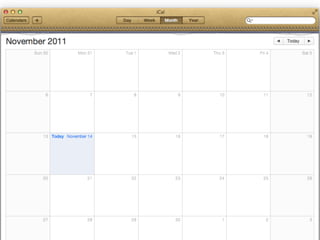
    Useless “Icons on acomputer are the way they are because they're a good way to represent the concept of a block of bytes on the disc, a concept that many users do not want to have to engage with. But a calendar is an abstract concept that people already have an accurate mental model of, and therefore it doesn't have to look any particular way at all, especially now that we're just using a bunch of pixels to do the presentation.”
  • 14.
    Incorrectly assuming user’sfamiliarity with the original component
  • 15.
    Does not accountfor the new possibilities offered by the digital
  • 16.
    Misplaced nostalgia? “They attempt to comfort us (to patronise us) by trying to show how they relate to physical objects in the real world when there is no need. How are we helped to understand what ‘Find My Friends’ does by the addition of leather trim?“
  • 17.
  • 18.
    “if it's walkinglike a duck, it should quack” (Tom Hume) “skeuomorphism is a justifiable and inevitable approach to take when the interactions in your interface are direct-manipulative and use physical metaphors. If they behave as though they are real things, should they not appear like real things?” Jack Schulze, Berg London
  • 19.
    Good Usability "texture andphysicality give clues as to how an interface works"
  • 20.
    A transition? “The arcanevisual languages being used (even encouraged in the HIG) are an over-reaction against the slick, affordanceless hardware. It’s a phase I think, and actually quite visually pragmatic. The challenge of new visual languages for glowing rectangles that are intimately tied to the physical world” Timo Arnall, 2010
  • 21.
    conclusion Contrasted perspective, skeuomorphscan be pertinent Different user targets, different design strategies Implicitly: the importance of physical objects in order to create digital interfaces
  • 22.
    Thank you Quote sources nicolas@hesge.ch http://www.tomhume.org/2012/03/if-its-walking-like-a-duck-it-should-quack.html http://speedbird.wordpress.com/2010/06/25/what-apple-needs-to-do-now/ http://www.interaksyon.com/infotech/the-hardest-button-to-button-thoughts-on-interface-design @nicolasnova http://www.techiestuffs.com/blog/can-skeuomorphs-be-used-to-enhance-web-page-appearance/ http://alexandtheweb.com/blatherings/post.php?s=2012-03-24-skeuomorphic-interfaces-and-something- about-early-renaissance-painting

Editor's Notes

  • #2 \n
  • #3 Coming from archaelogy, the notion of « skeuomorph » can be described as a feature of a current object inherited from some precursor artefact (Basalla, 1988). As described by Hayles (1999), this design feature « is no longer functional in itself but that refers back to a feature that was functional at an earlier time ». Skeuomorphs are often employed by designers as familiar cues to make a new object more accessible to the users.\n
  • #4 \n
  • #5 Semi-spherical keys on the iPhone are reminiscent of the Braun ET calculator: they are meant to stimulate the look of a rounded 3D button, to reassure the user\n
  • #6 Sound skeuomorph\n\n
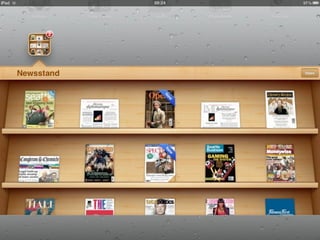
  • #7 Another example of Skeuomorph\n
  • #8 Backlash...\n
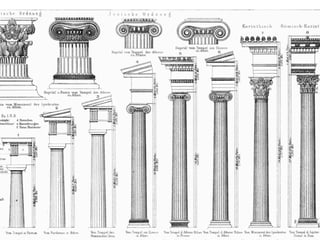
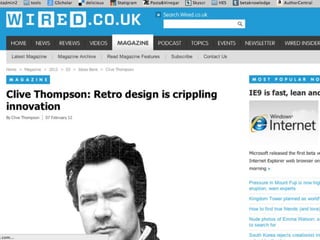
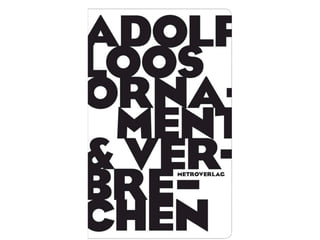
  • #9 Interestingly, this disgust is not new...\nOne way to look at it can be to compare what is similar and what’s new\nBut this is not where I am going...\n
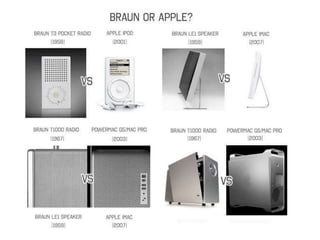
  • #10 Another surprising aspect = is that the company who was quite keen on minimalistic design... is now at the forefront of skeuomorphism...\nThis means that it’s an interesting research object, there must be curious tensions at stake here, controversies in the design process\n
  • #11 Which is why I conducted a series of interview with interaction designers + literature review of designer’s practice... in order to highlight these tensions and contradictions\n\n
  • #12 Source: Co.DESIGN\n
  • #13 Source: James Higgs: http://madebymany.com/blog/apples-aesthetic-dichotomy\n
  • #14 \n
  • #15 “Nearly everything about a real calculator is faithfully reproduced, but with the good comes the bad: nearly every limitation and frustration has also been reproduced. There’s very little reason to use the software facsimile over its real-world equivalent, and in some ways, the physical object is better. My preferred calculator [Soulver], which I will keep blogging about until it’s ubiquitous, wasn’t designed against any physical objects because there’s no physical equivalent to what it does.” Marco Arment\n
  • #16 Source: James Higgs: http://madebymany.com/blog/apples-aesthetic-dichotomy\n
  • #17 \n
  • #18 \n
  • #19 Source: Tom Hume: http://www.tomhume.org/2012/03/if-its-walking-like-a-duck-it-should-quack.html\n
  • #20 Source: Timo Arnall, in a comment to http://speedbird.wordpress.com/2010/06/25/what-apple-needs-to-do-now/\n
  • #21 \n
  • #22 \n