Saint Martin Academy, Inc.
Dumalag, Capiz
A.Y. 2023 – 2024
Flexible Instruction Delivery Plan
Grade: 11 Semester: 1ST
SEMESTER
Core Subject Title: General Mathematics No of hours/semester: 80 HOURS
Prerequisites (if needed)
Core Subject Description:
At the end of the course, the students must know how to solve problems involving rational, exponential and logarithmic functions; to solve business-related
problems; and to apply logic to real-life situations.
Culminating Performance
Standard:
The learners are able to apply their knowledge of Functions, Business Mathematics, and Logic in dealing with the intricacies of mathematical and scientific
concepts in higher education, entrepreneurial demands, middle-level skills development, and employment through the use of their critical and analytical
thinking skills and appropriate mathematical and financial tools to make sound and justifiable decisions.
What to Teach? Why Teach? How to Assess? What to Teach?
Content
Content
Standards
Most
Essential
Topics
Performance
Standards
Learning competencies Highest Thinking Skill to Assess
Highest Enabling Strategy to Use
in developing the Highest
Thinking Skill to Assess
Complete
KUD
Classification
Most Essential
KUD
Classificatio
n RBT Level
Flexible Assessment
Activities (FAA)
Enabling
General
Strategy
Flexible
Learning
Strategies
(FLS)
Performance Checks
Quarter 1
Functions
and Their
Graphs
The learner
demonstrates
understanding
of key concepts
of functions.
Modelling
Functions
The learner is
able to
accurately
construct
mathematical
models to
represent
real-life
situations
using
Represents
real-life
situations using
functions,
including piece-
wise functions.
Knowing
Represents real-
life situations
using functions,
including piece-
wise functions.
Knowing
Understandi
ng
Routine exercise on
representing situations
using functions, including
piece-wise functions Representation
 Self-
Regulated
Learning
Through
Provided
Learning
Module
 Learner’s
Evaluates a
function.
Understandi
ng
Evaluates a
function.
Understandi
ng
Evaluation
Routine exercise on
evaluating a function.
Reasoning and
Proof
Performs
addition,
Understan
ding
Performs
addition,
Understandi
ng
Evaluating
Routine exercise on
performing addition,
Reasoning and
Proof
functions subtraction,
multiplication,
division, and
composition of
function.
subtraction,
multiplication,
division, and
composition of
function.
subtraction,
multiplication, division,
and composition of
function.
Self-
Assessme
nt
 Reflection
Journal
 Explorator
y
 Technolog
y
Integratio
n
Solves
problems
involving
functions.
Doing
Solves problems
involving
functions.
Doing Creating
 Solving real-life
problems involving
functions.
 The learner will
create a real-life
problem involving
functions and then
show step-by-step
solution.
Problem
Solving
The learner
demonstrates
understanding
of key concepts
of rational
functions.
Rational
Functions
The learner is
able to
accurately
formulate and
solve real-life
problems
involving
rational
functions.
Represents
real-life
situations using
rational
functions.
Knowing
Represents real-
life situations
using rational
functions.
Knowing
Understandi
ng
Routine exercise on
representing real-life
situations using rational
functions.
Representation
Distinguishes
rational
function,
rational
equation, and
rational
inequality.
Understandi
ng
Distinguishes
rational
function,
rational
equation, and
rational
inequality.
Understandi
ng
Analysis
Classifying the given as
rational function, rational
equation, or rational
inequality
Communicatio
n
Solves rational
equations and
inequalities.
Doing
Solves rational
equations and
inequalities.
Doing Creating
Solving rational equations
and inequalities.
Problem
Represents a
rational
function
through its: (a)
table of values,
(b) graph, and
(c) equation.
Knowing
Represents a
rational function
through its: (a)
table of values,
(b) graph, and
(c) equation.
Knowing
Understandi
ng
Routine exercise on
representing a rational
function through its: (a)
table of values, (b) graph,
and (c) equation.
Representation
Finds the
domain and
range of a
rational
function.
Knowing
Finds the
domain and
range of a
rational
function.
Knowing
Understandi
ng
Routine exercise on
finding the domain and
range of a rational
function.
Representation
Determines
the:
Knowing
Determines the:
(a) intercepts
Knowing
Understandi
ng
Routine exercise on
determining the:
Representation
(a) intercepts
(b) zeroes; and
(c) asymptotes
of rational
functions
(b) zeroes; and
(c) asymptotes
of rational
functions
(a) intercepts
(b) zeroes; and
(c) asymptotes of rational
functions
Solves
problems
involving
rational
functions,
equations, and
inequalities.
Doing
Solves problems
involving
rational
functions,
equations, and
inequalities.
Doing Creating
 Solving real-life
problems involving
rational functions,
equations, and
inequalities.
 The learning will
create real-life
problem involving
rational function,
equation or inequality
and then show their
step-by-step solution
Problem
Solving
The learner
demonstrates
understanding
of key concepts
of inverse
functions,
exponential
functions, and
logarithmic
functions.
Inverse
and
Logarithm
ic
Functions
The learner is
able to apply
the concepts
of inverse
functions,
exponential
functions, and
logarithmic
functions to
formulate and
solve real-life
problems with
precision and
accuracy.
Represents
real-life
situations using
one-to one
functions.
Knowing
Represents real-
life situations
using one-to one
functions.
Knowing
Understandi
ng
Routine activity on
representing real-life
situations using one-to
one functions.
Representation
Determines the
inverse of a
one-to-one
function.
Knowing
Determines the
inverse of a one-
to-one function.
Knowing
Understandi
ng
Routine exercise on
determining the inverse of
a one-to-one function.
Representation
Represents an
inverse
function
through its: (a)
table of values,
and (b) graph
Knowing
Represents an
inverse function
through its: (a)
table of values,
and (b) graph
Knowing
Understandi
ng
Routine exercise on
representing an inverse
function through its: (a)
table of values, and (b)
graph
Representation
Finds the
domain and
range of an
inverse
function
Knowing
Finds the
domain and
range of an
inverse function
Knowing
Understandi
ng
Routine exercise on
finding the domain and
range of an inverse
function
Representation
Solves
problems
involving
inverse
functions
Doing
Solves problems
involving inverse
functions
Doing Creating
Solving problems
involving inverse
functions
Problem
Solving
Represents Knowing Represents real- Knowing Understandi Routine exercise on Representation
real-life
situations using
exponential
functions
life situations
using
exponential
functions
ng
representing real-life
situations using
exponential functions
Distinguishes
between
exponential
function,
exponential
equation, and
exponential
inequality
Understandi
ng
Distinguishes
between
exponential
function,
exponential
equation, and
exponential
inequality
Understandi
ng
Analysis
Classifying the given
exponential expression as
exponential function,
exponential equation, and
exponential inequality
Communicatio
n
Solves
exponential
equations and
inequalities.
Doing
Solves
exponential
equations and
inequalities.
Doing Creating
Solving exponential
equations and
inequalities.
Problem
Solving
Represents an
exponential
function
through its: (a)
table of values,
(b) graph, and
(c) equation.
Knowing
Represents an
exponential
function
through its: (a)
table of values,
(b) graph, and
(c) equation.
Knowing
Understandi
ng
Routine exercise on
representing an
exponential function
through its: (a) table of
values, (b) graph, and (c)
equation.
Representation
Finds the
domain and
range of an
exponential
function
Knowing
Finds the
domain and
range of an
exponential
function
Knowing
Understandi
ng
Routine exercise on
finding the domain and
range of an exponential
function
Representation
Determines the
intercepts,
zeroes, and
asymptotes of
an exponential
function
Knowing
Determines the
intercepts,
zeroes, and
asymptotes of
an exponential
function
Knowing
Understandi
ng
Routine exercise on
determining the
intercepts, zeroes, and
asymptotes of an
exponential function
Representation
Graphs
exponential
functions
Doing
Solves
problems
involving
exponential
functions,
equations, and
Doing Solves problems
involving
exponential
functions,
equations, and
inequalities
Doing Creating  Solving problems
involving exponential
functions, equations,
and inequalities
 The learner will
create real-life
Problem
inequalities
problem involving
exponential function,
equation or inequality
and then show their
step-by-step solution.
Represents
real-life
situations using
logarithmic
functions
Knowing
Represents real-
life situations
using
logarithmic
functions
Knowing
Understandi
ng
Representing real-life
situations using
logarithmic functions
Representation
Distinguishes
logarithmic
function,
logarithmic
equation, and
logarithmic
inequality.
Knowing
Distinguishes
logarithmic
function,
logarithmic
equation, and
logarithmic
inequality.
Knowing
Understandi
ng
Classifying the given
logarithmic expression as
logarithmic function,
logarithmic equation, and
logarithmic inequality.
Representation
Illustrates the
laws of
logarithms
Knowing
Solves
logarithmic
equations and
inequalities
Doing
Solves
logarithmic
equations and
inequalities
Doing Creating
Solving logarithmic
equations and inequalities
Problem
Solving
Represents a
logarithmic
function
through its: (a)
table of values,
(b) graph, and
(c) equation
Knowing
Represents a
logarithmic
function
through its: (a)
table of values,
(b) graph, and
(c) equation
Knowing
Understandi
ng
Representing a
logarithmic function
through its: (a) table of
values, (b) graph, and (c)
equation
Representation
Finds the
domain and
range of a
logarithmic
function.
Knowing
Finds the
domain and
range of a
logarithmic
function.
Knowing
Understandi
ng
Finding the domain and
range of a logarithmic
function.
Representation
Determines the
intercepts,
zeroes, and
asymptotes of
logarithmic
functions.
Knowing
Determines the
intercepts,
zeroes, and
asymptotes of
logarithmic
functions.
Knowing
Understandi
ng
Determining the
intercepts, zeroes, and
asymptotes of logarithmic
functions.
Representation
Solves Doing Solves problems Doing Creating  Solving problems Problem
problems
involving
logarithmic
functions,
equations, and
inequalities.
involving
logarithmic
functions,
equations, and
inequalities.
involving logarithmic
functions, equations,
and inequalities.
 The learner will
create real-life
problem involving
logarithmic function,
equation or inequality
and then show their
step-by-step solution.
Solving
Quarter 2
Basic
Business
Mathemati
cs
The learner
demonstrates
understanding
of key concepts
of simple
and compound
interests,
and simple and
general
annuities.
Interests
and
Annuities
The learner is
able to
investigate,
analyze and
solve
problems
involving
simple and
compound
interests and
simple and
general
annuities
using
appropriate
business and
financial
instruments.
Illustrates
simple and
compound
interests.
Knowing
Illustrates
simple and
compound
interests.
Knowing
Understandi
ng
Routine exercise on
illustrating simple and
compound interests.
Representation
 Self-
Regulated
Learning
Through
Provided
Learning
Module
 Learner’s
Self-
Assessme
nt
 Reflection
Journal
 Explorato
ry
 Technolog
y
Integratio
n
Distinguishes
between
simple and
compound
interests.
Knowing
Distinguishes
between simple
and compound
interests.
Knowing
Understandi
ng
Determining whether the
given problem represents
simple or compound
interest.
Representation
Computes
interest,
maturity value,
future value,
and present
value in simple
interest and
compound
interest
environment.
Understandi
ng
Computes
interest,
maturity value,
future value,
and present
value in simple
interest and
compound
interest
environment.
Understandi
ng
Application
Table Completion by
computing interest,
maturity value, future
value, and/or present
value in simple interest
and compound interest
environment.
Connection
Solves
problems
involving
simple and
compound
interests.
Doing
Solves problems
involving simple
and compound
interests.
Doing Creating
 Solving problems
involving simple and
compound interests.
 Creating real-life
problem involving
simple and
compound interest
Problem
Solving
Illustrates
simple and
general
annuities.
Knowing
Illustrates
simple and
general
annuities.
Knowing
Understandi
ng
Routine exercise on
illustrating simple and
general annuities.
Representation
Distinguishes Knowing Distinguishes Knowing Understandi Identifying whether the Representation
between
simple and
general
annuities.
between simple
and general
annuities.
ng
given problem represents
simple or general
annuities.
Finds the
future value
and present
value of both
simple
annuities and
general
annuities.
Knowing
Finds the future
value and
present value of
both simple
annuities and
general
annuities.
Knowing
Understandi
ng
Table Completion by
finding the future value
and present value of both
simple annuities and
general annuities.
Representation
Finds the
future value
and present
value of both
simple
annuities and
General
annuities.
Knowing
Finds the future
value and
present value of
both simple
annuities and
General
annuities.
Knowing
Understandi
ng
Finding the future value
and present value of both
simple annuities and
General annuities.
Representation
calculates the
fair market
value of a cash
flow stream
that includes
an annuity
Understandi
ng
calculates the
fair market
value of a cash
flow stream that
includes an
annuity
Understandi
ng
Application
Calculating the fair market
value of a cash flow
stream that includes an
annuity
Connection
Calculates the
present value
and period of
deferral of a
deferred
annuity.
Understandi
ng
Calculates the
present value
and period of
deferral of a
deferred
annuity.
Understandi
ng
Application
Routine problems on
calculating the present
value and period of
deferral of a deferred
annuity.
Connection
The learner is
able to
demonstrate
understanding
basic concepts
of stocks
and bonds.
Stocks
and
Bonds
The learner is
able to use
appropriate
financial
instruments
involving
stocks and
bonds in
formulating
conclusions
Illustrates
stocks and
bonds
Knowing
Illustrate stocks
and bonds
Knowing
Understandi
ng
Routine Exercise in
illustrating stocks and
bonds
Representation
Distinguishes
between
stocks and
bonds
Knowing Distinguishes
between stocks
and bonds
Knowing Rememberin
g
Determining whether the
given problem represents
stock or bond
Representation
and making
decisions.
Describes the
different
markets for
stocks and
bonds
Understandi
ng
Describes the
different
markets for
stocks and
bonds
Understandi
ng
Analyzing
Journal writing on
describing the different
markets for stocks and
bonds
Communicatio
n
Analyzes the
different
market indices
for stocks and
bonds
Understandi
ng
Analyzes the
different market
indices for
stocks and
bonds
Understandi
ng
Analyzing
Routine exercises on
analyzing the different
market indices for stocks
and bonds
Communicatio
n
Interprets the
theory of
efficient
markets
Knowing
Logic The learner
demonstrates
understanding
of key concepts
of propositional
logic; syllogisms
and fallacies.
Introducti
on to
Logic
The learner is
able to
judiciously
apply logic
in real-life
arguments
Illustrates a
proposition
Knowing
Symbolizes
propositions
Understandi
ng
Illustrates and
symbolizes
propositions.
Knowing
Understandi
ng
Routine exercise on
illustrating and symbolizes
propositions.
Representation
Distinguishes
between
simple and
compound
propositions
Understandi
ng
Distinguishes
between simple
and compound
propositions
Knowing
Understandi
ng
Determining whether the
given proposition is a
simple or compound
proposition
Representation
Performs the
different types
of operations
on
propositions
Evaluating
performs the
different types
of operations on
propositions
Understandi
ng
Evaluating
Performing the different
types of operations on
propositions
Reasoning and
Proof
Determines the
truth values of
propositions
Analysis
determines the
truth values of
propositions
Understandi
ng
Analysis
Situational Analysis:
Learners will determining
the truth values of
proposition by trying to
understand the given
situation and apply the
concepts using truth table
Communicatio
n
Illustrates the
different forms
of conditional
Understandi
ng
illustrates the
different forms
of conditional
propositions
Knowing Understandi
ng
Routine exercise on
illustrating the different
forms of conditional
propositions
Represenatatio
n
propositions
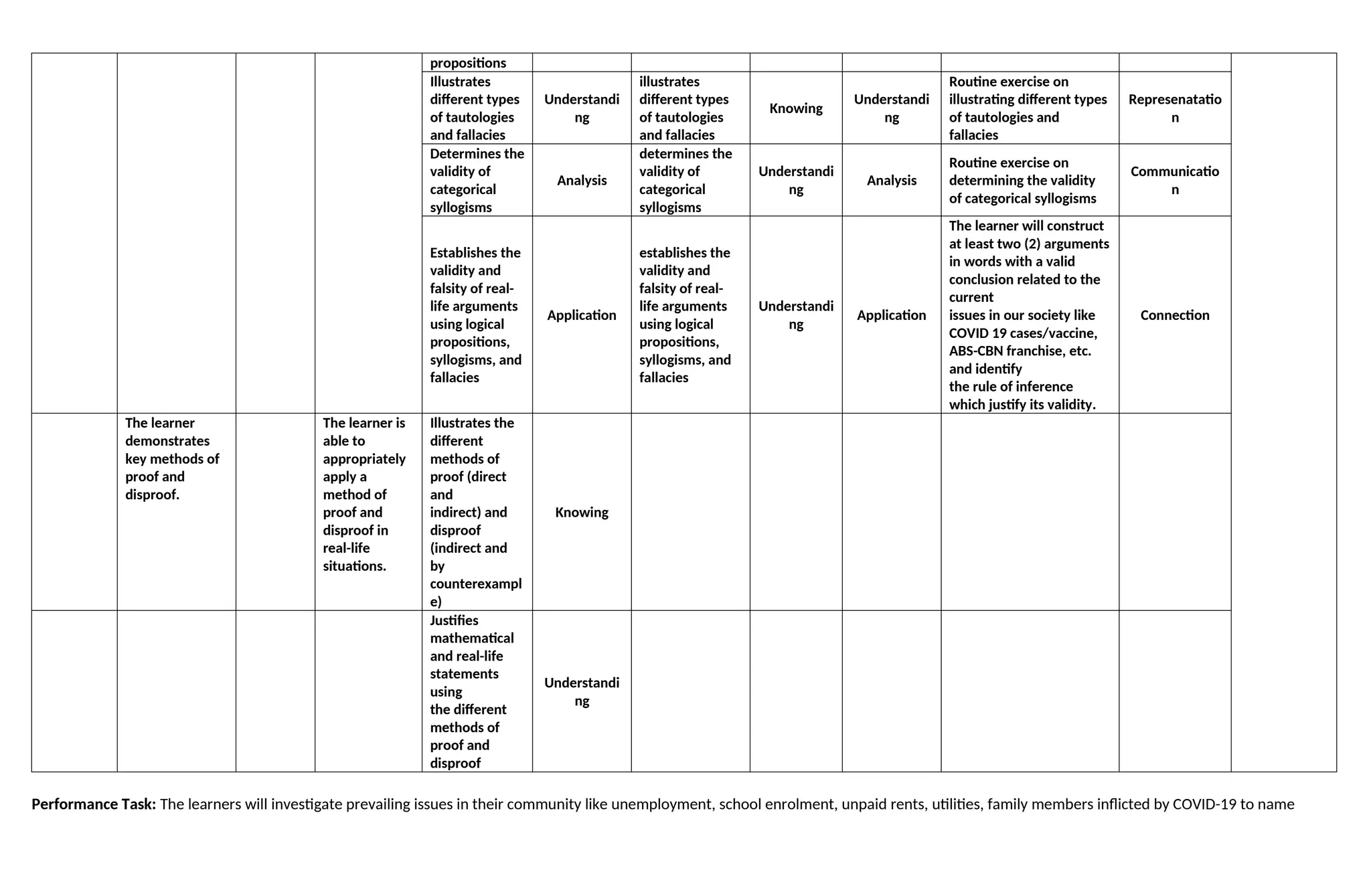
Illustrates
different types
of tautologies
and fallacies
Understandi
ng
illustrates
different types
of tautologies
and fallacies
Knowing
Understandi
ng
Routine exercise on
illustrating different types
of tautologies and
fallacies
Represenatatio
n
Determines the
validity of
categorical
syllogisms
Analysis
determines the
validity of
categorical
syllogisms
Understandi
ng
Analysis
Routine exercise on
determining the validity
of categorical syllogisms
Communicatio
n
Establishes the
validity and
falsity of real-
life arguments
using logical
propositions,
syllogisms, and
fallacies
Application
establishes the
validity and
falsity of real-
life arguments
using logical
propositions,
syllogisms, and
fallacies
Understandi
ng
Application
The learner will construct
at least two (2) arguments
in words with a valid
conclusion related to the
current
issues in our society like
COVID 19 cases/vaccine,
ABS-CBN franchise, etc.
and identify
the rule of inference
which justify its validity.
Connection
The learner
demonstrates
key methods of
proof and
disproof.
The learner is
able to
appropriately
apply a
method of
proof and
disproof in
real-life
situations.
Illustrates the
different
methods of
proof (direct
and
indirect) and
disproof
(indirect and
by
counterexampl
e)
Knowing
Justifies
mathematical
and real-life
statements
using
the different
methods of
proof and
disproof
Understandi
ng
Performance Task: The learners will investigate prevailing issues in their community like unemployment, school enrolment, unpaid rents, utilities, family members inflicted by COVID-19 to name
a few. Then, they will conduct a webinar to educate their constituents. Specifically, the students will find connection on these prevailing issues to concepts of borrowing and
investing. These will involve the application of the learners’ analytical and critical thinking skills and teamwork in strategizing how to arrive at logical solutions using available
technologies. Moreover, their solutions to the issues utilize concepts in Functions, Business Mathematics, and Logic. As financial analysts you are to present bank products, or
loan schemes of government agencies (SSS, GSIS, Pag Ibig) and other private financial institutions. It will also include requirements for loan applications, loan processing, investing
in stocks. With this, students will help the community members to make decisions on the products that best suit their lifestyle. The following are the specific outputs that are
needed from the learners:
On a separate Word file:
A finance-related problem
Profile of the different loan structures
On a separate PPT
A presentation version of the whole report. The report will be evaluated according to the following criteria:
Mathematical Content (45%), Persuasive Delivery (30%), and Creativity and Novelty (15%). Teamwork, Planning and Organization (10%)
Prepared by: Checked by: Approved by:
MS. JEZA F. FEOLA MS. MARIA MELISA V. FAGTANAC SR. MA. AGNES B. PINUELA, OP
Subject Teacher Academic Coordinator Principal

FIDP- GenMath.docxjsisisjsjsjsjsjdjdjejeuek mo

  • 1.
    Saint Martin Academy,Inc. Dumalag, Capiz A.Y. 2023 – 2024 Flexible Instruction Delivery Plan Grade: 11 Semester: 1ST SEMESTER Core Subject Title: General Mathematics No of hours/semester: 80 HOURS Prerequisites (if needed) Core Subject Description: At the end of the course, the students must know how to solve problems involving rational, exponential and logarithmic functions; to solve business-related problems; and to apply logic to real-life situations. Culminating Performance Standard: The learners are able to apply their knowledge of Functions, Business Mathematics, and Logic in dealing with the intricacies of mathematical and scientific concepts in higher education, entrepreneurial demands, middle-level skills development, and employment through the use of their critical and analytical thinking skills and appropriate mathematical and financial tools to make sound and justifiable decisions. What to Teach? Why Teach? How to Assess? What to Teach? Content Content Standards Most Essential Topics Performance Standards Learning competencies Highest Thinking Skill to Assess Highest Enabling Strategy to Use in developing the Highest Thinking Skill to Assess Complete KUD Classification Most Essential KUD Classificatio n RBT Level Flexible Assessment Activities (FAA) Enabling General Strategy Flexible Learning Strategies (FLS) Performance Checks Quarter 1 Functions and Their Graphs The learner demonstrates understanding of key concepts of functions. Modelling Functions The learner is able to accurately construct mathematical models to represent real-life situations using Represents real-life situations using functions, including piece- wise functions. Knowing Represents real- life situations using functions, including piece- wise functions. Knowing Understandi ng Routine exercise on representing situations using functions, including piece-wise functions Representation  Self- Regulated Learning Through Provided Learning Module  Learner’s Evaluates a function. Understandi ng Evaluates a function. Understandi ng Evaluation Routine exercise on evaluating a function. Reasoning and Proof Performs addition, Understan ding Performs addition, Understandi ng Evaluating Routine exercise on performing addition, Reasoning and Proof
  • 2.
    functions subtraction, multiplication, division, and compositionof function. subtraction, multiplication, division, and composition of function. subtraction, multiplication, division, and composition of function. Self- Assessme nt  Reflection Journal  Explorator y  Technolog y Integratio n Solves problems involving functions. Doing Solves problems involving functions. Doing Creating  Solving real-life problems involving functions.  The learner will create a real-life problem involving functions and then show step-by-step solution. Problem Solving The learner demonstrates understanding of key concepts of rational functions. Rational Functions The learner is able to accurately formulate and solve real-life problems involving rational functions. Represents real-life situations using rational functions. Knowing Represents real- life situations using rational functions. Knowing Understandi ng Routine exercise on representing real-life situations using rational functions. Representation Distinguishes rational function, rational equation, and rational inequality. Understandi ng Distinguishes rational function, rational equation, and rational inequality. Understandi ng Analysis Classifying the given as rational function, rational equation, or rational inequality Communicatio n Solves rational equations and inequalities. Doing Solves rational equations and inequalities. Doing Creating Solving rational equations and inequalities. Problem Represents a rational function through its: (a) table of values, (b) graph, and (c) equation. Knowing Represents a rational function through its: (a) table of values, (b) graph, and (c) equation. Knowing Understandi ng Routine exercise on representing a rational function through its: (a) table of values, (b) graph, and (c) equation. Representation Finds the domain and range of a rational function. Knowing Finds the domain and range of a rational function. Knowing Understandi ng Routine exercise on finding the domain and range of a rational function. Representation Determines the: Knowing Determines the: (a) intercepts Knowing Understandi ng Routine exercise on determining the: Representation
  • 3.
    (a) intercepts (b) zeroes;and (c) asymptotes of rational functions (b) zeroes; and (c) asymptotes of rational functions (a) intercepts (b) zeroes; and (c) asymptotes of rational functions Solves problems involving rational functions, equations, and inequalities. Doing Solves problems involving rational functions, equations, and inequalities. Doing Creating  Solving real-life problems involving rational functions, equations, and inequalities.  The learning will create real-life problem involving rational function, equation or inequality and then show their step-by-step solution Problem Solving The learner demonstrates understanding of key concepts of inverse functions, exponential functions, and logarithmic functions. Inverse and Logarithm ic Functions The learner is able to apply the concepts of inverse functions, exponential functions, and logarithmic functions to formulate and solve real-life problems with precision and accuracy. Represents real-life situations using one-to one functions. Knowing Represents real- life situations using one-to one functions. Knowing Understandi ng Routine activity on representing real-life situations using one-to one functions. Representation Determines the inverse of a one-to-one function. Knowing Determines the inverse of a one- to-one function. Knowing Understandi ng Routine exercise on determining the inverse of a one-to-one function. Representation Represents an inverse function through its: (a) table of values, and (b) graph Knowing Represents an inverse function through its: (a) table of values, and (b) graph Knowing Understandi ng Routine exercise on representing an inverse function through its: (a) table of values, and (b) graph Representation Finds the domain and range of an inverse function Knowing Finds the domain and range of an inverse function Knowing Understandi ng Routine exercise on finding the domain and range of an inverse function Representation Solves problems involving inverse functions Doing Solves problems involving inverse functions Doing Creating Solving problems involving inverse functions Problem Solving Represents Knowing Represents real- Knowing Understandi Routine exercise on Representation
  • 4.
    real-life situations using exponential functions life situations using exponential functions ng representingreal-life situations using exponential functions Distinguishes between exponential function, exponential equation, and exponential inequality Understandi ng Distinguishes between exponential function, exponential equation, and exponential inequality Understandi ng Analysis Classifying the given exponential expression as exponential function, exponential equation, and exponential inequality Communicatio n Solves exponential equations and inequalities. Doing Solves exponential equations and inequalities. Doing Creating Solving exponential equations and inequalities. Problem Solving Represents an exponential function through its: (a) table of values, (b) graph, and (c) equation. Knowing Represents an exponential function through its: (a) table of values, (b) graph, and (c) equation. Knowing Understandi ng Routine exercise on representing an exponential function through its: (a) table of values, (b) graph, and (c) equation. Representation Finds the domain and range of an exponential function Knowing Finds the domain and range of an exponential function Knowing Understandi ng Routine exercise on finding the domain and range of an exponential function Representation Determines the intercepts, zeroes, and asymptotes of an exponential function Knowing Determines the intercepts, zeroes, and asymptotes of an exponential function Knowing Understandi ng Routine exercise on determining the intercepts, zeroes, and asymptotes of an exponential function Representation Graphs exponential functions Doing Solves problems involving exponential functions, equations, and Doing Solves problems involving exponential functions, equations, and inequalities Doing Creating  Solving problems involving exponential functions, equations, and inequalities  The learner will create real-life Problem
  • 5.
    inequalities problem involving exponential function, equationor inequality and then show their step-by-step solution. Represents real-life situations using logarithmic functions Knowing Represents real- life situations using logarithmic functions Knowing Understandi ng Representing real-life situations using logarithmic functions Representation Distinguishes logarithmic function, logarithmic equation, and logarithmic inequality. Knowing Distinguishes logarithmic function, logarithmic equation, and logarithmic inequality. Knowing Understandi ng Classifying the given logarithmic expression as logarithmic function, logarithmic equation, and logarithmic inequality. Representation Illustrates the laws of logarithms Knowing Solves logarithmic equations and inequalities Doing Solves logarithmic equations and inequalities Doing Creating Solving logarithmic equations and inequalities Problem Solving Represents a logarithmic function through its: (a) table of values, (b) graph, and (c) equation Knowing Represents a logarithmic function through its: (a) table of values, (b) graph, and (c) equation Knowing Understandi ng Representing a logarithmic function through its: (a) table of values, (b) graph, and (c) equation Representation Finds the domain and range of a logarithmic function. Knowing Finds the domain and range of a logarithmic function. Knowing Understandi ng Finding the domain and range of a logarithmic function. Representation Determines the intercepts, zeroes, and asymptotes of logarithmic functions. Knowing Determines the intercepts, zeroes, and asymptotes of logarithmic functions. Knowing Understandi ng Determining the intercepts, zeroes, and asymptotes of logarithmic functions. Representation Solves Doing Solves problems Doing Creating  Solving problems Problem
  • 6.
    problems involving logarithmic functions, equations, and inequalities. involving logarithmic functions, equations, and inequalities. involvinglogarithmic functions, equations, and inequalities.  The learner will create real-life problem involving logarithmic function, equation or inequality and then show their step-by-step solution. Solving Quarter 2 Basic Business Mathemati cs The learner demonstrates understanding of key concepts of simple and compound interests, and simple and general annuities. Interests and Annuities The learner is able to investigate, analyze and solve problems involving simple and compound interests and simple and general annuities using appropriate business and financial instruments. Illustrates simple and compound interests. Knowing Illustrates simple and compound interests. Knowing Understandi ng Routine exercise on illustrating simple and compound interests. Representation  Self- Regulated Learning Through Provided Learning Module  Learner’s Self- Assessme nt  Reflection Journal  Explorato ry  Technolog y Integratio n Distinguishes between simple and compound interests. Knowing Distinguishes between simple and compound interests. Knowing Understandi ng Determining whether the given problem represents simple or compound interest. Representation Computes interest, maturity value, future value, and present value in simple interest and compound interest environment. Understandi ng Computes interest, maturity value, future value, and present value in simple interest and compound interest environment. Understandi ng Application Table Completion by computing interest, maturity value, future value, and/or present value in simple interest and compound interest environment. Connection Solves problems involving simple and compound interests. Doing Solves problems involving simple and compound interests. Doing Creating  Solving problems involving simple and compound interests.  Creating real-life problem involving simple and compound interest Problem Solving Illustrates simple and general annuities. Knowing Illustrates simple and general annuities. Knowing Understandi ng Routine exercise on illustrating simple and general annuities. Representation Distinguishes Knowing Distinguishes Knowing Understandi Identifying whether the Representation
  • 7.
    between simple and general annuities. between simple andgeneral annuities. ng given problem represents simple or general annuities. Finds the future value and present value of both simple annuities and general annuities. Knowing Finds the future value and present value of both simple annuities and general annuities. Knowing Understandi ng Table Completion by finding the future value and present value of both simple annuities and general annuities. Representation Finds the future value and present value of both simple annuities and General annuities. Knowing Finds the future value and present value of both simple annuities and General annuities. Knowing Understandi ng Finding the future value and present value of both simple annuities and General annuities. Representation calculates the fair market value of a cash flow stream that includes an annuity Understandi ng calculates the fair market value of a cash flow stream that includes an annuity Understandi ng Application Calculating the fair market value of a cash flow stream that includes an annuity Connection Calculates the present value and period of deferral of a deferred annuity. Understandi ng Calculates the present value and period of deferral of a deferred annuity. Understandi ng Application Routine problems on calculating the present value and period of deferral of a deferred annuity. Connection The learner is able to demonstrate understanding basic concepts of stocks and bonds. Stocks and Bonds The learner is able to use appropriate financial instruments involving stocks and bonds in formulating conclusions Illustrates stocks and bonds Knowing Illustrate stocks and bonds Knowing Understandi ng Routine Exercise in illustrating stocks and bonds Representation Distinguishes between stocks and bonds Knowing Distinguishes between stocks and bonds Knowing Rememberin g Determining whether the given problem represents stock or bond Representation
  • 8.
    and making decisions. Describes the different marketsfor stocks and bonds Understandi ng Describes the different markets for stocks and bonds Understandi ng Analyzing Journal writing on describing the different markets for stocks and bonds Communicatio n Analyzes the different market indices for stocks and bonds Understandi ng Analyzes the different market indices for stocks and bonds Understandi ng Analyzing Routine exercises on analyzing the different market indices for stocks and bonds Communicatio n Interprets the theory of efficient markets Knowing Logic The learner demonstrates understanding of key concepts of propositional logic; syllogisms and fallacies. Introducti on to Logic The learner is able to judiciously apply logic in real-life arguments Illustrates a proposition Knowing Symbolizes propositions Understandi ng Illustrates and symbolizes propositions. Knowing Understandi ng Routine exercise on illustrating and symbolizes propositions. Representation Distinguishes between simple and compound propositions Understandi ng Distinguishes between simple and compound propositions Knowing Understandi ng Determining whether the given proposition is a simple or compound proposition Representation Performs the different types of operations on propositions Evaluating performs the different types of operations on propositions Understandi ng Evaluating Performing the different types of operations on propositions Reasoning and Proof Determines the truth values of propositions Analysis determines the truth values of propositions Understandi ng Analysis Situational Analysis: Learners will determining the truth values of proposition by trying to understand the given situation and apply the concepts using truth table Communicatio n Illustrates the different forms of conditional Understandi ng illustrates the different forms of conditional propositions Knowing Understandi ng Routine exercise on illustrating the different forms of conditional propositions Represenatatio n
  • 9.
    propositions Illustrates different types of tautologies andfallacies Understandi ng illustrates different types of tautologies and fallacies Knowing Understandi ng Routine exercise on illustrating different types of tautologies and fallacies Represenatatio n Determines the validity of categorical syllogisms Analysis determines the validity of categorical syllogisms Understandi ng Analysis Routine exercise on determining the validity of categorical syllogisms Communicatio n Establishes the validity and falsity of real- life arguments using logical propositions, syllogisms, and fallacies Application establishes the validity and falsity of real- life arguments using logical propositions, syllogisms, and fallacies Understandi ng Application The learner will construct at least two (2) arguments in words with a valid conclusion related to the current issues in our society like COVID 19 cases/vaccine, ABS-CBN franchise, etc. and identify the rule of inference which justify its validity. Connection The learner demonstrates key methods of proof and disproof. The learner is able to appropriately apply a method of proof and disproof in real-life situations. Illustrates the different methods of proof (direct and indirect) and disproof (indirect and by counterexampl e) Knowing Justifies mathematical and real-life statements using the different methods of proof and disproof Understandi ng Performance Task: The learners will investigate prevailing issues in their community like unemployment, school enrolment, unpaid rents, utilities, family members inflicted by COVID-19 to name
  • 10.
    a few. Then,they will conduct a webinar to educate their constituents. Specifically, the students will find connection on these prevailing issues to concepts of borrowing and investing. These will involve the application of the learners’ analytical and critical thinking skills and teamwork in strategizing how to arrive at logical solutions using available technologies. Moreover, their solutions to the issues utilize concepts in Functions, Business Mathematics, and Logic. As financial analysts you are to present bank products, or loan schemes of government agencies (SSS, GSIS, Pag Ibig) and other private financial institutions. It will also include requirements for loan applications, loan processing, investing in stocks. With this, students will help the community members to make decisions on the products that best suit their lifestyle. The following are the specific outputs that are needed from the learners: On a separate Word file: A finance-related problem Profile of the different loan structures On a separate PPT A presentation version of the whole report. The report will be evaluated according to the following criteria: Mathematical Content (45%), Persuasive Delivery (30%), and Creativity and Novelty (15%). Teamwork, Planning and Organization (10%) Prepared by: Checked by: Approved by: MS. JEZA F. FEOLA MS. MARIA MELISA V. FAGTANAC SR. MA. AGNES B. PINUELA, OP Subject Teacher Academic Coordinator Principal