Personal
Narrative
Getting started!
First Writing Assignment
Think about:
• When was an important time in my life?
• What has happened in my experience that
I would enjoy writing about?
• Is there an event in my life that other
people would enjoy hearing/reading
about?
Components of a story
• Setting=Where the action in a story
happens.
• Theme=Basic idea or point of the story
• Mood=Feeling or atmosphere the author
creates for the story.
• Characters =The people in the story
• Plot=What happens in the story
Introduction-Narrative
• Describe the background of the story
(characters, setting, atmosphere)
• Prepare the reader on what to expect in
the story.
• Folse (2004) believes that in
introductions, you should have a “hook”
that will grab the reader’s attention, as
well as a thesis that organizes the essay.
What is a “hook”?
•The first two or three lines in the
introductory paragraph that grabs readers’
attention.
•Help set the stage for the story.
•Make readers guess what will happen next in
the story.
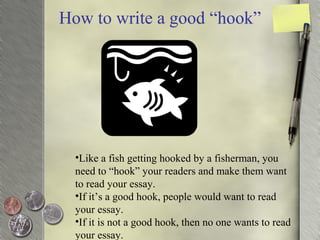
How to write a good “hook”
•Like a fish getting hooked by a fisherman, you
need to “hook” your readers and make them want
to read your essay.
•If it’s a good hook, people would want to read
your essay.
•If it is not a good hook, then no one wants to read
your essay.
Some suggestions…
• Ask a question. (How many of you spend hours
downloading music to your iPod?)
• Use an interesting observation (Because of the
economy, President Obama is having problems
sleeping well these days.)
• Create a unique scenario. (Traveling at more
than 300 km per hour, he traveled to another
dimension.)
• Use a famous quote (“To be or not to be; that is
the question.”)
• Use a statistic (If world temperatures continue to
rise, Singapore will be under water by 2050.)
Hooks-Connecting
Information
• After the hook, the writer usually writes
three to five sentences that connect it to
the topic.
Example from Keith Folse
Her daily routine was not glamorous. She
did everything from sweeping the floors
to cooking the meals. If someone had
asked her, “Are there any household
chores that you practically hate?”, she
probably would have answered, “None.”
Example
Write a sample hook for this paragraph:
At 16 I worked in the toy department of
Lotte Department Store, where I learned
that I enjoyed helping people. I always
went out of my way to help people
because I learned that if I worked hard, I
would succeed. This is the reason why I
want to go to a businessman and go to
business school.
Example
I had never been more anxious in my life. I
had just spent the last three hours trying
to get to the airport so that I could travel
home.
What questions do you have?
What do you think will happen next?
Thesis
• States the main idea of the essay (thesis
statements).
• In narrative essays, they introduce the
action that begins in the first paragraph of
the essay.
Examples
1) Now, as I watched the bus driver set my
luggage on the airport, I realized that my
frustration has only just begun.
2) I wanted my mother to watch me race
down the steep hill, so I called out her
name and then nudged my bike forward.
3) Because his pride wouldn’t allow him to
apologize, Ken now had to fight the
bully, and he was pretty sure that he
wouldn’t win.
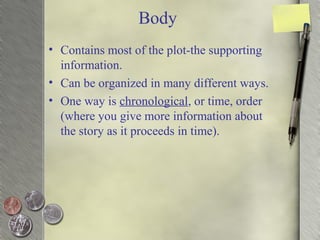
Body
• Contains most of the plot-the supporting
information.
• Can be organized in many different ways.
• One way is chronological, or time, order
(where you give more information about
the story as it proceeds in time).
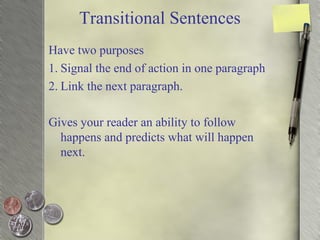
Transitional Sentences
Have two purposes
1. Signal the end of action in one paragraph
2. Link the next paragraph.
Gives your reader an ability to follow
happens and predicts what will happen
next.
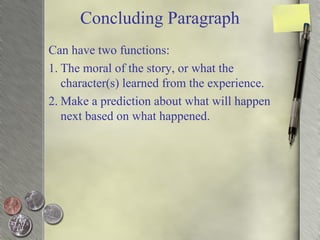
Concluding Paragraph
Can have two functions:
1. The moral of the story, or what the
character(s) learned from the experience.
2. Make a prediction about what will happen
next based on what happened.
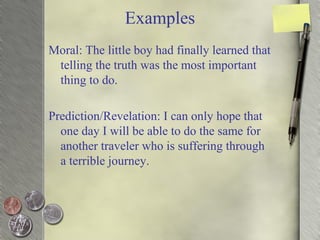
Examples
Moral: The little boy had finally learned that
telling the truth was the most important
thing to do.
Prediction/Revelation: I can only hope that
one day I will be able to do the same for
another traveler who is suffering through
a terrible journey.

How to Structure a Personal Narrative

  • 1.
  • 2.
    First Writing Assignment Thinkabout: • When was an important time in my life? • What has happened in my experience that I would enjoy writing about? • Is there an event in my life that other people would enjoy hearing/reading about?
  • 3.
    Components of astory • Setting=Where the action in a story happens. • Theme=Basic idea or point of the story • Mood=Feeling or atmosphere the author creates for the story. • Characters =The people in the story • Plot=What happens in the story
  • 4.
    Introduction-Narrative • Describe thebackground of the story (characters, setting, atmosphere) • Prepare the reader on what to expect in the story. • Folse (2004) believes that in introductions, you should have a “hook” that will grab the reader’s attention, as well as a thesis that organizes the essay.
  • 5.
    What is a“hook”? •The first two or three lines in the introductory paragraph that grabs readers’ attention. •Help set the stage for the story. •Make readers guess what will happen next in the story.
  • 6.
    How to writea good “hook” •Like a fish getting hooked by a fisherman, you need to “hook” your readers and make them want to read your essay. •If it’s a good hook, people would want to read your essay. •If it is not a good hook, then no one wants to read your essay.
  • 7.
    Some suggestions… • Aska question. (How many of you spend hours downloading music to your iPod?) • Use an interesting observation (Because of the economy, President Obama is having problems sleeping well these days.) • Create a unique scenario. (Traveling at more than 300 km per hour, he traveled to another dimension.) • Use a famous quote (“To be or not to be; that is the question.”) • Use a statistic (If world temperatures continue to rise, Singapore will be under water by 2050.)
  • 8.
    Hooks-Connecting Information • After thehook, the writer usually writes three to five sentences that connect it to the topic. Example from Keith Folse Her daily routine was not glamorous. She did everything from sweeping the floors to cooking the meals. If someone had asked her, “Are there any household chores that you practically hate?”, she probably would have answered, “None.”
  • 9.
    Example Write a samplehook for this paragraph: At 16 I worked in the toy department of Lotte Department Store, where I learned that I enjoyed helping people. I always went out of my way to help people because I learned that if I worked hard, I would succeed. This is the reason why I want to go to a businessman and go to business school.
  • 10.
    Example I had neverbeen more anxious in my life. I had just spent the last three hours trying to get to the airport so that I could travel home. What questions do you have? What do you think will happen next?
  • 11.
    Thesis • States themain idea of the essay (thesis statements). • In narrative essays, they introduce the action that begins in the first paragraph of the essay.
  • 12.
    Examples 1) Now, asI watched the bus driver set my luggage on the airport, I realized that my frustration has only just begun. 2) I wanted my mother to watch me race down the steep hill, so I called out her name and then nudged my bike forward. 3) Because his pride wouldn’t allow him to apologize, Ken now had to fight the bully, and he was pretty sure that he wouldn’t win.
  • 13.
    Body • Contains mostof the plot-the supporting information. • Can be organized in many different ways. • One way is chronological, or time, order (where you give more information about the story as it proceeds in time).
  • 14.
    Transitional Sentences Have twopurposes 1. Signal the end of action in one paragraph 2. Link the next paragraph. Gives your reader an ability to follow happens and predicts what will happen next.
  • 15.
    Concluding Paragraph Can havetwo functions: 1. The moral of the story, or what the character(s) learned from the experience. 2. Make a prediction about what will happen next based on what happened.
  • 16.
    Examples Moral: The littleboy had finally learned that telling the truth was the most important thing to do. Prediction/Revelation: I can only hope that one day I will be able to do the same for another traveler who is suffering through a terrible journey.