THEME:
What It Is and How to Find It
Theme:
• The moral or lesson of a story; its message.
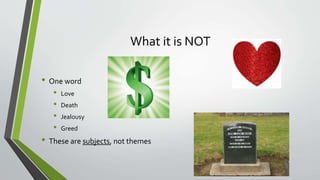
What it is NOT
• One word
• Love
• Death
• Jealousy
• Greed
• These are subjects, not themes
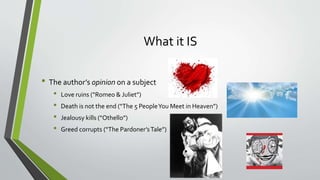
What it IS
• The author’s opinion on a subject
• Love ruins (“Romeo & Juliet”)
• Death is not the end (“The 5 PeopleYou Meet in Heaven”)
• Jealousy kills (“Othello”)
• Greed corrupts (“The Pardoner’sTale”)
Note that…
• A story can have many different themes, sometimes even conflicting ones.
• Since a theme is based on an opinion, you can’t really be wrong about a
theme, as long as it is well-supported by evidence from the text.
For example:
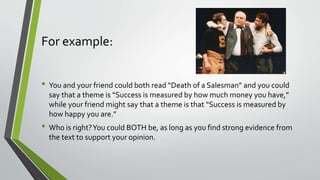
• You and your friend could both read “Death of a Salesman” and you could
say that a theme is “Success is measured by how much money you have,”
while your friend might say that a theme is that “Success is measured by
how happy you are.”
• Who is right?You could BOTH be, as long as you find strong evidence from
the text to support your opinion.
Some More Examples
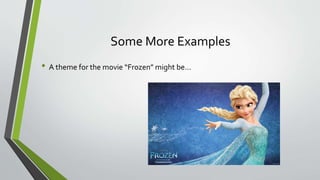
• A theme for the movie “Frozen” might be…
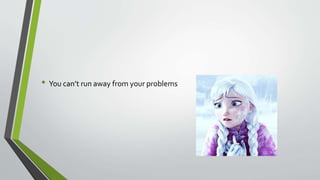
• You can’t run away from your problems
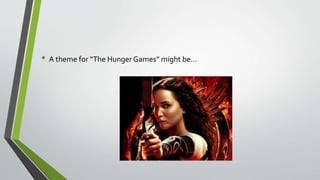
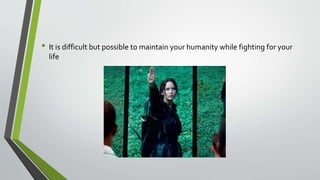
• A theme for “The Hunger Games” might be…
• It is difficult but possible to maintain your humanity while fighting for your
life
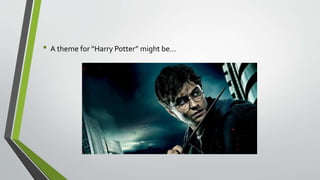
• A theme for “Harry Potter” might be…
• Love is the most powerful force of all.
How to Find aTheme
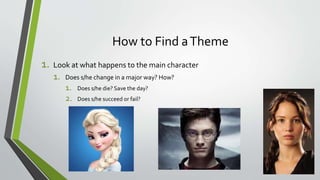
1. Look at what happens to the main character
1. Does s/he change in a major way? How?
1. Does s/he die? Save the day?
2. Does s/he succeed or fail?
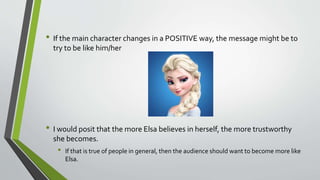
• If the main character changes in a POSITIVE way, the message might be to
try to be like him/her
• I would posit that the more Elsa believes in herself, the more trustworthy
she becomes.
• If that is true of people in general, then the audience should want to become more like
Elsa.
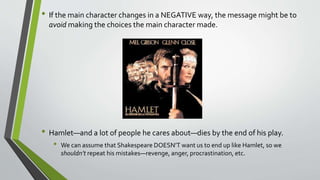
• If the main character changes in a NEGATIVE way, the message might be to
avoid making the choices the main character made.
• Hamlet—and a lot of people he cares about—dies by the end of his play.
• We can assume that Shakespeare DOESN’T want us to end up like Hamlet, so we
shouldn’t repeat his mistakes—revenge, anger, procrastination, etc.
A quick word on main characters and symbols…
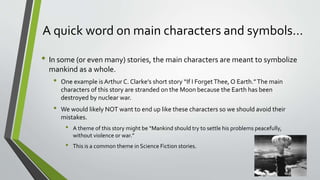
• In some (or even many) stories, the main characters are meant to symbolize
mankind as a whole.
• One example is Arthur C. Clarke’s short story “If I ForgetThee, O Earth.”The main
characters of this story are stranded on the Moon because the Earth has been
destroyed by nuclear war.
• We would likely NOT want to end up like these characters so we should avoid their
mistakes.
• A theme of this story might be “Mankind should try to settle his problems peacefully,
without violence or war.”
• This is a common theme in Science Fiction stories.
AnotherWay to FindTheme
2 .Watch for statements of theme.
• Sometimes, the author will simply state the theme of the story, often near the end of
the story.
• For example, one character might say to another, “Life is like that sometimes, you know.
Sometimes you win. Sometimes you lose. But you’ve got to play the game.”
• In this case, a theme could be that whether things turn out good or bad, some risks are
worth taking.
FindingTheme, Part 3
3. Analyze the title for clues.
• For this to work, think about what was going on in the book when the title was
mentioned or referred to.
• Was it something positive or negative?
• Did the main character(s) learn something when the title of the story was relayed to them?
• Examples:
• Of Mice and Men
• To Kill a Mockingbird
• The Call of theWild
• Brave New World
• The Grapes ofWrath
Examples ofThemes Based onTitles
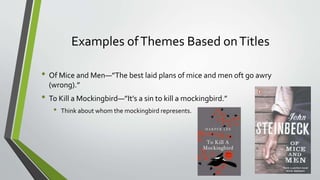
• Of Mice and Men—”The best laid plans of mice and men oft go awry
(wrong).”
• To Kill a Mockingbird—”It’s a sin to kill a mockingbird.”
• Think about whom the mockingbird represents.
A FinalWay to Find aTheme
4. Consider the main conflict.
• Look at this in an abstract way:
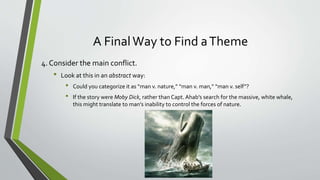
• Could you categorize it as “man v. nature,” “man v. man,” “man v. self”?
• If the story were Moby Dick, rather than Capt. Ahab’s search for the massive, white whale,
this might translate to man’s inability to control the forces of nature.
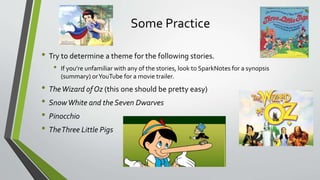
Some Practice
• Try to determine a theme for the following stories.
• If you’re unfamiliar with any of the stories, look to SparkNotes for a synopsis
(summary) orYouTube for a movie trailer.
• TheWizard ofOz (this one should be pretty easy)
• SnowWhite and the Seven Dwarves
• Pinocchio
• TheThree Little Pigs
• Special thanks to @mistersato411. Watch his video onYouTube:
https://www.youtube.com/watch?v=p4qME64SkxM

Theme: What It Is and How to Find It

  • 1.
    THEME: What It Isand How to Find It
  • 2.
    Theme: • The moralor lesson of a story; its message.
  • 3.
    What it isNOT • One word • Love • Death • Jealousy • Greed • These are subjects, not themes
  • 4.
    What it IS •The author’s opinion on a subject • Love ruins (“Romeo & Juliet”) • Death is not the end (“The 5 PeopleYou Meet in Heaven”) • Jealousy kills (“Othello”) • Greed corrupts (“The Pardoner’sTale”)
  • 5.
    Note that… • Astory can have many different themes, sometimes even conflicting ones. • Since a theme is based on an opinion, you can’t really be wrong about a theme, as long as it is well-supported by evidence from the text.
  • 6.
    For example: • Youand your friend could both read “Death of a Salesman” and you could say that a theme is “Success is measured by how much money you have,” while your friend might say that a theme is that “Success is measured by how happy you are.” • Who is right?You could BOTH be, as long as you find strong evidence from the text to support your opinion.
  • 7.
    Some More Examples •A theme for the movie “Frozen” might be…
  • 8.
    • You can’trun away from your problems
  • 9.
    • A themefor “The Hunger Games” might be…
  • 10.
    • It isdifficult but possible to maintain your humanity while fighting for your life
  • 11.
    • A themefor “Harry Potter” might be…
  • 12.
    • Love isthe most powerful force of all.
  • 13.
    How to FindaTheme 1. Look at what happens to the main character 1. Does s/he change in a major way? How? 1. Does s/he die? Save the day? 2. Does s/he succeed or fail?
  • 14.
    • If themain character changes in a POSITIVE way, the message might be to try to be like him/her • I would posit that the more Elsa believes in herself, the more trustworthy she becomes. • If that is true of people in general, then the audience should want to become more like Elsa.
  • 15.
    • If themain character changes in a NEGATIVE way, the message might be to avoid making the choices the main character made. • Hamlet—and a lot of people he cares about—dies by the end of his play. • We can assume that Shakespeare DOESN’T want us to end up like Hamlet, so we shouldn’t repeat his mistakes—revenge, anger, procrastination, etc.
  • 16.
    A quick wordon main characters and symbols… • In some (or even many) stories, the main characters are meant to symbolize mankind as a whole. • One example is Arthur C. Clarke’s short story “If I ForgetThee, O Earth.”The main characters of this story are stranded on the Moon because the Earth has been destroyed by nuclear war. • We would likely NOT want to end up like these characters so we should avoid their mistakes. • A theme of this story might be “Mankind should try to settle his problems peacefully, without violence or war.” • This is a common theme in Science Fiction stories.
  • 17.
    AnotherWay to FindTheme 2.Watch for statements of theme. • Sometimes, the author will simply state the theme of the story, often near the end of the story. • For example, one character might say to another, “Life is like that sometimes, you know. Sometimes you win. Sometimes you lose. But you’ve got to play the game.” • In this case, a theme could be that whether things turn out good or bad, some risks are worth taking.
  • 18.
    FindingTheme, Part 3 3.Analyze the title for clues. • For this to work, think about what was going on in the book when the title was mentioned or referred to. • Was it something positive or negative? • Did the main character(s) learn something when the title of the story was relayed to them? • Examples: • Of Mice and Men • To Kill a Mockingbird • The Call of theWild • Brave New World • The Grapes ofWrath
  • 19.
    Examples ofThemes BasedonTitles • Of Mice and Men—”The best laid plans of mice and men oft go awry (wrong).” • To Kill a Mockingbird—”It’s a sin to kill a mockingbird.” • Think about whom the mockingbird represents.
  • 20.
    A FinalWay toFind aTheme 4. Consider the main conflict. • Look at this in an abstract way: • Could you categorize it as “man v. nature,” “man v. man,” “man v. self”? • If the story were Moby Dick, rather than Capt. Ahab’s search for the massive, white whale, this might translate to man’s inability to control the forces of nature.
  • 21.
    Some Practice • Tryto determine a theme for the following stories. • If you’re unfamiliar with any of the stories, look to SparkNotes for a synopsis (summary) orYouTube for a movie trailer. • TheWizard ofOz (this one should be pretty easy) • SnowWhite and the Seven Dwarves • Pinocchio • TheThree Little Pigs
  • 22.
    • Special thanksto @mistersato411. Watch his video onYouTube: https://www.youtube.com/watch?v=p4qME64SkxM