Fiction
The features of a narrative text
Performer Heritage
Marina Spiazzi, Marina Tavella,
Margaret Layton © 2016
Fiction
The commonest form of fiction as a genre is the novel.
The novel
• depicts imaginary events and characters. They are
representative of real life;
• is written in prose, rather than verse;
• is a narrative;
• has characters, actions and a plot: it involves
people who act in a context ruled by chronology and
cause-and-effect relationships;
• involves an investigation of an issue of human
significance whose complexity requires a certain
length.
1. The novel
Performer Heritage
Fiction
A narrative text is made up of the story
The author can combine these events in different ways
using flashbacks, anticipation of events or by omitting
details of the story. This sequence of events is the plot.
2. The story / the plot
Performer Heritage
a sequence of events normally
presented in chronological order
Fiction
The pattern the author imposes on the action of the novel
generally includes four stages:
• introduction of the situation;
• breakdown of the initial situation;
• development of the story to the climax;
• end, where the initial situation can be restored
or changed.
2. The story / the plot
Performer Heritage
Fiction
The setting is the place and the time of the story.
• Place setting can be interior or exterior (D. Defoe,
Robinson Crusoe) it deals with the description
of the landscape, interiors and objects.
• Time setting usually refers to the time of the day, the
season, the year; social historical factors are also
important.
3. The setting
Performer Heritage
Fiction
• The so-called ‘cinematic’ novelists of the 19th century
anticipated the cinema.
• They cultivated the camera-eye and camera movement,
moving into their subjects using a zoom-like effect
followed by close-ups.
4. The cinematic technique
Performer Heritage
from the city into the street, from the street into the
house and taking the reader from room to room
Fiction
4. The cinematic technique
Performer Heritage
from the city into the street, from the street into the
house, and taking the reader from room to room.
The wide, panoramic, aerial views
ways of introducing an action
may be ‘bird’s-eye’ = not too high,
simply from elevated ground
Fiction
The narration resembles motion-pictures
4. The cinematic technique
Performer Heritage
it portrays actions and characters in a series
of images = the characters and objects are
described and seen in different positions since
people move up into the middle distance or
foreground, or alternatively recede and diminish.
Fiction
Performer Heritage
The choice of this narrator can have the following functions:
• to bring the reader close to the mind and feelings of the
narrator;
• to convey an impression of reality;
• to restrict the reader’s view.
5. The narrative techniques
The first-person narrator
• employs the I mode;
• can coincide with the author or a character.
Fiction
Performer Heritage
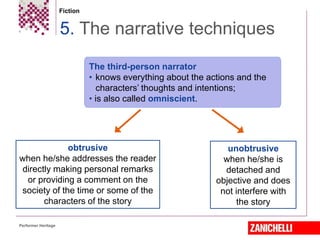
obtrusive
when he/she addresses the reader
directly making personal remarks
or providing a comment on the
society of the time or some of the
characters of the story
unobtrusive
when he/she is
detached and
objective and does
not interfere with
the story
5. The narrative techniques
The third-person narrator
• knows everything about the actions and the
characters’ thoughts and intentions;
• is also called omniscient.
Fiction
The author chooses the way to tell his story as
1. dialogue;
2. description;
3. narration.
These modes are usually interwoven.
The point of view is the angle/s from which the scene is
described and the story told. It is influenced by the kind of
narrator.
6. Narrative modes
and the point of view
Performer Heritage
Fiction
Performer Heritage
The presentation of a character can be:
• direct, through the description which the writer makes
of his/her personality and appearance;
• indirect, when the reader has to infer the features of the
character from his/her actions, reactions and behaviour.
There can be major and minor characters depending on
their role in the story.
7. The characters
Fiction
Performer Heritage
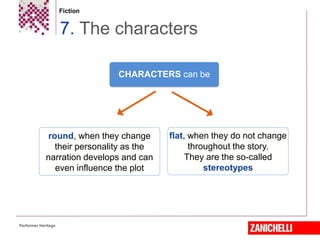
7. The characters
CHARACTERS can be
round, when they change
their personality as the
narration develops and can
even influence the plot
flat, when they do not change
throughout the story.
They are the so-called
stereotypes
Fiction
Performer Heritage
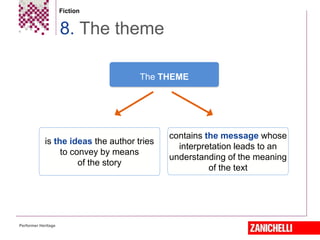
8. The theme
The THEME
is the ideas the author tries
to convey by means
of the story
contains the message whose
interpretation leads to an
understanding of the meaning
of the text

FICTION

  • 1.
    Fiction The features ofa narrative text Performer Heritage Marina Spiazzi, Marina Tavella, Margaret Layton © 2016
  • 2.
    Fiction The commonest formof fiction as a genre is the novel. The novel • depicts imaginary events and characters. They are representative of real life; • is written in prose, rather than verse; • is a narrative; • has characters, actions and a plot: it involves people who act in a context ruled by chronology and cause-and-effect relationships; • involves an investigation of an issue of human significance whose complexity requires a certain length. 1. The novel Performer Heritage
  • 3.
    Fiction A narrative textis made up of the story The author can combine these events in different ways using flashbacks, anticipation of events or by omitting details of the story. This sequence of events is the plot. 2. The story / the plot Performer Heritage a sequence of events normally presented in chronological order
  • 4.
    Fiction The pattern theauthor imposes on the action of the novel generally includes four stages: • introduction of the situation; • breakdown of the initial situation; • development of the story to the climax; • end, where the initial situation can be restored or changed. 2. The story / the plot Performer Heritage
  • 5.
    Fiction The setting isthe place and the time of the story. • Place setting can be interior or exterior (D. Defoe, Robinson Crusoe) it deals with the description of the landscape, interiors and objects. • Time setting usually refers to the time of the day, the season, the year; social historical factors are also important. 3. The setting Performer Heritage
  • 6.
    Fiction • The so-called‘cinematic’ novelists of the 19th century anticipated the cinema. • They cultivated the camera-eye and camera movement, moving into their subjects using a zoom-like effect followed by close-ups. 4. The cinematic technique Performer Heritage from the city into the street, from the street into the house and taking the reader from room to room
  • 7.
    Fiction 4. The cinematictechnique Performer Heritage from the city into the street, from the street into the house, and taking the reader from room to room. The wide, panoramic, aerial views ways of introducing an action may be ‘bird’s-eye’ = not too high, simply from elevated ground
  • 8.
    Fiction The narration resemblesmotion-pictures 4. The cinematic technique Performer Heritage it portrays actions and characters in a series of images = the characters and objects are described and seen in different positions since people move up into the middle distance or foreground, or alternatively recede and diminish.
  • 9.
    Fiction Performer Heritage The choiceof this narrator can have the following functions: • to bring the reader close to the mind and feelings of the narrator; • to convey an impression of reality; • to restrict the reader’s view. 5. The narrative techniques The first-person narrator • employs the I mode; • can coincide with the author or a character.
  • 10.
    Fiction Performer Heritage obtrusive when he/sheaddresses the reader directly making personal remarks or providing a comment on the society of the time or some of the characters of the story unobtrusive when he/she is detached and objective and does not interfere with the story 5. The narrative techniques The third-person narrator • knows everything about the actions and the characters’ thoughts and intentions; • is also called omniscient.
  • 11.
    Fiction The author choosesthe way to tell his story as 1. dialogue; 2. description; 3. narration. These modes are usually interwoven. The point of view is the angle/s from which the scene is described and the story told. It is influenced by the kind of narrator. 6. Narrative modes and the point of view Performer Heritage
  • 12.
    Fiction Performer Heritage The presentationof a character can be: • direct, through the description which the writer makes of his/her personality and appearance; • indirect, when the reader has to infer the features of the character from his/her actions, reactions and behaviour. There can be major and minor characters depending on their role in the story. 7. The characters
  • 13.
    Fiction Performer Heritage 7. Thecharacters CHARACTERS can be round, when they change their personality as the narration develops and can even influence the plot flat, when they do not change throughout the story. They are the so-called stereotypes
  • 14.
    Fiction Performer Heritage 8. Thetheme The THEME is the ideas the author tries to convey by means of the story contains the message whose interpretation leads to an understanding of the meaning of the text